Print ISSN: 1738-3110 / Online ISSN 2093-7717 JDS website: http://kodisa.jams.or.kr/
http://dx.doi.org/10.15722/jds.18.11.202011.47
A Study on the Distribution of Korean Ancient Books: Focused on Myongsimbogam
Sungchun CHO
1, Junho RYU
2Received: September 26, 2020. Revised: October 16, 2020. Accepted: November 05, 2020.
Abstract
Purpose: The purpose of this study is to investigate the distribution of ancient Korean books around the world, and to study the process and impact of Myongsimbogam’s distribution to East Asia and Europe. Research design, data and methodology: This study conducted literature research as its research method. The scope of research covers Korea, China, Japan, Vietnam, Spain, Germany and Russia.
Results: Ancient Korean books were distributed through the Kwanpan and Banggakbon, and leaked overseas in historical circumstances. Myongsimbogam was distributed to Korea, China, Japan, Vietnam, Spain, France, Germany, and Russia.
Myongsimbogam was the first ancient book to be translated into Western languages. Conclusions: The distribution of Myongsimbogam promoted the exchange of spiritual civilizations in the East and West, and became the basis for maintaining an individual philosophy, as well as social order. Therefore, the distribution of Myongsimbogam needs to be further expanded. For this, it is necessary to translate Myongsimbogam into English and popularize it through e-books, audio books and various lectures. While previous studies on Myongsimbogam have mainly focused on personality and moral education, this study is significant in that it examines the distribution and dissemination process of Myongsimbogam, its influence and significance.
Keywords : Myongsimbogam, Distribution, Translation, Publication JEL Classification Code: G40, G41,I21, I26
1. Introduction
12A country's ancient books are a measure of its historicality, identity and cultural competence. As a result, research on the distribution and dissemination of ancient books has been underway in Korea recently.
The former’s very meaningful in terms of understanding the period, situation, type, quantity, route, etc., of one country’s ancient books. Moreover, their distribution and dissemination to other countries, and the related impacts, can be better explored through such texts.
1 First A uthor. Assistant Professor, Dept of Liberal Arts, Eulji University, Korea. Email: [email protected]
2 Corresponding Author. Associate Professor, Dept of Early Childhood Education, Eulji University, Korea.
Email: [email protected]
ⓒCopyright: The Author(s)
This is an Open Access article distributed under the terms of the Creative Commons Attribution Non-Commercial License (http://Creativecommons.org/licenses/by-nc/4.0/) which permits unrestricted noncommercial use, distribution, and reproduction in any medium, provided the original work is properly cited.
Ancient Korean and Chinese books have been distributed and disseminated around East Asia and Western Europe, to promote East-West civilization exchanges. These manuscripts had a great influence on the cultural consciousness of each country’s ideas, ethics and morals (Wang, Yi, Liu, Lu, & Song, 2020).
One of the most representative of these ancient books is
‘The Four Books and Five Classics(Si Shu Wu Jing)’.
Recently, both domestic and foreign countries have been researching and analyzing the impact of the spread and distribution of The Four Books and Five Classics to Korea and Europe.
Yan(1968), and Zhu(1977) of China have both studied
the circumstances and impact of ancient Chinese books that
spread to Vietnam and Europe. Zhao(2012)'s study in China
examined the situation where the Four Books were
translated into English, then introduced and disseminated to
the English-speaking world. Yan(2013)’s research studies
the routes, times and methods of the dissemination of The
complete meaning of the Four Books(The Sishu daquan) to
Korea and Vietnam during the Ming and Qing Dynasty periods. Chen(2016) studied the process of the dissemination and distribution of the Four Books to the West, and how the Four Books were used as textbooks in Chinese education in the West.
In Korea, Kim(2018)’s research studies the meaning and influence of the Four Books’ distribution and dissemination in Joseon. Lee(2018)’s research looks at the publication, distribution and sales of ancient books from the angle of distribution of ancient books. He studied the process and types of books sold by Wanpan Panggakbon(the ancient books that was published in order to sell in Jeonju) and distributed to book stores in Seoul, Daegu and other regions in the early 20th century.
This study is significant in that it deals with the distribution of ancient books from the 17th to the 20th century. A study on the distribution of ancient books is important in terms of the distribution and dissemination of ancient books, but it is also meaningful in that it summarizes the cultural heritage of their country of origin, which was also disseminated abroad. This study aims to be the starting point of the study through Myongsimbogam (明 心寶鑑; Precious Mirror for Enlightening the mind) in accordance with the distribution, dissemination process, and the need for impact research of ancient books. The key virtues emphasized in this book are good deeds, sincerity, benevolence, morality, courtesy, faithfulness, filial piety, friendship, and integrity. This book has been an important textbook for education on character, morals, etiquette, and personal conduct from the Joseon Dynasty to the present.
There are two competing claims as to who the compiler of this book was: Chujeok (1245-1317), during the reign of King Chungnyeol of the Goryeo Dynasty, and Fan Liben (date of birth and death unknown), during the Ming Dynasty.
Researchers have looked at the Myongsimbogam in terms of its many aspects, but most of the study is concerned with translations and annotations. Since the original text was in Chinese, they have described and interpreted the book by using translations and annotations to understand its contents. These findings were published as annotated translations, and as of April 2020, 170 different versions had accumulated in the Korean National Assembly Library. Researchers have also studied Myongsimbogam from the perspective of education on character, morals and ethics (Kim, 2017; Chou, the compiler, 2010).
These studies were conducted mainly on degree and academic theses. As of April 29th, 2020, 93 research results could be found in the Korean National Assembly Library.
These studies emphasized the character and ethical/moral education provided by Myongsimbogam, and found that the compiler of this book was Fan Liben. However, other studies have been conducted from new perspectives,
including social, cultural and ideological backgrounds(Jung, 2009), the educational effects on information and communication ethics(Son & Lee, 2012) and the perspective of dissemination. These studies have explored ethical consciousness in society and culture, the communication of information through Myongsimbogam, and have analyzed the dissemination process in East Asia and Europe(Sung, 2005). These previous studies are meaningful in that they paid attention to the value of Myongsimbogam, and studied it from various angles.
However, they are unfortunate in that a deep understanding or interpretation of the original text should come first. Most previous studies of Myongsimbogam were conducted mainly from the angles of translation and annotation, personality and ethics and morals. However, Myongsimbogam was, first of all, distributed and disseminated among various countries in East Asia, such as Korea, Japan, China, and Vietnam, affecting the life, culture, philosophy, and ideas of East Asians. Secondly, it is of great significance in that it was the first Chinese book to be translated into a Western language and distributed to countries in Europe, such as Spain, and to influence intellectuals there at the time. Nevertheless, most studies so far have overlooked the two great significances of Myongsimbogam mentioned above, and research has not been active in this area.
Therefore, this study intends to look at Myongsimbogam in terms of the process and influence of its distribution and dissemination throughout East Asia and Europe. This study of Myongsimbogam, from a new angle of distribution; reveals its historical significance in civilization.
2. Research methods, research scope, research questions
This study aims to be a new starting point for the study of Myongsimbogam, based on the absolute necessity of studying process and influence of the distribution and dissemination of ancient books. The research method for this study is literature review.
The first literature selection is from Cho(2019) of Korea,
Lee, Chao, and Quan(2014) of China, a collection(1454)
from the University of Tsukuba Library in Japan,
Bach(1998) of Vietnam, and Plath(1863) of Germany. This
first selection focuses on the process and route by which
Myongsimbogam was distributed and disseminated to each
country. It also looks at the problems of the compiler, the
process of transforming the form of the book, and the
process of changing the contents, uses, values, and
significance in each country. The second selection is the
results of 170 translation and annotation studies in Korea,
while the third selection is academic research at home and abroad. In the 2nd selection, the accuracy of translation and annotation contents is to be noted; while in the 3rd selection, research perspective and direction are to be noted.
The scope of this study is Korea, China, Japan, Vietnam in East Asia, as well as Spain, Germany, and Russia in the West. These countries are the main targets in exploring the process by which Myongsimbogam was distributed and disseminated to East Asia and the West.
In the case of Korea, we look at the distribution and dissemination process of Myongsimbogam, the process of how it was transformed and how the final version was settled on, its uses, and research results. In the case of China, we consider the status of publication and the editions of the book, the process of dissemination and distribution, and its uses. In the case of Japan, we look at the process of the book’s dissemination and distribution from Korea and China, the status of publication, its influence on intellectuals, and the process of the Joseon Cheongjupanbon’s entry into Japan. In the case of Vietnam, we look at the book’s route of dissemination and distribution from Korea and China, and its uses. In the case of Spain and Europe, we consider the background, processes and routes by which the book has been translated into the Spanish language and disseminated to Spain and the West, as well as its influence on European intellectuals.
Furthermore, we look at distribution and dissemination of the book to Russia.
In previous studies, Korea, China, Japan, and Spain are mentioned, but Vietnam, Germany, and Russia are not.
Therefore, this study will have the effect of supplementing existing studies.
The research subject of this study is first, to consider the process of Myongsimbogam’s distribution and dissemination back and forth between countries in East Asia. Through this, we can see the cultural and ideological influences it had on each country in East Asia. Second, we explore the process and route of Myongsimbogam’s distribution and dissemination to the West. Through this, we can see how the book moved from the East to the West, the process of contact between the East and the West, and the perception of Eastern civilization by Westerners at the time.
3. Distribution of ancient books
3.1. Distribution through the Government Publication(Gwanpan)
Most ancient Korean books were printed, published, and distributed by state agencies during the Goryeo and Joseon Periods. The printing, publishing, and distribution
institutions of the Goryeo Dynasty were the Seojukjum, Seojukpo, and Seojukwon. During the Goryeo Dynasty, with the development of a publishing culture, the Chojo Daejanggyeong, Sokjanggyeong, and Tripitaka Koreana were published through woodblock printing, and the Sangjunggogumyemun was compiled in 1234 using metal type, 200 years before the Gutenberg printing press in Germany. The jikji, which is housed in the National Library of Paris, is the oldest existing metal print in the world.
In the Joseon Dynasty, institutions related to the publication and distribution of books of policy were installed, such as the Yemunchunchugwan, Sungkyunkwan, and Gyoseogam, and the publishing institutions Jujaso, Gyoseogwan and Gankyungdogam were established in that order to print, publish, and distribute books. The Joseon Dynasty mainly published books on Confucianism and history, but gradually books began to be published in a wider range of fields such as literature, science, language, music, agriculture, law, astronomy, and geography.
Numerous books were published, including the Gyeonggukdaejeon, Dongmunseon,
Donggukyeojiseungram, Akhakkabeom, Goryeosajolyo, Dongguktonggam, Donggukjeongwoon, and Samgang haengsildoonhae. As for the Joseon Dynasty, there were many types of books published, but the number of copies was very small, and distribution was not widespread. The distribution of Gwanpan was mainly done on the king’s bequest, and was limited to some of the noble classes.
3.2. Distribution through the Commercial Woodblock Printed Version(Banggakbon)
During the Joseon Dynasty, Banggakbon supplemented the limitations of the country’s Gwanpanbon publishing and distribution. The Banggakbon was a book published for profit by civilians during the Joseon Dynasty. The reason that the Banggakbon was published and that books could be distributed in the late Joseon Dynasty was, firstly, the gap between the supply of and demand for books in Seoul and other regions. Due to supply shortages in the provinces, when people could not purchase the books they needed, civilians produced and sold the books themselves. Secondly, there was an increase in the number of people who could read and there was demand for books related to knowledge, information, and entertainment in real life. This led to the promotion of book publishing and distribution.
The Banggakbon was published and distributed in Seoul,
Jeonju, Anseong, and Daegu, and the books were published
and distributed in Bangsa, Seobang, Seosa, and Seopo. The
spread of the Banggakbon in the late Joseon Dynasty had
the effect of promoting the supply and distribution of books
according to demand, creating an opportunity for Joseon to
become a civilized country with a printing and publishing
culture. However, old Korean books were leaked to Japan, China, the Americas, and Europe through plunder, gifting, and purchase.
3.3. The leak of old ancient books 3.3.1. To Japan
Japan is the country to which the ancient Korean books have been leaked. From the Three Kingdoms period, Japan was repeatedly engaged in large and small exchanges and aggression with Korea, and acquired what they needed by plunder, gifting, and purchase. As this situation continued for over a thousand years, Japan became the country with the largest collection of ancient Korean books.
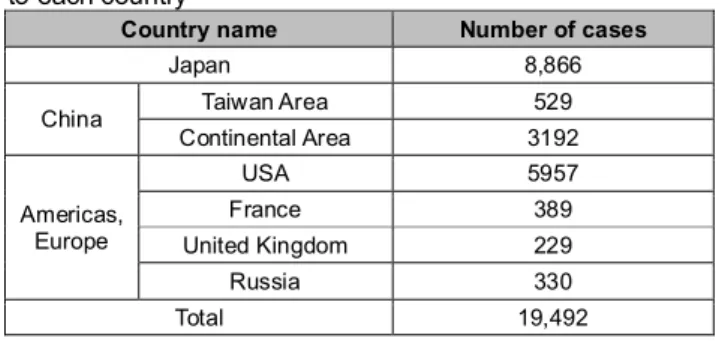
In particular, during the Japanese invasions of Korea and the Japanese colonial period, ancient Korean books were systematically looted. Ancient Korean books in Japan are widely held by 36 institutions, and the total number is estimated to be 8866(Hwang, 2008). For this reason, a study was conducted on ancient Korean books possessed by Japan.
The National Research Institute of Cultural Heritage (1991) studied the list of ancient Korean books in Japan, and Sim(2003) studied the current status and tasks of organizing ancient Korean literature. In addition, there is a paper on the collections of the Nippon Tenri University Library and the Jongyunggakmoongo(National Research Institute of Cultural Heritage, 2005, 2006), a paper on the collections of the Bongjwamoongo(Chun, 2003), and a paper on the collections of the Dongyanmoongo(Bak, 2012).
In particular, Fujimoto(2003)’s research looked in-depth at the acceptance of old Korean books in Japan and the institutions holding them.
3.3.2. To China
After Japan, the largest number of leaked ancient Korean books went to China. Firstly, one route of leakage to China was through an official request from China at the time of Goryeo Seonjong(1083~1094). During the Japanese invasions of Korea(1592~1598) and the Second Manchu invasion of Korea(1636~1637), many books were taken home by Chinese generals as well. In addition, there are cases where Chinese collectors purchased and took away old Korean books because their appearance was more beautiful than those of China and there were few errors in the content. In some cases, they were delivered as diplomatic presents or gifts. However, what makes the case of ancient Korean books being leaked to China noteworthy is that, first of all, they were often delivered through exchanges between writers. Secondly, there are many cases in which books that had been leaked to Japan then moved to China. Also worthy of note is that during the period of turmoil from the end of the Joseon Dynasty to the Japanese
colonial period, there were many leaks through Japanese officials who worked in China, and Koreans who migrated or exiled to China. Through this process, ancient Korean books came to be held in all regions of China and in every institution, with approximately 529 in Taiwan and 3192 in mainland China (Hwang, 2008)
Research was conducted on the process, details, and inventories of old Korean books leaked to China. Park(1990, 2003) analyzed the routes that ancient Korean books took to get into the National Palace Museum in Taiwan and the National Library of China, along with type, volume, and status, and described the important works. Hwang(2008) classified the ancient Korean books in Taiwan and China, compiled statistics for each collection, and described the important works. In addition, there is a paper on what is held in the Beijing Library in China(Park, 1996), a paper on what is in Nanjing Library(Park, 2018), a paper on what is in the Zhejiang Library(Kim & Ahn, 2019), and a paper on what is in the Peking University Library(Keum, 2018). In this study, not only were the lists and quantities of ancient Korean ancient books in each library described, but also the collection and inflow process.
3.3.3. To the Americas and Europe
It was during the age of civilization in the late Joseon Dynasty that ancient Korean books leaked to America and Europe. The first reason is looting. There is the case of when the French navy plundered the Oegyujanggak from Ganghwa Island, during the French campaign against Korea and transferred it to the French National Library. Another case is that of the one where diplomats, scholars, and missionaries dispatched to Korea collected and donated ancient books to their national libraries or handed them over to auction.
In 1888, the first French agency in Korea, Plancy, collected old documents and antiques and transferred them to the Oriental University of Paris and the National Library of France. Through this process, many ancient Korean books were leaked to the US and Europe. In the United States, there are approximately 5975 documents, including ancient books. There are 451 in the Library of Congress, 817 in the East Asian Library at Columbia University, 839 in the Asami Bookstore at Berkeley, and 3850 in the Harvard-Yenching Library(Hwang, 2008).
Recently, papers have been published that examine ancient Korean books held in each library in the United States, and study the collection history and process by subject, edition, and collection status. These collections are held by the Hamilton Library of the University of Hawaii (Bong & Lee, 2013), the Princeton University Library (Han
& Lee, 2014), and the Bryn Mawr University Library(Lee,
Pumroy, & Han, 2017). The studies introduce Korea’s
valuable ancient books in detail.
There are approximately 1400 cases in Europe.
Breaking it down, there are a total of 389 cases in France.
France has the largest collection of ancient Korean books among European countries. The National Library of Paris holds 191 documents, the Paris Oriental Language and Culture School has 98, and the Paris National Guimet Museum has 100. For this reason, an in-depth study was conducted on the ancient Korean books held by France.
Park(1985) found a list of the Oegyujanggak books looted by France during the French campaign against Korea at the National Library of Paris, discovered the Chosun Uigwe and made it known to the world, and compared the collections in Paris with domestic collections bibliographically. Li(2003) studied the current status and research trends of Korean Studies materials in the National Library of France and the Library of the Oriental Language University. Lee & Lee(2011) studied the current status and usage of old Korean books in the Collège de France, and Han, Kim, and Lee(2017) studied ancient Korean books held in the French National Library.
There are a total of 229 cases in the UK, which are in the British Library in London. There are a total of 330 cases in Russia, which are held in the National Library of Kazakhstan. In addition, a considerable amount of old literature was leaked to Germany. From the above, it can be seen that approximately 19,492 old Korean books leaked to Japan, China, the Americas, Europe, and Russia.
Table 1: Statistics on the leakage of ancient Korean books to each country
Country name Number of cases
Japan 8,866
China Taiwan Area 529
Continental Area 3192
Americas, Europe
USA 5957
France 389
United Kingdom 229
Russia 330
Total 19,492
The above statistics are based on the findings of Huang (2008)
4. The process and influence of distribution and dissemination in East Asia of Myongsimbogam
Among ancient books, Myongsimbogam was distributed and spread not only to East Asia but also to Europe;
affecting the ethics and moral thought of each book. This is discussed in the following.
4.1. Korea
Recently, researchers such as Aang(2010) have made it clear that the compiler of was Fan Liben, not Chujeok.
According to this view, Myongsimbogam was brought from China to Korea (Joseon). At that time, the text brought to Korea (Joseon) was a complete edition. A woodblock version was published in Cheongju(now Cheongju City, Chungcheongbuk-do) in 1454. This is called the Cheongjupan First Edition, or Cheongjupanbon(Figure 1).
According to the book’s preface, postscript and colophon, the compiler of Myongsimbogam was Fan Liben, and the publication year was the fifth year of the reign of the Jingtai Emporer of the Ming Dynasty(1454). When this book was brought to Korea(Joseon), it was published in big letters(Dazi) after correction(Jiaozheng). Therefore, the name of the Cheongjupanbon book is Xinke Jiao Jiaozheng Dazi Myongsimbogam. This book originally had 10 chapters in each of the first and second volumes, for 20 pieces in total, with 766 sentences divided into clauses and subclauses.
Since the 17th century in Korea (Joseon), the Myongsimbogam has been published in a reduced form, about one third of the length of the original. This is called the abridged edition(Figure 1). Published in this form, it was called the abridged Myongsimbogam.
When the original Myongsimbogam was abridged, many changes were made in particular contents, but anything related to Buddhism or Taoism was deleted. This is because Joseon at that time declared Confucianism as a national ideology. In this way, Myongsimbogam of China maintained Confucianism, Buddhism, and Taoist thought, but in Korea, it excluded Buddhism and settled it by confucianizing Taoist thought(Sung, 2005).
That is why it has been thought that Chujeok had compiled Myongsimbogam during the time it was being disseminated in Korea(Joseon). In the 1860s, when ChusSeMoon in Daegu published Myongsimbogam, he asked for a preface from Gimpobusa Heofu, who attributed the work to Chujeok. Subsequently, the preface and postscript of the Damyang edition established the notion that Chujeok had compiled Myongsimbogam. As a result, the Chosunmyongsin, Donggukmunheonbigo , Damyan geu p ji, etc., all name Chujeok as the compiler.
Cheongju edition Abridged edition Supplementary edition
Figure 1: Myongsimbogam of Cheongiu edition,
Abridged edition, Supplementary edition
Photographic source: GoogleSince 1918, a supplemental Myongsimbogam(Figure 1) has been disseminated. This version does not include the character for ‘abridge’ in the book’s title, and five chapters have been added to the 20 chapters of the abridged version.
These five chapters contain content on good deeds, filial piety, encouraging learning, integrity, and more. The content on integrity includes a Korean anecdote. This means that Myongsimbogam had already taken root as a Korean book.
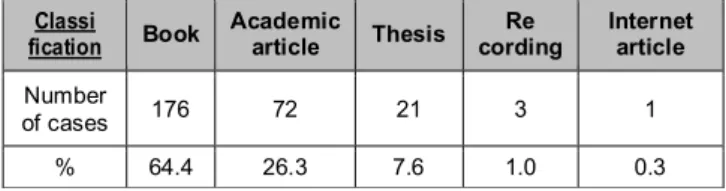
Myongsimbogam was disseminated to Korea in 1454, distributed and settled to the present day. It has become an important textbook for personality education, such as Chinese character education and character education of personality, morality, and etiquette in Seodang, home and various educational institutions, broadcasting media, and YouTube. Because of this, Myongsimbogam has been a major research subject of researchers. As of April 29th, 2020, there were a total of 273 Myongsimbogam studies in the National Assembly Library of Korea. These can be classified as follows.
Table 2: Myongsimbogam studies in the National Assembly Library of Korea
Classi
fication Book Academic
article Thesis Re
cording Internet article Number
of cases 176 72 21 3 1
% 64.4 26.3 7.6 1.0 0.3
As the above table shows, books make up 64.4 % of the studies, and books mainly focus on translation and annotation. The purpose of translation and annotation is to interpret and explain the contents of Myongsimbogam in order to disseminate training on personality and character, on the courtesy and order required to operate a family community, and on the moral ethics required to maintain and develop the state and society. Academic articles(26.3%) and theses(7.6%) have studied Myongsimbogam from various angles, mainly dealing with personal and social ethics and the cultivation of morals. The results of these studies indicate that Myongsimbogam was disseminated and distributed in Korea, affecting aspects of philosophical culture, such as personal cultivation and the ethical/moral education of Koreans.
4.2. China
According to the preface of the Cheongjupanbon, which is held by the University of Tsukuba Library in Japan, Myongsimbogam in China was published by Fan Liben in the 26th year of the reign of the Hongwu Emporer(1393).
However, the whereabouts of that version are unknown.
One version published in 1368 can be found in the National
Library of China. This is earlier than the 1393 publication.
In addition, there were editions published in 1553, 1621, and 1585(Lee, 2014).
On the problem of who compiled Myongsimbogam, although Lee acknowledged Fan Liben as a compiler, he did not reject Chujeok. Lee suggested the possibility that the compiler is Chujeok, and that the route of dissemination and distribution was from Korea to China.
During the Ming era, Myongsimbogam was disseminated and distributed to civilians, intellectuals and members of the royal court, and it had great significance and influence in the following ways. Firstly, it became an important textbook for children’s education in the private sector at the time. Important textbooks for children’s education in China included Three Character Scripture(San Zi Jīng), Enlarged writings of worthies(Zeng Guang Xian Wen), ABC of sound meters in Chinese Poetry(Sheng Lu Qi Meng), The Hundred Family Surnames(Bai Jja Xing), The Thousand Character Essay(Qian Zi Wen), On children's speech(Xiao Eer Yu), Master Chu's maxims on the family(Zhu Zi Jia Xun), Tales From the Children's Knowledge Treasury(You xue qiong lin gu shi), Students' Rules(Di Zi Gui), etc. Since these books are composed of verses and couplets, they have a rhythmic feel and are easy to remember. The contents encompass a wide range of knowledge, including astronomy, geography, literature, mathematics, nature, society and folklore. In addition to these books, Myongsimbogam was used as a practical textbook to nurture personality, virtue, and learning for children in the private sector until the Ming and Qing eras(Wang, 1991).
Secondly, it became an important book at the time for disseminating notions of encouraging good and punishing evil in society. Regardless of the age or the country, the fundamental purpose of politics is to create a good society by fostering individuals who are good at heart. It is for this reason that the thought of encouraging good and punishing evil has been promoted in China since ancient times.
Compiled in 1934, ‘the Great dictionary of morality books new and old(Gu Jin Shan Shu Da Ci Dian)’ recorded numerous Morality Books disseminated and distributed to Chinese civilians, and introduced the contents of each.
‘The Great dictionary of morality books new and old’ is a book that encourages people to do good deeds, and not to do evil. Myongsimbogam is included in it, and the introduction to it talks about how important the book was for encouraging ‘good’ among citizens. In Myongsimbogam, 83 out of a total of 765 entries emphasize good deeds (the Chinese character for ‘good’ is included), and these account for 10.8 % of the total content.
This refers to the degree of emphasis on good deeds (Aang,
2008). In this way, Myongsimbogam promoted the thought
of encouraging good and punishing evil to the Chinese
people, and played an important role in cultivating the good heart of the individual on a small scale, and good public sentiment on a large scale.
Thirdly, in the royal court of the Ming era, Myongsimbogam played an important role in maintaining and developing social order by cultivating public sentiment and tearing down false religions, such as White Lotus. The October 1587 record of the True Record of the Ming Emperor Shenzong(Ming Shen Zong Shi Lu) states, “The Royal Court of the Ming Dynasty, in order to reveal the good heart and destroy the false religion, made people learn the Da Gao, compiled by Chu Yuanchang, and Myongsimbogam. The Da Gao is a code of criminal law established by Chu Yuanchang to punish corrupt officials strictly and harshly. He distributed Grand Pronouncement(Da Gao)to each family for recitation and made it a must-read textbook for school and civil service examinations. In this way, he tried to edify the society of the time. The fact that Myongsimbogam was mentioned along with the Grand Pronouncement, which was edited by King Taejo of Ming, indicates the influence and important status it had in society at the time.
From the beginning of the royal court of the Ming Dynasty, false religions such as White Lotus were strongly prohibited. White Lotus was a Buddhist sect founded by MaoZiYuan(1096-1166) during Southern Song Dynasty. It became the ideological basis for resisting the domination of other nations when Yuan ruled China in the 13th century. It also became a Maitreya faith, teaching that a new savior would appear. As the power of White Lotus grew, the Yuan Dynasty repressed them, and they developed into a secret society combining patriotism and the Maitreya faith. Later, when the Yuan Dynasty fell and the Ming Dynasty was being established, White Lotus became the ideological basis for the Red Turbans’ rebellion. Ming Dynasty founder Zhu Yuanzhang started out as a member of White Lotus before unifying China and founding the Ming dynasty. However, as White Lotus gradually became more shamanistic, which led to negative effects and armed riots in many areas, the royal court of the Ming Dynasty felt the need to ban it. This led them to instead teach the Grand Pronouncement and Myongsimbogam, compiled by the Ming dynasty’s founder.
Through these texts, they tried to inspire the thought of encouraging good and punishing evil, to establish a moral code for each social class, and to correct public sentiments.
As such, Myongsimbogam, along with the Grand Pronouncement, played an important role in social edification at the time. This led Myongsimbogam to receive a great deal of attention in the Ming era royal court, and it was re-published in 1585 for further dissemination and distribution among private citizens.
In addition, in the various novels and comedies published in the Ming era, the content of Myongsimbogam
was often cited to promote thoughts of encouraging good and punishing evil.
In this way, Myongsimbogam was disseminated and distributed to every class of Chinese society, and became an important book in promoting children’s education, thoughts of encouraging good and punishing evil, and social edification. As a result, when Chinese people emigrated to Southeast Asia, they brought along Myongsimbogam, disseminating it organically to the Philippines and other countries. This provided the opportunity for certain Westerners, who were engaged in missionary work in the Philippines and other countries at the time, to learn about the book and introduce it to the West.
4.3. Japan
When Myongsimbogam made it to Japan, it affected politicians, intellectuals, and the general public in many ways. There were two routes to distribution and dissemination in Japan. The first route was through trade with China. A vibrant trade in people and goods was carried out between China and Japan during the Muromachi period (1338-1573). At the time, Wushan Monks served as diplomatic envoys and interpreters, as they were familiar with Chinese classics and Chinese. They entered Taicang, in Jiangsu Sheng, China, during the reign of Emperor Hongmu of the Ming Dynasty, and there they obtained an edition of Myongsimbogam published during the Ming Dynasty. They took back with them and disseminated in Japan. The second route was through Joseon during the Japanese invasion of Korea in 1592. The human and material resources of Joseon were introduced to Japan during the Japanese invasion of Korea in 1592, contributing greatly to the development of Japanese culture. The pottery, ceramics, type printing, and books of the Joseon Dynasty are some typical examples of this. The pottery and ceramics of Joseon led to the flourishing of Japanese ceramic culture, and the type printing and books contributed greatly to book making, the spread of knowledge, and the formation of philosophical thinking in Japan. During the Japanese invasion of Korea in 1592, the Cheongjupanbon Myongsimbogam was carried back to Japan by Toyotomi Hideyoshi’s troops. Furthermore, in Japan, through exchanges with China and Joseon, copies of editions published during the Qing Dynasty of China were introduced, as was the Joseon abridged edition. Using these as original scripts, Myongsimbogam was published in Japan. It is called the Hwakakbon. This meant the existence of copies of the Ming Dynasty edition, the editions of the Qing Dynasty, the Cheongjupanbon of Joseon, the abridged edition and Japan’s Hwakakbon.
Myongsimbogam had a profound influence on the
philosophy, ethics and moral thought of politicians,
intellectuals and even the general public of the time. In particular, monks, Confucian scholars, naturalist scholars, playwrights, Shindo, and classical scholars of the country read Myongsimbogam, and illuminated their own ideas by publishing quotations from it in relevant books. These include ‘Anthology of Passages from the Forests of Zen(Zenrin-kushū)’ by Tōyō Eichō (1428-1504), ‘Amakusa Collection of Golden Phrases’(Amakusaban Kinkushu) by Harbian (a Jesuit missionary in the seventeenth century), Shunteturoku by Fujiwara Seika (1561-1619), and Ukiyo- Monogatari by Asai Ryōi’s (1612–1691). All of these books cited many sentences from Myongsimbogamto support their ideas of encouraging good and punishing evil.
Notably, in China and Joseon, Myongsimbogam maintained the form of editions, which were disseminated and became influential, but in Japan, a related book quoting sentences from Myongsimbogam was published, which influenced the whole society(Sung, 2016). Currently, the University of Tsukuba’s library holds a copy of Joseon’s Cheongjupanbon which is not only intact, it is the only copy of that edition in the world(Figures 2). In the preface and postscript of this Cheongjupanbon, it is recorded that the Myongsimbogam was published by Fan Liben in the 26th year of the reign of Emperor Hongwu(1393), and that the Heongjupan Dazibon was published by Joseon’s Yu Deok Wha during the Ming Dynasty, in the fifth year of the reign of Emperor Jingtai (1454).
Property of the
library of Tsukuba University
Cover of the Myongsimbogam(
Property of the library of Tsukuba
University Inside page of the Myongsimbogam(
Property of the library of Tsukuba
University Introduction of Myongsimbogam(
Figure 2: Myongsimbogam (1454) kept in the library of Tsukuba University
4.4. Vietnam
Vietnam was influenced by Chinese ideas and writing culture until it became a French colony in the late 19th century. Accordingly, a large number of Chinese books, such as the Si Shu Wuj Ing and Myongsimbogam, were distributed and disseminated in Vietnam, which influenced Vietnam’s enlightenment and moral education.
Myongsimbogam came to Vietnam via two routes. The first route was distribution and dissemination from Korea to Vietnam. Due to a history of exchanges between Korea and Vietnam (2007-11-14, http://overseas.mofa.go.kr), and the Consulate-General in Ho Chi Minh, Myongsimbogam, compiled by Chujeok during the Goryeo Dynasty, was disseminated to Vietnam around the 13th or 14th century. It was translated into Vietnamese, distributed and disseminated under the title Minh Tam Bao Giam and read among Confucian scholars. The second route was distribution and dissemination from China to Vietnam. In a study by Yan(1968), many books distributed and disseminated from China to Vietnam are mentioned.
According to the research, books from various fields, including Myongsimbogam, were distributed and disseminated, and translated into Vietnamese, affecting Vietnamese ideas, philosophy, culture, literature, etc. (Yan, 1968). In addition, according to studies by Liu, Wang &
Chen(2002), Liu(2007), and Ruan(2009), Myongsimbogam was published and disseminated several times in Vietnam, and now there are eight extant versions. Among them, Myongsimbogam Shi Yi, published in 1888, is the property of the National Library of Vietnam (Figure 3). In addition, another Myongsimbogam was published by the Vietnam Society of Confucian Studies in 1957(Figure 3). In Vietnam, the Myongsimbogam is still being published in modern times, such Ta Thanh Bach’s Myongsimbogam was published by the Vietnam Society of Confucian Studies in 1957(Figure 3).
In Vietnam, the Myongsimbogam published in 1998. In this version, each sentence is interpreted and rendered phonetically in Vietnamese(Figure 3). In Vietnam, this book was used as an important textbook for cultivating individual morality and promoting the good customs of society.
Published in Vietnam in 1888 Myongsimbogam
Shi Yi
Published by the Vietnam Society of Confucian Studies in
1957 Myongsimbogam
Shi Yi
Translated version by Ta Thanh Bach,
Vietnam, 1998 Myongsimbogam