천궁의 세포배양에 의한 정유성분의 생산
신승원* • 박봄되
덕성여자대학교약학대학
(Received January 26. 1994)
The Production of Essential Oils by Tissue Culture of
Cnidium officinale
Seung-Won Shin** and Bommoi Park
College of Pharmacy, Duksung Women s University, Seoul 132-714
Abstract —Callus was derived from the shoots of Cnidium officinale. The growth rate of callus and the production of essential oils were studied under different culture conditions. The essential oils in the rhizome of Cnidium officinale and the cultivated callus were analyzed and compared by gas chromatography and mass spectrometry. It appeared that NAA induced higher growth rate and production of essential oils than 2,4-D. The compositions of essential oils were influenced by the illumination. Butyl phthalide, cnidilide, senkyunolide, butylidene phthalide, ligustilide, gran- disol, tricosane, 3-methylphenol and 2-pentylthiophene were identified in the cultivated callus.
Keywords □ Cnidium officinale, cell culture, essential oils, GC-MS, butyl phthalide, cnidilide, senky- unolide, butylidene phthalide, ligustilide.
천궁은 Umbelliferae에 속하는 다년생 초본으로
중국이 원산지이며, 강장. 진정, 진통, 구어혈 등외 작용이 있어서 빈혈 및 냉증, 월경장해 등 각종 질환에 사용되어 왔다.** 근래에 와서는 특히 천궁성분외 혈 관확장 작용에 대해 많은 관심이 모아지고 었으며, 그외 피부에서의 약물흡수 보조작용 등, 여러 방향의 약효에 대해 많은 연구가 진행되고 있다.균■하 천궁(Cm'-
dium officinale M akino)외 성분으로는 cnidilide, li
gustilide, neocnidilide, senkyunolide, butyl phtha- lide, butylidene phthalide 등외 정유성분과 그외 pregnenolone, vanillin, coniferyl ferulate, ferulic acid 등이 알려져 있다.**^** Shim om ura 등온 천궁외
callus 배앙에 외한 번식방법에 대해 보고한 바 있
으나, 이방법에 의한 정유생산에 대해서는 지금까지 연구된 바가 없었다.®*
정유생함성의 precursor 중의 하나인 mevalonic acid는 일반적으로 C4-C2 단위의 결합에 외해 함성
■•본 논문에 관한 문의는 이 저자에게로.
되지만 일부는 leucine으로 부터 복 잠 한 경로 거쳐 함성되는 것으로 알려겨 있다.*® Perilla속 식물의 세
포배앙에 있어서는 mevalonic acid나 m evalonic acid
lactone외 첨가에 외해서는 정유합성이 증가되지 않
으나 /-leucine의 첨가에 의해서는 현저히 증가하는
것이 보고된 바 있다.*» 천궁외 정유는 ph th a lid e계 성분이 주류를 이루고 있으며, 일반적으로 이 계열의
성분은 polykedide 경로로 합성되어지는 것으로 알
려겨 있으나, 천궁정유의 생합성과정에 대하여는 정 확히 밝혀진 바가 없다.
본 논문에서는 세포 배양법에 외헤 천궁외 정유성 분을 생산하는 방법에 대해 연구하기 위해 천궁외 어린싹으로부터 callus를 유도하여 계대배양한 후 배지내의 생장horm one의 농도, 정유 생합성외 첨가, 광선및 배양온도가 callus외 생장 및 정유함량에 미 처는 영향을 조사하였고 배양한 callus에서 생성된 정유의 조성을 gas chroamtography 및 gas chroamto- graphy-mass spectrometry의 방법으로 비교분석하고 결과를 보고하는 바이다.
179
신승 원 • 박봄되
실험 방법
정유의 분석一강원도 평창군 진부면에서 재배중인 천궁의 지하부를 채취하여 마쇄한 후 정유추출장치를 이용하여 장치에 ether를 2 m/ 가하고 4시간 동안 수증기 증류하여 정유를 얻었다. 각 조건에서 배양한 callus는 10일 간격으로 10개썩 시험관에서 꺼내 wet weight을 측정한 후, 유발에 같고 callus 중량의 약 2배정도의 물과 혼합하여 round bottomed flask에 넣고 장처에 연결한 후 4시간 가열한 후 ether층을 취하여 정유병에 넣고 rotary evaporator를 사용하여 용매를 날려보낸 후 중량을 측정하였다. 이렇게 얻 어 진 정유를 0.01 m/ 썩을 취하여 ether로 희석하여 1%
용액으로 만들어 GC분석용 시료로 하였다. Hewlett- Packard 5890A GC-MS 장치에 서 HP-1 capillary co- lumn(25 m X 0.2 mm X 0.53 m)을 사용하여 측정 한 MS data외 분석으로 조성을 확인하였다. 한편 Hew- lett Packard 5890 GC에서 분석하여 나타나는 각 성분 peak외 면적비율을 비교하여 배양조건에 따른 정유조성의 번화를 측정하였다.
배지 ■ 천궁 callus외 유도및 배양에 사용한 배 지는 Bs medium'2'£] 조성을 기본으로 하고 여기에 3% 의 sucrose와 0.1% 의 casein을 첨가하여 제조하였다. 여 기에 실험에 따라 일정버율외 식물생장 hormone 및 정유생함성 전구체를 첨가한 후, O.lN-NaOH와 0.1N- HC1 을 사용하여 pH를 5.5~5.6로 조절했고, 0.8% 의 한천을 가하고 lo o t 에 서 15분간 가열하여 용해 시 킨 후, 24X150 m m 외 시 험 관에 10 m/ 썩 분주하여 121 t 에 서 15분간 가압 멸균후 사면으로 굳혀 서 사용했 다.
Callus유도 및 배앙一천궁근경에서 자라나온 어린 싹을 0.2 m m 외 길이로 자른 후, clean bench내에서 sodium hypochlorite(유효염소량 2%)액에 담그어 30 초 동안 소득한 후, 멸균 증류수로 4 ~ 5 회 세 척하여 재료로 사용하였다. 위외 재료를 2,4-dichloro phe- noxy acetic add(2,4-D)와 kinetin을 각각 1 ppm 씩 첨가한 배지에 이식하고, 6 ~ 8 주간 callus를 유도시킨 후, 약 4주간씩 2차 계대배 양한 후 0.3~0.4g의 크기로 잘라 배지에 이식하고 aluminium foil로 업구를 단 단히 봉한 후 각 조건에서 배양하였다. 온도비교 설 험이외외 다른 실험에서의 배양온도는 에비실험 결과 천궁 callus 생장이 가장 빠른 것으로 나타난 23°C 로
하였다.
식울생장 hormone에 띠'른 callus생장 및 정유생성 버교실험一 Br, medium의 조성에 생장hormone을 (A) 2.4-D 1 ppm, kinetin 1 ppm, (B) 2,4-D 2 ppm, kinetin 0.2 ppm(C) NAA 1 ppm, kinetin Ippm (D) NAA 2
ppm, kinetin 0.2 ppm를 각각 첨가한 배 지를 조제하 여. 각각의 배지에 같은 중량의 callus를 이식하여 23 t , 암소에서 배양하였다.
배양온도비교一NAA 1 ppm과 kinetin 1 ppm를 첨 가한 Br, medium에 callus를 이식한 후 각각 21°C , 23°C , 25°C , 27°C 로 온도를 조절한 4개의 incubator에 각각 넣고 광선이 없는 상태에서 배양하여 비교하였 다.
광조건一NAA 1 ppm, kinetin 1 ppm을 첨가한 me- dium에 서 (1) 40일 간 1000 Lux외 fluorescene light를 조사. (2) 30일간 암소에서 배양한 후, 10일간 1000 Lux외 fluorescene light를 조사, (3) 40일간 계속 암 소에서 배양하여 비교하였는데 배앙온도는 3가지 경 우 모두 23°C 로 조정 하였다.
정유생합성의 precursor—23°C 암소에서 NAA와 kinetin을 각각 1 ppm썩 첨가한 medium에서 배양한 callus를 대조군으로 하고, 이 medium에 leucine을 Ig //, O.lg/7 씩 각각 첨가한 경우와 비교하였다.
실험결과 및 고찰
배앙조건이 callus의 정유생성랑에 미처는 영향~
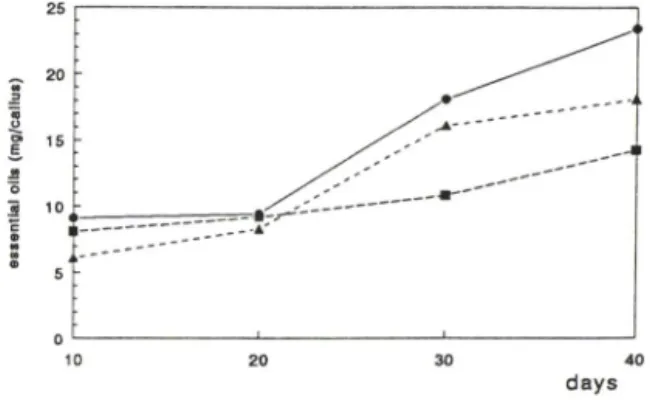
정유생성량은 40일 배양후 측정하였을 때, NAA 1 ppm과 kinetin 1 ppm을 첨가한 것이 2,4-D 1 ppm, kinetin 1 ppm이 첨가된 medium에서 이식한 callus 보다 약 2배 정도 많았고, 정유생 성은 전반적으로 20 일 이후 증가하였다(Fig. 1). 정유생성량을 callus외 무 게로 나눈 정유생성율에 있어서는 40일 배양했을때 2.4-1) 1 ppm, kinetin 1 ppm을 함유한 것이 1.47%로 NAA 1 ppm과 kinetin 1 ppm을 첨가한 것보다 높았 다.
온도조건을 2 r c , 23°C, 25°C, 27°C 로 각각 비교 하였을 때, 정유생 성 량은 27°C 에 서 배 양한 callus를 제외하고 모두 20일 이후에 현저히 상승하였고, 27
°C 의 경우에는 계속 낮은 정유생 성 량을 보이다가 30 일이후 감소하였cKFig. 2). Callus 무게당 정유생 성율 은 전반적으로 10일 이후 감소하는 경향이 있으며 23
]. Pharm . Soc. Korea
F ig .
d a y s
- Effects of plant growth regulators on produc
tion of essential oils in the callus induced from the shoots of Cnidium officinale cultivated on Br, medium containing 1 ppm 2,4-D and 1 ppm kinetin(-G-), 2 ppm 2,4-D and 0.2 ppm kinetin(-
•-), 1 ppm NAA and 1 ppm kinetin(-D-) and 2 ppm NAA and 0.2 ppm kinetin(-^).
d a y s
Fig. 3 —Effects of illumination on production of essen
tial olis in the callus cultivated in the dark for 40 days(-#-), in the light(fluorescens light, 1000 lux) for 10 days after culturing in the dark for 30 days(-A-) and in the light for 40 days(-H-).
d a y s Fig. 2 —Effects of temperature on production of essen
tial oils in the callus cultured at 2Tc ( - A - ) , 23C (-•-), 25C (-■-) and 2 7 t (-U-).
t 에서 배양한 callus는 30일까지는 높은 정유생성율 을 보이다가 30일 이후 급격히 감소하였다. 전반적 으로 가장 높은 정유생성량읍 보인 조건은 2 3 t 였으 며 40일 배앙시 정유생성율이 가장 높은 조건은 25 C 로 1.33%였다.
광선이 정유의 생성량에 미 처는 영향은 Fig. 3에 서 와 갑이 암소에서 배 양한 callus외 정유는 20일 이후 급격히 증가하였으나 fluorescene light를 조사한 cal- lus외 정유량은 완만한 증가를 보이고 었으며 30일 암소배앙한 후 fluorescene light를 조사한 callus의 경우는 30일 이후 정유생성량이 약간 증가하였다.
가장 높은 정유생성율을 보인 조건은 23°C 에 서 40일 간 암소배 양한 callus로 40일 배 앙시 정유함량은 1.25
% 였다.
정유 생함성 경로외 초기 단계 중 간체 로 알려진
leucine을 첨가하여 정유생성량을 증가시킬 수 있는
가를 실험하여 보았으나, 정유생성 량에서 볼 때 leu
cine 을 I g / / 첨가한 것과 0.1 g//를 첨가한 것 모두 유사한 pattern을 보였지만 leucine외 첨가에 의한 정유생성량외 증가는 없었다.
정유의조성버교" 천궁외 지하부 및 N A A I p p m과 kinetin 1 ppm을 함유한 배 지 에 서 배 앙한 callus 에 서 추출하여 얻은 정유외 gas chrom atogram이 거의 같 은 pattern을 나타내어 callus에 형성된 정유 조성의 유사성이 높움을 알 수 있었다. 그러나, 30일간 암소 에 서 배 양한 후 10일간 광선을 조사한 callus의 정유는 pattern이 다르며, 40일간 광선온 계속 조 사 한 상태 에 서 배 양한 callus의 정유와도 pattern이 다른 것으로 나타났다(Fig. 4).
천궁점유의 특유의 주성분 계열로 알려진 phtha- lide외 peak area를 비교했을 때, 천궁 모식 물 근경의 정유의 G C에서는 cnidilide(H) 25.9%, ligustilide 22.6
%(J), senkyunolide 10.2%{1), buthyl phthlide 6.9%
(F), buthylidene phthalide(5.0%)의 비율로 나타났고 NAA 1 ppm, kinetin 1 ppm을 첨가하고 40일간 계속 암소에서 배양한 callus의 정유도 이와 유사한 면적
Vol. 38, No. 2. 1994
Fig. 4 — GC-chromatograms of essential oils: (l)rhi- zome of Cnidium officinale, (2)callus cultivated on Br, medium containing 1 ppm NAA and 1 ppm kinetin in dark at 23t그, (3) callus cultiva
ted in the light for 10 days after culturing in the dark for 30 days at 23t: .(column: HP-1 25 mXO.2 mXO.52 lim, initial temp.: 80°C , final
temp./time: 220°C /min, rate 3°C /min, inj.
temp.: 250°C )
버를 나타내었다. 그러나 30일간 암소에서 배양한 후 10일간 광선조사하에서 배 양한 callus의 정유는 cnidi- lide 7.6%, ligustilide 7.2%, senkyunolide 3.1%외 비율을 나타내어 앞외 경우에 비해 현저히 낮은 ph
thalide 생성을 나타내었다(Fig.4).
천궁 모식물외 뿌리 및 각 배 양조건에 서 배 양한 ca-
llus로부터 추출한 정유를 GC-MS로 분석하여 측정된 Mass의 fragmentation의 해석을 위하여 Yamagish 등이 발표한 천궁의 phthalide 성분에 대한 논문을 참조하였으며, 그외 Mass-Databank(PBM Search of Library file)의 standard spectrum과의 비교 결과및 그외 이미 발표된 문헌상외 spectrum과 대조하였다.고그^
Table I —Compounds in essential oils identified by GC-MS
Peak Compounds ivr Distinctive ions(m/e) Identified sample
A styrene 104 51.77.89 root
B terpinen-4-ol 154 71.93,111 root
C 4-vinylguaiacol 150 51,77,107 root
D ethyl phthalide 162 51,77,105 root
E 2,6-bis[l,l-dimethyIethyl]-4-methylphenol 205 145.177,189 root, callus
F butyl phthlide 190 51.77.133 root, callus
G butylidenphthalide 188 77,103,159 root, callus
H cnidilide 194 77,79,93 root, callus
I senkyunolide 192 77,105.107 root, callus
J ligustilide 190 77,105,148 root, callus
K 3-methyl-3-cyclohexen-l-ol 112 57.97.123 root, callus
L 3-methylphenol 108 53.65,79 root, callus
M grandisol 180 57,68,97 callus
N 2-methoxy-4-(2-prophenyl)-phenol 164 57,103.131 callus
0 cycloheptane 124 57,88,97 callus
P tricosane 155 57,85.127 callus
J. Pharm . Soc. Korea 신승 원 • 박봄되
그결과 Table I에정리해놓은바와같이천궁근경외 정유에서는 styrene, terpinen-4-ol, 4-vinylguaiacol, butyl phthalide, butylidene phthalide, cnidilide, se
nkyunolide, ligustilide 등외성분이확인되었으며,
이들성분중 butyl phthalide, butylidene phthalide, cnidilide, senkyunolide, ligustilide callus■의정 유에서도확인되었다. 그외 callus로부터획득한정 유에서는 grandisoi, tricosane, 3-methylphenol, 2- methoxy- 4-(2-prophenyl)-phenol, cydoheptane 등이 확인되었다.
결 론
(1) 천궁의조직배양에있어서식물생장홀몬의조 성에따라정유생성량에있어서 2배이상외차를나 타냈으며, leucine외첨가에의한정유생성율외증가 는보이지않았다.
(2) 천궁으로부터유도된 callus의정유를 GC-MS로 분석한결파, butylphthalide, cnidilide, senkyunolide, butylidene phthlide, ligustilide, grandisol, tricosane, 3-methylphenol, 2-methoxy-4-(2-prophenyi)-phenol, 3-methyl-3-cyclohexene-l-ol 등이확인되었다.
(3) 천궁 callus에생성된정유의조성은천궁모식 물외정유와유사하였고, 광선조사에외해천궁 cal- lus외 phthalide생성량은감소하였다.
문 헌
1) 이창복: 한국식물도감, 향문사, P.583 (1980).
2) Hatano, K., Nishiika, I. and Iwasa, S.: On the steri
lity of Cnidium officinale Makino, Shoyakugaku Za- sshi 24, 81 (1970).
3) Namba, T. Sekiya, K., Kakota, S., Hattori, M., Kata- yama, K. and Koizumi, T.: The effects of senkyu
extracts as skin penetration enhancer, Yakugaku Zasshi 112, 638 (1992).
4) Yamagish, T. and Kaneshima H.: Structure of sen
kyunolide and GC-MS spectrometry of the related phthalide, Yakugaku Zasshi 97, 237 (1977).
5) Gijbels, M. J. M., Scheffer, J J. C. and Svendsen, A. B.: Occurence and prevention of isomerization of ligustilide during Gas Liquid Chromatography on packed column. Chromatographia 14, 452 (1981).
6) Gijbels, M. J. M., Scheffer, J J. C. and Svendsen, A. B.: Analysis of phthalides from umbelliferae by combined gas-liquid chromatography, Chromatogra
phia 15, 358 (1982).
7) Bohrmann, H., Stahl, E. and Mitsuhashi, H.: Chro
matographic studies on the constituents of Cni
dium officinale Makino, Chem. Pharm. B ull 15,
1606 (1967).
8) Lee, S. Y., Kim, M. J., Yim, D. S., Chi, H. J. and Kim, H. S.: Phthalide content of Cnidium rhizome,
Kor. J. Phramacogn. 21, 69 (1990).
9) Shimomura, K. Teshima, D. and Shoyama, Y.: Stu
dies on the breeding of Cnidium offcinale Makino.
I. The production of plants regenerated from shoot tips(l), Shoyakygaku Zasshi, 34, 306 (1980).
10) Staba, E. J.rPlant Tissue Culture as a Source of Biochemicals, Boca Raton, Florida CRC Press, p.67 (1980).
11) Nabeta, K. and Sugisawa, A.: Volatile components' produced by callus tissues from three Perilla pla
nts, Instrumental Analysis of Foods, 1, 65 (1983).
12) Gamborg, O. L. and Wetter, L. R.: Plant Tissue Culture Methods, National Research Council of Canada, pp.4-5 (1975).
13) Mclafferty, F. W. and Stauffer, D. B.: NBS Registry of Mass Spectral Data (1988).
Vol. 38. No. 2, 1994