Klaus van Leyen, PhD; Hahn Young Kim, MD; Seong-Ryong Lee, MD; Guang Jin, MD, PhD;
Ken Arai, PhD; Eng H. Lo, PhD
Background and Purpose—The natural product baicalein is a specific inhibitor of 12/15-lipoxygenase, but it also has antioxidant properties. The current study was designed to test if the neuroprotective properties of baicalein are related to its lipoxygenase inhibition.
Methods—The presence of 12/15-lipoxygenase in the ischemic mouse brain was demonstrated by immunohistochemistry.
A mouse model of transient middle cerebral artery occlusion was used to study lipoxygenase-dependent protection of the ischemic brain by baicalein. Rat primary neurons were subjected to oxidative stress in the presence or absence of baicalein.
Results—In a mouse model of transient middle cerebral artery occlusion, 12/15-lipoxygenase is increased in the peri-infarct area surrounding the primary infarction, predominantly in neurons. Oxidative toxicity in primary rat neurons is reduced by baicalein. C57Bl6J mice are protected against transient focal ischemia by intraperitoneal injection of baicalein, and a similar degree of protection is seen in 12/15-lipoxygenase knockout mice compared with wild-type mice. In contrast, the 12/15-LOX knockout mice are not further protected by baicalein.
Conclusion—Baicalein protects against ischemia/reperfusion injury by inhibiting the 12/15-lipoxygenase pathway to neuronal cell death. (Stroke. 2006;37:3014-3018.)
Key Words: antioxidant 䡲 baicalein 䡲 ischemia 䡲 lipoxygenase neuron
S
troke is a multifactorial disease in which neuronal cell death proceeds through a mixture of mechanisms includ- ing oxidative stress, excitotoxicity, apoptosis, and inflamma- tion.1 Infarction size is impacted both by transcriptional dys- regulation, as well as by release of neurotoxic glutamate and other substances from dying cells. Genes aberrantly upregulated in neurons after ischemia and reperfusion thus represent possible targets for neuroprotective therapy. Oxidative stress-related genes such as the lipoxygenases can be particularly damaging because of their lipid-oxidizing properties. Especially 12/15-li- poxygenase (12/15-LOX, encoded by the ALOX15 gene), the dominant isoform in the brain, is known for its ability to damage mitochondria.2– 4 Both we and others have recently suggested that 12/15-LOX contributes to brain damage after middle cere- bral artery occlusion (MCAO).5,6 It has previously not been studied if levels of 12/15-LOX are increased after stroke, but its gene expression is known to be susceptible to ischemic precon- ditioning,7and large amounts of 12/15-LOX metabolites have been found in ischemic gerbil brains.8 It therefore seemed reasonable to study if inhibition of 12/15-LOX would provide a therapeutic benefit following experimental stroke. Baicalein is a specific lipoxygenase inhibitor, but as a flavonoid also has antioxidant activity. Originally published as an inhibitor ofplatelet-type 12-LOX,9 it is also highly inhibitory toward the human 15-LOX isoform, and thus has the potential to inhibit the 12/15-LOX pathway.10In several settings, baicalein has been shown to be neuroprotective.11–14 In this study, we sought to address the question whether baicalein protects the ischemic brain by inhibiting the 12/15-LOX pathway.
Materials and Methods
Ischemia ProtocolAll experiments were performed following an institutionally ap- proved protocol in accordance with the National Institutes of Health Guide for the Care and Use of Laboratory Animals. A standard intraluminal middle cerebral artery method was used.15 General anesthesia was maintained with 1 to 1.5% halothane via face mask.
Laser Doppler flowmetry was used to measure cerebral cortical microperfusion (3 mm lateral to bregma). Body temperature was monitored and maintained at 36.5°C to 37.5°C with a feedback heating pad. After midline skin incision, the right external carotid artery was exposed, and its branches were electrocoagulated. A 7.0 nylon monofilament coated with silicon was introduced into internal carotid artery through the external carotid artery to occlude the origin of the middle cerebral artery. To allow reperfusion, blood flow was restored by withdrawal of the nylon suture. All animals were assessed with laser Doppler flowmetry to confirm adequate induction of focal ischemia and successful reperfusion between experimental
Received May 2, 2006; final revision received July 25, 2006; accepted August 14, 2006.
From Stroke and Neurovascular Research Group (K.v.L., G.J., K.A., E.H.L.), Department of Radiology, Massachusetts General Hospital, Charlestown, Mass.
Current address for H.Y.K.: Department of Neurology, Konkuk University School of Medicine, Seoul, Korea.
Current address for S.-R.L.: Department of Pharmacology, School of Medicine, Keimyung University, Taegu, South Korea.
Correspondence to Klaus van Leyen, PhD, Massachusetts General Hospital, Neuroprotection Research Laboratory, 149 13th St., R. 2401, Charlestown, MA 02129. E-mail [email protected]
© 2006 American Heart Association, Inc.
Stroke is available at http://www.strokeaha.org DOI: 10.1161/01.STR.0000249004.25444.a5
3014
by guest on February 2, 2017http://stroke.ahajournals.org/Downloaded from
groups. Blood gases and blood pressure were measured before induction of ischemia and again in ischemic mice after 1 hour of ischemia. Male mice⬇12 weeks old were used in all experiments.
Immunohistochemistry for LOX
To assess the distribution and expression of LOX after middle cerebral ischemia, anesthetized C57Bl6J mice (Jackson Laboratories; Bar Har- bor, Maine) were perfused transcardially with ice-cold phosphate- buffered saline (PBS), pH 7.4, followed with ice-cold 4% paraformal- dehyde in PBS, pH 7.4. The brains were removed, immersed in the same fixative overnight at 4°C, and cryoprotected in 15% and 30% sucrose solutions in PBS at 4°C. Frozen coronal sections (20-m-thick) were prepared using a cryostat. After blocking with PBS containing 0.2%
Triton X-100 and 3% normal goat serum, sections were incubated overnight at 4°C with an affinity-purified LOX rabbit polyclonal antibody,2diluted 1:200 in PBS/0.2% Triton X-100/2% normal goat serum. The sections were washed with PBS and incubated with secondary antibody (anti-rabbit FITC, 1:100; Jackson ImmunoRe- search) for 30 minutes. Negative control sections from ALOX15 knock- out mice (Jackson Laboratories; Bar Harbor, Maine) received identical treatment. As an additional control, wild-type mice received identical treatment except for the primary antibody (data not shown). Colocal- ization with neurons was analyzed by double staining with an antibody to NeuN (Chemicon).
Infarction Sizes
Male ALOX15 knockout mice and the genetically matched C57BL/6J wild-type controls were obtained from Jackson Laboratories. Treat- ment with baicalein was by intraperitoneal injection of 300 mg/kg baicalein, dissolved in DMSO, 5 minutes before ischemia. Control animals received an equal volume DMSO. In addition to the mice reported here, 2, 2, and 5 mice died in the studies depicted in Figure 3A, 3C, and 3D, respectively. In addition, 4, 0, and 1 mice, respectively, were excluded from the study because of either no infarction at all or infarction extending to the posterior cerebral artery territory. Ischemic brain damage was assessed by 2,3,5-triphe- nyltetrazolium chloride (TTC) staining on 1-mm brain slices after 90 minutes of ischemia and 22 hours 30 minutes of reperfusion and evaluation using the ImageJ program.
Oxidative Stress in Primary Neurons
Primary neurons were isolated from E17 rats as described,16,17 seeded at 3⫻105cells/well in 24-well plates and treated after 18 hours in culture. Treatment consisted of exchanging the medium to 1 mL fresh culturing medium and adding 5 mmol/L glutamate (stock solution 400 mmol/L in PBS) to induce oxidative stress in the presence or absence of either baicalein (Cayman Chemicals) or the solvent DMSO (maximum 0.1% final concentration) as control.
After 24 hours of treatment, medium was collected and the cells were lysed in 1 mL 0.5% Triton X-100, by incubating for 30 minutes at 37°C. Lactate dehydrogenase (LDH) content was determined sepa- rately for the cell extracts and corresponding media using a Cyto- toxicity Detection Kit (Roche), and the percentage of lactate dehy- drogenase released to the medium calculated after subtracting the corresponding background value. Results are given as mean⫾SEM.
Results
We first studied the relevance of 12/15-LOX to stroke pathology by determining its expression in a mouse model of transient
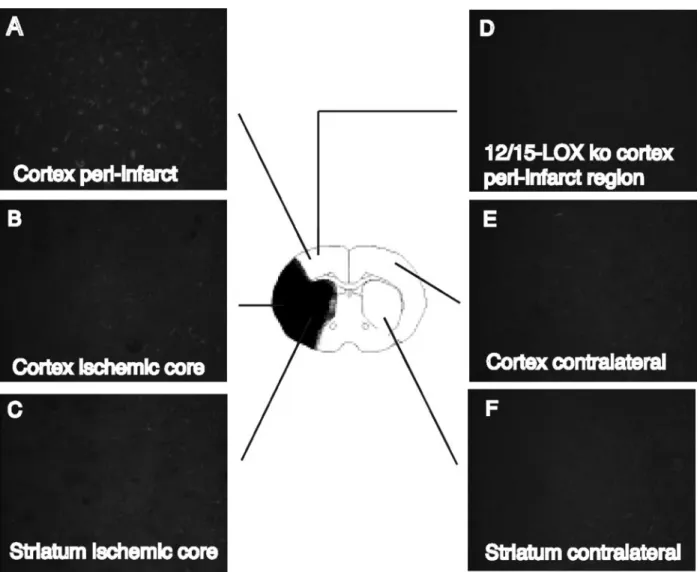
MCAO by immunohistochemistry. No significant differences in physiological parameters were detected between the ALOX15 knockout mice and corresponding wild-type C57BL/6J mice when subjected to MCAO (Table), suggesting that differences in infarct size are not caused by differences in the vascular response. In healthy mice, LOX protein is only weakly de- tected using an antibody raised against the rabbit lipoxygenase, 15-LOX-1 (data not shown). However, after 2 hours of transient focal cerebral ischemia and 4 hours of reperfusion, LOX levels were increased primarily in the peri-infarct region of the ische- mic cortex (compare Figure 1A to Figure 1B, 1C, 1E, 1F). This region, adjacent to the core infarct, is taken to be at risk for subsequent damage. The specificity of these data were con- firmed by the lack of LOX staining in ALOX15 knockout mice, in which the gene encoding 12/15-LOX has been deleted (Figure 1D). To confirm which cells exhibit the increased amounts of 12/15-LOX, we performed double labeling with an antibody directed against the neuronal marker NeuN. Most of the staining was associated with neurons (Figure 2A to 2C), although endothelial cell staining was also detected in some cases (data not shown).
These increased levels of 12/15-LOX in neurons of the peri-infarct region suggested to us that inhibiting neuronal LOX activity might be beneficial. Correspondingly, we tested baicalein, an inhibitor of the 12- and 15-lipoxygenases,6,9,10,18 in primary cortical neurons subjected to oxidative stress (Figure 2D). At 10mol/L, baicalein efficiently reduced cell death by glutamate treatment.11,12
In the next step, we treated mice subjected to MCAO with baicalein, applied by intraperitoneal injection 5 minutes before ischemia. After 90 minutes of ischemia and 22 hours 30 minutes of reperfusion, infarct sizes were significantly reduced compared with vehicle-treated mice (Figure 3A, 3B; n⫽6 per group). To investigate whether or not the beneficial effect of baicalein treatment is caused by lipoxygenase inhibition, we next com- pared brain infarct sizes in ALOX15 knockout mice with corre- sponding wild-type mice after 90 minutes ischemia and 22 hours 30 minutes of reperfusion. Infarction sizes in the ALOX15 knockouts were significantly smaller than those in wild-type mice, similar to the effect of baicalein treatment in wild-type mice (Figure 3C; n⫽7 per group). If baicalein protected the ischemic mice through lipoxygenase inhibition, then 12/15-LOX knockout mice should not derive an additional benefit from baicalein treatment. Indeed, baicalein treatment of the knockout mice did not provide significant additional protection (Figure 3D; n⫽4 per group). This result suggests that baicalein protects the ischemic brain mostly through inhibition of 12/15-LOX.
Taken together, these in vivo data suggest that 12/15-lipoxygen- Physiological Parameters for ALOX15(ⴙ/ⴙ)and ALOX15(ⴚ/ⴚ)Mice
Pre-MCAO 1-Hour MCAO
PO2 PCO2 pH BP PO2 PCO2 pH BP
WT 132.4⫾10.9 30.3⫾1.7 7.38⫾0.03 90.8⫾3.1 97.4⫾10.6 47.1⫾2.8 7.29⫾0.01 91.8⫾1.5 ALOX15(⫺/⫺) 120.0⫾3.3 37.3⫾2.6 7.33⫾0.03 87.0⫾5.4 105.7⫾10.4 45.5⫾3.3 7.29⫾0.02 91.3⫾7.4 Blood gas parameters immediately before and after 1 hour of MCAO in ALOX15(⫹/⫹)and ALOX15(⫺/⫺)mice (n⫽4 per group;
mean⫾SD).
BP indicates blood pressure.
by guest on February 2, 2017http://stroke.ahajournals.org/Downloaded from
ase contributes to brain damage after stroke, and that 12/15-LOX inhibition by baicalein is neuroprotective.
Discussion
Lipoxygenases are a family of lipid-oxidizing enzymes that generate a wide array of pro- and anti-inflammatory mediators.
The well-known 5-lipoxygenase and its activating protein, en- coded by the gene ALOX5AP, have recently been intensely studied because of a genetic linkage to stroke risk.19 –22 This must be separated from stroke severity, however, and deletion of the ALOX5 gene did not prove beneficial in a mouse model of transient focal ischemia.23In contrast, the 12/15-lipoxygenase Figure 1. Increased LOX expression after 2 hours transient focal ischemia and 4 hours of reperfusion. A, B, C, E, F, Immunohistochem- istry with a LOX antibody shows increased staining in the peri-infarct region on the ischemic side of the brain. D, The peri-infarct region in the ALOX15 knockout mouse does not show significant cellular staining.
Figure 2. Colocalization of LOX with a neuronal marker. A to C, LOX is expressed predominantly in neurons, as indicated by colocal- ization with the neuronal marker NeuN. D, Primary cortical neurons are protected against oxidative stress by baicalein. *P⬍0.05 vs glu- tamate alone.
by guest on February 2, 2017http://stroke.ahajournals.org/Downloaded from
knockout mice ALOX15(⫺/⫺)have been shown by us and others to be protected.5,6 In addition, 12/15-LOX may contribute to oxidative stress in mouse brains in vivo.24
For the first time, the results presented here document an increase of 12/15-LOX on the ischemic side of the infarcted brain, in the peri-infarct region of the cortex. This increase is detected predominantly in neurons, consistent with previous studies showing 12/15-LOX involvement in neuronal cell death in vitro.11,25–28 In addition, we also found increased levels of 12/15-LOX in endothelial cells in some cases, the significance of which we are currently investigating (data not shown). The strongest increases in 12/15-LOX expression were thus detected in neurons and sometimes endothelial cells, but 12/15-LOX in other cell types of the brain29 –31 may also contribute to the effects on stroke pathophysiology shown here. Consistent with this upregulation being detrimental after transient focal ische- mia, we have found an inhibitor of 12/15-LOX, baicalein, to protect the brain after stroke. Although the optimal dose, timing, and route of administration have yet to be worked out, the current dosage led to a significant decrease in infarct volume. A similar reduction in infarct volume occurred when we compared ALOX15(⫺/⫺)mice, in which the gene encoding 12/15-LOX has
been deleted, to matching wild-type C57Bl6 mice. In contrast, the ALOX15(⫺/⫺)mice were not further protected by baicalein.
This suggests that the protection afforded by baicalein may be mediated in large part through its inhibition of 12/15-LOX. This inhibition is likely to be direct, because baicalein is known to inhibit the 12/15-lipoxygenases in vitro with an IC50 in the low micromolar range, and baicalein has been modeled to interact directly with the iron located in the active site of the enzyme.10,18 Alternately, baicalein could also be decreasing oxidative stress, which would prevent activation of 12/15-LOX.4,11Either way, the decisive factor appears to be the activity of 12/15-lipoxygen- ase, because its removal abolishes the protective effect of baicalein. In this initial study, infarct size reductions were apparent at 24 hours, indicating a critical role for 12/15-LOX in acute ischemic injury. The effect of LOX inhibition on delayed infarct maturation and long-term outcome remains to be studied.
In summary, this is the first study to show that baicalein protects specifically through inhibition of the 12/15-LOX pathway. There are 2 consequences of our findings: (1) we confirm that 12/15-LOX is a valid drug target for stroke neuroprotective therapy, because its increased neuronal ex- pression appears to be detrimental; and (2) baicalein should Figure 3. Brain infarct volume, measured by TTC staining of sections taken at 24 hours after 90 minutes of focal ischemia, is reduced by baicalein in a 12/15-LOX–
dependent manner. A, Pharmacological inhibition with baicalein reduces infarc- tion sizes in wild-type mice. B, Slice-by slice comparison of infarct areas. C, The ALOX15 knockout has reduced infarction sizes compared with age-matched wild- type mice. D, Baicalein does not signifi- cantly further reduce infarction sizes in ALOX15 knockout mice. *P⬍0.05. Com- parison of infarct sizes of mice treated with or without baicalein, or deleted for the gene encoding 12/15-LOX.
by guest on February 2, 2017http://stroke.ahajournals.org/Downloaded from
be further investigated for its therapeutic potential to combat stroke.
Acknowledgments
We thank Dr A. Siddiq for help with the neuronal cultures, Dr C.
Ayata for help with the physiological measurements, and Drs M. A.
Moskowitz and R. R. Ratan for helpful comments on the manuscript.
Sources of Funding
Support from the National Institutes of Health (R01NS049430 to K.v.L.) and through a Scientist Development Grant from the Amer- ican Heart Association (to K.v.L.) is gratefully acknowledged.
Disclosures
None.
References
1. Lo EH, Moskowitz MA, Jacobs TP. Exciting, radical, suicidal: How brain cells die after stroke. Stroke. 2005;36:189 –192.
2. van Leyen K, Duvoisin RM, Engelhardt H, Wiedmann M. A function for lipoxygenase in programmed organelle degradation. Nature. 1998;395:
392–395.
3. Schewe T, Halangk W, Hiebsch C, Rapoport SM. A lipoxygenase in rabbit reticulocytes which attacks phospholipids and intact mitochondria.
FEBS Lett. 1975;60:149 –152.
4. Ku¨hn H, Walther M, Kuban RJ. Mammalian arachidonate 15-lipoxygen- ases structure, function, and biological implications. Prostaglandins Other Lipid Mediat. 2002;68 – 69:263–290.
5. Khanna S, Roy S, Slivka A, Craft TK, Chaki S, Rink C, Notestine MA, DeVries AC, Parinandi NL, Sen CK. Neuroprotective properties of the natural vitamin e alpha-tocotrienol. Stroke. 2005;36:2258 –2264.
6. van Leyen K, Lee S, Siddiq A, Ratan RR, Lo EH. 12/15-lipoxygenase and the proteasome as mediators of neuronal oxidative stress and stroke.
Program No 1356, 2004 Abstract Viewer/Itinerary Planner. Washington, DC: Society for Neuroscience; 2004.
7. Bernaudin M, Tang Y, Reilly M, Petit E, Sharp FR. Brain genomic response following hypoxia and re-oxygenation in the neonatal rat. Iden- tification of genes that might contribute to hypoxia-induced ischemic tolerance. J Biol Chem. 2002;277:39728 –39738.
8. Moskowitz MA, Kiwak KJ, Hekimian K, Levine L. Synthesis of com- pounds with properties of leukotrienes C4 and D4 in gerbil brains after ischemia and reperfusion. Science. 1984;224:886 – 889.
9. Sekiya K, Okuda H. Selective inhibition of platelet lipoxygenase by baicalein. Biochem Biophys Res Commun. 1982;105:1090 –1095.
10. Deschamps JD, Kenyon VA, Holman TR. Baicalein is a potent in vitro inhibitor against both reticulocyte 15-human and platelet 12-human li- poxygenases. Bioorg Med Chem. 2006;14:4295– 4301.
11. Li Y, Maher P, Schubert D. A role for 12-lipoxygenase in nerve cell death caused by glutathione depletion. Neuron. 1997;19:453– 463.
12. Lee HH, Yang LL, Wang CC, Hu SY, Chang SF, Lee YH. Differential effects of natural polyphenols on neuronal survival in primary cultured central neurons against glutamate- and glucose deprivation-induced neuronal death. Brain Res. 2003;986:103–113.
13. Hwang YS, Shin CY, Huh Y, Ryu JH. Hwangryun-hae-dok-tang (huanglian-jie-du-tang) extract and its constituents reduce ischemia- reperfusion brain injury and neutrophil infiltration in rats. Life Sci. 2002;
71:2105–2117.
14. Hamada H, Hiramatsu M, Edamatsu R, Mori A. Free radical scavenging action of baicalein. Arch Biochem Biophys. 1993;306:261–266.
15. Asahi M, Asahi K, Jung JC, del Zoppo GJ, Fini ME, Lo EH. Role for matrix metalloproteinase 9 after focal cerebral ischemia: effects of gene
knockout and enzyme inhibition with BB-94. J Cereb Blood Flow Metab.
2000;20:1681–1689.
16. Ratan RR, Ryu H, Lee J, Mwidau A, Neve RL. In vitro model of oxidative stress in cortical neurons. Methods Enzymol. 2002;352:
183–190.
17. van Leyen K, Siddiq A, Ratan RR, Lo EH. Proteasome inhibition protects HT22 neuronal cells from oxidative glutamate toxicity. J Neurochem.
2005;92:824 – 830.
18. Sadik CD, Sies H, Schewe T. Inhibition of 15-lipoxygenases by fla- vonoids: Structure-activity relations and mode of action. Biochem Pharmacol. 2003;65:773–781.
19. Lohmussaar E, Gschwendtner A, Mueller JC, Org T, Wichmann E, Hamann G, Meitinger T, Dichgans M. ALOX5AP gene and the PDE4D gene in a Central European population of stroke patients. Stroke. 2005;
36:731–736.
20. Helgadottir A, Gretarsdottir S, St Clair D, Manolescu A, Cheung J, Thorleifsson G, Pasdar A, Grant SF, Whalley LJ, Hakonarson H, Thor- steinsdottir U, Kong A, Gulcher J, Stefansson K, MacLeod MJ. Asso- ciation between the gene encoding 5-lipoxygenase-activating protein and stroke replicated in a Scottish population. Am J Hum Genet. 2005;76:
505–509.
21. Helgadottir A, Manolescu A, Thorleifsson G, Gretarsdottir S, Jonsdottir H, Thorsteinsdottir U, Samani NJ, Gudmundsson G, Grant SF, Thor- geirsson G, Sveinbjornsdottir S, Valdimarsson EM, Matthiasson SE, Johannsson H, Gudmundsdottir O, Gurney ME, Sainz J, Thorhallsdottir M, Andresdottir M, Frigge ML, Topol EJ, Kong A, Gudnason V, Hakonarson H, Gulcher JR, Stefansson K. The gene encoding 5-lipoxy- genase activating protein confers risk of myocardial infarction and stroke.
Nat Genet. 2004;36:233–239.
22. Markus HS, Alberts MJ. Update on genetics of stroke and cerebro- vascular disease 2005. Stroke. 2006;37:288 –290.
23. Kitagawa K, Matsumoto M, Hori M. Cerebral ischemia in 5-lipoxygenase knockout mice. Brain Res. 2004;1004:198 –202.
24. Chinnici CM, Yao Y, Ding T, Funk CD, Pratico D. Absence of 12/15 lipoxygenase reduces brain oxidative stress in apolipoprotein E-deficient mice. Am J Pathol. 2005;167:1371–1377.
25. Zhang Y, Wang H, Li J, Jimenez DA, Levitan ES, Aizenman E, Rosenberg PA. Peroxynitrite-induced neuronal apoptosis is mediated by intracellular zinc release and 12-lipoxygenase activation. J Neurosci.
2004;24:10616 –10627.
26. Lebeau A, Terro F, Rostene W, Pelaprat D. Blockade of 12-lipoxygenase expression protects cortical neurons from apoptosis induced by beta- amyloid peptide. Cell Death Differ. 2004;11:875– 884.
27. Khanna S, Roy S, Ryu H, Bahadduri P, Swaan PW, Ratan RR, Sen CK.
Molecular basis of vitamin E action: Tocotrienol modulates 12-lipoxy- genase, a key mediator of glutamate-induced neurodegeneration. J Biol Chem. 2003;278:43508 – 43515.
28. Canals S, Casarejos MJ, de Bernardo S, Rodriguez-Martin E, Mena MA.
Nitric oxide triggers the toxicity due to glutathione depletion in midbrain cultures through 12-lipoxygenase. J Biol Chem. 2003;278:21542–21549.
29. Wang H, Li J, Follett PL, Zhang Y, Cotanche DA, Jensen FE, Volpe JJ, Rosenberg PA. 12-lipoxygenase plays a key role in cell death caused by glutathione depletion and arachidonic acid in rat oligodendrocytes. Eur J Neurosci. 2004;20:2049 –2058.
30. Bendani MK, Palluy O, Cook-Moreau J, Beneytout JL, Rigaud M, Vallat JM. Localization of 12-lipoxygenase mRNA in cultured oligodendrocytes and astrocytes by in situ reverse transcriptase and polymerase chain reaction. Neurosci Lett. 1995;189:159 –162.
31. Paintlia AS, Paintlia MK, Singh I, Singh AK. IL-4-induced peroxisome proliferator-activated receptor gamma activation inhibits NF-kappaB trans activation in central nervous system (CNS) glial cells and protects oligodendrocyte progenitors under neuroinflammatory disease con- ditions: Implication for CNS-demyelinating diseases. J Immunol. 2006;
176:4385– 4398.
by guest on February 2, 2017http://stroke.ahajournals.org/Downloaded from
Print ISSN: 0039-2499. Online ISSN: 1524-4628
Copyright © 2006 American Heart Association, Inc. All rights reserved.
is published by the American Heart Association, 7272 Greenville Avenue, Dallas, TX 75231 Stroke
doi: 10.1161/01.STR.0000249004.25444.a5
2006;37:3014-3018; originally published online October 19, 2006;
Stroke.
http://stroke.ahajournals.org/content/37/12/3014
World Wide Web at:
The online version of this article, along with updated information and services, is located on the
http://stroke.ahajournals.org//subscriptions/
is online at:
Stroke Information about subscribing to Subscriptions:
http://www.lww.com/reprints
Information about reprints can be found online at:
Reprints:
document.
Permissions and Rights Question and Answer process is available in the
Request Permissions in the middle column of the Web page under Services. Further information about this Once the online version of the published article for which permission is being requested is located, click
can be obtained via RightsLink, a service of the Copyright Clearance Center, not the Editorial Office.
Stroke in
Requests for permissions to reproduce figures, tables, or portions of articles originally published Permissions:
by guest on February 2, 2017http://stroke.ahajournals.org/Downloaded from