․교신저자: 손창규 대전시 중구 대흥동 22-5번지
비알콜성지방간의 유병율과 병리기전에 대한 문헌적 고찰
박연화, 유사라, 손창규 대전대학교 한의과대학 간장면역학교실
Overview for Prevalence and Pathology of Non-Alcoholic Fatty Liver Disease
Yeun-hwa Park, Sa-ra Yoo, Chang-gue Son
Liver and Immunology Research Center of Dae-Jeon University Oriental Hospital ABSTRACT
Objectives : Non-alcoholic fatty liver disease (NAFLD) is known to be increasing and becoming a health-related issue worldwide. This study aimed to analyze its prevalence and characterize NAFLD.
Methods : NAFLD-related papers were surveyed via PubMed and in Korean medical journals, and then the prevalence and pathology were reviewed.
Results :The prevalence of NAFLD in the general population is around 10~30% worldwide. The prevalence of NAFLD in Korea is estimated as 15~30%, which is higher than in China and Japan. The most important etiological-factors of NAFLD include central obesity resulting from excessive calorie intake and less physical activity, which lead to adiponectin hypoactivity and insulin resistance. The Oriental medicine view point of NAFLD pathology is phlegm-dampness by dysfunction of free flow in liver.
Conclusions : This study provided an overview of the prevalence and pathology of NAFLD, and can support the development of a strategy for traditional Korean medicine-based prevention or treatment of NAFLD.
Key words : Non-alcoholic fatty liver disease, Non-alcoholic steatohepatitis, Traditional Korean medicine, Herbal medicine
Ⅰ. 서 론
비알콜성지방간 (non-alcoholic fatty liver disease :NAFLD)이란 음주 경력이 없거나 주 40g 미만의 알코올을 섭취함에도 불구하고 간조직 내의 지방 축적을 특징으로 하는 간질환을 말하는데, 알코올 성 간질환과 매우 유사한 간의 조직학적 손상을 보인다1. 일반적으로 비알콜성 지방간은 대부분 증 상이 없거나 매우 경미하지만, 경우에 따라서는 심
한 염증성 병변을 보이는 비알콜성지방간염(non- alcoholic steatohepatitis, NASH)으로 발전하기도 한다2. 특히, 비알콜성지방간염 (NASH) 환자의 약 20% 정도는 간섬유화나 간경변으로 진행하고 1%
는 간암으로도 진행하여 매우 중요한 의학적 문제 로 대두되고 있다3,4.
과거에는 비알콜성지방간은 거의 없었던 질환이 었으나, 과잉영양 및 운동부족과 과도한 스트레스 노출 등의 변화된 생활패턴으로 인하여 현대인의 본 질환 유병율은 매우 증가하는 것으로 알려져 있다5. 최근엔 특히 비만한 어린이나 청소년의 증
한 건강 문제로 대두되고 있다6. 비알콜성지방간이 인슐린저항성으로 대표되는 대사증후군과 매우 밀 접한 관련이 있다고 알려졌지만, 아직 본 질환의 병태에 대한 자세한 기전도 밝혀지지 않았으며 특 별한 치료방법도 없는 실정이다7,8. 본 질환의 임상 적 중요성에 비하여 국내외의 연구는 아직까지 매 우 부족한 상태이며, 전 세계적인 정확한 유병율도 체계적으로 파악되지 못하였다.
최근엔 비알콜성지방간에 대한 한약물이나 전통 적 처방을 이용한 실험적 효과연구 및 긍정적인 임상보고가 일부 이루어졌다9,10. 그동안의 간장질환 에 대한 한의학의 풍부한 이론과 경험에 비추어 볼 때, 한의계의 비알콜성 지방간의 치료약물 개발 의 필요성과 당위성은 매우 크다고 하겠다.
이에 본 연구는 국내외의 선행연구들을 조사하 여 비알콜성지방간 유병율과 병태를 고찰함으로서, 향후 이 질환에 대한 한의학적 전략을 세우고 치 료법을 개발함에 있어서 중요한 기초정보로 이용 하고자 한다.
Ⅱ. 연구 방법
1. 연구 설계
본 연구는 비알콜성지방간에 대한 국내외의 발 표 논문들을 조사하여 비알콜성 지방간에 대한 유 병율 분석과 병태를 고찰하였다.
2. 자료 수집 방법
본 연구를 위하여 Pubmed (http://www.ncbi.
nlm.nih.gov/sites/entrez?db=PubMed)와 한국의학 논문데이터베이스 (http://kmbase.medric.or.kr/Main.
aspx?d=KMBASE)를 통해 2010년 2월까지 제시 된 비알콜성지방간과 관련된 국내외의 논문을 조사 하였다. 유병율 조사를 위해서는 Pubmed에서 검색 어는 Title 하에 “fatty AND liver AND prevalence"
와 “fatty AND liver AND incidence"로 설정하고, 한국의학논문 데이터베이스에서는 검색어를 “지방 간”으로 하여 조사하였다. Pubmed에서 총 72편의 논문들 중에서 특정한 그룹을 대상으로 한 연구와 종설논문에 해당하는 61편을 제외한 11편과 국내 조사에서의 217편 논문 중에서 9편이 본 연구의 목 적에 부합하였다. 또한 비알콜성지방간의 병태에 대한 최신 지견의 논문들을 통하여 근래에 중요하 게 밝혀진 병태생리를 분석하였다.
Ⅲ. 결과 및 고찰
1. 국외에서의 비알콜성 지방간의 유병율
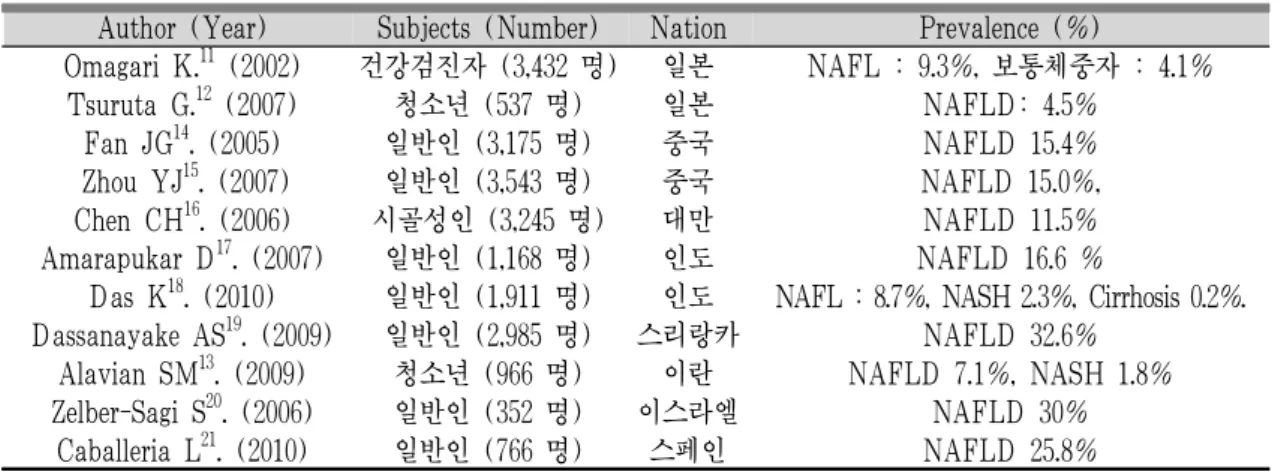
다양한 국가에서 정확한 비알콜성지방간의 유병 율을 조사하기위한 시도가 있었다. Pubmed에서 지 방간의 유병율에 대한 연구는 71편으로 대부분은 비만자나 고지혈증 혹은 특정한 질환을 가지고 있 는 그룹에서의 조사가 많았고 일반인을 대상으로 한 연구는 11편이었다(Table 1). 전체적으로는 일 반인들의 비알콜성지방간 유병율은 약 9~30% 정 도로 국가별 차이가 심했고, 같은 국가 내에서도 많은 차이를 보였다. 일본의 성인과 청소년의 비알 콜성 유병율은 9.3%와 4.5%로서 다른 국가에 비하 여 가장 낮았다11,12. 이란에서의 조사된 청소년 유 병율은 7.1%였다13. 중국과 대만에서는 약 3천명 이상을 대상으로 한 세 건의 연구가 있었는데, 모 두가 약 11~15%정도의 유병율을 보였다14-16. 지방 간 위험인자인 비만과 당뇨가 많아서 높은 유병율 이 알려진 인도는 두 건의 연구에서 16.6%와 8.7%
로 예상보다 높지 않았으며17,18. 인도의 주변국인 스리랑카와 이스라엘 및 스페인에서의 유병율이 25~32% 정도로 매우 높게 나왔다19-21. 이러한 유 병율의 차이는 실제로 존재하는 국가 간의 차이일 수도 있으나, 연구 대상자들의 크기나 특징 혹은 연 구방법상의 약간의 차이에 기인했을 수도 있겠다.
Author (Year) Subjects (Number) Nation Prevalence (%)
Omagari K.11 (2002) 건강검진자 (3,432 명) 일본 NAFL : 9.3%, 보통체중자 : 4.1%
Tsuruta G.12 (2007) 청소년 (537 명) 일본 NAFLD: 4.5%
Fan JG14. (2005) 일반인 (3,175 명) 중국 NAFLD 15.4%
Zhou YJ15. (2007) 일반인 (3,543 명) 중국 NAFLD 15.0%, Chen CH16. (2006) 시골성인 (3,245 명) 대만 NAFLD 11.5%
Amarapukar D17. (2007) 일반인 (1,168 명) 인도 NAFLD 16.6 %
Das K18. (2010) 일반인 (1,911 명) 인도 NAFL : 8.7%, NASH 2.3%, Cirrhosis 0.2%.
Dassanayake AS19. (2009) 일반인 (2,985 명) 스리랑카 NAFLD 32.6%
Alavian SM13. (2009) 청소년 (966 명) 이란 NAFLD 7.1%, NASH 1.8%
Zelber-Sagi S20. (2006) 일반인 (352 명) 이스라엘 NAFLD 30%
Caballeria L21. (2010) 일반인 (766 명) 스페인 NAFLD 25.8%
Table 1. Main reports for the prevalence of NAFLD in the world
2. 국내에서 조사된 비알콜성 지방간의 유병율 국내에서 비알콜성지방간 유병율에 대한 여러 연구가 있었으나 유병율이 약 9~30% 정도로 심한 편차를 보였다(Table 2). 주로 건강검진 수진자들 을 대상으로 한 연구가 대부분으로 2007년과 2010 년에 약 3만 명과 6천 7백 명을 대상으로 한 조사 에서 18.6%와 26.4%의 유병율을 보였다22,23. 일반인 을 대상으로는 2006년도에 약 6천 6백 명의 조사연 구가 있는데 16.1%의 비알콜성지방간 유병율의 결
과를 보였다24. 이 연구에서는 특히 남녀 간 약 두 배의 차이를 보여주었고(남자 21.6%, 여자 11.2%), 이는 여자만을 대상으로 한 다른 연구 결과와 동 일한 비율이었다25. 이러한 결과들을 종합하면, 한 국인의 전체적인 비알콜성지방간의 유병율은 약 15~25% 정도일 것으로 예측되고, 이는 일본이나 중국의 9~15%보다는 높은 것으로 여겨진다. 그러 나 한국에서는 일반인을 대상으로 한 연구가 부족 하여 좀 더 자세한 조사가 필요하다.
Author (Year) Subjects (Number) Prevalence (%) Na HY,23, (2010) 건강검진수검자(6,731명) NAFLD 26.4%
Jun EJ25, (2009) 여성 건강검진 수진자 (835명) NAFLD 11.9%
Kim SY26, (2007) 건강검진 수검자 (401명) NAFLD 27.2%
Seo SH22, (2006) 건강검진 수검자 (29,781명) NAFLD 18.6%
Park SH24. (2006) 일반인 (6,648 명) NAFLD 16.1%, 남자 21.6%, 여자 11.2%
Park JS27, (2004) 건강검진 수검자 (2,374명) NAFLD 9.5%
Park SH28, (2003) 건강검진수검자 (6,244명) NAFLD 9.1%
Kim HG29, (2002) 건강검진 수검자 (115명) NAFLD 26%
Ahn JE30, (1991) 병원 내원자 (1,335명) NAFLD 남자 29.6%, 여자 11.5%
Table 2. Main reports for the prevalence of NAFLD in Korea
3. 비알콜성 지방간의 병태생리와 한의학적 연구 비알콜성 지방간에 대한 정확한 원인은 자세히
당뇨, 고혈압, 패스트푸드 섭취횟수 및 적은 운동 량 등이 중요한 위험인자로 제시되고 있다31. 이러 한 것은 현대인의 생활패턴의 변화와 밀접한 관련 이 있음을 의미하는데, 비알콜성지방간의 또 하나 의 중요한 특징은 인슐린저항성을 갖는다는 것이 다32. 인슐린저항성과 위에서 언급한 위험인자들은 현대인에게 매우 중요한 질병으로 대두되고 있는 대사증후군의 특징과 동일하다는 점에서, 비알콜성 지방간을 대사증후군의 간조직 내부의 병리현상으 로 인식되기도 한다33,34. 비알콜성지방간의 일부환 자들은 장차 간경화나 간암으로 이행될 수 있는 비알콜성지방간염으로 진행되기도 하는데, 인도와 이란의 연구에 의하면 일반인과 청소년의 2.3%와 1.8%가 비알콜성지방간염을 가지고 있는 것으로 조사되었다13,17.
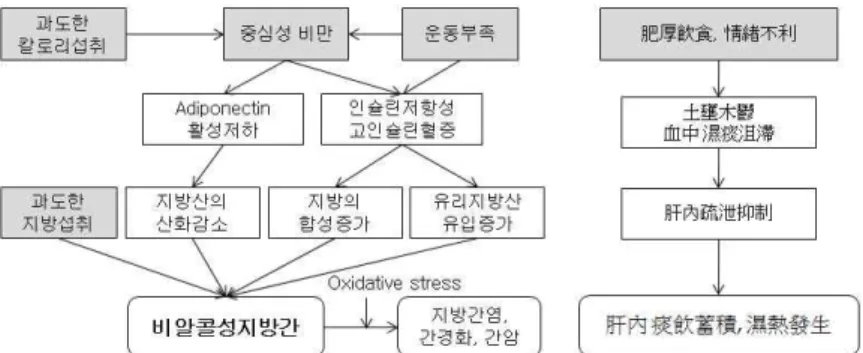
이러한 비알콜성지방간의 발생에 기여하는 기전 으로는 과도한 영양의 섭취와 운동부족으로 생기 는 내장비만에 이어서, 당조절과 지방산의 이화작 용에 중심역할을 하는 단백호르몬인 adiponectin의 활성저하 및 인슐린저항성 증가와 고인슐린혈증이 유도되는 것으로 요약된다35,36. 결과적으로 이렇게 되면 간조직 내에 지방산의 산화는 감소하는 대신
지방의 합성과 지방산의 유입이 증가함으로서 간 세포 내에 지방의 축적이 일어나게 된다,37. 간내의 지방축적이 과도하게 일어나면 활성산소의 증가에 따른 산화적 스트레스(oxidative stress) 상태에 빠 지고 점차적으로 간조직의 염증상태와 면역학적 불균형 상태로 진행된다38. 따라서본 질환의 예방이 나 치료에 있어서 비만의 억제나 개선은 가장 중 요한 요소이다.
한의학적으로 비알콜성지방간은 간의 주요 기능 인 소설기능이 이루어 지지 않음으로서 간장 내에 담음이 쌓이고 진행되면 습열이 발생하는 것이다39 (Fig. 1). 현재까지 한의학적 연구는 매우 미진하지 만 대표적인 간의 소설기능을 회복하는 청간탕의 가감방들이 동물모델에서 유효한 효과를 보여주었
다10,40. 향후 비알콜성비방간이나 비알콜성지방간염
에 대한 한의학적 치료법의 연구와 개발은 임상적 으로 매우 중요하고 가능성이 높다고 하겠다. 위에 서 언급하였듯이 비알콜성지방간은 여러 복합적인 요인이 유발하는 대사증후군의 한 형태로서 이러 한 증후군의 치료에는 단일 유효성분의 유효성은 매우 제한적이고 복합적인 약제로 구성된 전통적 처방이 주요한 치료수단일 수 있기 때문이다.
Fig. 1. Summary of mechanical process of non-alcoholic fatty liver disease.
Ⅳ. 결 론
비알콜성지방간에 대한 선행연구들을 고찰한 결
과, 전 세계적으로 비알콜성지방간의 유병율은 약 10~30% 정도로 현재 매우 중요한 의학적 이슈로 대두되고 있으며, 한국에서의 유병율은 약 15~25%
로 중국이나 일본보다도 높은 것으로 판단된다. 비 알콜성지방간은 최근엔 문제가 되고 있는 대사증 후군의 또 다른 형태로서, 영양과잉과 운동부족으 로 인한 간장 내의 지방합성과 축적이 유도되는 것으로 한의학적으로는 간의 소설기능 억제로 담 음축적과 습열이 생성되는 것으로 해석할 수 있다.
본 연구는 비알콜성지방간에 대한 국내외의 유병 율과 병리적 특징을 개괄적으로 보여준 것으로서 향후 한의학적 치료법 연구에 기초적인 데이터로 활용되길 기대한다.
감사의 글
이 논문은 2011년도 정부(과학기술부)의 재원으 로 한국연구재단의 지원 (No. 20100028119)과 의하 여 이루어진 것임.
참고문헌
1. Adams LA, Angulo P. Treatment of non-alcoholic fatty liver disease.Postgrad Med J. 2006;82(967) :315-22.
2. Clark JM, Diehl AM. Nonalcoholic fatty liver disease: an under-recognized cause of cryptogenic cirrhosis.JAMA, 2003;289(22):3000-4.
3. Chavez-Tapia NN, Uribe M, Ponciano-Rodríguez G, Medina-Santillán R, Méndez-Sánchez N. New insights into the pathophysiology of nonalcoholic fatty liver disease. Ann Hepatol. 2009;8:S9-S17.
4. Abrams GA, Kunde SS, Lazenby AJ, Clements RH. Portal fibrosis and hepatic steatosis in morbidly obese subjects: a spectrum of nonalcoholic fatty liver disease. Hepatology. 2004;40:475-83.
5. Neuschwander-Tetri BA. Lifestyle modification as the primary treatment of NASH. Clin Liver
6. Williams CD, Stengel J, Asike MI, Torres DM, Shaw J, Contreras M, et al. Prevalence of nonalcoholic fatty liver disease and nonalcoholic steatohepatitis among a largely middle-aged population utilizing ultrasound and liver biopsy:
a prospective study. Gastroenterology.2011;140(1) :124-31.
7. Larter CZ, Chitturi S, Heydet D, Farrell GC. A fresh look at NASH pathogenesis. Part 1: the metabolic movers. J Gastroenterol Hepatol.2010;
25(4):672-90.
8. Golovanova EV, Vinnitskaia EV, Shaposhnikova NA, Petrakov AV, Mel'kina ES. Effectiveness of the new plant hepatoprotector--Ropren in patients with non-alcoholic steatohepatitis. Eksp Klin Gastroenterol. 2010;(7):97-102.
9. Hong XZ, Li LD, Wu LM. Effects of fenofibrate and xuezhikang on high-fat diet-induced non- alcoholic fatty liver disease. Clin Exp Pharmacol Physiol. 2007;34(1-2):27-35.
10. Han CW, Lee JH. Effects of KHchunggan-tang on the Nonalcoholic Fatty Liver Disease in Palmitate-induced Cellular Model. J Korean Oriental Med.2011;32(1):109-20.
11. Omagari K, Kadokawa Y, Masuda J, Egawa I, Sawa T, Hazama H, et al. Fatty liver in non- alcoholic non-overweight Japanese adults: incidence and clinical characteristics. J Gastroenterol Hepatol. 2002;17(10):1098-105.
12. Tsuruta G, Tanaka N, Hongo M, Komatsu M, Horiuchi A, Hamamoto K, et al. Nonalcoholic fatty liver disease in Japanese junior high school students: its prevalence and relationship to lifestyle habits. J Gastroenterol. 2010;45(6) :666-72.
alcoholic fatty liver disease prevalence among school-aged children and adolescents in Iran and its association with biochemical and anthropometric measures.Liver Int. 2009;29(2) :159-63.
14. Fan JG, Zhu J, Li XJ, Chen L, Li L, Dai F, et al. Prevalence of and risk factors for fatty liver in a general population of Shanghai, China. J Hepatol. 2005;43(3):508-14.
15. Zhou YJ, Li YY, Nie YQ, Ma JX, Lu LG, Shi SL, et al. Prevalence of fatty liver disease and its risk factors in the population of South China.
World J Gastroenterol. 2007;13(47):6419-24.
16. Chen CH, Huang MH, Yang JC, Nien CK, Yang CC, Yeh YH, et al. Prevalence and risk factors of nonalcoholic fatty liver disease in an adult population of taiwan: metabolic significance of nonalcoholic fatty liver disease in nonobese adults. J Clin Gastroenterol. 2006;40(8):745-52.
17. Amarapurkar D, Kamani P, Patel N, Gupte P, Kumar P, Agal S, et al. Prevalence of non- alcoholic fatty liver disease: population based study.Ann Hepatol. 2007;6(3):161-3.
18. Das K, Mukherjee PS, Ghosh A, Ghosh S, Mridha AR, et al. Nonobese population in a developing country has a high prevalence of nonalcoholic fatty liver and significant liver disease. Hepatology. 2010;51(5):1593-602.
19. Dassanayake AS, Kasturiratne A, Rajindrajith S, Kalubowila U, Chakrawarthi S, De Silva AP, et al. Prevalence and risk factors for non- alcoholic fatty liver disease among adults in an urban Sri Lankan population. J Gastroenterol Hepatol. 2009;24(7):1284-8.
20. Zelber-Sagi S, Nitzan-Kaluski D, Halpern Z, Oren R. Prevalence of primary non-alcoholic fatty liver disease in a population-based study
and its association with biochemical and anthropometric measures. Liver Int. 2006;
26(7):856-63.
21. Caballeria L, Pera G, Auladell MA, Toran P, Munoz L, Miranda D, et al. Prevalence and factors associated with the presence of nonalcoholic fatty liver disease in an adult population in Spain. Eur J Gastroenterol Hepatol. 2010;22(1):24-32.
22. Seo SH, Lee HW, Park HW, Jang BG, Chung WJ, Park KS, et al. Prevalence and associated factors of nonalcoholic fatty Liver disease in the health screen examinees.Korean Association of Int. Med. 2006;70(1):26-32.
23. Na HY, Baek DJ, Lee SH, Choi YE, Cho KH, Pak SB, et al. Predictors Related to the Non-alcoholic Fatty Liver Disease. Korean J Fam Med. 2010;31(02): 94-100.
24. Park SH, Jeon WK, Kim SH, Kim HJ, Park DI, Cho YK, et al. Prevalence and risk factors of non-alcoholic fatty liver disease among Korean adults. J Gastroenterol Hepatol.
2006;21(1 Pt 1):138-43.
25. Jun EJ, Kim HS, Chung HK, Lee JH, Kim SR, Jung ED. Free T4 is Negatively Correlated with Non-alcoholic Fatty Liver Disease in Euthyroid Women.Edocrinology and Metabolism.
2009;24(2):87-92.
26. Kim SY, Lee HS, Lee SH, Oh YA, Kim HL, Sim KW. The Association of Nonalcoholic Fatty Liver Disease with Metabolic Syndrome.
Korean J Fam Med. 2007;28(9):667-74.
27. Park JS, Jung HC, Kim DY, Baek SD, Kim NI, Lee JU, et al. Risk factors of nonalcoholic fatty liver in healthy medical check up. The Dongguk Journal of Medicine.
2004;11(1):379-82.
28. Park SH, Kim BI, Yoo TW, Kim JW, Cho YK, Sung IK, et al. Nonalcoholic Fatty Liver Disease and Abnormal Liver Function Test in the Health Screen Examinees: the Relationship with Insulin Resistance. Korean J Gastroenterol. 2003;41(5):366-73.
29. Kim HK, Suh CJ, Yoon HJ, Hwang YH, Lee KY, Park HY, et al. Association between Non-alcoholic Fatty Liver and Metabolic Diseases. Edocrinology and Metabolism. 2002;
17(4):526-33.
30. Ahn JE, Ham JO, Hwang KY, Kim JJ, Lee BK, Nam TS, et al. A cross-sectional al study on prevalence rate and contributing factors of fatty liver diagnosed by ultrasonography. J. of Preventive Medicine and Public Health. 1991;
24(2):195-210.
31. Williams CD, Stengel J, Asike MI, Torres DM, Shaw J, Contreras M, et al. Prevalence of nonalcoholic fatty liver disease and nonalcoholic steatohepatitis among a largely middle-aged population utilizing ultrasound and liver biopsy:
a prospective study. Gastroenterology. 2011;
140(1):124-31.
32. Perez M, Gonzales L, Olarte R, Rodriguez NI, Tabares M, Salazar JP, et al. Nonalcoholic fatty liver disease is associated with insulin resistance in a young Hispanic population. Prev Med. 2011;52(2):174-7.
33. Vanni E, Bugianesi E, Kotronen A, De Minicis S, Yki-Jarvinen H, Svegliati-Baroni G. From
the metabolic syndrome to NAFLD or vice versa? Dig Liver Dis.2010;42(5):320-30.
34. Uchil D, Pipalia D, Chawla M, Patel R, Maniar S, Narayani, et al. Non-alcoholic fatty liver disease (NAFLD)--the hepatic component of metabolic syndrome. J Assoc Physicians India.
2009;57:201-4.
35. Polyzos SA, Kountouras J, Zavos C, Tsiaousi E. The role of adiponectin in the pathogenesis and treatment of non-alcoholic fatty liver disease.
Diabetes Obes Metab. 2010;12(5):365-83.
36. Lockman KA, Nyirenda MJ. Interrelationships between hepatic fat and insulin resistance in non-alcoholic fatty liver disease. Curr Diabetes Rev. 2010;6(5):341-7.
37. Liu Q, Bengmark S, Qu S. The role of hepatic fat accumulation in pathogenesis of non-alcoholic fatty liver disease (NAFLD). Lipids Health Dis. 2010;9:42.
38. Videla LA, Rodrigo R, Araya J, Poniachik J.
Insulin resistance and oxidative stress interdependency in non-alcoholic fatty liver disease. Trends Mol Med. 2006;12(12):555-8.
39. Kim SH, Lee JH, Jung YJ, Choi MY, Kim YC, Woo HJ. A Case of Nonalcoholic Steatohepatitis in a child patient. Korean J. Orient. Int. 2010;
31(2):1106-10.
40. Yoo JY, Lee JH. Effect of Saengangtanggami-bang on nonalcoholic fatty liver disease model induced by fatty liver. Korean J. Orient. Int. 2007;
Spring(1):143-57.