ORIGINAL ARTICLE
목질계 활성탄에 의한 수중의 Methylene blue와 Crystal violet의 제거 특성
전진우․유해나․감상규
1)
․이민규*
부경대학교 화학공학과, 1) 제주대학교 환경공학과
Removal Characteristics of Crystal Violet and Methylene Blue from Aqueous Solution using Wood-based Activated Carbon
Jin-Wo Jeon, Hae-Na Yu, Sang-Kyu Kam
1)
, Min-Gyu Lee*
Department of Chemical Engineering, Pukyong National University, Busan 608-739, Korea
1) Department of Environmental Engineering, Jeju National University, Jeju 690-756, Korea
Abstract
The adsorption ability of wood-based activated carbon to adsorb methylene blue (MB) and crystal violet (CV) from aqueous solution has been investigated. Adsorption studies were carried out on the batch experiment at different initial MB and CV concentrations (MB=150 mg/L~400 mg/L, CV=50 mg/L~350 mg/L), contact time, and temperature. The results showed that the MB and CV adsorption process followed the pseudo-second-order kinetic and intraparticle diffusion was the rate-limiting step. Adsorption equilibrium data of the adsorption process fitted very well to both Langmuir and Freundlich model. The maximum adsorption capacity (q m ) by Langmuir constant was 416.7 mg/g for MB and 462.4 mg/g for CV. The thermodynamic parameters such as ΔH°, ΔS° and ΔG° were evaluated. The MB and CV adsorption process was found to be endothermic for the two dyes.
Key words : Dye, Crystal violet, Methylene blue, Activated carbon, Adsorption
1. 서 론
1)
염료는 섬유, 가죽제품, 종이, 플라스틱 등 인간의 실생활에 밀접한 여러 산업에서 사용되고 있다. 오늘 날 상업적으로 사용되는 염료는 1만개 이상으로 알려 져 있으며, 전 세계적으로 연간 발생하는 염료 폐수의 양은 약 70만톤에 이르는 것으로 알려져 있다(Tan 등, 2008). 일반적으로 염료 폐수에는 난분해성 물질이 다 량 함유되어 있으며, 색도로 인한 불쾌감을 유발할 뿐
만 아니라, 색을 띄고 있는 염료가 수중에 유입되면 빛 을 차단시키기 때문에 수생 미생물의 성장에도 심각 한 위험을 야기 시킨다. 따라서 염색폐수의 처리 경우 에 유기물의 처리와 함께 색도제거가 큰 문제로 대두 되고 있다(Ahmad, 2009).
메틸렌블루(methylene blue, MB)는 페노티아진족 에 속하는 녹청색의 유기염료로 주로 인피섬유(bast fiber)에 사용되며, 종이, 가죽과 면의 매염(mordancy) 에 사용되기도 한다. 또한 생물학적 염색약으로 사용
Received 11 March, 2013; Revised 23 April, 2013;
Accepted 9 May, 2013
*
Corresponding author : Min-Gyu Lee, Department of Chemical Engineering, Pukyong National University, Busan 608-739, Korea Phone: +82-51-629-6435
E-mail: [email protected]
ⓒ The Korean Environmental Sciences Society. All rights reserved.
This is an Open-Access article distributed under the terms of the Creative Commons Attribution Non-Commercial License (http://
creativecommons.org/licenses/by-nc/3.0) which permits unrestricted
non-commercial use, distribution, and reproduction in any medium,
provided the original work is properly cited.
되며, 화학에서 산화-환원 지시약으로 쓰인다. 크리스 탈 바이올렛(crystal violet, CV)은 트리페닐메탄계에 속하는 보라색의 염기성 염료로, 명주, 양모, 종이 등 의 염색에 이용된다. MB 및 CV와 같은 양이온 염료 는 음이온 염료보다 독성이 더 강할 뿐만 아니라 발암 성 물질이며, 피부에 접촉하게 되면 소화기 계통과 호 흡기 그리고 신장에 문제를 야기 시키는 것으로 알려 져 있다(Hao 등, 2000).
현재 염료폐수의 처리방법으로는 오존산화처리, 응집처리, 활성탄 흡착, 생물학적 처리 등 여러 가지 방법이 있다. MB와 CV는 방향족 고리를 가지고 있어 서 생물학적 분해가 어렵고, 물리적 처리와 화학적 처 리과정은 제거 효율이 떨어지는 것으로 알려져 있다 (Carliell 등, 1996; Malik과 Saha, 2003; Perkins, 1980). 응집공정은 분산염료와 같은 불용성 염료의 제 거에는 효과적이지만 용존성 염료에 대해서는 효과적 이지 못할 뿐만 아니라 슬러지의 발생량이 많고, 방향 족 고리 구조를 가지는 염료의 경우 분해가 어려워 수 중의 색도를 완전히 제거하기 어려운 문제를 가지고 있다. 오존처리의 경우는 분산염료를 제외한 거의 모 든 염료의 제거에 효과적이지만 오존은 반감기가 짧 아 연속적으로 오존을 공급해야하기 때문에 경제적으 로 문제를 가지고 있다. 이에 반하여 흡착법은 다른 공 정에 비해 조작이 간단하며, 공정에 들어가는 비용이 저렴하기 때문에 염료폐수의 제거에 적합한 것으로 사료된다. 흡착제로 널리 사용되고 있는 활성탄은 비 교적 넓은 비표면적과 세공이 발달해 있기 때문에 다 양한 오염물질을 제거하기에 유용한 것으로 알려져 있다(Lee 등, 2008).
활성탄을 이용하여 각종 염료를 제거하는 연구가 많은 연구자들에 의해서 수행되어오고 있으며, 일반 적으로 농업 폐기물을 원료로 하여 제조한 활성탄을 많이 사용하고 있다. Yang과 Qiu(2010)은 호두껍질 을 활성화시켜 만든 활성탄을 흡착제로 사용한 경우 에 MB 흡착량이 355.5 mg/g이었다고 하였으며, Karagoz 등(2008)은 해바라기 씨를 활성화시켜 만든 활성탄을 흡착제로 사용한 경우에 흡착량이 16.4 mg/g이었다고 하였다. Mohanty 등(2006)은 왕겨를 활성화시킨 경우에 CV 흡착량이 11.2 mg/g이었다고 하였다. 또한, Basar(2006)는 폐살구를 활성화시켜 만
든 활성탄의 경우에 MB와 CV에 대한 흡착량이 102.0 mg/g 및 57.8 mg/g이었다고 하였다. 이들 연구는 주 로 저가의 농업 폐기물을 활성화시켜 흡착제로 사용 하고 있으며, MB와 CV에 대한 흡착량도 낮은 것으로 보여진다.
따라서 본 연구에서는 상용되고 있는 목질계 활성 탄을 흡착제로 하여 MB와 CV의 흡착능을 검토하고 선행 타연구자들의 흡착능 결과와 비교하였다. 회분 식 흡착 실험결과를 유사 1차 속도식과 유사 2차 속도 식을 적용하고, 흡착속도 메커니즘과 내부입자확산계 수 및 유효확산계수를 고찰하였다. 또한 흡착등온실 험 자료를 Langmuir, Freundlich 및 Dubinin- Radushkevich 흡착 등온식에 적용하여 검토하고, 온 도변화에 따른 흡착능 실험을 통해 열역학적 해석을 행하였다.
2. 재료 및 방법
2.1. 실험 재료
본 실험에서 흡착제로는 Westvaco 사의 목질계 활 성탄을 사용하였다. 활성탄은 먼저 100/140 mesh로 체분리한 다음에 증류수로 여러 번 세척하고 100
o
C의 건조기에서 24시간 건조하여 사용하였다. BET 비표 면 측정장치(Micromeritics, ASAP 2010)를 이용하여 활성탄의 비표면적, 총 세공부피 및 평균세공직경을 측정하였으며, FT-IR 측정장치(Jasco, FT-IR 4100)를 사용하여 활성탄의 표면 작용기의 분자구조와 성분을 측정하였다.MB와 CV는 분자식이 각각 C
1 6
H1 8
N3
SCl와 C25
H30
N3
Cl이며, 분자량은 373.9 g/mol와 407.98 g/mol이며, 파란색과 보라색을 띄는 염기성 양이온 염 료이다. 이들 염료의 분자 구조식을 Fig. 1에 나타내었 다. 흡착실험에서 MB(Duksan, Korea)와 CV(Duksan,MB CV
Fig. 1. Molecule structure of MB and CV.
Korea)는 1급 시약을 사용하였으며, 1000 mg/L의 stock solution을 제조하여 실험에 필요한 용액의 농도 로 희석시켜 사용하였다.
2.2. 실험 방법
실험은 회분식으로 수행하였으며, 250 ml 삼각플 라스크에 일정량의 염료 용액과 활성탄을 넣고 수평 진탕기(Johnsam, JS-FS-2500)를 사용하여 250 rpm으 로 교반하면서 일정 시간간격으로 시료를 채취하였 다. 채취한 시료는 원심분리기(Hanil, HA-12)를 이용 하여 3600 rpm에서 원심분리한 후 상등액을 채취하 였다. 용액 중의 MB와 CV 농도는 UV-vis분광광도계 (Shimadzu, MINI-1240)를 사용하여 MB와 CV의 최 대 흡수 파장인 664 nm와 582 nm에서 흡광도를 측정 하여 구하였다. 흡착량은 식 (1)에서 구하였다.
(1)
여기서, C
i
는 초기 농도(mg/L), Ct
는 시간 t에서 농 도(mg/L), V는 염료 용액의 부피(L), M은 흡착제의 양(g)이다.3. 결과 및 고찰
3.1. 특성분석
본 연구에서 사용한 활성탄의 BET 측정결과는 비 표면적이 1,760 m
2
/g, 총 세공부피는 1.498 cm3
/g, 평 균세공직경은 34.28Å이었다.Fig. 2는 본 연구에서 사용한 활성탄의 FTIR 분석 결과를 나타낸 것이다. 그림에서 3000~3500 cm
-1
의 피크는 O-H기, 1730 cm-1
의 피크는 비이온성 카복실 기(-COOH, -COOCH3
)의 C=O와 카복실산과 에스테 르를 나타낸다. 또한 1300 cm-1
의 피크는 카르복시산 의 C=O, 1100 cm-1
에서의 피크는 페놀의 C-O 결합을 나타낸다(Farinella 등, 2007; Gnanasambandamm과 Proctor, 2000). 따라서 활성탄 표면에서의 작용기들 이 MB와 CV의 흡착과 관련이 있는 것으로 보여진 다.Fig. 2. FTIR spectra of the activated carbon.
3.2. 흡착 시간에 따른 영향
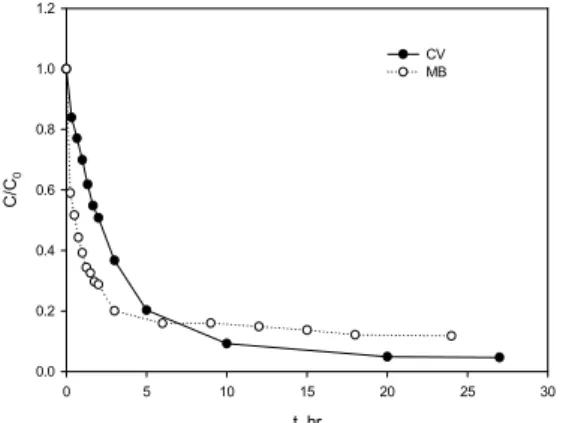
MB와 CV의 흡착특성을 알아보기 위해 두 염료의 초기농도가 각각 250 mg/L 및 400 mg/L인 용액 300 mL에 활성탄을 각각 0.15 g 및 0.3 g씩 넣고 교반하면 서 일정시간 간격으로 시료를 채취하여 농도를 분석 한 결과를 Fig. 3에 나타내었다. 그림에서 보듯이 MB 와 CV의 제거속도는 약 3∼5 hr까지 매우 빠르게 일 어났으며, 이후에는 서서히 감소하다가 20 hr 이후에 는 거의 평형에 도달하였다. 이러한 결과는 흡착 초기 에는 활성탄 표면에 이용 가능한 활성점이 풍부하기 때문에 급격한 농도 변화를 보이다가 흡착이 진행됨 에 따라 활성점이 줄어들기 때문에 흡착속도가 서서 히 느려지기 때문인 것으로 생각된다(Lee 등, 2012).
t, hr
0 5 10 15 20 25 30
C/ C
00.0 0.2 0.4 0.6 0.8 1.0 1.2
CV MB
Fig. 3. The effect of contact time on the adsorption of MB
and CV (activated carbon = 0.15 g(MB) and 0.3
g(CV), solution volume = 300 mL, agitation = 250
rpm, temperature = 24 o C, pH = 6).
t, hr
0 5 10 15 20 25 30
ln(qe-qt)
0 1 2 3 4 5 6
CV MB
(a) Pseudo-first-order
t, hr
0 5 10 15 20 25 30
t/qt
0.00 0.02 0.04 0.06 0.08
CV MB
(b) Pseudo-second-order
t1/2, hr1/2
0 1 2 3 4 5 6
qt, mg/g
0 100 200 300 400 500
CV MB
(c) Intraparticle diffusion Fig. 4. (a) Pseudo-first-order, (b) pseudo-second-order kinetics, and (c) intraparticle diffusion for the adsorption of MB and CV.
3.3. 흡착 속도 모델식
흡착속도를 검토하기 위하여 유사 1차 속도식, 유 사 2차 속도식, 그리고 내부입자 확산 모델식을 사용 하였다.
(a) 유사 1차 속도식
유사 1차 속도식은 다음과 같다(Ho와 Mckay, 1999).
(2) 여기서 k1
은 유사 1차 속도상수(l/min), qt
는 시간 t 에서의 흡착량(mg/g), qe
는 평형에서의 흡착량(mg/g) 이다.식 (2)를 적분하면 다음과 같이 된다.
ln ln
(3) (b) 유사 2차 속도식유사 2차 속도식은 다음과 같다(Ho와 Mckay, 1999).
(4) 여기서 k2
는 유사 2차 속도상수(g/mg min)이다.식 (4)를 적분하면 다음과 같이 된다.
(5)(c) 내부 입자 확산 모델식
Weber와 Morriss(1963)가 제안한 내부 입자 확산 모델식은 다음과 같다.
(6) 여기서 kd
는 입자내부 확산 속도상수(mg/g h0.5
)이 고, c는 경계층의 두께를 나타낸다.Fig. 3의 실험 자료를 식 (3), 식 (5) 그리고 식 (6)에 적용한 결과를 Fig. 4에 나타내었으며, 이로부터 구한 파라미터 값들을 Table 1에 나타내었다. 활성탄에 의 한 MB와 CV의 흡착 자료를 유사 1차 속도식에 적용 한 경우에는 결정계수(r
2
) 값이 각각 0.839 및 0.960이 었으며, 유사 2차 속도식에 적용한 경우는 각각 0.999 및 0.998이었다. 따라서 흡착공정은 유사 2차 속도식 을 더 만족하는 것으로 나타났으며, El-Sayed(2011) 도 야자껍질을 이용한 MB와 CV의 흡착 연구에서 유 사 2차 속도식에 잘 맞았다고 하였다.Fig. 4(c)는 식 (6)의 내부입자확산 모델식에 적용 한 것으로, 자료들이 선형관계를 보이지 않을 뿐만 아 니라 원점을 지나지 않는 것으로 나타났다. 이러한 결 과는 MB와 CV가 활성탄에 흡착되는 과정이 외부물 질전달과 내부입자 확산으로 복합적인 메커니즘으로 일어난다는 것을 말해준다(Lee 등, 2012). 따라서 그 림에서 흡착 초기 영역(t
1/2
<1.7의 직선 영역)에서는 물질 전달이 일어나며, 이 후의 직선영역(t1/2
>1.7의 직 선 영역)에서는 내부입자확산에 의한 흡착 공정이 일 어나는 것을 나타낸다. 식 (6)의 기울기로부터 구한 MB와 CV의 내부입자 확산속도상수는 각각 53.56 mg/g hr0.5
및 52.17 mg/g hr0.5
이었다.Table 1. Comparison of kinetic parameters for the adsorption of MB and CV
Adsorbate
Pseudo-first-order Pseudo-second-order Intraparticle diffusion k
1(l/min)
q
e(mg/g) r
2k
2×10
-3(g/mg·min)
q
e(mg/g) r
2k
d(mg/g h
0.5) r
2MB 0.227 131.6 0.839 7.63 405.2 0.999 53.56 0.786
CV 0.186 259.2 0.950 1.22 398.6 0.998 72.35 0.845
3.4. 흡착 등온식
등온 흡착실험 결과를 Langmuir 등온식, Freundlich 등온식, 그리고 Dubinin-Radushkevich(D-R) 등온식 에 적용하여 검토하였다.
(a) Langmuir 흡착 등온식은 다음과 같다.
(7)
식 (7)을 직선식으로 나타내면 다음과 같이 된다.
(8)여기서 q
m
은 최대 흡착량(mg/g), kL
는 Langmuir 상 수, Ce
는 평형 흡착농도(mg/L), qe
는 평형 흡착량 (mg/g)이다.(b) Freundlich 흡착 등온식은 다음과 같다.
(9) 식 (9)를 직선식으로 나타내면 다음과 같이 된다.
ln ln
(10)여기서 k
F
와 n은 Freundlich 상수이다.(c) Dubinin-Radushkevich(D-R) 흡착 등온식은 다 음과 같다(Seki와 Yurdakoc, 2009).
ln ln
(11)여기서 q
e
는 평형 흡착량(mg/g), qm
은 최대 흡착량 (mol/g), β는 흡착 에너지상수(mol2
/kJ2
)이다.그리고 ε은 Polanyi potential이며 다음과 같이 계산 된다.
ln
(12) 여기서 R은 이상기체상수(kJ/mol K), T는 절대온 도(K)이다. 또한 E는 평균 흡착 에너지(kJ/mol)로써 다음과 같이 계산된다.
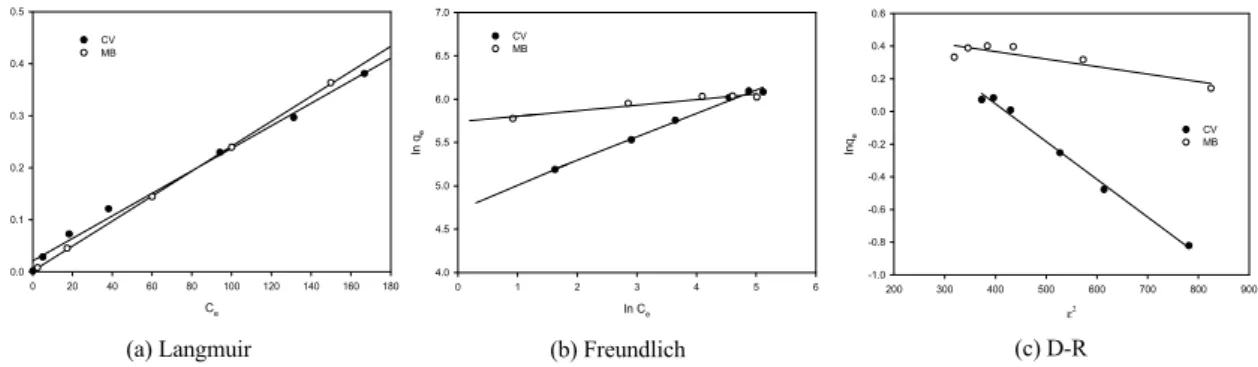
(13)Fig. 5는 평형흡착 실험으로부터 얻은 자료를 식 (8), 식 (10) 및 식 (11)에 적용한 결과를 나타낸 것이 며, 이로부터 구한 파라미터 값들을 Table 2에 나타내 었다. 그리고 Table 3은 MB와 CV의 흡착 연구를 수 행한 타 연구자들의 결과를 비교하여 나타낸 것이다.
Table 2에서 보듯이 MB와 CV의 흡착공정은 본 연구 의 실험범위 내에서는 Langmuir 등온식과 Freundlich 등온식 둘 다에 잘 만족하였으며, Langmuir식으로부 터 얻어진 MB와 CV의 최대 흡착량은 각각 416.7 mg/g 및 462.4 mg/g이었다. Table 3에 주어진 타 연구 자들의 결과를 보면, Yang과 Qiu(2010)은 호두껍질 을 활성화시켜 만든 활성탄을 흡착제로 사용한 경우 에 최대 흡착량이 355.5 mg/g이고, Hameed(2007)의 연구에서 등나무톱밥을 활성화시켜 만든 활성탄의 경 우에는 최대 흡착량이 294.1 mg/g이었다고 하였다.
또한 Senthikumaar 등(2006)은 코코넛 나무를 활성화 시켜 흡착제로 사용한 경우에 CV의 최대 흡착량은 85.8 mg/g이었다고 하였다. 그리고 El-sayed(2011)은 야자껍질을 활성화시켜 만든 활성탄을 흡착제로 사용 한 경우에 MB와 CV의 최대 흡착량은 각각 95.4 m/g 및 78.9 mg/g, Basar(2006)은 폐살구를 활성화시켜 흡 착제로 사용한 경우에 MB와 CV의 최대 흡착량은 각 각 102.0 mg/g 및 57.8 mg/g이었다고 하였다. 본 연구 에서 흡착제로 사용한 활성탄의 경우에 MB와 CV의
Adsorbate Adsorbent Q
max(mg/g) Reference
MB Activated carbon (walnut shell) 355.5 Yang and Qiu (2010)
Activated carbon (rattan sawdust) 294.1 Hameed et al. (2007)
Activated carbon (waste apricot) 102.0 Basar (2006)
Palm kernel fiber 95.4 El-Sayed (2011)
Activated carbon (sunflower oil cake) 16.4 Karagӧz et al. (2008)
Activated carbon 416.7 This study
CV Sulphuric acid activated carbon (male flowers coconut tree) 85.8 Senthilkumaar et al. (2006)
Palm kernel fiber 78.9 El-Sayed (2011)
Activated carbon (waste apricot) 57.8 Basar (2006)
Phosphoric acid activated carbon (male flowers coconut tree) 60.4 Senthilkumaar et al .(2006) Sulphuric acid activated carbon (rice husk) 11.2 Mohanty et al. (2006) Zinc Chloride activated carbon (rice husk) 3.8 Mohanty et al. (2006)
Activated carbon 462.4 This study
Table 3. Comparison of the maximum adsorption capacities of MB and CV with the other studies Adsorbate
Langmuir Freundlich D-R
Q
max(mg/g) k
L(l/g) r
2n k
F(mg/g)(l/mg)
1/nr
2ln q
m(mol/g) E
(kJ/mol) r
2MB 416.7 1.40 0.999 310.8 15.62 0.925 -6.639 33.52 0.798
CV 462.4 0.10 0.992 116.3 3.71 0.992 -5.935 14.70 0.994
Table 2. Langmuir, Freundlich, and D-R isotherm constants for the adsorption of MB and CV
Ce
0 20 40 60 80 100 120 140 160 180
Ce/qe
0.0 0.1 0.2 0.3 0.4 0.5
CV MB
(a) Langmuir
ln Ce
0 1 2 3 4 5 6
ln qe
4.0 4.5 5.0 5.5 6.0 6.5 7.0
CV MB
(b) Freundlich
ε2
200 300 400 500 600 700 800 900
lnqe
-1.0 -0.8 -0.6 -0.4 -0.2 0.0 0.2 0.4 0.6
CV MB
(c) D-R
Fig. 5. The linearized (a) Langmuir, (b) Freundlich, and (c) D-R adsorption isotherms for the adsorption of MB and CV (activated carbon = 0.05 g(MB), 0.1 g(CV), solution volume = 100 mL, agitation = 250 rpm, temperature = 24 o C, pH = 6).
최대 흡착량은 이들의 결과보다 더 높은 흡착량을 보 였다.
D-R 등온식에서 얻은 평균 흡착 에너지값은 활성 탄에 의한 MB와 CV의 흡착현상이 물리적인지 또는 화학적인지를 말해주며, 일반적으로 흡착 에너지값이 1~8 kJ/mol이면 물리흡착, 20~40 kJ/mol의 경우 화
학흡착으로 알려져 있다(Anirudhan와 Suchithra, 2010). Table 3에서 보듯이 MB의 흡착 에너지값은 33.52 kJ/mol, CV는 14.70 kJ/mol로 얻어졌다. 따라 서 활성탄에 의한 MB와 CV의 흡착공정은 화학흡착 의 영향이 더 큰 것으로 생각된다.
Adsorbate ∆ H
o(kJ/mol) ∆ S
o(J/mol ․ K) ∆ G
o(kJ/mol)
298.15K 313.15K 328.15K
MB 18.1 105.7 -31.5 -33.1 -34.7
CV 28.8 129.2 -38.5 -40.4 -42.3
Table 4. Thermodynamic parameters for the removal of MB and CV by activated carbon
Ce, mg/L
0 50 100 150 200
qe, mg/g
0 100 200 300 400 500 600
298.15 K 313.15 K 328.15 K
(a) MB
Ce, mg/L
0 50 100 150 200
qe, mg/g
0 100 200 300 400 500 600
298.15 K 313.15 K 328.15 K
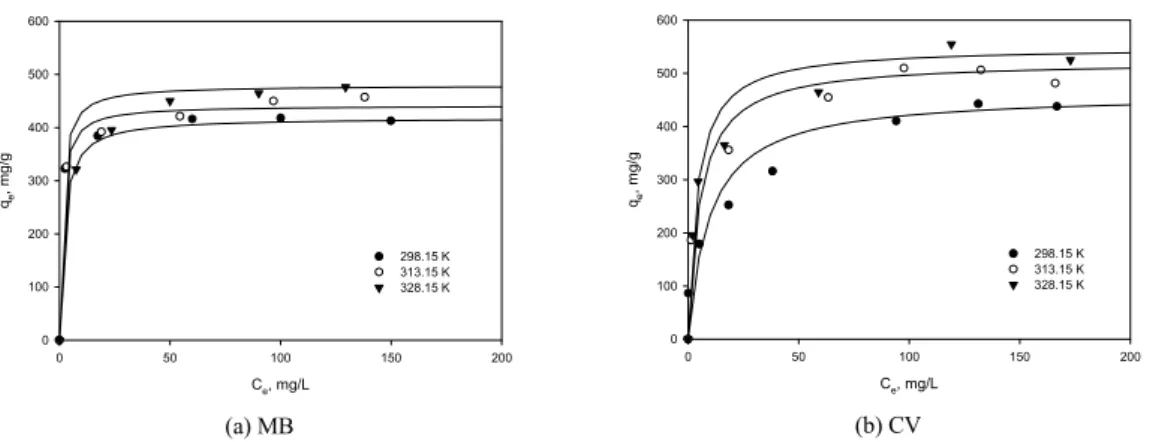
(b) CV Fig. 6. Adsorption isotherm of (a) MB and (b) CV at different temperatures.
3.5. 열역학적 해석
일반적으로 열역학적 파라미터인 Gibbs 자유에너 지(△G
o
), 엔탈피(△Ho
) 그리고 엔트로피(△So
)는 다 음과 같은 관계를 갖는다(Lee 등, 2012).∆
∆
∆
ln
(14) 여기서 KL
은 Langmuir 식의 최대 흡착량(qm
)과 Langmuir 상수(kL
)의 곱(qm
kL
)으로 표현된다. R은 이 상기체 상수(J/mol·K), T는 절대 온도(K)이다.평형상수 K
L
은 온도의 영향을 받으며, 다음과 같은 Van't Hoff 방정식으로 나타낼 수 있다.ln
∆
∆
(15) Fig. 6은 온도 변화에 따른 영향을 알아보기 위하여 초기 용액의 온도를 298.15 K, 313.15 K, 328.15 K로 달리하여 평형흡착 실험을 수행한 결과를 나타낸 것 이며, Fig. 7은 식 (15)에 의거하여 1/T에 대해 lnK
L
를 도시한 것이다. 그림의 기울기와 y절편으로부터 구한△H
o
와 △So
값과 식 (14)로부터 구한 △Go
값을 Table 4에 나타내었다. MB와 CV의 열역학적 파라미터 값들을 살펴보면 △H
o
가 각각 18.1과 28.8 kJ/mol로 양 의 값을 가지므로 활성탄에 의한 MB와 CV의 흡착 공 정이 흡열반응임을 나타내며, △Go
는 각각 -34.7∼-31.5 kJ/mol과 -42.3∼-38.5 kJ/mol로 음의 값을 갖는 것은 흡착공정이 자발적이라는 것을 말해준다. 또한
△S
o
가 각각 105.7과 129.2 J/mol·K로 양의 값을 가지 는 것을 보아 활성탄에 대한 두 염기성 염료들의 친화 도가 좋은 것으로 사료된다(Senthilkumaar 등, 2006).1/T, K-1
0.0030 0.0031 0.0032 0.0033 0.0034
ln KL
3.5 4.0 4.5 5.0 5.5 6.0 6.5
CV MB
Fig. 7. Application of van't Hoff equation.
4. 결 론
상용되고 있는 목질계 활성탄을 흡착제로 사용하 여 수중의 MB와 CV을 제거하는 회분식 흡착실험을 수행하였다. 활성탄에 의한 두 염료의 흡착은 약 3∼5 hr내에서는 매우 빠르게 일어났으며, 20 hr 이후에는 평형에 도달하였고, 흡착 속도는 유사 2차 모델식에 잘 맞는 것으로 나타났다. 흡착과정은 초기에 외부물 질전달이 일어나며, 이 후에 내부입자확산에 의한 단 계가 진행되는 것으로 나타났다. MB와 CV의 내부입 자확산속도 상수값은 각각 53.56 mg/g hr
0.5
및 52.17 mg/g hr0.5
으로 구해졌다. MB와 CV의 최대 흡착량은 각각 416.7 mg/g 및 462.4 mg/g이었으며, 타 연구에 서 사용한 흡착제에 비해 높은 것으로 나타났다. 또한 MB와 CV의 흡착에서 △Ho
는 각각 18.1 kJ/mol 및 28.8 kJ/mol이고, △Go
는 각각 -34.7∼-31.5 kJ/mol 및 -42.3∼-38.5 kJ/mol의 값을 가져 두 염료가 활성탄에 흡착하는 과정이 흡열반응이고, 자발적으로 일어나는 반응임을 알 수 있었다.참 고 문 헌