전통 콩발효 식품 유래 7, 8, 4'-Trihydroxyisoflavone의 피부 생리활성 연구
박 준 성†⋅김 동 현⋅심 진 섭⋅김 지 성⋅최 권 영*⋅김 병 기*⋅김 덕 희⋅김 한 곤
(주)아모레퍼시픽 기술연구원 피부과학연구소, *서울대학교 화학생물공학부 (2010년 9월 10일 접수, 2010년 9월 24일 수정, 2010년 9월 25일 채택)
7, 8, 4'-Trihydroxyisoflavone from Fermented Soybean Food and Its Biological Activity
Jun Seong Park†, Dong Hyun Kim, Jin-Sup Shim, Ji Seong Kim, Kwon-Young Choi*, Byung-Gee Kim*, Duck Hee Kim, and Han Kon Kim
Amorepacific Corporation R&D Center, 314-1, Bora-dong, Giheung-gu, Yongin-si, Gyeonggi-do 446-729, Korea
*School of Chemical and Biological Engineering, Seoul National University
(Received September 10, 2010; Revised September 24, 2010; Accepted September 25, 2010)
요 약: 10년 이상 자연 발효된 콩 발효 식품에서 희귀 이소플라본 성분인 7, 8, 4'-trihydroxyisoflavone을 분리하였고, 분리된 성분의 항산화 효과를 비효소적인 방법으로는 DPPH 법을, 효소적인 방법으로는 xanthine oxidase법을 이용하 여 확인하였다. 그 결과 7, 8, 4'-trihydroxyisoflavone는 농도 의존적으로 비타민 C와 유사한 DPPH 라디칼 소거 효능 을 가지고 있음을 보여주었고 6.6 ± 0.4 µM 농도에서 xanthine oxidase에서 생성된 superoxide 라디칼을 50 % 수준까 지 낮춤을 보여주었다. 또한, 이 희귀 이소플라본 성분은 UVB로 유도된 MMP-1의 생성을 초기 수준으로 억제하는 것으로 나타나 피부 노화 억제에 유용한 성분임을 확인할 수 있었다.
Abstract: A rare isoflavone, 7, 8, 4'-trihydroxyisoflavone, was isolated from a 10-year-old fermented soybean food.
7, 8, 4'-trihydroxyisoflavone was isolated for the first time from a Korean fermented soybean food. Evaluation tests of biological activity showed significantly inhibition activity for free radical scavenging on both non-enzymatic (DPPH system) and enzymatic method (xanthine oxidase system). DPPH radical scavenging effect of 7, 8, 4'-trihy- droxyisoflavone was similar with vitamin C in a dose-dependent manner. In xanthine oxidase (XO) system 7, 8, 4'-trihydroxyisoflavone showed superoxide radical inhibition activity of 50 % at a concentration of 6.6 ± 0.4 µM. Also, the compound significantly suppressed cellular MMP-1 formation. These results suggest that 7, 8, 4'-trihydroxyiso- flavone could be developed as a potential preventive or therapeutic agent against skin aging.
Keywords: 7, 8, 4'-trihydroxyisoflavone, fermented soybean, antioxidant, MMP-1, cosmetic
1. 서 론
1)
Skin aging generally results in a reduction in the amount of connective tissue and concomitant dis- organization of its structure. Extracellular matrix (ECM) macromolecules are important for creating cellular en- vironments required during development and morpho-
† 주 저자 (e-mail: [email protected])
genesis. Matrix metalloproteinases (MMPs) are neces- sary for tissue remodeling and healing cascade normal physiological condition. The expression of MMPs in UV-irradiated fibroblasts is known to be initiated by reactive oxygen species (ROS) and by activations of cell surface growth factors and cytokine receptors.
With age increase, collagen synthesis becomes lower
and MMP-1 levels become higher in sun-protected hu-
man skin in vivo. UV irradiation induces the synthesis
of MMP in human skin fibroblasts in vitro and MMP-mediated collagen destruction accounts, in large part, for the connective tissue damage that occurs in photoaging. A number of antioxidants that possess oxygen radical scavenging properties have been tested as potentially beneficial photoprotective agents from these extrinsic factors[1]. Recent research efforts on antioxidants have focused on flavonoids that show strong free radical scavenging effects and metal ion chelating properties. In addition to their antioxidant ac- tivity, flavonoids have been reported to inhibit various enzymes such as cyclooxygenase and lipoxygenase re- lated to inflammation[2]. Evidence for the presence of flavonoids in ancient remedies for burns and inflam- mation has been reported and these substances, which have been isolated, are presently used in commercial products. Thus, dietary flavonoids have attracted at- tention for potential beneficial effects on humans.
Fermented foods are important components of tradi- tional diets in some areas of the world. Fermented soy- bean food (FSF) is a unique fermented food in Korea.
It has been traditionally manufactured from soybeans which are fermented by diverse microorganisms includ- ing fungi and bacilli[3-7]. Epidemiological studies sug- gest that the consumption of FSF provides protection against cancers in humans. Also, a highly aged FSF showed greater biological activity[8]. Though free iso- flavones, such as daidzein, genistein and glycitein, that are produced during fermentation are generally known to be active compound in FSF, the effect of aging on biological activity of FSF is not clear[9]. Because the longer fermentation or aging time of FSF may be an important factor in its biological activity, we focused on the newly formed compounds in aged FSF to discover and determine new antioxidants.
2. Materials and Methods
2.1. Isolation and Identification of 7, 8, 4'-Trihydro- xyisoflavone from FSF
Ten-year-old FSF (100 g) was defatted three times with n-hexane (3 L) for 3 h. After removal of the sol- vent by filtration, it was re-extracted with 2 L of
MeOH in a soxhlet apparatus for approximately 6 h and was then filtered. Evaporation of the solvent under reduced pressure provided the FSF extract (23.2 g). It was subjected to medium-pressure liquid chromatog- raphy (MPLC) system (Yamazen Co., Japan) using a gradient elution system of distilled water (DW) and acetonitrile gradient with acetonitrile from 20 % to 80
% in 60 min at a flow rate of 30 mL/min. Ultra pack- ODS-S-50C column (Yamazen Co., Japan) was used.
The detector wavelength was set at 263 nm. Fifteen fractions with 30 mL fraction volume were collected.
The fractions were combined [fr. 1-4 (6.5 g), fr. 5 (0.11 g), fr. 6 and 7 (1.9 g), fr. 8 (0.31 g), and fr. 9 and 10-15 (3.24 g)] by monitoring HPLC again.
Because fraction no. five showed one peak in HPLC, and LC/MS and NMR analyses were conducted to de- termine its chemical structure.
7, 8, 4'-Trihydroxyisoflavone :
1H NMR (300 MHz, DMSO-d
6) δ 6.86 (d, J = 8.7 Hz, H-3'/5'), 7.09 (d, 8.5 Hz, H-6), 7.45 (d, J = 8.7 Hz, H-2'/6'), 7.46 (d, 8.7 Hz, H-5), 8.32 (s, H-2);
13C NMR (75 MHz, DMSO- d
6) δ 114.8 (C-6), 115.7 (C-3', 5'), 116.4 (C-5), 117.8 (C-10), 123.2 (C-3), 123.4 (C-1'), 130.5 (C-2', 6'), 133.4 (C-8), 147.2 (C-9), 150.5 (C-7), 153.1 (C-2), 157.1 (C-4'), 175.7 (C-4); LC/MS m/z 271.3 [M+H]
2.2. DPPH Radical Scavenging Assay
Reaction mixtures containing various concentrations of the test samples to be final concentration of 100, 250, 500, 750, 1,000, and 2,000 µM and 0.2 mM DPPH in methanol were incubated at room temperature for 30 min in the dark and their absorbances were measured at 517 nm (Jasco V-550 spectrophotometer.
2.3. Assay of Superoxide Anion Generated by Xanthine Oxidase
Superoxide anions were generated by the xanthine/
xanthine oxidase (XO) system, following the described
procedure. The reaction mixture consisted of xanthine
(0.5 mM), NBT (0.5 mM), and test samples at the
concentrations of 31, 63, 125, 250, and 500 µM, in a fi-
nal volume of 100 µL. Xanthine and NBT were dis-
solved in phosphate buffer 200 mM with 0.25 mM EDTA, pH 7.5. The reaction mixtures were preincu- bated at room temperature for 2 min, and their re- actions were initiated by the addition of 100 µL of XO (50 mU/mL). The mixtures (200 µL) were kept at 37
℃ for 30 min. To detect superoxide, a coloring reagent (final concentration of 300 µg/mL sulfanilic acid, 5 µg/
mL of N-(1-naphthyl)-ethylenediamine dihydrochlo- ride, and 16.7 % (v/v) acetic acid) was added after the incubation. The mixtures were allowed to stand at room temperature for 30 min, and their absorbance at 550 nm was measured (Ceres UV 900 Hdi).
2.4. Assay of Uric Acid Generated by Xanthine Oxidase The effect of compounds on xanthine oxidase activ- ity was evaluated by measuring the formation of uric acid from xanthine. The reaction mixtures contained the same proportion of components as in assay for su- peroxide anion, except NBT. The reaction mixture con- sisted of 0.5 mM xanthine dissolved in 200 mM phos- phate buffer with 0.25 mM EDTA, pH 7.5, and test samples at the concentrations of 31, 63, 125, 250, and 500 µM in a final volume of 100 µL. The reaction mix- tures were preincubated at room temperature for 2 min, and their reaction were initiated by the addition of 100 µL of XO (50 mU/mL). The mixtures (200 µL) were kept for 30 min at 37 ℃ and their reactions were stop- ped by the addition of HCl (20 µL, 5 M). The pro- duction of uric acid was determined spectrophotometri- cally at 295 nm (Ceres UV 900 Hdi).
2.5. MMP-1 Inhibition Assay
Human dermal fibroblasts were grown in monolayer culture using Dulbecco's modified essential medium (DMEM) supplemented with 10 % fetal bovine serum (FBS), 100 units/mL of penicillin, and 100 µg/mL of streptomycin. cells were seeded at 1 × 10 cells/well in a 6 well plate, grown for 24 h in FAD medium supple- mented with 10 % FBS, and the medium was replaced by FBS-free FAD medium, and cultured for another 24 h. Cells were then irradiated with 40 mJ/cm
2of UVB
O
O OH O
H
OH
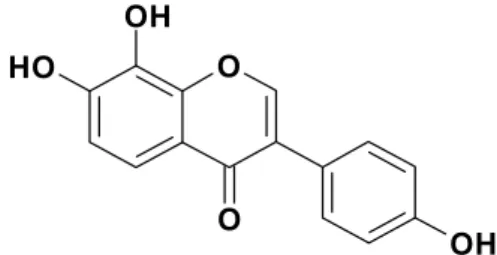
Figure 1. Structure of 7, 8, 4'-trihydroxyisoflavone isola- ted from 10-year-old fermented soybean paste (FSF).
and incubated with samples for 72 h before being sub- jected to MMP-1 analysis (R&D Systems Elisa, Mi- nneapolis, MN, USA).
3. Results and Discussion
3.1. Purification and Identification of 7, 8, 4'-Trihydro- xyisoflavone from FSF
To determine the structure of the isolated compound, LC/MS and NMR analyses were conducted. The com- pound was obtained as pale white amorphous powder.
The
1H NMR spectrum showed five kinds of aromatic protons [6.86 (d, J = 8.7 Hz, H-3'/5'), 7.09 (d, 8.5 Hz, H-6), 7.45 (d, J = 8.7 Hz, H-2'/6'), 7.46 (d, 8.7 Hz, H-5) and 8.32 (s, H-2)] indicating the 7, 8, 4'-trihy- droxyisoflavone skeleton, which was in good agreement with those published previously[10].
3.2. DPPH Radical Scavenging Effect of 7, 8, 4'-Trihy- droxyisoflavone
Most of the beneficial health effects of flavonoids are attributed to their antioxidant and chelating abilities.
The free radical scavenging activity of 7, 8, 4'-trihy-
droxyisoflavone was pared with that of vitamin C by
DPPH radical scavenging assay. The DPPH test is a
currently used non-enzymatic method to provide basic
information on the reactivity of compounds to scavenge
free radicals. Figure 2 shows the DPPH radical scav-
enging activity of compounds. Radical scavenging ef-
fect of 7, 8, 4'-trihydroxyisoflavone showed similar to
that of vitamin C in a dose-dependent manner.
Figure 2. DPPH radical scavenging effect of 7, 8, 4'- trihydroxyisoflavone.
3.3. Xanthine Oxidase Inhibition Activities of 7, 8, 4'- Trihydroxyisoflavone
Xanthine oxidase (XO) catalyzes the oxidation of xanthine to uric acid. During the oxidation of xanthine by XO, oxygen molecules act as electron acceptors, producing superoxide radicals and hydrogen peroxide.
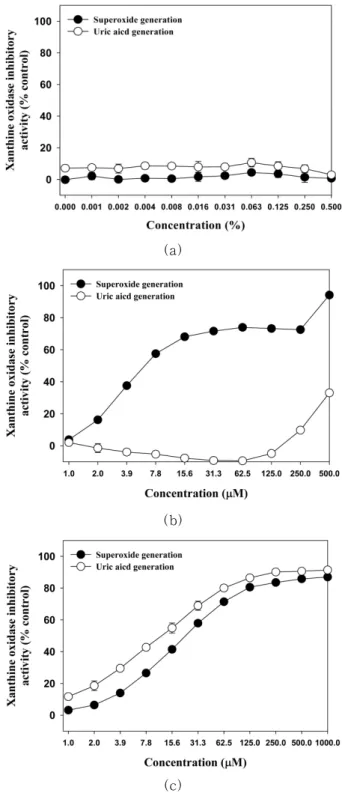
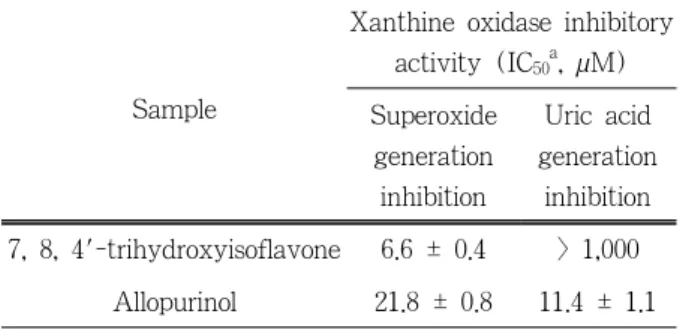
Consequently, XO reaction was considered to be an im- portant biological source of superoxide radicals. These are involved in many pathological processes such as in- flammation, cancer, and aging[11-13]. To compare an- ti-superoxide effect of 7, 8, 4'-trihydroxyisoflavone from 10-year-old FSF with what inhibition of XO and the scavenging effect on the superoxide anion were measured in one assay. For the comparison of inhibition effect of this compound the most well-studied xanthine oxidase inhibitor, allopurinol, was used as positive con- trol. Inhibition of XO resulted in the reduced production of uric acid, which was able to be measured spec- trophotometrically, and the reduced production of su- peroxide was measured by the nitrite method (Figure 3). Two IC
50values were calculated by linear regression analysis: 50 % inhibition of XO was calculated by 50
% decrease of uric acid production and 50 % reduction of the superoxide level. Each IC
50value of the com- pounds is listed in Table 1.
7, 8, 4'-trihydroxyisoflavone inhibited XO by 50 % at a concentration of 6.6 ± 0.4. It showed more activity than allopurinol and did not show inhibition of uric acid production as shown in Figure 3. It was concluded that 7, 8, 4'-trihydroxyisoflavone did not inhibit xanthine oxidase. Therefore, the effects measured on superoxide
(a)
(b)
(c)
Figure 3. Antioxidation effects of ortho-dihydroxyiso- flavones and isoflavones on xanthine/xanthine oxidase system. (a) DMSO, (b) 7, 8, 4'-trihydroxyisoflavone, (c) Allopurinol. Open circles indicate the uric acid generation activity and closed circles indicate the superoxide gen- eration activity.
Table 1. Xanthine Oxidase Inhibitory Activity of 7, 8, 4'- Trihydroxyisoflavone
Sample
Xanthine oxidase inhibitory activity (IC50a
, µM) Superoxide
generation inhibition
Uric acid generation
inhibition 7, 8, 4'-trihydroxyisoflavone 6.6 ± 0.4 > 1,000
Allopurinol 21.8 ± 0.8 11.4 ± 1.1
aFor each test, two IC50 values were calculated by linear re- gression analyse: 50 % inhibition of xanthine oxidase activity (50 % decrease in uric acid production and 50% decrease in su- peroxide level)
in the presence of 7, 8, 4'-trihydroxyisoflavone was considered as superoxide scavenging activities. 7, 8, 4'- trihydroxyisoflavone has an OH group in both 7 and 4' positions, indicating that the compound is a potential candidate for the inhibiting of superoxide reaction. The presence of OH group in 8 position makes them good candidates for superoxide reaction. This result suggests that 7, 8, 4'-trihydroxyisoflavone can be utilized for the development of new candidate of antioxidant.
3.4. Inhibitory Effect of 7, 8, 4'-Trihydroxyisoflavone on the Production of MMP-1 by Human Dermal Fibroblasts
We determined effects of 7, 8, 4'-trihydroxyiso- flavone on the production of MMP-1 by human dermal fibroblasts (HDFs) using an ELISA. Exposure of HDFs to UVB irradiation (40 mJ/cm
2) increased the level of MMP-1 in the culture medium after 48 h by two folds.
However, the enhancement of MMP-1 production in- duced by UVB irradiation was not completely inhibited by 10 µM of 7, 8, 4'-trihydroxyisoflavone (Figure 4).
The inhibition effect of 7, 8, 4'-trihydroxyisoflavone was quite similar with that of Retinoic acid (RA).
4. Conclusions
In the present study, we found that 7, 8, 4'-trihy- droxyisoflavone, is first isolated 10-year-old fermented soybean food, has significantly inhibition activity for
Figure 4. The effect of 7, 8, 4'- trihydroxyisoflavone on the production of MMP-1 by human dermal fibroblasts.