Received: 2012.10.30. Revised: 2013.2.1. Accepted: 2013.3.18.
Corresponding author: Nam Hyung Kim
Department of Animal Sciences, Chungbuk National University, 52 Naesudong-ro, Heungdeok-gu, Cheongju 361-763, Korea Tel: +82-43-261-2546 Fax: +82-43-272-8853
E-mail: [email protected]
*These authors contributed equally to this study.
Articles published in Obstet Gynecol Sci are open-access, distributed under the terms of the Creative Commons Attribution Non-Commercial License (http://creativecommons.
org/licenses/by-nc/3.0/) which permits unrestricted non-commercial use, distribution, and reproduction in any medium, provided the original work is properly cited.
Copyright © 2013 Korean Society of Obstetrics and Gynecology
Introduction
Since the first ice-free cryopreservation of mouse embryos by vitrification [1], many studies have helped to simplify and shorten the cryopreservation procedure. The vitrification of human embryos has been extensively tested and is now a routine technique in assisted reproduction laboratories [2].
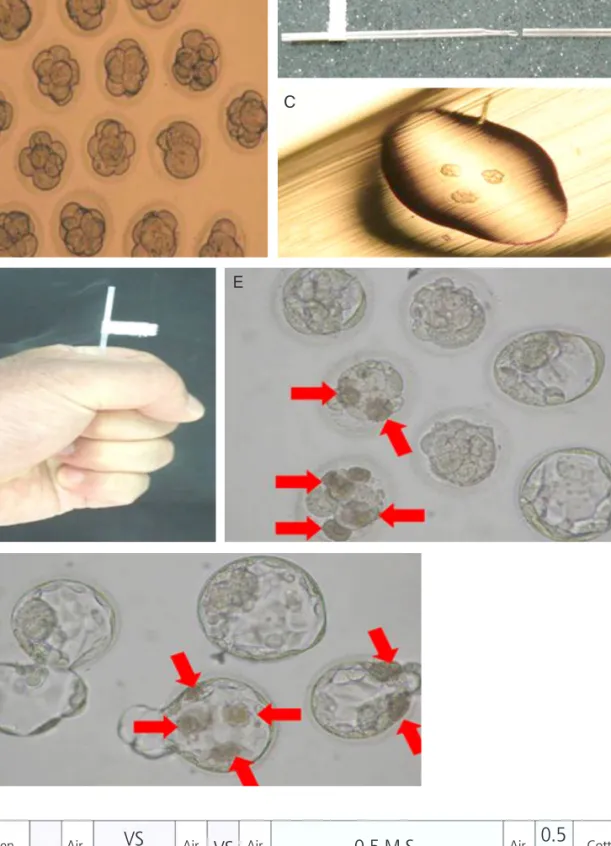
Among the variety of procedures used to cryopreserve em- bryos, a hand-made container called a pull and cut straw (PNC) has recently been reported [3]. Studies indicate that PNC is useful for the vitrification of human blastocysts and cleavage- stage embryos. The technique also has the benefits of simplic- ity, cost-efficiency and rapid cooling [4].
It is well known that damage caused by freezing is an im- portant factor influencing the quality of embryos. Such dam-
age induces zona hardening, delays embryo development and perturbs zona pellucida morphology, reducing the ability of
Clinical outcomes of vitrified-thawed embryo transfer using a pull and cut straw method
Joon Gyo Lim 1,2* , Young Tae Heo 1* , Seung Gi Min 3 , Byeong Yeol Min 2 , Sang Jun Uhm 4 , Nam Hyung Kim 1
1