ISSN: 2233-601X (Print) ISSN: 2093-6516 (Online)
Department of Thoracic and Cardiovascular Surgery, Catholic University of Daegu School of Medicine
Received: July 6, 2015, Revised: September 2, 2015, Accepted: September 14, 2015, Published online: February 5, 2016
Corresponding author: Chi-Hoon Bae, Department of Thoracic and Cardiovascular Surgery, Catholic University of Daegu School of Medicine, 33 Duryugongwon-ro 17-gil, Nam-gu, Daegu 42472, Korea
(Tel) 82-53-650-3420 (Fax) 82-53-629-6963 (E-mail) [email protected]
C
The Korean Society for Thoracic and Cardiovascular Surgery. 2016. All right reserved.
CC
This is an open access article distributed under the terms of the Creative Commons Attribution Non-Commercial License (http://creative- commons.org/licenses/by-nc/4.0) which permits unrestricted non-commercial use, distribution, and reproduction in any medium, provided the original work is properly cited.
The Risk Factors and Outcomes of Acute Kidney Injury after Thoracic Endovascular Aortic Repair
Yun-Ho Jeon, M.D., Chi-Hoon Bae, M.D.
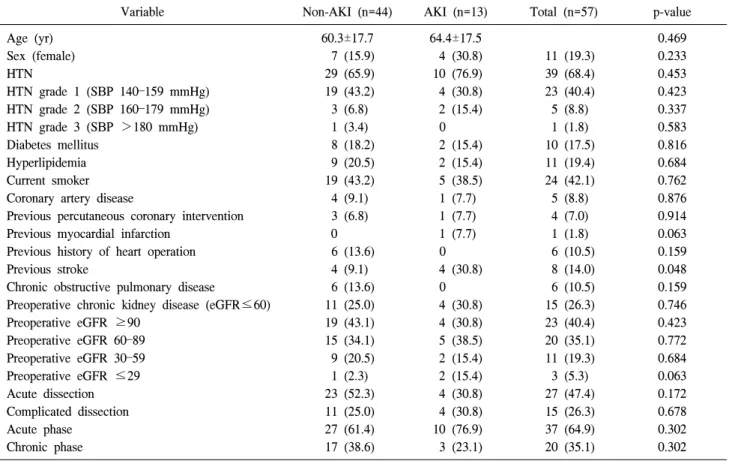
Background: We aimed to evaluate the incidence, predictive factors, and impact of acute kidney injury (AKI) after thoracic endovascular aortic repair (TEVAR). Methods: A total of 53 patients who underwent 57 TEVAR operations between 2008 and 2015 were reviewed for the incidence of AKI as defined by the RIFLE (risk, injury, failure, loss, and end-stage kidney disease risk) consensus criteria. The estimated glomerular filtration rate was determined in the perioperative period. Comorbidities and postoperative outcomes were retrospectively reviewed. Results: Under- lying aortic pathologies included 21 degenerative aortic aneurysms, 20 blunt traumatic aortic injuries, six type B aortic dissections, five type B intramural hematomas, three endoleaks and two miscellaneous diseases. The mean age of the patients was 61.2±17.5 years (range, 15 to 85 years). AKI was identified in 13 (22.8%) of 57 patients.
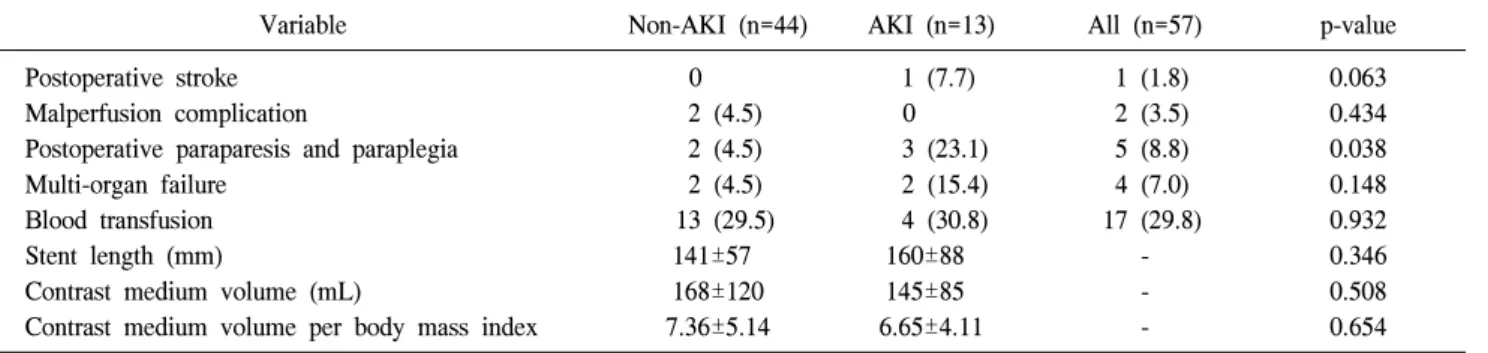
There was an association of preoperative stroke and postoperative paraparesis and paraplegia with AKI. The aver- age intensive care unit (ICU) stay in patients with AKI was significantly longer than in patients without AKI (5.3 vs.
12.7 days, p=0.017). The 30-day mortality rate in patients with AKI was significantly higher than patients without AKI (23.1% vs. 4.5%, p=0.038); however, AKI did not impact long-term survival. Conclusion: Preoperative stroke and postoperative paraparesis and paraplegia were identified as predictors for AKI. Patients with AKI experienced longer average ICU stays and greater 30-day mortality than those without AKI. Perioperative identification of high- risk patients, as well as nephroprotective strategies to reduce the incidence of AKI, should be considered as im- portant aspects of a successful TEVAR procedure.
Key words: 1. Thoracic endovascular aortic repair 2. Acute kidney injury
3. RIFLE
INTRODUCTION
Thoracic endovascular aortic repair (TEVAR) has emerged as an alternative to conventional open surgery for treatment of various thoracic aortic diseases such as degenerative aortic aneurysm, type B aortic dissection, and type B intramural hematoma. The suggested advantages of TEVAR include shorter operative time, reduced duration of general anesthesia, shorter
hospital stay, less blood loss, and avoidance of cardiopulmo-
nary bypass, aortic cross clamping, invasive thoracotomy, tho-
racoabdominal incision, and hypothermic arrest [1-3]. The in-
cidence of acute kidney injury (AKI) after TEVAR has been
reported to be 1% to 34% [4]. This relatively common com-
plication of TEVAR is associated with prolonged hospital
stays and increased risk of mortality [5-7]. The goal of this
clinical research was to investigate the risk factors and impact
http://dx.doi.org/10.5090/kjtcs.2016.49.1.15
Table 1. Underlying pathology in patients undergoing thoracic en- dovascular aortic repair (N=57)
Aortic pathology Value
Aortic aneurysm 21 (36.8)
Traumatic aortic injury 20 (35.1) Type B aortic dissection 6 (10.5)
Intramural hematoma 5 (8.8)
Endoleak 3 (5.3)
Miscellaneous 2 (3.5)
Values are presented as number (%).
Table 2. Aortic aneurysm classification according to location (N=21)
Aneurysm location Value
Aortic arch 8 (38.1)
Proximal descending aorta 2 (9.5) Descending thoracic aorta 11 (52.4)
Thoracoabdominal aorta 0
Values are presented as number (%).
Table 3. RIFLE
a)criteria for the classification of acute kidney injury
Class GFR criteria
Risk Plasma creatinine increase 1.5×from baseline or GFR decline >25%
Injury Plasma creatinine increase 2×from baseline or GFR decline >50%
Failure Plasma creatinine increase 3×from baseline or GFR decline >75% or acute plasma creatinine >4 mg/dL Loss Persistent acute renal failure=complete loss of kidney function requiring dialysis for >4 weeks but <3 months End-stage End-stage kidney disease requiring dialysis for >3 months
GFR, glomerular filtration rate.
a)