792 http://dx.doi.org/10.9713/kcer.2016.54.6.792
PISSN 0304-128X, EISSN 2233-9558
Synthesis of Monodisperse Silica Particles using Rotating Cylinder Systems
Young-Sang Cho† and Cheol Hwan Shin
Department of Chemical Engineering and Biotechnology, Korea Polytechnic University, 237, Sangidaehak-ro, Siheung, Gyeonggi, 15073, Korea (Received 7 July 2016; Received in revised form 20 August 2016; accepted 22 August 2016)
Abstract − Monodisperse silica nanospheres were synthesized by Stober method using rotating cylinder systems with batch or continuous manner. The particle size could be controlled by adjusting the reactant compositions such as the amount of monomer, catalyst, and water in the reaction mixture. The size and monodispersity of the ceramic particles could be controlled by changing the reaction medium with different alcohols other than ethanol or changing the reaction temperature. The effect of Taylor number (Ta) on the average diameter and standard deviation of silica particles were also studied by adjusting the rotation speed of inner cylinder, and the maximum diameter of particles was observed at Ta
≈ 3,000.
Key words: Monodisperse Particles, Stober Method, Rotating Cylinder
1. Introduction
Over the past decades, the synthesis routes of monodispersed ceramic particles have been developed for the applications of particle assem- bly such as superhydrophobic surfaces, templates for porous materi- als, and colloidal crystals [1-3]. For the synthesis of such particles, most researches involve bottom-up reactions using simple mechanical mixing during the reaction in batch-type reactor. However, incom- plete mixing inside such conventional reactors may induce ‘dead zones’, which may cause inhomogeneous conversion, finally resulting in the increase of polydispersity in particulate products. Thus, it is necessary to develop a novel fabrication technique to avoid such problems for the synthesis of extremely monodisperse particles.
After the pioneering researches by Taylor on the instability of fluid flow, rotating streams have been studied intensively since effective mixing can be expected from the vortex generated by Taylor flow compared to simple mechanical stirring [4]. Using a Taylor vortex reac- tor, significant progres has been made in various applications such as mesoporous materials, food industries, and crystallization technologies [5-7]. Besides these functional materials, monodispersed ceramic particles were synthesized by Ogihara et al. using the Couette-Vor- tex flow reactor [8-10]. Although these researches are challenging for industrial production, robust recipes for the particle synthesis are still necessary to prepare ceramic beads with much wider controlla- ble range of particle diameter using rotating cylinder system.
We studied Stober reactions for the synthesis of silica nano- spheres and controlled the diameter of the particles by adjusting the reaction parameters such as the amount of monomer and catalyst.
Sol-gel reaction was carried out by varying the reaction temperature from 20 to 60oC using batch type rotating cylinder system. Mono- disperse silica nanospheres were also fabricated using continuous operation of the rotating cylinder system for potential applications in industry production.
2. Experimental
2-1. Materials
For the synthesis of silica particles, TEOS (tetraethylorthosilicate, 99%, Aldrich) and ammonium hydroxide (NH4OH) were used as silica precursor and catalyst, respectively, for hydrolysis reaction. Methanol, ethanol, isopropyl alcohol, or butanol was used as reaction medium for the particle synthesis.
2-2. Synthesis of silica nanospheres
Stober reaction was performed to synthesize monodisperse silica nanospheres with narrow size distribution, as suggested by several researchers for modification method [11]. The experimental appara- tus is composed of two concentric cylinders, and the annular region is used as the space for the reaction. While the outer cylinder is sta- tionary, the inner cylinder can be rotated with adjustable speed. For batch reactions, the reactants were fed to the reactor. First, ethanol as reaction medium containing NH4OH and H2O was poured into batch- type reactor. Then, diluted TEOS with ethanol (the volume ratio of TEOS:ethanol = 1:4) was added to the reactor during the rotation of inner cylinder. The detailed synthesis conditions can be found from Table 2. The reaction was continued for two hours, and the products were washed by centrifugation and redispersion of the sedimented particles in fresh ethanol by sonication.
For continuous synthesis of silica nanospheres, syringe pumps were used to feed the TEOS diluted with ethanol and ethanol contain- ing water and ammonia to the rotating cylinder system with constant
†To whom correspondence should be addressed.
E-mail: [email protected]
This is an Open-Access article distributed under the terms of the Creative Com- mons Attribution Non-Commercial License (http://creativecommons.org/licenses/by- nc/3.0) which permits unrestricted non-commercial use, distribution, and reproduc- tion in any medium, provided the original work is properly cited.
speed. While the inner cylinder rotates, the reactants are fed to the bottom of the reactor, and the products are collected from the top of the reactor. The samples were collected on cover glass with regular time intervals.
2-3. The measurement of particle size and standard deviation The diameter and standard deviation of silica particles were esti- mated by measuring the size of several particles from SEM images.
Dynamic light scattering was also performed for the diluted silica suspension to measure the size and distribution of the particles.
2-4. Instruments for characterizations
The morphology of the silica particles was observed by using field emission scanning electron microscope (FE-SEM, Hitachi-S4700).
The particle suspension was deposited on glass substrate by drying at room temperature. Then, sputter coating was performed for SEM observation. The particle size distribution was obtained by measuring the diameter of several particles from SEM image. Alternatively, dynamic light scattering was applied to measure the size distribution of the sil- ica suspension.
3. Results and Discussion
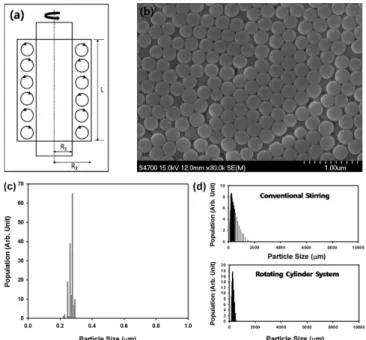
Fig. 1(a) contains a schematic of the rotating cylinder system for the synthesis of silica nanospheres with narrow size distribution. During the rotation of the inner cylinder, the reactants are effectively mixed due to the formation of a Taylor vortex in the annular region of the reactor. The number of vortices inside the reactor can be affected by the height of the cylinder, L, and the size of a vortex depends on the gap distance (d = R2 – R1) of the reactor. Taylor vortex can be formed in a certain range of Taylor number, which can be defined as the fol- lowing dimensionless group [8]:
(1)
The critical value of Taylor number for the generation of Taylor vortex was reported as 41.3, which can be achieved by the rotating cylinder system used in this study [8]. The dimensional values such as R1, R2, and L are listed in Table 1. The notations in Equation (1) such as ω (rad/sec) and ν (m2/sec) represent angular velocity and kinematic viscosity of the liquid.
Fig. 1(b) contains the scanning electron microscope image of mono-
disperse silica nanospheres synthesized using a rotating cylinder sys- tem. The rotating speed of the inner cylinder was fixed at 505 rpm, and the sol-gel reaction was performed at room temperature. As con- tained in the SEM image, spherical silica nanospheres with about 281.2 nm in diameter were successfully synthesized with narrow size distribution. The detailed synthesis conditions are summarized in Table 2 as a reference sample in this article. For particle synthesis, 9.27 ml of solution #1 in Table 2 was first loaded to Taylor vortex reactor and the mixing was performed for 20 minutes. Then, 3.229 ml of solution #2 in Table 2 was added to the reactor for the formation of particles by Stober process. Fig. 1(c) contains the size distribution of the silica nanospheres obtained by measuring the diameter of several particles from the SEM image of Fig. 1(b). The particle monodisper- sity can be confirmed from the standard deviation of the particles, which was measured as 0.01442 μm.
In this study, silica nanospheres were synthesized using conven- tional stirrer under the same reaction conditions shown in Table 2.
Fig. 1(d) contains the size distribution of the silica nanospheres mea- sured by light scattering method. The results were obtained for the samples prepared using conventional stirrer and rotating cylinder sys- tem to compare the effect of mixing apparatus. As contained in the
Ta d
R1 ---
⎝ ⎠⎛ ⎞0.5ωR1d ---ν
=
Fig. 1. (a) Schematic figure of rotating cylinder system (side view) and (b) Scanning electron microscope image of monodisperse sil- ica nanospheres synthesized using rotating cylinder system.
The rotation speed of inner cylinder was fixed as 505 rpm. Scale bar indicates 1 µm. (c) Size distribution of the silica nanospheres obtained from the electron microscope image. (d) Particle size distribution of the silica nanospheres synthesized using con- ventional stirrer and rotating cylinder system.
Table 1. The Geometries of Rotating Cylinder System for the Synthesis of Silica Nanospheres
L R1 R2
45 mm 25 mm 33 mm
Table 2. The Synthesis Conditions of Monodisperse Silica Nanospheres Shown in Fig. 1
#1 #2 Reaction Conditions
NH4OH H2O EtOH TEOS EtOH Temperature RPM
1 ml 2.25 ml 19 ml 1.749 ml 6 ml 20 °C 505
graphs, the size distribution of the particle suspension synthesized using rotating cylinder system is very narrow compared to that of the sample fabricated using a conventional stirrer, indicating that the rotating cylinder system is efficient means for the synthesis of mono- disperse silica suspension.
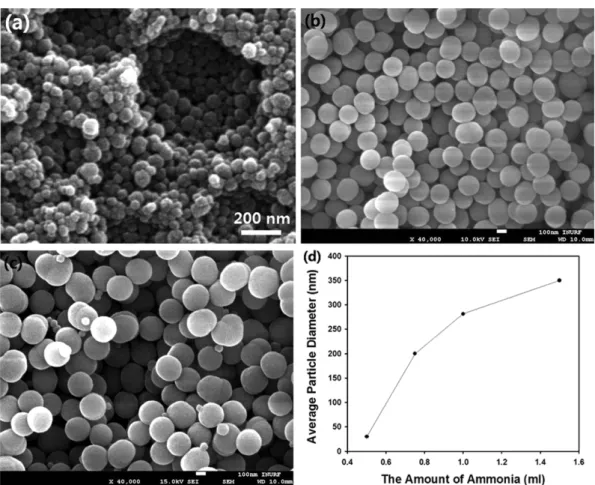
For the control of particle size, the concentration of ammonia was adjusted to change the amount of the catalyst for sol-gel reaction. In solution #1, the volume of ammonium hydroxide was changed by 50 to 150% compared to the conditions shown in Table 2. By fixing the other reaction parameters, the size of silica particles could be con- trolled from about 50 to 350 nm, as displayed in the electron micro- scope images of Fig. 2. When small amount of ammonia was used, nanosized silica particles could be obtained, whereas nonspherical silica nanospheres were formed when the sample was prepared with excess amount of ammonium hydroxide, as contained in the mor- phologies of Fig. 2. Although there are commercially available routes, nanosized silica nanoparticles can be used as source materials for the synthesis of porous particles by colloidal templating method, as sug- gested by our previous results [12]. The spherical shape of silica sus- pension was not maintained when 150% of NH4OH was used as catalyst, implying that the aggregation of particles and successive growth resulted in the formation of dimeric or triangular shapes shown in the SEM image of Fig. 2(c). The change of particle diameter is plotted in Fig. 2(d) as a function of the amount of ammonia, showing that a
drastic decrease of particle size could be observed when the volume of ammonia was smaller than 0.75 ml.
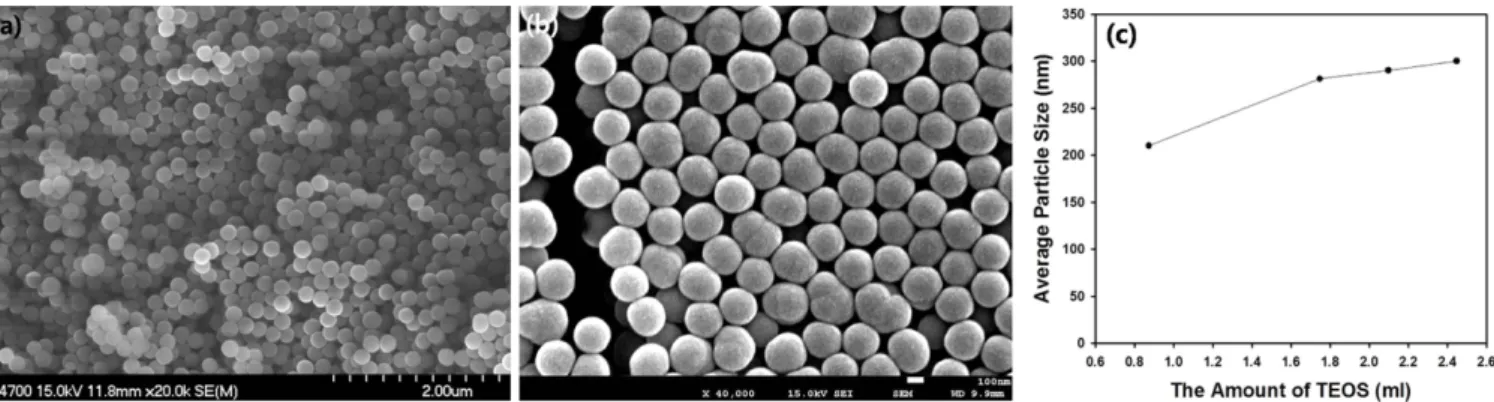
Besides the amount of catalyst, the concentration of silica precursor was also adjusted to control the size of silica nanospheres. For this purpose, the volume of TEOS was changed as 75% and 120% com- pared to the amount shown in Table 2, and the resultant particle mor- phologies are displayed in Fig. 3(a) and 3(b). The monodispersity and spherical shapes of silica nanospheres were maintained when the amount of TEOS was 75% compared to the reference sample. How- ever, the particles became nonspherical when the volume of TEOS increased to 120%, implying that serious aggregation of particles proceeded during the synthesis due to the excess amount of the pre- cursor concentration. When 140% of TEOS with respect to the refer- ence sample was used, the results were similar and the number of nonspherical particles increased, although the result is not reproduced here. Thus, it can be concluded that the critical concentration of TEOS lies between 100 and 120% for the synthesis of spherical sil- ica particles with excellent monodispersity. The change of particle diameter as a function of the amount of TEOS is plotted in the graph of Fig. 3c, and linear increment was confirmed.
Besides the concentration of precursor, the amount of water was also changed to study the effect on the particle diameter. In this study, the volume of water was adjusted as 50 or 150% with respect to the amount shown in Table 2. During the Stober reaction, the precursor
Fig. 2. Scanning electron microscope image of monodisperse silica nanospheres synthesized using (a) 50, (b) 75, and (c) 150% of NH4OH com- pared to the reference sample. The Scale bar indicates 200 nm for (a) and 100 nm for (b) and (c). (d) The change of particle diameter as a function of ammonia concentration.
material such as TEOS can be hydrolyzed with water before conden- sation reaction to form silica particles. Thus, the amount of water was adjusted to study the effect on the particle size. Fig. 4(a) and 4(b) contain the scanning electron microscope images of the resultant par- ticles. When the amount of water was too small, the particles became polydisperse and the average size was about 79.5 nm, as displayed in the SEM image of Fig. 4(a). However, excess amount of water caused relatively monodisperse particles, and the diameter of the silica nano- spheres increased to about 281.2 nm. Further increase of water con-
centration led to the decrease of particle diameter as 173.1 nm, which can be confirmed from Fig. 4(b), and this trend is plotted as the graph shown in Fig. 4(c). Fig. 4(d) displays the standard deviation of the particle size.
The reaction temperature was also adjusted to examine the effect on the particle size. Fig. 5(a) to 5(c) contains the electron microscope images of silica nanospheres synthesized at 40, 60, and 70oC, respec- tively. As temperature increased, the diameter of silica particles decreased, as displayed in the SEM images. For instance, the particle size decreased Fig. 3. Scanning electron microscope image of monodisperse silica nanospheres synthesized using (a) 75% and (b) 120% of TEOS compared to the reference sample. Scale bars indicate 2 µm and 100 nm, respectively. (c) The average size of silica particles as a function of the amount of TEOS.
Fig. 4. Scanning electron microscope image of monodisperse silica nanospheres synthesized using (a) 50% and (b) 150% of H2O compared to the reference sample. Scale bars indicate 200 nm and 100 nm, respectively. (c) and (d) The change of average particle diameter and standard deviation as a function of the amount of water.
to 200 and 100 nm when the Stober reaction was performed at 40 and 60oC, respectively. Further decrease of particle size was observed for silica nanospheres when the reaction temperature increased to 70oC, and the particle diameter was measured as around 70 nm.
Since most of the reaction medium evaporated at elevated tempera- ture, particle synthesis could not be performed at 80oC. A decreasing trend of particle diameter was observed with increasing reaction temperature, as contained in the graph of Fig. 5(d). Since the number of nuclei increased as increasing temperature, the diameter of parti- cles became smaller under fixed concentration of precursor.
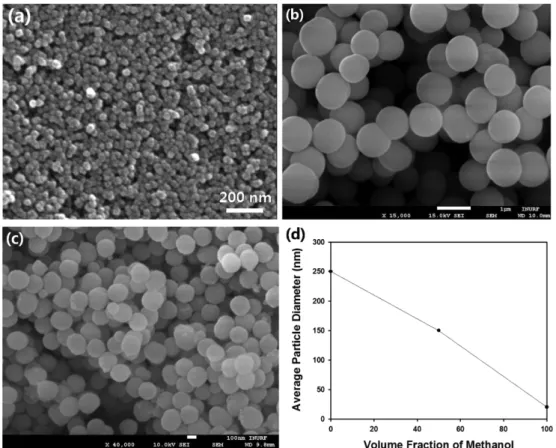
To control the size of silica particles, the reaction medium was also changed as alcohols with different molecular weight. For instance, methanol and isopropyl alcohol were used as dispersion medium instead of ethanol, fixing the other synthesis conditions. Fig. 6(a) and 6(b) contain the electron microscope image of the resultant silica col- loids after reaction for two hours. By changing the solvent medium, the size of silica particles changed drastically, as contained in the SEM images. For the case of methanol, the particle diameter was only 20 nm, whereas the size of silica nanospheres increased up to 900 nm when isopropyl alcohol was used. This drastic change of particle diameter can be attributed to the decrease of dielectric constant of reaction medium. As the chain length of alcohol increased, bigger particles became stable due to the decrease of dielectric constant of dispersion
medium, which hindered the hydrogen bonding between particles [13].
Thus, the particle size became larger as the amount of high-molecular weight alcohol increased in reaction medium. The effect of solvent mixing was also studied using the mixture of methanol and ethanol with 1:1 volume ratio. Fig. 6(c) contains the resultant SEM image of monodisperse silica nanospheres with 150 nm in diameter, which is larger than the silica particles synthesized using pure methanol. Thus, the composition of reaction medium can be adjusted to control the diameter of monodisperse silica nanospheres. This trend is plotted in Fig. 6(d) as a function of the volume fraction of methanol, showing that wide size range from 20 to 250 nm could be obtained by the addition of methanol in reaction medium.
Thus, the composition of reactants was adjusted to control the diameter of silica nanospheres. The particle size could be controlled from 20 to 900 nm by changing the concentration of reactants, which was effective to tune the diameter of particles. Size control could be also achieved by varying the rotation speed of the inner cylinder as displayed in the results of Fig. 7. For instance, the diameter of silica particles increased to about 300 nm under the faster cylinder rotation speed (712.5 rpm), as shown in the SEM image of Fig. 7(a). The par- ticle size decreased again to about 180 nm when the rotation speed of cylinder further increased as 1,750 rpm, as displayed in the SEM image of Fig. 7(b). This trend was plotted as a function of Taylor num- Fig. 5. Scanning electron microscope image of monodisperse silica nanospheres synthesized at (a) 40oC, (b) 60oC, and (c) 70oC, respectively.
Scale bars indicate 100 nm. (d) The particle size of silica nanospheres as a function of reaction temperature.
Fig. 7. Scanning electron microscope image of monodisperse silica nanospheres synthesized at (a) 712.5 and (b) 1,750 rpm. Scale bars indicate 1µm. (c) and (d) The change of particle diameter and standard deviation of the particle size as a function of Taylor number, respectively.
Fig. 6. Scanning electron microscope image of monodisperse silica nanospheres synthesized using (a) methanol and (b) isopropyl alcohol as reaction medium, respectively. Scale bars indicate 200 nm and 1µm, respectively. (c) SEM image of silica nanospheres synthesized using the mixture of methanol and ethanol. Scale bar is 100 nm. (d) The average size of silica particles as a function of the volume frac- tion of methanol in reaction medium.
ber in the graph of Fig. 7(c). Collectively, the particle size could be controlled from 180 to 300 nm by adjusting the Taylor number of the reaction system. When the Taylor number was adjusted between 1,000 and 3,000, a gradual increase of particle size was observed, whereas the slight decrease of particle diameter was reported for 30 < Ta < 160 in the previous study [14]. When Ta is small (30 < Ta < 160), the number of nuclei increases resulting in the formation of relatively small particles because of enhanced mixing of the reactants, whereas bigger particles can be formed due to agglomeration of the nuclei, as reported in the results of our experiments [14].
In addition to the diameter of particles, standard deviation of silica suspension could be also controlled by changing the rotation speed of the inner cylinder. Excellent monodispersity was observed from the sample fabricated at 505 rpm, and particles became polydisperse with increasing value of rotation speed from Ta = 1,000 to 3,000.
This trend is also plotted in the graph of Fig. 7(d), showing that fur- ther increase of rotation speed resulted in the decrease of standard deviation in the range of Ta = 3,000 to 5,000.
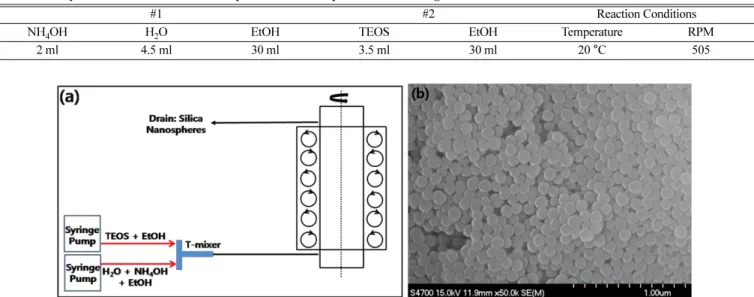
Besides batch operation, silica particles were synthesized with continuous manner using the rotating cylinder system. The injection rate of two input streams (#1 and #2 in Table 3) to T-mixer was 180 μl/
min, and the resultant mixed materials were fed to the reactor for further growth of the particles, as outlined schematically in Fig. 8(a). During the reaction, small amount of sample was taken by draining from the top of the cylindrical reactor to observe the morphologies of the par- ticles, as contained in the SEM image of Fig. 8(b). The mean diame- ter of the silica nanospheres was about 98 nm, and the excellent monodispersity was maintained compared to the samples fabricated using batch operation of the reactor.
For the synthesis of silica nanospheres with continuous manner, we have tried other types of reactor by changing R1, R2, and L as 20, 24, and 98, respectively. Fig. 9 displays the change of particle diame-
ter as a function of production time during the operation of the rotating cylinder system as continuous reactor. The electron micrographs of samples per every 10 minute intervals are included as inset image of Fig. 9. The synthesis conditions are listed in Table 4, and feed rate of each stream was 7.9 and 2.1 ml/h for #1 and #2, respectively. In the initial stage of the particle synthesis, the diameter of silica nanospheres was about 200 nm, and the size increased slowly up to about 230 nm after 50 minutes. After then, this value was maintained, implying that several minutes might be required to reach the steady-state diameter after the start-up of the particle synthesis. The size uniformity of the particle was quite excellent for all samples, as displayed in the inset SEM images of Fig. 9. Since the extent of reaction was relatively low in the initial stage of the particle synthesis, the particle diameter increased until a stabilized size was achieved after 50 minutes.
Fig. 8. (a) Schematic for the synthesis of silica nanospheres with continuous manner. and (b) Scanning electron microscope image of mono- disperse silica nanospheres synthesized with continuous operation. The rotation speed of inner cylinder was 505 rpm, and the synthesis was performed at room temperature. Scale bar indicates 1µm. The sample was taken after the reaction for 1 hour.
Fig. 9. The change of particle diameter as a function of production time.
The SEM images of samples are inserted as inset figure.
Table 3. The Synthesis Conditions of Monodisperse Silica Nanospheres Shown in Fig. 8b
#1 #2 Reaction Conditions
NH4OH H2O EtOH TEOS EtOH Temperature RPM
2 ml 4.5 ml 30 ml 3.5 ml 30 ml 20 °C 505
By continuous operation of the rotating cylinder system, the seeded growth of silica nanospheres was performed to increase the size of silica nanospheres. Fig. 10(a) contains the morphologies of the seed parti- cles with 176 nm in diameter. This seed particle dispersion was con- tinuously supplied to the reactor, and simultaneous mixing with the silica precursors was performed by separate feeding of the precursors to the reaction system. After 1 hour, the resultant suspension was taken for the observation using electron microscopy, and the morphologies of the grown particles are displayed in Fig. 10(b). As shown in the SEM image, the particle diameter was slightly increased with around 220 nm.
4. Conclusions
Monodisperse silica particles were synthesized by Stober method using rotating cylinder systems in alcohol as reaction medium. The particle size was controlled by adjusting the reaction parameters such as reaction temperature and reactant compositions. The effect of the rotating speed of inner cylinder was studied systemically by considering the effect of Taylor number on the average particle diameter and standard deviation of the particles. For comparative purposes, silica suspension was prepared using a conventional stirrer, and the size distribution of the resulting particles was broader than that of the par- ticles synthesized using a rotating cylinder system.
The size range of the silica particles could be adjusted from 20 to 500 nm using batch-wise operation of the reactor, implying that a wide range of particle diameter can be covered using the Taylor vortex reac- tor. Besides the batch-wise operation, continuous synthesis of mono- disperse silica nanospheres was also possible using a T-mixer as premixing apparatus.
Acknowledgment
This research was supported by a grant (16CTAP-C114861-1) from Infrastructure and Transportation Technology Promotion Research Program funded by Ministry of Land, Infrastructure and Transport (MOLIT) of Korea Government.
References
1. Cho, Y.-S., Moon, J. W., Lim, D. C. and Kim, Y. D., “Fabrication of Superhydrophobic Surfaces Using Structured Colloids,” Korean J. Chem. Eng., 30(5), 1142-1152(2013).
2. Kim, Y., Cho, C.-Y., Kang, J.-H., Cho, Y.-S. and Moon, J. H.,
“Synthesis of Porous Carbon Balls From Spherical Colloidal Crys- tal,” Langmuir, 28(28), 10543-10550(2012).
3. Kang, D. and Clark, N. A., “Fast Growth of Silica Colloidal Crys- tals,” J. Kor. Phys. Soc., 41(5), 817-819(2002).
4. Coquart, L., Sipp, D. and Jacquin, L., “Mixing Induced by Rayleigh- Taylor Instability in a Vortex,” Phys. Fluids, 17, 021703-1-4(2005).
5. Kim, W.-J. and Yang, S.-M., “HelicaL Mesostructured Tubules From Taylor Vortex-assisted Surfactant Templates,” Adv. Mater., 13(15), 1191-1195(2001).
6. Melebari, M. A., “Development of Ultraviolet Taylor Couette Reactor to Apply Non-thermal Pasteurization on Milk,” M.S. The- sis, The University of Guelph, 2012.
7. Kim, W.-S., “Application of Taylor Vortex to Crystallization,” J.
Chem. Eng. Jpn., 47(2), 115-123(2014).
8. Ogihara, T., Matsuda, G., Yanagawa, T., Ogata, N., Fujita, K. and Nomura, M., “Continuous Synthesis of Monodispersed Alumina Particles,” J. Ceram. Soc. Jpn. 103, 151-154(1995).
9. Ogihara, T., “Preparation of Monodispersed Particles Using Taylor Vortex as a Hydrolysis Reactor,” J. Soc. Powder Technol., Jpn., 40, 808-814(2003).
10. Ogihara, T. and Nomura, M., “Continuous Synthesis of Monodispersed Alumina Particles by the Hydrolysis of Metal Alkoxide Using a Taylor Vortex,” KONA Powder J., 20, 231-237(2002).
11. Yoon, H.-S., Hwang, U. and Park, H.-S., “Effects of Synthetic Conditions and Electrolytes on the Formation of Monodispersed Spherical Silica Particles Prepared by the Sol-gel Method,” Korean Chem. Eng. Res., 34(5), 556-563(1996).
12. Cho, Y.-S., “Fabrication of Hollow or Macroporous Silica Particles by Spray Drying of Colloidal Dispersion,” J. Dispersion Sci. Tech., 37, 23-33(2016).
13. Park, J. S., Hah, H. J., Koo, S. M. and Lee, Y. S., “Effect of Alcohol Chain Length on Particle Growth in a Mixed Solvent System,” J.
Ceram. Processing Res., 7(1), 83-89(2006).
14. Tadao Sugimoto, Fine Particles: Synthesis, Characterization, and Mechanisms of Growth, 1st ed., CRC Press(2000).
Fig. 10. Scanning electron microscope image of monodisperse silica nanospheres. (a) The seed particles and (b) the grown particles from the seed. The rotation speed of inner cylinder was 505 rpm, and the synthesis was performed at room temperature. Scale bars indicate 200 nm. The sample was taken after the reac- tion for 1 hour.
Table 4. The Synthesis Conditions of Monodisperse Silica Nanospheres Shown in Fig. 9
#1 #2 Reaction Conditions
NH4OH H2O EtOH TEOS EtOH Temperature RPM
8 ml 18 ml 144 ml 16 ml 54 ml 20 °C 400