668 Korean Chem. Eng. Res., 55(5), 668-678 (2017)
https://doi.org/10.9713/kcer.2017.55.5.668 PISSN 0304-128X, EISSN 2233-9558
Ultrasonic Speed and Isentropic Compressibility of 2-propanol with Hydrocarbons at 298.15 and 308.15 K
Suman Gahlyan, Sweety Verma, Manju Rani* and Sanjeev Maken†
Department of Chemistry, Deenbandhu Chhotu Ram University of Science and Technology, Murthal-131 039, India
*Department of Chemical Engineering, Deenbandhu Chhotu Ram University of Science and Technology, Murthal-131 039, India (Received 16 May 2017; Received in revised form 15 June 2017; accepted 30 June 2017)
Abstract − Intermolecular interactions were studied for binary mixtures of 2-propanol + cyclohexane, n-hexane, ben- zene, toluene, o-, m- and p-xylenes by measuring ultrasonic speeds (u) over the entire range of composition at 298.15 K and 308.15 K. From these results the deviation in ultrasonic speed was calculated. These results were fitted to the Redlich-Kister equation to derive the binary coefficients along with standard deviations between the experimental and calculated data. Acoustic parameters such as excess isentropic compressibility (KEs), intermolecular free length (Lf) and available volume (Va) were also derived from ultrasonic speed data and Jacobson’s free length theory. The ultrasonic speed data were correlated by Nomoto’s relation, Van Dael’s mixing relation, impedance dependence relation, and Schaaff’s collision factor theory. Van Dael’s relation gives the best prediction of u in the binary mixtures containing ali- phatic hydrocarbons. The ultrasonic speed data and isentropic compressibility were further analyzed in terms of Jacob- son’s free length theory.
Key words: Ultrasonic speed, Oxygenate, 2-Propanol, Hydrocarbon, Jacobson’s free length theory, Graph theoretical approach
1. Introduction
Increasing global concern over greenhouse gas emissions has gen- erated much interest in environmentally friendly alternative bio- fuels. Bio-fuels for internal combustion engines as oxygenated com- pounds are also becoming important due to depleting fossil fuel, occasional oil crises and increasing air pollution [1]. Oxygenates produced from renewable sources, including higher alcohol such as propanol, butanol and pentanol, may have acceptable properties as gasoline blend components and could be considered as potential sec- ond generation bio-fuel additives [2]. Propanol can be produced by microbial fermentation of cellulose [3]. This prompted us to study the thermo-physical properties of oxygenate additive with hydrocar- bons that would be of great importance in process engineering design, in formulating motor fuels [4], and also in understanding the nature of intermolecular interactions in these binary mixtures [5-7].
In continuation of earlier work [8-11], ultrasonic speeds of 2-pro- panol + cyclohexane, n-hexane, benzene, toluene, o-, m- and p-xylenes over the entire range of composition at 298.15 K and at 308.15 K are reported in the present paper. The ultrasonic speeds data were cor- related by various correlations like Nomoto’s relation, Van Dael’s mixing relation and impedance dependence relation, and Schaaff’s collision factor theory. The accoustic data were further analyzed in terms of Jacobson’s free length theory (FLT).
2. Experimental
2-1. Chemicals
Cyclohexane (Merck 99%) was washed several times with a mix- ture of concentrated nitric acid and concentrated sulfuric acid to nitrate any benzene that may have been present [12]. After repeated washing with NaHCO3 solution and distilled water, it was fractionally dis- tilled over and dried over 0.3 nm molecular sieves (Merck) in an amber colored bottle for several days before use.
n-Hexane (Merck AR grade 99.5%) was treated with concen- trated sulfuric acid, then with a 0.1N solution of potassium perman- ganate in 10% sodium hydroxide [13]. The n-hexane was then washed with water, distilled and dried over type 0.3 nm molecular sieves (Merck). 2-Propanol, benzene, toluene and xylenes were purified as described earlier [14].
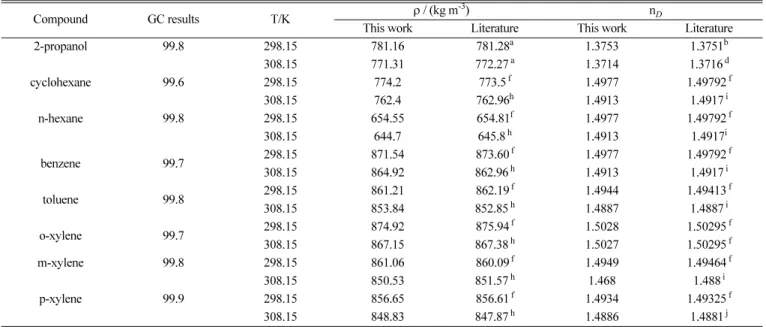
The purity of purified samples was checked by measuring densi- ties and refractive indices of the pure compounds, and these agree well with their respective literature values as shown in Table 1 [5,15-23].
The purified samples were also analyzed by gas chromatography for their purity and found to have better than 99.6 wt% (Table 1).
2-2. Apparatus and procedure
The ultrasonic speed was measured by using a variable path sin- gle-crystal interferometer (Mittal Enterprises, Model M-81, India).
A crystal-controlled high-frequency generator was used to excite the transducer at a frequency of 2 MHz. The interferometer cell was filled with the test liquid, and water was circulated around the measuring cell from a constant temperature bath maintained at (298.15±0.01) K.
Details of the ultrasonic speed measurements have been given ear-
†To whom correspondence should be addressed.
E-mail: [email protected]
This is an Open-Access article distributed under the terms of the Creative Com- mons Attribution Non-Commercial License (http://creativecommons.org/licenses/by- nc/3.0) which permits unrestricted non-commercial use, distribution, and reproduc- tion in any medium, provided the original work is properly cited.
lier [24] and the data are reproducible within ±3%.
Refractive indices (±0.001) and density (±5×10⁻⁵ g cm−3) of pure components were measured with a thermostatically controlled Abbe refractometer (OSAW, India) and dilatometric technique described elsewhere [25,26].
3. Results
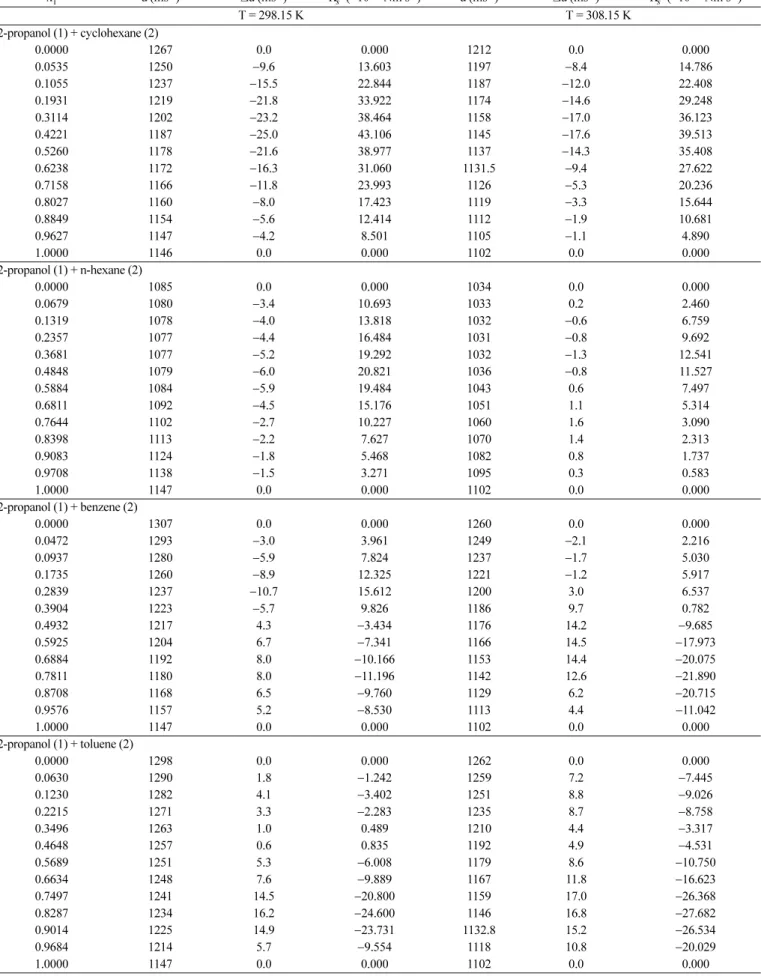
The deviation in ultrasonic speed (Δu) was calculated using Eq.
(1) and reported along with measured ultrasonic speed in Table 2.
The variation of deviation in ultrasonic speed (Δu) with mole frac- tion of 2-propanol is represented graphically in Fig. 1.
(1) (2)
(3)
where
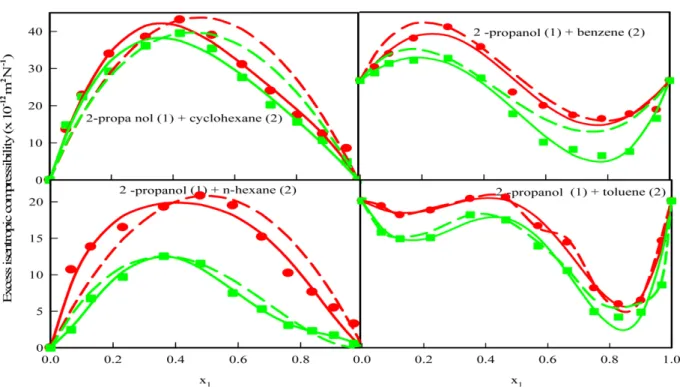
(4) (5) (6) where φ, V, αp and Cp are the volume fraction, molar volume, isobaric expansivity and molar heat capacity, respectively. The values of αp and Cp are taken from literature [19,27-29]. The values of excess compressibility calculated from Eq. (8) are tabulated in Table 2 and shown in Figs. 2 and 3.
(7)
(8) The densities, ρij, of the binary mixtures were calculated from their excess molar volume data [14] using the Eq. (9)
(9) Δu u ρ= –( idKsid)–1/2
ρid=φ1ρ1+φ2ρ2
Ksid φ1Ks 1, φ2Ks 2, T φ1V1(αp 1, )2 Cp 1,
--- φ2V2(αp 2, )2 Cp 2,
--- Vid( )αpid2 Cpid --- – +
+ +
=
Vid=x1V1+x2V2 αp
id=φ1αp 2, +φ2αp 2,
Cpid=x1Cp 1, +x2Cp 2,
Ks=(u2ρ)–1
KsE=Ks–Ksid
VE xi
i 1=
∑
2 Mi( )ρij –1 xi i 1=∑
2 Mi( )ρi–1–
=
Table 1. Purities (wt%), measured densities (r) and refractive indices (nD) of the pure components
Compound GC results T/K ρ / (kg m-3) nD
This work Literature This work Literature
2-propanol 99.8 298.15 781.16 781.28a 1.3753 1.3751b
308.15 771.31 772.27 a 1.3714 1.3716 d
cyclohexane 99.6 298.15 774.2 773.5 f 1.4977 1.49792 f
308.15 762.4 762.96h 1.4913 1.4917 i
n-hexane 99.8 298.15 654.55 654.81f 1.4977 1.49792 f
308.15 644.7 645.8 h 1.4913 1.4917i
benzene 99.7 298.15 871.54 873.60 f 1.4977 1.49792 f
308.15 864.92 862.96 h 1.4913 1.4917 i
toluene 99.8 298.15 861.21 862.19 f 1.4944 1.49413 f
308.15 853.84 852.85 h 1.4887 1.4887 i
o-xylene 99.7 298.15 874.92 875.94 f 1.5028 1.50295 f
308.15 867.15 867.38 h 1.5027 1.50295 f
m-xylene 99.8 298.15 861.06 860.09 f 1.4949 1.49464 f
308.15 850.53 851.57 h 1.468 1.488 i
p-xylene 99.9 298.15 856.65 856.61 f 1.4934 1.49325 f
308.15 848.83 847.87 h 1.4886 1.4881 j
a[5]; b[15]; c[16]; d[17]; e[18]; f[19]; g[20]; h[21]; i[23]; j[22]
Fig. 1. Deviation in ultrasonic velocity of 2-propanol (1) + hydro- carbon (2) mixture as a function of mole fraction of 2-pro- panol at 298.15 and 308.15 K: ● cyclohexane, ■ n-hexane,
◆ benzene, toluene, ★ o-xylene, ▼ m-xylene, ○ p-xylene.
The line represents the value calculated from Eq. (10) and dashed line represents literature value of cyclohexane (Savaroglu and Aral, 2004).
Table 2. Experimental ultrasonic velocity (u), deviation in ultrasonic velocity (Δu) and excess isentropic compressibility (KsE) of binary mixtures at different temperatures
x1 u (ms-1) Δu (ms-1) KsE(×10-12 Nm s-2) u (ms-1) Δu (ms-1) KsE(×10-12 Nm s-2)
T = 298.15 K T = 308.15 K
2-propanol (1) + cyclohexane (2)
0.0000 1267 0.0 0.000 1212 0.0 0.000
0.0535 1250 −9.6 13.603 1197 −8.4 14.786
0.1055 1237 −15.5 22.844 1187 −12.0 22.408
0.1931 1219 −21.8 33.922 1174 −14.6 29.248
0.3114 1202 −23.2 38.464 1158 −17.0 36.123
0.4221 1187 −25.0 43.106 1145 −17.6 39.513
0.5260 1178 −21.6 38.977 1137 −14.3 35.408
0.6238 1172 −16.3 31.060 1131.5 −9.4 27.622
0.7158 1166 −11.8 23.993 1126 −5.3 20.236
0.8027 1160 −8.0 17.423 1119 −3.3 15.644
0.8849 1154 −5.6 12.414 1112 −1.9 10.681
0.9627 1147 −4.2 8.501 1105 −1.1 4.890
1.0000 1146 0.0 0.000 1102 0.0 0.000
2-propanol (1) + n-hexane (2)
0.0000 1085 0.0 0.000 1034 0.0 0.000
0.0679 1080 −3.4 10.693 1033 0.2 2.460
0.1319 1078 −4.0 13.818 1032 −0.6 6.759
0.2357 1077 −4.4 16.484 1031 −0.8 9.692
0.3681 1077 −5.2 19.292 1032 −1.3 12.541
0.4848 1079 −6.0 20.821 1036 −0.8 11.527
0.5884 1084 −5.9 19.484 1043 0.6 7.497
0.6811 1092 −4.5 15.176 1051 1.1 5.314
0.7644 1102 −2.7 10.227 1060 1.6 3.090
0.8398 1113 −2.2 7.627 1070 1.4 2.313
0.9083 1124 −1.8 5.468 1082 0.8 1.737
0.9708 1138 −1.5 3.271 1095 0.3 0.583
1.0000 1147 0.0 0.000 1102 0.0 0.000
2-propanol (1) + benzene (2)
0.0000 1307 0.0 0.000 1260 0.0 0.000
0.0472 1293 −3.0 3.961 1249 −2.1 2.216
0.0937 1280 −5.9 7.824 1237 −1.7 5.030
0.1735 1260 −8.9 12.325 1221 −1.2 5.917
0.2839 1237 −10.7 15.612 1200 3.0 6.537
0.3904 1223 −5.7 9.826 1186 9.7 0.782
0.4932 1217 4.3 −3.434 1176 14.2 −9.685
0.5925 1204 6.7 −7.341 1166 14.5 −17.973
0.6884 1192 8.0 −10.166 1153 14.4 −20.075
0.7811 1180 8.0 −11.196 1142 12.6 −21.890
0.8708 1168 6.5 −9.760 1129 6.2 −20.715
0.9576 1157 5.2 −8.530 1113 4.4 −11.042
1.0000 1147 0.0 0.000 1102 0.0 0.000
2-propanol (1) + toluene (2)
0.0000 1298 0.0 0.000 1262 0.0 0.000
0.0630 1290 1.8 −1.242 1259 7.2 −7.445
0.1230 1282 4.1 −3.402 1251 8.8 −9.026
0.2215 1271 3.3 −2.283 1235 8.7 −8.758
0.3496 1263 1.0 0.489 1210 4.4 −3.317
0.4648 1257 0.6 0.835 1192 4.9 −4.531
0.5689 1251 5.3 −6.008 1179 8.6 −10.750
0.6634 1248 7.6 −9.889 1167 11.8 −16.623
0.7497 1241 14.5 −20.800 1159 17.0 −26.368
0.8287 1234 16.2 −24.600 1146 16.8 −27.682
0.9014 1225 14.9 −23.731 1132.8 15.2 −26.534
0.9684 1214 5.7 −9.554 1118 10.8 −20.029
1.0000 1147 0.0 0.000 1102 0.0 0.000
Table 2. (continued)
x1 u (ms-1) Δu (ms-1) KsE(×10-12 Nm s-2) u (ms-1) Δu (ms-1) KsE(×10-12 Nm s-2)
T = 298.15 K T = 308.15 K
2-propanol (1) + toluene (2)
0.0000 1298 0.0 0.000 1262 0.0 0.000
0.0630 1290 1.8 −1.242 1259 7.2 −7.445
0.1230 1282 4.1 −3.402 1251 8.8 −9.026
0.2215 1271 3.3 −2.283 1235 8.7 −8.758
0.3496 1263 1.0 0.489 1210 4.4 −3.317
0.4648 1257 0.6 0.835 1192 4.9 −4.531
0.5689 1251 5.3 −6.008 1179 8.6 −10.750
0.6634 1248 7.6 −9.889 1167 11.8 −16.623
0.7497 1241 14.5 −20.800 1159 17.0 −26.368
0.8287 1234 16.2 −24.600 1146 16.8 −27.682
0.9014 1225 14.9 −23.731 1132.8 15.2 −26.534
0.9684 1214 5.7 −9.554 1118 10.8 −20.029
1.0000 1147 0.0 0.000 1102 0.0 0.000
2-propanol (1) + o-xylene (2)
0.0000 1355 0.0 0.000 1320 0.0 0.000
0.0616 1330 −9.2 9.670 1297 −6.1 7.614
0.1205 1325 0.5 0.841 1295 7.2 −5.852
0.2173 1309 7.7 −6.285 1277 13.2 −12.315
0.3443 1291 18.7 −19.008 1259 25.2 −27.811
0.4589 1271 23.4 −26.310 1235 27.7 −33.748
0.5631 1253 26.8 −32.701 1215 29.7 −39.518
0.6581 1239 31.5 −41.141 1198 32.5 −46.702
0.7452 1218 26.9 −37.481 1178 29.8 −45.889
0.8253 1197 20.4 −30.246 1159 25.7 −42.223
0.8993 1178 14.3 −22.489 1142 21.6 −37.617
0.9677 1156 3.9 −6.512 1122 14.1 −26.053
1.0000 1147 0.0 0.000 1102 0.0 0.000
2-propanol (1) + m-xylene (2)
0.0000 1328 0.0 0.000 1285 0.0 0.000
0.0627 1314 −3.9 4.602 1275 −0.4 1.408
0.1224 1303 −5.5 6.918 1264 −2.5 4.568
0.2206 1290 −2.6 4.658 1252 2.0 0.001
0.3484 1271 0.0 2.362 1230 1.8 0.549
0.4635 1251 0.2 2.112 1210 2.1 0.059
0.5676 1234 2.2 −0.755 1192 3.5 −2.183
0.6622 1220 6.0 −6.519 1180 9.4 −11.775
0.7487 1204 6.7 −8.416 1164 9.8 −13.663
0.8280 1190 8.3 −11.792 1149 11.2 −17.331
0.9009 1178 11.0 −16.869 1137 14.5 −24.664
0.9682 1161 7.7 −12.617 1118 9.0 −16.564
1.0000 1147 0.0 0.000 1102 0.0 0.000
2-propanol (1) + p-xylene (2)
0.0000 1317 0.0 0.000 1272 0.0 0.000
0.0629 1301 −6.5 7.521 1260 −3.2 4.806
0.1228 1280 −18.8 21.622 1242 −12.6 17.077
0.2213 1263 −20.9 25.434 1225 −14.9 21.391
0.3492 1241 −22.7 29.313 1207 −12.8 20.055
0.4644 1222 −22.7 30.834 1190 −10.9 18.275
0.5685 1219 −7.9 11.981 1187 4.0 −3.264
0.6631 1209 −1.2 2.854 1174 8.1 −10.170
0.7494 1190 −4.5 7.470 1155 4.5 −5.555
0.8285 1172 −7.7 12.523 1138 2.4 −2.785
0.9012 1164 −1.9 3.383 1126 4.3 −7.082
0.9684 1153 0.1 −0.026 1114 5.4 −10.036
1.0000 1147 0.0 0.000 1102 0.0 0.000
where xi, Mi and ρi are the mole fraction, molar mass and density of the pure components in 2-propanol (1) + hydrocarbon (2) mix- tures.
The Δu data were also fitted to the following Redlich-Kister equa- tion [30].
(10)
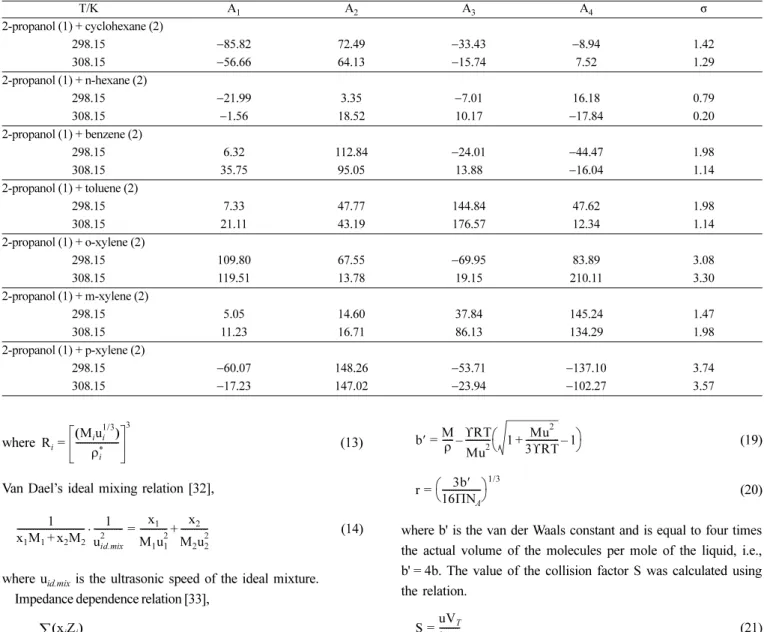
where An are the adjustable parameters that were evaluated by fitting measured Δu data to Eq. (10) by the least squares method and reported in Table 3 along with the standard deviations σ(Δu) of Δu.
(11) where m is the number of experimental values, and n is the num- ber of adjustable parameters in Eq. (10). The choice of n to have 1-4 values was dictated by the consideration that the maximum deviation σmax (Δu) of Δu (as calculated from Eq. (10) from the corresponding experimental Δu values satisfied the relation σmax (Δu) ≤ 2σ(Δu). Comparison of experimental Δu values for the studied systems together with smoothing curves from Eq. (10) is shown in Fig. 1.
The ultrasonic speed data for the present binary systems was also estimated theoretically by the following relations:
Nomoto’s relation [31], which is based on assumption of additiv- ity of ultrasonic speed and no volume change on mixing, is given as
(12) Δu x1(1 x– 1) An
n 1=
∑
4 (1 2x– 1)n 1–=
σ Δu( )={[
∑
(Δuexptl.–Δucalcd.(Eq.(10)))2]/ m 1( – )}1/2u Rm
Vmix ---
⎝ ⎠
⎛ ⎞3 x1R1+x2R2 x1V1+x2V2 ---
= =
Fig. 2. Values of excess isentropic compressibility of 2-propanol (1) + hydrocarbon (2) mixture as a function of mole fraction of 2-propanol.
Symbols represent experimental data; ● 298.15 K; ■308.15 K; Solid lines and dashed lines represent the values calculated from Eq.
(10) and Graph theory, respectively.
Fig. 3. Values of excess isentropic compressibility of 2- propanol (1) + hydrocarbon (2) mixture as a function of mole fraction of 2-propanol. Symbols represent experimental data; ● 298.15 K;
■ 308.15 K; Solid lines and dashed lines represent the values calculated from Eq. (10) and Graph theory, respectively.
where (13)
Van Dael’s ideal mixing relation [32],
(14)
where uid.mix is the ultrasonic speed of the ideal mixture.
Impedance dependence relation [33],
(15)
where Zi=μiρi* is specific acoustic impedance of component i.
According to Schaaff’s collision factor theory (CFT) [34-36],
(16)
where u∞ is 1600 m/s and b and S are the geometric volume and collision factor, respectively. The actual volume of the molecules per mole of the liquid was computed using the relations.
(17)
where r is the molecular radius which has been computed using Schaaff’s [36] relation
(18)
(19)
(20)
where b' is the van der Waals constant and is equal to four times the actual volume of the molecules per mole of the liquid, i.e., b' = 4b. The value of the collision factor S was calculated using the relation.
(21)
To make a numerical comparison of the estimation capability of the various relations, percentage standard deviations were calculated using above relation and given in Table 4.
(22)
where n represents the number of experimental data points. A comparison of these correlated values with respective experimen- tal ultrasonic speed values is shown in Figs. 4, 5 and 6.
4. Discussion
The Δu versus x1 plots for these systems are shown in Fig. 1. The Δu values for the 2-propanol (1) + cyclohexane or p-xylene or n-hex- ane (2) systems are negative over the whole composition range, while these are positive for 2-propanol (1) + toluene or o- xylenes (2) and Δu versus x1 plots are S-shape for benzene or m-xylene contain- Ri (Miui1/3)
ρi*
---
3
=
1 x1M1+x2M2 --- 1
uid.mix2 ---
⋅ x1
M1u12 --- x2
M2u22 --- +
=
u
∑
(xiZi) xiρi*( )
∑
---=
umix u∞(x1S1+x2S2) x( 1b1+x2b2) Vmix
---
=
b 4Πr3NA ---3
=
r M
ρNA
---
⎝ ⎠
⎛ ⎞1/3 3 16Π --- 1 ϒRT
Mu2
--- 1 Mu2 3ϒRT ---
+ –1
⎝ ⎠
⎛ ⎞
–
=
1/3
b′ M --- ϒρ RT
Mu2
--- 1 Mu2 3ϒRT ---
+ –1
⎝ ⎠
⎛ ⎞
–
=
r 3b′ 16ΠNA
---
⎝ ⎠
⎛ ⎞1/3
=
S uVT bu∞ ---
=
σ %( )
∑
{100(Δuexptl.–Δutheo.)/Δuexptl.}2 n 1–( )
---
1/2
=
Table 3. Redlich-Kister equation parameters, An, and standard deviation, σ, (m s-1) for deviation in ultrasonic speed, Δu, of 2-propanol (1) + hydrocarbon (2) system
T/K A1 A2 A3 A4 σ
2-propanol (1) + cyclohexane (2)
298.15 −85.82 72.49 −33.43 −8.94 1.42
308.15 −56.66 64.13 −15.74 7.52 1.29
2-propanol (1) + n-hexane (2)
298.15 −21.99 3.35 −7.01 16.18 0.79
308.15 −1.56 18.52 10.17 −17.84 0.20
2-propanol (1) + benzene (2)
298.15 6.32 112.84 −24.01 −44.47 1.98
308.15 35.75 95.05 13.88 −16.04 1.14
2-propanol (1) + toluene (2)
298.15 7.33 47.77 144.84 47.62 1.98
308.15 21.11 43.19 176.57 12.34 1.14
2-propanol (1) + o-xylene (2)
298.15 109.80 67.55 −69.95 83.89 3.08
308.15 119.51 13.78 19.15 210.11 3.30
2-propanol (1) + m-xylene (2)
298.15 5.05 14.60 37.84 145.24 1.47
308.15 11.23 16.71 86.13 134.29 1.98
2-propanol (1) + p-xylene (2)
298.15 −60.07 148.26 −53.71 −137.10 3.74
308.15 −17.23 147.02 −23.94 −102.27 3.57
ing mixtures. The Δu values for equimolar mixtures follow the sequence: o-xylene > toluene > benzene > m-xylene > n-hexane > p- xylene > cyclohexane. The sign and magnitude of Δu play an import- ant role in the understanding of molecular interactions occurring among the component molecules in the mixtures. Positive devia- tions indicate the increasing strength of interaction between compo- nent molecules of binary liquid mixtures. As excess ultrasonic speed is directly proportional to density, therefore, the denser the medium, the higher would be the ultrasonic speed. At the simplest qualitative level, Δu values may be attributed to the resultant of two opposing effects. The negative contribution to Δu values arises from the break- ing of self-associated 2-propanol and dipole-dipole interactions between monomers and dimers of 2-propanol and from the disrup-
tion in the favorable orientation order of the hydrocarbons. The posi- tive contribution arises due to the presence of electron-donor- acceptor interactions between 2-propanol and hydrocarbons and change in free volume in real mixtures. The deviation in ultrasonic speed for the binary mixture of 2-propanol (1) + cyclohexane (2) has also been reported in literature and compared with our experimental values in Fig. 1 [37].
The versus x1 plots for these binary systems are shown in Figs.
2 and 3. It was found that values for the 2-propanol (1) + cyclo- hexane (2) and 2-propanol (1) + n-hexane (2) systems are positive over the whole composition range and for 2-propanol (1) + benzene or toluene or xylenes (2), these are S-shape at both temperatures. The
KsE
KsE Fig. 4. Ultrasonic velocity of 2-propanol (1) + hydrocarbon (2) pre-
dicted by various correlations. ● Exptl. 298.15 K, ▼at
308.15 K. Fig. 5. Ultrasonic velocity of 2-propanol (1) + benzene or toluene
(2) predicted by various correlations. ● Exptl. 298.15 K, ▼ at 308.15 K.
Table 4. Standard deviation of calculated values of ultrasonic speed using various correlations for the binary mixture at 298.15 K and 308.15 K
Binary mixture T/K Nomoto Van Deal Impedance CFT
2-propanol (1) + cyclohexane (2) 298.15 2.691 0.559 2.001 1.470
308.15 2.056 0.999 1.404 0.724
2-propanol (1) + n-hexane (2) 298.15 2.293 1.894 3.193 2.628
308.15 1.851 1.602 2.899 2.142
2-propanol (1) + benzene (2) 298.15 1.539 1.213 1.552 1.001
308.15 1.028 1.781 1.035 0.639
2-propanol (1) + toluene (2) 298.15 0.586 0.839 2.207 2.249
308.15 0.699 4.649 0.943 1.333
2-propanol (1) + o-xylene (2) 298.15 0.815 7.118 0.949 1.295
308.15 0.727 7.779 1.224 1.728
2-propanol (1) + m-xylene (2) 298.15 0.711 6.539 0.755 1.068
308.15 0.613 6.987 1.031 1.452
2-propanol (1) + p-xylene (2) 298.15 2.040 5.047 1.181 0.861
308.15 1.279 6.012 0.851 0.962
positive contribution to may be owing to expansion in volume resulting in increase in compressibility of the mixtures.
The observed negative values of indicate the presence of spe- cific interaction between 2-propanol and hydrocarbon molecules. In these mixtures the magnitude of values at equimolar composi- tion follows the sequence: cyclohexane > p-xylene > n-hexane > m- xylene > benzene > toluene > o-xylene. The above trend for isentro- pic compressibility should also be reflected by the available volume and intermolecular free length in these binary mixtures calculated from Jacobson’s free length theory [37,38]
4-1. The Jacobson free length theory (FLT)
Jacobson derived the intermolecular free length from molar vol- ume and surface area for a large number of liquids [39,40]. It was suggested that compressibility can be well understood in terms of the intermolecular free length, which is the distance between the sur- faces of the molecule. The intermolecular free length is related to available volume and surface area per molecule. The intermolecular free length depends on the type of packing and extent of association in given liquid. Lf is the intermolecular free length of the binary mix- ture which is given by
(23)
Here, Va represents the available volume per mole. Y is surface area per mole and these may be expressed as
(24) (25) where NA is Avogadro’s number and Vo and VT are the molar vol- umes at 0 K and at temperature T respectively. Vo is calculated from Eq. (26) using critical temperature Tc. The value of critical temperature is taken from the literature [41].
(26) The critical temperature of binary mixture is the mole fraction additive of the values of its pure components as given by the relation:
(27) The intermolecular free lengths (Lf) were computed using Eq. (28):
(28)
Intermolecular free length and available volume are shown in Figs. 7 and 8, respectively.
The values of ultrasonic speed (u) for these binary mixtures using
KsE
KsE
KsE
Lf 2Va ---Y
=
Va=VT–Vo Y=(36ΠNA Vo2)1/3
Vo=VT(1 T/T– c)0.3
Tc=x1Tc1+x2Tc2
Lf 2 V[ T–{x1V0+x2V02}] x1Y1+x2Y2 ---
=
Fig. 6. Ultrasonic velocity of 2-propanol (1) + xylenes (2) predicted by various correlations. ● Exptl. 298.15 K, ▼at 308.15 K.
Fig. 7. Excess intermolecular free length of 2-propanol (1) + hydro- carbon (2) mixture as a function of mole fraction of 2-pro- panol at 298.15 and 308.15 K: ● cyclohexane, ■ n-hexane,
◆ benzene, toluene, ▼o-xylene,★ m-xylene, ○ p-xylene.
various correlations (Eqs. (12)~(16)) as well as experimental data are graphically represented in Figs. 4, 5 and 6. It has been observed that while Van Deal’s relation gives the best prediction of u in the binary mixtures containing n-hexane a
nd cyclohexane, the u values calculated by impedance dependent relation, Nomoto’s relation and SCF theory also agree well with the experimental data. The difference in the experimental and calculated ultrasonic speed calculated using impedance dependence relation and Schaaff’s collision factor theory may be due to non-ideal behav- ior of binary mixture.
Fig. 8. Available volume of binary mixture of 2-propanol (1) + hydro- carbon (2) mixture as a function of mole fraction of 2-pro- panol at 298.15 and 308.15 K: ● cyclohexane, ■ n-hexane, ◆ benzene, toluene, ▼o-xylene,★ m-xylene, ○ p-xylene.
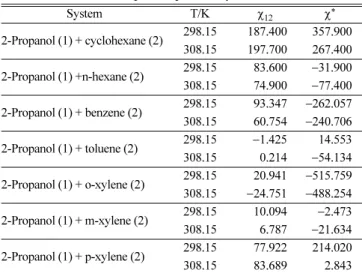
Table 5. Values of Graph theory interaction parameters χ12 and χ∗ for excess isentropic compressibility
System T/K χ12 χ∗
2-Propanol (1) + cyclohexane (2) 298.15 187.400 357.900 308.15 197.700 267.400 2-Propanol (1) +n-hexane (2) 298.15 83.600 −31.900 308.15 74.900 −77.400 2-Propanol (1) + benzene (2) 298.15 93.347 −262.057 308.15 60.754 −240.706 2-Propanol (1) + toluene (2) 298.15 −1.425 14.553 308.15 0.214 −54.134 2-Propanol (1) + o-xylene (2) 298.15 20.941 −515.759 308.15 −24.751 −488.254 2-Propanol (1) + m-xylene (2) 298.15 10.094 −2.473 308.15 6.787 −21.634 2-Propanol (1) + p-xylene (2) 298.15 77.922 214.020 308.15 83.689 2.843
Table 6. Comparison of excess isentropic compressibility (KsE) values calculated from Graph theory with their corresponding experimental values for binary mixtures
x1
KsE(×10-12Nm s-2)
Exptl. Graph Exptl. Graph
298.15 K 308.15 K
2-propanol (1) + cyclohexane (2)
0.0535 13.603 9.559 14.786 9.807
0.0535 13.603 9.559 14.786 9.807
0.1055 22.844 17.585 22.408 17.630
0.1931 33.922 28.510 29.248 27.683
0.3114 38.464 38.464 36.123 36.123
0.4221 43.106 43.106 39.513 39.513
0.5260 38.977 43.529 35.408 39.173
0.6238 31.060 40.560 27.622 35.978
0.7158 23.993 34.852 20.236 30.556
0.8027 17.423 26.925 15.644 23.381
0.8849 12.414 17.204 10.681 14.820
0.9627 8.501 6.036 4.890 5.164
2-propanol (1) + n-hexane (2)
0.0679 10.693 5.179 2.460 4.433
0.1319 13.818 9.400 6.759 7.675
0.2357 16.484 14.855 9.692 11.105
0.3681 19.292 19.292 12.541 12.541
0.4848 20.821 20.821 11.527 11.527
0.5884 19.484 20.278 7.497 9.291
0.6811 15.176 18.260 5.314 6.644
0.7644 10.227 15.191 3.090 4.108
0.8398 7.627 11.385 2.313 2.026
0.9083 5.468 7.070 1.737 0.612
0.9708 3.271 2.415 0.583 -0.010
2-propanol (1) + benzene (2)
0.0472 3.961 7.498 2.216 4.734
0.0937 7.824 12.544 5.030 7.626
0.1735 12.325 16.731 5.917 9.261
0.2839 15.612 15.612 6.537 6.537
0.3904 9.826 9.826 0.782 0.782
0.4932 −3.434 2.369 −9.685 −5.643
0.5925 −7.341 −4.630 −17.973 −11.077
0.6884 −10.166 −9.681 −20.075 −14.367
0.7811 −11.196 −11.754 −21.890 −14.734
0.8708 −9.760 −10.162 −20.715 −11.669
0.9576 −8.530 −4.468 −11.042 −4.862
2-propanol (1) + toluene (2)
0.0630 −1.242 −1.194 −7.445 −7.215
0.1230 −3.402 −3.285 −9.026 −8.645
0.2215 −2.283 −1.801 −8.758 −7.321
0.3496 0.489 0.489 −3.317 −3.317
0.4648 0.835 0.835 −4.531 −4.531
0.5689 −6.008 −6.455 −10.750 −9.850
0.6634 −9.889 −8.993 −16.623 −16.231
0.7497 −20.800 −19.843 −26.368 −23.453 0.8287 −24.600 −26.032 −27.682 −25.647 0.9014 −23.731 −23.509 −26.534 −24.365
0.9684 −9.554 −8.550 −20.029 −19.024
5. Conclusion
Ultrasonic speeds for binary mixtures of 2-propanol + cyclohex- ane, n-hexane, benzene, toluene, o-, m- and p-xylenes were reported as 298.15 K and 308.15 K over the whole composition range. The measured data were correlated by Nomoto’s relation; Van Dael’s mixing relation, impedance dependence relation and Schaaff’s colli- sion factor theory. The calculated deviations in ultrasonic speed were also fitted to the Redlich-Kister equation. Acoustic parameters such as excess isentropic compressibility ( ), intermolecular free length (Lf) and available volume (Va) were also derived from ultrasonic speed data and Jacobson’s free length theory.
Acknowledgment
Suman Gahlyan acknowledges University Grant Commission, New Delhi, India for the award of a Senior Research Fellowship.
References
1. Surisetty, V. R., Dalai, A. K. and Kozinski, J., “Alcohols as Alternative Fuels: An Overview,” Appl. Catal. A: General, 404, 1-11(2011).
2. Veloo, P. S. and Egolfopoulos, F. N., “Studies of n-propanol, Iso- propanol, and Propane Flames,” Combust. Flame, 158, 501-510 (2011).
3. Luque, R., Menendez, J. A., Arenillas, A. and Cot, J., “Microwave- assisted Pyrolysis of Biomass Feedstocks: the Way Forward?,”
Energy Environ. Sci. 5, 5481-5488(2012).
4. Chan, Q. N., Bao, Y. and Kook, S., “Effects of Injection Pres- sure on the Structural Transformation of Flash-boiling Sprays of Gasoline and Ethanol in a Spark-ignition Direct-injection (SIDI) Engine,” Fuel, 130, 228-240(2014).
5. Hwang, I.-C., Park, S.-J., Han, K.-J. and In, S.-J., “Liquid-liquid Equilibria for Ternary Systems of Dimethyl Carbonate + C1 - C4 Alcohols + Water at 298.15 K and Atmospheric Pressure,” J. Ind.
Eng. Chem., 18, 499-503(2012).
6. Kumar, S., Cho, J. H., Park, J. and Moon, I., “Advances in Die- sel-alcohol Blends and Their Effects on the Performance and Emissions of Diesel Engines,” Renew. Sustain. Energy Rev., 22, 46-72(2013).
7. Mejía, A., Segura, H. and Cartes, M., “Experimental Determina- tion and Theoretical Prediction of the Vapor-liquid Equilibrium and Interfacial Tensions of the System Methyl-tert-butyl ether + 2,5-dimethylfuran,” Fuel, 116, 183-190(2014).
8. Bhardwaj, U., Maken, S. and Singh, K. C., “Excess Molar Volumes of (an isomer of butanol + benzene or toluene) at the Tempera- ture 308.15 K,” J. Chem. Thermodyn., 28, 1173-1177(1996).
9. Maken, S., Park, J .J., Bhardwaj, U., Singh, K. C., Park, J-W, Han, S. D. and Deshwal, B. R., “(Vapour + liquid) Equilibria of (1-butanol + benzene, or toluene, or o-, or m-, or p-xylene) at T=308.15 K,” J. Chem. Thermodyn., 36, 309-15(2004).
10. Singh, K. C., Kalra, K. C., Maken, S. and Gupta, V., “Excess Heat of Mixing of 1-propanol or 2-propanol with Benzene, Toluene, o-, m- and p-xylenes at 298.15 K,” Thermochim. Acta, 275, 51- 65(1996).
11. Singh, K. C., Kalra, K. C., Maken, S. and Gupta, V., “Excess Enthalpies and Volumes of Mixing of 1-propanol or 2-propanol + cyclohexane at 298.15 and 308.15 K,” Fluid Phase Equilib., 123, 271-81(1996).
12. Barta, L., Kooner, Z. S., Hepler, L. G., Roux-Desgranges, G. and Grolier, J. P. E., “Thermodynamics of Complex Formation in Chloroform + 1,4-dioxane,” Can. J. Chem., 67, 1225-1229(1989).
13. Aminabhavi, T. M., Patil, V. B., Aralaguppi, M. I., Ortego, J. D.
and Hansen, K. C., “Density and Refractive Index of the Binary Mixtures of Cyclohexane with Dodecane, Tridecane, Tetradecane, and Pentadecane at (298.15, 303.15, and 308.15) K,” J. Chem.
Eng. Data, 41, 526-528(1996).
14. Gahlyan, S., Rani, M. and Maken, S., “Excess Molar Volume of KsE
Table 6. (continued)
x1
KsE(×10-12Nm s-2)
Exptl. Graph Exptl. Graph
298.15 K 308.15 K
2-propanol (1) + o-xylene (2)
0.0616 9.670 0.454 7.614 −4.011
0.1205 0.841 −1.940 −5.852 −8.973
0.2173 −6.285 −8.829 −12.315 −17.743
0.3443 −19.008 −19.008 −27.811 −27.811 0.4589 −26.310 −26.310 −33.748 −33.748 0.5631 −32.701 −29.924 −39.518 −35.691 0.6581 −41.141 −30.029 −46.702 −34.196 0.7452 −37.481 −27.095 −45.889 −29.882 0.8253 −30.246 −21.643 −42.223 −23.315 0.8993 −22.489 −14.155 −37.617 −14.976
0.9677 −6.512 −5.047 −26.053 −5.264
2-propanol (1) + m-xylene (2)
0.0627 4.602 1.042 1.408 1.633
0.1224 6.918 1.694 4.568 4.917
0.2206 4.658 2.254 0.000 0.005
0.3484 2.362 2.362 0.549 0.549
0.4635 2.112 2.112 0.059 0.059
0.5676 −0.755 −1.736 −2.183 −2.340
0.6622 −6.519 −1.336 −11.775 −10.591
0.7487 −8.416 −7.542 −13.663 −12.685
0.8280 −11.792 −10.987 −17.331 −15.635 0.9009 −16.869 −15.987 −24.664 −23.458 0.9682 −12.617 −11.735 −16.564 −14.176 2-propanol (1) + p-xylene (2)
0.0629 7.521 8.776 4.806 8.664
0.1228 21.622 15.456 17.077 14.103
0.2213 25.434 23.468 21.391 18.865
0.3492 29.313 29.313 20.055 20.055
0.4644 30.834 30.834 18.275 18.275
0.5685 11.981 15.587 −3.264 −6.435
0.6631 2.854 2.239 −10.170 −9.365
0.7494 7.470 9.638 −5.555 −5.635
0.8285 12.523 16.114 −2.785 −1.983
0.9012 3.383 3.961 −7.082 −6.837
0.9684 −0.026 −0.034 −10.036 −10.837
Binary Mixtures Containing an Oxygenate,” J. Mol. Liq., 199, 42-50(2014).
15. Gahlyan, S., Verma, S., Rani, M. and Maken, S., “Viscometric Studies of Molecular Interactions in Binary Mixtures of Forma- mide with Alkanol at 298.15 and 308.15 K,” Korean Chem. Eng.
Res., 55, 520-529(2017).
16. Park, S.-J., Han, K.-J. and Gmehling, J., “Vapor - liquid Equilibria and Excess Properties for Methyl Tert-butyl Ether (MTBE) Con- taining Binary Systems,” Fluid Phase Equilib., 200, 399-409(2002).
17. Gahlyan, S., Rani, M., Maken, S., Kwon, H., Tak, K. and Moon, I., “Modeling of Thermodynamic Properties of An Oxygenate +aromatic Hydrocarbon: Excess Molar Enthalpy,” J. Ind. Eng.
Chem., 23, 299-306(2015).
18. Iloukhani, H., Samiey, B. and Moghaddasi, M. A., “Speeds of Sound, Isentropic Compressibilities, Viscosities and Excess Molar Volumes of Binary Mixtures of Methylcyclohexane + 2-alkanols or Ethanol at T = 298.15K,” J. Chem. Thermodyn., 38, 190-200 (2006).
19. Gahlyan, S., Rani, M. and Maken, S., “Ultrasonic Speeds, Viscosi- ties, Refractive Indices and FT-IR Spectroscopic Studies of an Oxy- genate with Aliphatic and Aromatic Hydrocarbons at 298.15 K and 308.15 K,” J. Mol. Liq., 219, 1107-1123(2016).
20. González, B., Dominguez, A. and Tojo, J., “Viscosities, Densities and Speeds of Sound of the Binary Systems: 2-propanol with Octane, or Decane, or Dodecane at T = (293.15, 298.15, and 303.15) K,” J. Chem. Thermodyn., 35, 939-953(2003).
21. George, J. and Sastry, N. V., “Densities, Excess Molar Volumes, Viscosities, Speeds of Sound, Excess Isentropic Compressibilities, and Relative Permittivities for CmH2m+ 1(OCH2CH2)nOH (m = 1 or 2 or 4 and n = 1) + benzene, + toluene, + (o-, m-, and p-) xylenes, + ethylbenzene, and + cyclohexane,” J. Chem. Eng. Data, 48, 977- 989(2003).
22. Aralaguppi, M. I., Jadar, C. V. and Aminabhavi, T. M., “Density, Refractive Index, Viscosity, and Speed of Sound in Binary Mixtures of Cyclohexanone with Benzene, Methylbenzene, 1,4-dimethyl- Benzene, 1,3,5-trimethylbenzene, and Methoxybenzene in the Temperature Interval (298.15 to 308.15) K,” J. Chem. Eng. Data, 44, 446-50(1999).
23. Ali, A., Nain, A. K., Chand, D. and Ahmad, R., “Volumetric, Ultra- sonic, Viscometric and Refractive Index Behavior of Binary Mixtures of 2,2,4-trimethylpentane with Aromatic Hydrocar- bons: An Experimental and Theoretical Study,” J. Mol. Liq., 128, 32-41(2006).
24. Rani, M., Gahlyan, S., Gaur, A. and Maken, S., “Ultrasonic Study on Molecular Interactions in Binary Mixtures of Formamide with 1-propanol or 2-propanol,” Chinese J. Chem. Eng., 23, 689- 698(2015).
25. Kumar, S., Maken, A., Agarwal, S. and Maken, S., “Topological Studies of Molecular Interactions of 1,4-dioxane with Formamides or
Anilines at 308.15 K,” J. Mol. Liq., 155, 115-120(2010).
26. Weissenberger, A., Physical Methods of Organic Chemistry, 3rd ed., Interscience, New York(1959).
27. Páramo, R., Zouine, M. and Casanova, C., “New Batch Cells Adapted to Measure Saturated Heat Capacities of Liquids,” J. Chem. Eng.
Data, 47, 441-448(2002).
28. Sharma, V. K., Dua, R., Dimple and Jangra, S. K., “Heat Capac- ities of Binary and Ternary Mixtures Containing o-chlorotoluene, Cyclic Ether and Aromatic Hydrocarbons,” Fluid Phase Equilib., 378, 83-92(2014).
29. Bolotnikov, M. F., Neruchev, Y. A., Melikhov, Y. F., Verveyko, V. N. and Verveyko, M. V., “Temperature Dependence of the Speed of Sound, Densities, and Isentropic Compressibilities of Hexane + Hexadecane in the Range of (293.15 to 373.15) K,” J. Chem.
Eng. Data, 50, 1095-1098(2005).
30. Redlich, O. and Kister, A. T., “Algebraic Representation of Thermodynamic Properties and the Classification of Solutions,”
Ind. Eng. Chem., 40, 345-348(1948).
31. Nomoto, O., “Empirical Formula for Sound Velocity in Liquid Mixtures,” J. Phy. Soc. Japan, 13, 1528-1532(1958).
32. Van Deal, W., Thermodynamic Properties and Velocity of Sound, Butterworth, London(1975).
33. Yu, C.-H. and Tsai, F.-N., “Excess Volumes of Binary Mixtures of Benzene + 1-alkanols at 298.15 and 308.15 K,” J. Chem. Eng.
Data, 39, 441-443(1994).
34. Schaaffs, W., “Study of Molecular Interaction in Ternary Mix- tures Through Ultrasonic Speed Measurements,” Acoustica, 33, 272-276(1975).
35. Schaaffs, W., Molekularakustik, Springer-Verlag (1963).
36. Nutsch-Kuhnkies, R., “Studies on Thermo-acoustic Parameters in Binary Liquid Mixtures of Phosphinic Acid with Different Dilu- ents at 303.15 K,” Acoustica, 15, 383-386(1965).
37. Savaroglu, G. and Aral, E., “Densities, Speed of Sound and Isen- tropic Compressibilities of the Ternary Mixture 2-propanol+ace- tone+cyclohexane and the Constituent Binary Mixtures at 298.15 and 313.15 K,” Fluid Phase Equilib., 215, 253-262(2004).
38. Dubey, G. P. and Sharma, M., “Volumetric, Viscometric and Acous- tic Properties of Binary Mixtures of 2-propanol with n -alkanes (C6, C8, C10) at 298.15 and 308.15 K,” Phys. Chem. Liq., 46, 610-626(2008).
39. Jacobson, B., “Intermolecular Free Lengths in the Liquid State. I.
Adiabaic and Isothermal Compressibilities,” Acta Chem. Scand., 6, 1485-1498(1952).
40. Jacobson, B., “Association Numbers in Liquid Systems from Intermolecular Free Length Relationships,” Acta Chem. Scand., 9, 997-1008(1955).
41. Weast, R. C., Handbook of Chemistry and Physics CRC, Boca Raton, FL(1986).