102
Received: May 25, 2021 Revised: July 11, 2021 Accepted: July 25, 2021
Address for Correspondence: Yung-Taek Ouh, Department of Obstetrics and Gynecology, Kangwon National University Hospital, School of Medicine, Kangwon National University, 156 Baengnyeong-ro, Chuncheon 24289, Korea
Tel: 82-33-258-2000, E-mail: [email protected], ORCID: https://orcid.org/0000-0001-5887-4497
BRIEF COMMUNICATION
Copyright © by The Korean Society of Meno pause
This is an Open Access article distributed under the terms of the Creative Commons Attribution Non-Commercial License (http://creativecommons.org/licenses/by-nc/4.0/).
INTRODUCTION
Spontaneous rupture of an ovarian artery aneurysm is an extremely rare disease and occurs most often dur- ing the intrapartum or puerperium period. This paper presents a case of retroperitoneal and intraperitoneal bleeding caused by spontaneous rupture of a right ovar- ian artery aneurysm in a 56-year-old postmenopausal woman with well-controlled hypertension. She was di- agnosed by contrast-enhanced computed tomography (CT) and treated by transcatheter arterial embolization (TAE).
CASE REPORT
A 56-year-old menopausal woman, gravida 2 para 1, visited the emergency department with right lower quadrant abdominal pain for 3 hours. She had no his- tory of abdominal trauma or physical stress. She was
taking anti-hypertensive mediation for well-controlled blood pressure and had not used any anticoagulants.
She had a history of 1 vaginal delivery, 1 spontaneous abortion, and menopause at 3 years prior. At presenta- tion, she was hyperventilating due to extreme abdomi- nal pain that radiated through the whole abdominal area including the upper abdomen. She complained of nausea without vomiting.
On arrival, her blood pressure was 96/60 mmHg, pulse rate was 117 beats per minute, and body tempera- ture was 36.7°C. The patient was pale with a distended abdomen. Physical examination was significant for muscle guarding with pain in the right lower quadrant.
Laboratory results showed decreased hemoglobin concentration of 8.6 g/dL and hematocrit of 25.1% and an elevated white blood cell count (14,500/mm3). The liver enzymes were slightly elevated (aspartate trans- aminase [AST] 44 U/L and alanine transferase [ALT]
54 U/L). The hemoglobin concentration dropped to 5.9
https://doi.org/10.6118/jmm.21015 J Menopausal Med 2021;27:102-105 pISSN: 2288-6478, eISSN: 2288-6761
Spontaneous Rupture of Ovarian Artery Aneurysm in a Postmenopausal Woman: A Case Report and Literature Review
Yoon Hyeon Hu, Yung-Taek Ouh, Chorong Kim, Se Jin Lee, Tae Gyu Ahn, Hyang Ah Lee
Department of Obstetrics and Gynecology, Graduate School of Medicine, Kangwon National University, Chuncheon, Korea
Spontaneous rupture of an ovarian artery aneurysm is an extremely rare, life-threatening disease and has been reported to be most highly associated with pregnancy. The current study presents a case of intraperitoneal and retroperitoneal hematoma caused by spontaneous rupture of a right ovarian artery aneurysm in a 56-year-old woman. A 56-year-old woman visited the emergency room with right lower quadrant abdominal pain. Contrast-enhanced computed tomography showed a large retroperitoneal and intraperitoneal hematoma and active extravasation of contrast medium in the right retroperitoneum. Consequently, transcatheter arterial embolization was successfully performed. Spontaneous rupture of an ovarian artery aneurysm should be suspected in multiparous women with abdominal or flank pain even if it is unrelated to pregnancy. Suspicion of this entity is needed for earlier diagnosis and management.
Key Words: Aneurysm, Retroperitoneal space, Spontaneous rupture, Therapeutic embolization
103
Spontaneous Rupture of Ovarian Artery Aneurysm in a Postmenopausal Woman
g/dL at 2 hours after arrival. Conservative treatment in- cluding aggressive fluid therapy and blood component transfusion was administered.
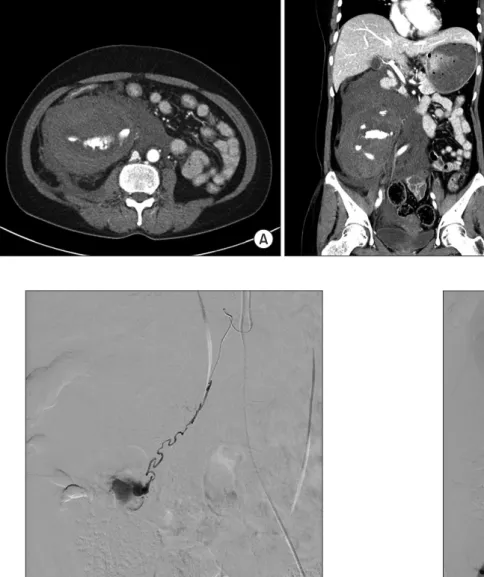
To investigate suspected hemoperitoneum, emer- gent contrast-enhanced abdominal and pelvic CT was performed. CT showed a large hematoma and active extravasation of intravenous contrast in the right retro- peritoneum. A moderate amount of hemoperitoneum was observed in the pelvic cavity and right subphrenic space (Fig. 1). Emergent transfemoral angiography revealed active contrast extravasation suggestive of an aneurysm at the distal portion of the right ovarian ar- tery (Fig. 2). Abdominal aortogram examined the main artery that could cause massive retroperitonal bleed- ing, including the abdominal aorta, and there were no
abnormal vascular findings (Fig. 3). Embolization was conducted using diluted glue (1:7) with a concerto coil (2 mm × 4 cm). Abdominal aortic angiogram showed no contrast extravasation after embolization (Fig. 4).
The next day, there was no significant change in amount of right retroperitoneal hematoma or hemo- peritoneum and no evidence of active bleeding on CT.
The abdominal pain gradually subsided, vital signs stabilized, and hemoglobin concentration increased to 10.1 g/dL. The patient was managed conservatively with antibiotics and did not need further surgical inter- vention. She was discharged 8 days after embolization and she did not complain of any symptoms during 2 months of follow-up.
https://doi.org/10.6118/jmm.21015
A B
Fig. 1. Contrast-enhanced dynamic computed tomography: A large he- matoma with active extravasation of intravenous contrast in the right retroperitoneum. A moderate amount of hemoperitoneum also was found in the pelvic cavity and right subphrenic space. (A) Coronal view. (B) Sagittal view.
Fig. 2. Abdominal aortogram: Selective right gonadal arteriogram
showing contrast extravasation at the right distal gonadal artery. Fig. 3. Abdominal aortogram: No abnormalities of the abdominal aorta and other arteries.
Yoon Hyeon Hu, et al.
104 www.e-jmm.org
DISCUSSION
Retroperitoneal hematoma is a life-threatening emer- gency event. Abdominal trauma resulting from iat- rogenic injury during large vessel surgery is the most common cause of retroperitoneal hemorrhage [1,2].
Furthermore, renal artery rupture, retroperitoneal tu- mor, and coagulopathic disorder have been suggested as major causes of retroperitoneal hemorrhage [3].
Most ruptures of an ovarian artery aneurysm are re- lated to pregnancy and occur during the peripartum or postpartum period. The hemodynamic and hormonal changes during pregnancy appear to cause arterial
alterations that can lead to new aneurysm formation and/or weakening of a preexisting aneurysm [4]. Post- partum uterine involution induces a dextrorotated uterus to return to the normal prepregnant position, and the associated physiological changes can be in- volved in the formation of ovarian artery aneurysms.
The clinical manifestation is often nonspecific and can be erroneously diagnosed as placental abruption or re- nal calculus.
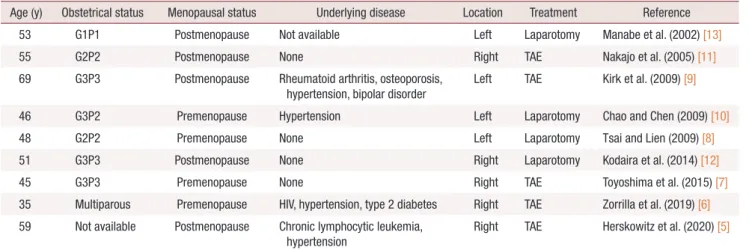
Based on a MEDLINE search of the English language literature from 1995 to 2020, only 9 cases of spontane- ous rupture of an ovarian artery aneurysm not related directly to pregnancy have been published (Table 1) [5- 13]. The ages of the patients ranged from 35 to 69 years (mean, 51.2 years), and 5 of 9 patients were postmeno- pausal. All reported cases occurred in multiparous women, as with our case.
Most previously reported ruptures of an ovarian artery aneurysm occurred in multiparous or grand multiparous woman, suggesting that repeat pregnancy is a risk factor for rupture of an ovarian artery aneu- rysm [14]. The repeated hemodynamic and endocrine changes during multiple pregnancies could be the cause of arterial change that can exacerbate an aneurysm or rupture a pre-existing aneurysm [10]. Of the 9 cases, 4 had hypertension, including ours. High blood pressure might be a risk factor for spontaneous rupture of ovar- ian artery aneurysm. Although we could not investigate the recent fluctuation of blood pressure in our case, such fluctuation might cause aneurysm rupture [10].
Because spontaneous rupture of an ovarian artery an- eurysm is rare, it might be underdiagnosed. The most common presenting symptom of rupture of ovarian
Table 1. Present case and 9 reported cases of spontaneous rupture of ovarian artery
Age (y) Obstetrical status Menopausal status Underlying disease Location Treatment Reference
53 G1P1 Postmenopause Not available Left Laparotomy Manabe et al. (2002) [13]
55 G2P2 Postmenopause None Right TAE Nakajo et al. (2005) [11]
69 G3P3 Postmenopause Rheumatoid arthritis, osteoporosis,
hypertension, bipolar disorder Left TAE Kirk et al. (2009) [9]
46 G3P2 Premenopause Hypertension Left Laparotomy Chao and Chen (2009) [10]
48 G2P2 Premenopause None Left Laparotomy Tsai and Lien (2009) [8]
51 G3P3 Postmenopause None Right Laparotomy Kodaira et al. (2014) [12]
45 G3P3 Premenopause None Right TAE Toyoshima et al. (2015) [7]
35 Multiparous Premenopause HIV, hypertension, type 2 diabetes Right TAE Zorrilla et al. (2019) [6]
59 Not available Postmenopause Chronic lymphocytic leukemia, hypertension
Right TAE Herskowitz et al. (2020) [5]
G: gravida, P: para, HIV: human immunodeficiency virus, TAE: transcatheter arterial embolization.
Fig. 4. Abdominal aortogram: After selective embolization of right gonadal artery.
105
Spontaneous Rupture of Ovarian Artery Aneurysm in a Postmenopausal Woman
artery aneurysm is acute abdominal and flank pain with hemodynamic instability. In earlier reports, an- eurysm rupture was diagnosed mostly by exploratory laparotomy. However, CT and angiography recently have improved the diagnostic process and location of hemorrhage. Contrast-enhanced abdominal CT can be helpful for rapid diagnosis and identification of bleed- ing focus. In our case, hematoma was found not only in the retroperitoneum, but also in the intraperitoneum and could be diagnosed on CT.
According to previously published literature [1,6,7], most of the spontaenous rupture of ovarian artery an- eurysm requires immediate management because they were accompanied by massive bleeding and life-threat- ening. Of the 9 published cases, 5 underwent successful TAE. Since TAE was used to successfully manage a rup- tured ovarian artery aneurysm in 1990 [15], it has been used as a treatment option along with ligation of the ovarian artery through laparotomy. Nevertheless, ex- ploratory laparotomy should be performed with failed TAE or if the patient is unstable hemodynamically.
In conclusion, we reported a rare case of spontaneous rupture of an ovarian artery aneurysm presenting as a retroperitoneal hematoma that was not associated with pregnancy. Diagnostic angiography followed by TAE can be an effective therapeutic procedure for such an event. In women presenting with severe acute pain of the abdomen and flank, rupture of an ovarian artery should be suspected, especially in multiparous women with retroperitoneal hematoma.
CONFLICT OF INTEREST
No potential conflict of interest relevant to this article was reported.
REFERENCES
1. Mondie C, Maguire NJ, Rentea RM. Retroperitoneal hematoma.
Treasure Island: StatPearls; 2021.
2. Sahu KK, Mishra AK, George SV, Siddiqui AD. Managing retro- peritoneal hematoma: associated complexities and its challenges.
Am J Emerg Med 2020; 38: 1957-8.
3. Codina Cazador A, Ruiz Feliu B, Roig García J, Tuca Rodríguez F, Farres Coll R, Masvidal Calpe R. [Retroperitoneal hematoma secondary to anticoagulation treatment as a cause of abdominal pain]. Rev Esp Enferm Dig 1993; 83: 133-5. Spanish.
4. Enakpene CA, Stern T, Barzallo Salazar MJ, Mukherjee P. Sponta- neous rupture of an ovarian artery aneurysm: a rare postpartum complication. Case Rep Obstet Gynecol 2016; 2016: 1029561.
5. Herskowitz MM, Wong CM, Leonardo RF. Ruptured ovarian artery pseudoaneurysm in a postmenopausal patient treated with transcatheter embolization. Case Rep Radiol 2020; 2020: 6728318.
6. Zorrilla AM, Fein LA, James K, Alhman PP, Mohan PP, Pastor Carvajal SM. Retroperitoneal hematoma secondary to spontane- ous rupture of ovarian artery pseudoaneurysms: case report and review of literature. J Obstet Gynaecol 2019; 39: 422-4.
7. Toyoshima M, Kudo T, Igeta S, Makino H, Momono Y, Shima T, et al. Spontaneous retroperitoneal hemorrhage caused by rupture of an ovarian artery aneurysm: a case report and review of the lit- erature. J Med Case Rep 2015; 9: 84.
8. Tsai MT, Lien WC. Spontaneous rupture of an ovarian artery an- eurysm. Am J Obstet Gynecol 2009; 200: e7-9.
9. Kirk JS, Deitch JS, Robinson HR, Haveson SP. Staged endovascu- lar treatment of bilateral ruptured and intact ovarian artery aneu- rysms in a postmenopausal woman. J Vasc Surg 2009; 49: 208-10.
10. Chao LW, Chen CH. Spontaneous rupture of an ovarian artery aneurysm: case report and review of the literature. Gynecol Obstet Invest 2009; 68: 104-7.
11. Nakajo M, Ohkubo K, Fukukura Y, Nandate T, Nakajo M. Embo- lization of spontaneous rupture of an aneurysm of the ovarian ar- tery supplying the uterus with fibroids. Acta Radiol 2005; 46: 887- 90.
12. Kodaira Y, Iwamura T, Hoshino H, Takahashi K, Kawahigashi Y, Matsumoto K. Spontaneous rupture of aneurysms of the ovarian artery at times remote from pregnancy. J Nippon Med Sch 2014;
81: 101-5.
13. Manabe Y, Yoshioka K, Yanada J. Spontaneous rupture of a dissec- tion of the left ovarian artery. J Med Invest 2002; 49: 182-5.
14. Sakaguchi I, Ohba T, Ikeda O, Yamashita Y, Katabuchi H. Embo- lization for post-partum rupture of ovarian artery aneurysm: case report and review. J Obstet Gynaecol Res 2015; 41: 623-7.
15. King WL. Ruptured ovarian artery aneurysm: a case report. J Vasc Surg 1990; 12: 190-3.
https://doi.org/10.6118/jmm.21015