H. Y. Jeong ・ A. H. Naing ・ C. K. Kim ()
Department of Horticultural Science, Kyungpook National University, Daegu 41566, Korea
e-mail: [email protected]
Establishment of protocol for genetic transformation of carnation with 1-aminocyclopropane-carboxylate deaminase (acdS) gene
Hui Yeong Jeong ・ Aung Htay Naing ・ Chang Kil Kim
Received: 13 June 2021 / Revised: 28 June 2021 / Accepted: 28June 2021
ⓒ Korean Society for Plant Biotechnology
This is an Open-Access article distributed under the terms of the Creative Commons Attribution Non-Commercial License (http://creativecommons.org/licenses/by-nc/4.0) which permits unrestricted non-commercial use, distribution, and reproduction in any medium, provided the original work is properly cited.
Abstract This study was conducted to develop an Agro- bacterium-mediated genetic transformation protocol for the carnation cv. “Jinju” to counteract its ethylene sensitivity.
The new protocol involves the use of an improved shoot regeneration medium, optimized minimal concentrations of the selective agent, a pre-culture period, and co-cultivation periods. Silver nanoparticles (NAg) added at a concentration of 2.0 µM to the Murashige and Skoog (MS) basal shoot regeneration medium supplemented with 0.1 mg/L indole-3- butyric-acid (IBA) and 0.2 mg/L thidiazuron (TDZ) improved the shoot regeneration efficiency, number of shoots per explant, and plant growth compared to the control without the addition of NAg. The phosphinothricin (PPT) concentration of 1.0 mg/L was determined to be the minimal and optimal concentration for the selection of putative transgenic plants.
When the explants were infected with Agrobacterium cells harboring the acdS gene, the explants that were pre-cultured for three days induced more putative transgenic plants than those that were co-cultivated for four days. Therefore, we expect that the results of this study will benefit researchers who are developing genetic transformations of carnations.
Keywords Carnation, Transformation, 1-aminocyclopropane- 1-carboxylate deaminase, Ethylene, Vitrification
Introduction
Around the world, carnations are one of the three most popular cut flowers in floristry due to their high attract- iveness to consumers. Currently, the market value of car- nations is steadily increasing and is expected to reach 2,950
million USD in 2024 (Naing et al. 2021). However, as car- nation flowers are highly sensitive to ethylene, their post- harvest flower quality is negatively affected by the ethylene that is produced during long-term transportation through domestic or global markets before arriving in consumers’
hands, which means that low-quality flowers are being sold on the market. Low-quality cut flowers are poor market competitors for high-quality flowers, and this results in significant economic losses for florists and floriculturists.
To overcome the problem, many attempts have been made to reduce the sensitivity of carnations to ethylene. Metabolic engineering, conventional breeding, and ethylene inhibitors are some of the approaches that have been used to reduce ethylene sensitivity. Although ethylene inhibitors have been proven to reduce ethylene production, they create environ- mental pollution and pose a risk to public health. Although the conventional breeding technique has long been used to produce novel cultivars, but it is difficult to obtain a cultivar with desirable traits due to the large number of genes that exist in its genome.
Plants produce ethylene due to the accumulation of the 1-aminocyclopropane-1-carboxylic acid (ACC) enzyme, which is an ethylene precursor found in plant tissues. ACC is converted into ethylene by ACC oxidase. The ACC de- aminase enzyme present in plant growth-promoting bacteria (PGPB) is encoded by the acdS gene, and ACC deaminase can break down ACC into ammonia and α-ketobutyrate (Glick et al. 2014). A promising approach for reducing ethylene production is to break down ACC accumulation in plant tissues with overexpression of the acdS gene isolated from PGPB. Overexpression of the acdS gene via Agrobacterium-mediated genetic transformation has been demonstrated to reduce ACC accumulation and ethylene production in horticultural plants such as tomato, canola, Camelina sativa, and petunia (Grichko 2000; Grichko and Glick 2001; Heydarian et al. 2016; Klee 1991; Nie 2002;
Sergeeva 2006; Stearns 2005). In their studies, transgenic
Research Article
plants overexpressing the acdS gene produced lower levels of ethylene, which improved flower longevity, shelf life, and abiotic stress tolerance. However, genetic transformation of carnations is limited by a low shoot regeneration rate and other adverse factors, such as an inefficient pre-culture period and co-cultivation period. Thus, the genetic trans- formation process might impede the efficiency of genetic transformation efficiency (Naing et al. 2016). To date, the overexpression of the acdS gene has not been achieved in carnations. Therefore, it would be a breakthrough to develop a genetic transformation protocol for carnations that over- expresses the acdS gene if it produces an ethylene-resistant carnation cultivar.
In this study, we optimized factors that are involved in the Agrobacterium-mediated genetic transformation process to develop transgenic carnations overexpressing acdS to evaluate the effects on ethylene production and the quality of cut carnations.
Materials and Methods Plant material
In a previous study, in vitro vitrified leaves exhibited superior shoot regeneration efficiency compared with normal leaves (Thu et al. 2020). In addition, utilization of in vitro vitrified carnation leaves as explants produced a transgenic carnation (Firoozabady et al. 1995). Therefore, in this study, induction of vitrified leaves was performed by culturing 4-week-old carnation shoot tips (cv. Jinju) in a Murashige and Skoog (MS) basal medium (pH 5.7) with 2% sucrose (LPS solution, Korea), 80 mg/L adenine hemisulfate (MB cell, Korea), and 85 mg/L sodium phosphate monobasic (Sigma, Germany).
The culture bottles were placed at 25°C ± 2°C under a 16 h photoperiod with 70 µmol m
-2s
-1light intensity. After four weeks of culture, vitrified leaves were used as materials for shoot regeneration and genetic transformation.
Effect of sodium nitroprusside (SNP) and sliver nanoparticles (NAgPs) on shoot regeneration
The combination of indole-3-butyric-acid (IBA 0.1 mg/L) (Duchefa, The Netherlands) and thidiazuron (TDZ 0.2 mg/L) (Duchefa, The Netherlands) induced a reasonable number of shoots per leaf explant (approximately 0.5 cm in size) in the carnation cv. Jinju (Thu et al. 2020). To verify whether the addition of sliver nanoparticles (Sigma-Aldrich, Germany) or sodium nitroprusside (Sigma-Aldrich, Germany) to the
shoot regeneration media would improve shoot regeneration efficiency and plant growth, different concentrations (0, 0.25, 0.5, 1.0, 1.5, 2.0 µM sliver nanoparticle or 0, 5, 10, 15, 20, 30 µM sodium nitroprusside) were added to the shoot regeneration media. Leaf segments (approximately 0.5 ~ 1.0 cm) excised from the 4-week-old in vitro vitrified leaves were cultured on regeneration media containing dif- ferent concentration of nano silver particles or sodium nitroprusside. The plates were placed at the same culture condition as described above. One treatment contained ten explants, and there were three replicates for each treatment.
Data on the percentage of shoot induction and number of shoots per explant were collected after four weeks of culture.
Optimization of the PPT concentration for the selection of putative transgenic explants
To reduce the risk of damage to putative transgenic plants during the selection period, different concentrations of the selective agent phosphinothricin (0, 0.3, 0.5, 1.0, and 1.5 mg/L PPT) were added to the shoot regeneration medium.
Then, four-week-old in vitro vitrified leaves were segmented cut into 0.5 ~ 1.0 cm pieces and used as sources of explants.
The segments were cultured in shoot regeneration media containing PPT. Each treatment contained ten explants with three replications. The plates were placed in the same incu- bation room as described above. After four weeks of culture, the minimum concentration that suppressed shoot generation was determined and recorded.
Plasmid construction
Agrobacterium tumefaciens strains GV3101 harboring the plasmid pCB302-3 were used in this study. The plasmid was constructed with the acdS gene isolated from Pseu- domonas veronii-KJ (Jung et al. 2018), in which the acdS gene was placed under the control of the cauliflower mosaic virus 35S (CaMV 35S) promoter, and the bar gene conferring PPT resistance was used as the selection marker.
Effect of the pre-culture period on shoot regeneration Whole leaves (approximately 0.5 to 1.0 cm) were excised from the vitrified plants of 4-week-old in vitro plants.
Explants were initially pre-cultured in the shoot regeneration
medium for 1, 2, and 3 days under dark conditions. The
shoot regeneration medium (pH 5.8) supplemented with
2.5% gelrite, 3% sucrose, 590 mg/L MES monohydrate
(Duchefa, The Netherlands), 0.1 mg/L indole-3-butyric acid (Duchefa, The Netherlands), and 0.2 mg/L thidiazuron (TDZ;
Duchefa, The Netherlands). After that, the plates were placed in the same incubation room as described above. Each treatment contained ten explants with three replications.
After four weeks of culture, the percentage of shoot regen- eration and number of shoots per explant were recorded.
Effect of the co-cultivation period on shoot regeneration from leaf explants inoculated with Agrobacterium
Based on the above preculture period result, the explants were pre-cultured for three days in the dark. Agrobacterium tumefaciens strains GV3101 were cultured for two days on solid Luria Broth containing antibiotics (50 mg/ml kanamycin and 25 mg/ml rifampicin) and were inoculated in liquid Luria Broth containing antibiotics (50 mg/ml kanamycin and 25 mg/ml rifampicin) for 15 ~ 16 hours on a rotary shaker (at 28℃, 200 rpm, dark). The Agrobacterium sus- pension was pelleted using a centrifuge at 3,500 rpm for 20 minutes. The upper solution was removed using a pipette, and a liquid solution (pH 5.4) containing 1% sucrose, ½ MS, and 100 µM acetosyringone were used to reveal its effects on the transformation efficiency. Following this method, the pre-cultured explants were infected with Agro- bacterium suspension, which was adjusted to an OD
600= 0.6 ~ 0.7 and incubated at 28℃ on a rotary shaker at 50 rpm for 15 minutes. After inoculation, the explants were blotted dry on sterilized tissue and placed on the pre- treatment medium again. To optimize the co-culture period, the infected leaf explants were plated onto the medium for 3, 4, or 5 days. Each treatment contained ten explants with three replicates. From pre-treatment to co-cultivation, the petri dishes were plated in the dark. After that, they were transferred to light condition. The plates were placed in the same incubation room as described above.
Regeneration of putative transgenic explants
After co-cultivation, explants were washed three times with distilled water (pH 5.8) containing 300 mg/L ticarcillin disodium/
clavulanate potassium (Duchefa, The Netherlands). After blotting dry using sterilized tissue paper, leaf segments were transferred on MS medium (pH 5.8) supplemented with 2.5% gelrite, 3% sucrose, 590 mg/L MES monohydrate, 0.1 mg/L IBA, 0.2 mg/L TDZ, 1.0 mg/L PPT, and 300 mg/L ticarcillin disodium/clavulanate potassium.
After three weeks, the shoots were regenerated and trans- ferred to a new medium that had the same composition for
another three weeks. If small shoots clusters had been formed, they were separated into 2 ~ 3 sections. After another three weeks, the shoot clusters were harvested and moved to the rooting medium (pH5.7) supplemented with MS media, 2%
sucrose, 80 mg/L adenine hemisulfate, 85 mg/L sodium phosphate monobasic, and 0.8% plant agar for three weeks.
To normalize the vitrified shoots, the elongated shoots were selected and transferred to a conversion medium (pH5.7) that has the same composition as the rooting medium with 1% plant agar instead of 0.8% for four weeks. Healthy normal shoots were harvested two to three times in the subcultures.
Statistical analysis
A statistical analysis was conducted using SPSS (version 25.0). All data were presented as mean and bar in the figure shown the standard deviation. ANOVA was conducted to show differences between groups by Duncan’s multiple range test (DMRT, p ≤ 0.05). Each treatment was performed in triplicate.
Results and Discussion
Effect of sodium nitroprusside (SNP) and sliver nanoparticles (NAgPs) on shoot regeneration
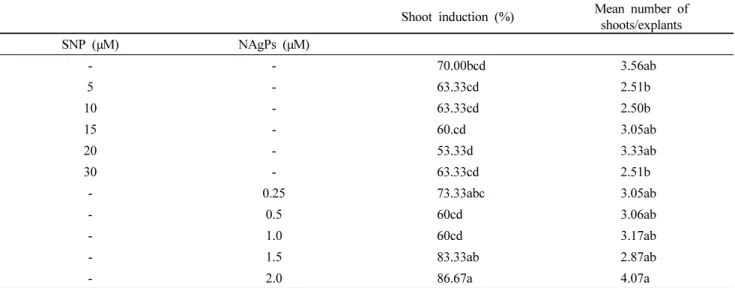
The addition of different concentrations of SNP to the
shoot regeneration medium could neither improve shoot
regeneration and the number of shoots per explant nor
shoot growth or size. Similar results were observed when
different concentrations of NAgPs (0.25 ~ 1.5 µM) were
added to the shoot regeneration media, whereas the per-
centage of shoot regeneration observed in 1.5 µM NAgPs
was significantly better than the control (Table 1). In con-
trast to other treatments, 2.0 µM NAgPs significantly
improved the percentage of shoot regeneration and number
of shoots per explant as well as plant growth and size
compared to other treatments, including the control. There-
fore, it can be ruled out that SNP is not applicable for
improving the shoot regeneration of this cultivar, whereas
2.0 mg/L NAgPs were applicable. A positive effect of NAg
was also observed in the in vitro shoot growth of Hosta
capitata (Pe et al. 2020), whereas lower NAg concentrations
did not promote plant growth or shoot regeneration, as
was observed in this study, yet a higher NAg concentration
promoted plant growth and shoot regeneration. In our pre-
vious study (Thu et al. 2020), the combination of 0.1 mg/L
Table 1 Effects of different NAgPs and SNP concentrations on shoot regeneration of carnation
Shoot induction (%) Mean number of shoots/explants
SNP (μM) NAgPs (μM)
- - 70.00bcd 3.56ab
5 - 63.33cd 2.51b
10 - 63.33cd 2.50b
15 - 60.cd 3.05ab
20 - 53.33d 3.33ab
30 - 63.33cd 2.51b
- 0.25 73.33abc 3.05ab
- 0.5 60cd 3.06ab
- 1.0 60cd 3.17ab
- 1.5 83.33ab 2.87ab
- 2.0 86.67a 4.07a
Different letters denote significant differences at p ≤ 0.05
of IBA and 0.2 mg/L of TDZ provided a reasonable per- centage of shoot regeneration (66.67%) and 3.46 number of shoots per explant in the carnation cv. Jinju. This was determined to be the optimal combination for Agrobacterium- mediated genetic transformation. However, the shoots induced from the leaf explants showed slow growth and were small in size. Therefore, we tried to improve the regeneration media by adding various concentrations of SNP and NAgPs. SNP and NAgPs promoted shoot regeneration efficiency and in vitro growth in previous studies (Arun 2017; Castro-Gonzalez et al. 2019; Kim 2017; Subiramani 2019). In contrast to those studies, SNP at any concentration did not promote the number of shoots per explant and even suppressed them in some cases. This was not in agreement with the results of Arun et al. (2017), who claimed that 0.83 µM SNP could promote shoot regeneration and plant growth in chrysanthemums. This discrepancy could be due to the difference in plant species and/or plant growth regulators used in the regeneration medium; BA 4.44 µM was used in the study by Arun et al. (2017). In fact, the concen- trations used in our study and that of Pe et al. (2020) were relatively different, despite their positive effects. This discrepancy may be due to the different plant species that were used. Considered together, the media comprising IBA (0.1 mg/L), TDZ (0.2 mg/L), and NAgPs (2.0 µM) was selected as the optimal media composition for Agrobacterium- mediated genetic transformation of carnation cv. Jinju.
Optimization of the minimal PPT concentration on the suppression of shoot regeneration
To obtain an efficient transformation protocol, optimization
of the minimal concentration of a selective agent was an essential step during the selection period. Because a high concentration of a selective agent such as PPT can kill transgenic plants, a lower concentration can give both escape and putative transgenic plants, which will be laborious in the further selection of putative transgenic plants.
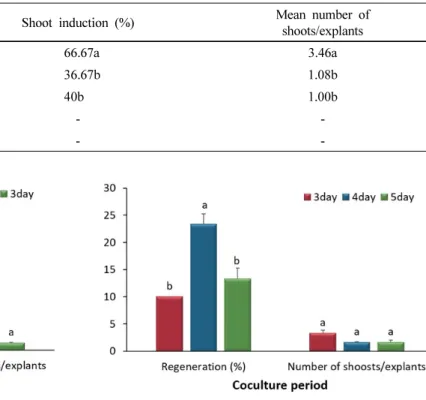
In this study, the addition of different concentrations of PPT (0.3 ~ 0.5 mg/L) to the shoot regeneration medium did not completely suppress shoot regeneration, whereas complete suppression of shoot regeneration was observed in media containing PPT (1.0 or 1.5 mg/L) (Table 2). Based on this result, 1.0 mg/L PPT is optimal minimal concentration that can kill escape plants (non-transgenic plants).
Effect of the pre-culture period on shoot regeneration In this study, pre-culturing the explants in the shoot re- generation media for three days prior to Agrobacterium infection promoted high transformation efficiency compared to that after one or two days. The explants were pre-cultured in the shoot regeneration medium and were placed in a dark condition for 1, 2, or 3 days, followed by infection with Agrobacterium cell suspension and co-cultivation for 3 days.
On the selection medium containing 1.0 mg/L PPT, the
induction of shoots was observed from the cut-edge of the
explants. However, the explants pre-cultured in a dark con-
dition for 3 days exhibited a higher percentage of shoot
regeneration, although the number of shoots per explant
was not significantly different (Fig. 1). Therefore, it was
suspected that a pre-culture of the explants for three days
would improve the transformation efficiency of carnation
cv. Jinju.
Fig. 1 Effects of pre-cultivation period on regeneration and number of shoots/explants of carnations (DMRT, p ≤ 0.05)
Table 2 Effects on different PPT concentrations on carnation shoot regeneration (DMRT, p ≤ 0.05)
PPT concentration (mg/L) Shoot induction (%) Mean number of
shoots/explants
- 66.67a 3.46a
0.3 36.67b 1.08b
0.5 40b 1.00b
1.0 - -
1.5 - -
Fig. 2 Effect of co-culture period on regeneration and number of shoots/explants of carnation (DMRT, p ≤ 0.05)
During the genetic transformation process, before explants were infected with an Agrobacterium cell suspension, the pre-culture of the explants in a dark condition was important for improving the transformation efficiency (M.Marutani-Hert et al. 2012). Pre-culturing the explants in shoot regeneration media for an optimum period increased the competency of Agrobacterium, as cell division and dedifferentiation were initially started (Chateau et al. 2000). Although the precise mechanism of action is not yet known, the thin walls of cells were newly formed after vigorous cell division due to the effects of pre-culturing on shoot regeneration, changes in microtubule composition, and increases in plant cells in the S-phase, which make it easy to insert T-DNA (Sangwan et al. 1992). However, the longer the pre-treatment period, the longer the wound recovery period, which makes it dif- ficult for bacteria, get through to the plant cell.
Effect of the co-cultivation period on shoot regeneration According to the results shown in Figure 1, a pre-culture of the explants in the dark condition for three days exhibited improved regeneration efficiency.
In this study, when the co-cultivation periods were extended three to five days, a variation in shoot regeneration efficiencies was observed, specially the explants that were
co-cultivated with Agrobacterium cells for four days sig- nificantly improved the shoot regeneration of the PPT- containing media compared to those co-cultivated for three or five days, despite no difference in the number of shoots per explant (Fig. 2). This indicated that the application of the pre-culture period (three days) and co-cultivation period (four days) would have more potential to improve the transformation efficiency of this carnation. Agrobacterium cells transfer their T-DNA into the plant genome during the co-cultivation period (Thomashow et al. 1980). If the co-cultivation period is too short, bacteria are not able to effectively transfer their T-DNA into the plant genome.
Similarly, if the co-cultivation period is too long, over-growth of bacteria can occur in the explants, and which will negatively affect the survival of the explants.
In the above experiments, shoots were induced from the
edge of the explants in the selection medium. Most of the
shoots were vitrified and likely to have low chlorophyll
contents in their leaves (Fig. 3A). The shoots produced
roots in the rooting media and converted to normal shoots
when they were further cultured on hormone-free MS
media containing 1.0% plant agar (Fig. 3B). Subsequent
transfer of the normalized plants to the same media
containing 1.0% plant agar produced completely normalized
plants (Fig. 3C).
Fig. 3 Transformation of Dianthus caryophyllus L. cv. Jinju. (A) Shoot regenerated after four weeks in the selection medium (bar
= 1 mm). (B) Shoots gradually changed to normal in the conversion medium. (C) Shoots normalized and rooted in the conversion medium