131
Lactobacillus rhamnosus _p1을 이용한 절단형 고다치즈 제조방법 및 숙성 중 품질특성
박종혁1*․정후길1․문혜정1․오전희1․이주희1․김명곤2․나상언3․김윤정3․황영태4
1임실치즈과학연구소, 2전북대학교 바이오식품공학과,
3전라북도보건환경연구원 식약품분석과, 4우리촌
Manufacture of Cutting-Gouda Cheese using Lactobacillus rhamnosus_p1 and the Physicochemical Properties of Gouda Cheese during Ripening Periods
Jong-Hyuk Park1*, Hoo-Kil Jung1, Hye-Jung Moon1, Jeon-Hui Oh1, Joo-Hee Lee1, Myung-Kon Kim2, Sang-Eon Na3, Youn-Jeong Kim3 and Young-Tae Hwang4
1Imsil Research Institute of Cheese Science, Imsil 566-881, Korea
2Dept. of Bio Food Technology, Chonbuk National University, Iksan 570-752, Korea
3Division of Food and Drug Analysis, Jeollabuk-Do Institute of Health & Environment Research, Imsil 566-806, Korea
4Woorichon Co., Imsil 566-861, Korea
Abstract
The aim of this study was to manufacture Cutting-Gouda cheese and to investigate the change in physicochemical properties of Cutting-Gouda cheese made with Lactobacillus rhamnosus_p1. Lactic acid bacteria were isolated from Gouda cheese ripened for more than 1 year. They were identified as 2 strains of L. rhamnosus, Lactobacillus casei, Lactobacillus curvatus, and Staphylococcus saprophyticus by 16S rDNA sequencing and named L. rhamnosus_p1, L. casei_p2, L.
curvatus_p3, L. rhamnosus_p4 and S. saprophyticus_p5. The proteolytic activities of isolated strains against casein were measured using prepared skim milk agar plates. L. rhamnosus_p1 showed the highest proteolytic activity. Cutting-Gouda cheese was made with L. rhamnosus_p1, and its physicochemical properties (moisture, protein, fat, ash and free amino acid content) were measured during ripening periods. Because of the modified atmosphere packaging (N2-), there was no change in moisture, protein, fat, and ash in the experimental group. The total amount of free amino acids in the control and experimental group gradually increased during ripening periods. The sensory evaluation showed that the experimental group was preferable to the control group. This result suggests that L. rhamnosus_p1 has potential to be developed as a new starter for Gouda cheese.
Keywords: Gouda cheese, lactic acid bacteria, Lactobacillus rhamnosus, proteolysis
* Corresponding author: Jong-Hyuk Park, Imsil Research Institute of Cheese Science, Imsil 566-881, Korea. Tel: +82-63-644-2181, Fax: +82-63-644-2185, E-mail: [email protected]
서 론
치즈(Cheese)란 생우유, 저지방유, 탈지유 또는 크림 등 에 유산균, rennet, 산 등을 첨가하여 casein을 응고시켜 유 청을 제거한 후 압축, 성형 등의 처리에 의하여 만들어진
신선한 응고물 또는 발효 숙성 유제품을 말한다(Lee and Nam, 1996). 치즈의 품질은 치즈 제조 시 사용되는 원료유, 미생물, 응유효소 및 제조공정 등에 따라서 차이가 난다고 보고되어 있다(Lee and Nam, 1996). 치즈의 독특한 풍미성 분 생성 및 조직의 형성은 rennet의 작용에 의한 curd 형성 단계와 미생물 또는 미생물 분비효소들에 의한 숙성단계가 있으며, 이러한 숙성은 치즈를 일정한 조건하에서 보존하 면서 치즈의 조직과 풍미를 갖도록 하는 제조 과정 중의 하 나로 단백분해, 지방분해 등의 생화학적 및 효소학적 그리 고 미생물학적 변화가 일어나, 부드럽고 유연한 조직과 고 유의 풍미를 준다고 보고되어 있다(Visser, 1977). Gouda cheese는 네덜란드 남부의 Gouda 지방이 원산지이며, 담황 색 또는 버터 황색의 원반형이 많고, 수분함량이 30~40%인 경질 cheese로 세계적으로 널리 알려진 네덜란드 타입의 cheese이며, 주로 사용되는 starter bacteria로는 Lactococcus lactis subsp. cremoris, Lc. lactis subsp. diacetylactis, Lc. lactis subsp. lactis, Leuconostoc mesenteroides subsp. cremoris 등이 사용되며, 단독균주 또는 복합균주로 사용하여 제조된다 (Van den Berg et al., 2004). Gouda cheese의 풍미에 영향 을 주는 주요 휘발성 향기성분으로는 지방유래 휘발성성분 (methyl ketons, 유리지방산, lactones 및 ehtyl ester)보다는 단백질 분해효소에 의해 단백질의 분해로 생성되는 아미노 산에 의한 영향을 많이 받는 것으로 보고되어 있다(Van Kranenburg et al., 2002). Grappin 등(1985)은 숙성이 진행 됨에 따라 수용성 질소, 비단백태 질소 및 아미노태 질소 함량도 증가한다고 하였으며, Yamauchi 등(1986)은 이러한 증가는 단백질분해효소 시스템에 기인한 것으로 보이며, 이러한 기작은 사용되는 rennet 및 starter bacteria에 의해서 다양한 풍미가 형성된다고 보고하였다. Gouda cheese의 풍 미 향상을 위해 stater bacteria의 변화, 유지방성분의 변화 및 rennet 첨가량의 변화 등의 연구가 진행되어 왔으나, 상 업적 이용은 미비한 실정이다(Visser and De Groat-Mastert;
1977, Visser, 1977; Exterkate et al., 1987). Starter bacteria 에 의한 단백질 분해 작용을 강화하거나 유리아미노산을 첨가하여 치즈 내에서 유리아미노산의 함량을 증가시키는 방법으로는 cheese의 풍미 향상에 영향을 주지 않는 것으로 보고되어 있으며(Visser, 1977; Wallace and Fox, 1997), Yvon 와 Rijnen(2001)는 유산균이나 Brevibacterium linens와 같 은 starter bacteria 이외의 치즈 숙성 중 관여하는 비의도적 미생물에 의한 아미노산 이화작용을 연구함으로 치즈 풍미 성분 생성을 촉진시키는 방법을 제시하였다. 그러나 Gouda cheese는 염지 후 표면을 수용성 plastic coating 처리를 함 으로써 비의도적 미생물의 오염을 최소로 하면서 치즈 숙 성을 진행하는데, 이때 표면은 딱딱하고 내부는 부드러운
제형이 나타나게 된다. 딱딱해진 표면은 섭취가 어려워 표 면을 제거해야 하는 문제점이 발생하게 됨으로써 Gouda cheese 제조 시 성형 방법을 개선할 필요가 있다고 보여진다.
따라서 본 연구는 고다치즈의 숙성기간 단축 및 풍미 향 상을 위하여 1년 이상 숙성된 고다치즈에서 단백분해능이 우수한 유산균주를 screening 하여 L. rhamnosus_p1을 분 리․동정하였으며, 이 균주를 이용하여 성형방법을 개선한 고다치즈를 제조하고, 숙성기간에 따른 품질변화를 측정하 여 국내산 고다치즈의 풍미 향상을 위한 기초자료로 사용 하고자 한다.
재료 및 방법
1. 재료
유산균 분리를 위하여 1년 이상 숙성된 고다치즈는 이플 영농조합법인(Imsil, Korea), 치즈가(Imsil, Korea) 및 Westlann kaasexport사(Zuiderzee, Holland)에서 제조된 시판제품을 구입하여 실험에 사용하였다. 고다치즈 제조에 사용된 원 유는 임실지역 낙농가에서 착유하여 사용하였으며, 상업용 균주는 Chr. Hansen사(Hørsholm, Denmark)의 Flora Danica 50을 이용하였으며, 구성 균주는 Lc. lactis subsp. cremoris, Lc. lactis subsp. diacetylactis, Lc. lactis subsp. lactis, Leu.
mesenteroides subsp. cremoris로 구성되어 있다. Starter 배 양을 위한 배지로는 환원 탈지유(Seoul Milk Co., Ltd., Korea) 를 10% 농도로 희석하여 사용하였다.
2. 유산균 분리 및 배양
1년 이상 숙성된 고다치즈 시료를 각각 25 g과 멸균생리 식염수 225 mL를 sterile filter bag에 넣고 stomacher(Easy Mix, AES chemunex, France)를 이용하여 혼합하였다. 여기 서 액상부분 1 mL를 취하여 십진 희석법으로 희석한 후 100 μL를 취해 MRS agar(Lactobacilli MRS agar, Difco, USA)에 도말하여 37℃에서 24시간 배양하였다. 각 시료별 배지에서 형태가 다른 단일 colony를 1차 분리하였다. 1차 분리된 균주들을 BCP agar(Eiken chemical Co., Ltd., Japan) 에 획선평판법으로 접종한 후 37℃에서 24시간 배양하여 노란색을 보이는 colony를 2차 분리하였다. 이플 올드 고다 치즈 제품으로부터 2종, 치즈가 고다치즈 제품으로부터 2 종, 올드 암스테르담 제품으로부터 1종이 분리되었으며, 이 를 MRS agar에 접종하여 37℃에서 24~72시간 배양 후 4℃
로 냉장 보관하면서 사용하였다.
3. 분리된 유산균의 단백질 가수분해능 실험
치즈 단백질의 대부분을 차지하는 casein을 가수분해할
수 있는지 측정하기 위하여 nutrient agar 23 g과 skim milk 50 g을 증류수 100 mL에 녹인 후 멸균한 다음 plate에 20 mL로 분주 후 굳혔다. 그 후 분리된 유산균주를 백금이로 도말하여 균체주위에 투명환이 나타나는지 측정하였다.
4, 내산성 측정
1 N HCl를 사용하여 pH 2.5로 조정한 MRS broth(Lacto- bacilli MRS broth, Difco, USA)를 사용하여 내산성을 측정 하였다. 분리된 유산균을 MRS broth에서 37℃로 24시간 배양한 후 4,000 rpm에서 15분간 원심분리 후 상등액을 버 리고 균을 회수하였다. pH 2.5로 조정한 MRS broth 10 mL 에 회수한 균 1%를 접종하여, 37℃에서 2시간 배양한 후 생균수를 측정하였다.
5. 분리 균주의 동정
분리균은 16S rRNA 결정법으로 동정하였으며, 염기서 열 분석회사인 (주)Macrogen(Daejeon, Korea)에 의뢰하여 수 행하였다. 균의 16S rRNA를 universal primer인 27F(5'-AG AGTTTGATCMTGGCTCAG-3')와 1492R(5'-TACGGYTAC CTTGTTACGACTT-3') primer를 사용하여 PCR(DNA engine tetrad 2 peltier thermal cycler, Bio-rad lab., USA)을 수행하 여 증폭시켰다. PCR 산물은 BigDye Terminator v3.1 cycle sequencing kit(Applied Biosystems, Belgium)를 이용하여 ABI Prism 3730XL analyzer(Applied Biosystems, Belgium)로 염 기서열을 분석하였다. 그 결과는 NCBI BLASTN 프로그램 (http://blast.ncbi.nlm.nih.gov/Blast.cgi)을 사용하여 유산균을 동정하였다.
6. 분리 균주를 이용한 고다치즈 제조
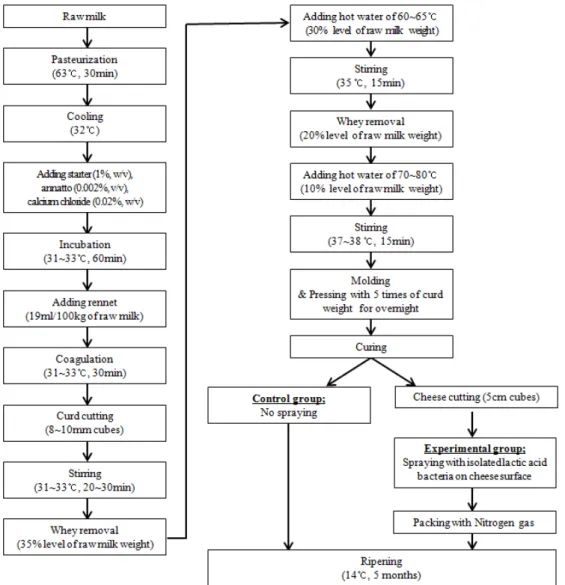
치즈제조용 starter는 MRS broth에 2회 계대배양한 선발 균주를 10%(w/v) 환원탈지유에 1%(v/v) 접종하여 108 CFU/mL 이상으로 배양한 후 4℃로 냉장보관하며 사용하였다. 상업 용 균주인 Flora Danica 50을 상기와 동일한 방법으로 배양 하여 사용하였다. 대조군은 Flora Danica 50 만을 starter로 사용하였고, 실험군은 Flora Danica 50을 이용하여 치즈를 만든 후 최종제품을 세절하고 분리균주를 1×10⁸ CFU/mL 농도로 조정하여 분무기로 세절한 Gouda cheese 표면에 3 초간 분사한 다음, 건조 후 질소치환 포장을 하여 14℃ 저 온 저장고에서 5개월간 숙성하면서 1개월마다 시료를 채취 하여 이화학분석시료로 사용하였다(Fig. 1).
7. 일반성분 분석
AOAC법에 따라서 수분, 단백질, 지방과 회분 함량을 측 정하였으며, 1개월 간격으로 총 5개월 동안의 변화를 측정
하였다(AOAC, 1990).
8. pH 측정
pH는 시료를 10 g 취하여 멸균생리식염수 20 mL로 균질 화 시킨 다음, pH meter(UB-10, Denver Instrument Co., Ltd., USA)를 이용하여 1개월 간격으로 총 5개월 동안의 변화를 측정하였다.
9. 유리아미노산 분석
유리아미노산의 정량 분석은 소요시간이 상대적으로 짧은 Waters AccQ-tag 방법을 이용하여 분석하였다. HPLC(Waters e2695, Waters Co., USA)의 분석조건은 Table 1과 같으며, 17종의 아미노산 표준품으로 aspatic acid(Asp), serine(Ser), glutamic acid(Glu), glycine(Gly), histidin(His), arginine(Arg), threonine(Thr), alanine(Ala), proline(Pro), cysteine(Cys), tyro- sine(Tyr), valine(Val), methionine(Met), lysine(Lys), isoleucine (Ile), leucine(Leu), phenylalanine(Phe)과 AccQ-Fluor reagen 및 Borate buffer는 Waters사 제품을 사용하였다.
10. 유산균수 측정
고다치즈의 숙성 중 유산균수의 변화는 1개월 간격으로 시료를 채취하여 멸균식염수에 십진 희석법으로 희석한 뒤, BCP 한천배지를 이용하여 평판배양법으로 37℃에서 48시간 배양하였다. 그 후 나타난 노란색 colony 수를 측정 하여 log CFU(colony forming unit)/mL로 나타내었다.
11. 고다치즈의 관능검사
관능검사요원 15명을 대상으로 색(color), 향(flavor), 맛 (taste), 조직감(texture) 및 전반적인 기호도(overall acceptability) 를 5점 척도법으로 평가하도록 하였다.
결과 및 고찰
1. 스타터 제조를 위한 유산균 분리 및 동정
고다치즈 제조를 위한 유산균주의 분리원은 1년 이상 숙 성된 고다치즈를 사용하였으며, MRS agar를 이용하여 총 5 종의 균주를 분리하였다(Table 2). 분리 유산균주는 이플 고다치즈에서 분리한 L. rhamnosus, L. casei 2종과 치즈가 고다치즈에서 분리한 L. curvatus, L. rhamnosus 2종, 올드 암스테르담에서 분리한 S. saprophyticus 1종이 분리되었으 며, 16s rDNA의 염기서열을 표준 균주와 비교하여 작성한 계통수 결과, 각각의 균주는 표준균주와 모두 98% 이상 일 치하였고, 각각 L. rhamnosus_p1, L. casei_p2, L. curvatus_
p3, L. rhamnosus_p4 및 S. saprophyticus_p5로 명명하였다.
Fig. 1. The manufacturing process of Gouda cheese.
2. 분리된 유산균의 단백질 가수분해능
선택된 유산균주 L. rhamnosus_p1, L. casei_p2, L. curvatus_
p3, L. rhamnosus_p4 및 S. saprophyticus_p5의 단백질 가수 분해능을 측정하기 위하여 각각의 균주는 1.0×10⁸ CFU/mL 로 조정하여 skim milk에 대한 가수분해능을 조사하였다 (Table 3). 선택된 유산균주 L. rhamnosus_p1, L. casei_p2, L. curvatus_p3, L. rhamnosus_p4 및 S. saprophyticus_p5 각 각은 13, 8, 7, 9 및 0 mm의 투명환을 보였다. L. rhamnosus 치즈의 풍미 및 조직감에 중요하게 작용하는 유산균으로 여겨지며, Back 등(1983)의 연구결과 L. casei YIT 9018은 37℃ 및 pH 7.0에서 casein 분해 능력이 우수하다고 보고하 였으며, 본 연구에서는 L. rhamnosus_p1의 casein 분해능이 제일 우수하게 나타났다.
3. 분리된 유산균의 내산성
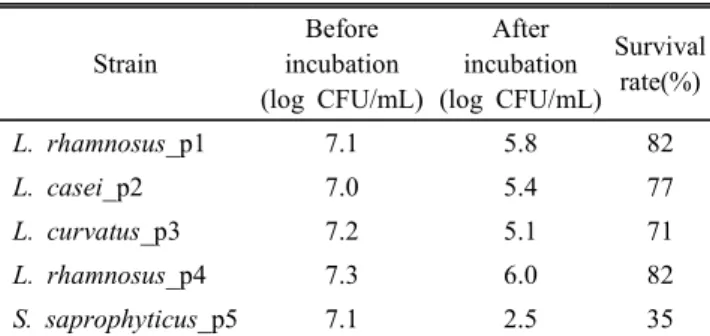
분리된 유산균이 probiotics 및 발효유 starter가 되기 위 한 필수조건으로 위장관 상부의 산성 조건 및 담즙이 존재 하는 환경에서의 생존되어야 장내에 부착되어 기능성을 나 타낸다고 보고되어 있다(Ouwehand et al., 1999). 유산균주 의 내산성을 확인한 결과(Table 4), 생존율은 L. rhamnosus_
p1 및 p4가 82%로 가장 높았으며, 그 다음으로 L. casei_
p2, L. curvatus_p3 및 S. saprophyticus_p5 각각 77, 71 및 35%로 나타났다. S. saprophyticus_p5를 제외하고, 모두 70%
이상의 내산성을 확인하였다. You 등(2005)은 kefir에서 분 리한 L. rhamnosus의 내산성 분석 결과, pH 5에서는 2×10⁹ CFU/mL, pH 2에서는 7×10⁸ CFU/mL로 약 38% 감소하였 다고 보고하였으며, 본 연구에 있어서도 L. rhamnosus_p1, p4 및 L. casei_p2가 이와 유사한 내산성을 나타내었다. 사 람의 분비위액의 pH는 1~2 정도이지만 침과 음식의 섭취 에 의해 희석되므로, 위에서의 L. rhamnosus_p1, p4 및 L.
Table 1. HPLC operating conditions for free amino acids analysis in cheese
Items Conditions
Mobile phase
A: Aqueous buffer, Waters AcccQ-Tag Eluent A B: 60% acetonitrile
Column Nova-PAKTM C18, 4 μm Column
temperature 37℃
Flow rate 1 mL/min
Detector Excitation wavelength : 250 nm Emission wavelength : 395 nm
Time(min) Flow rate A(%) B(%)
Initial 1.0 100 0
0.5 1.0 98 2
15 1.0 93 7
19 1.0 90 10
32 1.0 67 33
33 1.0 67 33
34 1.0 0 100
37 1.0 0 100
38 1.0 100 0
64 1.0 100 0
65 1.0 0 100
100 1.0 0 100
Table 2. Results of 16S rRNA sequencing of isolates from cheese
Strains Query Subject Score Identities
Start End Description AC Length Start End Bit Raw EV Match Total Pct.(%)
A1) 3 1474
Lactobacillus rhamnosus gene for 16S rRNA, partial sequence, stain:
JCM8649
AB690234.1 1509 7 1465 2579 1396 0.0 1450 1473 98
B 4 1514 Lactobacillus casei BD-II, complete
genome CP002618.1 3069926 256173 257682 2761 1495 0.0 1508 1513 99
C 1 1499
Lactobacillus curvatus gene for 16S rRNA, partial sequence, strain:
Ni998
AB600200.1 1531 17 1514 2761 1495 0.0 1498 1499 99
D 1 1506
Lactobacillus rhamnosus gene for 16S rRNA, partial sequence, strain:
JCM 8649
AB690234.1 1509 7 1509 2750 1489 0.0 1501 1506 99
E 3 1496
Staphylococcus saprophyticus subsp.
saprophyticus ATCC 15305 DNA, complete genome
AP008934.1 2516575 743737 745224 2715 1470 0.0 1487 1494 99
1) A: L. rhamnosus isolated from Gouda cheese (이플), B: L. casei isolated from Gouda cheese (이플), C: L. curvatus isolated from Gouda cheese (치즈가), D: L. ? isolated from Gouda cheese (치즈가), E: S. saprophyticus isolated from Gouda cheese (Westlan kaas export).
Table 3. Proteolytic activities of isolated strains against casein
Indicator Activity
L. rhamnosus_p1 L. casei_p2 L. curvatus_p3 L. rhamnosus_p4 S. saprophyticus_p5
Casein ++1) + + + -
1) Degree of clarity of clear zone by proteolysis: -; none, +; below 10 mm, ++; above 10.1 mm.
Table 4. Survival rate of isolated strains after 2 hr in MRS broth (pH 2.5)
Strain
Before incubation (log CFU/mL)
After incubation (log CFU/mL)
Survival rate(%)
L. rhamnosus_p1 7.1 5.8 82
L. casei_p2 7.0 5.4 77
L. curvatus_p3 7.2 5.1 71
L. rhamnosus_p4 7.3 6.0 82
S. saprophyticus_p5 7.1 2.5 35
casei_p2이 균의 생존율은 크게 나쁘지 않은 것으로 추정되
며, 본 연구에서는 casein의 분해효과가 높고 내산성이 우 수한 L. rhamnosus_p1 균주를 우선적으로 선정하여 고다치 즈 제조하였다.
4. 선택된 유산균주에 따른 Gouda cheese의 이화학적 특성 변화
선택된 유산균주 L. rhamnosus_p1을 이용하여 Gouda cheese 를 제조하였으며, 대조구는 상업적 균주 Flora Danica 50을 사용하여 숙성 중 이화학적 특성을 비교하였다. 숙성 초기 대조구의 수분, 단백질, 지방 및 회분의 함량은 각각 43.1,
20.1, 31.2 및 3.6%이었고, L. rhamnosus_p1을 처리한 실험 구는 각각 44.2, 21.0, 30.9 및 3.5%로 측정되어 제조 직후 의 일반성분 함량의 차이는 나타나지 않았다(Table 5). 숙 성기간에 따른 수분, 단백질, 지방 및 회분의 변화는 대조 구의 경우, 숙성기간 증가할수록 수분함량이 감소하였으며, 이에 따라 지방, 단백질 및 회분의 함량이 증가하였고, L.
rhamnosus_p1을 처리한 실험구는 숙성기간에 따른 일반성
분 함량의 변화가 없는 것으로 나타났다. Lee와 Nam(1996) 은 Gouda cheese 숙성 중 일반성분은 수용성 plastic coating 처리시 숙성기간이 증가할수록 단백질, 지방 및 회분의 함 량은 증가하는 반면, 수분의 함량은 감소한다고 하였고, 이
Table 5. Physicochemical characteristics of Gouda cheese with L. rhamnosus_p1
Treatment (%)
Moisture Protein Fat Ash
Control1) 43.1±0.82) 20.1±1.2 31.2±0.3 3.6±0.2
GCL 44.2±1.2 20.9±0.3 31.5±0.7 3.3±0.1
1) Control: Gouda cheese with commercial starter, GCL: Gouda cheese with L. rhamnosus_p1
2) Mean±SD.
Fig. 2. Change in general components of Gouda cheese during ripening periods. Control: Gouda cheese with commercial starter, GCL: Gouda cheese with L. rhamnosus_p1
는 수분의 감소에 따른 타 고형분의 상대적인 증가 때문이 라고 보고하였으며, 진공포장의 경우는 수분 및 기타 고형분 의 함량 변화는 없는 것으로 보고하여 본 연구에 있어서도 질소포장의 경우와 유사한 결과를 나타내었다(Fig. 2). Gouda cheese 숙성 과정 중의 pH 변화는 Fig. 3에 나타내었다. 대 조구는 숙성 초기 5.30에서 숙성 3개월째 5.20으로 감소하 였다가 그 후 숙성기간 동안 증가하여 5.52까지 증가하였고,
Fig. 3. Change in pH of Gouda cheese during ripening periods.
Control: Gouda cheese with commercial starter, GCL:
Gouda cheese with L. rhamnosus_p1
L. rhamnosus_p1을 처리한 실험구는 숙성 초기 5.29에서 숙성 2개월까지 약간 감소하여 5.22였다가 숙성 3개월째부 터 증가하여 숙성 5개월째에 5.61까지 증가하였다. Lee와 Nam(1996)은 숙성 초기 curd 내에 잔존하는 lactose 분해에 따른 lactic acid의 생성으로 인해 pH가 감소하고, 그 후 pH 의 상승은 단백질 분해와 암모니아 생성에 따른 상승이라 보고하였다. 또한 cheese 내 pH의 증가 이유를 lactic acid의 분해, 비활성 성분, 치환물의 생성, acetic acid, carbonic acid 와 같은 약하거나 완전 해리되지 않은 산의 생성 등과 단백 질 분해에 의한 알칼리 물질의 유리 등이라고 보고한 연구 도 있다(Visser and De Groat-Mastert, 1977; Visser, 1977).
본 연구에 있어서도 L. rhamnosus_p1을 첨가한 실험구는 대조 구에 비해 1개월 빠르게 pH가 증가하였으며, L. rhamnosus_
p1 첨가에 따른 유리아미노산이 증가하여 숙성 후반의 pH 증가한 것으로 생각된다.
5. 선택된 유산균주에 따른 Gouda cheese의 유리아미노 산 변화
Gouda cheese의 숙성 중 유리아미노산의 변화를 Table 6 및 Table 7에 나타내었다. 대조구 및 L. rhamnosus_p1을 첨가
Table 6. Free amino acid composition of Gouda cheese during ripening periods
FAA1) Ripening periods (month)
0 1 2 3 4 5
Asp 0.49 0.77 0.90 1.02 1.80 2.61
Ser 0.60 1.18 1.19 1.42 1.76 2.91
Glu 3.33 6.87 7.60 7.74 10.99 14.32
Gly 0.30 0.63 0.70 0.87 1.01 2.12
His 0.85 0.98 1.27 1.55 1.27 2.20
Arg 0.54 0.44 1.17 1.16 0.80 1.48
Thr 1.06 2.27 2.45 2.76 2.82 4.44
Ala 0.53 0.97 0.95 1.26 1.30 2.37
Pro 0.59 1.02 0.89 1.43 1.62 3.76
Cys 0.76 1.16 1.30 1.52 1.79 2.95
Tyr 1.04 1.86 1.88 2.39 1.01 3.04
Val 1.11 2.45 2.60 2.89 3.59 5.33
Met 0.33 0.62 0.81 1.24 1.98 2.33
Lys 0.21 0.41 0.66 0.89 1.21 1.58
Ile 0.41 1.01 1.05 1.26 1.79 3.60
Leu 2.56 6.09 6.26 6.88 8.24 10.26
Phe 1.92 3.66 3.86 4.52 4.69 6.25
Total 16.63 32.39 35.54 40.80 47.67 71.55
1) FAA: Free amino acid
한 실험구의 유리아미노산의 총 함량은 숙성 초기 각각 16.63 및 16.01 mg/100 g에서 숙성기간이 증가함에 따라 숙성 3 개월째 각각 40.80 및 54.70 mg/100 g으로 증가하였고, 숙 성 5개월째에 71.55 및 77.12 mg/100 g으로 증가하였다. 주요 유리아미노산으로는 glutamin acid, leucine 및 phenylalanine 으로 대조구는 각각 14.32, 10.26 및 6.25 mg/100 g으로, L.
casei_p2를 첨가한 실험구는 각각 16.33, 12.31 및 5.80 mg/
100 g으로 나타났다. 유리아미노산은 starter bacteria 및 비의 도적 미생물에 의하여 단백질 분해 작용의 결과로 cheese 숙성이 진행되는 과정에서 cheese의 풍미에 중요한 역할을 하는 것으로 보고되어 있으며(Lee and Nam, 1996), cheese의 풍미에 영향을 주는 주요 아미노산으로 methionine, cysteine, phenylalanine, tyrosine, tryptophan, valine 및 leucine으로 보고 되어 있으며(Van Kranenburt et al., 2002; Yvon and Rijnen, 2001), 본 연구에 있어서도 glutamic acid, leucine 및 phenyl- alanine이 아미노산의 주요 성분으로 나타났다. L. rhamnosus_
p1을 첨가한 실험구는 대조구에 비해 숙성 초기에는 유리 아미노산의 총 함량은 차이가 없다가 숙성 3개월째부터 증 가하기 시작하였으며, 이로 인해 L. rhamnosus_p1을 첨가한 실험구의 pH는 숙성 3개월째 증가하는 것으로 보여진다.
Table 7. Free amino acid composition of Gouda cheese with L. rhamnosus_p1 during ripening periods
FAA1) Ripening periods (month)
0 1 2 3 4 5
Asp 0.51 0.85 1.59 2.68 2.94 3.12
Ser 0.55 1.33 1.38 2.68 2.79 3.04
Glu 3.32 6.82 7.45 7.89 11.32 16.33
Gly 0.22 0.63 0.68 0.93 1.02 2.33
His 0.75 1.52 1.99 2.54 2.45 2.134
Arg 0.45 0.99 1.85 1.97 2.09 2.23
Thr 0.98 2.35 2.54 3.04 3.11 4.374
Ala 0.49 0.59 1.11 1.42 1.66 2.75
Pro 0.52 1.65 1.88 2.89 3.21 3.51
Cys 0.55 1.38 1.75 2.09 2.41 2.57
Tyr 1.22 1.79 1.89 2.09 2.63 3.63
Val 1.82 2.44 2.51 3.88 3.96 4.02
Met 0.29 0.57 0.92 2.11 2.59 3.15
Lys 0.25 0.33 1.12 1.52 1.69 2.13
Ile 0.4 1.11 1.32 2.45 2.99 3.69
Leu 2.41 6.22 6.85 8.64 8.96 12.31
Phe 1.28 3.66 3.82 5.88 5.99 5.8
Total 16.01 34.23 40.65 54.70 61.81 77.12
1) FAA: Free amino acid
6. 선택된 유산균주에 따른 Gouda cheese의 관능검사 Gouda cheese의 숙성 중 맛, 향기, 조직감 및 전체적인 기 호도를 5점 척도법으로 실시하였으며, 대조구는 각각 4.2, 4.0, 4.6 및 4.3로, L. rhamnosus_p1을 첨가한 실험구는 각 각 4.8, 4.6, 4.8 및 4.7로 나타났다(Table 8). 관능검사 결과, 대조구에 비해 맛, 향기, 조직감 및 전체적인 기호도는 우수 한 것으로 보이며, 고다치즈의 향기성분은 지방 분해, 단백 질 분해 및 유당의 대사물 등에 의해 영향을 받으며, Alewijn 등(2005)은 지방 유래의 향기성분 물질인 ketones보다는 단백질 유래 대사산물에 의해서 영향을 받는다고 하였고,
Table 8. Sensory characteristics of Gouda cheese with L.
rhamnosus_p1 (n=15)
Items Control1) GCL
Taste 4.2±0.6422) 4.8±0.72
Flavor 4.0±0.44 4.6±0.38
Texture 4.6±0.64 4.8±0.31
Overall acceptability 4.3±0.39 4.7±0.46
1) Control: Gouda cheese with commercial starter, GCL: Gouda cheese with L. rhamnosus_p1
2) Mean±SD.
특히 Mariley와 Casey(2004)은 황함유 아미노산에 의해서 풍미가 증가된다고 보고하였다.
요 약
본 연구는 숙성기간 단축 및 최종 제품의 소비자 편의를 높이기 위한 방법으로 1년 이상 숙성된 고다치즈에서 단백 분해능이 우수한 유산균주를 screening하여 단백분해능 및 내산성이 높은 L. rhamnosus_p1을 분리․동정하였으며, 이 균주를 이용한 고다치즈를 제조하여 숙성기간에 따른 품질 변화를 측정하였다. 1년 숙성된 고다치즈 3개 제품에서 분 리해낸 유산균주는 총 5종이며, 16S rDNA의 염기서열을 표준 균주와 비교하여 작성한 계통수 결과, L. rhamnosus 2 종, L. casei, L. curvatus 및 S. saprophyticus로 판명되었고, 이 중 단백분해능과 내산성이 높은 L. rhamnosus_p1을 우 선적으로 선정하여 절단형 고다치즈 제조 후 질소포장하여 숙성기간 중 이화학적 변화 및 아미노산 변화를 측정하였 다. 숙성기간에 따른 수분, 단백질, 지방 및 회분의 변화는 대조구의 경우, 숙성기간이 증가할수록 수분함량이 감소하 여 이에 따른 지방, 단백질 및 회분의 함량이 증가하였고, L.
rhamnosus_p1을 처리한 실험구는 숙성기간에 따른 일반성
분 함량의 변화 없는 것으로 나타났다. 대조구 및 L. rhamnosus_
p1을 첨가한 실험구의 유리아미노산의 함량은 숙성 초기 각각 16.63 및 16.01 mg/100 g에서 숙성기간이 증가함에 따라 숙성 3개월째 각각 40.80 및 54.70 mg/100 g 증가하였 고, 숙성 5개월째에 71.55 및 77.12 mg/100 g으로 증가하였다.
주요 유리아미노산으로는 glutamic acid, leucine 및 pheny- lalanine으로 대조구는 각각 14.32, 10.26 및 6.25 mg/100 g 으로, L. casei_p2를 첨가한 실험구는 각각 16.33, 12.31 및 5.80 mg/100 g 나타났다. 관능검사 결과, 맛, 향기, 조직감 및 전체적인 기호도에 있어서 대조구보다는 L. rhamnosus_p1을 첨가한 실험구가 우수한 것으로 보이며, 향후 복합균주에 대한 연구가 추가적으로 진행된다면 Gouda cheese 제조를 위한 스타터로서의 이용 가능성이 높을 것으로 판단된다.
감사의 글
본 연구는 전라북도테크노파크 지역기반육성사업의 지 원에 의하여 이루어진 것으로 이에 감사드립니다.
참고문헌
1. Alewijn, M., Sliwinski, E. L. and Wouters, J. T. M. 2005.
Production of fat-derived (flavour) compounds during the ripening of Gouda cheese. Int. Dairy J. 15:733-740.
2. AOAC. 1990. Official methods of analysis. 13th ed, Association of Official Analytical Chemists, Washington, DC, pp. 125-139.
3. Back, Y. J., Yoon, K. B., Yoon, Y. H. and Kim, H. U. 1983.
Studies on the intracellular proteinase of Lactobacillus casei YIT 9018. Korean J. Ani. Sci. 25:1-7.
4. Exterkate, F. A., de Veer, G. J. C. M and Stadhouders, J. 1987. Acceleration of the ripening process of Gouda cheese by using heat-treat mixed-strain starter cells. Neth.
Milk and Dairy J. 41:307-320.
5. Grappin, R., Rank, T. C. and Olson, N. F. 1985. Primary proteolysis of cheese proteins during ripening. A review.
J. Dairy Sci. 68:531-540.
6. Lee, S. W and Nam, M. S. 1996. Change in the casein, free amino acid and textures during ripening of Gouda cheese. Korean J. Food Sci. Ani. Resour. 16:35-40.
7. Lee, S. W. and Nam, M. S. 1996, Change in chemical com- position and nitrogenous compounds during ripening of Gouda cheese. Korean J. Food Sci. Ani. Resour. 16:41-46.
8. Marilley, L. and Casey, M. G. 2004. Flavours of cheese pro-
ducts: metabolic pathways, analytical tools and identification of producing strains. Int. J. Food Microbiol. 90:139-159.
9. Ouwehand, A. C., Kirjavainen, P. V., Shortt, C. and Salminen, S. 1999. Probiotics; mechanisms and established effects. Int. Dairy J. 9:43-52.
10. Van den Berg, G., Meijer, W. C., Dusterhoft, E. M. and Smit, G. 2004. Gouda and related cheeses. 3rd ed. pages 103-135 in Major cheese groups: Vol. 2. Cheese: Che- mistry, physics and microbiology. P. F. Fox, ed. Elsevier Academic Press, London. UK.
11. Van Kranenburg, R., Kleerebezem, M., Van Hylckama Vlieg, J., Ursing, B. M., Boekhorst, J., Smit, B. A., Ayad, E. H.
E., Smit, G. and Siezen, R. J. 2002. Flavour formation from amino acids by lactic acid bacteria: predictions from genome sequence analysis. Int. Dairy J. 12:111-121.
12. Visser, F. M. W. 1977. Contribution of enzymes from rennet, starter bacteria milk to proteolysis and flavour development in Gouda cheese. 2. Development of bitterness and cheese flavour. Neth. Milk and Dairy J. 31: 188-209.
13. Visser, F. M. W. 1977. Contribution of enzymes from rennet, starter bacteria milk to proteolysis and flavour development in Gouda cheese. 3. protein breakdown : analysis of the soluble nitrogen and amino acid nitrogen fractions. Neth, Milk and Dairy J. 31:247-264.
14. Visser, F. M. W. and De groat-Mastert, A. E. A. 1977.
Contribution of enzymes from rennet, starter bacteria milk to proteolysis and flavour development in Gouda cheese. 4. Protein breakdown : a gel electrophoretical study. Neth. Milk and Dairy J. 31:247-264.
15. Wallace, J. M. and Fox, P. F. 1997. Effect of adding free amino acids to Cheddar cheese curd on proteolysis, flavour and texture development. Int. Dairy J. 7:157-167.
16. Yamaguchi, K., Igoshi, K. and Kaminogawa, S. 1986.
Purification and property of proteinases with an oupti- mum pH at 8.0 from Gouda type cheese and its com- parition with milk proteinases. Jpn. J. Zootech Sci. 58:
516-527.
17. You, S. J., Cho, J. K., Hwang, S. G. and Heo, K. C. 2005.
Probiotic charateristics of Lactobacillus rhamnosus isolated from Kefir. Korean J. Food Sci. Ani. Resour. 25:357-364.
18. Yvon, M. and Rijnen, L. 2001. Cheese flavour formation by amino acid catabolism. Int. Dairy J. 11:185-201.
(Received 6 November, 2014 / Accepted 6 December, 2014)