Association of the Length of Doctor-Patient Relationship with Primary Care Quality in Seven Family Practices in Korea
Countries with historically unlimited patient choice of medical provider, such as Korea, have been promoting rational health care pathways. Factors related to the length of doctor-patient relationship (DPR) for enhancing primary care in those countries should be studied. Participants were patients who had visited their family practices on six or more occasions over a period of more than 6 months. Five domains (21 items) of the Korean Primary Care Assessment Tool (first contact, coordination function, comprehensiveness, family/community orientation, and personalized care) and general questions were administered in the waiting rooms. From seven practices, the response rate was 83.7%
(495/591). The older the age, the lower the income, the shorter the duration of education, the more the number of diseases the patients had, and in provincial cities rather than in Seoul, the longer length of DPR ( ≥ 4 yr) was shown. The long-term DPR was associated with total primary care quality score (upper [ ≥ 71.4] vs lower [ < 71.4], OR, 1.74; 95% CI, 1.10-2.76), especially with coordination function (OR, 1.01; 95% CI, 1.00-1.02), being adjusted for confounding variables. Strengthening the coordination function may have to be the first consideration in primary care policy in countries like Korea.
Key Words: Primary Health Care; Quality Assurance; Health Care Policy; Korea Jae-Ho Lee,1 Yong-Jun Choi,2
Seung Hwa Lee,3 Nak-Jin Sung,4 Soo-Young Kim,5 and Jee Young Hong6
1Department of Family Medicine, The Catholic University of Korea College of Medicine, Seoul;
2Department of Social and Preventive Medicine, Hallym University College of Medicine, Chuncheon;
3Department of Family Medicine, Ajou University College of Medicine, Suwon; 4Department of Family Medicine, Ilsan Hospital, Dongguk University, Goyang; 5Department of Family Medicine, Hallym University College of Medicine, Kangdong Sacred Heart Hospital, Seoul; 6Department of Preventive Medicine, Konyang University College of Medicine, Daejeon, Korea
Received: 29 September 2012 Accepted: 6 February 2013 Address for Correspondence:
Jae-Ho Lee, MD
Department of Family Medicine, The Catholic University of Korea College of Medicine, 222 Banpo-daero, Seocho-gu, Seoul 137-701, Korea
Tel: +82.2-2258-6288, Fax: +82.2-2258-2907 E-mail: [email protected]
http://dx.doi.org/10.3346/jkms.2013.28.4.508 • J Korean Med Sci 2013; 28: 508-515
INTRODUCTION
Evidence of the value of primary care in health systems contin- ues to accumulate. Research has confirmed that strong primary care health systems provide better population health, more eq- uity in health throughout the populations, and greater econo- my in the use of resources (1). In the World Health Organiza- tion’s 2008 World Health Report, all countries were encouraged to orient their health care systems toward strengthened prima- ry care (2). Such reforms are unlikely to improve overall popu- lation health, equalize distribution of health care resources or reduce costs unless they address both the systemic and clinical characteristics of primary care (3).
In Korea, the health care system has been dominated by the private sector ( > 90% in health care facilities) (4), comprised of big hospitals owned by global companies (so-called ‘chaebols’) or private university foundations, and small-to-medium sized facilities of private medical doctors (mostly specialists). Hence the value of primary care has been often neglected by govern- ment, as well as providers and patients, for over 30 yr (5). Medi-
cal specialists who can run their own community clinics see patients directly without referrals by family physicians. Private sector dominance in health care has led Korea to exhibit the characteristics of a free market even in the National Health In- surance (NHI) system (6). Primary care does not have a gate- keeping role in Korea. The fee schedule for primary care provid- ers is based on the fee-for-service (FFS) (rather than on capita- tion), resulting in physicians’ lack of incentive to focus on health prevention and promotion (4). Under these circumstances, ‘in- duced demand’ by physicians and ‘doctor shopping’ by pa- tients are more likely. It is not strange that Korea shows the high level of outpatient contacts per year per capita compared to the average level of all countries (including Korea) of the Organiza- tion for Economic Co-operation and Development (OECD) (6.5 vs 13.0 times in 2009) (7).
It is widely believed that a long-term, sustained doctor-pa- tient relationship (DPR) is vital to good primary health care, promoting satisfaction, effectiveness, and reduced costs. Such relationships are thought to increase in value as the practitio- ners come to know patients over time, and vice versa. The ben-
efits of this knowledge can be expected to accrue in a variety of ways. For example, patients should make fewer visits because many problems can be managed on the phone. Fewer hospital- izations should also result, since practitioners are more likely to be able to ascertain whether the problem can be managed at home (8). Literature suggests several further benefits of sustain- ed relationships, including greater satisfaction among patients (9-17), physicians, and other staff (13); fewer and/or shorter hospitalizations (9); fewer broken appointments (18); decreased use of laboratory tests (17); and decreased use of emergency rooms for care (10). In addition, increased patient disclosure of personal problems (18) and better compliance with physician instructions have been reported (11).
Recognizing the benefits of primary care, the Government of Korea tried to introduce the family doctor registration system in 1996. This effort failed due to resistance from the Korean Medi- cal Association (KMA), lack of consensus in public opinion, in- sufficient drive by the Government and scant evidence about the effectiveness of such a system in Korea (19, 20). Since 2003, the Government tried a few demonstration projects locally to induce patients with chronic conditions to enroll to their usual source of care (USC), using financial incentives. Recently, the Government has negotiated a new national program with the KMA. This program is expected to encourage patients with chronic conditions (initially, hypertension and diabetes) to designate a USC among community clinics to improve primary care efficiency by establishing a long-term DPR. Against this background, the authors intend to investigate influential factors associated with length of DPR in the Korean health care setting.
MATERIALS AND METHODS Participant practices
We restricted subject selection to community clinics where family physicians serve, since family medicine is the only pri- mary care specialty in Korea, and family physicians are relative- ly homogenous due to a standardized residency curriculum.
The family medicine specialty was introduced in 1979. In addi- tion, family practices are homogenous in that they are remu- nerated by the FFS method under the NHI system and own solo practices (93.5% in 2008) (21). We chose the study sample from the data collected to evaluate the validity of the Korean Primary Care Assessment Tool (K-PCAT) (22). Practices which had been established more than five years before were eligible.
Among seven practices recruited, two were in Seoul (the big- gest and the most populous city in Korea), two in its adjacent satellite cities (Seongnam and Hanam), and three in small cit- ies remote from Seoul (Gyeongju and Pohang) (Table 1).
Patient selection and the definition of the USC
The patient sample consisted of patients (or guardians) who visited one of the participant practices and agreed to complete the questionnaire before seeing their physicians. Eligible par- ticipants were individuals for whom the practice served as their usual source of care. The usual source of care was defined as a provider whom the user had visited at least six times over a pe- riod of more than 6 months.
Data collection
The interviewers were trained for standardized technique. In- terviewers visited each family practice and administered ques- tionnaires to study subjects and helped them answer the struc- tured questionnaires. The questionnaires included the K-PCAT items and demographic characteristics. The data collection was performed from April 23rd to June 23rd, 2007. For the patients who were less than 18 yr old or disabled, the guardian filled out the questionnaire.
Description of the K-PCAT
The K-PCAT is a validated tool based on the Korean primary care definition, consists of five domains and 21 items including first contact (5), comprehensiveness (4), coordination function (3), personalized care (5), and family/community orientation (4). The Cronbach’s alpha within each domain for the K-PCAT Table 1. Characteristics of seven family practices which participated in this study, by its location
Parameters
Location of practices Metropolitan area
Small cities
Seoul Satellite cities
Number of practices Two* Two† Three‡
Structural characteristics by ownership, physician number, and remuneration method Private and solo practices remunerated by the fee-for-service
Gate-keeping role§ No patient list and no referral system
Population density around the practices (person/km2)II 36,331 10,516 2,648
Density of medical institutions around the practices (number/km2)II 14.6 3.9 0.5
Physical accessibility to medical doctors¶ Very high High Not high
Duration after the establishment of practice (yr) 5.6 and 11.1 5.0 and 6.2 7.2, 7.3 and 10.9
*All in Yang-Chun district; †Seongnam and Hanam; ‡one in Gyeongju and two in Pohang. §Source: OECD 2010. IISource: 2008 statistics of local governments. ¶In South Korea, 30.2% of medical doctors are in Seoul, 18.5% in Gyeonggi Province (including Seongnam and Hanam), and 3.8% in Gyeongbuk Province (including Gyeongju and Pohang) in 2011 (23). The accessibility was assessed by the authors’ views.
ranged from 0.69 to 0.78, except within the first contact domain which consists of five independent subscales (first contact-uti- lization, facility accessibility, cost appropriateness, demograph- ic accessibility, and basic health care) (22). Each response is on a 5-point Likert scale from 0 to 4. Means of item scores in the same domain are multiplied by 25 to yield domain scores (0- 100). Total primary care average score representing primary care quality is the mean of five domain scores. The K-PCAT has been introduced in the Care Coordination Measures Atlas is- sued by the Agency for Healthcare Research and Quality of the US Government (24).
Statistical analysis
The length of DPR, which was a main topic in this article, was categorized into 3 categories; “ < 2 yr”, “2-3 yr”, and “ ≥ 4 yr”. So- cio-demographic data of participant patients by the length of DPR were analyzed by Mantel-Haenszel chi-square test. Attri- bute scores of primary care on the K-PCAT were analyzed by one-way analysis of variance. Although the distribution of our outcome measure was not normal, parametric methods could still be used in situations where the sample size was as large as ours (25). We established four logistic regression models for in- vestigating the effects of providers’ factors, patients’ character- istics and K-PCAT scores on the long term ( ≥ 4 yr) DPR: model 1 including only providers’ factor, model 2 including providers’
factors and patients’ characteristics, model 3 including provid- ers’ factors, patients’ characteristics and total primary care qual- ity score, and model 4 including providers’ factors, patients’
characteristics and the five domain scores. Statistical software SAS 9.1.3 (SAS Institute, Cary, NC, USA) was used for the analysis.
Ethics statement
This study was approved by the institutional review board of the Catholic University of Korea (IRB No. KCMC05OT112). Written informed consent was obtained from all of subjected patients.
RESULTS
Among those who visited their family practice as a USC and were eligible to participate in this survey (n = 591), there were no significant differences between the participants (n = 495, 83.7%) and non-participants (n = 96, 16.3%) in terms of age and sex. The most common reason for refusing to complete the questionnaire was that the patient was too busy. After exclud- ing samples with more than three missing responses (n = 6), a total of 489 effective samples were used for the analysis.
Distributions of socio-demographic variables by the length of DPR
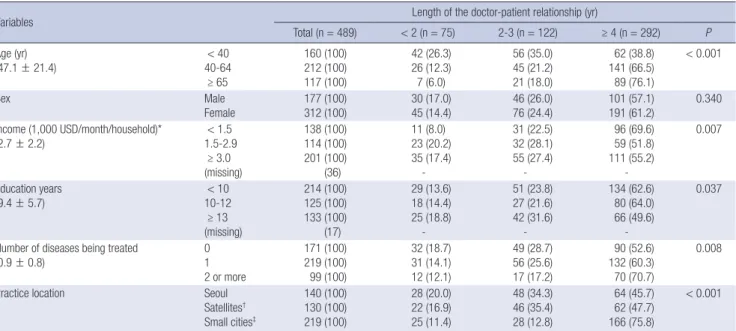
The average age of the patients, who participated in this study, was 47.1 ( ± 21.4) yr (Table 2). When patients’ age was catego- rized as young ( < 40 yr), middle (40-64 yr), and aged ( ≥ 65 yr) groups, the older the age of patient, the longer the length of DPR (P < 0.001). In the old age ( ≥ 65 yr) group, those patients who had a long-term ( ≥ 4 yr) relationship with their physicians was 76.1%. In contrast, that was only 38.8% in the young age ( < 40 yr) group. Female patients were 63.8% and did not show longer term relationship with their family physicians than males.
The lower income ( < 1,500 USD equivalent per month) group tended to have longer term ( ≤ 4 yr) relationship with their fam- ily physicians. In contrast to the upper income group, middle
Table 2. Distribution of the socio-demographic variables of the patient participants by the length of doctor-patient relationship: frequency (%)
Variables Length of the doctor-patient relationship (yr)
Total (n = 489) < 2 (n = 75) 2-3 (n = 122) ≥ 4 (n = 292) P Age (yr)
(47.1 ± 21.4) < 40
40-64
≥ 65
160 (100) 212 (100) 117 (100)
42 (26.3) 26 (12.3) 7 (6.0)
56 (35.0) 45 (21.2) 21 (18.0)
62 (38.8) 141 (66.5) 89 (76.1)
< 0.001
Sex Male
Female 177 (100)
312 (100) 30 (17.0)
45 (14.4) 46 (26.0)
76 (24.4) 101 (57.1)
191 (61.2) 0.340 Income (1,000 USD/month/household)*
(2.7 ± 2.2) < 1.5
1.5-2.9
≥ 3.0 (missing)
138 (100) 114 (100) 201 (100) (36)
11 (8.0) 23 (20.2) 35 (17.4)
-
31 (22.5) 32 (28.1) 55 (27.4)
-
96 (69.6) 59 (51.8) 111 (55.2)
-
0.007
Education years
(9.4 ± 5.7) < 10
10-12
≥ 13 (missing)
214 (100) 125 (100) 133 (100) (17)
29 (13.6) 18 (14.4) 25 (18.8)
-
51 (23.8) 27 (21.6) 42 (31.6)
-
134 (62.6) 80 (64.0) 66 (49.6)
-
0.037
Number of diseases being treated
(0.9 ± 0.8) 0
1 2 or more
171 (100) 219 (100) 99 (100)
32 (18.7) 31 (14.1) 12 (12.1)
49 (28.7) 56 (25.6) 17 (17.2)
90 (52.6) 132 (60.3) 70 (70.7)
0.008
Practice location Seoul
Satellites† Small cities‡
140 (100) 130 (100) 219 (100)
28 (20.0) 22 (16.9) 25 (11.4)
48 (34.3) 46 (35.4) 28 (12.8)
64 (45.7) 62 (47.7) 166 (75.8)
< 0.001
Mantel-Haenszel chi-square test. *One US dollar equals 956 Korean Won (KRW) on the day of survey (April 1, 2007). Average household income was 3,092,200 KRW per month during the second quarter of 2007 in Korea. †In Seongnam and Hanam. ‡One in Gyeongju and two in Pohang.
income (1,500-2,900 USD equivalent per month) group tended to have shorter term ( < 2 yr) relationship with their family phy- sicians (P = 0.007). University graduates (education ≥ 13 yr) tended to have a shorter term relationship with their family physicians, in contrast with groups of education years less than 13 yr (P = 0.037). The number of the diseases being treated show- ed a significant difference by the length of physician-patient re- lationship, the more the number ( ≥ 2 or more) of the diseases being treated patients had, the longer ( ≥ 4 yr) the length of phy- sician-patient relationship patients showed (P = 0.008). Patients of the practices in small cities tended to have the longer term DPR, comparing to those in Seoul or its satellite cities (P < 0.001).
Primary care scores of the five domains of the K-PCAT by the length of DPR
Among 5 domains of primary care of the K-PCAT, the personal- ized care (91.1 ± 10.5) and the first contact (89.5 ± 10.5) showed relatively high scores compared to the coordination function (62.3 ± 29.6) and the comprehensiveness (50.1 ± 23.5) domains (Table 3). The total primary care quality score (the average of the 5 domain scores) was 71.7 ± 12.8 on a 100 point scale. By the bivariate analysis, primary care scores of the 3 domains, i.e., coordination function (P = 0.026), comprehensiveness (P = 0.001), and family/community orientation (P = 0.030), were significantly different by the length of DPR. Among 5 subscales of the first contact domain, only the first contact-utilization was significantly different in scores with the length of DPR. Between the shorter and middle term DPR, there was no significant rela- tionship in the total primary care quality score. After the length of the DPR became ≥ 4 yr, the total primary care quality score care showed a significant difference (P = 0.001) from those of the other two terms.
Factors associated with the length of DPR
In the model 1, the long term DPR was significantly associated with practice location (small cities vs metropolitan area; odds
ratio [OR], 2.08; 95% confidence interval [CI], 1.18-3.66) and duration after the establishment of practice ( ≥ 7 yr vs < 7 yr;
OR, 6.08; 95% CI, 3.29-11.23) (Table 4). In the model 2 after ad- justing providers’ factors, the long term DPR was significantly associated with some patients’ characteristics including age (unit: year) ([40-64 vs < 40; OR, 3.53; 95% CI, 2.01-6.20] and [ ≥ 65 vs < 40; OR, 5.91; 95% CI, 2.83-12.35]), and household income per month (unit: USD) ( ≥ 3.0 vs < 1.5; OR, 2.00; 95%
CI, 1.04-3.84). After adjusting providers’ factors and patients’
characteristics, the long term DPR was significantly associated with total primary care quality score (upper [ ≥ 71.4] vs lower [ < 71.4]; OR, 1.74; 95% CI, 1.10-2.76) in the model 3 and the co- ordination function (OR, 1.01; 95% CI, 1.00-1.02: P = 0.044) in the model 4.
DISCUSSION
The aim of this study was to investigate the influential attributes of primary care associated with length of DPR. The previous study demonstrated that the socio-demographic variables of this study were significantly associated with primary care do- main scores of the K-PCAT (22). Therefore the authors con- trolled these confounding variables by multivariate analysis.
The study showed that long-term duration ( ≥ 4 yr) of DPR of family practice was positively associated with total primary care quality score of the K-PCAT in both bivariate and multivariate analysis. The more interesting finding was that this long-term DPR was positively associated specifically with the coordina- tion function among the 5 domains of the K-PCAT in both bi- variate and multivariate analysis. Coordination is essential for the attainment of each of the other primary care features. With- out it, longitudinality would lose much of its potential, compre- hensiveness would be made difficult, and the first-contact func- tion would become purely administrative. Descriptions of pri- mary care from the physician’s vantage often refer to the prima- ry care professional as the patient’s advocate or in terms of the Table 3. Patient assessment of quality (attribute scores) of primary care by the length of doctor-patient relationship, using the Korean Primary Care Assessment Tool (K-PCAT):
mean±SD
Domains No. of items Total
(n = 489)
Length of the doctor-patient relationship (yr)
< 2 (n = 75) 2-3 (n = 122) ≥ 4 (n = 292) P
First contact*
First contact-utilization Facility accessibility Cost appropriateness Demographic accessibility Basic health care
5 1 1 1 1 1
89.5 ± 10.5 89.8 ± 18.1 92.1 ± 16.9 85.9 ± 20.3 96.7 ± 11.0 82.9 ± 26.3
88.4 ± 12.4 86.3 ± 21.1† 93.2 ± 15.1 88.7 ± 18.1 94.7 ± 14.4 79.0 ± 31.3
88.4 ± 11.6 85.9 ± 20.6‡ 94.3 ± 11.0‡ 85.7 ± 21.5 96.5 ± 11.3 79.7 ± 29.7
90.2 ± 9.4 92.4 ± 15.6†,‡
90.8 ± 19.1‡ 85.3 ± 20.3 97.3 ± 9.8 85.2 ± 20.0
0.175
< 0.001 0.137 0.431 0.187 0.057
Comprehensiveness 4 50.1 ± 23.5 44.7 ± 22.1† 45.9 ± 24.6‡ 53.2 ± 22.9†,‡ 0.001
Coordination function 3 62.3 ± 29.6 59.7 ± 32.7 56.9 ± 33.3‡ 65.1 ± 26.8‡ 0.026
Personalized care 5 91.1 ± 10.5 89.7 ± 11.4 90.5 ± 11.0 91.7 ± 10.1 0.273
Family/community orientation 4 65.8 ± 16.1 65.8 ± 17.0 62.5 ± 16.8‡ 67.1 ± 15.4‡ 0.030
Total primary care quality score§ 21 71.7 ± 12.8 69.6 ± 13.9† 68.8 ± 13.8‡ 73.5 ± 11.8†,‡ 0.001
ANOVA, multiple comparisons with the LSD method. *First contact, composite domain, consists of score average of 5 independent subscales. Statistical significances †between
< 2 yr and ≥ 4 yr and ‡between 2-4 yr and ≥ 4 yr in length of the doctor-patient relationship. §Score average of 5 domains of the K-PCAT.
primary care physician’s commitment to people. To accom- plish what these terms imply, the primary care physician must be aware of all of the patient’s health-related problems in what- ever context they arise (26). The concept of the primary care physician as a chief agent and coordinator has been the profes- sional response to the increasing complexity of medical knowl- edge and specialization. Countries where patient choice was limited have taken steps to extend it, while countries with un- limited choice have been trying to promote rational health care pathways, notably by implementing gate-keeping. The effec- tiveness of gate-keeping depends however on the ability of pri- mary care physicians acting as effective agents managing and co-coordinating the follow-up of patient care, while utilizing in- formation available on the quality and prices of services sup- plied by providers of secondary care (27).
Initiatives measuring patients’ experiences with individual primary care physicians will achieve different results if studies include patients who have seen the physician versus those whom administrative data indicate as established members of the physician’s panel (28). In measuring patients’ experience with primary care physicians, patients should have a USC and have experienced its services before. Therefore, to compare the pa- tient assessment of primary care internationally or among insti- tutions, it is required to have a common definition of USC. The
PCAT originally invented by Shi et al. (29) used 3 questions to identify a USC and the strength of that affiliation: 1) Is there a doctor or place that you usually go if you are sick or need advice about your health? (usual source), 2) Is there a doctor or place that knows you best as a person? (knows best), and 3) Is there a doctor or place that is most responsible for your health care?
(most responsible). On the other hand, however, in using the K- PCAT, the authors applied the different definition of USC (22), considering the health care context of Korea where the choice of provider by patients was virtually open, even under the NHI.
The temporal length of DPR is one of the quantitative aspects of longitudinality in primary care (30). Longitudinality, in the context of primary care, is a long-term personal relationship between physicians and the patients in their practice. Having longitudinal care means that individuals in the population iden- tify with a source of care as “theirs”; that the provider at least implicitly recognize the existence of a formal or informal con- tract to be their regular source of person-focused (not disease- focused) care and that this relationship exists for a defined pe- riod of time or indefinitely until explicitly changed. Although the word continuity is usually used instead of longitudinality, the latter conveys the spirit better than the former (26). On the other hand, continuity has been defined in numerous ways. For example, Saultz proposed a hierarchical definition of continuity Table 4. Odds ratio and 95% confidence interval of having the long-term (≥ 4 yr) doctor-patient relationship in seven Korean family practices
Variables Model 1 Model 2 Model 3 Model 4
I. Provider’s characteristics
Location of practices-small cities* (reference: metropolitan area†) Seven or more years after the establishment of practice (reference: < 7)
2.08 (1.18-3.66) 6.08 (3.29-11.23)
2.62 (1.40-4.90) 6.20 (3.10-12.39)
2.39 (1.26-4.52) 5.95 (2.98-11.87)
2.22 (1.16-4.25) 5.76 (2.85-11.66) II. Patient’s characteristics
Female (reference: male) Age (yr) (reference : < 40) 40-64
≥ 65
Education years (reference: < 10) 10-12
≥ 13
Income (1,000 USD/month/household)‡ (reference: < 1.5) 1.5-2.9
≥ 3.0
Number of diseases being treated (reference: none) One
Two or more
- - - - - - - - -
1.23 (0.78-1.96) 3.53 (2.01-6.20) 5.91 (2.83-12.35) 1.34 (0.75-2.38) 0.71 (0.38-1.32) 1.08 (0.58-2.02) 2.00 (1.04-3.84) 1.34 (0.81-2.41) 1.14 (0.57-2.27)
1.25 (0.78-2.00) 3.64 (2.06-6.42) 6.30 (2.99-13.29) 1.24 (0.69-2.23) 0.65 (0.34-1.23) 1.02 (0.55-1.92) 1.96 (1.01-3.79) 1.34 (0.77-2.33) 1.05 (0.52-2.11)
1.30 (0.81-2.09) 3.80 (2.13-6.76) 6.94 (3.21-15.00) 1.17 (0.65-2.11) 0.60 (0.31-1.14) 0.99 (0.52-1.88) 1.93 (0.99-3.79) 1.40 (0.80-2.45) 1.08 (0.53-2.20) III. K-PCAT§ score
Total primary care quality scoreII-upper ( ≥ 71.4) (reference: < 71.4) - - 1.74 (1.10-2.76) - Five domains’ scores of the K-PCAT
First contact Comprehensiveness Coordination function Personalized care Family/community orientation
- - - - -
- - - - -
- - - - -
0.99 (0.97-1.02) 1.01 (0.99-1.02) 1.01 (1.00-1.02)¶ 1.00 (0.97-1.03) 1.01 (0.99-1.03)
R-square 0.247 0.317 0.325 0.333
Multiple logistic regression analysis (n = 489), adjusted for practice location, duration after the establishment of practice (in the model 1), patients’age, sex, education years, household income, the number of disease being treated (in the model 2), and primary care quality scores of the K-PCAT (in the models 3 and 4). *One in Gyeongju and two in Pohang; †Two in Seoul, one in Seongnam and one in Hanam; ‡One US dollar equals 956 Korean Won (KRW) on the day of survey (April 1, 2007). Average household income was 3,092,200 KRW per month during the second quarter of 2007 in Korea; §Korean Primary Care Assessment Tool; IIScore average of 5 domains of the K-PCAT. ¶Statistically significant (P = 0.044).
from informational to longitudinal to interpersonal (31). How- ever, in primary care it is “mainly viewed as the relationship be- tween a single practitioner and a patient that extends beyond specific episodes of illness or disease” (32). The US Institute of Medicine holds that continuity, defined as an ongoing partner- ship between patients and physicians, is a central and impor- tant component of primary care (33).
Many studies suggest that continuity of care can be regarded as an outcome, and research are needed in how to better achieve it (34-36). If continuity of care is deemed an outcome, then it can become a benchmark of the quality of care rather than an independent variable (37). In our study the length of DPR, one of the measures for the continuity of care, was treated as a de- pendent variable.
The longer the duration of the DPR, the higher the satisfac- tion, even when factors such as number of consultations; age and sex of patient; age, sex, location, and type of practice and reimbursement of provider; and type of consultation, illness, and duration of problem are taken into account. For example, patients in 133 Norwegian general practices who had duration of relationship of more than 5 yr were over one-third more like- ly to report being very satisfied than those with relationships of 1-5 yr (12). In our study, it was interesting that the total primary care quality score of the K-PCAT was not significantly different in the bivariate analysis until the length of DPR reached 4 yr.
This suggests that a good quality of primary care will support patients to establish long-term DPR based on mutual trust.
In Korea, expanded access to health care by the introduction of the National Health Insurance (since 1989) has contributed to a marked increase in health spending (38). The health sector has evolved based on competition among private-sector pro- viders that maximize their profits in practice. More than 90% of physicians work in private clinics or hospitals. In addition, 96%
of hospitals and clinics are privately-owned and they account for 90% of beds. There is intense competition between hospi- tals, which run large outpatient centers, and physician clinics, some of which have inpatient care (4). Under this laissez-faire system, even with the NHI, it may be natural that the Korean people who have a USC comprise only 30% of the adult popula- tion (39), contrasted with other OECD countries over 80% (40).
Patients are free to consult any provider at any time without proof of medical necessity and with reimbursement by the NHI.
In addition, family physicians are only 8.2% (6,285/76,379) of all physicians officially trained after the graduation of medical school in 2011 (41). In this health care background, the quality of primary care, especially coordination, can be expected to be poor in Korea.
Since most patients enter the health system at the primary care level, primary care is frequently seen as key to improving the coherence and coordination of care (27). Primary health care is often fragmented in many countries, with little coordina-
tion among providers and among levels of care. Those most af- fected by poor co-ordination are older people and people with chronic conditions. They may require a long term DPR by high quality services in primary care with coordination function. In our study it is expected that patients more than 65 yr old had much longer DPR compared to those less than 40 yr old.
Lack of primary care coordination in Korea can be explained by our finding that practice location was a significantly associ- ated with long-term DPR. Rural areas have 19% of the popula- tion but just 10% of the physicians, indicating that the physician to population ratio is about two times higher in urban areas.
Large regional variations in the supply of medical facilities also create questions about access (27). Seoul has 25.5 % of all health- care facilities and the highest facility density per 100,000 popu- lation (207.6) in 2011 in Korea (42). This study shows that the continuity of care (the temporal length of DPR in this study) can be hampered by the poor coordination in primary care in metropolitan areas like Seoul where health care providers are abundant and competitive.
The strength of the Korean primary care evaluated by the Starfield’s approach has been reported as the weakest compar- ing to the other 13 OECD countries (43). Therefore, the key pol- icy priority for improving the quality of care in Korea should be the development of a strong primary care sector. This study shows the importance of the coordination function of primary care in the future primary care reform plan for long-term DPR.
This study has several limitations. First, in the context of the Korean health care delivery system, the data obtained only from family medicine practices are not enough to represent primary care in Korea. However, because there has been no official con- sensus about the range of primary care provider, regarding a family physician as a primary care provider is more reasonable than any other combination of providers for the homogeneity of data, in that family medicine is the only medical discipline claiming to stand for primary care and having an official resi- dency program in Korea. Second, the participant practices were not sampled randomly and were too few (n = 7) to represent family practices in Korea. Third, other factors likely to affect the length of DPR were not controlled in the regression analysis, e.g.
other practice characteristics such as the number and kind of staffs, the number of patients a day, and medical equipments as well as the mode of health care coverage (the NHI vs Medical Aid). However, providers were homogenous in that they are family physicians who have experienced the formal residency program and run a solo community-based private practice. In addition, it is not likely that the mode of coverage affected the results, because Medical Aid beneficiaries are only 3% of the Korean people.
In conclusion, the study shows that the quality in primary care is significantly improved after 4 yr of DPR and the long-term DPR is significantly associated with the coordination function
among the 5 primary care attribute domains of the K-PCAT. In Korea, primary care policies may require having a focus on strengthening the coordination function, such as the gate-keep- ing role of the General Practitioner in the several European coun- tries, to establish a long term DPR in primary care. The results of this study would help policy makers design a plan to enhance primary care in countries with weak primary care infrastruc- tures.
ACKNOWLEDGMENTS
The authors have no conflicts of interest to disclose.
REFERENCES
1. Starfield B. Primary care: an increasingly important contributor to ef- fectiveness, equity, and efficiency of health services: SESPAS report 2012.
Gac Sanit 2012; 26: 20-6.
2. World Health Organization. The world health report 2008: primary health care: now more than ever. Geneva: World Health Organization, 2008.
3. Starfield B, Shi L. Policy relevant determinants of health: an interna- tional perspective. Health Policy 2002; 60: 201-18.
4. Chun CB, Kim SY, Lee JY, Lee SY. Republic of Korea: Health system re- view. Health Syst Transit 2009; 11: 1–184. Available at http://www.euro.
who.int/__data/assets/pdf_file/0019/101476/E93762.pdf [accessed on 28 February 2013].
5. Lee JH, Choi YJ, Volk RJ, Kim SY, Kim YS, Park HK, Jeon TH, Hong SK, Spann SJ. Defining the concept of primary care in South Korea using a Delphi method. Fam Med 2007; 39: 425-31.
6. Peabody JW, Lee SW, Bickel SR. Health for all in the Republic of Korea:
one country’s experience with implementing universal health care. Health Policy 1995; 31: 29-42.
7. Organization for Economic Co-operation and Development. Health at a Glance 2011: OECD Indicators: OECD Publishing 2011. Available at:
http://dx.doi.org/10.1787/health_glance-2011-en [accessed on 10 March 2012].
8. Starfield B. Primary care: concept, evaluation and policy. New York:
Oxford University Press, 1992.
9. Wasson JH, Sauvigne AE, Mogielnicki RP, Frey WG, Sox CH, Gaudette C, Rockwell A. Continuity of outpatient medical care in elderly men: a ran- domized trial. JAMA 1984; 252: 2413-7.
10. Hurley RE, Gage BJ, Freund DA. Rollover effects in gatekeeper programs:
cushioning the impact of restricted choice. Inquiry 1991; 28: 375-84.
11. Dietrich AJ, Marton KI. Does continuous care from a physician make a difference? J Fam Pract 1982; 15: 929-37.
12. Hjortdahl P, Laerum E. Continuity of care in general practice: effect on patient satisfaction. BMJ 1992; 304: 1287-90.
13. Becker MH, Drachman RH, Kirscht JP. A field experiment to evaluate various outcomes of continuity of physician care. Am J Public Health 1974; 64: 1062-70.
14. Freeman GK, Richards SC. Is personal continuity of care compatible with free choice of doctor? Patients’ views on seeing the same doctor. Br J
Gen Pract 1993; 43: 493-7.
15. Kibbe DC, Bentz E, McLaughlin CP. Continuous quality improvement for continuity of care. J Fam Pract 1993; 36: 304-8.
16. Breslau N, Mortimer EA Jr. Seeing the same doctor: determinants of sat- isfaction with specialty care for disabled children. Med Care 1981; 19:
741-58.
17. Breslau N. Continuity reexamined: differential impact on satisfaction with medical care for disabled and normal children. Med Care 1982; 20:
347-60.
18. Hjortdahl P, Borchgrevink CF. Continuity of care: influence of general practitioners’ knowledge about their patients on use of resources in con- sultations. BMJ 1991; 303: 1181-4.
19. Kim CY. Primary care in Korea: mirage or reality. Korean J Public Health 2000; 37: 25-35.
20. Lee JH, Moon OR, Lee WC, Yoon SJ, Lee B, Jun CS. An analysis of opin- ion polls for family medicine specialists on the implementation of family doctor registration system in Korea. J Korean Acad Fam Med 1999; 20:
43-54.
21. Im GJ, Min HY, Choi JW, Lim SM, Park YH. Financial state of primary care physicians under the Korean insurance system. J Korean Med Assoc 2011; 54: 98-111.
22. Lee JH, Choi YJ, Sung NJ, Kim SY, Chung SH, Kim J, Jeon TH, Park HK;
Korean Primary Care Research Group. Development of the Korean pri- mary care assessment tool: measuring user experience: tests of data qual- ity and measurement performance. Int J Qual Health Care 2009; 21: 103- 11.
23. Oh YH. Survey on the current status of national health care resources in Korea: the Ministry of Health and Welfare 2011 (Government Policy Re- port, No. 2011-56-1). Available at: http://www.bokjiro.go.kr/data/sta- tusView.do?board_sid=297&data_sid=5802964 [accessed on 28 Febru- ary 2013].
24. Agency for Healthcare Research and Quality. Care coordination mea- sures atlas. Rockville: Agency for Healthcare Research and Quality, 2010.
Available at http://www.ahrq.gov/qual/careatlas/careatlas.pdf [accessed on 8 March 2012].
25. Lumley T, Diehr P, Emerson S, Chen L. The importance of the normality assumption in large public health data sets. Annu Rev Public Health 2002;
23: 151-69.
26. Starfield B. Primary care: balancing health needs, services, and technol- ogy. New York: Oxford University Press, 1998.
27. Organization for Economic Co-operation and Development. Health Systems Institutional Characteristics: a survey of 29 OECD countries:
OECD Health Working Papers No. 50. Unclassified DELSA/HEA/WD/
HWP (2010)1. 28-Apr-2010. Available at http://search.oecd.org/official- documents/displaydocumentpdf/?cote=DELSA/HEA/WD/HWP(2010) 1&docLanguage=En [accessed on 28 February 2013].
28. Rodriguez HP, von Glahn T, Chang H, Rogers WH, Safran DG. Patient samples for measuring primary care physician performance: who should be included? Med care 2007; 45: 989-96.
29. Shi L, Starfield B, Xu J. Validating the adult primary care assessment tool.
J Fam Pract 2001; 50: 161W-75W.
30. Adler R, Vasiliadis A, Bickell N. The relationship between continuity and patient satisfaction: a systematic review. Fam Pract 2010; 27: 171-8.
31. Saultz JW. Defining and measuring interpersonal continuity of care. Ann Fam Med 2003; 1: 134-43.
32. Haggerty JL, Reid RJ, Freeman GK, Starfield BH, Adair CE, McKendry R.
Continuity of care: a multidisciplinary review. BMJ 2003; 327: 1219-21.
33. Institute of Medicine. Primary Care: America’s health in a new era. In:
Donaldson MS, Yordy KD, Lohr KN, Vanselow NA, editors. Washington, D.C.: National Academy Press, 1996.
34. Mainous AG 3rd, Gill JM. The importance of continuity of care in the like- lihood of future hospitalization: is site of care equivalent to a primary clinician? Am J Public Health 1998; 88: 1539-41.
35. Gill JM, Mainous AG 3rd. The role of provider continuity in preventing hospitalizations. Arch Fam Med 1998; 7: 352-7.
36. Gill JM, Mainous AG 3rd, Nsereko M. The effect of continuity of care on emergency department use. Arch Fam Med 2000; 9: 333-8.
37. Christakis DA. Continuity of care: process or outcome? Ann Fam Med 2003; 1: 131-3.
38. Jeong HS, Shin JW. Trends in scale and structure of Korea’s health ex- penditure over last three decades (1980-2009): financing, functions and
providers. J Korean Med Sci 2012; 27: S13-20.
39. Kim JH, Cho HJ. Effects of having regular source of care on preventive services and disease control. J Korean Acad Fam Med 2007; 28: 278-85.
40. Schoen C, Osborn R, Huynh PT, Doty M, Zapert K, Peugh J, Davis K.
Taking the pulse of health care systems: experiences of patients with health problems in six countries. Health Aff (Millwood) 2005; Suppl Web Exclu- sives: W5-509-25.
41. Ministry of Health and Welfare. Health and Welfare Statistics 2012. Avail- able at http://hawelsis.kihasa.re.kr/websquare.html?w2xPath=/web/
stats/HSIW001_01NP.xml&stast_id=H0101-109-2012-0000105&clss_
cd=H0101&up_clss_cd=H0100 [accessed on 28 February 2013].
42. Korea Institute for Health and Social Affairs. The current status of supply in health care institutions and hospital beds. Issue Focus 2012; 129: 1-8.
43. Ahn SH. Assessment of primary care level in Korea and comparison with the developed countries. J Korean Acad Fam Med 2001; 22: 483-97.