Print ISSN: 2288-4637 / Online ISSN 2288-4645 doi:10.13106/jafeb.2020.vol7.no8.001
*Acknowledgements:
We gratefully acknowledge advice and suggestions provided by Henry Oppenheimer. For comments on an earlier version, we would like to thank S. Ghon Rhee, Piman Limphapayom, Kenneth Kim and conference participants at PACAP in Melbourne, EFA in Baltimore, and FMA in Toronto. Financial support from the Sigmund Weis School of Business is greatly appreciated.
1
First Author and Corresponding Author. Associate Professor of Finance, Sigmund Weis School of Business, Susquehanna University, USA [Postal Address: 514 University Avenue, Selinsgrove, PA 17870, USA] Email: [email protected]
2
Associate Professor of Finance, School of Business Administration, Penn State Harrisburg, USA. Email: [email protected]
© Copyright: The Author(s)
This is an Open Access article distributed under the terms of the Creative Commons Attribution Non-Commercial License (http://Creativecommons.org/licenses/by-nc/4.0/) which permits unrestricted noncommercial use, distribution, and reproduction in any medium, provided the original work is properly cited.
Revisiting Managerial Ownership and Firm Value in the Absence of Market Forces: Evidence from Singapore and Thailand*
Sirapat POLWITOON
1, Oranee TAWATNUNTACHAI
2Received: May 31, 2020 Revised: June 14, 2020 Accepted: July 03, 2020
Abstract
This study examines the effect of managerial ownership on firm value in capital markets where outside governance mechanisms to discipline managers are weak or non-existent. We hypothesize that strong market forces in the U.S. confound the effect of managerial ownership on firm value, i.e., the convergence of interest argument. We test the hypothesis using data from 112 firms from Singapore Stock Exchange and 205 firms from the Stock Exchange of Thailand prior to the Asian financial crisis in 1997 when the market forces were weak, yet the investor protection was sufficient to prevent outright appropriation from management. For ease of comparison, we use methodologies from studies done on the U.S. sample firms during the same study period as ours. We find that, both in Singapore and Thailand, firm value is a function of managerial ownership, and the relation is of the famous inverted U-shaped. Moreover, the relation is robust under different model specifications. The results from Thai sample, with weaker market forces than in Singapore, lend support to many agency cost hypotheses advanced in the U.S. Our results provide useful implication for investors in emerging and frontier markets where outside governance mechanisms are yet to be fully developed.
Keywords: Agency Cost, Corporate Governance, Endogeneity, Southeast Asia JEL Classification Code: G30, G32, G34
1. Introduction
This paper reexamines the relationship between managerial ownership and firm value in capital markets where outside governance mechanisms such as market for corporate control, industry concentration, and shareholder activism are virtually non-existent. The traditional point of
view, from Jensen and Meckling (1976), suggests that stock ownership is an important mechanism to align the interests of managers with those of shareholders. Large bodies of theoretical works, (Stulz, 1988; Harris & Raviv, 1988), and empirical research, (Morck, Shleifer & Vishny, 1988;
McConnell & Servaes, 1990; Fahlenbrach & Stulz, 2009), find that firm value is positively correlated with managerial ownership and the relation is of an inverted U-shape.
The empirical findings on the relation of managerial ownership and firm value are somewhat marred by the problems of endogeneity and causation (Demsetz &
Lehn, 1985; Villalonga, 2019). Others such as Lederer
and Martin (1997) and Cho (1998) empirically show that
management ownership is a function of firm value. This
implies that managers own more shares because their
firms have better prospects, and not vice versa. More
recently, Fabisik, Fahlenbrach, Stulz and Taillard (2019)
use a large sample of all cap U.S. firms from 1988 to 2015
to show that firm value is negatively related to managerial
ownership. Their results on large firms are, however,
consistent with the findings from prior literature that the
relation is increasing and concave i.e. the humped shape
or the inverted U-shape.
Jensen (1993) suggests that managerial behavior is influenced by both inside and outside governance mechanisms. For example, Kim and Lu (2011) show that the relation between managerial ownership and firm value depends on the strength of external governance. Aggarwal, Erel, Ferreira and Matos (2011) find that international institution investment improves firm value (see also Vu, Phan and Dang, 2020 on Vietnamese sample). Faccio and Lasfer (1999) find no relations on the U.K. sample and attribute their findings to the fact that U.K. provide stronger outside governance mechanisms than the U.S.
In the U.S. and U.K., the market for corporate control and investor protection are very well developed and active;
consequently, there is a view that managerial behavior in the U.S. is much influenced by the outside governance mechanisms (Shleifer & Vishny, 1997; Faccio & Lasfer, 1999). If this view is accurate, one reason that empirical works on the U.S. market do not find overwhelming evidence to support the argument that managerial ownership affects firm performance is that the effect of managerial ownership is confounded by the effect of the outside governance mechanisms.
This paper attempts to examine the relation between managerial ownership and firm value in the absence of strong market forces. We hypothesize that: 1) if the relationship between ownership and firm value exists, we would be more likely to find the relation in such market environment, and 2) since the causality could go in either direction, the consistency of the relation between ownership and firm value obtained from different model specifications used by previous studies should provide us with some confidence regarding whether firm value is a function of ownership.
For ease of comparison, we choose model specifications from studies done in the U.S. at the same time period as our study. The weak empirical support from U.S. studies has put the convergence of interest hypothesis on a questionable ground. By replicating different model specifications used in previous studies, we believe that the results from the alternative setting free of strong market forces can help provide further empirical evidence on the issue of the relation between ownership and firm value. We test the hypotheses on Singapore and Thailand before the Asian financial crisis.
After the crisis, many Asian capital markets have engaged in corporate governance reform to improve the outside governance mechanisms such as disclosure, shareholder rights, and contract laws.
Thailand is suitable as an alternative setting to study this relationship. First, unlike that in the U.S., there is no active market for corporate control to discipline managers and boards of directors in Thailand (Johnson, Boone, Breach
& Friedman, 2000). This condition implies that inside mechanisms such as ownership and monitoring from block
holders are likely to affect managerial decision (La Porta, Lopez-de-Silanes, Shleifer & Vishny, 1998; 2000).
Second, unlike such countries as Russia, Indonesia and Italy, Thailand and Singapore provide some level of investor protection (La Porta et al., 2000). This legal environment helps prevent managers from outright appropriation, thus making managers become relatively more accountable to shareholders than in countries where investor protection is weaker. Third, unlike Japan and Korea, the corporate governance mechanisms such as the keiretsu in Japan and cheobol in Korea do not exist in Thailand. The extent studies on these types of corporate governance suggest that firms with such affiliation perform differently from the so-called independent firms (Limphapayom & Kim, 1997; Mehadi
& Mazumder, 2017). The absence of this type of corporate governance mechanism underscores the importance of managerial ownership in the market environment such as Thailand.
Together, the absence of a market for corporate control, sufficient investor protection and the absence of such governance mechanisms as keiretsu make Thailand a unique setting; one that is influenced, in large part, by internal governance mechanisms. Singapore represents market with better outside monitoring system than Thailand (Johnson et al., 2000; La Porta et al., 2000), yet with much less active market for corporate control than in the U.S. and U.K. As such, Singapore and Thailand are very good alternatives to test for the relation between ownership and firm value.
The implications about the relation between ownership and firm value is also significant to countries where market for corporate control is yet to be fully developed. Whether managerial stock holding enhances firm value is still a very important question for investors in such countries and for those who are considering investment in them.
Using a cross section of 205 non-financial firms listed on Stock Exchange of Thailand (SET) in 1992 and 1993 and 112 non-financial firms on the Singapore Exchange in 1991 and 1992, we find significant evidence to support the convergence of interest hypothesis. We find that, consistent with Jensen and Meckling (1976) and Stulz (1988), managerial ownership has a significantly positive relation with firm value. Our results show that the positive relation remains significant under different model specifications, i.e., OLS and simultaneous equation regression (2SLS). We avoid making any argument on the endogeneity of the relation. We have a rather limited ambition that is to utilize the alternative settings that is free of market forces, to determine if firm value is a function of managerial ownership, and if so to determine if the relation is robust regardless of model specifications.
The paper is organized as follows. The next section we
discuss the background of the empirical evidence on the
relations between ownership and firm value. In the third section, we present the research questions. Then, we present data and research methodology, discuss the empirical results, and conclude the paper.
2. Background
2.1. Single-Equation Studies
Jensen and Meckling (1976) argue that managerial stock ownership affects firm value. In particular, they argue that increased managerial stock ownership increases shareholder wealth by better aligning managers’ interest with those of shareholders. Various empirical studies identify managerial stock ownership as one of the determinants of firm value (Morck et al., 1988; McConnell & Servaes, 1990). Both studies find evidence to support the convergence of interest hypothesis at the insider ownership level below 5 percent.
Many authors such as Morck et al. (1988) and McConnell and Servaes (1990) acknowledge in their caveats that ownership may be determined endogenously (see also Limphapayom & Polwitoon, 2004; Vijayakumaran &
Vijayakumaran, 2019).
Himmelberg, Hubbard, and Palia (1999) suggest that, to remedy the endogeneity concern, focusing on ownership changes would be useful to understand the relation between firm value and ownership. Fahlenbrach and Stulz (2009), by examining changes in managerial ownership, find that managers increase stock holding when firm perform well and vice versa. Fabisik et al. (2019) expand the work of Fahlenbrach and Stulz (2009) and find that, for all cap stocks, the relation is negative. By restricting to only large cap firms, the results in Fabisik et al. (2019) support the alignment of interest and managerial entrenchment, i.e. the relation is the inverted U-shape. Given the inconsistent empirical results of the relationship between insider ownership and firm value, the question frequently asked is whether managers make better decisions because they own more stock, or whether they own more stock because their firms have better performance.
2.2. Simultaneous Equations Studies
Demsetz and Lehn (1985) are among the first who treat ownership as an endogenous variable. Accounting for the endogeneity of ownership, the authors use recursive regression to test the relationship between ownership and firm performance and find that there is no relationship between the two. Villalonga (2019) provides historical background and update of the debate on the endogeneity of ownership.
Loderer and Martin (1997), L&M hereafter, cast the relationship between ownership and firm value in a structural equation framework. The authors find that, like Demsetz and Lehn (1985), the causality runs from firm value to insider ownership. Cho (1998), Cho hereafter, confirms the existence of such a relation. These two studies provide empirical evidence that ownership is endogenous, and that ownership is a function of firm value. The results in L&M and Cho are of interest to our paper because they share the time period with our study thus underscoring our assumption that the effects of market forces might in fact cause the inconsistent results found on the U.S. studies.
One important difference between results in L&M and Cho is the signs of the coefficients related to firm value as measured by Tobin’s q. In L&M, the q ratios have a significantly negative relationship to insider ownership (pp. 239), whereas in Cho, the q ratios have a significantly positive relationship to ownership (pp.117).
L&M offers two interpretations for the negative relationship. First, managers of high q firms have more incentive to liquidate their stock than hold on to it. The managers do so for diversification reason, especially if their human capital is firm-specific. Second, the negative relationship may be attributed to the fact that managers in underperforming firms increase their stock holding in order to window-dress the situation. According to Cho, managers holding on to more stock when their firms have better prospects cause the positive relationship between Q and ownership.
We summarize the results under simultaneous equation regressions from Cho and L&M as follow:
Variables Cho’s L&M’s
Firm Value equations (Tobin’s q proxy):
InsOwn +, insignificant –, insignificant
InsOwn
2+, insignificant N/A
Firm size –, significant –, insignificant
Firm risk N/A +, significant
Capex +, significant N/A
Leverage –, insignificant N/A
Ownership equations (Insider ownership):
Q +, significant –, significant
Firm size –, sig., insignificant –, significant, significant (MVE, asset) (MVE, sales) Firm risk +, insignificant +, significant
Liquidity +, insignificant N/A
3. Research Questions
While the extant theory and empirical evidence suggest that firm value is a function of ownership, the more recent studies employing different model specification suggest otherwise. The relation between firm value and ownership found under simultaneous equations, however, might be driven by sample-specific factors. L&M uses a sample of firms that made acquisitions during 1978-1988 whereas Cho looks at 326 Fortune 500 firms in 1991. The studies report the opposite effect of firm value on insider stock ownership.
While L&M reports that firm value has a positive effect on managerial stock ownership, the Cho study reports otherwise.
Taken at face value, the results suggest that insiders of firms engaging in corporate acquisitions act differently from those of non-acquiring firms when it comes to equity ownership.
It might also suggest that in acquisitions paid by stocks, managers of the acquiring firms use over-valued stocks, which they do not want to own, to pay for the acquisition.
Besides differences in sample, the two studies employ different specifications. The different results might as well due to different model specifications including a different choice of variables.
The proponents of structural equation studies argue that the results obtained with single-equation studies are sensitive to model specification. L&M uses a system of two equations, including three predetermined variables, to investigate the relationship between firm value and ownership. Cho argues that investment is the link between ownership and firm value. He uses a system of three equations, including five predetermined variables, to investigate the relationship among ownership, investment and firm value.
Specifically, L&M express the relationship as:
Insider ownership = f(Firm value, sales, standard deviation of stock price, variance of stock price),
Firm value = g(Insider ownership, sales, dummy variable indicate type of payment for acquisition).
Cho express the relationship as: (All with industry dummy)
Insider ownership = f(Market value of equity, firm value, investment, volatility of earnings),
Firm value = g(Insider ownership, investment, financial leverage, asset size)
Investment = h(Insider ownership, firm value, volatility of earning, liquidity)
L&M acknowledge that their specification is somewhat arbitrary (p. 236). The specification in Cho is more carefully developed. Neither specification has ever been tested elsewhere. Both studies consistently find that ownership is a
function of firm value. However, the signs on the coefficient for firm value are opposite. From model perspective, our question is that whether the different results are driven by the difference in sample and model specification. In other words, the issues are whether the two different specifications yield the same results on the same sample, and whether the same specification yields consistent results when employed on different sample.
In this paper, we ask two questions. First, is firm value a function of ownership? Second, in a “naturally controlled setting” where outside governance mechanisms are weak, do different specifications yield consistent results regarding the relationship between firm value and ownership? Since no specification can be proven right in this case, we employ both single-equation model and the two simultaneous equation frameworks introduced by L&M and Cho on a sample of non-financial companies listed on Singapore Stock Exchange and the Stock Exchange of Thailand (SET).
4. Data and Methodology
For comparison purpose, we place our study squarely with the previous studies on U.S. Our period of study (1992- 1993) is the same period as in Cho. We employ the same specification as in L&M and in Cho on the Singapore and Thai data.
We use a cross section of all non-financial companies listed on the Stock Exchange of Thailand during 1992 and 1993. There are 248, 279 and 322 non-financial firms in 1991, 1992 and 1993. Companies that are included in the study are those that 1) appear in PACAP financial statement file from 1991-1993, and 2) have financial data to compute Tobin’s q proxy. As for the Singapore sample, there are 161 and 174 non-financial firms with financial statement data available for 1991 and 1992 of which 152 and 120 firms have ownership data available in 1991 and 1992 respectively.
Merging sample firms that have financial data and ownership data available, we are left with 112 firms that appear on PACAP database from 1990 to 1992. The ownership data for Thai firms is available for 1992 and 1993, and that for Singapore firms is available from 1991 and 1992.
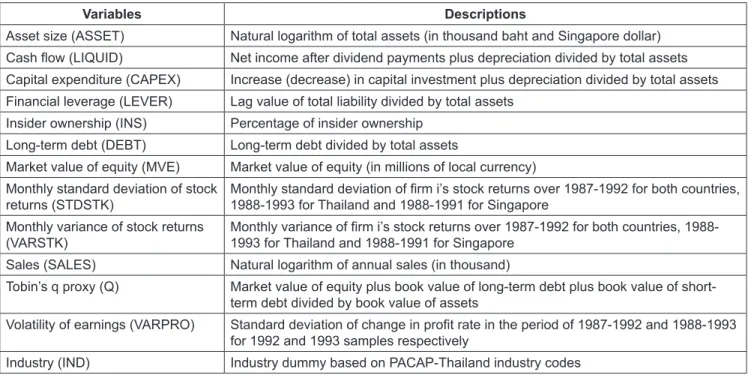
We obtain financial statement data from the PACAP database at the Sandra-Ann Morsilli Pacific-Basin Capital Markets (PACAP) Research Center at the University of Rhode Island. Ownership data for Thai firms is obtained from CD-ROM database provided by Manager Information System, Ltd., (Thailand), the maker of Thailand Company Handbook. Singapore firms’ ownership data is collected from Company Handbook available at the PACAP Research center. Table 1 presents descriptions of variables used in this study.
In selecting and measuring the variables, we follow Cho
and L&M. We measure all variables at year-end. McConnell
and Servaes (1990) use six as cutoff point for Tobin’s q ratio.
We use eight as a cutoff point simply because the average q ratio of Thai firms is higher than U.S. firms. As a result, we have left with a sample of 205 firms.
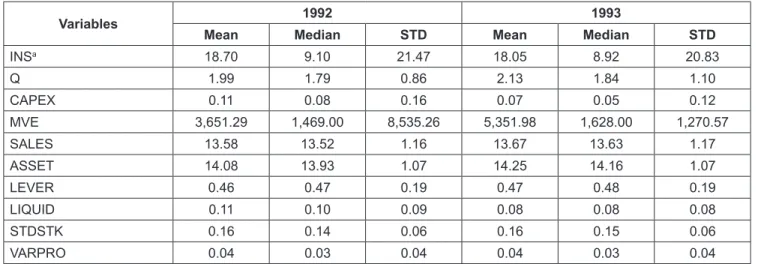
Table 2 contains summary descriptive statistics of the sample. Table 2 Panel A describes variables for the Thai sample. The mean of share ownership of officers and board of directors of Thai firms is 18.7% in 1992 and 18.05% in 1993, compared with 326 Fortune 500 firms in Cho’s sample that report the mean of 12.14% in 1991. There are 55 Thai firms in 1992, and 59 in 1993 that have 0% insider ownership.
Tobin’s q has a mean of 1.99 and 2.13 in 1992 and 1993 respectively, compared with the U.S. firms of 1.1 and 1.3 in 1990 and 1991. In our 1993 sample, there two firms with q greater than 6. There are also two firms in Cho’s sample with q greater than six. These two firms do not influence our regression results. Among the 205 sample firms, there are some firms with missing financial data to compute the variables. The variable that has the most missing data is volatility of earning (VARPRO). There are 194 and 195 observations of VARPRO in 1992 and 1993. As a result, the Cho’s model that includes VARPRO uses 194 and 195 observations in 1992 and 1993 analysis.
Table 2 Panel B presents the variables used in the study for Singapore firms. On average, Singapore firms have unusually large q value with a mean of 9.6 and 8.13 and a median of 8.9 and 7.7 in 1991 and 1992 respectively. In order to preserve the sample size, we do not use any cutoff point
for q proxy because the median value of the Singaporean data is well over the cutoff point of eight that we use for the Thai data. The mean of insider share ownership of the Singaporean firms is 14% and 10%, lower than that of the Thai firm. On the contrary, most insiders of Singaporean firm own some part of their company. Only seven firms in 1991 and 12 firms in 1992 have 0% of insider ownership.
Table 3 reports the distributions of the sample statistics, ranked by level of insider ownership. Table 3 Panel A shows that about 50% of Thai firms have insider ownership less than 10%, compared with about 68% of U.S. firms with insider ownership less than 10%. On the other end, about 20% of Thai firms have insider ownership more than 40% compared with 10% of U.S. firms. Table 3 Panel A also suggests that there is positive relationship between q proxy and ownership level of the Thai firms. Such positive relationship is not present in the Singaporean data as shown in Table 3 Panel B.
About 60% of Singaporean firms have their insiders holding between some fractions of a percent to 10% of the firms share outstanding.
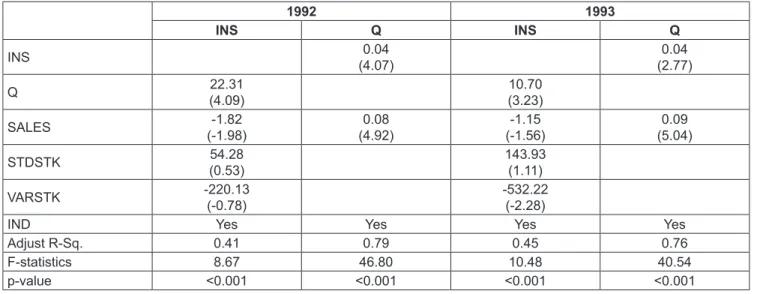
Following L&M, we estimate the following system of equations under two-stage least square (2SLS):
Q
i= g
12INS + b
11SALES + b
12IND + e
1i(1) INS
i= g
21Q + b
21SALES + b
22STDSTK + b
23VARSTK +
b
24IND + e
2i(2)
Table 1: Descriptions of Variables
Variables Descriptions
Asset size (ASSET) Natural logarithm of total assets (in thousand baht and Singapore dollar) Cash flow (LIQUID) Net income after dividend payments plus depreciation divided by total assets Capital expenditure (CAPEX) Increase (decrease) in capital investment plus depreciation divided by total assets Financial leverage (LEVER) Lag value of total liability divided by total assets
Insider ownership (INS) Percentage of insider ownership Long-term debt (DEBT) Long-term debt divided by total assets
Market value of equity (MVE) Market value of equity (in millions of local currency) Monthly standard deviation of stock
returns (STDSTK) Monthly standard deviation of firm i’s stock returns over 1987-1992 for both countries, 1988-1993 for Thailand and 1988-1991 for Singapore
Monthly variance of stock returns
(VARSTK) Monthly variance of firm i’s stock returns over 1987-1992 for both countries, 1988- 1993 for Thailand and 1988-1991 for Singapore
Sales (SALES) Natural logarithm of annual sales (in thousand)
Tobin’s q proxy (Q) Market value of equity plus book value of long-term debt plus book value of short- term debt divided by book value of assets
Volatility of earnings (VARPRO) Standard deviation of change in profit rate in the period of 1987-1992 and 1988-1993 for 1992 and 1993 samples respectively
Industry (IND) Industry dummy based on PACAP-Thailand industry codes
Table 2: Sample Summary Statistics Panel A: Thailand
Variables 1992 1993
Mean Median STD Mean Median STD
INS
a18.70 9.10 21.47 18.05 8.92 20.83
Q 1.99 1.79 0.86 2.13 1.84 1.10
CAPEX 0.11 0.08 0.16 0.07 0.05 0.12
MVE 3,651.29 1,469.00 8,535.26 5,351.98 1,628.00 1,270.57
SALES 13.58 13.52 1.16 13.67 13.63 1.17
ASSET 14.08 13.93 1.07 14.25 14.16 1.07
LEVER 0.46 0.47 0.19 0.47 0.48 0.19
LIQUID 0.11 0.10 0.09 0.08 0.08 0.08
STDSTK 0.16 0.14 0.06 0.16 0.15 0.06
VARPRO 0.04 0.03 0.04 0.04 0.03 0.04
a