* 본 연구는 한국환경산업기술원의 “2013년도 기술료사업 - 도시지역 생태계 건전성 확보를 위한 멸종위기종 서식처 복원기술 개발”의 지원에 의해 수행되었음.
First author:Shim, Yun-Jin, NEXUS Environmental Design Centre, Tel:+82-2-578-2930, E-mail:[email protected]
Corresponding author:Cho, Dong-Gil, NEXUS Environmental Design Centre, Tel:+82-2-578-2930, E-mail:[email protected]
Received:31 March, 2014. Revised:15 April, 2014. Accepted:16 April, 2014.
- 109 -
맹꽁이 서식처 복원을 위한 서식처 적합성 지수(HSI) 개발*
심윤진1)․조동길1)․박소현1)․이동진1)․서윤희1) 김상혁1)․김덕호1)․고상범2)․차진열3)․성현찬4)
1)넥서스환경디자인연구원(주)․2)제주양서류생태연구소
3)국립공원관리공단․4)단국대학교 녹지조경학과
Development of Habitat Suitability Index for Habitat Restoration of Narrow-mouth Frog(
Kaloula borealis
)*Shim, Yun-Jin1)
․Cho, Dong-Gil
1)․Park, Sohyun
1)․Lee, Dong-Jin
1) Seo, Yun-Hee1)․Kim, Sang-Hyuk
1)․Kim, Duck-Ho
1)․Ko, Sang-Beom
2)Cha, Jin-Yeol3) and Sung, Hyun-Chan4)
1)NEXUS Environmental Design Centre, 2)Jeju amphibian ecology institute,
3)Korea National Park Service, 4)Dept. of Green & Landscape Architecture, Dankook University.
ABSTRACT
Kaloula borealis is the species of Amphibia which belongs to Kaloula genus and it is the only species inhabiting in Korea. The population size and habitat of Kaloula borealis have been significantly decreased on a national scale due to the diversified developments and the uses of agricultural pesticides. Accordingly, the Ministry of Environment has designated and managed them as the class II of endangered species, in accordance with 「Endangered Species Protection and Management Act」; however, a particular study focused on the ecological restoration of Kaloula borealis is desperately needed to prevent their extinction.
This study was conducted to propose the HSI (Habit Suitability Index) of Kaloula borealis based
on literature survey on ecology and habitats of Kaloula borealis, as well as their HSI. Factors to be investigated in HSI include: space, feed, cover, water(breeding) and threatening factors and the variables of each factor were also proposed. The distance from wetland, grassland, farm, stream and rice paddy, as well as the altitude of spawning pond were proposed as the variables of space, whereas the bed structure of forest and low-rise grassland were proposed as the variables of feeding.
The variables of water (breeding) include the area of permanent and temporary wetlands, coverage of emerged pants (ratio of open water), water depth, water temperature, water quality, pH level, etc., whereas the presence of predator, distance from street and pollutants were proposed as the variables of threatening factor. The sub-standards by HSI factor of Kaloula borealis have been drawn from in-depth consultation with experts and based on this, the final HSI of Kaloula borealis was developed.
Key Words:Endangered Species, Amphibians, Habitat Evaluation Procedure, Ecological Restoration.
I. 서 론
최근 급격한 기후변화와 서식지 파괴로 인한 개체수 감소에 따라 양서류는 전 세계적으로 멸 종될 위험에 처해 있는 중요한 분류군으로 간주 되고 있다(Wake and Vredenburg, 2008).
맹꽁이는 Kaloula속에 속하는 양서류로 우리 나라에서는 유일하게 한 종이 서식하고 있으나 (Ko et al., 2011a), 각종 개발과 농약의 사용으 로 현재 전국의 개체군의 크기 및 서식지가 크 게 감소하고 있다(Yang et al., 2001; National Institute of Biological Resources(이하 NIBR), 2011). 이에 환경부는 「야생생물보호및관리에 관한법률」에 의거하여 맹꽁이를 멸종위기야생 생물 Ⅱ급으로 지정․관리하고 있으나 맹꽁이 의 절멸 방지를 위해서 맹꽁이에 대한 생태복원 연구가 절실히 필요하다.
맹꽁이에 대한 연구사를 보면 1980년 이전에 는 주로 분포나 생물학적 특징에 관한 연구가 수행되었고, 1980년대부터 2000년 이전까지는 대부분 유전적 분석에 대하여 연구들이 주류를 이루고 있다(Ko, 2012). 2000년 이후로 맹꽁이 의 생태 및 서식처 복원에 관한 연구가 시작되
었는데, 생태에 관하여는 맹꽁이의 울음소리와 행동 및 발생(Hwang, 2000), 산란지 분포(Ko et al., 2011a), 나이구조 분석(Ko et al., 2011b), 번 식기간 중 먹이 습성(Ko et al., 2012a), 번식에 영향을 주는 기상요인(Ko et al., 2012b) 등 2010 년 이후 다양한 연구가 수행된 바 있다. 그러나 맹꽁이의 생태에 대한 다양한 연구에도 불구하 고 서식처 복원에 대한 연구는 미흡하다.
Jung(2009)은 맹꽁이 서식처적합도 평가기준 도 출을 통해 대체서식지 조성 모델을 제시하였으 나 맹꽁이의 서식 및 서식처에 대한 생태적 정 보가 부족하여 일반적인 양서류에 대한 서식처 적합도와 대체서식지 조성 모델 제시에 그치고 말았다. 특히, 맹꽁이의 번식기, 활동기, 동면기 등 활동 범위 및 생활모습이 최근 맹꽁이의 생 태 연구를 통해 밝혀진 내용과 차이가 나타났다 (NIBR, 2012). Kim(2010)은 맹꽁이의 서식공간 에 대한 개선방안을 제시하였으나 맹꽁이의 생 활사 중 번식기에 대해서만 이루어져 맹꽁이 서 식처 전반에 대한 내용을 다루지 못했다.
맹꽁이 서식처 복원을 위해서는 서식처 모형
즉, 서식처 복원 모델 연구가 중요한데 이러한
연구는 대체로 서식처 적합성 평가와 관련이 있
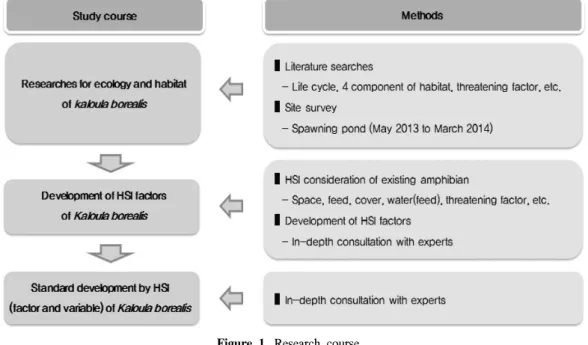
Figure 1. Research course.
다(Kim et al., 2013). US Fish and Wildlife Service(1980)에서는 서식처 적합성 지수(Habitat Suitability Index, 이하 HSI)를 기준으로 서식 처를 평가하는 방법인 HEP(Habitat Evaluation Procedure)를 개발하였다(Shim, 2004). HSI란 특정 어류나 야생생물종이 서식할 수 있는 서식 처의 능력을 나타내는 정량적 지표로
1), 구성요 소와 변수에 따른 기준 도출을 통해 특정 생물 종의 서식을 위한 요구조건을 제시할 수 있으며 이를 통해 서식처 모형을 제시할 수 있는 근거 가 된다.
따라서, 본 연구는 맹꽁이의 생태 및 서식처 현황 조사와 맹꽁이의 HSI 관련 문헌조사를 바 탕으로 맹꽁이의 HSI를 개발하는 것을 목적으 로 하며, 이를 통해 향후 맹꽁이 서식처 복원 모 델 연구의 기초 자료로 제시하고자 한다.
II. 연구 방법
본 연구는 맹꽁이의 생태와 서식처 현황 조사 및 분석, 맹꽁이 HSI 항목(구성요소 및 변수) 개발, 맹꽁이 HSI 항목(구성요소 및 변수)별 기준 개발 로 크게 3단계로 구분하여 수행하였다(Figure 1).
1. 맹꽁이의 생태 및 서식처 현황 조사 및 분석 1) 문헌 조사
맹꽁이의 생태 및 서식처 현황에 대하여 2000 년도 이후 연구된 문헌을 토대로 검토하였다
2). 맹꽁이의 생활사, 야생동물의 서식처 4대 구성요 소(공간, 먹이, 물, 은신처)(Lee et al., 2009) 및 기존 양서류 +관련 HSI 항목에서 주로 언급되는 구성요소를 토대로 공간, 먹이, 은신처, 물(번식), 동면, 기타 생활사, 위협요소 등을 조사하였다.
1) HSI란 동일한 목표종에 대하여 최적의 서식처 조건 대 연구대상지역의 서식처 조건의 비라고 할 수 있으며 다음과 같이 식으로 나타낼 수 있다(Shim, 2004).
HSI = 연구대상지역의 서식처 조건
최적의 서식처 조건
2) 2000년 이전은 주로 맹꽁이의 분포 및 유전적 분석에 대한 연구가 주류를 이루고 있다.
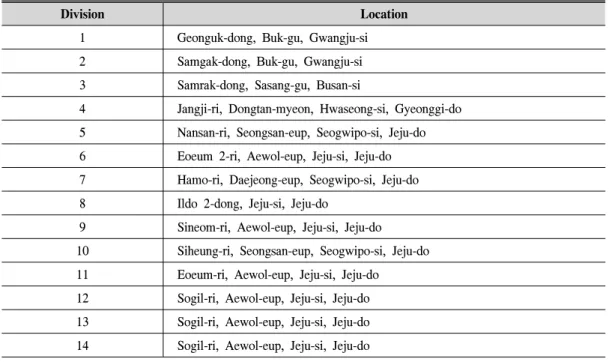
Table 1. Study sites.
Division Location
1 Geonguk-dong, Buk-gu, Gwangju-si 2 Samgak-dong, Buk-gu, Gwangju-si 3 Samrak-dong, Sasang-gu, Busan-si
4 Jangji-ri, Dongtan-myeon, Hwaseong-si, Gyeonggi-do 5 Nansan-ri, Seongsan-eup, Seogwipo-si, Jeju-do 6 Eoeum 2-ri, Aewol-eup, Jeju-si, Jeju-do 7 Hamo-ri, Daejeong-eup, Seogwipo-si, Jeju-do 8 Ildo 2-dong, Jeju-si, Jeju-do
9 Sineom-ri, Aewol-eup, Jeju-si, Jeju-do 10 Siheung-ri, Seongsan-eup, Seogwipo-si, Jeju-do 11 Eoeum-ri, Aewol-eup, Jeju-si, Jeju-do 12 Sogil-ri, Aewol-eup, Jeju-si, Jeju-do 13 Sogil-ri, Aewol-eup, Jeju-si, Jeju-do 14 Sogil-ri, Aewol-eup, Jeju-si, Jeju-do
2) 현지 조사
맹꽁이의 서식처 현황 조사는 2013년 5월부 터 2014년 3월까지 산란지를 중심으로 서식지 경관과 산란지 환경요인으로 구분하여 실시하 였다(Table 1). 조사지역 선택은 개발이 많이 이 루어지지 않아 서식지 상태가 양호한 제주도 지 역을 중심으로 조사하였다. 서식지 경관에 대하 여 은신처, 먹이형태, 고도, 산란지 반경 150m 이내 토지이용 등으로 구분하였으며 산란지 환 경요인으로 습지유형, 면적, 수심, 수생식물의 피도, pH, 용존산소, 염도, 개방수면 등으로 구 분하여 조사하였다. 맹꽁이는 멸종위기야생생 물 Ⅱ급으로 지정․관리되고 있어 종 보존을 위 해 정확한 좌표는 생략하였다.
2. 맹꽁이 HSI 항목(구성요소 및 변수) 개발 1) 기존 양서류 HSI 고찰
맹꽁이 HSI 항목인 구성요소 및 변수를 개발 하기 위해 먼저 기존 양서류 HSI에 대한 연구를
고찰하였다. 해외 연구로는 영국의 Great Crested Newt(ARG UK, 2010), 일본 Natori강 유역의 무 미류(Kei et al., 2011), 콜롬비아 아마존의 두꺼비 (Tole, 2006), 황소개구리(Graves and Anderson, 1987) 등을 고찰하였으며, 국내 연구로는 한국산 개구리(Shim, 2004)를 고찰하였다.
기존 연구 자료를 토대로 HSI 항목 중 구성 요소를 공간, 먹이, 은신처, 물(번식), 동면, 위협 요소 등으로 구분하고 이에 따라 변수를 세분화 하였다.
2) 맹꽁이 HSI 항목 구축
맹꽁이의 생태 및 서식처 현황 조사․분석 (문헌 조사 및 현지 조사)과 기존 양서류에 대 한 HSI 고찰을 토대로 맹꽁이의 HSI 항목을 1 차적으로 선정하였다. 그 후 국내 양서류 전문 가 3명과의 심층 면담
3)을 통해 각 항목의 타당 성과 추가 및 제외시켜야 하는 항목들을 검토하 여 맹꽁이 HSI 항목을 최종적으로 도출하였다.
3) 2014년 1월부터 3월까지 수차례 걸친 대면 인터뷰 및 이메일을 통해 자문을 받았다.
3. 맹꽁이 HSI 항목(구성요소 및 변수)별 기준 개발
맹꽁이 HSI 항목을 바탕으로 구성요소에 따 른 변수별 기준을 국내 양서류 전문가 3명과의 심층 면담을 통해 제시하였다
4). 기준의 타당성 과 수정 및 보완 사항을 검토하여 맹꽁이 HSI 항목별 기준을 제시, 최종적으로 맹꽁이 HSI를 개발하였다.
III. 연구 결과 및 고찰
1. 맹꽁이의 생태 및 서식처 현황 조사 및 분석 1) 문헌 조사
맹꽁이의 생태 및 서식처 현황에 대한 문헌 조 사 결과는 Table 2와 같다. 맹꽁이는 강원도를 제 외한 모든 지역에서 분포되며(Kim, 2009; NIBR, 2012) 번식지로부터 500m 이상 먼 거리까지 이 동하나(NIBR, 2012) 제주도의 경우 154m까지 이 동하는 것으로 확인되었다(Ko, 2012). 먹이는 주 로 곤충, 거미류, 지렁이 등이며(Ko et al., 2012a;
NIBR, 2012) 주로 흙 속이나 돌 밑에 숨어 지낸 다(Ko, 2012; NIBR, 2012). 장마철 전후 많은 비가 내리는 날에 산란을 하며(Ko et al., 2011a;
Ko et al., 2012b; NIBR, 2012) 비가 온 후 연못 이나 물이 고인 웅덩이에 산란이 많이 이루어지 고 있다(NIBR, 2012). 산란 시 습지의 식생은 정수식물 및 부엽식물이 주로 분포하며(Kim and Lee, 2010; Ko et al., 2011a) 산란지의 수심 은 10∼50cm 정도이다(Kim and Lee, 2010; Ko et al., 2011a). 다른 양서류와 달리 발생기간이 짧아 산란 후 1∼2일 이내 올챙이로 부화하며
(NIBR, 2012) 알에서 성체가 되는 기간은 약 20
∼40일 가량 소요된다(Ko et al., 2011a; NIBR, 2012). 붕어, 미꾸라지, 붉은귀거북, 물방개 등 이 유생의 포식자이며(Ko, 2012; NIBR, 2012) 농약이나 비료 살포로 인하여 산란지가 교란되 고 있다(Ko, 2012). 동면과 관련된 연구는 없는 데, 이는 주로 맹꽁이의 울음소리를 들을 수 있 는 산란기에 맹꽁이를 주로 발견하여 연구가 수 행되었기 때문이며 향후 맹꽁이의 동면 연구가 이루어져야 한다고 판단된다.
2) 현지 조사
14개 산란지를 현지 조사한 결과(Appendix), 은신처는 주로 흙이나 돌 밑으로 나타났으며 먹 이는 곤충을 비롯한 절지동물이 주를 이루었다.
산란지 주변 서식지의 고도는 해발 4m∼256m 로 나타났으며
5), 산란지 반경 150m 이내 토지 이용은 초지나 농경지가 주를 이루었다. 산란지 습지 유형은 주로 연못 형태의 영구습지가 가장 많았으며 초지, 수로, 묵논, 논 등 일시적 습지도 나타났다
6). 산란지의 면적은 최소 30m
2에서 최 대 1500m
2까지 다양하며 수심은 C 지역 70cm 를 제외하고는 50cm를 넘지 않았다. 산란지의 수생식물의 피도는 침수식물을 포함하여 최소 20%에서 최대 80%까지 다양하게 나타났다. pH 는 최저 5.8에서 최고 9.2까지이며 용존산도 (DO)는 최저 5.1 ppm에서 최고 13.6 ppm 까지 나타났다. 염도는 41.6 ppm에서 662.8ppm으로 나타나 다른 지역에 비해 상대적으로 염도가 높 은 산란지도 포함되었다
7). 개방수면도 20%∼
80%로 다양하게 나타났다.
4) 맹꽁이 산란지 현지 조사 대상지가 14개소에 불과하여 통계 처리에 한계가 있다는 전문가의 자문의견을 수렴, 14개소 현지 조사와 기존 문헌 자료를 토대로 전문가 심층 면담으로 맹꽁이 HSI 항목의 기준을 제시하였다.
5) 제주지역 맹꽁이의 산란지는 해안가에서부터 관찰되기 시작해서 해발 400m까지 산란지가 분포되고 있다(Ko, 2012).
6) 산란지의 행태는 NIBR(2012)은 초지>농수로 등 수로>논>웅덩이 주변 습지 순으로 분포한다고 하며 Ko et al.
(2011a)는 영구 습지>하천주변>일시적 습지>농경지나 주택 주변 순으로 분포한다고 하였다.
7) NIBR(2012)에 의하면 염도가 높은 태안 신두리 지역에서도 맹꽁이의 산란지가 관찰되었다.
Table 2. Literature searches for ecology and habitat of Kaloula borealis.
Factor Contents Literature
Space
Habitat
distribution Observed at all areas excluding Gangwon-do Kim, 2009;
NIBR, 2012 Home range Able to move beyond 500m from the spawning pond NIBR, 2012 Sharing the places for spawning and habitat. Able to move up to 154m Ko, 2012
Feed Adult Insect, arthropod, earthworm, etc. NIBR, 2012
Diptera, ground beetle, ants, spiders, etc. Ko et al., 2012a Larva Tissues debris from dead animals, bog moss or algae NIBR, 2012
Cover
Hide
From single to dozens of Kaloula borealis hide under the moist stone in the drained furrow or artificial articles
Under the soil or stones, between the stones
NIBR, 2012 Get into deep more than 20cm below the soil if soft soil
and under the stones, etc. Ko, 2012
Hide (larva)
Digging a round furrow in the grass under the puddle
and hide themselves there NIBR, 2012
Action period
Hiding under the soil during the daytime
To be out during the nighttime from April to November for feeding Many Kaloula borealis are moving on rainy day or highly humid day Working after sunset during the hot summer season
Kaloula borealis to be observed at temperature higher than 15℃
NIBR, 2012
Water (breeding)
Breeding Period
Spawning during the summer with high temperature or heavy rains Ko et al., 2011a Breeding at the late period among anuran inhabited in Korea and has a short breeding
period Ko et al., 2012b
Breeding from the end of April to the end of August around rainy season NIBR, 2012 Climatic The factor affecting the spawning of Kaloula borealis: the most significant factor
is rainfall followed by humidity and air pressure Ko et al., 2012b
Spawning pond
Active spawning occurred in pond or puddle after raining NIBR, 2012 To be distributed from grassland>waterway including agricultural waterway>rice
paddy>wetland around puddle NIBR, 2012
To be distributed from permanent wetland>around stream>temporary wetland>around
farmland or residence Ko et al., 2011a
Vegetation of wetland for
spawning
Scirpus triangulatus Roxb., Echinochloa crusgalli (L.) P.Beauv., Spirodela polyrhiza (L.) Sch., Persicaria hydropiper (L.) Spach, Oenanthe javanica (Blume) DC., Nymphaea tetragona Georgi, etc.
Emerged plants are accounting for the most species followed by floating leaves plant
Ko et al., 2011a
Preferring non-opened space as lower colony of emerged plants including Phragmites communis Trin., Typha orientalis C.Presl, Juncus effusus var. decipiens Buchenau, Oenanthe javanica (Blume) DC., etc.
Coverage of emerged plant colony should be more than 50%.
Spawning at an area with lower ratio of open water or shaded area
Kim and Lee, 2010
Water depth in spawning pond
Area less than 50cm Ko et al., 2011a
10cm∼40cm.
Water depth at least 1m needs to be secured to prevent freezing. Kim and Lee, 2010 Surroundings of
spawning pond To be distributed from farm>stream>rice paddy NIBR, 2012
Hibernation - No research data -
Living condition
Occurrence
period Hatch out to tadpole within 1 to 2 days after spawning NIBR, 2012 Period from egg
to adult
About 25 days NIBR, 2012
About 20∼40 days Ko et al., 2011a
Threatening factor
Urbanization Landfill and decreases of spawning pond by urbanization Ko, 2012 Road kill caused by creation of street or trails NIBR, 2012 Agriculture Distribution of agricultural pesticide and fertilizer Ko, 2012
Predator Carassius Carassius LINNAEUS., Misgurnus mizolepis, Trachemys scripta Ko, 2012 Cybister japonicus, larval of Cybister japonicus, larval of dragonflies NIBR, 2012
2. 맹꽁이 HSI 항목(구성요소 및 변수) 개발 1) 기존 양서류 HSI 고찰
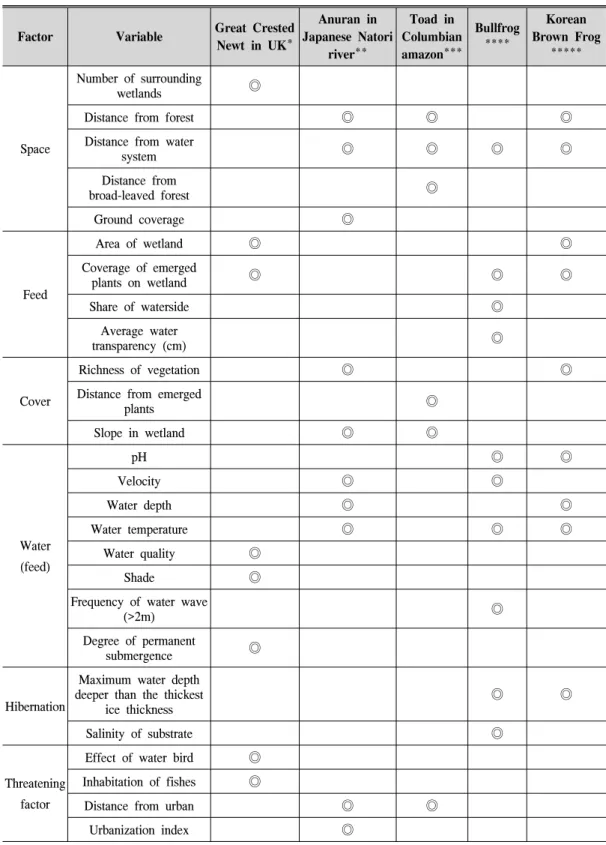
구성요소를 공간, 먹이, 은신처, 물(번식), 동 면, 위협요소로 구분하고 변수를 세분화하여 기 존 문헌을 고찰한 결과(Table 3), 공간으로는 수 계와의 거리와 산림과의 거리 변수가 가장 많이 나타났다. 이는 양서류의 생태적 특성 상 습지 를 중심으로 산림과 서식처를 공유하고 있기 때 문이라고 판단된다. 먹이로는 습지의 면적, 습 지의 수생식물 피도 변수가 많이 나타났는데 생 물다양성이 높은 습지에서 양서류의 다양한 먹 이원이 존재하기 때문이라 판단된다. 은신처로 는 식생의 풍부도와 습지 경사도 변수가 많이 나타났는데 이 또한 먹이와 관련이 있기 때문이 라 생각된다. 물(번식)으로는 pH, 유속, 수심, 수온 등 양서류의 산란지인 습지와 수환경 특성 과 관련된 변수가 많이 나타났다. 동면 항목에 는 최고 얼음두께보다 깊은 최고 수심 변수가 있는데 이는 습지에서 동면을 하는 양서류의 특 성을 반영한 것이라 판단된다. 위협요소로는 도 심지와의 거리 등 서식지 교란과 관련된 변수가 나타났다.
2) 맹꽁이 HSI 항목 구축
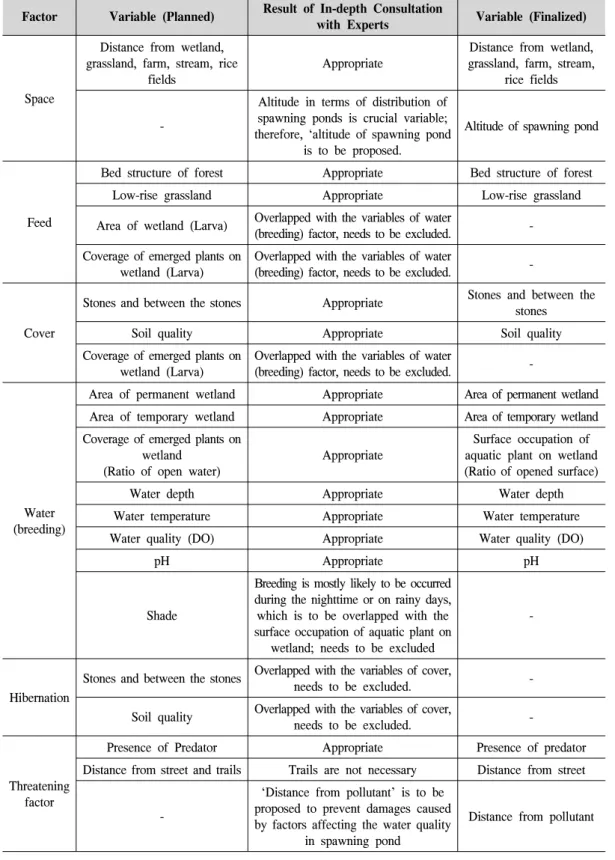
맹꽁이의 HSI 항목은 공간, 먹이, 은신처, 물 (번식), 위협요소 등의 구성요소를 포함하며 각 구성요소별 변수를 제시하였다(Table 4). 우선 공간 변수로는 습지, 초지, 밭, 하천, 논과의 거 리를 제시하였으며 산란지 분포에 있어 고도가 중요하다는 전문가 의견을 수렴하여 산란지 고 도를 추가하였다. 먹이 변수로는 수림대 층상 구조와 저층 초지 공간을 변수로 구축하였다.
유생의 먹이를 고려하여 습지 면적과 습지 수생 식물의 피도를 제시하였으나 물(번식) 변수와 중복되어 전문가 심층 면담 결과 제외하였다.
은신처 변수는 돌 및 돌 틈, 토질을 구축하 였으며 유생의 은신처를 고려하여 습지 수생식 물의 피도를 제시하였으나 물(번식) 변수와 마 찬가지로 중복되어 전문가 심층 면담 결과 제 외하였다. 물(번식) 변수로는 영구습지 면적, 일시습지 면적, 습지 수생식물의 피도(개방수 면 비율), 수심, 수온, 수질, pH 등을 구축하였 다. 산란 시 그늘 여부를 고려하여 그늘 여부를 제시하였으나 번식은 주로 비 오는 날이나 야 간에 이루어지며 수생식물의 피도와 중복되어 전문가 심층 면담 결과 제외하였다. 동면 구성 요소로는 돌 및 돌 틈, 토질을 제시하였으나 둘 다 은신처 변수와 중복되어 전문가 심층 면담 결과 제외하였다.
마지막으로 위협요소 변수는 포식자 유무, 도 로와의 거리를 제시하였으며 산란지 수질에 영향 을 미치는 오염원도 고려해야 된다는 전문가 의 견을 수렴하여 오염원과의 거리를 추가하였다.
3. 맹꽁이 HSI 항목(구성요소 및 변수)별 기준 개발
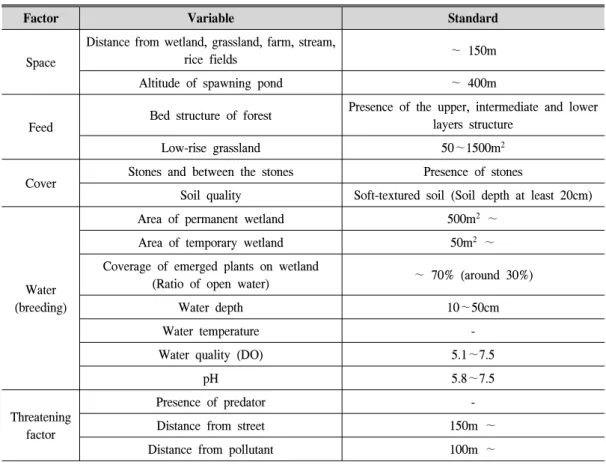
기존 문헌 및 현지 조사를 바탕으로 전문가 심층 면담을 통해 맹꽁이 HSI 항목별 기준을 제시하였다(Table 5). 공간 변수인 습지, 초지, 밭, 하천, 논과의 거리는 150m 이내로 기준을 설정하였으며
8)산란지 고도는 현지 조사 결과 (4m∼256m)와 Ko(2012)의 연구 결과(400m 이 하)를 바탕으로 400m 이하로 설정하였다. 먹이 변수 수림대 층상 구조는 상층, 중층, 하층 층상 구조의 존재로 기준을 설정하였으며 저층 초지 공간은 현지 조사 결과를 바탕으로 50∼1500m
2로 설정하였다.
은신처 변수 돌 및 돌 틈은 돌의 도입을 기준 으로 설정하였으나 구체적인 수치를 제시하지 못하여 향후 지속적인 연구가 필요하다. 토질은
8) 맹꽁이가 번식지에서 154m까지 이동하는 것을 확인한 Ko(2012)의 연구 결과를 바탕으로 150m 이내로 기준을 설정하였다.
Table 3. HSI consideration of existing amphibian.
Factor Variable Great Crested
Newt in UK*
Anuran in Japanese Natori
river**
Toad in Columbian amazon***
Bullfrog
****
Korean Brown Frog
*****
Space
Number of surrounding
wetlands ◎
Distance from forest ◎ ◎ ◎
Distance from water
system ◎ ◎ ◎ ◎
Distance from
broad-leaved forest ◎
Ground coverage ◎
Feed
Area of wetland ◎ ◎
Coverage of emerged
plants on wetland ◎ ◎ ◎
Share of waterside ◎
Average water
transparency (cm) ◎
Cover
Richness of vegetation ◎ ◎
Distance from emerged
plants ◎
Slope in wetland ◎ ◎
Water (feed)
pH ◎ ◎
Velocity ◎ ◎
Water depth ◎ ◎
Water temperature ◎ ◎ ◎
Water quality ◎
Shade ◎
Frequency of water wave
(>2m) ◎
Degree of permanent
submergence ◎
Hibernation
Maximum water depth deeper than the thickest
ice thickness
◎ ◎
Salinity of substrate ◎
Threatening factor
Effect of water bird ◎ Inhabitation of fishes ◎
Distance from urban ◎ ◎
Urbanization index ◎
* ARG UK, 2010; ** Kei et al., 2011; *** Tole, 2006; **** Graves and Anderson, 1987; ***** Shim, 2004.
Table 4. Development of HSI factors of Kaloula borealis.
Factor Variable (Planned) Result of In-depth Consultation
with Experts Variable (Finalized)
Space
Distance from wetland, grassland, farm, stream, rice
fields
Appropriate
Distance from wetland, grassland, farm, stream,
rice fields
-
Altitude in terms of distribution of spawning ponds is crucial variable;
therefore, ‘altitude of spawning pond is to be proposed.
Altitude of spawning pond
Feed
Bed structure of forest Appropriate Bed structure of forest
Low-rise grassland Appropriate Low-rise grassland
Area of wetland (Larva) Overlapped with the variables of water
(breeding) factor, needs to be excluded. - Coverage of emerged plants on
wetland (Larva)
Overlapped with the variables of water
(breeding) factor, needs to be excluded. -
Cover
Stones and between the stones Appropriate Stones and between the stones
Soil quality Appropriate Soil quality
Coverage of emerged plants on wetland (Larva)
Overlapped with the variables of water
(breeding) factor, needs to be excluded. -
Water (breeding)
Area of permanent wetland Appropriate Area of permanent wetland Area of temporary wetland Appropriate Area of temporary wetland Coverage of emerged plants on
wetland (Ratio of open water)
Appropriate
Surface occupation of aquatic plant on wetland (Ratio of opened surface)
Water depth Appropriate Water depth
Water temperature Appropriate Water temperature
Water quality (DO) Appropriate Water quality (DO)
pH Appropriate pH
Shade
Breeding is mostly likely to be occurred during the nighttime or on rainy days, which is to be overlapped with the surface occupation of aquatic plant on
wetland; needs to be excluded
-
Hibernation
Stones and between the stones Overlapped with the variables of cover,
needs to be excluded. -
Soil quality Overlapped with the variables of cover,
needs to be excluded. -
Threatening factor
Presence of Predator Appropriate Presence of predator Distance from street and trails Trails are not necessary Distance from street
-
‘Distance from pollutant’ is to be proposed to prevent damages caused by factors affecting the water quality
in spawning pond
Distance from pollutant
Table 5. Standard development by HSI (factor and variable) of Kaloula borealis.
Factor Variable Standard
Space
Distance from wetland, grassland, farm, stream,
rice fields ∼ 150m
Altitude of spawning pond ∼ 400m
Feed Bed structure of forest Presence of the upper, intermediate and lower layers structure
Low-rise grassland 50∼1500m2
Cover Stones and between the stones Presence of stones
Soil quality Soft-textured soil (Soil depth at least 20cm)
Water (breeding)
Area of permanent wetland 500m2 ∼
Area of temporary wetland 50m2 ∼
Coverage of emerged plants on wetland
(Ratio of open water) ∼ 70% (around 30%)
Water depth 10∼50cm
Water temperature -
Water quality (DO) 5.1∼7.5
pH 5.8∼7.5
Threatening factor
Presence of predator -
Distance from street 150m ∼
Distance from pollutant 100m ∼
Ko(2012)의 문헌 결과를 바탕으로 부드러운 흙 으로 토심 20cm 이상 확보하는 것을 기준으로 설정하였다. 물(번식) 변수 중 영구습지 면적은 500m
2이상으로, 일시습지 면적은 50m
2이상으 로 현지조사 결과 내용을 바탕으로 설정하였다.
습지 수생식물의 피도
9)(개방수면 비율)은 70%
내외(30% 내외), 수심 10∼50cm
10), 수질(DO) 5.1∼7.5, pH 5.8∼7.5로 각각 그 기준을 설정하 였다. 수온은 자료 미흡으로 기준을 설정하지 못하여 향후 지속적인 추가 연구가 필요하다.
위협요소 변수인 도로와의 거리는 150m 이 상으로
11), 오염원과의 거리는 100m 이상으로
기준을 제시하였으며 포식자 유무에 대해서는 향후 연구 보완이 필요하다.
IV. 결 론
본 연구는 맹꽁이의 생태 및 서식처 현황 조 사와 맹꽁이의 HSI 관련 문헌조사를 바탕으로 맹꽁이의 HSI를 제시하고자 수행되었다. 본 연 구를 통해 개발된 맹꽁이 HSI는 서식처 복원 모델의 중요한 근거 자료가 되며 국내 최초로 맹꽁이 서식처 현지 조사를 바탕으로 진행한 점 에 있어서 큰 의의가 있다.
9) 습지 수생식물의 피도는 침수식물을 제외한 정수, 부엽, 부유식물을 기준으로 제시하였다.
10) 맹꽁이는 육상에서 동면을 하므로 전문가 의견을 수렴하여 동결심도는 고려하지 않았다.
11) 맹꽁이의 이동반경을 고려한 공간 변수인 습지, 초지, 밭, 하천, 논과의 거리 150m 이내와 같은 기준으로 설정하였다.
맹꽁이의 HSI 항목은 공간, 먹이, 은신처, 물 (번식), 위협요소 등 5개의 구성요소를 포함하 며 각 구성요소별로 총 16개의 변수를 제시하 였다. 우선 공간 변수로는 습지, 초지, 밭, 하천, 논과의 거리와 산란지 고도를 제시하였다. 먹이 변수로는 수림대 층상 구조와 저층 초지 공간을 제시하였으며 은신처 변수로는 돌 및 돌 틈, 토 질을 제시하였다. 물(번식) 변수로는 영구습지 면적, 일시습지 면적, 습지 수생식물의 피도(개 방수면 비율), 수심, 수온, 수질, pH 등을 제시 하였으며 위협요소 변수로는 포식자 유무, 도로 와의 거리, 오염원과의 거리를 제시하였다. 맹 꽁이의 HSI 항목별 세부 기준은 전문가 심층 면담을 통해 도출되었으며 이를 토대로 최종적 으로 맹꽁이 HSI를 개발하였다.
본 연구는 멸종위기에 처한 맹꽁이의 절멸 방지를 위한 서식처 복원 및 생태 관련 정보를 제공하며 ‘대체서식지 조성․관리 환경영향평 가 지침’을 비롯한 다양한 생태복원 관련 정책 의 중요한 기초자료로 활용될 수 있다. 또한 환 경부에서 추진하고 있는 생태복원 사업인 생태 계보전협력금 반환사업, 자연마당 등에 맹꽁이 서식처 조성 시 적용이 가능하다.
향후 연구로서 맹꽁이 HSI에 대한 검증 연구 가 필요하며 이는 맹꽁이 서식처 복원 모델 구 축 및 Test-bed 조성, 모니터링과 연계되어 이루 어져야 한다. 또한 환경부 지정 기후변화 생물 지표 100종 중 맹꽁이가 포함되어 있는 바 한반 도 기후변화에 따른 맹꽁이 적응 및 서식처 변 화 연구도 필요하다고 판단된다.
인 용 문 헌
Amphibian and Reptile Groups of the United Kingdom(ARG UK). 2010. Great crested newt habitat suitability index. ARG UK advice note 5.
Cho, D. G. 2011. Ecological restoration planning
and designing. NEXUS Environmental design centre, Seoul. (in Korean)
Graves, B. M. and S. H. Anderson. 1987. Habitat suitability index models: bullfrog. Research report to U.S. Fish and Wildlife Service.
82/10.138.
Hwang, Y. S. 2000. Study in the ecology of the Korean narrow-mouthed frog (Kaloula borealis). MA dissertation, Graduate School of Korea National University of Education.
(in Korean with English summary) Jung, Y. S. 2008. A planning model for a substitute
habitat of wildlife based on wetland: case of Shinki village Dang dong in Gunpo city. Ph.D dissertation, Sangmyung University. (in Korean with English summary)
Kei, N.․J. i. Shiraiwa and S. Kazama. 2011.
Evaluation of seasonal habitat variations of fresh water fishes, fireflies, and frogs using a habitat suitability index model that includes river water temperature. Journal of Ecological Modelling 222(21): 3718-3726.
Kim, J. B. 2009. Taxonomic list and distribution of Korean amphibians. The Korean Research Society of Herpetologists 1(1): 1-13. (in Korean with English summary)
Kim, J. C. 2010. A Study on Habitat Improvement for Narrow-mouth frog(Kaloula borealis) In-situ Conservation. MA dissertation, University of Seoul. (in Korean with English summary) Kim, J. C. and G. J. Lee. 2010. A study on habitat
improvement for Narrow-mouth frog(Kaloula borealis) in-situ conservation. Proceedings of the Korean Society of Environment and Ecology Conference 20(1): 150-154. (in Korean with English summary)
Kim, S. R.․J. H. Lee․J. Y. Song․M. H. Chang․
H. C. Sung and D. G. Cho. 2013. A Study
on the Habitat Restoration Model for Chinemys reevesii. Journal of the Korea Society of Environmental Restoration Technology 16(2):
115-125. (in Korean with English summary) Ko, S. B.․Y. M. Ko and H. S. Oh. 2011a.
Distribution of Spawning Site of Kaolula borealis in Jeju Island. Korean Journal of Environment and Ecology 25(6): 846-852. (in Korean with English summary)
Ko, S. B.․J. H. Lee and H. S. Oh. 2011b. Age Structure Analysis of Kaolula borealis. Korean Journal of Environment and Ecology 25(6):
861-866. (in Korean with English summary) Ko, S. B. 2012. Ecological Study of Kaloula
borealis on Jeju Island. Ph.D dissertation, Jeju National University. (in Korean with English summary)
Ko, S. B.․M. H. Chang, K. S. Yang and H. S.
Oh. 2012a. Feeding Habitats of the Kaloula borealis during the Breeding Season. Korean Journal of Environment and Ecology 26(3):
333-341. (in Korean with English summary) Ko, S. B.․M. H. Chang, J. Y. Song and H. S.
Oh. 2012b. Meteorological Factors Influencing Breeding Biology of Kaloula borealis. Korean Journal of Environment and Ecology 26(6):
876-883. (in Korean with English summary) Lee, W. S. et al. 2010. Ecological management
of endangered animals. Life Science Publishing
Co, Seoul. (in Korean)
Tole, L. 2006. Choosing reserve sites probabilistically:
A Colombian Amazon case study. Journal of Ecological Modelling 194(4): 344-356.
National Institute of Biological Resources(NIBR).
2011. Red Data Book of Endangered Amphi- bians and Reptiles in Korea. pp. 22-27. (in Korean)
National Institute of Biological Resources(NIBR).
2012. Precise Ecological Survey of Endangered Herptile (Kaloula borealis) and Post- Evaluation and Improvement of Proliferation and Restoration Project. (in Korean) Shim, Y. J. 2004. A study on the site selection
of wetland replacement using Korean redfrog (Runa amurensis coreana Okada) habitat suitability index: focusing on Pangyo residential development site. MA dissertation, Seoul National University. (in Korean with English summary)
Wake, D. B. and V. T. Vredenburg. 2008. Are we in the midst of the sixth mass extinction?
A view from the world of amphibians.
Proceedings of the National Academy Sciences of United States America 105(1): 11466-11473.
Yang, S. Y.․J. B. Kim․M. S. Min․J. H. Suh
and Y. J. Kang. 2001. Monograph of Korean
Amphibia. Academy press, Seoul. (in Korean)
Appendix. Field survey of Kaloula borealis habitat.
Classification A B C D E
Landscape of habitat
Location
Geonguk-dong, Buk-gu, Gwangju-si
Samgak-dong, Buk-gu, Gwangju-si
Samrak-dong, Sasang-gu,
Busan-si
Jangji-ri, Dongtan-myeon,
Hwaseong-si, Gyeonggi-do
Nansan-ri, Seongsan-eup,
Seogwipo-si, Jeju-do Cover Soil Tree, rock Reeds beds Grassland, soil Grassland, soil
Feed Insect Insect,
arthropod Insect Insect,
arthropod
Insect, arthropod
Altitude (m) 36 57 4 44 73
Land uses within a
150m radius of spawning
pond
Farm land
(%)
50 30 - 20 100
Grass land (%)
10 - 100 - -
Forest
(%) - 30 - 60 -
Reside-
nce (%) 40 40 - 20 -
Environ- mental factor of spawning
pond
Type of wetland
Waterway (temporary
wetland)
Wet rice paddy (temporary
wetland))
Pond (permanent
wetland)
Rice paddy (temporary wetland))
Grass land (temporary wetland))
Area (m2) 60 100 500 30 50
Water depth (cm) 10 10 70 20 20
Coverage of emerged plants on wetland (%) (including submerged plant)
20 30 40 20 50
pH 6.7 6.8 7.4 6.9 5.8
Dissolved oxygen
(ppm) 5.2 5.1 5.6 5.3 6.4
Salinity (ppm) 43.1 51.2 62.8 41.6 48.3
Open water (%) 80 70 60 80 50
Appendix. Continued.
Classification F G H I J
Landscape of habitat
Location
Eoeum 2-ri, Aewol-eup, Jeju-si, Jeju-do
Hamo-ri, Daejeong-eup,
Seogwipo-si, Jeju-do
Ildo 2-dong, Jeju-si, Jeju-do
Sineom-ri, Aewol-eup, Jeju-si, Jeju-do
Siheung-ri, Seongsan-eup,
Seogwipo-si, Jeju-do
Cover Under the stones, soil
Under the stones, soil
Under the stones, soil
Under the stones, soil
Under the stones, soil
Feed Insect Insect,
arthropod Insect Insect Insect,
arthropod
Altitude (m) 175 4 78 40 3
Land uses within a
150m radius of spawning
pond
Farm land
(%)
100 100 - 80 80
Grass land (%)
- - - - -
Forest
(%) - - 30 10 -
Reside-
nce (%) - - 70 10 20
Environ- mental factor of spawning
pond
Type of wetland
Pond (permanent
wetland)
Pond (permanent
wetland)
Pond (permanent
wetland)
Pond (permanent
wetland)
Grass land (temporary
wetland)
Area (m2) 50 500 400 80 1500
Water depth (cm) 30 30 30 50 20
Coverage of emerged plants on wetland (%) (including submerged plant)
40 30 20 40 80
pH 6.7 6.3 8.4 6.8 7.5
Dissolved oxygen
(ppm) 6.3 5.4 12.9 7.9 6.8
Salinity (ppm) 171.0 70.4 163.6 622.8 57.8
Open water (%) 60 70 80 60 20
Appendix. Continued.
Classification K L M N
Landscape of habitat
Location
Eoeum-ri, Aewol-eup, Jeju-si,
Jeju-do
Sogil-ri, Aewol-eup, Jeju-si, Jeju-do
Sogil-ri, Aewol-eup, Jeju-si, Jeju-do
Eoeum-ri, Aewol-eup, Jeju-si,
Jeju-do
Cover Under the stones, soil
Under the stones, soil
Under the stones, soil
Under the stones, soil Feed Insect, arthropod Insect, arthropod Insect, arthropod Insect, arthropod
Altitude (m) 256 200 217 151
Land uses within a
150m radius of spawning
pond
Farm land
(%)
70 100 80 90
Grass land (%)
30 - - -
Forest
(%) - - 20 10
Reside-
nce (%) - - - -
Environ- mental factor of spawning
pond
Type of wetland Pond (permanent wetland)
Pond (permanent wetland)
Pond (permanent wetland)
Pond (permanent wetland)
Area (m2) 153 86 130 230
Water depth (cm) 20 30 50 20
Coverage of emerged plants on wetland (%) (including submerged plant)
80 70 80 80
pH 9.2 6.9 7.0 6.9
Dissolved oxygen
(ppm) 13.6 7.0 8.9 9.5
Salinity (ppm) 95.4 130.9 208.8 145.1
Open water (%) 20 30 20 20