• 검색 결과가 없습니다.

A Study on the Impact of Perceived Value of Art Based on Artificial Intelligence on Consumers' Purchase Intention

N/A
N/A
Protected

Academic year: 2021

Share "A Study on the Impact of Perceived Value of Art Based on Artificial Intelligence on Consumers' Purchase Intention"

Copied!
7
0
0

로드 중.... (전체 텍스트 보기)

전체 글

(1)

JKSCI

A Study on the Impact of Perceived Value of Art Based on Artificial Intelligence on Consumers' Purchase Intention

1)

Ruomu Wang*

*PhD student, Dept. of Global Fine Art Graduate School, Kyonggi University, Suwon, Korea

[Abstract]

The purpose of this research is to explore what factors affect consumers' purchasing decisions when purchasing artificial intelligence artworks. The research pointed out that in the real shopping model, customer perceived value includes three dimensions: product perceived value, service perceived value and social perceived value. On this basis, an artificial intelligence work purchase decision-making influence model was constructed, and an online survey was attempted to collect data. Through analysis of the reliability, effectiveness and structural equations of SPSS24.0 and AMOS24.0, and scientific verification and analysis, we found that product cognitive value and service cognitive value have a positive impact on consumers’ purchase intentions, but social cognition Value has no positive effect on consumers' purchasing intentions.

▸Key words: AI artwork, product perception value, service perception value, social perception value, Consumers' Purchase Intention

[요 약]

본 연구의 목적은 인공지능예술작품 구매할 때 소비자들이 어떤 감지가 있는지 , 그리고 구매의 향과 어떤 관계가 있는지 살펴보는데 있다 . 본 연구에서 고객감지가치가 제품감지가치, 서비스감

지가치 그리고 사회감지가치 총 3가지를 제시하였다. 이를 바탕으로 고객감지가치와 구매의향 간

의 모델을 구축하였다 . 연구를 위해 데이터 수집은 온라인 설문 조사를 실시하였다. SPSS24.0와 AMOS24.0을 통해 수집한 데이터의 신뢰성, 타당성 및 구조 방정식 분석을 통해 가설 검증을 하 였다. 검정결과를 보면 제품인지가치와 서비스인지가치는 소비자의 온라인 구매의향에 긍정적인 영향을 미친다 . 그러나 사회인지가치가 소비자의 구매의향에 영향을 주지 않는 결과가 나타났다.

▸주제어: 인공지능예술작품, 제품감지가치, 서비스감지가치, 사회감지가치, 소비자구매의향

∙First Author: Ruomu Wang, Corresponding Author: Ruomu Wang

*Ruomu Wang ([email protected]), Dept. of Global Fine Art Graduate School, Kyonggi University

∙Received: 2021. 01. 12, Revised: 2021. 01. 27, Accepted: 2021. 01. 27.

Copyright ⓒ 2021 The Korea Society of Computer and Information http://www.ksci.re.kr pISSN:1598-849X | eISSN:2383-9945
(2)

I. Introduction

With the development of artificial intelligence technology, artificial intelligence art has also become a way of consumption in the art field, but the factors affecting the purchase decision of artificial intelligence creations have become a hot issue in consumer behavior research. These factors will directly affect the customer's shopping experience. Creating perceived value for customers has become a source for art companies to attract consumers and gain competitive advantages. As for the connotation of customer perceived value, existing researches can be roughly divided into gains and losses view, cognitive view and element view. In the view of gains and losses, we believe that customer perceived value is the overall evaluation of product utility based on gains and losses[1].

"Perceived gains" include the physical attributes, service attributes, and quality levels of products or services; "perceived gains" include monetary payments and non-monetary payments such as the time and energy spent to obtain products. In the cognitive view, we believe that perceived value is the customer’s perceived preference and evaluation of product attributes and achieving product use goals[2]. In the element view, it is pointed out that the perceived value of customers cannot only be regarded as a trade-off between quality and price. The value provided by any product or service includes functional value, social value, emotional value, cognitive value and context Value[3]. Some scholars divide customer perceived value into three dimensions: the first is functional value, the second is emotional value, and the third is social value. Although the measurement dimensions of customer perceived value are different, the existing studies generally believe that customer perceived value will affect the choice of online services, and different dimensions of customer perceived value interact with each other and have different effects on

consumers' online shopping decisions. Consumer purchase is a response to a problem. The decision-making steps can be described as problem identification, information search, alternative evaluation and product selection. In a specific shopping environment, consumers will weigh different value dimensions[4]. The analysis of customer perceived value will help businesses understand the consumer decision-making process and implement effective decision-making on the basis of mastering the market situation.

Based on the measurement dimensions and

mechanism of customer perceived value, this

article points out that in the art shopping model,

customer perceived value includes three

dimensions: product perceived value, service

perceived value and social perceived value. Taking

whether the consumer buys as the dependent

variable, this paper selects offline shopping and

online Taobao and Jingdong artificial intelligence

art shopping as examples, conducts a

questionnaire survey on customers who have

artificial intelligence art purchasing experience,

aggregates them according to category, age,

gender, credit rating, etc., and obtains 400

analysis samples to investigate the impact of

customer perceived value on consumers' purchase

The mechanism of buying decision. This study

also proposes the measurement dimension of

customer perceived value in online shopping

environment, and analyzes the mechanism of

customer perceived value on online shopping

decision-making, which will further enrich the

theory of customer perceived value. The

conclusion is helpful to improve the

decision-making level of consumers, and to

understand the transformation process of

consumers' decision-making.

(3)

II. Theoretical framework

2.1 Customer perceived value and purchase decision

Perceived value is composed of quality factor, price factor, social value and emotional value.

Customers' perception of value will directly affect their purchase intention[5]. Because only value can ultimately drive customer loyalty, positive purchase behavior means the improvement of customer loyalty. Customer perceived value is the direct antecedent of consumer behavior tendency, and customer satisfaction will affect customer's perception of value, thus indirectly influencing behavior tendency through customer perceived value[6]. According to Sheth's analysis of perceived value, the five dimensions (social value, emotional value, functional value, situational value and cognitive value) have an impact on customers' choice behavior at the levels of purchase, product and brand . Zeithaml proved from the perspective of consumer psychology that the higher the consumer's perceived benefit of a product or service, the higher the perception of value, and the increased perceived value will increase consumers' willingness to purchase products[7]. Although there are different interpretations of the specific connotations of customer perceived value, consumers’ judgments on product quality and performance, convenience and pleasure of the shopping process, and the realization of consumption goals will form the customer’s shopping and consumption experience, and produce Customer perceived value.

Consumers pay more attention to the consumption experience of other consumers when purchasing experience products, and pay more attention to the objective information provided by websites when purchasing search products. Objective reviews have a significant impact on the purchase of search products, while subjective reviews have a significant impact on the purchase of experiential products .

2.2 Product Perceived Value and Purchase Decision

According to the Delivered Value Theory, when customers purchase goods, they will first consider which enterprise can provide them with higher perceived value. They should consider customer perceived value from the perspective of customer satisfaction and delivered value. Delivered Value is the difference between total customer value and total customer cost. Value perception represents a trade-off between consumers' perceived benefits in a product or service and their perceived effort by paying prices[8]. Customer perceived value is the market perceived quality relative to product price adjustment . Price is the most important factor influencing purchase intention. Generally, consumers will prefer products with lower prices, but when the price of a product is too low, it will increase consumers' purchase risk and increase consumers' uncertainty about the quality of the product. In the dynamic price mechanism, consumers prefer price discounts rather than bonus gifts, and new customers are more sensitive to prices than regular customers. According to Chevalier's analysis of book sales data on Amazon.com, when prices increase, book sales will decrease. Forman et al. used Amazon's online reviews, prices and other data, and found that online retail prices will affect sales rankings.

When shopping online, consumers' judgment on

price is an important source of product perceived

value. The quality and performance of search

products are relatively objective, and the

performance of products of the same type has

little difference, and there is little room for price

differentiation[9]. If the price is on the low side, it

will cause consumers to question the quality of

their products. Experiential products are more

personalized, consumers' expected prices and the

resulting perceived value of products will be quite

different, and the price mechanism will be more

effective. Compared with search products, in

experiential products, price has a more obvious

effect on consumers' purchasing decisions.

(4)

2.3 Service perceived value and purchase decision

Customer perceived value can be regarded as the emotional bond between the customer and the manufacturer when the customer uses the product or service. This emotional bond comes more from the service level and credibility of the business.

Consumers’ familiarity and trust with merchants positively affect their purchase intentions. Trust is a component of consumer beliefs[10]. The more consumers trust the merchant, the more they can promote purchase. In order to avoid risks, many consumers choose sellers with high reputation. In Ebay's auction mechanism, the more good credit records a merchant has, the more consumers will think that the merchant is more credible, and the higher the price will be. However, it is not that the higher the credit rating, the better the purchase. Ye et al. found that the credit rating promotes purchases with nonlinear characteristics. In a certain range, the credit rating promotes purchases more significantly. When the credit rating is at a very higher level or a very lower level, it cannot effectively promote purchases. Susan and David also found this feature similar to the inverted "U" curve in the analysis of online reviews. When the depth of online reviews, that is, the star rating of reviews, increases to a certain extent, the usefulness of reviews does not improve significantly.

2.4 Social Perceived Value and Purchase Decision

Kantamneni and Coulson believe that customer perceived value includes social value, experience value, functional value, and market value. Social value is defined as the meaning or value of a product to society, which has a certain degree of subjectivity[11]. The reason is that customer perceived value is the customer's perception of product value through subjective thinking. It is not a value inherent in the product or service itself, but a subjective judgment of whether the value of the product or the function of the service is reasonable.

This judgment will cause a certain social impact. In the online shopping mode, online reviews reflect customers' subjective judgments on product value and become an important source of information for consumers to understand product quality and services[12]. The greater the number of online reviews means the higher the degree of attention to the product. Based on avoiding risk and reducing uncertainty, consumers' purchase intention increases with the increase of reviews. Duan et al.

found that the content of online movie reviews makes no great difference to movie box office revenue, but the number of online movie reviews has a significant impact on movie box office revenue.

The number of online reviews has a stronger effect on consumers with low levels of involvement, because such consumers will not invest much effort in analyzing online review content.

III. Establishment of model and proposal of hypothesis

3.1 Model introduction

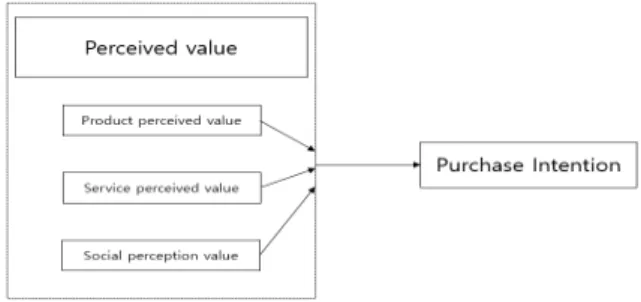
Based on the above theoretical research foundation, we propose the following models and assumptions for artificial intelligence art consumers. The research model is shown in Figure 1. The dependent variable is purchase intention, and the independent variable consists of three parts: product perceived value (price, quality, performance), service perceived value (price, quality, convenience, pleasure) and social perceived value (quality , Image, pleasure).

Fig. 1. Author’s Collation Model

(5)

3.2 Formulation of assumptions

According to the research model, we can put forward the following research hypotheses:

H1: The product value of artificial intelligence artworks has a beneficial effect on consumers' purchasing intentions.

H2: The service value of artificial intelligence artworks has a beneficial effect on consumers' purchasing intentions.

H3: The social value of artificial intelligence artworks has a beneficial effect on consumers' purchasing intentions.

IV. Empirical analysis

4.1 Selection of samples

This research uses the recent online and offline consumer groups of artworks (art works, design works, etc.) based on artificial intelligence technology that have appeared online and offline as the research object. It will start from April 1, 2020 to May 1, 2020. Through the research 500 questionnaires were distributed in the same way, and 495 were recovered. Aside from invalid questionnaires, 472 valid questionnaires were finally used for data collation and analysis.

SPSS24.0 and AMOS24.0 were used to analyze the data. Descriptive statistical analysis of the data, reliability analysis of the data through reliability analysis, validity analysis of research variables through validity analysis.

4.2 data analysis

AMOS24.0 software was used to evaluate the model and verify the hypothesis, and then the hypothesis test was carried out, and the conclusion was obtained.

4.2.1 Reliability Analysis

The role of reliability analysis is to test the consistency of each question in the questionnaire, or to measure the stability of each indicator. When

the stability between the scales is higher, or the consistency is higher, the reliability of the questionnaire will become better, so that the validity of the questionnaire content can be tested. The usual reliability test will use Cronbacha's Alpha value. According to experience, the interval of Cronbach's alpha coefficient is 0 to 1. The closer the Cronbach α coefficient is to 1, the higher the reliability; the opposite is the lower the reliability.

When the Alpha value of Cronbachα is less than 0.5, we believe that the reliability of the questionnaire survey data is poor. In this case, the corresponding statistical analysis cannot be performed. To judge whether the reliability level of the questionnaire data is acceptable, we use Cronbach's alpha coefficient to judge. When the value is greater than 0.5 and less than 0.7, the questionnaire data can be judged to be acceptable; when the Cronbach's alpha value is greater than 0.7, then the questionnaire data High level of reliability. It can be seen from Table 2 that the reliability of the first four variables of the questionnaire is greater than 0.8, and the alpha value of the last variable Cronbach is between 0.5 and 0.7. This value is acceptable, indicating the overall reliability of the data in this questionnaire.

Degree is higher.

  Cronbach’s α items

Product Perceived Value 0.969 3

Service perceived value 0.955 4

Social

Perceived Value 0.965 3

Purchase Decision 0.934 3

Table 1. Reliability analysis

According to the reliability analysis conducted by SPSS, it can be seen from the table (Table 1:

reliability analysis ) that the Cronbach α values of

all factors are above 0.9. According to general

experience, we can judge that the reliability is

good and can be used.

(6)

4.2.2 Validity analysis

Validity analysis is mainly to study the validity of variables, specifically, to test whether the questions set by the questionnaire can cover the variables to be analyzed.


factor

1 2 3 4

CS 0.909 0.127 0.200 0.186

QS 0.894 0.081 0.200 0.231

PS 0.887 0.126 0.226 0.194

SP 0.843 -0.099 0.210 0.339

PTP 0.057 0.929 0.206 0.211

QP 0.068 0.916 0.221 0.242

PP 0.063 0.899 0.198 0.260

PI2 0.247 0.185 0.871 0.240

PI1 0.214 0.221 0.868 0.197

PI3 0.267 0.244 0.855 0.082

SI 0.310 0.313 0.197 0.846

SQ 0.307 0.293 0.185 0.845

SLP 0.325 0.288 0.197 0.834

Cronbach a 0.969 0.955 0.965 0.934

KMO 0.890      

Table 2. Validity analysis

The results in Table 2 are obtained by factor analysis, principal component extraction and varimax method. We can see that the composition of each factor is good, and the kmo value is 0.89, indicating that the validity of the constituent factor is good.

4.2.3 Structural Equation Model Test

In this study, SPSS software was used for reliability and validity analysis. We can see that the research model in this article has high reliability and validity. Next, this research uses AMOS 24.0 to verify the structural equation of the theoretical model in this paper. This article uses structural equation modeling to verify whether the statistical data collected through the survey can meet the hypothesis.

In this study, the hypothesis was verified by AMOS 24.0. Hypothesis testing usually discusses the P value of the test result. P value mainly detects whether there is a significant influence between variables. When the P value is less than 0.001, it indicates that the significance between

them is very high. When the P value is less than 0.01, the table shows that the significance between them is high. When the P value is less than 0.05, it indicates that there is significance between them, but not very high. When the P value is less than 0.10, it indicates that the significance between them is not high. When the P value is greater than 0.10, it indicates that there is no significance between them.

   Estimate S.E. C.R. P

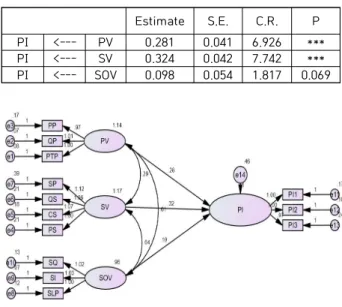
PI <--- PV 0.281 0.041 6.926 ***

PI <--- SV 0.324 0.042 7.742 ***

PI <--- SOV 0.098 0.054 1.817 0.069 Table 3. path test results

Fig. 2. Construction equation structure model

4.3 Research results and discussion

As shown in Figure 2, in the model test results,

we got the relevant indicators of the verification

model P(0.000), CMIN/DF(4.794), GFI(0.916),

AGFI(0.87)RMSEA(0.049) all conform to the

structural equation model Inspection standards. By

constructing the result table of the equation model

(Table 3: Path result table), we can see that the

product value of art based on artificial intelligence

has a beneficial effect on consumers’ purchase

intentions, and the service value of art based on

artificial intelligence is also It has a beneficial

effect on consumers’ purchasing intentions, but

the social value of art based on artificial

intelligence has not had a beneficial effect on

consumers’ purchasing intentions.

(7)

V. Conclusions and Enlightenment

This research takes the artificial intelligence artwork that has emerged in recent years as the research object, and takes the product value, service value and social value of artificial intelligence artwork as variables to study the impact of these three independent variables on the dependent variable. Through scientific analysis methods, we can see that the quality of artificial intelligence artwork has a beneficial effect on consumers' purchase intention, and the service quality of artificial intelligence artwork has a beneficial effect on consumers' purchase intention.

It shows that after so many years of artificial intelligence development, a large part of sophisticated artificial intelligence has reached the ability to produce high-end artworks, and these artworks have also been recognized by consumers.

But the social value of artworks has not yet reached the expected results. It shows that in the field of artificial intelligence art, the recognition of the whole society, the recognition of artists, art connoisseurs and consumers will take some time.

In the future, this research can also be conducted in a more detailed manner. After subdividing the artwork from the specific perspective of calligraphy, calligraphy or design, it should also obtain better effects and more meaningful meaning. The data collection of this study should be more widely collected samples from all over the world should have a better verification effect. In addition, scientific analysis methods can be carried out from the perspective of big data, and more meaningful conclusions should be drawn.

REFERENCES

[1] E. L. Spratt,A. Elgammal. “Computational, Beauty:

Aesthetic Judgment at the Intersection of Art and Science”, ECCV 2014 Workshops,pp.35~53.Sep. 2014. DOI:

10.1007/978-3-319-16178-5_3

[2] Stork,D.G.,“Computer vision and computer graphics

analysis of paintings and drawings: An introduction to the literature,In: Computer Analysis of Images and Patterns”,

Springer,pp.9~24. Aug. 2009. DOI: 10.1007/978-3-642- 03767-2_2

[3] Ahmed Elgammal; Bingchen Liu; Mohamed Elhoseiny; Marian Mazzone,“CAN: Creative Adversarial Networks Generating

“Art” by Learning About Styles and Deviating from Style Norms”,

eprint arXiv:1706.07068.06/2017.pp.12-20. Jun. 2017.

[4] Wu Han Dong. “Institutional arrangement and legal regulation in the age of artificial intelligence”. Journal of Northwest University of political science and law, pp.128-136, Jun. 2017.

[5] Sun Shan. “Proof of work attributes of artificial intelligence generated content”, Journal of Shanghai University of Political Science and Law, pp.84-94. Mar. 2019.

[6] Ma Zhiguo, Liu Zhen. “The qualitative and institutional arrangement of the copyright of artificial intelligence creations”.

Science, Technology and Publishing, pp. 107 -114. Oct. 2019.

[7] Huang Yuye, Sima hang. “The right ownership of AI generated works from the perspective of fruits”. Journal of Henan Normal University Philosophy and Social Sciences, pp.23-29. April 2018.

[8] Yi Jiming. “Are artificial intelligence creations works?” Science of Law Journal of Northwest University of Political Science and Law, pp.137-147. May 2017.

[9] Harold Cohen, artist-obituary, The Telegraph, http://www.teleg raph.co.uk/obituaries/2016/05/22 /haroldcohen-artist--obituary/

[10] L. Gatys and etc, “A Neural Algorithm of Artistic Style”, Journal of Vision, Vol.16, pp.326. Sep 2015. DOI: 10.1167/16.12.326 [11] A.Elgammal and etc, “CAN: Creative Adversarial Networks

Generating ‘Art’ by Learning About Styles and Deviating from Style Norms”, June 23, 2017,pp.1-22.

[12] Arthur P. Shimamura and Stephen E. Palmer, “Aesthetic Science: Connecting Minds, Brains, and Experience”, Toward a Science of Aesthetics, January, 2012. ,DOI: 10.1093/acprof:os o/9780199732142.003.0010

Authors

Ruomu Wang received a bachelor's degree in art and design from Dalian University of Technology in 2013 and her master's degree in fine arts from Dalian University of Technology in 2016. Since 2019,

she studying for a doctorate in Global Fine Art at Kyonggi University in South Korea. Ruomu Wang once taught in Dalian art college in 2017, responsible for art education.

She is interested in fine arts and contemporary multimedia

art, and has conducted in-depth research on contemporary

multimedia installation art.

수치

Fig.  1.  Author’s  Collation  Model
Fig.  2.  Construction  equation  structure  model

참조

관련 문서

본 연구는 신약개발 연구기관에서 인공지능 신약 개발 시스템의 지각된 가치와 활용의도에 미치는 영 향을 실증적인 분석을 통해 살펴보고자 한다.. 이를 위해 본

In this paper, we will construct a model of the relationship between intelligent music products and consumers' intention to buy, and introduce the function

따라서 본 연구는 확장된 기술수용모델(TAM2)을 통 해 온라인 쇼핑몰의 특성이 소비자의 구매 의도에 어떠 한 영향을 미치는지 알아보고, 소비자가 추구하는 가치

Finally, the study investigated mediation and moderation effect of shopping values that consumers cog- nized by business control and/or subjective well-being, and it found

Third, analyzed result about interaction effect of consumer characteristics, Classified group of pursuing uniqueness and ostentation value, expressing high prior

In this study, a questionnaire survey was conducted among ginseng product consumers living in jilin, and 360 valid samples were statistically analyzed using SPSS 23.0.The

따라서 본 연구는 확장된 기술수용모델(TAM2)을 통 해 온라인 쇼핑몰의 특성이 소비자의 구매 의도에 어떠 한 영향을 미치는지 알아보고, 소비자가 추구하는 가치