• 검색 결과가 없습니다.

A Study on the Influence of Originality and Usefulness of Artificial Intelligence Music Products on Consumer Perceived Attractiveness and Purchase intention

N/A
N/A
Protected

Academic year: 2021

Share "A Study on the Influence of Originality and Usefulness of Artificial Intelligence Music Products on Consumer Perceived Attractiveness and Purchase intention"

Copied!
8
0
0

로드 중.... (전체 텍스트 보기)

전체 글

(1)

JKSCI

A Study on the Influence of Originality and Usefulness of Artificial Intelligence Music Products on Consumer Perceived Attractiveness and Purchase intention

1)

Jin Meilin*

*Lecturer, Dept. of Vocal Performance, Music Conservatory, Anshan Normal University, Anshan, China

[Abstract]

In this paper, we propose an intention to study the purchase of smart music by Chinese consumers.

To study the influence of the originality and usefulness of intelligent music products on the purchase intention of Chinese consumers, and to explore how the originality and usefulness of intelligent music products affect the purchase intention. To achieve this goal ,372 questionnaires were collected through the Internet for frequency analysis, factor analysis, confidence analysis and structural equation analysis of data collection, and were carried out by SPSSV22.0 and AMOSV22.0 methods. Research the validation of assumptions in the model to reveal the psychological and behavioral responses of consumers to smart music products.

The results show that the originality and usefulness of new products not only directly affect the purchase intention of Chinese consumers, but also indirectly affect their purchase intention by enhancing their attractiveness. The conclusion of this study is of guiding significance for the development of intelligent music product development and marketing strategy.

▸Key words: Artificial Intelligence Music, Originality, Usefulness, Attractiveness, Purchase Intention

[요 약]

본 연구는 중국 인공지능 음악의 발전상을 접목하여 스마트 음악 제품의 독창성, 유용성과 소 비자의 구매 의도의 관계에 대한 모형을 설정하였다. 또한 제품의 매력성을 매개변수로 활용하여 스마트 음악 제품의 독창성과 유용성이 소비자 지각된 제품의 매력성을 통해 구매의도를 형성하 는 과정을 제시하였다 . 이러한 연구를 통해 기업의 제품 개발 전략을 수립하고 고객 만족도와 충 성도를 높이기 위한 이론적 근거를 제공하며, 기업이 더 효과적인 마케팅을 진행할 수 있도록 시 사점을 제시하고자 하였다. 이러한 목표 달성을 위해 본 연구는 인터넷을 통해 372부의 설문지를 수집하였고 수집된 데이터는 SPSS V 22.0와 AMOS V 22.0 를 활용하여 빈도분석, 요인분석, 신뢰 도분석, 구조방정식 분석을 실시하였다.

분석결과를 제시하면 다음과 같다 . 신제품의 독창성과 유용성은 중국 소비자의 구매의도에 직 접적인 영향을 미칠 뿐 아니라 제품의 매력성 향상을 통해 구매의도에 간접적인 영향까지 미치는 것으로 나타났다. 본 연구의 결론은 인공지능 음악 제품 개발과 마케팅 전략 수립에 대하여 현실 적인 지도적 의의를 가지며 , 기업은 광고와 마케팅 전략을 수립할 때 신제품의 독창적 특징을 전 달할 뿐 아니라 소비자에게 신제품의 기능적 가치를 제시하였다 . 또한 신제품 시장의 매력에 대 한 소비자의 인지 수준을 높임으로써 소비자의 구매 의도에 영향을 미칠 수 있다.

▸주제어: 인공지능음악, 독창성, 유용성, 매력, 구매의도

∙First Author: Jin Meilin, Corresponding Author: Jin Meilin

*Jin Meilin ([email protected]), Dept. of Vocal Performance, Music Conservatory, Anshan Normal University

∙Received: 2020. 07. 28, Revised: 2020. 08. 25, Accepted: 2020. 08. 27.

Copyright ⓒ 2020 The Korea Society of Computer and Information http://www.ksci.re.kr pISSN:1598-849X | eISSN:2383-9945
(2)

I. Introduction

Information technology based on strong computing power is beginning to shock and influence every aspect of society. Artificial intelligence as a branch of computer science will become a new trend in technology in this era [1] .

The development of technology has injected new elements into music and gradually changed the way people write, perform, make and appreciate music [2] . The rapid development and progress of modern scientific and technological means have great challenge and impact on the application of music, which has brought about changes in material and technical aspects to the development of artificial intelligence music, and plays an important role in promoting the innovation of artificial intelligence music in both modes and ideas [3] .

The combination of artificial intelligence and music has a long history. In recent years, the positive attempts and breakthroughs made by AI in music applications have been amazing, and research has included various aspects of music creation, music performance, music theory and music applications [4] . Along with the rapid development and application of artificial intelligence, AI music research has matured abroad, and a large number of related platforms have been put into the market. In China, through reading and researching related literature, Chinese scholars have found that there is little research into the purchasing behavior of artificial intelligence music customers [5] . Because artificial intelligence music is still a new technology in China, on the other hand, Chinese consumers are skeptical about whether or not the effect of artificial intelligence music is good or bad, and they are not paying enough attention to it, thus developing and applying it later. According to a survey conducted by iResearch, there is generally a low conversion rate for purchases of all kinds of smart music products, less than 20 percent [6] . Compared with other products, smart music

products have new, unique and cool features, but their life cycle is short and the market is more competitive. Therefore, it is of great practical significance to accelerate the rapid development of the artificial intelligence music industry, guide the enterprises to develop more attractive artificial intelligence music products and enhance customer satisfaction and loyalty [7] .

In this paper, we will construct a model of the relationship between intelligent music products and consumers' intention to buy, and introduce the function of product innovation to consumers' sense of product, attractiveness and intention to purchase, so as to provide a basis for the enterprise to develop its research and development strategy, improve customer satisfaction and loyalty, and guide its marketing.

II. Theoretical literature

1. The Effect of Product Creativity on Purchasing Intention

Product creativity refers to the extent to which the target customer perceives the originality and usefulness of the product relative to the competitor [8] . Most studies suggest that originality and usefulness are two important indicators of product creativity [9] .

Usefulness refers to the extent to which a

consumer perceives a product or service to help

the user perform the task effectively and improve

performance [10] . While some studies have shown

that usefulness is positively correlated with

consumer's positive attitude, others have also

shown that usefulness is not significantly related to

attitude. This study concludes that usefulness can

help users solve practical problems, efficiently, and

effectively accomplish target tasks, which are

important and necessary to consumers [11] . If a

consumer perceives a smart product as useful, that

is, it can satisfy a user's needs, it is possible for

the consumer to buy the product. Conversely, if

(3)

the product is not useful, the consumer will perceive that the product is not of use value and refuses to buy it. Davis argues that usefulness is one of the most important factors affecting users' purchase intention. Based on this, the following assumptions are proposed.

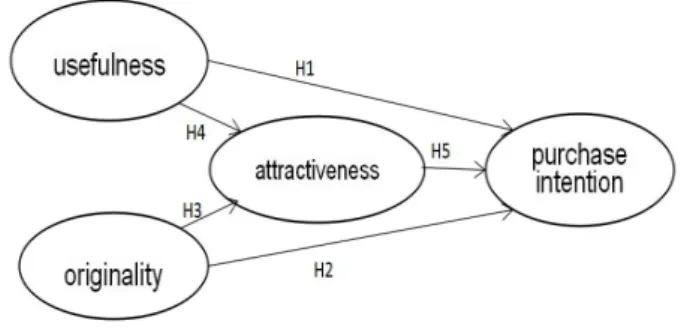
H1: The use of intelligent music products is affecting consumers' purchase intention.

Originality is defined as the degree to which consumers perceive products are novel and unique in comparison with existing similar products [12] . Original products may be different from existing products in terms of technology or function, so originality is more likely to arouse consumers' interest and surprise consumers. Some studies have shown that originality significantly affects consumer attitudes and moods, and that new products with high originality are more likely to trigger a positive reputation than those with low originality [13] . People will meet their uniqueness needs by purchasing products or services with novel and unique characteristics, and demonstrate their distinctive self and social image, reflecting their individuality and style. Moreover, originality can positively affect the purchase intention whether it is a whole new product or an improved product.

Therefore, the following assumptions are proposed.

H2: The originality of smart music products is affecting consumers' purchase intention.

2. The Effect of Product Creativity on Product Attractiveness

Attractiveness is the extent to which a consumer perceives the attractiveness of a product, and its fine appearance and unique functionality are an important source of product attractiveness [14] . Hassenzahl believes that the utility value (e.g.

usefulness) and pleasure value (e.g., originality and innovation) are key factors in enhancing the attractiveness of the product. Of these, practical value focuses mainly on the task design of the product, which focuses on the originality, beauty, fashion and fun features of the product. Smart

music products often have unique and useful characteristics. These unique and useful functional designs can help users do their work efficiently and effectively. In addition to improving efficiency and effectiveness, there are some smart music products that give users more fun. This novel and useful product is more attractive to young consumers.

Based on this, the following assumptions are proposed.

H3 The originality of smart music products is affecting consumer perception attractiveness.

H4 The usefulness of smart music products is positively affecting consumer perception attractiveness.

3. The Effects of Product Attractiveness on the Purchase Intention

Attractiveness plays an important role in consumer perception and evaluation of products in the process of consumer decision making. It has been found that product attractiveness can attract consumers' attention and improve product identification, thus enhancing consumer preferences and largely determining consumers' intention to buy [15] . Schrepp et al. believes that improving the attractiveness of the software interface can help improve user usage behavior [16] . Schnurr et al. further noted that consumers lack sufficient experience in using unfamiliar products and are more inclined to use them as a clue to external society, It is also more likely that when a product can trigger positive consumer perception of attractiveness, they will be more likely to engage in close rather than evasive behaviors. Based on this, the following assumptions are proposed.

H5 Attractiveness of smart music products is affecting consumers' purchase intention.

H6 Between originality and purchase intention, the attractiveness will be mediated.

H7 Between usefulness and purchase intention,

the attractiveness will be mediated.

(4)

III. research method

1. Research Model

Based on the above analysis, this paper constructs the research model.

Fig. 1. Research model

2. Subject Investigated

This study targets ordinary music creators currently living in Beijing, China. As a result, an offline survey was conducted to verify the purpose of this paper, and the survey was conducted for about 30 days from May 1 to June 1, 2020. The total number of valid samples collected was 372 persons.

3. Operational Definition and Measurement Scale of Variables

variable Definition reference

literature

Originality

It's the novelty and unique level of consumer perception products

Sundar(201 4)

Usefulness

It refers to the extent to which a consumer perceives a product or service to help the user perform the task effectively and improve performance

Davis(1989)

Attractiveness

Product attractiveness can attract consumers' attention and improve product identification, thereby

enhancing consumer

preferences

Schrepp M, Held T &

L a u g w i t z B.(2006)

P u r c h a s e intention

It's the possibility and subjective probability of consumers buying a product

Dodds(1991) Table 1. Operational Definition and Measurement Scale of Variables

4. Analysis process

For empirical analysis, SPSS V. 22.0 and AMOS V. 22.0 were used. The analysis process is as follows. First, frequency analysis was conducted to identify sample characteristics, the discriminant validity of variables was checked, the single dimension of each configuration concept was analyzed, and reliability analysis was conducted to check the internal consistency of questionnaire.

Structural equation model analysis was performed to confirm the suitability and impact of the established study model in this study.

IV. Analysis Result

1. Demographic Characteristics of The Sample In terms of the general characteristics of the subjects studied, 156(41.9%) of the 372 respondents were men and 216 (58.1%) of women. The survey showed 145 respondents (39.0%) aged between 30 and 39. Next, 95 respondents aged 40 to 49 (25.5%) were the second highest. Forty-five respondents (12.1%) answered with the lowest response rate.

College graduates accounted for 183 (49.2%), 81 (21.8%), 67 (18.0%), and 41 (11.0%), respectively. The monthly level was the highest with 184 respondents (49.5%) of between 3 million and 4 million. Next, 61 respondents (16.4%) received 2 to 3 million won, followed by 52 respondents (14.0%) who received 4 to 5 million won. 43 respondents (11.6%) had the lowest response rate of less than 2 million won.

2. Exploratory Factor Analysis and Reliability Analysis

2.1 Exploratory Factor Analysis and Reliability Analysis

An exploratory factorial analysis was performed

using SPSS 24.0 to ensure that the measurement

tools for each measurement variable used in the

model were identical to the purpose of the study.

(5)

Configuration

concept Survey question Factor load

value α

purchase intention

intention3 .762

.935

intention5 .747

intention4 .706

intention2 .689

intention1 .649

usefulness

usefulness2 .838

usefulness1 .793 .932

usefulness3 .749

usefulness4 .728

attractivene ss

attractiveness4 .205

.911 attractiveness5 .821

attractiveness3 .762 attractiveness1 .644 attractiveness2 .616

originality

originality1 .812

.898

originality2 .778

originality3 .763

Table 2. Exploratory factor analysis of independent variables

In <Table 2>, the study conducted an overall analysis of all variables, with all eigenvalues greater than 1 and cumulative variance of 78.909%.

In addition, the factor reference load capacity of each variable is all greater than .5, and the confidence coefficient Cronbach's α value of the scale is all greater than .8. This explains that the scale has a high overall reliability and validity, which enables further analysis verification of the entire data.

2.2 Confirmatory Factor Analysis

It was used as AMOS 24.0 for checking the convergence feasibility and discriminative validity of each measurement variable and a positive factor analysis was performed.

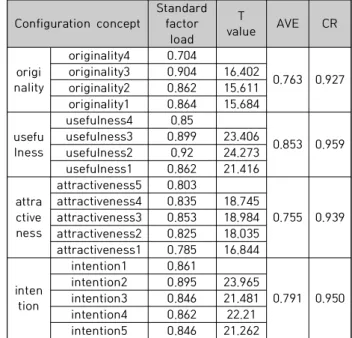
The results of the analysis of this study are specifically shown in Table 3, which shows the suitability of the measurement model x² =284.35, P=.000, DF=129, CMIN/DF=2.204, GFI=0.92, AGFI=0.894, IFI=0.975, TLI=0.97, CFI=0.974, RMR=0.021. The suitability of the measurement model resulted in relatively satisfactory results. The measurement models used in this study were found to be superior.

Configuration concept

Standard factor

load

T

value AVE CR

origi nality

originality4 0.704

0.763 0.927 originality3 0.904 16.402

originality2 0.862 15.611 originality1 0.864 15.684

usefu lness

usefulness4 0.85

0.853 0.959 usefulness3 0.899 23.406

usefulness2 0.92 24.273 usefulness1 0.862 21.416

attra ctive ness

attractiveness5 0.803

0.755 0.939 attractiveness4 0.835 18.745

attractiveness3 0.853 18.984 attractiveness2 0.825 18.035 attractiveness1 0.785 16.844

inten tion

intention1 0.861

0.791 0.950 intention2 0.895 23.965

intention3 0.846 21.481

intention4 0.862 22.21

intention5 0.846 21.262

x² =284.35, P=.000, DF=129, CMIN/DF =2.204, GFI=0.92, AGFI=0.894, IFI=0.975, TLI=0.97, CFI=0.974, RMR=0.021

*P<.05, **P<.01, ***P<.001

Table 3. Confirmatory Factor Analysis

At the same time, composite reliability (CR) was also calculated with Amos. In the measurement item, the acceptable reference value of 0.7 may be found to be above and the result value can be trusted. The combined reliability of each variable was also calculated through Amos. The results were reliable because the items of all variables were higher than the general acceptance criterion of 0.7. Another measure of convergence feasibility, meanwhile, is the Average Variance Extracted (AVE), which is known to be more than 0.5 of the magnitude of the variance that the indicator can describe for the potential concept. In this study, the mean variance extraction (AVE) of all variables was higher than 0.5.

3. Research Hypothesis Verification

A structural equation model was used to verify

the hypothesis in this study. The path coefficients

for the structural model to verify the hypothesis

can be found in Table 5. The goodness-of-fit index

for the structural model used in this study is

X2=284.35, P=.000, DF=129, CMIN/DF =2.204,

GFI=0.92, AGFI=0.894, NFI=0.954, IFI=0.975,

(6)

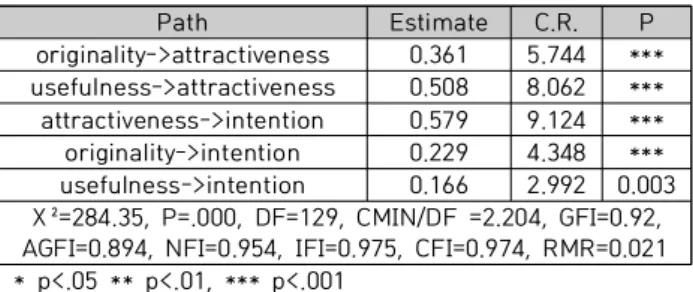
CFI=0.974, RMR=0.021, it was shown to be suitable for structural model analysis.

Path Estimate C.R. P

originality->attractiveness 0.361 5.744 ***

usefulness->attractiveness 0.508 8.062 ***

attractiveness->intention 0.579 9.124 ***

originality->intention 0.229 4.348 ***

usefulness->intention 0.166 2.992 0.003 X²=284.35, P=.000, DF=129, CMIN/DF =2.204, GFI=0.92, AGFI=0.894, NFI=0.954, IFI=0.975, CFI=0.974, RMR=0.021

* p<.05 ** p<.01, *** p<.001

Table 4. Structural model analysis result

H1 originality is about the effect on activity, and originality is shown to have a statistically positive effect on activity(Estimate=0.361, C.R.=5.744, p=0.000, p<.05) Hypothesis H1 has been adopted.

H2 usefulness is about the effect on activity, and usefulness is shown to have a statistically positive effect on activity (Estimate=0.508, C.R.=8.062, p=0.000, p<.05) Hypothesis H2 has been adopted.

H3 attractivity is about the effect on the purchase intention, and the effect on the purchase intention is statistically shown to have a positive effect (Estimate=0.579, C.R.=9.124, p=0.000, p<.05) Hypothesis H3 has been adopted.

H4 originality is about the effect on the purchase intention , and originality is shown to have a statistically positive effect on the purchase intention (Estimate=0.229, C.R.=4.348, p=0.000, p<.05) Hypothesis H4 has been adopted.

H5 usefulness is about the effect on the purchase intention, and usefulness is shown to have a statistically positive effect on the purchase intention (Estimate=0.166, C.R.=2.992, p=0.003, p<.05) Hypothesis H5 has been adopted.

Path Estimate p

originality->attractiveness->purchase

intention 0.311 0.004

usefulness->attractiveness->purchas

e intention 0.244 0.006

* p<.05 ** p<.01, *** p<.001 Table 5. Mediation effect

This study confirmed that the significant probability of the mediated effect was significant at

the level of .05 through the bootstraping method.

The results of the verification of the direct and indirect effects significance using the bootstraping method are as follows.

If the parameters of attractivity are checked, the parameter effect of originality on purchase intention through attractivity is 0.311. These results are statistically important results under a 0.05 significance level(p<0.05). Hypothesis 6 was therefore validated as expected.

The parameter effect of usefulness on purchase intention through attractivity is 0.244. These results are statistically important results under a 0.05 significance level(p<0.05). Hypothesis 7 was therefore validated as expected.

V. Conclusions

1. Conclusion and theoretical contribution This study reveals consumers' psychological and behavioral responses to the creativity of smart music products, establishes relationship models, introduces attractiveness as intermediary variables, reveals the role of creativity in consumer perception products, and concludes the following important conclusions through research.

1. Research results show that both the originality and the usefulness are significantly positive in affecting the purchase intention of Intelligent Music Products. Some scholars have studied the two dimensions of product creativity in Western countries, namely the effect of originality and usefulness on consumer behavior. As one of the larger markets in the world, China has unique cultural characteristics that are different from the Western countries, but few literature discusses the creative behavior response of Chinese consumers to smart music products. The study, conducted in a Chinese context, found that both originality and usefulness of products can positively affect consumers' purchase intention.

2. The results of this study further demonstrate

(7)

that the originality and usefulness of the product not only directly affect the purchase intention, but also indirectly promote the purchase intention by enhancing consumer perception attractiveness.

This study suggests and confirms that the product originality and usefulness have a stronger predictive effect on consumer perception appeal, which further influences the purchase intention.

This finding suggests that both the originality and usefulness of smart music products have a direct and indirect effect on consumers' purchase intention. Therefore, from the perspective of product attractiveness perception, this study reveals the mechanism of the effect of product creativity on consumers' intention to buy.

2. Practical Revelations

The conclusion of this study is of practical guidance to the development and marketing strategy of intelligent music products.

1. The empirical results of this study show that both originality and usefulness of the product can positively influence Consumer's purchase intention.

Therefore, companies need to focus on both original and useful characteristics of the product when designing and developing smart products, which can avoid being rejected or resisted by consumers as a result of ignoring the balance between originality and usefulness of the product.

2. This study also found that the originality and usefulness of the product can attract through consumer products to inform indirectly of the intention to purchase. This means that consumer buying decisions are influenced by the originality and usefulness of the product, and crucially because they can increase consumers' perception of the attractiveness of the new product market, which can serve as an external clue to consumers' judgment of the quality and function of the product. For businesses, therefore, efforts need to be made to enhance the market appeal of new products, which is critical to accelerating the spread of the new product market and further

enhancing brand influence. To achieve this goal, companies not only convey original characteristics of new products but also promote functional value of new products to consumers when developing advertising and marketing strategies. A mere emphasis on originality or usefulness could lead to a failure in marketing new products.

3. Limitations and future research direction With intelligent music products as the object of this study, the results may be limited by product type and sample group, and it remains to be examined whether the results are applicable to other products and groups. In addition, while controlling the effects of gender, age, and income when examining structural models, other variables may affect the robustness of research conclusions, such as consumer attitudes, personality traits, education, and individual values, and suggest future research. In addition, product creativity is a key factor influencing the adoption of new products by consumers, how to combine originality and attractiveness with a theoretical model of planned behavior, building an integrated model that is more explanatory to consumers' willingness to adopt would be a question worth exploring.

REFERENCES

[1] R. Louie, A. Coenen, C. Z. Huang, M. Terry, & C. J. Cai,

"Novice-AI Music Co-Creation via AI-Steering Tools for Deep Generative Models." In Proceedings of the 2020 CHI Conference on Human Factors in Computing Systems, Vol, 4, No, 4, pp. 1-13, Apr. 2020. DOI: https://doi.org/10.1145/3313831.3376739 [2] J. Eerola, "The story of Aitokaiku: Utilizing artificial intelligence

for music." XRDS: Crossroads, The ACM Magazine for Students, Vol, 24, No, 3, pp. 50-53, Dec. 2018. DOI: 10.1145/3186693 [3] O. Lopez-Rincon, O. Starostenko, & G. Ayala-San Martín,

"Algoritmic music composition based on artificial intelligence: A

survey." In 2018 International Conference on Electronics,

Communications and Computers, Vol, 2, No, 899, pp. 187-193,

Feb. 2018. DOI: 10.1109/CONIELECOMP.2018.8327197

[4] V. Myrthianos, F. Vendrell-Herrero, G. Parry, & O. Bustinza,

(8)

"Firm profitability during the servitization process in the music industry." Strategic Change: Briefings in Entrepreneurial Finance, Vol, 23, No, 5, pp. 317-328, Oct. 2020. DOI: https://doi.org/10 .1002/jsc.1979

[5] S. Amershi, D. Weld, M. Vorvoreanu, A. Fourney, B. Nushi, P.

Collisson, & J. Teevan, "Guidelines for human-ai interaction." In Proceedings of the 2019 CHI Conference on Human Factors in Computing Systems, Vol, 3, No, 3, pp. 1-13, May. 2019. DOI:

https://doi.org/10.1145/3290605.3300233

[6] J. McCormack, T. Gifford, P. Hutchings, M. T. Llano Rodriguez, M. Yee-King, & M. d'Inverno, "In a Silent Way: Communication between AI and improvising musicians beyond sound." In Proceedings of the 2019 CHI Conference on Human Factors in Computing Systems, Vol, 3, No, 38, pp. 1-11, May. 2019. DOI:

https://doi.org/10.1145/3290605.3300268

[7] M. Kaliakatsos-Papakostas, A. Floros, & M. N. Vrahatis, "Artificial intelligence methods for music generation: a review and future perspectives." In Nature-Inspired Computation and Swarm Intelligence, Vol, 67, No, 1, pp. 217-245, May. 2020. DOI: https://

doi.org/10.1016/B978-0-12-819714-1.00024-5

[8] W. Zhang, "A Study on the User Acceptance Model of Artificial Intelligence Music Based on UTAUT." Journal of the Korea Society of Computer and Information, Vol, 25, No, 6, pp. 25-33, Jun. 2020. DOI: https://doi.org/10.9708/jksci.2020.25.06.025 [9] P. Saint-Dizier, "Music and Artificial Intelligence. In A Guided

Tour of Artificial Intelligence Research." In A Guided Tour of Artificial Intelligence Research, Vol, 15, No, 3, pp. 503-529, May.

2020. DOI: https://doi.org/10.1007/978-3-030-06170-8_16 [10] D. Choi, & K. K. Johnson, "Influences of environmental and

hedonic motivations on intention to purchase green products: An extension of the theory of planned behavior." Sustainable Production and Consumption, Vol, 18, pp. 145-155, Apr. 2019.

DOI: https://doi.org/10.1016/j.spc.2019.02.001

[11] S. Liou, & X. Lan, "Situational salience of norms moderates cultural differences in the originality and usefulness of creative ideas generated or selected by teams." Journal of Cross-Cultural Psychology, Vol, 49, No, 2, pp. 290-302, Feb. 2018. DOI:

https://doi.org/10.1177/0022022116640897

[12] Y. C. Hsiao, & Z. X. Hsu, "Firm-specific advantages-product innovation capability complementarities and innovation success:

A core competency approach." Technology in Society, Vol, 55, pp. 78-84, Nov. 2018. DOI: https://doi.org/10.1016/j.techsoc.201 8.06.009

[13] M. Zhang, X. Zhao, & M. Lyles, "Effects of absorptive capacity, trust and information systems on product innovation."

International Journal of Operations & Production Management, Vol, 38, No, 2, pp. 493-512, Feb. 2018. DOI: https://doi.org/10.11 08/IJOPM-11-2015-0687

[14] S. Shahshahani, "Brand Compatibility with the Spirit of

Customers and Its Influence on Customer Attraction." Available at SSRN 3390370. Vol, 4, No, 9, pp. 34-34, Jun. 2019. DOI:

http://dx.doi.org/10.2139/ssrn.3390370

[15] K. Sokolova, & H. Kefi, "Instagram and YouTube bloggers promote it, why should I buy? How credibility and parasocial interaction influence purchase intentions." Journal of Retailing and Consumer Services, Vol, 53, pp. 68-73, Mar. 2020. DOI:

https://doi.org/10.1016/j.jretconser.2019.01.011

[16] F. A. Konuk, "The role of store image, perceived quality, trust and perceived value in predicting consumers’ purchase intentions towards organic private label food." Journal of Retailing and Consumer Services, Vol, 43, pp. 304-310, Jul. 2018. DOI:

https://doi.org/10.1016/j.jretconser.2018.04.011

Authors

Jin Meilin received her bachelor's degree in

Musicology from Shenyang Normal University

in 2003 and her master's degree in

Musicology from Northeast Normal University

in 2010. Since 2019, she has been studying

for a doctorate degree in Global Music at Kyonggi

University in South Korea. Jin Meilin has been teaching at

Anshan Normal University in China since 2003. Currently,

she is mainly responsible for music education. She is

interested in traditional music and has conducted in-depth

research on traditional music in northeast China.

수치

Fig.  1.  Research  model
Table  2.  Exploratory  factor  analysis  of  independent  variables
Table  4.  Structural  model  analysis  result

참조

관련 문서

This study was carried out to analyze factors influencing Korean consumers' attitude and buying behavior on the green products.. The research model was

An Empirical Study on the Influence on Entrepreneurship Education Quality and Career Choice Reasons to University Student’s Entrepreneurial Intention..

Objectives: This study aimed to investigate the relationship between job stress and turnover intention of employed opticians and to investigate the mediating effect of burnout

The purpose of this study is to verify whether The mediating effects of planned happenstance skills on the relationship between perceived social support

In order to verify whether the museum exhibition of intangible cultural heritage has a significant influence on the visitor's behavioral intention, a

The purpose of this study is to analyze the effects of service quality on customer satisfaction and revisit intention perceived by Chinese golf range

In this Thesis, an empirical study on the Influence of Consumer's Preferences and Satisfaction on Purchase Intention of Korean Automobile in Vietnamese Consumers

This paper aims to compare and analyze the appreciation area in highschool music textbooks and to study on the teaching method.. The Seventh Curriculum and