• 검색 결과가 없습니다.

The Impact of Online and Offline Wine Purchase Channels on Consumer Perceptions of Wine Attributes and Repurchase Intention

N/A
N/A
Protected

Academic year: 2021

Share "The Impact of Online and Offline Wine Purchase Channels on Consumer Perceptions of Wine Attributes and Repurchase Intention"

Copied!
7
0
0

로드 중.... (전체 텍스트 보기)

전체 글

(1)

Abstract

Purpose – This study investigates the effects consumer per - ceptions of wine attributes have on repurchase intention. It ex- amineshow wine purchase channels (online or offline) influence perceptions about wine attributes and repurchase intention.

Research design, data, and methodology – A total of 390 re - sponses from Florida residents over 21 were collected using on- line surveys. Responses were analyzed using exploratory factor analysis to identify the underlying wine attribute factors. Multiple regression and multi-group analysis were employed to test the hypotheses.

Results – Results revealed that consumer perceptions of wine attributes (sensory, origin, reputation, and price point) sig- nificantly influence their repurchase intention. Additionally, the ef- fects of wine attributes on repurchase intentions were found to be significantly different based on the channel used. Findings in- dicated that wine attributes pertaining to reputation and price point strongly influenced repurchase behavior of online consum- ers, while offline wine consumers were influenced more by sen- sory and origin attributes.

Conclusions – Study findings provide useful information for wine industry sales channels for developing new marketing strat- egies to effectively attract wine consumers to repurchase wine.

Keywords: Wine Attributes, Consumer Repurchase Intention, Purchase Channels, Online And Offline Channels, Consumer Behavior.

JELClassifications: M19, M15, L86.

* 1

st

Author, Associate Professor, Division of Business Administration, Hoseo University, South Korea. E-mail: [email protected].

** 2

nd

Author, Professor, Dedman School of Hospitality, United States.

E-mail:[email protected].

*** Corresponding Author, Adjunct Professor, Dedman School of Hospitality, Florida State University, United States E-mail:

[email protected].

1. Introduction

Online purchasing channels gained popularity for conducting commercial transactions for various types of products because of perceived customer advantages including saving time, con- venience, ease of searching and comparing information, and price transparency (Kollmann et al., 2012;Yoo et al., 2015).

Many organizations have expanded their sales channels and at- tempted to increase sales volume by using a combination of on- line and offline sales channels (Jelassi & Leenen, 2003 Markey

& Hopton, 2000). Ample evidence provided by previous studies document that adding an online channel to the traditional dis- tribution channel system not only results in an increased sales volume, but also improves customer loyalty (Chen & Popovich, 2003; Stone et al., 2002).

Given the explosive growth of electronic commerce, the wine industry has strived to increase market share through expanding distribution channels in this direction (Cho et al., 2014).

Supporting this position, Amazon.com, the largest Internet-based retailer in the United States, began selling wine online in 2012, and now offers the largest online selection of domestic wine in the U.S. In recognition of this, the wine industry now expects that adding a wine online sales channel will greatly contribute to an increase in wine sales.

There are, however, contradictory opinions regarding online wines sales. Some wine product categories are considered to be unsuitable for selling on online channels due to the chal- lenge of being unable to make wine characteristics tangible.

This includes touching, smelling and feeling (tasting) wine products. One researcher in particular (Richardson, 2002) as- serted that wine is not a proper product category for web-based commerce because the wine purchase decision process is greatly dependent upon consumer evaluations related to wine sensory attributes (taste, flavor and color). On the other hand, Lockshin (2000) documented that wine can be a suitable prod- uct category to be sold through an online channel because on- line wine shopping provides the very useful advantages of ease of price comparison, capabilities for searching rare and unique wines, and well-structured information pertaining to various wine tastes. Based upon these findings, the appropriateness of wine as being able to be sold online is questionable.

Print ISSN: 1738-3110 / Online ISSN 2093-7717 http://dx.doi.org/10.15722/jds.13.10.201510.57

The Impact of Online and Offline Wine Purchase Channels on Consumer Perceptions of Wine Attributes and Repurchase Intention

8)

Sora Kang*, Mark A. Bonn**, Meehee Cho***

Received: September 09, 2015. Revised: September 21, 2015. Accepted: October 15, 2015

(2)

Several previous studies have investigated online and offline consumer buying attitudes and behaviors and found systematic differences(Degeratu et al., 2000; Lynch & Ariely, 2000; Shankar et al., 2001). These research studies revealed that consumers with high price sensitivity tend to purchase products online rath- er than purchasing products via offline markets. Brands and rep- utations have also been found to be very important product at- tributes that influence consumer purchasing channel decisions regarding online and offline options. Because of this, it is very important for the wine industry to obtain a better understanding of the role consumer perceptions have upon wine attributes and repurchasing intention when purchasing wine online and offline.

Therefore, this study attempts to 1) investigate the effects con- sumer perceptions about wine attributes have upon repurchase intention, 2) investigate if wine consumer repurchase intentions would be different according to wine purchase channels, and 3) exam whether or not significant differences in the effects of on- line and offline purchase environments exist.

2. Theoretical Background

2.1. Wine product attributes and consumer repurchase intentions

Wine is regarded as a sophisticated and civilized alcoholic beverage and is greatly affected by grape variety and country of origin. Diverse agricultural and climatic environments of specific regions are critical determinants of wine sensory attributes.

Because of these factors, wine product quality is widely heterogeneous.

Wine product attributes have been found to be directly asso- ciated with consumer purchase intentions and behavior (Dodd et al., 2005). Lockshin et al. (2006) documented that wine is cate- gorized into a very specific product category. They revealed that wine attributes related to taste, vintage, brand, reputation and country of origin greatly influence consumer wine preference, and further become critical determinants of purchasing decision.

Another subsequent wine research study conducted by Barber et al. (2008) demonstrated that wine attributes related to sen- sory product characteristics (taste, aroma, and color) are key components for wine purchasing decision.

Lockshin et al. (2006) asserted that wine origin and reputa- tion attributes may play a very important role in purchasing wine online because these attributes can be used as clues of wine product quality. In support of these findings, Mueller & Szolnoki, (2010) documented that country of origin and product reputation representing brand, medal/ rating information and wine labels were found to be critical product attributes influencing wine pur- chasing decisions. Consistent with the important role product price category has upon consumer purchase decision, wine price has been found to be an important factor affecting con- sumer wine purchase intentions(Thrane, 2004). Based upon the evidence presented above, this study expects that consumer perceptions about wine attributes greatly influence their wine re-

purchase intention. The following hypotheses were developed:

<Hypothesis 1>: Consumers’ perceived importance of wine at- tributes positively influence their repurchase intentions.

<Hypothesis 1a>: Consumers’ perceived importance of a wine

‘sensory’ attribute positively influences re- purchase intention.

<Hypothesis 1b>: Consumers’ perceived importance of a wine

‘origin’ attribute positively influences re- purchase intention.

<Hypothesis 1c>: Consumers’ perceived importance ofa wine

‘reputation’ attribute positively influences re- purchase intention.

<Hypothesis 1d>: Consumers’ perceived importance of a wine

‘price point’ attribute positively influences repurchase intention.

2.2. Online and Offline Wine Purchase Channels

Consumers seek different attributes and show different pur- chasing behavior according to types of products and purchasing channels such as with online and offline purchasing (Rohm &

Swaminathan, 2004). Generally, consumers perceive that online shopping is better for providing the desired price and offering a wide selection and more convenience than offline shopping.

Offline shopping is perceived to provide a better shopping expe- rience involving see-touch-handle, personal service, no-hassle exchange and speedy delivery compared with the online shop- ping experience (Levin et al., 2003).

In support of this, Childers et al. (2002) revealed that price sensitivity is found to be higher when consumers shop in the online environment rather than in the offline setting. Degeratu et al. (2000) revealed that brand name of a certain product cat- egory is a more important factor in shopping online than in the traditional offline shoppingenvironment.Also,research demon- strates that online shopping provides various incentives such as accessibility at any time of the day or night, broader selections, continual information updates, and price comparison(Chen &

Gillenson, 2002; Keeney, 1999). However, web-based commerce is not always successful when competing with traditional offline channels, and continues to face formidable challenges with re- spect to obtaining a better understanding of online consumer needs, requirements and expectations.

A study conducted by Gurau et al. (2003) demonstrated that offline shoppers expect to be able to purchase better quality products compared with online shopping for the same products.

Offline shopping strength involving the ability to see, smell, touch and feel products are especially important for clothing, health food and beverages including wine (Shin & Park, 2006).

Therefore, most online purchasing channels strive to provide ex-

cellent website quality representing design, functionality, in-

formation, security, reliability and responsiveness (Ahn et al.,

2004). Considering the online shopping’s disadvantage with re-

spect to an inability for consumers to see and feel products, the

brand and reputation associate with products represent key in-

(3)

dicators of product quality (Kumar & Venkatesan, 2005).

Consequently, consumers who purchase wine through online channels may seek different wine product attributes compared to when they purchase wine via a traditional offline channels. In consideration of these situational differences, this study expects that the relationship consumer perceptions of wine attributes have upon repurchase intention would be affected by channels for pur- chasing wine. In summary, the effects of consumer perceptions about wine attributes upon repurchaseintentionswoulddifferdepend- ing upon whether shopping channels were online or offline. With this in mind, the following hypotheses were developed:

<Hypothesis 2>: The influences of consumer perceptions about wine attributes upon repurchase in- tentions are significantly different according to channels used for purchasing wine.

<Hypothesis 2a>: The influence of a wine ‘sensory’attribute on repurchase intention is greater when purchasing wine using offline channels than when using online channels.

<Hypothesis 2b>: The influence of a wine ‘origin’ attribute on repurchase intentions is greater when pur- chasing wine using offline channels than when using online channels.

<Hypothesis 2c>: The influence of a wine ‘reputation’attribute on repurchase intentions is greater when purchasing wine using online channels than when using offline channels.

<Hypothesis 2d>: The influence of a wine ‘price point’ attrib- ute on repurchase intentions is greater when purchasing wine using online chan- nels than when using offline channels.

Based upon our hypotheses, the study’s research conceptual model was established and shown in Figure 1.


Sensory 

Origin  Reputation  Price Point 

Repurchase  intention   


Online vs.  Offline  
<Figure 1> Research model

3. Methodology

3.1. Data collection and sampling

This study was performed in Florida (United States)where on- line wine purchasing to adult residents is permitted. Potential re- spondents were identified from a list of over 5,000 wine club members provided by a wine retail company based in Florida.

Wine club members had all previously agreed to voluntarily re- ceive occasional information from that company pertaining to wine-related subjects. All individuals were sent emails inviting them to participate in this study. Using the incentive of receiving a discount on their next purchase of a bottle of wine, a total of 1,255wine club members agreed to participate in this research study (Rong-Da & Lim, 2011; Chiou et al., 2005). All re- spondents met the study’s requirements of being Florida resi- dents, over the age of 21 years old and having purchased wine online and offline within the past 12 months. All individuals were provided information pertaining to the study’s purpose, the aver- age time required to complete the survey, and the link to the survey site, which included instructions for completing the survey. The main online survey was conducted during a two week period.

A total of 390 usable responses (31%) from the overall list of 1,255 wine club members agreeing to participate in the study were obtained from individuals willing to report their experience in purchasing wine via online sites (39.5%) and offline shops (60.5%). Demographic characteristics of the overall respondents represented females (50.3 %) having earned an undergraduate or graduate degree (93.8%). Age groups were reported to in- clude individuals between 31-40 years of age (27.2%), followed by respondents classified as being 51-60 years old (23.3 %), 41-50 years old (22.8%), 21-30 years old (13.6 %) and 61 years old or older (13.1 %). Respondent indicated they pur- chased between 1-3 bottles of wine each month (73.3 %), and spent up to $50 per month (50.3%) using online wine channels.

Offline wine purchasing channels were reported at the rate of between 1-3 bottles of wine per month (47.9 %) while spending up to $50 dollars per month (36.4%) to do so.

3.2. Instrument and measurement

The survey instrument consisted of three sections. The first two sections contained two constructs pertaining to (1) the im- portance of wine attributes influencing a wine purchase decision process and (2) wine repurchase intentions. The last section of this study contained items related to socio-demographics and behaviors associated with online and offline wine purchasing.

The importance of wine attributes was measured using 12 items affecting wine purchasing and included taste, aroma, color, qual- ity, region, grape varietal, wine type, brand, aging, price, label and medal/award/rating score based upon wine attributes which were all used in previous studies (Jaeger et al., 2010;

Tzimitra-Kalogianni et al., 1999; Quester and Smart, 1996).To

measure wine repurchase intentions, five items were adapted

(4)

from Baker et al. (2002)’s study and an example statement was

"I intent to keep purchasing wine using a primarily purchased shop (online sites or offline shops)".All items were measured us- ing a five point scale asking respondents to indicate their level of agreement or disagreement with each statement (1 equaling

‘strongly disagree’ and 5 equaling ‘strongly agree’). This study also included socio-demographic information (gender, level of education, and age), and prior experience with online and offline wine purchasing (frequency and average amount spent per bot- tle per month).To classify our respondents into online and offline consumers, one item was used to require our respondents to choose only one shopping channel (online/ offline) that they mainly use to purchase wine.

4. Results

The survey instrument consisted of three sections. The first two sections contained two constructs pertaining to (1) the im- portance of wine attributes influencing a wine purchase decision process and (2) wine repurchase intentions. The last section of this study contained items related to socio-demographics and behaviors associated with online and offline wine purchasing.

The importance of wine attributes was measured using 12 items affecting wine purchasing and included taste, aroma, color, qual- ity, region, grape varietal, wine type, brand, aging, price, label and medal/award/rating score based upon wine attributes which were all used in previous studies (Jaeger et al., 2010;

Tzimitra-Kalogianni et al., 1999; Quester and Smart, 1996).

4.1. Validity and reliability of measurements

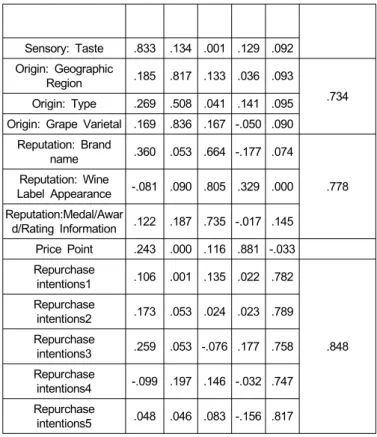
Prior to hypotheses validation, the reliability and validity of measurement tools were tested (Table 1). First, an exploratory factor analysis (EFA) using principal component analysis with Varimax rotation was performed. Two wine attributes items (aging and quality) produced a factor loading below the 0.5 cut-off, and were removed. The remaining items were factor an- alyzed again. This processes successfully generated five factors having eigenvalues greater than 1. Internal consistency of each construct estimated with coefficients of Cronbach’s alpha ranged from 0.734 and 0.848, surpassing the criteria for reliability ac- ceptability (Nunnally, 1978). Therefore, construct validity and reli- ability measures used in this study were deemed to meet ac- ceptable levels.

<Table 1> Validity and reliability of measurements

Factor Extraction:Principal Component Analysis Rotation:Varimax with Kaiser Normalization.

Factors were converged after 6 rotations.

Table 2 contains the means, standard deviations and the cor- relation matrix for all the variables included in this study. The average values of wine attributes pertaining to ‘sensory’ (4.09) and ‘price point’ (4.02) were found to be highest, followed by

‘origin’ (3.86) and ‘reputation’ (3.63). All four wine attributes were found to significantly correlate to consumer repurchase intentions.

<Table 2> Descriptive Statistics and Correlation of Variables

Variables Mean Std. 1 2 3 4

1. Sensory 4.09 .65

2. Origin 3.86 .746 439**

3. Reputation 3.63 .76 .456** .365**

4. Price point 4.02 .88 .334** .152** .234**

5. Repurchase

intentions 3.67 .58 .335** .252** .211** .017

*p<.05, **p<.01.

Items Factors Cronbach’s

alpha

1 2 3 4 5

Sensory: Color .560 .184 .388 .277 .198 Sensory: Aroma .597 .238 .294 .093 .191 .786

Sensory: Taste .833 .134 .001 .129 .092 Origin: Geographic

Region .185 .817 .133 .036 .093 Origin: Type .269 .508 .041 .141 .095 .734 Origin: Grape Varietal .169 .836 .167 -.050 .090

Reputation: Brand

name .360 .053 .664 -.177 .074 Reputation: Wine .778

Label Appearance -.081 .090 .805 .329 .000 Reputation:Medal/Awar

d/Rating Information .122 .187 .735 -.017 .145 Price Point .243 .000 .116 .881 -.033 Repurchase

intentions1 .106 .001 .135 .022 .782

.848 Repurchase

intentions2 .173 .053 .024 .023 .789 Repurchase

intentions3 .259 .053 -.076 .177 .758 Repurchase

intentions4 -.099 .197 .146 -.032 .747 Repurchase

intentions5 .048 .046 .083 -.156 .817

(5)

4.2. Hypotheses testing

4.2.1. The Relationships between Wine Attributes and Repurchase Intentions

Hypotheses 1a to 1 dexpected that the wine attributes have an impact on wine repurchase intentions. To test these hypoth- eses, we analyzed the regression equations with the in- dependent variables (sensory, origin, reputation, and price point attributes) and dependent variable (wine repurchase in- tentions).The results are presented in Table 3. As predicted, re- sults showed that all wine attributes have a positive association with wine repurchase intention. The ‘price point’ attribute was shown to have the strongest effect upon wine repurchase in- tention ( = 0.218), followed by ‘reputation’ ( = 0.189), ‘origin’ β β ( = 0.171) and ‘sensory’ ( = 0.126). Therefore, Hypothesis 1 β β is fully supported.

<Table 3> Results of Testing Hypothesis 1

Independent Variables Dependent Variable Wine Attributes Wine Repurchase Intentions

Sensory Attribute .126(2.145)**

Origin Attribute .171(3.141)**

Reputation Attribute .189(3.574)***

Price Point Attribute .218(4.229)***

R

2

.238

Adjusted R

2

.230

F value 30.003***

Standardized regression coefficients are reported (t values are in parentheses).

p<.10, *p<.05, **p<.01, ***p<.001.

4.2.2. Wine Purchase Channels: Offline vs. Online

This study employed the two group comparison analysis ap- proach to verify the moderating effect. In order to test the mod- erating effect of the types of wine purchasing channels in the relationship between wine attributes and wine repurchase in- tentions, 390 samples were divided into two groups based upon their main wine purchasing channel. One group comprised in- dividuals that primarily used offline wine shops for purchasing wine (n=236), and the other group represented consumers who primarily purchased wine through online sites n=154). Using the 2 test, the path coefficient related to the impact of sensory at

χ -

tribute ( = .202, p < .01) and price point attribute ( = .136, p β β

<.05) on wine repurchase intentions were verified to discern whether results differ between the two groups. Results revealed that there was a significant difference between these two groups (‘sensory’ attribute: Δχ Δ 2/ df = 3.540, p < .05, ‘price point’ attrib - ute: Δχ Δ 2/ df = 3.255, p < .05). Regarding the impact that

‘origin’ and ‘reputation’ attributes have on wine repurchase in- tentions, the moderating effect of the type of wine purchase channels was not supported as 2 values did not significantly χ change following changes in the degrees of freedom.

Hypotheses 2a and 2d were supported, but hypotheses 2b and 2c were not supported. The results are presented in Table 4.

<Table 4> Results of Testing Hypothesis 2 Hypotheses Type of Channels

2 χ Offline Online ∆

H2a. Sensory attribute →

Wine repurchase intentions .202(2.561)** -.024(-.272)ns 3.540 (p < .05) H2b. Origin attribute →

Wine repurchase intentions .190(2.734)** .142(1.633)ns .021(ns) H2c. Reputation attribute →

Wine repurchase intentions .128(1.799)† .217(2.676)** 1.047(ns) H2d. Price point attribute →

Wine repurchase intentions .136(2.000)* .279(3.732)*** 3.255 (p < .05) Standardized regression coefficients are reported (t values are in parentheses).

p<.10, *p<.05, **p<.01, ***p<.001.

5. Discussion

5.1. Conclusions and implications

This study investigated consumer perceptions about wine at- tributes and their influence upon repurchase intentions. In addi- tion, the impact of wine purchase channels (online and offline) upon the relationships between wine attributes and repurchases intentions was also examined.

Results revealed that wine consumers expressing high im- portance on wine attributes pertaining to ‘sensory’, ‘origin’,

‘reputation’ and ‘price point’ are more likely to repurchase wine.

As expected, the ‘price point’ attribute is the most powerful influ- ential factor for increasing wine consumer repurchase intention.

The ‘reputation’ and ‘origin’ attribute were also found to have a significant influence on repurchase intention. This result sup- ported the (MacDonald et al., 2013) study proposition that wine attributes involving brand, wine label design, and wine rating and natural environmental characteristics (e.g., country of origin, style, and grape varietal) are directly associated with consumer attitudes and purchasing behavior toward wine products. The

‘sensory’attribute was also found to have a significant effect for increasing repurchase intention.

In addition, this study investigated the impact wine purchase

channels have upon the relationship between consumer percep-

tions about wine attributes and repurchase intentions. Results

showed significantly different influences of consumer perceptions

about wine attributes upon repurchase intention when purchasing

wine via online channels compared with purchasing via offline

(6)

channels. In particular, the ‘sensory’ and ‘origin’ attributes have a significant influence on repurchase intention when purchasing wine via offline channels, but these two attributes do not show any significant influence when purchasing wine via online channels. This result implies that wine consumers placing a high importance upon wine sensory and origin attributes are more likely to continue to purchase wine via traditional offline wine channels.

The wine ‘reputation’ attribute was found to be a critically im- portant determinant of online wine consumer purchasing behavior. Online wine consumer perceptions pertaining to

‘sensory’ and ‘origin’ attributes are less important, but they were found to focus on brand name, label, and award information.

This finding can be supported in consideration of online shop- ping characteristics that represent consumer inabilities to see, feel, taste and smell wine products. Therefore, online wine con- sumers are more likely to rely on wine attributes pertaining to brand names, wine labels, and medal/ award/ rating information that can represent wine product qualities. Additionally, the ‘price point’ attribute was shown to have a significant influence on re- purchase intention when purchasing wine from both online chan- nels and offline channels. However, this study’s result docu- mented that online wine consumer perceptions about wine price influenced their repurchase intentions more highly than it did for those wine consumers primarily purchasing wine offline. This finding supported Childers et al. (2002)’s proposition that online shoppers are more sensitive to product prices than are offline shoppers.

Most importantly, this study contributes to the existing body of knowledge in terms of understanding consumers purchase be- havior through the investigation of wine purchase channels and its effects upon consumer perceptions about wine attributes and repurchase intention. Because some of wine attributes were found to be more important when purchasing wine through on- line channels than through offline channels, wine business man- agers using multiple sales channels (online and offline) can now begin to develop effective marketing strategies based upon these study findings. Wine consumers are becoming more aware of various wine purchase channels and have begun to look for a more beneficial wine market (Thrane, 2004). This can provide empirical evidence that wine online channels should de- velop effective and successful wine website strategies. This study confirmed that consumer having a high importance level of sensory attributes might be less likely to purchase wine using offline channels. However, this study also demonstrated that when wine websites can provide reliable information on wine reputation and can sell wines at more reasonable prices, online wine sales volume can greatly be increased. Therefore, for a successful online wine business, customized information on wine products should be delivered through well-organized websites.

Previous studies have emphasized that ‘channel extension’is one very useful tool to increase market share and improve busi- ness performance (Agatz et al., 2008 Gensleret al., 2012;

Kollmann et al., 2012). Therefore, wine business owners should develop differential marketing strategies that can be applied to online and offline consumers respectively. Especially considering

the rapid growth of online sales volume, wine business manag- ers should focus on increasing online consumer loyalty through various promotions and advertisements of their wine brands.

5.2. Limitations and Recommendations for Future Research

Limitations exist with this study, and with this in mind, the findings should be interpreted with caution. First, an online cross-sectional survey having purchased wine online during the previous 12 months was conducted. Even though the method- ology employed was designed to reduce sampling bias issues, the findings are not generalizable to apply to all wine consumers. Therefore, future research studies should use more robust sampling methods to prove significant differences in re- purchasing behavior between online wine consumers and offline wine consumers. Another limitation of this study is that re- spondents were all residents of Florida, who were permitted to shop and purchase wine online and have their purchases ship- ped to their Florida residence. Therefore, future wine studies need to investigate wine consumer attributes and behavior to- ward different wine purchase channels residing in locations other than Florida.

Lastly, due to using email invitation, the response rate of this study’s survey was low. Therefore, it is recommended that fu- ture research involving email data collection of online and offline wine consumers that show low response rates should conduct a nonresponse bias check.

References

Agatz, N. A., Fleischmann, M., & Van Nunen, J. A. (2008).

E-fulfillment and multi-channel distribution A review. – European Journal of Operational Research, 187(2), 339-356.

Ahn, T., Ryu, S., & Han, I. (2005). The impact of the online and offline features on the user acceptance of Internet shopping malls. Electronic Commerce Research and Applications, 3(4), 405-420.

Baker, J., Parasuraman, A., Grewal, D., & Voss, G. B. (2002).

The influence of multiple store environment cues on per- ceived merchandise value and patronage intentions.

Journal of Marketing, 66(2), 120-141.

Barber, N., Dodd, T., & Ghiselli, R. (2008). Capturing the younger wine consumer. Journal of Wine Research, 19(2), 123-141.

Chen, L., Gillenson, L., & Sherrell, L. (2002). Enticing online consumers: an extended technology acceptance per- spective, 39 (8), 709 719. doi: 10.1016. S0378-7206 – (01), 00127-6.

Chen, I. J., & Popovich, K. (2003). Understanding customer re-

lationship management (CRM) People, process and

technology. Business Process Management Journal, 9(5),

672-688.

(7)

Childers, T. L., Carr, C. L., Peck, J., & Carson, S. (2002).

Hedonic and utilitarian motivations for online retail shop- ping behavior. Journal of Retailing, 77(4), 511-535.

Chiou, J. S., Huang, C. Y., & Chuang, M. C. (2005).

Antecedents of Taiwanese adolescents' purchase in- tention toward the merchandise of a celebrity: The mod- erating effect of celebrity adoration. The Journal of Social Psychology, 145(3), 317-334.

Cho, M., Bonn, M. A., & Kang, S. (2014). Wine attributes, per- ceived risk and online wine repurchase intention: The cross-level interaction effects of website quality.

International Journal of Hospitality Management, 43, 108-120.

Degeratu, A. M., Rangaswamy, A., & Wu, J. (2000). Consumer choice behavior in online and traditional supermarkets:

The effects of brand name, price, and other search attributes. International Journal of Research in Marketing, 17(1), 55-78.

Gensler, S., Verhoef, P. C., & Böhm, M. (2012). Understanding consumers’ multichannel choices across the different stages of the buying process. Marketing Letters, 23(4), 987-1003.

Gurau, C. (2003). Tailoring e-service quality through CRM.

Managing Service Quality: An International Journal, 13(6), 520-531.

Jaeger, S. R., Danaher, P. J., & Brodie, R. J. (2010).

Consumption decisions made in restaurants: The case of wine selection. Food quality and Preference, 21(4), 439-442.

Jelassi, T., & Leenen, S. (2003). An E-Commerce Sales Model for Manufacturing Companies: A Conceptual Framework and a European Example. European Management Journal, 21(1), 38-47.

Keeney, R. L. (1999). The value of Internet commerce to the customer. Management Science, 45(4), 533-542.

Kollmann, T., Kuckertz, A., & Kayser, I. (2012). Cannibalization or synergy? Consumers' channel selection in online off – - line multichannel systems. Journal of Retailing and Consumer Services, 19(2), 186-194.

Kumar, V., & Venkatesan, R. (2005). Who are the multichannel shoppers and how do they perform?: Correlates of multi- channel shopping behavior. Journal of Interactive Marketing, 19(2), 44-62.

Lockshin, L. (2000) Wine marketing in the new millennium, Australian Wine Industry Journal, 15, 89 90. –

Lockshin, L., Jarvis, W., d’Hauteville, F., & Perrouty, J. P.

(2006).Using simulations from discrete choice experi- ments to measure consumer sensitivity to brand, region, price, and awards in wine choice. Food Quality and Preference, 17(3), 166-178.

Lynch Jr, J. G., & Ariely, D. (2000). Wine online: Search costs

affect competition on price, quality, and distribution.

Marketing Science, 19(1), 83-103.

MacDonald, J. B., Saliba, A. J., & Bruwer, J. (2013). Wine choice and drivers of consumption explored in relation to generational cohorts and methodology. Journal of Retailing and Consumer Services, 20(3), 349-357.

Markey, R. G., & Hopton, C. (2000). E-customer loyalty applying – the traditional rules of business for online success.

European Business Journal, 12(4), 173-79.

Mueller, S., & Szolnoki, G. (2010). The relative influence of packaging, labelling, branding and sensory attributes on liking and purchase intent: Consumers differ in their responsiveness. Food Quality and Preference, 21(7), 774-783.

Nunnally, J. C. (1978). Psychometric Theory, second ed.

McGraw-Hill, New York.

Quester, P. G., & Smart, J. (1996). Product involvement in con- sumer wine purchases: Its demographic determinants and influence on choice attributes. International Journal of Wine Marketing, 8(3), 37-56.

Richardson, O. (2002) Utilisation of the World Wide Web by wine producers, International Journal of Wine Marketing, 14(3), 65 79. –

Rohm, A. J., & Swaminathan, V. (2004). A typology of online shoppers based on shopping motivations. Journal of Business Research, 57(7), 748-757.

Rong-Da Liang, A., & Lim, W. M. (2011). Exploring the online buying behavior of specialty food shoppers. International Journal of Hospitality Management, 30(4), 855-865.

Shankar, V., Urban, G. L., & Sultan, F. (2002). Online trust: a stakeholder perspective, concepts, implications, and fu- ture directions. The Journal of Strategic Information Systems, 11(3), 325-344.

Shin, B. S., & Park, J. Y. (2006). The Effect of the Consumer's Perceived Risk on the Level of Information Search.

Journal of Global Academy of Marketing Science, 16(3), 143-167.

Stone, M., Hobbs, M., & Khaleeli, M. (2002). Multichannel cus- tomer management: The benefits and challenges. The Journal of Database Marketing, 10(1), 39-52.

Thrane, C. (2004). In defence of the price hedonic model in wine research. Journal of Wine Research, 15(2), 123-134.

Tzimitra-Kalogianni, I., Papadaki-Klavdianou, A., Alexaki, A., &

Tsakiridou, E. (1999). Wine routes in Northern Greece:

consumer perceptions. British Food Journal, 101(11), 884-892.

Yoo, C. W., Kim, Y. J., & Sanders, G. L. (2015). The impact of

interactivity of electronic word of mouth systems and

E-Quality on decision support in the context of the

e-marketplace. Information & Management, 52(4), 496-505.

수치

Table 2 contains the means, standard deviations and the cor- cor-relation matrix for all the variables included in this study

참조

관련 문서

To further analyze and compare the differences between these four types of online and offline delinquency, we examined independent variables concerning self-control factors

The purpose of this study is to investigate the effect of online shopping mall characteristics on direct purchasing satisfaction of foreign consumers and purchase

Micro- and nano-sized pores were formed on the surface of the alloy using PEO and anodization methods, and the pore shape change according to the Zr

This study set out to examine online shopping behaviors among consumers in middle school and the influences of sociodemographic variables,

The purpose of this study is to determine customer satisfaction and repurchase intentions based on various characteristics when Korean Chinese consumers actually

Measuring Up Online: The Relationship between Social Presence and Student Learning Satisfaction.. Journal of Scholarship of

This study was intended to identify a measuring method of destination attributes, perceived tour value, satisfaction and revisiting intention through

1) There was significant relevance between demographic variable of the consumer and satisfaction behavior(word-of-mouth, repeat purchase). 2) There