• 검색 결과가 없습니다.

A Study on the User Acceptance Model of Artificial Intelligence Music Based on UTAUT

N/A
N/A
Protected

Academic year: 2021

Share "A Study on the User Acceptance Model of Artificial Intelligence Music Based on UTAUT"

Copied!
9
0
0

로드 중.... (전체 텍스트 보기)

전체 글

(1)

JKSCI

A Study on the User Acceptance Model of Artificial Intelligence Music Based on UTAUT

1)

Weiwei Zhang*

*Lecturer, Dept. of Vocal Performance Music Conservatory, Anshan Normal University, Anshan, China [Abstract]

In this paper, the purpose is to verify the impact of performance expectations, effort expectations, social impact, individual innovation and perceived value on the intent of use and the behavior of use. Used Unified Theory of Acceptance and Use of Technology (UTAUT) to verify the applicability of this model in China, and established the research model by adding two new variables to UTAUT according to the situation of the Chinese market. To achieve this goal, 345 questionnaires were collected for experienced music creators using artificial intelligence nuggets in China by means of Internet research. The collected data were analyzed through frequency analysis, factor analysis, reliability analysis, and structural equation analysis through SPSS V. 22.0 and AMOS V 22.0. The verification of the hypotheses presented in the research model identified the decisive influence factors on the use of artificial intelligence music acceptance by Chinese users.

The study is innovative in that it attempts to verify the applicability of UTAUT in the Chinese context. In the construction of the user acceptance model of AI music, three influencing factors will have an effect on users’

intentions, and according to the degree of effect, from largest to smallest, they are respectively Perceived Innovativeness, Performance Expectancy and Effort Expectancy. This paper will also provide some management advices, i.e. improving the utility and usability of AI music, encouraging users with individual innovativeness, developing competitive and attractive pricing policies, increasing publicity, and prioritizing word-of-mouth advertising.

▸Key words: Artificial Intelligence Music, UTAUT, Perceived Innovativeness, Performance Expectancy, Effort Expectancy

[요 약]

본 연구는 정보 기술 수용 모델 (UTAUT)을 사용하여 이 모형은 중국 내 적용성을 검증하였으 며, 중국 시장의 실태에 따라 UTAUT에 새로운 변수 2개를 추가하여 연구 모델을 설립하였다. 이 와 같이 본 연구의 목적은 성과기대, 노력기대, 사회영향력, 개인혁신성, 지각된 가치가 사용의도 와 사용행동에 미치는 영향을 검증하고자 한다 . 이러한 목적을 달성하기 위해 인터넷 조사 방식 으로 중국에 있는 인공지능음악 제품을 사용 경험 있는 음악 창작자들을 대상으로 345부의 설문 지가 수집되었다. 수집된 자료는 SPSS V. 22.0와 AMOS V 22.0을 통해 빈도분석, 요인분석, 신뢰 도분석, 구조방정식모형분석을 실시하여 결과를 분석하였다. 연구모델에서 제시된 가설의 검증을 통해 중국 사용자들의 인공지능 음악 수용에 대한 사용에 결정적인 영향 요인을 확인하였다 .

본 연구의 결과는 UTAUT모형이 중국 배경에서의 적용성을 검증하고, 중국 배경에서의 인공지 능 음악 사용자 수용 모델을 구축하였으며 , 3 가지 영향 요소가 사용자의 사용 의도에 영향을 미 치며, 이러한 영향요소의 역할이 영향의 크기에 따라 정렬하는 것이 효과적이다. 본 연구는 인공 지능 음악의 유용성을 높이고, 인공지능 음악의 유용성을 높이며, 개인 혁신적인 사용자를 활용해 경쟁력 있고 매력적인 가격 전략을 수립하고, 입소문 홍보에 주력할 것을 관리 조언하였다.

▸주제어: 인공지능음악, UTAUT, 성과기대, 노력기대, 개인혁신성

∙First Author: Weiwei Zhang, Corresponding Author: Weiwei Zhang

*Weiwei Zhang ([email protected]), Dept. of Vocal Performance Music Conservatory, Anshan Normal University

∙Received: 2020. 04. 24, Revised: 2020. 05. 25, Accepted: 2020. 05. 25.

Copyright ⓒ 2020 The Korea Society of Computer and Information http://www.ksci.re.kr pISSN:1598-849X | eISSN:2383-9945
(2)

I. Introduction

With the advance of technology, "artificial intelligence" has become synonymous with a new era. With the deepening of technology application and the interdisciplinary development of science and technology, the cross-border integration of music and technology has become a field of thought. As a new major in Taiwan, "music technology" is still in its infancy, and has long developed internationally into a comprehensive subject [1] .

At present, artificial intelligence has been widely applied in various industries, and the combination of artificial intelligence technology and music has helped upgrade the music industry [2] . According to relevant research results, AI technology can make very complicated music creation while the level of music creation is very high. AI technology establishes basic logic and rules such as musical structure, rhythm, style and scale in the process of creating music, creating melodies through accurate algorithmic system, and combining the sound characteristics and effects of musical instruments.

Artificial music software is so powerful that it can edit, modify, record, and play songs at any time, and intelligently process a variety of musical elements. This new music system is also widely used in music teaching. AI Smart technology and instruments can combine software and hardware to make complex playing simple and easy to learn, and the training process is more interesting, bringing artificial intelligence music to music classrooms, allowing many students to learn new kinds of smart musical instruments that can be played by one person, which provides a new teaching model for current music education. At the same time, students could create in class, combine different musical instruments and play them on the spot, improving the quality of music teaching [3] .

To sum up, artificial intelligence technology has been widely used in the music industry, which can help create music, making it more efficient and universal, and driving the commercial development of music. In addition, AI technology can be applied

in musical instruments, producing intelligent instruments, and in entertainment teaching, which can be used gradually to promote the upgrading and transformation of the music industry [4] .

Artificial intelligent music is not a simple extension of the music industry. Artificial intelligence music has its own technical infrastructure, business model and value chain, new user value, so it needs new thinking, new research perspective and new theoretical framework, because of the characteristics of artificial intelligence music, we believe it is necessary to revise the traditional technology acceptance theory to form a theoretical model more suitable for artificial intelligence music.

Despite the extensive use of artificial intelligence music, the number of users is relatively small, and many have taken a wait-and-see attitude. User use is the basis for the development of artificial intelligence music, and user acceptance, however advanced, is a prerequisite for its development and profit-making [5] . Users' willingness to use is undoubtedly one of the major factors influencing the development of AI music, which directly determines whether AI music can be popularized and widely used among many users. Therefore, it is necessary to study what causes Chinese users to use artificial intelligence music. At present, most of the results of research on artificial intelligence music come from developed countries, and further research remains to be done to prove the applicability of the Chinese market [6] . In addition, AI music is a new musical product. Whether or not it can be accepted by the user affects the user's willingness to use through "individual innovation", while the cost is a factor that must be considered by the user when accepting a new thing. The

"sensory cost" also affects the user's willingness to

use. Therefore, the purpose of this paper is to

analyze which factors will affect users' willingness

to use mobile commerce in the context of China,

and to consider whether individual characteristics

will affect the relationship of variables, and verify

by empirical research.

(3)

II. Theoretical literature

This study is divided into independent and dependent variables by the relationship between variables. An independent variable is regarded as a variable affecting or determining a dependent variable and is a prerequisite and cause for change in the dependent variable. There are two main reasons why, according to the theory of rational behavior, an individual's specific behavior is determined by his intention to use, i.e. behavior can be predicted by his intention, and studies show that the intention to use is more easily measured and accurate in empirical research. Therefore, the use intention is set as a dependent variable in this study.

Factors affecting the acceptance of emerging IT may not fully explain user motivations as different technology types, target users, and use environments differ. Therefore, this study attempts to excavate the common factor from the existing theoretical basis and extract the main variable's effort expectations, social effects, individual innovation, and perceived costs from the research background of the study.

1. Relationship Between Performance Expectations and Usage Intention

Researchers note that the use of a particular new technology by users can bring about performance that is positively affecting the use of the technology by individuals.

Performance expectations integrate perceived usefulness in TAM/TAM2/C-TAM-TPB models, external incentives in MM models, job matching in MPU models, comparative advantage in IDT and outcome expectations in SCT. Cheng and Park found that perception of usefulness had a significant impact on the intent to use mobile networks [7] . This is consistent with the results of other studies of the integrated variables, such as external incentives, job matching, comparative advantage, and outcome expectations [8] .

Performance expectations are seen as the most

powerful predictive tool in UTAUT when interpreting the intention of the system to use the system. Therefore, the relationship between the expectation of measurement performance and the intention to use it in this study is presented with assumptions:

H1: Performance expectations have a positive effect on use intent.

2. Relationship Between Expectation and Use Intention

The effort needed to learn and use a technology affects the user's acceptance and use of it.It can be seen from Davis' theoretical model that "sensory ease of use" contains a cost-benefit assessment, whether the information system that the user touches is simple to operate or complex to instruct, and requires a lot of mental and time to understand the memory, so that he is cognitively judged by value. Although there may be other factors, such as the user's personal background, interest, etc. In a free-learning context, at least perception of ease of use can be a basic condition for arousing the will to act, i.e. systems that require less effort are more likely to be accepted by users [9] .

In the UTAUT model, efforts are viewed as a direct determinant of use intent. According to research results in China's mobile communications market, Chinese users are more receptive to basic and user-friendly technologies such as text messaging rather than advanced but lacking in user-friendly technologies such as WAP. So, Chinese users may be more likely to look forward to this factor than users in other developed countries [10] .

Therefore, the relationship between the expectation of the measurement effort and the intention to use in this study is presented with assumptions:

H2 strives to have a positive effect on the

intended use.

(4)

3. Relationship Between Social Impact and Usage Intention

Social impact integrates subjective norms in TAM/TAM2/TPB/DTPB/C-TAM-TPB, social factors in MPCU, and images in IDT. In the information system, a great deal of research has proved the significant effect of social influence on the purpose of use [11] . Nysveen et al shows that when people use a mobile service in a public setting, they must first observe and be influenced by others. The positive relationship between social influence and the intention to use has been proved by empirical research, documentary proof and theoretical model [12] .

UTAUT argues that there is a significant relationship between social impact and use intent, and that the relationship is also proven in many other models (TAM, TRA, TPB, and DTPB) [13] . Therefore, this study measures the relationship between the social impact and the intention to use and makes assumptions:

H3 Social effects have positive salient effects on use intent.

4. Relationship Between Individual Innovation and Usage Intention

Individual innovation first intervened in the information technology field by Agarwal et al. It was used to measure the individual's willingness to experiment with new information technology.

UTAUT measures many variables, but ignores the study of individual characteristics [14] , such as individual innovation. Therefore, increasing individual innovation on the basis of UTAUT will help explain the process of technology acceptance and use. Kenneth argues that individual innovation has a positive effect on both perceived usefulness and perceived ease of use [15] . Therefore, this study proposes assumptions:

H4 Individual Innovation has a positive effect on the purpose of use.

5. Relationship Between Perception cost and intention to use

In the study of artificial intelligence music, scholars have all mentioned that prices have a huge impact on artificial intelligence music, because the price sensitivity of the AI music business is not a rigid demand business [16] . The price is not absolute, but consumer perception, which defines the cost as the sum of the costs involved in the use of artificial intelligence music [17] .

It can be seen from this that perceived cost is one of the most important influencing factors in the user's acceptance of artificial intelligence music, so add perceived cost variables to this study model and make assumptions:

H5 Significant Effect of Perception Cost on Usage Intention

III. research method

1. Research Model

Fig. 1. Research model

2. Subject Investigated

This study targets ordinary music creators currently living in Beijing, China. As a result, an offline survey was conducted to verify the purpose of this paper, and the survey was conducted for about 30 days from March 2 to April 2, 202.The total number of valid samples collected was 345 persons.

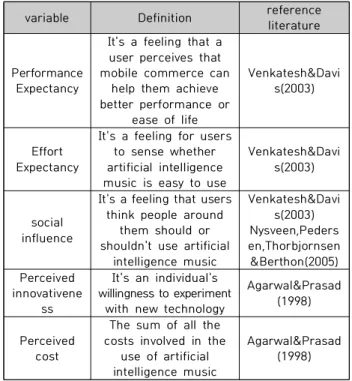
3. Operational Definition and Measurement

Scale of Variables

(5)

variable Definition reference literature

Performance Expectancy

It's a feeling that a user perceives that mobile commerce can

help them achieve better performance or

ease of life

Venkatesh&Davi s(2003)

Effort Expectancy

It's a feeling for users to sense whether artificial intelligence music is easy to use

Venkatesh&Davi s(2003)

social influence

It's a feeling that users think people around

them should or shouldn't use artificial

intelligence music

Venkatesh&Davi s(2003) Nysveen,Peders en,Thorbjornsen

&Berthon(2005) Perceived

innovativene ss

It's an individual's willingness to experiment

with new technology

Agarwal&Prasad (1998)

Perceived cost

The sum of all the costs involved in the

use of artificial intelligence music

Agarwal&Prasad (1998) Table 1. Operational Definition and Measurement Scale of Variables

4. Analysis process

For empirical analysis, SPSS V. 22.0 and AMOS V.

22.0 were used. The analysis process is as follows.

First, frequency analysis was conducted to identify sample characteristics, the discriminant validity of variables was checked, the single dimension of each configuration concept was analyzed, and reliability analysis was conducted to check the internal consistency of questionnaire. Structural equation model analysis was performed to confirm the suitability and impact of the established study model in this study.

IV. Analysis Result

1. Demographic Characteristics of The Sample In terms of the general characteristics of the subjects studied, 49(14.2%) of the 345 respondents were men and 296 (85.8%) of women. The ratio of women is higher than that of men. Meanwhile, the largest number of respondents aged 40 to 49 was 127 (36.8%). Next was 103 (29.9%) aged 20 to 29.Then there were 72 respondents (2.9%) aged between 30 and 39.There were four respondents (1.2%) under the age of 20 with the lowest answer rate. Among the

graduate students who received the most answers, 165 (47.8%) were university graduates. Next was 68 college graduates (19.7%) and 58 high school graduates (16.8 %). 54 or 15.7 percent of those with the lowest answer rate were from graduate students.

The largest number of management responders (38.0%) were among the job survey results. The second was 67(19.4%) in technical jobs. Then came 55(15.9%) of the respondents to the production job.

The others with the lowest answer rate were 38(11.0%).According to the survey, 118 respondents (34.2%) answered between 3 and 4 million won (34.2%). Next was 74 (21.4%) out of 4 to 5 million.

Next was 70(2.3%) or more of the five million won or more.37 respondents (1.7%) answered the lowest of 200-3 million respondents.

2. Exploratory Factor Analysis and Reliability Analysis

2.1 Exploratory Factor Analysis and Reliability Analysis

Configur ation concept

Survey question

Factor load value

α

Performa nce Expectan

cy

Performance Expectancy4 .762

.905 Performance Expectancy1 .759 Performance Expectancy3 .742 Performance Expectancy2 .683 Performance Expectancy5 .652

Effort Expectan

cy

Effort Expectancy1 .715

.933 Effort Expectancy2 .667 Effort Expectancy5 .639 Effort Expectancy3 .629 Effort Expectancy4 .619

Social Influence

Social Influence3 .738

.928 Social Influence4 .717 Social Influence5 .684 Social Influence2 .615 Social Influence1 .555 Perceived

Innovativ eness

Perceived Innovativeness4 .771 Perceived Innovativeness3 .743 .893 Perceived Innovativeness5 .638 Perceived Innovativeness1 .628 Perceived

Cost

Perceived Cost2 .756 .885 Perceived Cost4 .622 Perceived Cost3 .596 Behavioral

Intention

Behavioral Intention1 .679 .872 Behavioral Intention2 .659 Behavioral Intention3 .626 Use

Behavior

Use Behavior2 .781

.898

Use Behavior1 .699

Use Behavior3 .511

Table 2 Exploratory factor analysis of independent

variables

(6)

As a result, as shown in Table 2 , all factors were extracted above .5, showing 15.88 percent, 12.94 percent, 12.596 percent, 12.596 percent, 12.37 percent, and 8.74 percent, respectively. In addition, the results of the reliability analysis of the test items show that the Cronbach's Alpha coefficient is above .8 in general allowable values as shown in Table 2.

2.2 Confirmatory Factor Analysis

In [18] order to verify the convergence and discriminant appropriateness of measurement variables, the deterministic element analysis was carried out. It can be observed from Table 3 that the suitability of the measurement model is X2 = 642.03, P = .000, DP = 329, CMIN/DF = 1.951, GFI = .878, AGFI

=.849, IFI =.931, IFI =.965, CF =.965, RF=.965, RM=.031.

The suitability of the measurement model can be evaluated as a more satisfactory fit.In addition, the measurement model X2(df) = displayed as 642.03(329), suggested that X2/d.f. be priced below 1.951 (large number of specimens), up to 5 Confirm that the measurement model used in this study is good.

In addition, both the elements of the validation factor analysis and the inventory amount show the t-value that is statistically noted and confirm the rationality of convergence. The comprehensive trust was also evaluated through Amos. All projects exceed the generally allowed 0.6, indicating that the result value is trustworthy. On the other hand, the mean fractional extract (AVE) value is calculated by using other measured values of convergent propriety, which is the size of the dispersion that the indicator can account for potential concepts, and is said to be more than 0.5 to be reasonable. The average divergent extract (AVE) value of all factors is above 0.5 in this study, ensuring convergence.

3. Research Hypothesis Verification

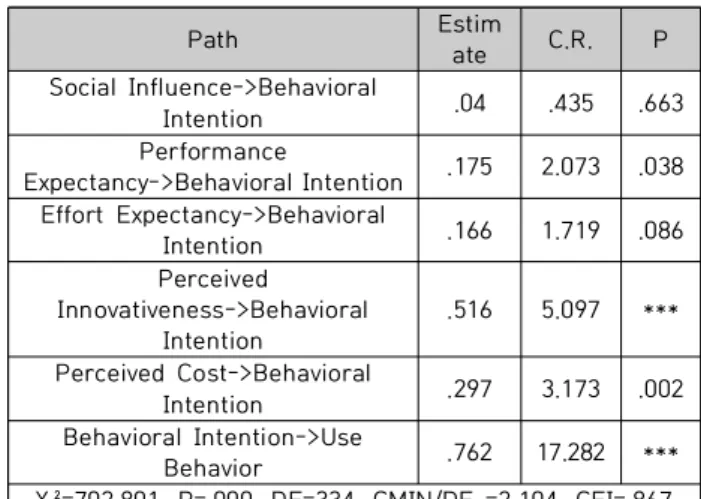
AMOS was used to verify the hypothesis. To verify the hypothesis, the path coefficients of the structural equation model can be found in Table 4 .The suitability index for the structural model used in this study is X2 = 702.801, P =.000, DP =334,

CMIN/DF = 2.104, GFI =.867, AGFI =.839, NFI =.924, IFI =.94, CFI =.959, CMR =.039.The suitability of the structural equation in this study is not a problem and can be assessed as an acceptable level.

Configuration concept

Standard

factor load T value CR AVE

Social Influence

.844 .835 .796 .796 .776

19.417 17.552 17.488 16.884

.946 .802

Performance Expectancy

.857 .884 .882 .828 .845

22.292 21.969 19.647 2.374

.891 .725

Effort Expectancy

.808 .811 .822 .915 .892

17.547 17.773 2.923

2.14

.912 .761

Perceived Innovativeness

.849 .855 .782 .808

2.546 16.588 17.431

.929 .715

Perceived Cost

.886 .88

.795 17.858

17.996 .925 .779 Behavioral

Intention

.901 .882 .868

24.315 22.757

.911 .759

Use Behavior

.855 .901

.843 22.44

19.475 .919 .715 X²=642.03, P=.000, DF=329, CMIN/DF =1.951, GFI=.878,

AGFI=.849, NFI=.931, IFI=.965, CFI=.965, RMR=.031

*P<.05, **P<.01, ***P<.001

Table 3. Confirmatory Factor Analysis

Path Estim

ate C.R. P

Social Influence->Behavioral

Intention .04 .435 .663

Performance

Expectancy->Behavioral Intention .175 2.073 .038 Effort Expectancy->Behavioral

Intention .166 1.719 .086

Perceived Innovativeness->Behavioral

Intention .516 5.097 ***

Perceived Cost->Behavioral

Intention .297 3.173 .002

Behavioral Intention->Use

Behavior .762 17.282 ***

X²=702.801, P=.000, DF=334, CMIN/DF =2.104, GFI=.867, AGFI=.839, NFI=.924, IFI=.959, CFI=.959, RMR=.039

* p<.05 ** p<.01, *** p<.001

Table 4. Structural model analysis result

(7)

H1. Regarding the effect of Social Information on Behavioral Intention, as observed in Table 4, the effect of Social Information on Behavioral Intention is .04. The results of such a study were statistically meaningless at the level noted in .05(C.R=.435, p>.05). Therefore, H6 was rejected.

H2.Regarding the effect of Performance Expectancy on Behavioral Integration, as observed in Table 4, the effect of Performance Expectancy on Behavioral Integration is .175. The results of such a study were statistically significant at a limited level of .05 (C.R=2.073, p<0.5)Therefore, H7 is verified as expected.

H3. Regarding the effect of Effort Expectancy on Behavioral Intention, as observed in Table 4, Effort Expectancy has an impact of .166.These results are not statistically significant at a limited level of .05(C.R=1.719, p>.05). Therefore, H3 was rejected.

H4.Regarding the effect of Percival Involvement on Behavioral Intention, as observed in Table 4, the effect of Percival Involvement on Behavioral Intention is .516.These findings are statistically significant at a limited level of .05 (C.R =5.097, p<0.05). Therefore, H4 is verified as expected.

H5. Regarding the effect of Perceived Cost on Behavioral Intention, as observed in Table 4, Perceived Cost has an effect of .297.These results are statistically significant at a limited level of .05 (C.R

=3.173, p<.05). Therefore, H5 is verified as expected.

H6. Regarding the effect of Behavioral Intention on Use Behavior, as observed in <Table 5>, the effect of the Behavior Intention on Use Behavior is .762.These results are statistically significant at a limited level of .05(C.R = 17.282, p<.05). Therefore, H6 is verified as expected.

V. Conclusions

1. Research conclusion

With the further development of technology application and the interdisciplinary development, the combination of artificial intelligence technology

and music helps upgrade the music industry. In this context, based on the relevant models and theories in the field of technical acceptance, this paper studies various factors that affect the user's acceptance behavior, constructs the user acceptance model of artificial intelligence music, collects an effective questionnaire through the questionnaire, and examines and analyzes the model and related hypotheses using the structural equation model, and concludes as follows:

1. On the whole, there are three factors that influence the user's intention to use. Their roles range from large to small to performance expectations, effort expectations, and individual innovation.

2. Social and perceived costs have no statistically significant effect on the intent to use.

2. Research on the Revelation of Management Practice

From the results of the study, we can see that in order to enhance the user's initiative and willingness to use, we can start with the following aspects: improving performance expectations, striving expectations and innovating.

1. Improve the usefulness of AI music. The study showed that performance expectations had a positive correlation with use, and that the effect was most significant. Therefore, artificial intelligence music should be considered to bring the practicality of a potential user, who feels that the application is useful and can be of practical value.

2. Increase the ease of use of artificial intelligence music. Hard work is also an important factor affecting the user's willingness to use artificial intelligence music. Lowering the time and effort spent on artificial intelligence music is the primary goal, while emphasizing and promoting user "easy to use" and at the same time enhancing user's perception of usefulness.

3. Take advantage of individual innovative users.

Because individual innovation has a positive and

significant effect on the intent to use, it is possible

(8)

to identify innovative groups and then use them as target customers for the first stage of market strategy by looking for common characteristics.

4. Develop a competitive and attractive price strategy. Cost is always a consideration for users, and this price is not the absolute price of the goods, but the perception of the user. Different levels of users will have different perceptions of the same price. Therefore, enriching the pricing model and maximizing the price ratio of artificial intelligence music are necessary for the development of the business.

5. We should intensify our publicity efforts and pay more attention to publicity by word of mouth.

We should strengthen the depth and breadth of publicity, increase the frequency of investment, extend the time of investment, expand the channel of investment, and enrich the form of investment.

Through publicity, consumers can get all kinds of information about AI music anytime, anywhere, quickly and easily, thereby constantly enhancing consumers' perception of social impact.

3. Limitations and Prospects of Research Due to the limitations of manpower, material and time, this research still has limitations in the way and content of research, and a careful summary will be provided for future researchers.

1. The basic model of this study is the model, i.e.

the extension based on the model. Thus, the variables are mainly selected, while a new variable is added, namely performance expectations, effort expectations, social effects, individual innovation and perceived costs. All variables are single-dimensional, and the results are more abstract. From now on, performance expectations can be further divided into work performance, convenience, entertainment experience and social impact, which can be divided into the influence of people around you and the influence of mass media. In this way, concrete proposals for artificial intelligence music can be better made, and the acceptance models obtained will be more detailed.

2. Factors affecting the acceptance of mobile

commerce by individual users can be explored in many ways. This study is aimed only at the individual users of artificial intelligence music to explore the behavior of using it by means of willingness to use it, expectation of performance, expectation of effort, social impact, perceived cost and individual innovation. In later studies, research can also be carried out from other angles.

REFERENCES

[1] L. Rincon, Starostenko, & A. S. Martín, "Algoritmic music composition based on artificial intelligence: A survey." In 2018 International Conference on Electronics, Communications and Computers, Vol, 5, pp. 187-193, Feb. 2018. DOI:

10.1109/CONIELECOMP.2018.8327197

[2] Z. Qiu, Y. Ren, C. Li, H. Liu, Y. Huang, Y. Yang, & K. Zhang,

"Mind Band: a crossmedia AI music composing platform." In Proceedings of the 27th ACM International Conference on Multimedia, Vol, 3, No, 3, pp. 2231-2233, Oct. 2019. DOI:

https://doi.org/10.1145/3343031.3350610

[3] D. Johnson, "Generating polyphonic music using tied parallel networks." In International conference on evolutionary and biologically inspired music and art, Vol, 4, pp. 128-143, Apr.

2017. DOI: https://doi.org/10.1007/978-3-319-55750-2_9 [4] S. Lee, "Artificial Intelligence Applications to Music

Composition." The journal of the convergence on culture technology, Vol, 4, No, 4, pp. 261-266, Mar. 2018. DOI:

https://doi.org/10.17703/JCCT.2018.4.4.261

[5] Q. H. Nguyen, T. T. Do, T. B. Chu, L. V. Trinh, D. H. Nguyen, C. V. Phan, & M. C. Chua, "Music Genre Classification using Residual Attention Network." In 2019 International Conference on System Science and Engineering, Vol, 9, No, 2, pp. 115-119, Jul.

2019. DOI: 10.1109/ICSSE.2019.8823100

[6] G. Zaccagnino, "Computer Music Algorithms." Bio-inspired and Artificial Intelligence Applications, Vol, 39, No, 6, pp. 52-74, Jun.

2017. DOI: http://dx.doi.org/10.14273/unisa-963

[7] Y. K. Dwivedi, N. P. Rana, A. Jeyaraj, M. Clement, & M. D.

Williams, "Re-examining the unified theory of acceptance and use of technology (UTAUT): Towards a revised theoretical model." Information Systems Frontiers, Vol, 21, No, 3, pp.

719-734, Mar. 2019. DOI: https://doi.org/10.1007/s10796-017-9 774-y

[8] R. Hoque, & G. Sorwar, "Understanding factors influencing the

adoption of mHealth by the elderly: An extension of the UTAUT

model." International journal of medical informatics, Vol, 101, pp.

(9)

75-84, Dec. 2017. DOI: https://doi.org/10.1016/

j.ijmedinf.2017.02.002

[9] J. Khalilzadeh, A. B. Ozturk, & A. Bilgihan, "Security-related factors in extended UTAUT model for NFC based mobile payment in the restaurant industry." Computers in Human Behavior, Vol, 70, pp. 460-474, Sep. 2017. DOI: https://doi.org/10.1016/j.chb.20 17.01.001

[10] S. Rahi, M. Ghani, F. Alnaser, & A. Ngah, "Investigating the role of unified theory of acceptance and use of technology (UTAUT) in internet banking adoption context." Management Science Letters, Vol, 8, No, 3, pp. 173-186, Feb. 2018. DOI:

10.5267/j.msl.2018.1.001

[11] N. M. Suki, "Determining students’ behavioural intention to use animation and storytelling applying the UTAUT model: The moderating roles of gender and experience level." The International Journal of Management Education, Vol, 15, No, 3, pp. 528-538, Feb. 2017. DOI: https://doi.org/10.1016/

j.ijme.2017.10.002

[12] E. L. Slade, Y. K. Dwivedi, N. C. Piercy, & M. D. Williams,

"Modeling consumers’ adoption intentions of remote mobile payments in the United Kingdom: extending UTAUT with innovativeness, risk, and trust." Psychology & Marketing, Vol, 32, No, 8, pp. 860-873, Apr. 2015. DOI: https://doi.org/10.10 02/mar.20823

[13] S. Rahi, & M. A. Ghani, "The role of UTAUT, DOI, perceived technology security and game elements in internet banking adoption." World Journal of Science, Technology and Sustainable Development, Vol, 15, No, 4, pp. 338-356, oct. 2018. DOI:

https://doi.org/10.1108/WJSTSD-05-2018-0040

[14] P. Sarker, D. L. Hughes, & Y. K. Dwivedi, "Extension of META-UTAUT for Examining Consumer Adoption of Social Commerce: Towards a Conceptual Model." In Advances in Digital Marketing and eCommerce, Vol, 6, No, 2, pp. 122-129, May. 2020. DOI: https://doi.org/10.1007/978-3-030-47595-6_16 [15] N. Shaw, & K. Sergueeva, "The non-monetary benefits of mobile

commerce: Extending UTAUT2 with perceived value." International Journal of Information Management, Vol, 45, pp. 44-55, Feb. 2019. DOI: https://doi.org/10.1016/j.ijinfo mgt.2018.10.024

[16] S. K. Abbas, H. A. Hassan, J. Asif, B. Ahmed, & S. S. Haider,

"Integration of TTF, UTAUT, and ITM for mobile Banking Adoption. " International Journal of Advanced Engineering, Management and Science (IJAEMS), Vol, 4, No, 5, pp. 375-379, May. 2018. DOI: https://doi.org/10.1016/j.ijinfomgt.2018.10.024 [17] F. Z. Barrane, G. E. Karuranga, & D. Poulin, "Technology adoption and diffusion: a new application of the UTAUT model." International Journal of Innovation and Technology Management, Vol, 15, No, 6, pp. 195-233, Jun. 2018. DOI:

https://doi.org/10.1142/S0219877019500044

Authors

Weiwei Zhang received a B.A. degree in

music from Shenyang Conservatory of Music

in 2003 and a M.A. degree in music from

Northeast Normal University in 2010. Since

2017, she has been a Ph.D. student in

international music of Gyeonggi University in Korea. Weiwei

Zhang has been teaching in the Music Conservatory of

Anshan Normal University in China since 2003 and she is

currently a lecturer in the Music Conservatory of Anshan

Normal University. Her professional direction is vocal

performance, focusing on the study of intangible cultural

heritage music projects.

수치

Table  2  Exploratory  factor  analysis  of  independent  variables
Table  4.  Structural  model  analysis  result

참조

관련 문서

The results indicate that utilitarian shopping value has a positive effect on performance expectancy, effort expectancy, and social influence for omni- channel

The proposed curriculum helps students to understand the principles of the elementary curriculum by learning the artificial intelligence method in board game

본 연구의 목적은 통합기술수용이론(UTAUT) 기반으로 사용자 경험 구성요인들이 패션 공유경제 서 비스 수용에 미치는 영향 요인을 실증적으로 밝히고, 공유 경제