• 검색 결과가 없습니다.

A Study on the Purchase Intention of Ginseng Products based on the theory of Perceived Value and TPB

N/A
N/A
Protected

Academic year: 2021

Share "A Study on the Purchase Intention of Ginseng Products based on the theory of Perceived Value and TPB"

Copied!
8
0
0

로드 중.... (전체 텍스트 보기)

전체 글

(1)

A Study on the Purchase Intention of Ginseng Products based on the theory of Perceived Value and TPB

Xiu-Na Bai

1

, Gi-Young Jung

2

, Hyung-Ho Kim

3*

1

Professor, Faculty of Management, Jilin Engineering Normal University

2

Professor, Dept. of Business Management, Sehan University

3

Professor, Dept. of Air Transport and Logistics, Sehan University

인지가치와 계획행위 이론에 기초한 인삼제품 구매의지 연구

백수나

1

, 정기영

2

, 김형호

3*

1

길림공정기술사범학원 공상관리학원 교수,

2

세한대학교 경영학과 교수,

3

세한대학교 항공교통물류학과 교수

Abstract The purpose of this study is to make an empirical analysis of the influencing factors of consumer purchase intention of ginseng products, one of the specialties of jilin province in china, on the basis of expanding the theoretical model of planned action at the level of perceived value, so as to better grasp consumer purchase behavior of ginseng products. In this study, a questionnaire survey was conducted among ginseng product consumers living in jilin, and 360 valid samples were statistically analyzed using SPSS 23.0.The analysis results show that behavioral attitude, subjective norms, cognitive behavior control, price value, emotional value and social value have considerable influence on consumers' intention to buy ginseng products, and the influence of perceived value is significantly greater than the three factors of planned action theory. Moreover, the functional value has little influence on consumers' intention to buy ginseng products.

Key Words : Perceived value, Attitude towards the behavior, The theory of planned behavior(TPB), Ginseng products, Purchase intention

요 약 본 연구의 목적은 인식가치 차원의 계획행동에 대한 이론적 확대모형을 바탕으로 길림성 특산품 중 하나인 인삼제품에 대한 소비자의 구매의도에 미치는 영향요인을 실증 분석하고, 소비자들의 인삼제품 구매행태를 보다 정확 하게 파악하는 것이다. 본 연구에서는 길림성 거주 인삼제품 소비자를 대상으로 설문 조사를 실시하였고, 유효 응답 360개의 샘플을 SPSS 23.0을 이용하여 통계적 분석을 수행하였다. 분석결과 행동 태도, 주관적 규범, 인지된 행동 통제, 가격 가치, 감정 가치, 사회적 가치가 인삼 제품을 사려는 소비자들의 의도에 상당한 영향을 미치는 것으로 나타 났으며, 인지된 가치의 영향은 계획된 행동 이론의 세 가지 요인보다 현저하게 작은 것으로 나타났다. 또한 기능적 가치는 소비자들의 인삼제품 구매 의도에 큰 영향을 미치지 않는 것으로 분석 되었다.

주제어 : 가치 감지, 계획 행위 이론(TPB), 태도, 인삼 제품, 구매 의도

*Corresponding Author : Hyung-Ho Kim([email protected]) Received October 17, 2019

Accepted December 20, 2019 Revised November 8, 2019

Published December 28, 2019

(2)

1. Introduction

Jilin Province is the main producing area of ginseng, and the production of ginseng in the province is about 85 % of the nationwide[1]. With the maturity of extraction technology, ginseng began to develop from a single medicinal use to a broader public product. Ginseng products, as characteristic agricultural products of Jilin province, also play an important role in increasing regional economic income and promoting economic development in Jilin province. There is a certain research foundation for ginseng products, for example: Kim & Han surveyed 600 consumers through using the five-point scale method on the perception, consumption patterns, and satisfaction of ginseng products ,which concluded that "public relations" is a key factor in the development of the ginseng industry[2]. Chung conducted a joint analysis of four categories and five elements in a survey of American consumers. It was proposed that subdividing consumers according to consumers 'response patterns to conceptual elements can be helpful for food marketing experts to formulate marketing strategies[3]. Kim and Hwang focused on the research of the ginseng traceability system with a holistic mind[4,5].

The purpose of this study is to explore the consumer behavior of ginseng products. With the help of a more mature theoretical model of planning behavior, the variable of perceived value was added to analyze the role of different dimensions of behavioral attitude, subjective norms, perceived behavior control and perceived value in the purchase intention of ginseng products. Help businesses explain and predict consumer behavior.

2. Theoretical basis 2.1 The theory of planned behavior

The theory of planned behavior(TPB) was

proposed by American psychologists Ajzen &

Fishbein in the process of studying how individual attitudes affect their own behavior[6].

It includes three main factors that affect behavioral intentions, which are attitude towards the behavior(AT), subjective norm(SN), and perceptual behavior control(PBC). AT can be understood as the degree to which an individual has a good impression or dissatisfaction with a certain behavior. SN refers to the social pressure that an individual perceives when deciding whether to perform a particular behavior[7]. PBC refers to the difficulties and obstacles that individuals are expected to perform. In general, the more favorablethe attitude towards the behavior and the subjective norms, the higher perceived control over the behavior will be, and the individual's willingness will be stronger to consider the behavior.

TPB has a precedent in studying Chinese consumer behavior. For example, X M Deng used TPB to study the influencing factors that affect consumer ethical purchase intentions, which demonstrates that TPB has good cross-cultural adaptability[8]. S. S. Zhang used the TPB to study the purchase intentions of wedding reception products in high-star hotels and put forward suggestions. The study has demonstrated that the relative importance of AT, SN, and PBC to intention prediction is different in different behaviors and situations. Therefore, in the practical application, it can be extended and verified for different research objects or different research fields[9-10].

2.2 Perceptual Value

Perceived value, also known as customer value, is seen by many marketing experts as the key to business's long-term success. Albrecht argues that "In the new world of quality, the only thing that matters is delivering customer value[11]."

Consumer perceived value is related to consumers'

value preference for certain attributes of

(3)

products, which is different from consumers' personal values and intrinsic value of products. It is the value that has been determined by consumers’subject perception instead of being determined objectively by enterprises[12]. Consumers' perceived value will affect their behavioral intention and the behavior of buying again[13-14].

Perceived value can promote consumers' behavioral tendency to recommend the products to others[15]. This study is conducted based on the characteristics of ginseng products and four measurement dimensions of customer perceived value proposed by Sweeney & Soutar.

Four-dimensional perceived value refers to: price value, the utility of the product stems from its short-and long-term cost reduction, emotional value that is the utility obtained from the feeling or emotional state produced by the product, functional value that is utility comes from the perceived quality and expected performance of the product, and social value that is a utility derived from the product's ability to enhance social self-concept[16].

3. Research Design 3.1 Assumptions and model construction

The theory of planning behavior has a mature precedent and reference in the study of consumer purchase behavior, and perceptual value also has a certain empirical research basis in predicting and explaining consumer purchase intentions. In order to predict and explain consumer consumption behavior of ginseng products more accurately, this study will use the above theory to put forward a hypothetical model.

TPB has a very mature precedent and reference in the study of consumer purchase behavior. Perceptual value also has a certain empirical research basis in predicting and explaining consumer purchase intentions. In order to predict and explain consumer

consumption behavior of ginseng products more accurately, this study will use the above theory to put forward a hypothetical model.

3.1.1 Assumptions based on the TPB model In this study, the AT is the degree of acceptance or preference for the purchase of ginseng products. It is the individual's feeling after the comprehensive evaluation of the purchase behavior of ginseng products.

Therefore, the hypothesis is put forward.

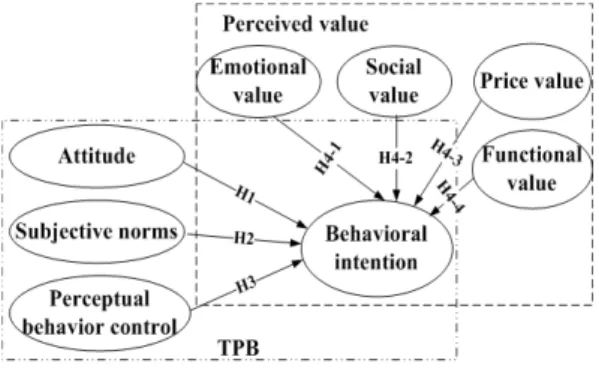
H1: AT have a significant positive effect on the purchase intention of ginseng products.

In this study, the SN for the purchase behavior of ginseng products is set to be that when consumers decide whether to purchase ginseng products, they are pressured by important others or groups such as whether they can get the support of families, friends, and colleagues.

Therefore, the hypothesis is put forward:

H2: SN has a significant positive effect on the purchase intention of ginseng products.

In this study, PBC of ginseng products was set to be the knowledge about ginseng, skills of using ginseng products, consumer payment ability and purchase of ginseng products.

Therefore, the assumption is made that:

H3: PBC has a significant positive effect on the purchase intention of ginseng products.

3.1.2 Assumptions based on perceived value

According to the four-dimensional perceived

value proposed by Sweeney and Soutar,

combined with the theme of this study, the price

value of ginseng products refers to the

perception of whether the price of ginseng

products is reasonable. The emotional value of

ginseng products refers to the feelings and

emotional states produced by customers through

ginseng products. Functional value refers to the

consumer's value perception of the quality and

efficacy of ginseng products. The social value of

ginseng products refers to the consumer's

(4)

perception of the value of enhancing social ties through ginseng products. Therefore, the assumption is made that:

H4-1: Perceptual of emotional value has a significant positive effect on the purchase intention of ginseng products.

H4-2: Perceptual of social value has a significant positive effect on the purchase intention of ginseng products.

H4-3: Perceptual of price value has a significant positive effect on the purchase intention of ginseng products.

H4-4: Perception of functional value has a significant positive impact on the purchase intention of ginseng products.

This study builds an extended model based on the planning behavior theory model as shown in the fig. 1 below.

Fig. 1. Theoretical model of purchase intention of ginseng products

3.2 Derived measurement items

This study designed a questionnaire consisting of 36 question items based on assumptions. The questionnaire was measured using the Richter five-point scale. In the planning behavior theory section, the design of the question references the measurement scale of Maloney, Ajzen, and French, Park & amp and Lessig et al.to design 17 problem items. The perceptual value measurement section references the 4-dimensional value measurement scale proposed by Sweeney and Soutar, and 19 problem items are designed in

conjunction with the study of Margaret.J.E.

Through a small range of tests and adjustments, the final determination of the subject questionnaire includes 33 questions.

3.3 Data collection methods

The survey questionnaire was distributed mainly in Yanbian, Tonghua, Ji'an, Baishan and other areas, which are main ginseng origins in Jilin Province. Two methods of online research and on-site investigation were adopted, and 496 questionnaires were collected. Remove the unqualified questionnaire, the remaining 360, the pass rate is 72.6 %. The number of scales in this study is 34, and the sample number(360) has reached a specified standard of 10 times. It can be used to explore the relationship between the variables in the new model. We use SPSS23.0 for data processing.

4. Empirical analysis 4.1 General characteristics of specimens

In terms of gender, 34.4 percent of males and 65.5 percent of females.8.89%are under the age of 25, 45.83 % are between the ages of 26 and 45, 39.45 % are between the ages of 46 and 65, and 5.83 % are over the age of 66. In the income situation, 6.1 % of the income is below 2000 yuan, 6.1 % of 2001~3000 yuan, 38.9 % of 3001~5000 yuan, 30.0 % of 5001~8000yuan, and 18.9 % of more than 8,000 yuan. Professional and technical occupations accounted for 42.2 %, entrepreneurs 11.1 %, service industries 14.4 %, civil servants 11.7 %, civil servants 6.7 %, Housewives 5.6 %, students 1.71 %, and other personnel 6.7 %. The sample is basically reasonable.

4.2 Detection factor analysis

The extraction of the determination variables

(5)

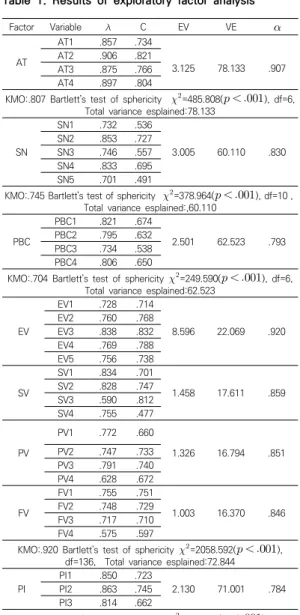
is based on the study of various factors. In order to test the rationality and credibility of the extracted variables, exploratory factor analysis and credibility analysis were carried out. As follows: Table 1.

Factor Variable λ C EV VE 

AT

AT1 .857 .734

3.125 78.133 .907

AT2 .906 .821

AT3 .875 .766

AT4 .897 .804

KMO:.807 Bartlett’s test of sphericity 

=485.808(    ), df=6, Total variance esplained:78.133

SN

SN1 .732 .536

3.005 60.110 .830

SN2 .853 .727

SN3 .746 .557

SN4 .833 .695

SN5 .701 .491

KMO:.745 Bartlett’s test of sphericity 

=378.964(    ), df=10,

Total variance esplained:,60.110 PBC

PBC1 .821 .674

2.501 62.523 .793

PBC2 .795 .632

PBC3 .734 .538

PBC4 .806 .650

KMO:.704 Bartlett’s test of sphericity 

=249.590(    ), df=6, Total variance esplained:62.523

EV

EV1 .728 .714

8.596 22.069 .920

EV2 .760 .768

EV3 .838 .832

EV4 .769 .788

EV5 .756 .738

SV

SV1 .834 .701

1.458 17.611 .859

SV2 .828 .747

SV3 .590 .812

SV4 .755 .477

PV

PV1 .772 .660

1.326 16.794 .851

PV2 .747 .733

PV3 .791 .740

PV4 .628 .672

FV

FV1 .755 .751

1.003 16.370 .846

FV2 .748 .729

FV3 .717 .710

FV4 .575 .597

KMO:.920 Bartlett’s test of sphericity 

=2058.592(    ), df=136, Total variance esplained:72.844

PI PI1 .850 .723

2.130 71.001 .784

PI2 .863 .745

PI3 .814 .662

KMO:.701 Bartlett’s test of sphericity 

=164.184(    ), df=3, Total variance esplained:71.001

Table 1. Results of exploratory factor analysis

In order to avoid multiple linearity in exploratory factor analysis, this study has used a right-angled rotation method called varimax to perform the main component analysis.

The first factor attitude exploratory factor.

The analysis results show that KMO: .807 is higher than the standard value(>.5),which is suitable for factor analysis. Bartlett's test of sphericity  = 485.808((p<.001 ), means factors are independent. The Factor Loadings λ value are between .857 ~.906(≥. 4). Commonality C value are between .734 ~. 821(≥. 4). The Eigenvalue EV is 3.125(≥ 1.0). The Variance Explained VE value is 78.133 %, which shows a higher force. The Reliability value is .907(≥

.6), which is higher than the standard value.

The second factor is subjective normative exploratory factor. The analysis results show that KMO: .745 is higher than the standard value(>.5) that is suitable for factor analysis,. Moreover, Bartlett's test of sphericity

= 378.964((p<.001 ) means factors are independent. The Factor Loadings λ value are between .701 ~.853(≥. 4).

Commonality C value are between .536~.727≥.

4). The Eigenvalue EV is 3.005(≥ 1.0). The Variance Explained VE value is 60.110%, which close to standard. The Reliability value is .830 (≥ 06), higher than the standard value.

The third factor perception behavior control exploratory factor. The analysis results show that KMO: .704 is higher than the standard value(>.5) that is suitable for factor analysis. Moreove, Bartlett's test of sphericity

= 249.590((p<.001 ) means factors are independent. The Factor Loadings value are between.734~.821(≥. 4).

Commonality C value are between.538 ~.674(≥.

4). The Eigenvalue EV is 2.501(≥ 1.0). The Variance Explained VE value is 62.523%, which shows a higher force. The Reliability value is .793(≥ .6), and Well above the norm.

The fourth factor is perceptual value

exploratory factor. The analysis result shows that

KMO : .920 is higher than the standard value(>.5)

that is suitable for factor analysis, Bartlett's test

of sphericity

=2058.562((p<.001 ) means factors

are independent. The Factor Loadings λ value are

(6)

Hypothesis

Model Unstandardized

Coefficients Standardized coefficients

t-value Sig

Independent

Variable Dependent

variable  Std.error 

AT-BI AT BI .676 .055 .676 12.250 .000

F= 150.061    ) , 

= .401,Adj. 

=.454

SN-BI SN BI .566 .062 .566 9.161 .000

F= 83.927(    ) ,

= .320,Adj. 

=.317

PBC-BI PBC BI 607 .060 .607 10.204 .000

F= 104.116(    ) ,

= .369,Adj. 

=.366

V-BI

EV

BI

.246 .089 .246 2.755 .006

SV .185 .080 .185 2.293 .023

PV .268 .085 .268 3.174 .002

FV .000 .092 .000 3.876 .998

F= 23.822(    ) ,

= .401,Adj. 

=.338 Table 2. Results of regression analysis

between .575~.838(≥. 4). Commonality C value are between .597 ~.832(≥. 4). The Eigenvalue EV are between 1.003 ~8.596(≥ 1.0). The Variance Explained VE value is 72.844%, which shows a higher force. The Reliability  are between .846~.920(≥ .6), and Well above the norm.

Specifically, affective value consists of five items.

and its Reliability is .920 and The Eigenvalue EV is 22.069 %. Social values consist of four items, and its Reliability is .859 and the Eigenvalue EV is 17.611 %. The price value consists of four items, and its Reliability is .851 and The Eigenvalue EV is 16.794%. The functional value consists of 4 items, and its Reliability is .846 and The Eigenvalue EV is 116.370%.

The fifth factor is purchase intention exploratory factor. The analysis results show that KMO: .701 is higher than the standard value(>.5) that is suitable for factor analysis. Furthermore, Bartlett's test of sphericity

= 164.184((p<.001 ) shows factors are independent. The Factor Loadings λ value are between .814~.8631(≥. 4).

Commonality C value are between .662 ~.745(≥.

4). The Eigenvalue EV is 2.130(≥ 1.0). The Variance Explained VE value is 71.001%, which shows a higher force. The Reliability value is .784(≥ .6), and Well above the norm.

4.3 Regression analysis test hypothesis In this study, multiple regression analysis and simple regression analysis were carried out to verify the effect of four factors: attitude, personal norm, perceptual behavior control and perceived value on consumer purchase intention of ginseng products. The results of the study are shown in table 2.

H1: The effect of AT on the BI of ginseng products is positive(F=150.061, p<.001, Adj.

=.454). The influence coefficient of AT on BI is . 676(

 →  

=. 676, T =12.250, p<.001), indicating that the behavior attitude has a significant positive effect on the purchase intention, assuming that H1 is verified.

H2: The effect of SN on the BI of ginseng products is positive ( F=83.927, p<.001, Adj.

= .317). The influence coefficient of SN on BI is .566(

→  

=.566, T = 9.161, p<.001), indicating that consumers' subjective norms have a significant positive impact on purchase intention. Hypothesis H2 is verified and the hypothesis is valid.

H3:The effect of PBC on the BI of ginseng

products is positive(F=104.116, p<.001, Adj.

=

.366). The influence coefficient of PBC on BI is

.607(

  →  

=.607, T = 10.204, p<.001). It

indicates that perceived behavioral control has a

significant positive impact on purchase

(7)

intention. Hypothesis H3 is verified and the hypothesis is valid.

H4: The influence data of consumer perceived value on BI of ginseng products are shown as follows: F=23.822(p<.001), Adj.

=.338.

Sub-hypothesis H4-1 EV standardized coefficient of BI =.246(

→  

=.246, T = 2.755, p<.01), indicating that emotional value has a significant positive effect on purchase intentions. Assuming that H4-1 is verified, the assumption is true.

H4-2 SV standardized coefficient = .185(

→  

=.185, T = 2.293,p<.05), indicating that SV have a positive impact on BI assuming that H4-2 is verified. H4-3 price value(PV) standardized coefficient = .266(

→  

=.266, T = 3.174, p<.01), indicating that the price value has a significant positive effect on the purchase intention.

Assuming that H4-3 is verified, the assumption is true. H4-4 functional value(FV) has significance levels that are higher than .05. Thus, it do not influence BI.

5. Conclusions

Many scholars have studied the consumption behavior of ginseng products from various aspects, but this study innovatively added the dimension of perceived value on the basis of the theory of planned behavior to explore consumers' shopping willingness to ginseng products.After empirical analysis, the following conclusions are drawn.

For consumers of ginseng products in jilin province, attitude, subjective norms and perceived behavior control are the main factors that affect the intention of ginseng products. By comparing these three factors, the influence coefficient of behavior attitude is the largest, the influence of perceived behavior norms is the second, and the influence of subjective norms is slightly lower than the other two factors. The

analysis results show that consumers with more positive attitude towards ginseng products can develop stronger behavioral intention and willingness to buy ginseng products. Consumers' opinions also have great influence on their behavioral intention to buy ginseng products. The stronger the purchasing power, the richer the product knowledge, the more convenient the purchasing conditions, and the stronger behavioral intention to purchase ginseng products.

Price value, social value and emotional value have significant impacts on the purchase intention of ginseng products. Among them, the influence coefficient of price value is the largest, the influence coefficient of emotional value is the second, and the influence coefficient of social value is slightly lower than the first two.

The results show that although ginseng products have special functions, the price factor is still the key to the purchase intention. The value perception consumers get from the feeling or emotional state of ginseng products has a great influence on purchase intention, which is also caused by people's inherent emotion towards ginseng as a famous Chinese medicine.

Consumers with higher social value of ginseng products have stronger purchasing intention. The main reason is that ginseng products are good gifts in interpersonal communication and have great social utility.The influence coefficient of perceived price value, social value and emotional value on consumers' willingness to buy ginseng products is obviously smaller than the three factors in the theory of planned behavior.

The effect of functional value perception on

purchase intention of ginseng products is not

significant. Ginseng is regarded as a precious

commodity in China. Its main purpose is to be

given as a gift. Consumers' perception of its

value is mainly reflected in the convenience of

social value and emotional value, while

functional value perception has no significant

impact on purchase intention.

(8)

REFERENCES

[1] M. R. Li. (2017). Comparative analysis of international competitiveness of Chinese and Korean ginseng industry. Doctoral thesis of jilin university.

[2] N. Y. Kim & M. J. Han. (2012) Consumer Behavior and Perception of Ginseng Products by Different Age Groups. Journal of the Korean Society of Food Culture, 27(3), 324-330.

DOI : 10.7318/KJFC/2012.27.3.324

[3] H. S. Chung, H. D. Hong, K. Kim, C. W. Cho, H. R.

Moskowitz & S. Y. Lee. (2011). Consumer attitudes and expectations of ginseng food products assessed by focus groups and conjoint analysis. Journal of Sensory Studies, 26(5), 346-357.

DOI : 10.1111/j.1745-459X.2011.00350.x

[4] N. H. Kim, I. O. Ahn, H. I. Choi & T. J. Yang. (2012).

Est-ssr marker sets for practical authentication of all nine registered ginseng cultivars in korea. Journal of Ginseng Research, 36(3), 298.

DOI : 10.5142/jgr.2012.36.3.298

[5] Y. M. Hwang, J. Moon & S. Yoo.(2015). Developing A RFID-based Food Traceability System in Korea Ginseng Industry: Focused on the Business Process Reengineering. International Journal of Control &

Automation, 8(4), 397-406.

[6] I. Ajzen. (1991). The theory of planned behavior. Organizational Behavior & Human Decision Processes, 50(2), 179–211.

DOI : 10.1016/0749-5978(91)90020-T

[7] I. Ajzen & M. Fishbein. (2005). The Influence of Attitudes on Behavior. The handbook of attitudes, 173(221), 31.

[8] X. M. Deng. (2012). A study on consumers' ethical purchase intention in the context of China - from the perspective of TPB. Nankai management review, (3), 22-32.

[9] S. S. zhang. (2012). Based on the theory of deconstruction program behavior, high star-rated hotel reception product purchase intention study. Doctoral dissertation, zhejiang university.

[10] S. Y. Hong & S. H. Cho. (2013). Explore to Use of Pod cast Through Theory of Planned Behavior : The Case of Korean Pod casting Users. Journal of Digital Convergence, 11(2) , 183-191.

DOI : http://www.earticle.net/Article/A195843 [11] Albrecht & Karl. (1992). The Only Thing That Matters,

Executive Excellence, 9 .

[12] M. Hui, & W. Jian. (2016). Research on online consumers' purchase intention from the perspective of consumer value. Heilongjiang social science 6 , 67-72.

[13] V. A. Zeithaml & L. L. B. Parasuraman. (1996). The behavioral consequences of service quality. Journal of Marketing, 60(2), 31-46.

DOI : 10.2307/1251929

[14] J. Y. Kim & K. H. Chu. (2014). The Role of Perceived Value

on the Continuance Intention in Mobile Social Network Service. Journal of Digital Convergence, 12(10) , 211-222.

DOI : http://www.earticle.net/Article/A233578 [15] A. Kumar & D. B. Grisaffe. (2004). Effects of extrinsic

attributes on perceived quality, customer value, and behavioral intentions in b2b settings: a comparison across goods and service industries. Journal of Business-to-Business Marketing, 11(4) , 43-74.

DOI : 10.1300/J033v11n04_03

[16] C. Sweeney & N. Soutar. (2001). Consumer Perceived Value:The Development of a Multiple Item Scale.

Journal of Consumer Research, 77, 203-220.

DOI : 10.1300/J033v11n04_03

백 수 나(Xiu Na Bai) [정회원]

․ 2003년 6월 : 장춘공정학원 (관리학학사)

․ 2008년12월 :길림대학 관리학원 (관 리학석사)

․ 2018년 5월 ~ 현재 : 세한대학교 경 영대학원 박사과정

․ 2003년 9월 ~ 현재 :길림공정기술사 범학원 공상관리학원 교수

․ 관심분야 : 마케팅, 기업 관리

․ E-Mail : [email protected]

정 기 영(Gi-Young Jung) [정회원]

․ 1984년 2월 : 조선대학교 공과대학 (공학사)

․ 1986년 8월 : 명지대학교 대학원 무 역학과(경영학석사)

․ 1990년 5월 : University of Bridgeport (경영학석사)

․ 1993년 5월 : Golden Gate University (경영학박사)

․ 1997년 3월 ∼ 현재 : 세한대학교 경영학과 교수

․ 관심분야 : 고객관계관리, 장소마케팅

․ E-Mail : [email protected]

김 형 호(Hyung-Ho Kim) [정회원]

․ 1989년 2월 : 경희대학교 전자계산공 학과(공학사)

․ 1992년 8월 : 경희대학교 전자계산공 학과(공학석사)

․ 2018년 2월 : 인천대학교 동북아물류 대학원(물류학박사)

․ 1998년 3월 ∼ 현재 : 세한대학교 항 공교통물류학과 교수

․ 관심분야 : 신경회로망, 항공운송, System Dynamics

․ E-Mail : [email protected]

수치

Fig.  1.  Theoretical  model  of  purchase  intention  of  ginseng  products
Table  1.  Results  of  exploratory  factor  analysis

참조

관련 문서

The purpose of this study is to analyze the effects of service quality on customer satisfaction and revisit intention perceived by Chinese golf range

In this Thesis, an empirical study on the Influence of Consumer's Preferences and Satisfaction on Purchase Intention of Korean Automobile in Vietnamese Consumers

In this study, two experiments were conducted to understand the effects of additional charge on the detailed growth mechanism of Alq 3 and to determine the effect of

The purpose of this study is to determine customer satisfaction and repurchase intentions based on various characteristics when Korean Chinese consumers actually

출처 : IAEA 발표 자료(Comprehensive inspection exercise at bulk handling facilities, “U-235 Enrichment measurements by gamma-ray spectroscopy”) 13.  Uranium

Objective: This study was conducted to identify the association between vitamin D and Sarcopenia among all adults in Korea using data from the National Health and

Also, in-depth questionnaire was conducted on 9 music teachers of middle school and 10 professional vocalists based on the analyzed singing instruction

Based on the results of survey, this study analyzed the Arban’s trumpet and comparatively analyzed its original version with its translated version.. The