†Corresponding author: Hae-Young Lee, School of Hospitality and Tourism Management, Kyungsung University, 309, Suyeong-ro, Nam-gu, Busan
608-736, South Korea, Tel. +82-51-663-4465, Fax. +82-51-627-6830, E-mail: [email protected]
The Structural Relationships among Shopping Orientation, Perceived Value, Concentration, and Purchase Intention
in Restaurant Mobile Commerce
Dong-Seok Cho, Earl L. Reid and Hae-Young Lee
†School of Hospitality and Tourism Management, Kyungsung University, South Korea
ABSTRACT
With the increasing popularity of mobile commerce, restaurant service has become one of the leading service categories. Thus, this study attempted to understand the shopping behavior of restaurant mobile consumers by focusing on their shopping orientations.
Specifically, this study investigated the structural relationships among shopping orientations, perceived value, concentration, and purchase intention in restaurant mobile commerce. Data analysis employing a structural equation approach was carried out for this study. Results revealed that, first, a consumer's shopping orientations was found to have a positive influence on perceived value, with time/convenience orientation possessing a stronger influence on perceived value than other factors (economic and hedonic). Second, a consumer's perceived value was found to affect concentration and purchase intention. Third, a consumer's concentration also appeared to influence purchase intention.
Keywords: restaurant mobile commerce, shopping orientation, perceived value, concentration, purchase intention
INTRODUCTION
In recent years, the technological development of mobile devices and the popularization of smartphones have created a new form of electronic commerce, called mobile commerce.
Based on its strength of enabling consumers to enjoy shopping with easy anywhere, at anytime, the mobile commerce market continued to prosper. In Korea, specifically, there is an in- tensification of both investment in and competition to win the mobile commerce market (Korea Internet & Security Agency, 2015). In addition to using the existing open market and Internet based social commerce, various companies such as department stores, TV home shopping, telecommunication com- panies, and Internet portal sites have also entered the mobile commerce market.
Restaurant-related services have attracted attention as one of the more popular products purchased through mobile com- merce. Underlying this contention is data provided by the Korea Internet & Security Agency (2015) revealing that 52.2
% of mobile users engage in mobile shopping, and 28.9% of
mobile shopping consumers have experienced purchasing food related products. Currently, in Korea, not only are there brand- ed applications of franchise companies such as Pizza Hut and Starbucks, but there are also numerous other applications related to restaurants that have attracted the attention of con- sumers, notably Restaurantnjoy and Wishland, and other food information portal applications, Bdtong and Yogiyo (Cho &
Lee, 2014).
Therefore, identifying and categorizing the shopping orien- tation, and establishing a marketing strategy through market segmentation, are very important for increasing business per- formance. It is based on this fact that companies are interested in the shopping orientation of consumers in order to grasp the increasingly diverse needs of consumers (Chae, 2016). Indeed, these needs are changing as the lifestyles of modern people change in response to an increase in leisure time, education, and income levels, the recent continued popularization of smartphones, and a growing orientation of consumers to buy through mobile commerce service.
Despite this importance, however, there has not been widely-
conducted research in various fields on the shopping orienta- tion of mobile commerce consumers. The food service industry in particular has only limited information on consumer shopping orientation. Existing related studies have mainly focused on understanding shopping orientation in terms of practical and functional aspects, such as information, price, and conveni- ence. As a result, there is a limitation to understanding the consumer shopping behavior in the mobile restaurant shopping context, especially since it is also necessary to consider plea- surable aspects, such as fun, pleasure, and concentration, that also act on the consumption orientation of consumers. When a comprehensive approach to shopping propensity is undertaken, a restaurant mobile environment that can provide the best service to consumers can be established (Park & Jin, 2007).
This study thus attempts to gain a deeper understanding of the shopping behavior of restaurant mobile commerce con- sumers by examining various types of consumer shopping orientations. Time/convenience, economic, and hedonic have been suggested by this study as three important shopping orientations. The structural relationships between these three shopping orientations and perceived value was examined, with concentration and purchase intention as expected outcome variables. By verifying the shopping orientations and outcomes of restaurant mobile commerce consumers, this study will be useful in understanding the shopping behaviors of mobile consumers, and will suggest various management implications to the restaurant industry.
THEORETICAL BACKGROUND
Consumer Shopping Orientation
Rapid technological development and globalization that breaks barriers between countries continue to rapidly change the way people live in a modern society. As a result, iden- tifying and understanding the trends of rapidly changing consumers, and providing products and services that meet those needs have become an integral part of a company’s marketing strategy. First, shopping orientation is a specific lifestyle of shopping that incorporates interests and opinions in the shopping activities of consumers related to economic, social, and leisure activities (Shim & Kotsiopulos, 1992). In addition, shopping orientation can be defined by a style that
shows a comprehensive attitude and behavior related to sho- pping, or a certain reaction including an individual's internal values related to shopping (Ju & Lee, 2015).
Various research has long been engaged in attempting to grasp the shopping orientation of consumers, and to segment the market and establish a marketing strategy for companies.
For example, Brown, Pope, and Voges (2001) classified con- sumer shopping orientations into hedonic, convenient, and price-oriented, and examined the influence of various shopping tendencies on purchase intention. Hwang and Yang (2006) suggested clothes shopping to be hedonic, time/convenience, and price conscious shopping orientations. Tai (2008) also classified consumers into 3 types, self-satisfaction, pleasure, and economic, in an exploratory study of the shopping orien- tation of Chinese consumers. Yang (2010) examined the causal relationship between attitudes toward mobile shopping and purchasing behavior by categorizing the shopping propensity of US mobile consumers as practical or hedonic. In addition, Kim and Park (2010) examined differences in consumer sa- tisfaction by classifying consumer shopping orientation as hedonic, economic, and convenient.
Consumer shopping orientation vary slightly in accordance with academic field and researcher’s standards, but generally shopping orientation can be classified into utilitarian aspects such as convenience and price, and hedonic aspects, such as fun and pleasure (Brown et al., 2001). The time/convenience shopping orientation is one that pursues convenient and rea- sonable purchasing with less time and effort expended in the process of shopping. Li, Kuo and Russell (1999) argued that the time/convenience shopping orientation positively affects the ongoing purchase of online shopping mall consumers. Swa- minathan, Lepkowska, and Rao (1999) also pointed out that consumers frequently visit online shopping malls and purchase goods due to the value they place on time and convenience.
It is generally acknowledged that consumers prefer online
shopping to offline shopping because of convenience and time
saving. Economic shopping orientation has been defined in
such terms as price discount oriented, low price oriented, and
price value oriented. Consumers with a price shopping orienta-
tion place the highest value on price. In general, price is the
most important factor that determines the purchasing behavior
of such consumers. Yang (2010) found that the price orientation
is the main stimulus of online and mobile shopping. Lim and Na (2005) also argued that consumers have to pay the price set for the product in order to purchase it, which affects the image formation and purchase intention for the product or service.
The hedonic shopping orientation has been treated as a concept that contrasts with time-oriented or price-oriented shopping orientation. Consumers with a hedonic shopping orientation tend to get fun or enjoyment from the shopping activity itself rather than the efficacy or price of the product to be purchased (Han & Koh, 2001). In addition, these con- sumers enjoy shopping as a leisure activity, do not become conscious of price, actively participate in information search activities, and spend a good deal of time shopping. In this regard, Brown et al. (2001) attempted to gauge the shopping behavior of online consumers by focusing on the hedonic shopping orientation. Nam and Kim (2003) analyzed the diffe- rences in shopping value among female college students by dividing their shopping orientations into hedonic and conveni- ent. Seock and Bailey (2007) analyzed consumer's information searches and purchasing behaviors from the hedonic shopping orientation perspective. Kim and Ha (2011) showed differen- ces in brand preference between utilitarian and hedonic shopping shoppers.
Perceived Value
In general, perceived value is the overall assessment of the consumer’s attitude toward the product or service that the consumer receives during the purchase process (Lee, 2016;
Zeithaml, 1988). In other words, the consumer perceives the value of the product in comparison with the cost, time, and effort for the product or service paid by the user during the purchase of the product. Mittal and Sheth (2001) argued that all interaction that occurs in the human consumption process is due to value, not money, and that understanding a con- sumer’s perceived value is the core of corporate marketing strategy. Compared to existing offline shopping, the mobile commerce environment makes it easier to compare product prices or services. Consumers are now able to compare more products with less effort in the purchase process, and the significance of perceived value is increasing due to the re- duced search costs for consumers using mobile commerce
(Anderson & Srinivasan, 2003).
The role of service value perceived by consumers has been understood in various aspects, such as consumer satisfaction, attitude, and purchase intention (Dodds, Monroe, & Grewal, 1991; Parasuraman & Grewal, 2000). For example, Kim and Oh (2000) reported that the service value of consumers has a positive effect on repurchase intention, while Son and Joo (2008) point out that perceived value of hotel customers affects customer satisfaction. Kuo, Wu, and Deng (2009) examined the positive effects of perceived value of mobile commerce consumers on consumer satisfaction and purchase intention.
The service value of perceived service has constantly attracted attention in the food service field in particular. Suh and Ahn (2012) revealed that the service value of seafood restaurant customers has a significant influence on service conversion cost and customer loyalty. Choi and Lee (2012) investigated the effects of the perceived value of eco-friendly restaurant consumers on customer satisfaction and service loyalty. Ryu, Han, and Kim (2008) also confirmed that the perceived value of fast-food restaurant customers positively influences customer satisfaction and behavioral intentions.
Concentration
In general, concentration has a lexical meaning of pouring
all the power on one thing. Moon and Kim (2001) explained
that when a person is in a particular situation, the person’s
attention will become focused on that activity. The focus of
the convergence is narrowed to a limited range of stimulation,
and irrelevant thoughts and perceptions are filtered. In other
words, a person can concentrate on the situation to such an
extent that consciousness of other concerns is lost and certain
behaviors are engaged. As the experience of a consumer’s im-
mersion is developed for various purposes in a wide range of
fields, studies have been carried out to identify the components
of immersion as a composite concept, composed of various
components. First, Koufaris (2002) explained the immersive
experiences of consumers in online environment through the
three factors of enjoyment, control, and concentration. Wang
and Liao (2008) added factors such as playfulness and curi-
osity. Various studies have been conducted including factors
such as time distortion (Guo & Klein, 2009) and concentrated
immersion (Agarwal & Karahanna, 2000). The components of
immersion have been dealt with in various ways according to the characteristics of the academic field and the viewpoint of the researcher. However, in general, fun and concentration are the most commonly used concepts.
In recent years, online communities, blogs, and cafes, which were once PC-based, have become linked to smartphones, as well as various SNS sites and mobile commerce. Consumer engagement in the mobile environment has become an increa- singly important issue, and attempts to understand its role have been made in various areas such as travel, airline, hotel, convention, and dining out (Jin & Jang, 2016). In restaurant mobile shopping, customer engagement plays an important role in the continuous purchases by consumers. Furthermore, given the increasing number of consumers who perceive sho- pping activities as leisurely and hobby-like, it seems apparent that the convenience of mobile commerce shopping is suffi- cient to draw the attention of consumers.
RESEARCH METHODS
Research Hypothesis
Shopping orientation is a concept that represents a compre- hensive style of psychological, cognitive, and behavioral aspects that occur in the purchase process of consumers. By possessing an understanding of the shopping behavior of consumers, providing appropriate products and services plays a major role in raising the value consumers have for the companies and products (Na & Suh, 2007). The perceived value of a con- sumer is an overall assessment that compares the time, cost, and time to pay for goods, services, and purchases (Zeithaml, 1988). Much research has been conducted to examine market segmentation or purchase behavior according to consumer ori- entation (Hawkins, Best, & Coney, 2001). First, Chae (2016) found that various consumer shopping orientations have a positive effect on the perceived value. Na and Suh (2007) also found that the effect of shopping orientation on consumers’
perceived value of mobile shopping. Therefore, this study hy- pothesized that the time/convenient, economic, and hedonic shopping orientations of restaurant mobile commerce consu- mers will positively affect consumer perceived value.
H1. Time/convenience shopping orientation of a restau-
rant mobile consumer will have a positive influence on his/her perceived value.
H2. Economic shopping orientation of a restaurant mo- bile consumer will have a positive influence on his/
her perceived value.
H3. Hedonic shopping orientation of a restaurant mobile consumer will have a positive effect on his/her per- ceived value.
Compared to the existing offline shopping environment, it is possible to compare the price of goods with the service more easily in a mobile environment, and the value of perceived value to consumers is becoming increasingly important. The positive value generated by consumers is more focused on mobile commerce, which leads to frequent visits and plays a positive role in purchasing products. The relationship between perceived value and purchase intention has been tested several times in previous studies (Dodds, Monroe, & Grewal, 1991;
Parasuraman & Grewal, 2000). For instance, Kim and Song (2010) have proved that the perceived value of consumers in a coffee shop makes them more focused on the brand. Kim, Kwon, and Seo (2009) have found that the perceived value of online travel club members increases their concentration on travel products. Therefore, this study assumed that the percei- ved value of restaurant mobile commerce consumers will po- sitively affect both the concentration and purchase intention of consumers, and established the following hypotheses.
H4. The perceived value of a restaurant mobile consumer will have a positive impact on his/her concentration.
H5. The perceived value of a restaurant mobile consumer will have a positive impact on his/her purchase in- tention.
Consumer concentration has been viewed as an important
component of the concept of flow and has been studied in
a variety of disciplines to examine human behavior (Koufaris,
2002). Lu, Zhou, and Wang (2009) found that the concentra-
tion experienced by SNS messenger consumers had a positive
effect on their purchase intention. Lee, Park, and Kim (2001)
explained that the intensive experience of Internet consumers
plays a role in increasing purchase intention. Therefore, this
study concluded that the concentration of restaurant mobile commerce consumers will have a positive effect on purchase intention.
H6. The concentration of a restaurant mobile consumer will have a positive impact on his/her pur chase intentions.
Measurement
All of the measures used in this study were modified from previous studies by the researcher in accordance with the context of restaurant mobile commerce. All items except for questions about the general use of mobile commerce and que- stions related to demographic characteristics were answered on a scale from 1=‘strongly disagree’ and 5=‘strongly agree’.
In particular, the shopping orientation of restaurant mobile commerce consumers was selected from 3 items of time/
convenience, economic, and hedonic shopping propensity used in Seock and Bailey’s (2007) study. Based on the research by Anderson and Srinivasan (2003), and Chang, Wang, and Yang (2009), perceived value was composed of 1 item and concentration was based on the research of Zhou, LI, and Liu (2010). Lastly, purchase intention consists of 2 items based on the research of Cyr, Hassanein, Head, and Ivanov (2007).
Data Collection
The data for this study was collected through an online survey agency (http://www.esurvey.kr) from consumers who have actually used restaurant mobile commerce. The final que- stionnaire was completed after collecting and revising opinions on the fitness and composition of the questionnaire through a preliminary survey. The survey was conducted over 10 days from May 12, 2014 to May 21, 2014. Of the total 336 que- stionnaires collected, 15 responses were excluded due to being incomplete or untruthful, rendering 321 questionnaires for use as the sample for the final analysis. The demographic characte- ristics of the respondents used in this study are as follows. The sample of 316 respondents was 48.1% Male (152 respondents) and 51.9% Female (164 respondents). The age distribution was 21.2% (67 respondents) in the 20 ∼29 range, 35.8% (113 res- pondents) in the 30 ∼39 range, 31.6% (100 respondents) in the 40 ∼49 range, and 10.1% (32 respondents) over 50 years of
age. With regard to education level, most respondents had completed university (186 respondents).
Analysis Methods
The collected data were analyzed for structural equation modeling (SEM), which is employed to verify the fitness of a research model and hypothesis testing, for which the stati- stical program LISREL 8.5 was used. SPSS 22.0 for Windows statistical package program was also used to begin data ana- lysis by examining the demographic characteristics of the respondents, and the general use of restaurant mobile commerce.
In order to ensure the validity and reliability of the proposed measures, the measurement model was confirmed through a confirmatory factor analysis and structural models were tested in order to verify the proposed hypotheses (Anderson & Ger- bing, 1988).
RESULTS
Measurement Model
The factor structure of consumer shopping orientation was first compared with a three factor model of shopping orienta- tion and a one factor model in and effort to clarify the detailed dimensions. Measurement models were compared by focusing the differences in Chi-square values and degrees of freedom (Jöreskog & Sörbom, 1993). Results (Δχ
2=423.68) showed that the three-factor model (χ
2=85.15, df=24) was more suitable than the one-factor model (χ
2=508.83, df=27) Therefore, consumer shopping orientation can be understood to be multidimensional (time/convenience, economic, hedonic) rather than as a single dimension.
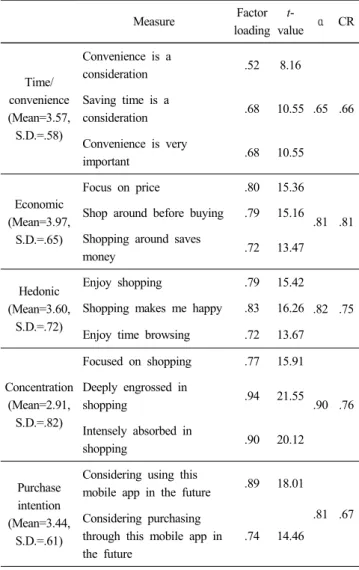
As shown in Table 2, fit indices of the measurement model was good (χ
2=182.91, df=76, p<.001; RMSEA=.07, CFI=.97, IFI=.97, NNFI=.95). The factor loadings of the variables for the measurement concept were all over .52 and the lowest t-value was found to be 8.16 (p<.001), indicating that the con- vergent validity was high. For the reliability of the constructs, the composite reliability was over .66, and the Cronbach’s alpha was also .65 or higher. The internal consistency of the detailed variables was also verified.
Structural Model
Table 1. The comparison of the proposed model and the alternative model
Model fit
χ
2 dfSRMR GFI CFI IFI
3-factor model 85.15 24 .08 .94 .94 .94
1-factor model 508.83 27 .16 .74 .60 .60
Table 2. Results of the confirmatory factor analysis
Measure Factor
loading
t-value α CR
Time/
convenience (Mean=3.57,
S.D.=.58)
Convenience is a
consideration .52 8.16
.65 .66 Saving time is a
consideration .68 10.55
Convenience is very
important .68 10.55
Economic (Mean=3.97,
S.D.=.65)
Focus on price .80 15.36
.81 .81 Shop around before buying .79 15.16 Shopping around saves
money .72 13.47
Hedonic (Mean=3.60,
S.D.=.72)
Enjoy shopping .79 15.42
.82 .75 Shopping makes me happy .83 16.26 Enjoy time browsing .72 13.67
Concentration (Mean=2.91, S.D.=.82)
Focused on shopping .77 15.91
.90 .76 Deeply engrossed in
shopping .94 21.55
Intensely absorbed in
shopping .90 20.12
Purchase intention (Mean=3.44,
S.D.=.61)
Considering using this
mobile app in the future .89 18.01 .81 .67 Considering purchasing
through this mobile app in the future
.74 14.46
χ
2=182.91(df=76, p<.001), RMSEA=.07, CFI=.97, IFI=.97, NNFI=.95
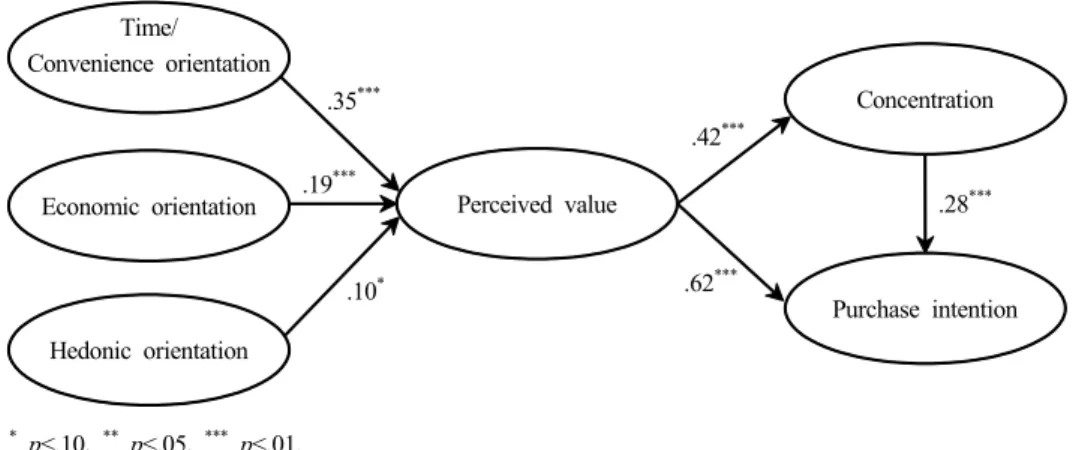
As shown in Table 3, fit indices of the structural model were also good (χ
2=231.61, df=82; RMSEA=.08, CFI=.95; IFI
=.95; NNFI=.93). All the structural relations of the research model proposed in this study are confirmed as significant. Spe- cifically, time/convenience (γ=.35, p<.01), economic (γ=.19, p<.01), and hedonic (γ=.10, p<.10) were all significantly rela-
Table 3. Results of structural model
Path Standardized
coefficients
t-valueTime/convenience → Perceived value .35 5.22
***Economic → perceived value .19 3.05
***Hedonic → perceived value .10 1.65
*Perceived value → concentration .42 7.49
***Perceived value → purchase intention .62 12.54
***Concentration → purchase intention .28 5.40
***χ
2=231.61(df=82, p<.001), RMSEA=.08, CFI=.95, IFI=.95, NNFI=.93
* p<.10, ** p<.05, *** p<.01.
ted with perceived value, thus supporting H1, H2, and H3.
In addition, the relationships between perceived value and concentration (β=.42, p<.01), and between perceived value and purchase intention (β=.63, p<.01) were also positively related, thus supporting H4 and H5. Lastly, the relationship between concentration and purchase intention (β=.28, p<.01) was shown to be a statistically significant positive relation- ship, allowing for H6 to also be adopted.
DISCUSSION AND CONCLUSIONS
Considering the rapid growth of the restaurant mobile commerce market, this study examined restaurant mobile con- sumer shopping behavior based on their shopping orientations.
To this end, consumer shopping orientations were subdivided into time/convenience, economic, and hedonic shopping orien- tations, and structural relationships among the three shopping orientations, perceived value, concentration, and purchase intention were proposed. By seeking a better understanding of restaurant mobile consumer shopping orientations, this study seeks to provide more comprehensive information on the shop- ping behavior of restaurant mobile consumers.
Regarding the academic contributions, first, this study con-
firmed that a consumer’s shopping orientation, which has been
proven in the online context, can also be applied to the mobile
context. A consumer's shopping orientation influenced percei-
ved value, concentration, and even purchase intention. Thus,
under the condition that mobile commerce exceeds e-commerce
market size, specified shopping orientation can be used as a
.35
***.19
***.10
*.62
***.42
***.28
***Time/
Convenience orientation
Economic orientation
Hedonic orientation
Perceived value
Concentration
Purchase intention
* p<.10, ** p<.05, *** p<.01.