1. Introduction
In cities, runoff from storms is widely known to degrade water quality by altering delicate hydrological patterns in the following ways: accelerated flow, disturbed ecological habitats, and increased load and concentrations of waterborne pollutants (USEPA,
2000). Urbanization can exacerbate these problems by increasing the total area of impervious surface over which stormwater flows, and urban landscapes are characterized by complex spatial heterogeneity including differ land uses and land covers (Wu et al., 2011). Research has repeatedly demonstrated that there is a strong positive relationship between the extent of
Urbanization and Quality of Stormwater Runoff:
Remote Sensing Measurements of Land Cover in an Arid City
Min Jo Kang*
†, Victor Mesev* and Soe W. Myint**
*Department of Geography, Florida State University
**School of Geographical Sciences and Urban Planning, Arizona State University
Abstract : The intensity of stormwater runoff is particularly acute across cities located in arid climates.
During flash floods loose sediment and pollutants are typically transported across sun-hardened surfaces contributing to widespread degradation of water quality. Rapid, dense urbanization exacerbates the problem by creating continuous areas of impervious surfaces, perforated only by a few green patches. Our work demonstrates how the latest techniques in remote sensing can be used to routinely measure urban land cover types, impervious cover, and vegetated areas. In addition, multiple regression models can then infer relationships between urban land use and land cover types with stormwater quality data, initially sampled at discrete monitoring sites, and then extrapolated annually across an arid city; in our case, the city of Phoenix in Arizona, USA. Results reveal that from 30 storm event samples, solids and heavy metal pollutants were found to be highly related with general impervious surfaces; in particular, with industrial and commercial land use types. Repercussions stemming from this work include support for public policies that advocate environmental sustainability and the more recent focus on urban livability. Also, advocacy for new urban construction and re-development that both steer away from vast unbroken impervious surfaces, in place of more fragmented landscapes that harmonize built and green spaces.
Key Words : Stormwater runoff, Spectral Mixture Analysis (SMA), Water quality, Urbanization, Land use, Imperviousness
Received May 31, 2014; Revised June 9, 2014, Revised June 25, 2014; Accepted June 25, 2014.
†
Corresponding Author: Min Jo Kang ([email protected])
This is an Open-Access article distributed under the terms of the Creative Commons Attribution Non-Commercial License
(http://creativecommons. org/licenses/by-nc/3.0) which permits unrestricted non-commercial use, distribution, and reproduction in
any medium, provided the original work is properly cited
imperviousness and the volume of urban stormwater runoff; as well as a strong negative relationship between the area of imperviousness and stormwater quality (inter alia Arnold and Gibbons, 1996; Adams and Papa, 2000; Brabec et al., 2002; Tong and Chen, 2002; Lee and Heaney, 2003; Dougherty et al., 2004;
Carlson, 2008). Another consensus view is that predominantly flat impervious surfaces increase the amount of time that rainfall remains on the surface as runoff and reduces the rate of infiltration into the soil (USEPA, 2003). In addition to pollutants, such as oil, solvents, solids and heavy metals carried by stormwater runoff, studies have further demonstrated that discharges from storm drain systems often include waste and wastewater from non-point sources, referred to as illicit discharges. This results in untreated discharges contributing to elevated overall loads of organic and inorganic pollutants and pathogens (Lopes et al., 1994; UESPA, 2000; Brezonik and Stadelmann, 2002; Brattebo and Booth, 2003; Gobel et al., 2007;
Carlson, 2008). The link between widespread impervious surfaces_which tend to increase surface stormwater runoff and degrade the quality of water_is now widely established in the literature. What is also recognized is that rapid urbanization leads to more urban land being used for residential, commercial and industrial activities, and conversely fewer and smaller biophysical spaces (natural and undeveloped land composed mostly of vegetation and exposed soil) (Simon et al., 2009; Xiao et al., 2012). Commercial and industrial land use types tend to be more likely sources of pollutants than biophysical spaces, while low density residential land uses are less likely _ despite the widespread use of lawn fertilizers in many suburbs.
Particularly, key urban sources of heavy metal include building roofs, pavements, road dusts, agricultural support industries, chemical and associated produce manufacturing, commercial livestock processing industries, metal product manufacturing, meter processing manufacturing, motor vehicle service
facilities, and catchment soil quality, etc (Davis et al., 2001; Kennedy and Sutherland 2008; Wicke et al., 2012).
However, where more research is still required is on techniques that measure surface imperviousness quickly, more precisely and not by rigid categorical land use distinctions but on a sliding scale of imperviousness. To attempt this more continuous representation of urban imperviousness consider ground-based surveys, published maps and aerial photographs, which have traditionally been used to delineate land use and land cover types. These sources are collected sporadically, can be expensive and demand skilled manual interpretation. As a viable alternative, multispectral data captured by satellite remote sensors are a rapid and relatively cheaper means with which to not only calculate graded mixtures of impervious and biophysical land surfaces across the whole urban area (Liu et al., 2010) but also contribute to landscape ecology identification and landscape pattern analysis (Shao and Wu, 2008). In addition, Kim et al. (2013) applied hydrological modeling using high resolution multi-satellite precipitation analysis.
Moreover, satellite sensor images are digital and can
be analyzed using a variety of statistical methods. One
suite of calculations relies on spectral mixture models,
used widely by geospatial scientists to estimate
continuous ranges of land cover variability in the urban
landscape given known pure classes (Wu and Murray,
2003; Myint and Okin, 2009). Spectral Mixture
Analysis (SMA) models have been used to derive the
fractional contribution of endmember materials to
image spectra and monitor urban environments of
measuring water quality (Weng, 2012) and to classify
forest area in more detailed spatial scale (Song et al.,
2014). Additionally, Multiple Endmember Spectral
Mixture Analysis (MESMA) is constructed an
endmembers from candidate image and reference
endmembers as considering all combinations of library
endmembers of SMA model for the best-fit model
(Powell et al., 2007). Different approaches using spectral, spatial and temporal variability have been used to drive soft classification such as fuzzy theory and other sub-pixel mapping (Weng, 2010). In addition, the normalized difference vegetation index (NDVI) is a simple yet robust metric that calculates the abundance of chlorophyll in growing vegetation (Jiang et al., 2006) and characterize patterns of variation in time series data and track changes in vegetation cover (Jung and Change, 2013). Together these techniques can routinely, at high levels of accuracy and precision, measure pure and subtle combinations of impervious and biophysical surfaces. Such output is critical in calculating, with any degree of scientific rigor, the precise relationship between imperviousness and stormwater quality using inferential statistics, such as multiple regression models. Indeed the use of remote sensing, geographic information systems (GIS) and spatial statistics for measuring urbanization and urban hydrological interruptions is gaining momentum with researchers (Cruise et al., 2010).
Applications using medium spatial resolution data from Landsat TM satellite sensors are reported by Carlson (2004) while high spatial resolution sensors onboard the satellites IKONOS and QuickBird were investigated by Goetz et al. (2003) and Thanapura et al. (2007) respectively. Ganbaatar and Lee (2014) refined the spatial characteristics of crop lands using Landsat TM. Furthermore, laser-based LiDAR (light detection and ranging) data are an exciting new development that allows even finer precision for measuring detention basins (Liu and Wang, 2008;
Bailang et al,. 2010; Shin et al., 2014). Once measured by remote sensing, GIS and spatial statistics are critical for the rigorous analysis of how urban surfaces affect water flow and quality (see early work by Coroza et al., 1997 and a review by Martin et al., 2005). Most research focus on linear relationships (for example, Thanapura et al., 2007; Jat et al., 2009), but some develop stochastic modifications (see Adams and Papa,
2000), and even simulated flow (Tong and Shen, 2002).
In sum, remote sensing is quickly establishing a major role for collecting objective and current data on urban land use and urban land cover. These data are then analyzed to measure mixtures of impervious and biophysical (mostly vegetation and soil) surfaces that can be used to represent any city, but cities in arid areas are particularly prone to flash floods and frequent stormwater activity. One such arid city is Phoenix in the US state of Arizona, which is used as a test site to statistically explore the degree to which topographic factors _ surface imperviousness, vegetation coverage and drainage basin areas _ affect the levels of pollutant loads suspended in stormwater across an entire desert city. For dry-weather stormwater drainage planning, preparing for periodic drought and resultant strict water conservation and reuse are all critical factors (Pitt and Clark, 2008). In doing so, broader planning implications are explored for deciding on the types, quantities, spatial configuration and densities of construction, road paving and green space that may be developed in an arid city with respect to how these zones impact on the discharge and quality of stormwater. There seems to be a dearth of this type of research on cities located in the world’s arid zones. One notable contribution is of Nouh and Al-Noman (2009) who used applied regression models for the prediction of stormwater water quality in conjunction with dust storms in the Middle East.
We end with a discussion on the debate of how rapid and dense urban over-development can result in vast tracts of continuous impervious surfaces and hence exacerbate the runoff problem in a desert city. Also, how policies that advocate mixed land uses perforated by biophysical spaces are likely to lead to more reduced dispersion of water-borne pollutants.
These echo the recommendations of Thurston et al.
(2003) who advocate a ‘tradable allowance’ for
impervious surfaces; Brattebo and Booth (2003),
Conway (2007), and Schiff and Benoit (2007) on the
balance between quality and quantity of ‘permeable pavements;’ and even Carter and Jackson (2007) and Butler and Davis (2011) on more vegetated roofs. The debate can be widened to incorporate notions of environmental sustainability and urban livability; both underscored by ecological analogies of the ‘extended metabolism model,’ which balances resource inputs with waste outputs (Newman, 1999; Slavin, 2011), and the ‘carrying capacity,’ which is the population that a given habitat can support (Wedding and Crawford- Brown, 2007). Ultimately, the search is for a balance between quality of life, environmental habitat tolerance and economic progress (van Kamp et al., 2003). But for now the general consensus is on heterogeneous land use zoning policies, fragmented impervious surfaces interspersed with green patches, and a curb on expanding residential lot sizes (Stone and Bullen, 2006).
2. Study Area and Data
The Arizona city of Phoenix is one of the fastest growing in the United States. From approximately
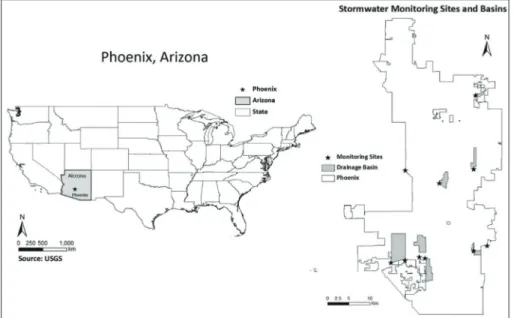
100,000 in 1950 it grew to just under one million by 1990 and to 1.45 by 2010 on 474 square miles (US Census Bureau, 2010) (Fig. 1). Phoenix is an example of an urban area located in a warm and arid climatic zone where temperatures frequently exceed 38°C and the mean annual precipitation is typically between 16 and 20 cm, yet its proximity to elevated terrain contributes to some topographic heterogeneity. Indeed, the anomalous ridge pattern of Arizona’s mountains is partly responsible for severe storms in the central part of the state, as well as dust storms throughout Arizona.
For Phoenix this produces rainfall patterns that are typically variable with localized thunderstorms during the summer months producing flash floods and substantial runoff. Conversely, winter storms, which may last longer, are normally at lower intensities.
The City of Phoenix has seven outfall stormwater monitoring sites by the Flood Control District of Maricopa County (FCDMC) and are composed of seven outfall locations (discharges from a sewer, drain or stream) (Fig. 1). The outfall locations measure stormwater pollutant concentrations; a storm event is defined as more than 0.1 inches of rainfall occurring during at least 72 hours after the previous storm event
Fig. 1. Study Area: Phoenix, Arizona.
(City of Phoenix, 2005). Our analyses are based on storm event datasets and measures individual stormwater pollutant concentrations for the city. Data on stormwater pollutant concentrations are derived from 30 samples taken from the ten outfall locations between July 2002 and June 2007, and include biochemical oxygen demand (BOD
5), total dissolved solids (TDS), total suspended solids (TSS), phosphorus, and oil and grease (all measured in mg/L);
and copper (Cu), zinc (Zn), and lead (Pb) (all measured in μg/l). Additionally, each storm event data includes land use data: acre size of industrial, commercial, residential, and undeveloped area. We calculated the percentage of various land use types based on acre sizes of each land use and drainage basins. The analysis is limited to the three in stream and seven outfall sites, which means that some hydrological basins are not directly monitored. Although a relatively small number of samples the ten sites are well distributed across the city, and in terms of land use and land cover, two of the seven outfall sites are located on industrial land, two on commercial, and one each for residential, agricultural and undeveloped.
In addition to data on stormwater quality, a remotely sensed image taken by the Landsat-5 Thematic Mapper (TM) satellite sensor on March 8, 2005 is used to measure the impervious and biophysical surfaces of Phoenix (Fig. 1). Landsat TM images offer global coverage, are sampled at a 30 m spatial resolution, and are routinely classified for many applications into broad land use and land cover categories, such as urban, commercial, residential, vegetation, etc. Their capacity to represent surface properties at multiple spectral wavelengths, including a thermal range, allows techniques such as spectral mixture analysis and the normalized difference vegetation index (NDVI) to measure mixtures of imperviousness and vegetation cover. However, medium spatial resolution remotely sensed data, such as those recorded by the Landsat TM sensor typically result in low classification accuracies
when used to interpret the complex arrangement of heterogeneous land cover types that are characteristic of urban areas. Slightly finer spatial resolutions, for example using 10 m data from SPOT sensors (see early work by Morgan et al., 1993), can improve classification accuracy, but only over the last decade have imagery at scales of a few meters or even sub meter resolutions been able to represent spatially distinct urban detail. However these finer spatial resolution images are data-heavy, require matching of multiple scenes to capture the entire city, and in any case contain excessive spectral noise which ultimately renders classification accuracies almost as low. Even finer spatial resolutions, associated with light detection and ranging (LiDAR) data, are also excellent at delineating topographic depressions in watersheds (Liu and Wang, 2008), but such surface variations at micro scales are not normally known to alter stormwater runoff patterns.
Instead the data we use from the Landsat TM multispectral sensor are more suited for calculating the entire range of impervious and biophysical surfaces across an entire city. We follow Carlson (2004) lead in using Landsat TM sensor data in conjunction with runoff measurements and an urban growth model to estimate impacts on future water quality.
However, we also investigate individual water
pollutants (solids and heavy metals) with respect to a
broader range of explanatory variables using inferential
models. Moreover, we use a fine spatial scale resolution
image at a 2.4 m resolution (taken by the QuickBird
sensor on July 11, 2005) to calibrate the Landsat TM
image. This is common practice in remote sensing
where the clarity of a finer scale image is used as
ground truth in lieu of field samples. Lastly, pollutant
data and remotely sensed data are linked with other
information on climatic and demographic
characteristics. In terms of affected population, census
data are collected from the US 2010 Census Bureau at
the block level.
3. Methods and Analysis
The premise is that the land use and land cover of an urban area affect the proportion of rainfall that remains as surface runoff. Also, that the types of land use is a major contributing factor to the volume and variety of pollutants. Remotely sensed data are well suited to represent land use and land cover types because they represent whole cities consistently and can be collected at frequent time intervals. They can also be analyzed by techniques that classify them into thematic land use and land cover categories and by techniques that measure the continuum of the surface characteristics they represent. The latter is particular important because there are two techniques that measure the continuum of proportions of impervious surface and the continuum of vegetation cover. Spectral mixture analysis and the normalized difference vegetation index are used to measure these proportions respectively.
Spectral mixture analysis is one of the more promising techniques used to improve the interpretation of satellite imagery representing urban surfaces (Wu and Murray, 2003; Myint and Okin, 2009). It is a sub pixel statistical model that alleviates intrinsic high radiometric inseparability _ characteristic of urban reflectance as measured by remote sensors _ by calculating the level of mixing between two or more urban land use or land cover categories. This includes calculating the amount of impervious surface an image pixel represents based solely on its spectral reflectance.
The model relies on endmembers (pixels that represent spectrally pure land use or land cover classes) between which a linear relationship is fitted using the following notation,
R
b= f
iR
ib+ e
b(1) This is where R
bis the spectral reflectance for each image band b of a pixel, n is the number of endmembers, f
iis the fraction of an endmember i, R
ibis the spectral reflectance of endmember i in band b, and
e
bis a non-modeled residual (1). Endmember selection is an important step and if flawed will lower classification accuracy. Commonly, calculation of the minimum noise fraction and the pixel purity index are used to select endmembers. The minimum noise fraction in particular helps separate excess noise by determining the true or inherent dimensionality of the endmember data (Wu and Murray, 2003). Endmember fractions are calculated by spectral mixture analysis from the four endmembers of vegetation (agriculture, golf courses, grass and other types of green areas), dark impervious (such as asphalt), bright impervious (such as concrete), and soil using spectral data from the Landsat TM sensor image representing Phoenix.
Vegetation and soil are consistent with known vegetated and soil areas. However, because of severe spectral similarity endmembers for dark and bright impervious surfaces separately cannot be directly interpreted from the satellite sensor image. Instead, fractions of total imperviousness represented by each pixel can be calculated by adding the fractions of dark impervious and bright impervious end members using the Wu and Murray (2003) model as follows, R
imp.b= f
darkR
dark.b+ f
brightR
bright.b+ e
b(2)
This is where R
imp.bis the reflectance spectra of impervious surfaces for band b, and f
darkand f
brightare the fractions of dark impervious and bright impervious respectively. R
dark.band R
bright.bare the reflectance spectra of dark impervious surfaces and bright impervious surfaces for band b respectively, and e
bis again the residual (2). From Fig. 2, high fractions of impervious surfaces are located around the urban center, medium levels in dense residential areas, and the lowest in intermittent residential areas.The hypothesis that higher levels of surface imperviousness increase the volume of stormwater runoff, and hence pollutant dispersion across a city. Conversely, abundant vegetation cover facilitates water absorption and helps to reduce urban stormwater runoff.
Σ
n i = 1Where spectral mixture analysis is used to measure imperviousness, the Normalized Difference Vegetation Index (NDVI) is employed to calculate spectral reflectance associated with vegetation cover. The NDVI is an established technique widely used in remote sensing, and is a ratio between two wavelength
bands; the near infrared, which records high reflectance of actively growing vegetation rich in chlorophyll, and the red band which records much lower reflectance (Jiang et al., 2006). Fig. 3c illustrates the result of the NDVI analysis applied to the Landsat TM image of Phoenix. Notice the bright pixels which illustrate the Fig. 2. Results of Spectral Mixture Analysis of the Landsat TM Sensor Image: (a) Impervious surface, (b) Vegetation, and (c) Soil.
(a) (b) (c)
Fig. 3. Landsat TM Sensor Image: (a) Red Band, (b) Near Infrared Band, (c) NDVI.
(a) (b) (c)
location of high vegetation cover; this can be contrasted with the less vivid images of the red band (Fig. 3a) and the near infrared band (Fig. 3b).
The QuickBird image used to test the accuracy of the classified results. As noted earlier, the QuickBird image acts as a convenient source for ground truth;
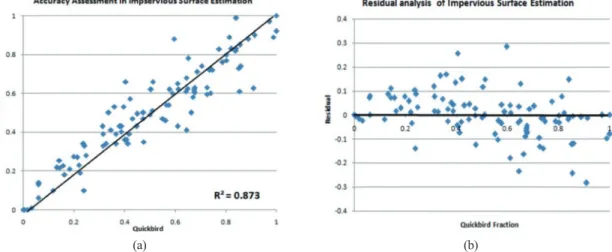
finer scaled to identify the spatial configuration of surface properties but because of high data volume the image covers only a small section of Phoenix. A simple ISODATA classification of the QuickBird image produced classes of impervious surfaces, vegetation, soil, and also water bodies. These are rescaled from 2.4 m to fit the 30 m of the Landsat TM pixels. Next, 100 pixels were randomly selected to measure accuracy by fitting a linear regression between spectral mixture fractions and referenced fractions from the QuickBird image. In an ideal case, the slope would be 1, the intercept 0, and the coefficient of determination (R
2) at 1.0. The regression results in “y (spectral mixture) = 0.872x (QuickBird) + 0.066”, with a R
2value of 0.873.
This is a very strong fit and demonstrates that the spectral mixture analysis produced reliable results. The relationship between modeled fractions estimated by spectral mixture analysis using Landsat TM and referenced fractions obtained from QuickBird image,
along with the residuals of the estimated impervious fractions are presented in Fig. 4a and 4b respectively.
Additionally, there are two types of error measurement to evaluate the accuracy of the fraction estimation. Root Mean Square (RMS) is the average absolute value of difference between modeled and measured fraction values for considering individual case. Bias means the difference between the modeled fractional value and reference fractional value of impervious surface (Powell et al., 2007). The RMS and bias for every image pixel are calculated to assess the performance of this model. The RMS model is assessed by the residual term e
bor the RMS (3) (Wu and Murray 2003; Powell et al., 2007) over all bands (M):
RMS = ( e
b2/M) (3) Bias is the average of the error, and it indicates overall trends in overestimated or underestimated estimation (Powell et al., 2007):
bias = (Z
fki_ Z
rki)/ n (4) where Z
fkiis the modeled fractional value of land-cover component k measured at pixel i, Z
rkiis reference fractional value, and n is the number of samples (4) (Powell et al., 2007). Results present that the overall estimation RMS is 9.36%, and bias is 0.0017 for all
Σ
n i = 112