말소리와 음성과학 제2권 제3호 (2010) pp. 81~89
Compensation in VC and Word
Yun, Ilsung 1)
ABSTRACT
Korean and three other languages (English, Arabic, and Japanese) were compared with regard to the compensatory movements in a VC (Vowel and Consonant) sequence and word. For this, Korean data were collected from an experiment and the other languages’ data from literature. All the test words of the languages had the same syllabic contexture, i.e., /CVCV(r)/, where C was an oral stop and intervocalic consonants were either bilabial or alveolar stops. The present study found that (1) Korean is most striking in the durational variations of segments (vowel and the following hetero-syllabic consonant); (2) unlike the three languages that show a constant sum of VC, Korean yields a three-way distinction in the length of VC according the type (lax unaspirated vs. tense unaspirated vs. tense aspirated) of the following stop consonant; (3) a durational constancy is maintained up to the word level in the three languages, but Korean word duration varies as a function of the feature tenseness of the intervocalic consonants; (4) consonant duration is proven to differentiate Korean the most from the other languages. It is suggested that the durational difference between a lax consonant and its tense cognate(s) and the degree of compensation between V and C are determined by the phonology in each language.
Keywords: compensation, VC, word, micro-/macro-structure, preconsonantal vowel shortening, incompressibility
1. Introduction
Many languages have a reverse durational relationship between the preceding vowel and the following consonant (e.g., English:
House & Fairbanks, 1953; Peterson & Lehiste, 1960; French:
Chen, 1970; Mack, 1982; Spanish: Zimmerman & Sapon, 1958;
Norwegian: Fintoft, 1961; Dutch: Slis & Cohen, 1969; Berg, 1988; Japanese: Port, et al., 1987; Tamil: Balasubramanian, 1981;
Hindi: Maddieson & Gandour, 1975; Russian: Chen, 1970;
German: Kohler, 1979; Swedish: Elert, 1964; Carlson &
Granström, 1986; Arabic: Alghamdi, 1990; Korean: Chen, 1970;
Kim, 1987; Yun, 2004, 2009). That is, vowel is longer before a lax (voiced) consonant than before its tense (voiceless) cognate(s) while the lax consonant itself is shorter than its tense counterpart(s).
With regard to the inverse relation in the VC structure,
1) Kyung Hee University [email protected]
Received: August 2, 2010 Revision: September 16, 2010 Accepted: September 18, 2010
however, there are some conflicting views. First, we have traditionally known that vowel length varies with the voicing feature of the following consonant. Against this, Yun (2009) states that the voicing feature should be replaced with the tenseness feature at least in Korean where (1) there is no phonological voicing contrast in consonants, (2) even phonetic voicing existing in intervocalic lax obstruents is neither significantly nor consistently correlated with the preceding vowel duration and (3) vowel shortens before tense consonants. Yun steps further to insist that the presumably same linguistic phenomenon should be explained in the same way irrespective of language, suggesting that the vowel shortening before tense consonants is basically a kind of physiologically-motivated coarticulation even though the degree or pattern of the coarticulation is governed by the phonology in each language.
Second, English has been known to show the greatest variation
of vowel duration as a function of the following consonant across
many languages (e.g., Chen, 1970). However, this is also
challenged by the claim that it is the case only when the
durational variation takes place within a syllable, not when it
does across a syllable boundary (Delattre, 1962; Kim, 1987). For
instance, Zimmerman & Sapon (1958) compared Spanish and English with regard to the vowel duration varying with the following surd/sonant consonants and they obtained much smaller variation in Spanish than in English – the average difference of vowel durations before surds and sonants was 18.2 ms (i.e., 109.2 vs.127.4) in Spanish and it was 83.2ms (i.e., 145 vs. 228.3) in English. However, the Spanish test words were all bi-syllabic (e.g., pito/pido) while the English ones were all mono-syllabic (e.g., neat/need). Indicating this, Delattre (1962, p.1142) states that it is no wonder English shows considerably greater differences than Spanish (e.g., Spanish /p/β/, 93/130; English /p/b/, 126/200) and suggests that “a fair comparison would have been Spanish pito/pido with English bitten/bidden….” Chen (1970) also compared the average ratios of vowel duration before voiceless consonants to vowel duration before voiced consonants in seven languages: 0.61 in English, 0.87 in French, 0.82 in Russian, 0.78 in Korean, 0.90 in German, 0.86 in Spanish and 0.82 in Norwegian. English ratio was the lowest and Korean one the second lowest. But it should be noted that six out of the seven pairs of English speech materials were mono-syllabic words (e.g., /sent/ vs. /send/) and of course vowel duration was examined within the mono-syllables whereas all seven Korean word pairs were bi-syllabic words (e.g., /kat
ha/ vs. /kata/) and the inverse durational variation was tested across the syllable boundaries. This contextual difference in speech items is thought to be an important reason for Chen (1970)’s result: the variation is much greater in English (0.61) than in Korean (0.78). Such a view can be supported by Kim (1987)’s data. Kim conducted two pilot experiments and one main experiment as to intervocalic vocal stop consonants in British English and Korean, using electropalatograph, laryngograph and accelerometer, etc. One of the results showed that in English the mean ratio of durations of vowel followed by voiceless stops to those of vowel followed by voiced stops was 0.89, 0.87 and 0.79 in the order of the pilot experiments 1, 2 and the main experiment. These ratios are markedly higher than 0.61 in Chen (1970) and even higher than 0.78 of Korean. With regard to the fact that the shortening ratios in the preceding vowel due to the following stops were generally higher than those reported in the existing literature about English, Kim suggested some possible reasons: the contextual difference (intervocalic position [pilot experiment 1, 2: isolated word, aba-apa, etc.; main experiment: mobbing-mopping, etc. in a sentence frame] and word-final position in the existing literature), between-subject variability, and dialectal differences, etc.
Contrasted with the case of English, Korean data in Kim (1987)
show markedly lower ratios than that in Chen (1970): 0.60 (before tense unaspirated stops, /p', t', k'/), 0.63 (before tense aspirated stops, /p
h, t
h, k
h/) in the pilot experiment 1; 0.70 (before /t'/), 0.56 (before /t
h/) in the main experiment. In addition to that, Yun (2009) reveals that the average ratios between vowel durations followed by the three kinds of stop consonants in Korean (i.e., the first vowel /a/ of /maCa/ where C is /p, t, k/, /p', t', k'/ and /p
h, t
h, k
h/) are 1:0.75:0.75. This is in general agreement with Kim (1987)’s findings, although there are some differences between the two studies including speakers and speech materials, etc. Therefore, as far as Kim (1987) and Yun (2009)’s data are concerned, intervocalic stop consonants give more effects on the preceding vowel duration in Korean than in English.
Another notable difference of English (or many other languages) and Korean is found in the duration of consonants themselves. According to Chen (1970), the ratio of average time for voiced consonants to their voiceless cognates is 1 (88 ms) : 1.59 (140 ms) in English and 1 (54 ms) : 2.3 (124 ms) in Korean. Kim (1987) reports that for English the ratio is 1 (125 ms) : 1.11 (139 ms), 1 (105 ms) : 1.24 (118 ms), 1 (65 ms) : 1.22 (79 ms) in the order of the pilot experiment 1, 2 and the main experiment, while for Korean the ratio between the three types of stop closure durations is 1 (85 ms: lax) : 2.01 (171 ms:
unaspirated tense) : 1.62 (137ms: aspirated tense) in the pilot experiment 1, and 1 (61 ms) : 3.36 (205 ms) : 2.52 (154 ms) in the main experiment. Yun (2009) reports that the average ratio between the three types of Korean stop closure durations is 1 (47 ms: lax) : 2.55 (120 ms: unaspirated tense) : 2.14 (101 ms:
aspirated tense). The above three studies show similar results, although there are some differences in speech materials, subjects, and the methods of data classification (i.e., Chen (1970) classified Korean consonants into two groups according to voicing feature as in English, whereas Kim (1987) and Yun (2009) categorized them into the three phonological groups: voiceless lax unaspirated stops /p, t, k/, voiceless tense unaspirated stops /p', t', k'/ and voiceless tense aspirated stops /p
h, t
h, k
h/). Thus, it is likely to be reasonable to suggest that the mean ratio between closure durations of tense vs. lax or voiceless vs. voiced stop consonants is much greater in Korean than in English (or many other languages), which may in turn have significantly different effects on the timing pattern in each language.
The inverse variation of the preceding vowel and the following
consonant generally results in a constant sum of the two
variables, e.g., English and Japanese (Port, 1981; Port, et al.,
1987). Interestingly, however, Korean yields a markedly different
timing pattern, i.e., Korean VC or word unit is significantly longer when the consonant is tense than when it is lax (Sato, 1993; Yun, 2004). It means that temporal patterns can be realized diversely between languages, although they have similar phenomena in microstructure (vowel and consonant level) or macrostructure (VC and/or word level) of speech (Port et al., 1980).
The literature reveals inconsistent or even contradictory reports about the effect of tenseness (voicing) on the durations of the preceding vowel and the following consonant (closure interval) in Arabic VC sequences. For example, Port, et al. (1980) found that there was a significant difference (about 8% or 13 ms) in the durations of stressed vowels preceding /d/ and /t/ in Arabic three-syllabic words, e.g., [kataba]-[kadara]-[karama] while durations of the medial stops themselves were not significantly different from each other. On the other hand, Flege & Port (1981) reported significant durational variations neither in the preceding vowel nor in the following stop of Arabic mono-syllabic word pairs – the vowel duration difference in means was only 3% or 6-7 ms and word final stops were also very similar, e.g., /gaat/ (/aa/ – 177 ms; /t/ – 72 ms) vs. /gaad/
(/aa/ – 183ms; /d/ – 72ms). The similarity in stop duration led them to presume Arabic differs from languages in which voiceless stops are longer than their voiced cognates. Furthermore Al-Ani (1970) describes that voiced /d/ is even longer than voiceless /t/
in Arabic, as contrasted with the general tendency in many other languages. Unlike the above studies, however, Alghamdi (1990) states that Arabic is one of the languages whose vowels are shorter before a voiceless (tense) stop than before a voiced (lax) stop whereas a voiceless stop is longer than its voiced cognate.
Alghamdi indicates that the differences between studies might result from three factors: the language, the informants and the materials. Arabic dialects are often so different in the phonology, morphology and syntax that for instance, an illiterate Egyptian and an illiterate Iraqui may have a great difficulty in communication (Al-Ani, 1970). In line with that, Alghamdi pointed out that the five informants in Port, et al. (1980) had different dialects: two Egyptians, two Iraqis and one Kuwaiti.
Moreover the informants were asked to speak Standard Arabic, not their dialects. Flege & Port (1981) had six Saudi Arabian informants who, however, came from different provinces: central or northeastern Saudi Arabia. The dialect of the eastern province of Saudi Arabia is close to the Gulf dialect in some Gulf states such as Kuwait, Iraq and Qatar (Alghamdi,1990). To avoid such defects seen in the previous studies, Alghamdi used 22 informants
who were homogeneous in their dialect, age, education and foreign language experience. The speech materials were all real words and the recording was even carried out in Riyadh, Saudi Arabia to exclude possible effects from foreign linguistic environment. Thus the Arabic data of Alghamdi (1990) are more likely to be reliable than those of the other studies, supporting that Arabic also belongs to the languages that show the preconsonantal vowel shortening effects. At the same time, however, we may have to acknowledge that it is difficult to observe across Arabic dialects consistent and remarkable durational variations between the preceding vowel and the following consonant, considering other studies that reported only small or non-significant or even contradictory tenseness effects. In that sense, Arabic appears to be different from other languages (e.g., English, Korean) that have stable and substantial effects of tenseness (voicing) on VC units irrespective of accents (e.g., British or American accent).
This study aims at disclosing the typical timing pattern of Korean cross-linguistically with regard to the consonant type (tense/lax) effect on the compensatory movements in a VC sequence and word. For this, Korean and three other languages (English, Arabic and Japanese) are compared. We collected Korean data directly through a spectrographic experiment while the other three languages’ data from the literature. Our interests include both microstructure and macrostructure of speech.
2. Method
For better comparison, the data of the three languages collected from the literature were confined to only bi-syllabic words embedded in a carrier sentence. All the test words of the languages had the same syllabic contexture, i.e., /CVCV(r)/, where C is one of oral stops in each language and especially the intervocalic consonants were a bilabial or alveolar stop. The words finally chosen for our comparison are dibber vs. dipper and deeber vs. deeper in English (Port, 1981); /kada/ vs. /kata/ in Japanese (Port, et al., 1987); /badar/ vs. /batar/ in Arabic (Alghamdie, 1990). In English the speech items carried in a sentence “I say _____ again every Monday.” were spoken five times by 10 speakers of American English. The Japanese test words were embedded in a carrier sentence, “Korewa _____
desu.” (= This is a _____.) and 10 native speakers of Japanese
read the sentences three times. 22 Arabic native speakers, who
had the same dialect and spent their first 17 years in the same
region, pronounced three times the Arabic items inserted in the
carrier sentence, /ʔamla: ____ wasakat/ (= He dictated ____ and stopped.).
Korean stimuli for our experiment were devised in accordance with the above conditions. They are /papa/ vs. /pap'a/ vs. /pap
ha/
and /pata/ vs. /pat'a/ vs. /pat
ha/. Some of them are real words (e.g., /pap'a/ “to be busy”; /pata/ “the sea”) while the others are nonsense but possible words. On the other hand, it should be remembered that Korean has a three-way distinction between its stops (i.e., phonologically lax unaspirated /p, t, k/, tense unaspirated /p', t', k'/ and tense aspirated /p
h, t
h, k
h/) whereas the other three languages (English, Japanese, Arabic) have a two-way distinction between their stops (i.e., phonologically voiced unaspirated stops vs. voiceless aspirated stops). So the three languages do not have counterparts corresponding to Korean tense unaspirated stops /p', t', k'/. Apart from that, it is basically not possible to find out speech stimuli with exactly the same conditions across the languages that differ from each other in phonology and morphology, etc. On balance the word pairs of the four languages are reasonably acceptable for the comparison of preconsonantal vowel shortening. The Korean test words were carried in the sentence, “ige ____da.” (= This is a _____.). A reading list was prepared where the sentences were written in a randomized order. Six Seoul Korean speakers (three males and three females) read the list 10 times at their normal speech rate, producing a total of 360 tokens (6 words (sentences) × 10 repetitions × 6 subjects).
Their speech was directly recorded into a computer through a microphone in the sound treated recording room of the Speech Laboratory at Hankuk University of Foreign Studies. The recording was digitised at a sampling rate of 16 kHz with 16 bit resolution and saved as files to be processed by the software package Praat. Waveforms and spectrograms were generated from the files. The targets of measurements were closure duration (C1) and voice onset time (VOT1) of the initial stop /p/, preceding vowel duration (V1), closure duration (C2) and voice onset time (VOT2) of the following consonant and the following vowel duration (V2). Closure duration in stops was the interval from the end (the offset of the regular pulse of vowels and/or the end of the first and second formants of vowels) of the preceding vowel /e/ or /a/ to the release of the stops.
3. Results
3.1 Korean data
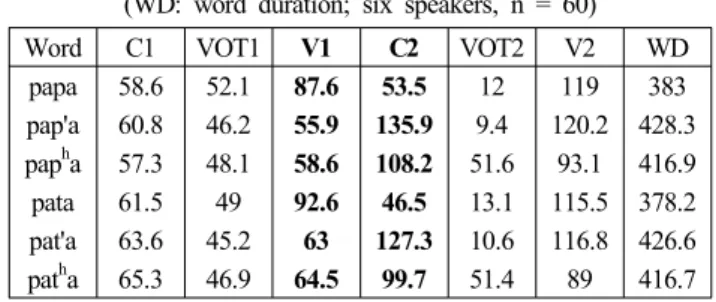
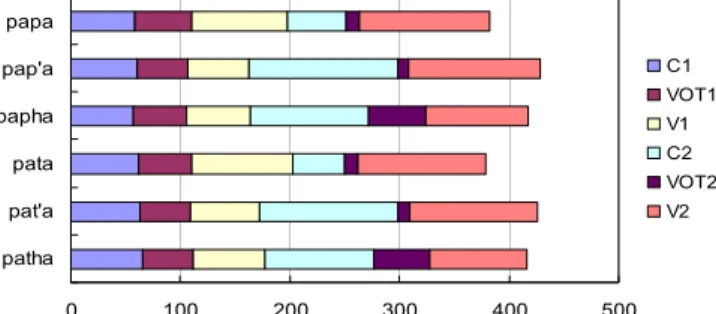
The mean intervals measured from Korean speech materials are
presented in Table 1 and are cumulatively plotted in Figure 1.
Table 1. Average durations (ms) of each measuring unit in Korean speech materials
(WD: word duration; six speakers, n = 60)
Word C1 VOT1 V1 C2 VOT2 V2 WD
papa 58.6 52.1 87.6 53.5 12 119 383
pap'a 60.8 46.2 55.9 135.9 9.4 120.2 428.3 pap
ha 57.3 48.1 58.6 108.2 51.6 93.1 416.9 pata 61.5 49 92.6 46.5 13.1 115.5 378.2 pat'a 63.6 45.2 63 127.3 10.6 116.8 426.6 pat
ha 65.3 46.9 64.5 99.7 51.4 89 416.7
As expected, vowels were longer before lax consonants than before their tense cognates while lax consonants were shorter than their tense counterparts. First, the durational ratio of V1 was 1:0.64:0.67 before /p/, /p'/ and /p
h/, and it was 1:0.68:0.7 before /t/, /t'/ and /t
h/. Two-way ANOVAs with Subject and Phoneme Type as factors produced significant main effects for both of the two factors in each set of vowels preceding the target consonants, i.e., Subject: F [5, 162] = 31.49, p = 0.000; Phoneme Type: F [2, 162] = 267.63, p = 0.000 before /p, p', p
h/ and Subject: F [5, 162] = 25.23, p = 0.000; Phoneme Type: F [2, 162] = 291.21, p
= 0.000 before /t, t', t
h/. Interaction between Subject and Phoneme Type was significant before /t, t', t
h/, but not before /p, p', p
h/.
Post-hoc Tukey’s HSD tests (p = 0.05) showed that vowel duration before lax stops /p/ and /t/ was longer than those before their tense cognates /p', p
h/ and /t', t
h/ respectively while the preceding vowel duration was not significantly affected by the absence/presence of aspiration in the following tense stops.
By contrast, the ratio between /p/, /p'/ and /p
h/ was 1:2.54:2.02, and that between /t/, /t'/ and /t
h/ was 1:2.74:2.14. The results of two-way ANOVAs with Subject and Phoneme Type as factors showed that both of the two factors had significant main effects on the duration of the following consonants (Subject: F [5, 162]
= 51.77, p = 0.000 on /p, p', p
h/; F [5, 162] = 61.80, p = 0.000 on /t, t', t
h/; Phoneme Type: F [2, 162] = 2068.66, p = 0.000 on /p, p', p
h/; F [2, 162] = 2309.17, p = 0.000 on /t, t', t
h/).
Significant interactions were also observed of Subject × Phoneme Type on each set of consonants. However, Post-hoc Tukey’s HSD tests (p = 0.05) revealed that unlike preceding vowel duration (V1), following consonant durations (C2) significantly differed from each other according to the three types of consonants, i.e., /p/ < /p
h/< /p'/; /t/ < /t
h/ < /t'/.
The inverse durational variations considerably offset each other,
but still leave significant differences between the target units
(VC) embedding the three different types of stops. Analyses of
variance showed that Factors Subject and Phoneme Type had a significant main effects on VC with each set of stops (Subject: F [5, 162] = 65.55, p = 0.000 on VC with /p, p', p
h/; F [5, 162] = 29.13, p = 0.000 on VC with /t, t', t
h/; Phoneme Type: F [2, 162]
= 329.14, p = 0.000 on VC with /p, p', p
h/; F [2, 162] = 405.22, p = 0.000 on VC with /t, t', t
h/). Interactions of Subject × Phoneme Type were also significant on each set of consonants.
Post-hoc Tukey’s HSD tests (p = 0.05) revealed that durations of VC were longer in the same order as consonant durations, i.e., /ap/ < /ap
h/ < /ap'/; /at/ < /at
h/ < /at'/.
Durational differences remain significant at the level of VOT1+VC as well. There were significant main effects of Factors Subject and Phoneme Type on the durations of /VOT1+VC/
(Subject: F [5, 162] = 204.63, p = 0.000 in /p, p', p
h/; F [5, 162]
= 207.39, p = 0.000 in /t, t', t
h/; Phoneme Type: F [2, 162] = 258.69, p = 0.000 in /p, p', p
h/; F [2, 162] = 348.63, p = 0.000 in /t, t', t
h/). Interactions of Subject × Phoneme Type were also significant on each set of consonants. Post-hoc Tukey’s HSD tests (p = 0.05) revealed that durations of h
1VC (“h
1” indicates VOT1 of the initial stop /p/) were longer in the same order as consonant durations, i.e., /h
1ap/ < /h
1ap
h/ < /h
1ap'/; /h
1at/ < /h
1at
h/ < /h
1at'/.
0 100 200 300 400 500
patha pat'a pata papha pap'a papa
C1 VOT1 V1 C2 VOT2 V2
Figure 1. Cumulative segmental durations for Korean test words (ms)
Unlike VC or hVC unit, word duration was differentiated only by the tense/lax feature of the following consonants – words embedding a lax intervocalic stop were shorter than those with a tense stop whereas the absence/presence of the feature aspiration did not induce significant durational differences between words with tense stops. The results of two-way ANOVAs with Subject and Phoneme Type as factors showed that both of the two factors had significant main effects on word duration /paCa/ (Subject: F [5, 162] = 260.80, p = 0.000 when /C/ is /p, p', p
h/; F [5, 162] = 297.51, p = 0.000 when /C/ is /t, t', t
h/; Phoneme Type: F [2, 162] = 165.41, p = 0.000 when /C/ is /p, p', p
h/; F [2, 162] = 238.88, p = 0.000 when /C/ is /t, t', t
h/). Significant interactions were also observed of Subject × Phoneme Type on each set of word durations. However, post-hoc Tukey’s HSD tests (p = 0.05)
revealed that unlike VC or hVC, words with lax stops /p/ and /t/
were shorter than those with their tense cognates /p', p
h/ and /t', t
h/ respectively while words with tense stops were similar in duration.
Post-hoc comparisons using Tukey’s HSD tests (p = 0.05) were applied to each level (from the consonant C to VC to hVC to word level). The average durations of target units with three different types of stops remain significantly different from C through VC to hVC level, with the differences narrowing. On the other hand, words prove significantly shorter when the intervocalic consonant is lax than when it is tense. It is also notable that there are no significant differences between words with tense stops even though words carrying an aspirated tense stop are a little shorter than those embedding a non-aspirated tense stop. The overall results of our study are in good agreement with those of Yun (2004), even if the two studies use different speech materials and speakers, etc.
3.2 Cross-linguistic comparison
As mentioned earlier, Korean and three other languages (English, Japanese and Arabic) were compared with regard to preconsonantal vowel shortening and compensatory movements in both micro- and macro-structures. Table 2 shows mean durations of the preceding vowel (V), the following consonant (C) and word (W) in Korean, English, Japanese and Arabic. In the English and Japanese data, however, vowel duration includes VOT of the preceding consonants /d/ and /k/, for Port (1981) and Port, et al. (1987) present VOT+V as V, not separating them. In addition, English word durations are not available from Port (1981).
As seen in Table 2, Korean is remarkable in the durational
variation of both vowel and consonant, compared to the other
three languages. First, the mean ratios of vowel duration before a
lax stop to those before a tense unaspirated stop and before a
tense aspirated stop are 1:0.64:0.67 in the set of /p, p', p
h/ and
1:0.68:0.7 in the set of /t, t', t
h/. The mean ratios of VOT+V are
1:0.73:0.76 before /p, p', p
h/ and 1:0.76:0.79 before /t, t', t
h/. In
English the ratio is 1:0.83 when the vowel is /ɪ/ and 1:0.88 when
the vowel is /i/. It is 1:0.85 in Japanese and 1:0.89 in Arabic. As
introduced earlier, English is said to show the greatest variation
of vowel duration as a function of the following consonant across
many languages (e.g., Chen, 1970). It may be the case within a
syllable. However, the results of our study demonstrate that
English is not the language in which vowel duration varies the
greatest when the durational variation takes place across a
syllable boundary. Rather, the language with the greatest variation is Korean out of the four languages compared in this study.
Second, the mean durational ratios between a lax stop and its tense cognates in Korean are 1:2.54:2.02 in the set of /p, p', p
h/ and 1:2.74:2.14 in the set of /t, t', t
h/. They are 1:1.29 after vowel /I/ and 1:1.23 after vowel /i/ in English. The ratio is 1:1.4 in Japanese and 1:1.2 in Arabic respectively. Therefore, the durational variation of consonant as a function of its tenseness feature is greater than that of vowel in Korean and also much greater than those of consonants in the other languages. On the other hand, the sum of the vowel and consonant (V+C) is significantly differentiated according to the type of C in Korean, whereas not in the other three languages (see Port, 1981; Port, et al., 1987; Alghamdi, 1990). That is, V and C show the greatest reverse temporal movements in Korean out of the four languages, but V compensates for C only partially, leaving the V+C significantly different according to the type of C. Aside from the level of VC, word durations also vary with the ±tense feature of the intervocalic stop in Korean while they are similar in the other languages (average word durations are not presented in Port (1981), but it is presumed that they remain similar in English as well regardless of the type (tense vs. lax) of the intervocalic stop, considering Sato (1993) that reported similar word durations in English). Therefore, the significant discrepancy in the VC and word duration due to the intervocalic consonant is likely to be a language specific feature of Korean, with a constant duration of the VC or word unit being language universal across many languages. Although direct comparisons may not be allowed between the languages due to the differences in speech materials, etc., we can say that the phoneme type effect is marked in Korean timing from the cross-linguistic point of view as well as from the individual-linguistic point of view.
Figure 2, which was made based on the data in Tables 1 and 2, explicitly demonstrates the differences between the languages.
For convenience, only one set (/ap/ vs. /ap'/ vs. /ap
h/) of Korean V and C is presented. Figure 2 first shows that the V and C lines are asymmetric in Korean, but they look almost symmetric in the other three languages. And the gradients of the lines for vowel and consonant are in general steeper in Korean than those in the other languages, which is a reflection of the markedly greater durational variations of both vowel and consonant in Korean. In particular, it is notable that unlike in the other languages the length of the line for consonant is conspicuously long (steep) in Korean, compared to that for vowel. This explains why the whole durations of the vowel and consonant noticeably differ according to the phoneme type in Korean whereas not in
the other languages where vowel and consonant lines have similar length or steepness. The relatively shorter (less steep) consonant line of Korean /p
h/ than that of /p'/ is due to the considerably long aspiration which follows the closure of /p
h/. The Korean vowel line moves upwards but keep similar (even slightly higher) steepness when we regard VOT+V as vowel duration V as in the English and Japanese data (see the dotted line in Fig. 2). English reveals similar steepness of the V and C lines irrespective of the length of vowel, i.e., short vowel /ɪ/ vs. long vowel /i/. Therefore, the crossing itself of the V and C lines is not likely to be important. On the other hand, Arabic seems to have relatively weak tenseness effects, considering that the Arabic V and C lines produce the most gentle gradients out of the four languages compared in Figure 2 even if the three languages except Korean do not noticeably differ in the gradient.
Table 2. Mean durations (ms) of the preceding vowel (V), the following consonant (C) and word (W) in Korean, English, Japanese and Arabic (V in Korean and Arabic, VOT+V in
English and Japanese)
Language Source Word (VOT)+V C V+C W
Korean The present study papa 87.6 53.5 141 383 pap'a 55.9 135.9 192 428 pap
ha 58.6 108.2 167 417 pata 92.6 46.5 139 378 pat'a 63 127.3 190 427 pat
ha 64.5 99.7 164 417
English Port (1981) dibber 84 65 149 -
dipper 70 84 154 -
deeber 115 66 181 -
deeper 101 81 182 -
Japanese Port, et al. (1987) kada 96 43 139 308
kata 82 60 142 301
Arabic Alghamdi (1990) badar 76.2 53.3 130 295 batar 67.7 64.1 132 307
0 20 40 60 80 100 120 140 160
papa pap'a papa papha dibber dipper deeber deeper kada kata badar batar
Duration (ms)
(VOT)+V C VOT+V