Platform Business and Value Creation:
Using Public Open Data
1플랫폼 비즈니스와 가치 창출: 개방형 공공데이터 활용
ABSTRACT
Variety of data have been opened or connected by several levels of government. In smart city initiatives, open data become the source of a new business model. This paper is to foster ways of public open data (POD) by analyzing the start-up company that utilizes POD. In order to fulfill it, this paper adapts the case study research. Findings say that POD has potential to validate and further enrich the platform business. But to find which types of public open data are most prevalent is insufficient. To do this, it is more needed that sophisticated and many cases should be examined. However, this paper shows that platform business by using POD could lead to reduce the cost and increase the benefits for both providers and customers. From the findings, this paper shows that public open data has an important role not only to boost new venture creations which are prevalent ways of smart city but also to foster different platforms enabling new value capture and creation according to development of internet of things based on ICT technology.
Keywords: Platform business, Business model, Public open data, Smart city.
1) The current study was supported by the Hongik University Faculty Research support Fund in 2018.
논문접수일: 2019년 2월 1일; 1차 수정: 2019년 3월 2일; 게재확정일: 2019년 3월 9일
2) The author would like to thank anonymous reviewers for fruitful advices and valuable comments.
E-mail: [email protected]
1. Introduction
All organizations, public and private, use similar resources (i.e., knowledge, human, capital and technology) to offer services and products (Al-
Debei and Avison 2010; Breidbach and Brodie 2017). Utilization of knowledge management via new data is more important to make new business (Kim and Om 2018). The trend of development of IoT (Internet of Things) technology is beyond aSoftware Engineering Dept, Hongik University2
Junghee Han (한 정 희)
imagination. Evolution of ICT (Information Communication Technology) has led a new economy system called alternatively the digital economy, the sharing economy, and platform economy. Basically, this implies that new value is co-created and co-captured (Ahokangas et al.
2015). Open collaborations of knowledge through software program enables to boost innovation and new business (Koo et al. 2017).
Now that knowledge and information are important factors of production, to acquire them at low cost becomes associated with competitiveness in the sharing and digital economy. Such rapid changes have an influence on both the supply side and demand side.
By embracing the transformational power of platforms, enterprises across all industries are capturing new growth opportunities and changing the way they do business. And it’s these new business models and the ecosystems being built around them that are driving the most profound changes in the global macroeconomic environment since the Industrial Revolution.
Platform ecosystem is nothing less than the foundation for new value creation in the digital economy. Such platform-based business models fundamentally change how companies can do business.
What makes these models special? They allow companies to create entire ecosystems that do
much of the work to grow the company and drive strategies. The platform has become the business model that is opening up entirely new paths to growth for companies (Benson-Rea et al. 2013;
Breidbach and Brodie 2017; Wang et al. 2017;
Song et al. 2018). While tech companies and the born digital have successfully mastered platform strategies, the opportunity is now opening up to every company in every industry.
In the business model perspective, although vast amounts of data have been opened by several levels of government and hope continues to be expressed with respect to open data’s potential for innovation, whether public open data (POD) will be utilized for new business area is still questioned. In the app contest, developers are challenged to build apps that reuse POD to make new business creation. Government also has emphasized the venture business policy by reusing the public open data in Korea. The new economic system created by smart devices and cyber-physical system have given both opportunity and change. In this paper, we aim to answer the following research questions: (1) Which elements of PODs are founded in the private company? (2) How can POD be used, and how can it create new value?
Although looking at the case through the lens of the author brings some limitations, this paper can contribute to expand the use of POD to create
start-ups. Moreover, this study’s contribution is to show how platform business can evolve in the full-fledged smart city era.
The remainder of the study is structured as follows. Section 2 presents the literature review of public open data platform (POD) and business model. Section 3 presents methodology and analyzes the start-up that is initial stage company through the use of POD. Section 4 presents the results and discusses them. Finally, Section 5 presents conclusions and implications.
2. Literature review
2.1. Platform and platform business
With the development of ICT technology, the
‘platform’ attracts the research topics for not only researchers but managers. Traditionally, the term ‘platform’ has used to industrial sector as innovation tool and product-based systems (Gawer and Cusumano 2014). Platforms are however shifting towards a value and network- centric notion in that they evolve from the joint actions of network actors rather than the features.
Platforms comprise a ‘set’ of subsystems and interfaces (Cusumano and Gawer 2002). From the point of view of product platforms, Robertson and Ulrich (1998) defined a platform as a “collection of assets”. An increasing number of mature
incumbent organizations in a variety of industries are in environments in which they either need to operate as a platform provider or integrate into a business ecosystem governed by platforms (Altman 2015). In the perspective of technology, a platform comprises of hardware and software, and platform is architecture of hardware and software.
The important thing is the economic aspect of platform. Some scholars have focused more on the economic theory of a two-sided market in order to explain platforms and the business environment (Eisenmann et al. 2006). Eisenmann et al. (2011) explained that products and services that bring together groups of users in two- sided market are platforms. Shortly, ‘two-sided market’ comprising ‘network effect’, and ‘business ecosystem’ are core theoretical concepts and key systematic nature of the platform business model. In order words, we can define a platform consisting of a set of rules and components as comprising of users whose transactions are subject to network effects. With transactions and network effects, a business ecosystem is created.
And in a business ecosystem, firms coevolve their abilities to develop new innovations (Schumpeter 1942).
A two-sided market is an economic platform with various distinct players and stakeholder that provide each other within network advantage
and benefits (Armstrong and Wright 2007; Nocke et al. 2007). There is no consensus definition of platform. However, based on both Eisenman et al.
(2006, 2011) and Cusumano (2010), we can define that platform comprising of two-sided market is a component or subsystem of a technological system. In reality, the word of platform came along with the advent of the Internet based on ICT. After that, discussions about business model at platform related to this were paid attentions by some scholars (Timmers 1994; Tapscott et al. 2000; Eisenmann et al. 2001; Applegate 2001; Chesbrough and Rosenbloom 2002; Zott and Amit 2007; Nenonen and Storbacka 2010;
Eisenmann et al. 2011).
Platforms act as an intermediary (i.e., supplier and buy, provider and consumer, buyer and seller). In case of real estate, platform can comprise of buyer and seller. Also platform provides a function to facilitate transaction such as a payment system (cardholder and merchant).
a two-sided market classified into three types (Evans 2003). The first is a market maker, which is responsible for linking parties on both sides (buyer and seller) who want to make a deal. The second is an audience maker, which links an advertiser to an audience. The third is a demand-coordinator, which is responsible for creating goods or services that generate cross-network externalities. Evans and Schmalensee (2013) classified two-sided
markets into four types by sub-dividing the demand coordinator: ‘Exchanges’, which link a purchaser to a seller; ‘Advertiser-supported media’; ‘Transaction systems’ such as credit card payment system; and ‘Software platforms’. Based on the theoretical studies so far, we can see that the platform is like a black box for creating a business.
Needless to say, business model evolve ceaselessly over time. New industries are emerging when old ones are discarded. Thus, business model has evolved into a prevalent term and a focal concept for business. Though there are many definition of what business model is (see, Teece 2010; Amit and Zott 2001), it is a tool that can create new values. This business model has been paid attention to as research topic by scholars (e.g, Amit and Zott 2001). Uncertainty associated with the viability of new business model may be considerable. Uncertainty arises not only because of entrepreneurs’ inability to predict customers’ response to their offering, future market conditions and dynamics, but also because of the computational and dynamic complexity associated with business model planning and design.
Given the case to be discussed below, a business model is a tool for new initiatives as ICT technology advances. Literature on platforms suggests that lead firms need to devise and
implement an appropriate architecture to enable novel offerings and coordinate network actors.
This paper analyzes the case in terms of three component business characteristics (e.g., value proposition, value, value architecture, value network).
2.2. Definition of public open data
Ideally, public open data is any kind of data or information created by public organizations.
Once public agencies or organizations register their public data and its list allowed to be opened in public, they can be turned into Open Data, which everyone can share and use. According to the definition of open data from Berner-Lee (2010), open data is available online under an open license, in a structured, non- proprietary open format, using URLs, and linked to other data. If the data is open and it is related to the government data, it is called public open data (Kucera et al. 2013; Styrin 2016). There are various views on POD. It focuses on the innovation, which can bring on boosting re-use of POD to develop new services of new value creation (Lieselot et al.
2017). Up to now, many prior studies show how to accumulate and how to make open data (Attard et al. 2015; Danneels and Viaene 2015; Maccani et al.
2015), rather than how to use it and how to foster the value creation. Considering that opening of data is a representative example of changes
in government roles due to ICT technology advances, utilization of POD is crucial for both public side and private side because government eventually has a role to make quasi-markets. In reality, data created by government has initially public benefit rather private profit. When re-using it, it should be considered first to maximize social utilities.
Osborne and Gaebler (1992) suggest that public sector must abandon its monopolistic control that may have worked in the industrial age but is poorly suited in the information age and instead ask “How do you take a bureaucratic system and transform it into an entrepreneurial system?” This question is ignited by market. In other words, a market is closer to people than government.
The transformation of government, in terms of changes in the organization, operations and governance of the public sector, has been an important topic in electronic government and public sector reform for a while (Borins 2014; Janowski 2015). The main feature of this transformation is the promotion of market reforms (Le Grand 2007). This market can be created by opening of public data. Such changes have an impact on both supply side and demand side of public service. This is an increase in the number of public service offerings (Ranerup et al. 2016). Lieselot et al. (2017) expressed for POD to transform government. Government
itself is a digital platform, and POD is one of the most promising forces driving this vision forward. When considering prior studies, we can define public open data as production factors or a catalyst which could be used for new value creation.
2.3 Public open data in Korea
According to the administrative law, public data is a crucial resource to influence national competitiveness. Public data is defined as the data that can be used to agenda settings and decision-making by collecting, storing, processing, analyzing and expressing the data that public organizations create, and manage in Korea. Open
data offered from open data portal is available to anyone in accordance with the law, and can be freely used including the purpose of the profit (Article 1, Article 3). As reviewed above, public open data (POD) means that the digital data, generated or acquired by all public agents is provided to people who have a willingness to reuse it for the purpose of public service, and to give them the right to recycle them in business and or nonprofit. Korea government released ‘The 2nd basic public data openness plan’ aiming to achievement of social value by using it in 2018.
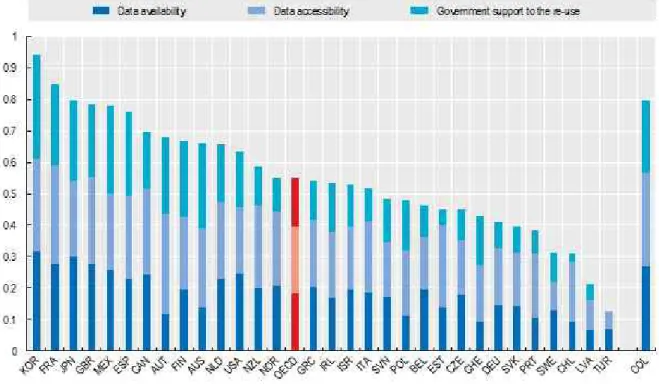
In OECD Public Data Open Index, Korea government ranked 1st 2018, and was evaluated as a leader in the field of public data openness. The
Figure 1. Open-useful- reusable-government data (Source: OECD 2018)
OECD OUR Data Index assesses governments’
efforts to implement open data in the three critical areas - Openness, Usefulness and Re- usability of government data.
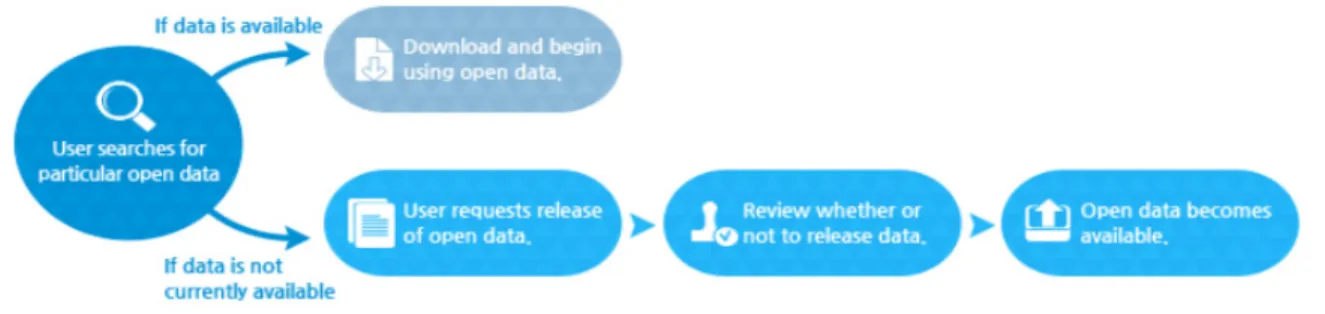
As of 2018, central government including regional has opened 395,343 public data. In particular public data is provided to private sectors in real time as open API form. Citizens can get POD from the public service data platform. The figure below depicts the procedure.
Figure 2. The procedure of POD obtaining (Source www.data.or.kr)
Step 1. Searching for the information; Users can search for particular information through the Open Data platform (www.data.go.kr). Step 2.Requesting open data; If the data users are looking for is not available on the Open Data Portal (www.data.go.kr), they have to submit open data disclosure request. A department that received the request may transfer it to the relevant department or institutions in charge of
data disclosure. Step 3. Decision on whether or not to provide data; After a request for data is made, the relevant public institution will decide whether or not to provide the data within 10 days of receiving the request. If the institution is unable to decide within 10 days for some unavailable reasons, the waiting period may be extended for up to 10 days. Step 4 Notification of decisions on whether or not to provide data; If the data can be released, the public institution responsible will notify the applicant of its decision, explicitly indicating how the data will be provided and what information will be included on the Open Data Platform. To effectively provide public data, the Minister of Government Administration and Home Affairs shall build and manage an integrated provision system POD platform. The Minister of Government Administration and Home Affairs may request cooperation from the heads of public institutions in linking and providing the public data needed to build and operate the open data portal. In such a case, Figure 2. The procedure of POD obtaining (Source www.data.or.kr)
the heads of public institutions receiving such requests shall comply with such requests unless there are special reasons not to do so (Figure 3).
3. Case study
3.1. Methodology
This paper takes a case following a qualitative case study methodology. A case study approach is now possible as both projects have reached
finalization and I can make use of that by assessing the whole of the developed business using platforms. The reasons why I utilize case studies are that this can give the facts that how decision-making happened, and were implemented, and what the results were (Creswell 2007; Schramm 1971). Also, case studies offer the information which is their (inter) organizational context and the transformation process that took place. The fact that the authors were also involved in the research and design in Figure 3. Public Open Data Platform (adjusted by author)
the projects means that I had full access to all case details (Yin 1999; 2011). As research goal is not the representative capturing of all possible variations of transformation through platforms, but to gain a deeper understanding of how platforms can be used in a transformation effort and to explore instruments and challenges used and encountered, an author may think that the benefits of having in-depth information of the transformation efforts outweigh the consequential generalize ability limitations. This is because a case study is a useful method when verifying or expanding well-known theories or challenging a specific theory (Yin 2008). This study seeks to state the frame of analysis based on the previously established theories through a single case. The SALADPIE (hereafter SP) was selected as a model example, because it was the first service firm that achieved a high level of quality service in terms of platform business model using POD.
This study was conducted from June 2018 to the end of December 2018. This makes this case study a form of participant observation (Yin 2008). In order to obtain data on author conducted in-depth interviews with CEO and researchers on October 12, 2018.
The required data were obtained via emails on the condition that certain sensitive matters should be kept confidential. The interviewees then
agreed to record the interview sessions. In this way, a 20-minute interview data were collected for each interviewee. Apart from the internal data of the subject company, other objective data were obtained through webpages, Facebook contents as well as literature reviews.
3.2. Company overview
SP is a company that provides information on all single houses and buildings in Korea such as location, price, transaction history, and further provides a virtual ‘building experience’ by utilizing VR technology.
Namely, the SP is a platform firm that offers building information modeling service to consumers who want to build their own house. It was established on Sept 9, 2017. SP is a platform business company that enables customers to search and find information on all single houses and buildings in Korea, such as location, price, transaction history, etc., and to make virtual
‘building experience’ possible by using VR technology. The CEO who is 47 year old has over 20 year experience in real estate brokerage. His first job was an interior designer at small and medium size enterprise 20 year ago. After that, he has experienced real estate, such as construction of the buildings, marketing the houses over time.
In the middle of 2000s, when the real estate market was booming, he started his own business
at first, but he completely failed due to Sub-Prime mortgage crisis.
He was looking for a business model that would reduce the social costs caused by bad construction, and found the platform model that can bring the win-win for all architects, architects, and brokers by using ICT technology.
He first thought that if he can shorten the delivery time to customer regarding blueprint of the buildings from the architect, benefits happens to not only the customers but architect in terms of cost reduction and reducing complaints. In the perspective of a broker who has made a deal between the client who has the desire to build new building and the architect, he can save the cost, and return it to both. Therefore, if possible, this platform business model makes values to win-win for all.
The motive of the new creation of startup lie in the government’s opening of public data. As a real estate broker, soon after recognizing public service platform, he decided to start a business. The most difficult work in the transaction of the buildings or in the construction of the new buildings is to obtain the relevant land information about the surrounding area because only government offers this data (i.e., information on buildings, trade and lease transactions, individual public price and standard public price). It takes a long time consumption as well as trouble tasks to reach the
data from government agency before initialing of public service platform. The CEO launched SP with developing a VR service by considering the fact that he can easily use architecture, land information from government. According to explanation about another decision to start a new business, he has foresight promising that the smart city construction will be strongly implemented in the near future, and then public data can be accessed more easily than it is now.
In other words, he has confident that there would be more opportunities to business created by the smart city. SP is a company that uses information asymmetry between suppliers and consumers in the real estate market where there is a lot of money from tens of thousands of won to a lot of hundreds of billions won in one time transaction.
3.3 Exploitation of new business model The CEO said that he spent only one year in preparation for VR service development and own platform development with a researcher at a university. The company, an architectural service platform that combines public data with ICT technology, is proud of technology development.
This platform provides values that customers can enjoy happiness to customize their own home.
In particular, CEO emphasized that the most important service he provides that customers can design their house dozens of times in advance.
Also customers can have total benefits with regard to building construction. A lot of preparation to check the condition is needed to build a new house (e.g., floor area ratio and coverage ratio to the land). SP has provided total real estate development service, such as real estate development and planning, construction and relay to bank to get loan service for customers through the platform.
In fact, in the existing real estate services market, both consumers and brokers had to suffer inconvenience. For consumers, it was difficult to reflect and confirm the opinions of construction, resulting in disputes due to increased costs and inconveniences for interior and furniture purchasing. For brokers, they had a lot of difficulty in explaining how to loan the money, and where the house customers required to be located.
This process needs substantial time spent on transactions and expenses. However, SP has provided all kind of services in real time by using the platform. The researcher from interview said that “Even if it’s a small room, if you can decorate it the way you want, you will get satisfaction or comfort’. The greatest happiness to consumers through the service of SP is the reason that SP platform exists, and creates values.
By exploiting the platform, SP is matching the government portal of real estate to enhance the objectivity of information, and preparing a service
that combines VR technology with it. It’s not just for consumers to see real estate information, but for building experience as well.”
SP provides services through the open API between government data platforms and their platforms.
With the opening of the building information, users will be expanded to private companies and the general public in various fields such as small business owners, data distribution, finance, real estate purchasing and consulting, and construction related industries such as architectural design, construction maintenance and inspection, do. The general public can utilize the building-based data integration and utilization, and can save time and cost by utilizing building management (use check, energy management, etc.) and finding the best residence. In the construction industry, we expect that architectural related industries such as architectural design, maintenance and inspection will be activated by expanding and opening architectural information.
In fact, SP that has implemented the trial, using open data predict that annual cost will be reduced by 2.5 billion won for location analysis and real estate consulting.
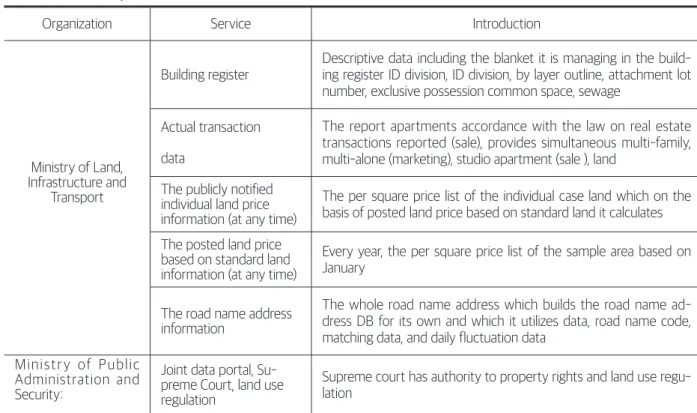
The figure below illustrates the example of one of the use of government platforms. The specific data types from Public Service Platform SALADPIE uses are follows (Table 3).
As argued already, SP provides information on single-family homes and buildings using public data from the Ministry of Land, Transport and Transport, the Ministry of Public Administration and Security, the Supreme Court and the Land Use Regulatory System.
4. Summary and discussion
Open data means that everyone uses the data without discrimination and freely. Open platform also mean that everyone utilizes it. SP is the platform business company using POD.
Platform business model is a systemic and conceptually rich construct, involving multiple components, several players and actors and Table 2. Service items and public open data
Characteristics of SALADPIE Public open data from public service Platform Platform composed of VR(virtual reality)+AR(argument reali-
ty)R+ICT (Information and communication Technology)
Offers 3rd dimension BIM (Building, Information Modeling)
1step : Procedure of Platform utilizations;
- Searching for land and building address
- Basic information about land or building (purpose of land, location and Area size, configuration, usage approval date)
2nd step: Service provisions;
- current trend of land and housing information (surrounding price level, legal conditions)
- Land utilization plans
- Ownership and rights related to land and housings) - Cadastral information
3rd Step : BIM model
- Building, Information Modeling - Online-to-offline service
Ministry of Land, Infrastructure and Transport from public service Platform
-Real deal data (buy/purchasing of land and building -General overview, housing price, attached lot number, etc.),
closed erase ledger (basic outline, summary by floor, attached lot number), building permit (road name book, parking lot, etc.) Parking lot, etc.), building energy (energy use per customer), building maintenance check (report of receipt of inspection, inspection result, maintenance build- ing management ledger)
The Ministry of the Interior and Safety - Street name address
-public data portal
-Land-use regulation system
(*Building information is information that arises in the whole of administrative work related to building life from planning to annihilation of building (permit → construction → approval of use → maintenance → demolition etc)
Table 3. Public Open Data List
Organization Service Introduction
Ministry of Land, Infrastructure and
Transport
Building register
Descriptive data including the blanket it is managing in the build- ing register ID division, ID division, by layer outline, attachment lot number, exclusive possession common space, sewage
Actual transaction data
The report apartments accordance with the law on real estate transactions reported (sale), provides simultaneous multi-family, multi-alone (marketing), studio apartment (sale ), land
The publicly notified individual land price information (at any time)
The per square price list of the individual case land which on the basis of posted land price based on standard land it calculates The posted land price
based on standard land information (at any time)
Every year, the per square price list of the sample area based on January
The road name address information
The whole road name address which builds the road name ad- dress DB for its own and which it utilizes data, road name code, matching data, and daily fluctuation data
Ministr y of Public Administration and Security:
Joint data portal, Su- preme Court, land use regulation
Supreme court has authority to property rights and land use regu- lation
various interdependencies and dynamics. Because of that, the managerial effort required to visualize and explore possibilities for platform business model as well as the effort for managing the business model may be considerable.
The platforms (SP) were selected as a case.
I used a criterion based theoretical sampling approach, and initially defined criteria regarding adherence to my theoretical definition of value platforms in order to identify and select suitable case (Eisenhardt 1989). Based on view of platforms as (1) dynamic configurations of tangible and intangible resources; on which (2) network members can co-create value through a set of specific activities. SP mainly uses data from
Ministry of Land, Infrastructure and Transport and Value Platform (POD). SP only uses seven kinds of public open data out of the 395,343. The data is about housing, which is a big concern of the people. Mutual data exchange between the two (POD platform and SP platform) is not founded from the case analysis. In Korea, many people get used to apartment type residential models. However, SP case is a very useful business model for customers who want a stand- alone residence. First, utilization of POD has created new values in terms of value proposition.
It is diverse and easy to access information. This is the differential values of SP. Customer gets static information regarding housing states from
existing real estate agency, while SP has provided dynamic information the customer gets dynamic information in the housing market because of platform business.
A s d isc usse d prev iously, SP prov ides information on single-family homes and buildings from the Land, Infrastructure and Transport, the Ministry of Public Administration and Security, the Supreme Court and the Land Use Regulatory System. Public agencies are not for profit organization. In perspective of traditional view, public open data has mainly made social values (i.e., public service) rather economic values.
However, public platforms in the emerging digital era can be resource of new value creation. Based on findings of SP, E-government now creates quasi-market.
The value platforms varied in complexity,
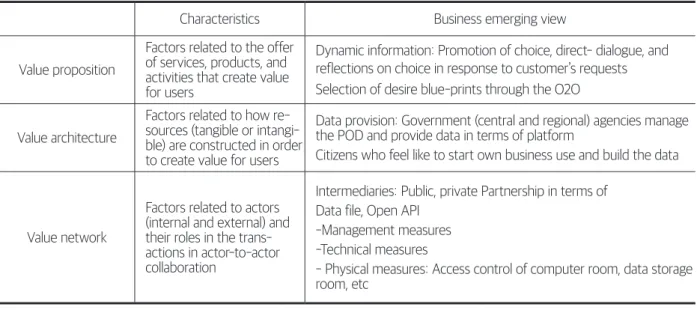
which enabled us to identify a range of lead firm network orchestration practices. Hence, the value- creating systems (Möller and Svahn 2006) also varied, from renewal of existing systems to the emergence of new ones. In addition, the choice of cases was based on full access to the lead firm and access to other network actors and that the addition of the case would add variability to our view of value platforms. In the case studies, the research focused on identifying the orchestration practices of the lead firm. Ultimately the lead firm benefits if the platform progresses to incur network value. From the findings, we can outline the new business model (Table 4).
In order to achieve steady value creations, a balancing act is required to value creation with value capture (Amit and Zott 2015). Long-term value creation and value capture can possible
Table 4. New business model
Characteristics Business emerging view
Value proposition
Factors related to the offer of services, products, and activities that create value for users
Dynamic information: Promotion of choice, direct- dialogue, and reflections on choice in response to customer’s requests Selection of desire blue-prints through the O2O
Value architecture
Factors related to how re- sources (tangible or intangi- ble) are constructed in order to create value for users
Data provision: Government (central and regional) agencies manage the POD and provide data in terms of platform
Citizens who feel like to start own business use and build the data
Value network
Factors related to actors (internal and external) and their roles in the trans- actions in actor-to-actor collaboration
Intermediaries: Public, private Partnership in terms of Data file, Open API
-Management measures -Technical measures
- Physical measures: Access control of computer room, data storage room, etc
when the relationships within the network do operate. Mutual information changes are very important to ceaseless development. Value capture and creation is a token of economic viability of platform business model (Amit and Zott 2015).
From the findings, it is difficult to know whether this case does give enough information regarding co-value creation between POD and SP own platform because SP is an early stage company.
Thus, value co-creation without value exchange or value capture would not resonate with business aspects for all players.
As argued above, POD platform is one kind of quasi-market. Despite the lack of analytical results, there are two kind of positive sources:
direct and indirect network effects. The former, direct network effects explain the value that is generated through a direct effect of the number of other actors on the quality of the service. The latter, indirect network effect is related to value creation based on diffusion of SP’s business model. The higher the diffusion of SP’s model, the more services and applications will be provided that are compatible according to not only development of ICT technology but evolving of smart cities. It is somewhat shortcoming to regard it as an independent success business model because SP is early stages.
5. Conclusion
Knowledge becomes more important resources to create new values. Utilization of data is a nutshell of knowledge management in the period of 4th industrial revolution.
The source of tremendous revenue for Google and Facebook is the data by using the platforms.
In Korea now, data-driven platform business is just beginning. Government provides POD with public agencies as well as private citizens who want to use it for own business in Korea. As a result of the analysis, POD use by business is in the early stage. SP only uses 7 data out of the 395,343. SP case is not enough to answer about research questions. Nevertheless, this study has many contributions.
First, this case has shown that data availability can be a new business model. What I highlight in the era of the 4th industrial revolution is the new business by using the data, capturing through IoT. Namely, data is resource of new business upcoming smart city era. When considering that sharing economy is one of the most significant socio-economic trends of the last decade since advent of network connectivity technology. SP is the most prominent example of how to apply the platform business model to the sharing economy society by using public open data. As confirmed
through interviews, if SP has more accumulated data regarding transactions then exchange them, positive network effects occur in the marketplace.
This is exactly a characteristic of the platform business: Network Effects/Two-Sided Market exists when two user groups (typically, producer and consumer) generate network value for each other, resulting in mutual benefits that drive demand-side economies of scale. The network effects of platforms, with more connected users and transactions, drive value creation and scale.
Second, data that are directly related to daily life and have a high degree of cost expenditure can be highly used to start new firms. When considering it, the production of data that is closely related to real daily can contribute to start- ups activities. Actually, only a very few number of data (7) are used to make new firm among the more than 30,000 pieces of pubic open data. This means that it provides information on what kinds of data is useful for platform business both public side and private side.
To sum, this case reveals that POD is fruitful to the new platform business. One of the most important aspects is to understand which business models are suitable to bring the strength of the trend of the 4th industrial revolution. Just as the government shares data, numerous data would be shared. And it will be utilized for various aims.
In a wider economic sense, this platform reduces
search and transaction costs for it participants.
This is why all of a sudden individual player can offer products and service at competitive cost.
This paper has some limitations. I investigated only SP business model focusing on three core component of business model. I have not studied a large number of cases as well as not implemented the in-depth business model analysis as nine block models by Osterwalder et al. (2005). Research methodology consisted of interviews and examinations. Such research methodology has limitation to longitudinal in- depth studies. Considering that the new business by using the POD is at early stage, findings of this study give research ideas for the further study.
References
1. Ahokangas, P., Ailila, H., Hellaakoski, H., Kyllonen, V., Lehtimaki, T., Peltomaa, I., Seppanen, V., and Tanner, H. 2015.
Collaborative Business Networks of the Future” VTT Value Network 2.0. VTT Technical Research Centre of Finland.
2. Al-Debei, M. M., and Avison, D. 2010.
“Developing a unified framework of the business model concept,” European Journal of Information Systems (19), pp. 359–376.
3. Altman, E. J. 2015. “Platform and ecosystem transitions: strategic and organizational implications,” doctoral dissertation, Harvard Business School, available at: http://nrs.
harvard.edu/urn-3:HUL.InstRepos:16881891.
4. Amit, R., and Zott, C. 2015. “Crafting business architecture: the antecedents of business model design,” Strategic Entrepreneurship Journal (9:4), pp. 331-350.
5. Amit, R., and Zott, C. 2001, “Value creation in e-business,” Strategic Management Journal (22:6-7), pp. 493-520.
6. Applegate, L. M. 2001. Emerging networked business models: lessons from the field.
HBS No. 9-801-172, Harvard Business School, Boston, MA.
7. Armstrong, M., and Wright, J. 2007. “Two- sided markets, competitive bottlenecks and
exclusive contracts,” Economic Theory (32:2), pp. 353-380.
8. Attard, J., Orlandi, F., Scerri, S., and Auer, S. 2015. “A systematic review of open government data initiatives, Government information Quarterly (32:4), pp. 399-418.
9. Berners-Lee, T. Linked data. 2010. http://
www.w3org/DesignIssues/linkedData.html.
10. Benson-Rea, M., Brodie, R. J., and Sima, H.
2013. “The plurality of co-existing business models: investigating the complexity of value drivers,” Industrial Marketing Management (42:5), pp. 717-729.
11. Borins, S. 2014. The Persi stenc e of innovation in government, Cambridge:
Brookings Institution Press with Ash Center for Democratic Governance and Innovation.
12. Breidbach, C. F., and Brodie, R. J. 2017.
“Engagement platforms in the sharing economy: conceptual foundations and research directions,” Journal of Service Theory and Practice (27:4), pp. 761-777.
13. Chesbrough, H., and Rosenbloom, R.S.
2002. “The role of the business model in capturing value from innovatsion: evidence from Xerox Corporation’s technology spin
‐off companies,” Industrial and corporate change (11:3), pp. 529-555.
14. Creswell, J. W. 2007. Qualitative inquiry and research design: Choosing among
five approaches (2nd ed.). Thousand Oaks, CA:Sage.
15. Cusumano, M. A., and Gawer, A. 2002. “The elements of platform leadership,” MIT Sloan Management Review (43:3), pp. 51-58.
16. Cusumano, M. A. 2010a. “Technology strategy and management The evolution of platform thinking,” Communications of the ACM (53:1), pp. 32-34.
17. Danneels, L., and Viaene, S. 2015. “Simple rules strategy to transform government: An ADR approach,” Government information Quarterly (32:4), pp. 516-525.
18. Eisenmann, T., Hallowell, R., and Tripsas, M.
2001, “Internet business models: texts and cases.” New York: McGraw-Hill Eduction.
19. Eisenmann, T., Parker, G., and Van Alstyne, M. 2006. “Platform envelopment,” Strategic Management Journal (32:12), pp. 1270-1285.
20. Eisenhardt, K. M. 1989. “Building theories from case study research,” Academy of Management Review (14:4), pp. 532–550.
21. Eisenmann, T., Parker, G., and Van Alstyne, M. 2011. ‘Platform envelopment’, Strategic Management Journal (32:12), pp. 1270-1285.
22. Evans, D. S. 2003. “Some empirical aspects of multi-sided platform industries,” Review of Network Economics (2:3).
23. Evans, D. S., and Schmalensee, R. 2013. “The antitrust analysis of multi-sided platform
businesses,” National Bureau of Economic Research.
24. Fu, W., Wang, Q., and Zhao, X. 2017. “The influence of platform service innovation on value co-creation activities and the network effect,” Journal of Service Management (28:2), pp. 348-388.
25. Gawer, A., and Cusumano, M. A. 2014.
“I ndust r y plat for ms a nd ecosystem innovation,” Journal of Product Innovation Management (31:3), pp. 417–433.
26. Janowski, T. 2015. “Digital government evolut ion: F rom t r a n s for m at ion to contextualization,” Government Information Quarterly (32 :4), pp. 221–236.
27. Kim, D. J., and Om, K. Y. 2018. “Influence of R&D intensity on innovation performance in the Korean Pharmaceutical Industry:
Focusing on the Moderating effects of R&D collaboration,” Knowledge Management Research (19:3), pp. 189-223.
28. Koo, K. M., Baek, H. M., and Lee. S. R. 2017.
“The Impact on Structures of Knowledge Creation and Sharing on Performance of Open Collaboration: Focus on Open Source Software Development Communities,”
Knowledge Management Research (18:4), pp. 287-306.
29. Kucera, J., Chalpek, D., and Necasky, M.
2013. “Open government data catalogs:
current approaches and quality perspective, Tech nolog y- enabled i n novat ion for democracy. pp. 8061.
30. Le Grand, J. 2007. The other invisible hand:
Delivering public services through choice and competition, Princeton: Princeton University Press.
31. Lieseelot, D., Stijn, V., and Joachim, V-den, B. 2017. “Open data platforms: Discussing alternative knowledge epistemologies,”
Government Information Quarterly (34), pp. 365-378.
32. Maccani, G., Donnellan, B., and Helfert, M.
2015. “Exploring the factors that influence the diffusion of open data for new service development: An interpretive case study,”
ECIS 2015: Proceedings of 23rd European conference on information systems, munster.
33. Nenonen, S., and Storbacka, K. 2010,
“Business model design: conceptualizing networked value co-creation,” International Journal of Quality and Service Sciences (2:1), pp. 43-59.
34. Nocke, V., Peitz, M., and Stahl, K. 2007.
“Platform ownership,” Journal of the European Economic Association (5:6), pp.
1130-1160.
35. O sb or ne , D. , a nd Gaebler, T. 19 9 2 . R ei nvent i ng gover n ment: How t he
entrepreneurial spirit is transforming the public sector, Reading: MA: Addison-Wesley.
36. Osterwalder, A., Pigneur, Y., and Tucci, C.L. 2005. “Clarifying business models:
origins, present, and future of the concept,”
Communications of AIS (15), pp. 1-43.
37. Ranerup, A., Henriksen, H. Z., and Hedman, J. 2016. “An analysis of business models in public Service platforms,” Government Information Quarterly (33), pp. 6-14.
38. Schramm, W. 1971. “Notes on case studies of instructional medial project,” Working paper for the Academy for Educational Development, Washington, DC.
39. Schumpeter, J. A . 1942. “Capit a l i sm , Socialism and Democracy.” Abingdon:
Taylor and Francis.
40. Song, P., Xue, L., Rai, A., and Zhang, C. 2018
“The ecosystem of software platform: A study of asymmetric cross-side network effects and platform governance,” MIS Quarterly (42:1), pp. 121-142.
41. Styrin, E., Luna-Reyess, L., and Harrison, T.
M. 2016. “Open data and open government:
From abstract principles to institutionalized practices : Proceedings of 17th annual inter nat iona l conference on dig ita l government research, Shanghia, Chia. 42. Tapscott, D., Lowy, A., and Ticoll, D. 2000.
Digital Capital: Harnessing the Power of
Business Webs, Harvard Business School Press, Boston, MA.
43. Teece, D. J. 2010. “Business models, business strategy and innovation,” Long Range Plannin (43:2), pp. 172-194.
44. Timmers, P. 1998. “Business models for electronic markets,” Electronic Markets (8:2), pp. 3-8.
45. Yin, R. K. 1999. Enhancing the quality of case
studies in Health services research, Health Services Research (34), pp. 1209-1224.
46. Yin, R. K. 2011. Qualitative research from start to finish, New York: Guilford.
47. Zott, C., Amit, R. and Massa, L. 2011. “The business model: recent developments and future research,” Journal of Management (37:4), pp. 1019-1042.
저 자 소 개
한 정 희 (Junghee Han)
현재 홍익대학교 세종캠퍼스 과학기술대학 소프트웨어융합학부 교수로 재직 중이다. 서울 대학교에서 박사학위를 취득하였다. 주요 관심분야는 지식경영, 기술사업화와 창업, 지식 공유와 소프트웨어 비즈니스모델 이다. International journal of innovation technology, European Planning studies 등 44편의 논문을 발표하였다.