Characteristics of Chungkookjang that Enhance the Flavor and GABA Content in a Mixed Culture of Bacillus subtilis MC31 and Lactobacillus sakei 383
Ga-Young Lee1, Su-In Kim1, Min-Gi Jung1, Jong-Hwan Seong1, Young-Guen Lee1, Han-Soo kim1, Hun-Sik Chung1, Byoung-Won Lee2 and Dong-Seob Kim1*
1Department of Food Science & Technology, Pusan National University, Miryang 627-706, Korea
2Department of Functional Crop Nat’l. Institute of Crop Science, RDA, Miryang 627-803, Korea Received June 24, 2014 /Revised October 2, 2014 /Accepted October 13, 2014
Chungkookjang has several functional properties, such as fibrinolytic activity, anticancer effects, and an- tioxidant effects. However, children do not like Chungkookjang because of its foul odor. A mixed cul- ture of Bacillus subtilis MC31 and Lactobacillus sakei 383 was used to improve the production of GABA in Chungkookjang and its flavor. Most of the foul odor of Chungkookjang was removed. The slime con- tent and viscosity of Chungkookjang fermented in the mixed culture were similar to those of commer- cial Chungkookjang when B. subtilis MC31 and Lactobacillus sakei 383 were inoculated in a 1:1 ratio. The maximum GABA content was obtained when Chungkookjang was fermented with B. subtilis MC31 and L. sakei 383, which was fermented at 37℃ for 72 hr. During the period of fermentation, the viable cell number of B. subtilis MC31 reached a peak (log 9.13 CFU/g) at six days, and L. sakei 383 reached a peak (log 6.78 CFU/g) at two days. The moisture, crude ash, crude protein, crude fat, and crude fiber contents were 61.71%, 2.05%, 17.54%, 8.36%, and 1.95%, respectively. The amino-type nitrogen content of Chungkookjang fermented by B. subtilis MC31 and L. sakei 383 was less than Chungkookjang fermented by B. subtilis MC31 alone. The ammonia-type nitrogen and reducing sugar content of the Chungkookjang fermented by B. subtilis MC31 and L. sakei 383 were higher than that of steamed soybean. The glutamic acid and GABA content detected with an amino acid analyzer were 1.40 mg/g and 0.47 mg/g, respectively. These results suggest that fermentation with B. subtilis MC31 and L. sakei 383 in a 1:1 ratio removes more of the foul odor and increases the GABA content compared with sin- gle fermentation.
Key words : Baillus subtilis, Chungkookjang, lactic acid bacteria, mixed culture, γ-aminobutyric acid (GABA)
*Corresponding author
*Tel : +82-55-350-5356, Fax : +82-55-350-5359
*E-mail : [email protected]
This is an Open-Access article distributed under the terms of the Creative Commons Attribution Non-Commercial License (http://creativecommons.org/licenses/by-nc/3.0) which permits unrestricted non-commercial use, distribution, and reproduction in any medium, provided the original work is properly cited.
Journal of Life Science 2014 Vol. 24. No. 10. 1102~1109 DOI : http://dx.doi.org/10.5352/JLS.2014.24.10.1102
서 론
대두는 단백질과 지방질이 풍부하여 영양공급원으로의 가 치가 높다고 알려져 있다. 최근 대두의 isoflavone, saponin, phytate, pinitol, trypsin inhibitor, oligosaccharides 등의 여러 가지 기능성 성분들이 만성질환을 예방하거나 일부 치료효과 를 나타낸다는 보고가 있다[25]. 우리나라는 전통적으로 대두 를 이용하여 곡물 위주의 식생활에서 부족하기 쉬운 단백질을 보충해 왔는데 특히 고추장, 간장, 된장, 청국장 등의 발효식품 들이 발달하였다. 이 중에서도 청국장은 소금을 첨가하지 않 고 대두를 단기간에 발효시킨 무염 대두 발효식품으로 일본의 natto, 네팔의 kinema, 인도네시아의 tempeh 등과 유사한 형 태이다[20].
청국장은 대두를 잘 씻어 18시간 이상 불려서 익힌 후, 사이 사이에 볏짚을 꽂아 일정한 온도에서 2~3일 보온하여 제조된 다[23]. 이때 볏짚에 존재하는 Bacillus 균주가 protease, amy- lase, lipase와 같은 다양한 가수분해효소를 생산하는데 이 효 소들에 의해 원료 대두의 당질, 단백질, 지질 등이 분해되어 청국장 고유의 점질물이 생성된다. 생성된 점질물에는 fructan 계 물질인 levan과 polypeptide성 물질인 polyglutamate 등이 함유되어 있다[17, 30, 32]. 청국장에는 발효과정 중에 생성되 는 효소들에 의해 대두의 영양성분들이 분해되어 유리아미노 산, vitamin B1, B2, isoflavone, aglycon등의 함량이 높아지게 된다[26, 28, 29]. 청국장은 Bacillus 균주가 생산하는 혈전용해 효소에 의한 혈전용해능효과[12], cytokine에 의한 면역증강효 과[6], 발효균주의 probiotic에 의한 항산화·항암효과[43] 등의 여러 가지 기능성을 가지고 있다. 그러나 특유의 불쾌취로 인 해 어린이나 젊은이들에게 외면을 받고 있어 불쾌취를 줄이고 대중성을 높이고자 최근에는 청국장에 율무[37], 유카[11], 녹 차[21] 등을 첨가하여 발효하거나 불쾌취를 적게 생산하는 Bacillus균주를 분리[27] 또는 Bacillus균과 유산균을 혼합발효 [13, 15]하는 등의 연구가 진행되고 있다.
한편, 유산균은 여러 당류를 에너지원으로 사용하여 젖산을
생성하며 식품이나 사람과 동물의 장내에서 indole, phenol 등의 해로운 물질을 생성하지 않고 부패를 방지하는 유익한 균이다[16]. 유산균은 장내 유해균을 억제하고 정장작용, 혈중 콜레스테롤 감소, 항암 작용, 면역 증강 작용 등의 기능이 있으 며 식품의 보존성 향상, 풍미 증진, 길항 물질에 의한 건강 증진 효과를 목적으로 산업과 제품개발에 널리 이용되고 있다 [16, 18, 40].
GABA는 gamma-aminobutyric acid의 약자로 자연계에 널 리 분포하는 비단백질 아미노산의 일종으로 L-glutamate가 glutamate decarboxylase (GAD)에 의해 탈탄산 반응이 일어 나 이산화탄소와 함께 생성된다[24]. GABA는 흥분 억제성 신 경전달물질로서 혈압조절, 항불안, 항경련, 성장호르몬 분비 조절에 관여하여 약리적으로 매우 주목 받고 있는 물질이다.
하지만 자연 상태에서의 GABA 함유량은 식물체에 소량으로 존재하므로 화학적 방법, 미생물 이용방법 등을 활용하여 그 함량을 증대시켜 다양한 제품에 적용시킬 수 있다[34, 38].
GABA의 함량은 발아곡류[5], 녹차[10] 등에서 높게 나타난다 고 알려져 있는데 특히 식품의 발효[14, 38]를 통해서도 그 양 이 증가한다는 연구가 발표되었다.
본 연구에서는 GABA 생성력이 높은 B. subtilis MC31 [35]
과 L. sakei 383 [18]을 이용하여 청국장의 GABA 함량을 높이 고 불쾌취를 줄여 대중성을 높이고자 하였다.
재료 및 방법
사용균주
청국장제조에 사용된 균주는 본 실험실에서 분리하여 보관 중인 B. subtilis MC31 [35]과 L. sakei 383 [18]을 사용하였다.
B. subtilis MC31은 Luria-Bertani broth (Difco, Sparks, MD, USA) 에서 37℃, 24시간 전 배양한 후 3시간 주 배양하고 L.
sakei 383은 MRS broth (Difco, Sparks, MD, USA)에서 35℃, 24시간 전 배양한 후 3시간 주 배양하여 종균으로 사용하였다.
청국장 제조
대두를 3회 수세하여 25℃, 12시간 동안 불려 autoclave에서 121℃, 30분 동안 멸균·증자하였다. 멸균된 콩을 clean-bench 에서 약 40℃까지 식히고 B. subtilis MC31과 L. sakei 383을 총 접종량이 1%가 되게 하여 1:1, 1:2, 1:3, 2:3, 3:2, 2:1, 3:1의 비율로 접종한 후 30℃, 35℃, 37℃, 40℃, 45℃에서 48시간, 60시간, 72시간 발효하였다.
점질물의 점도 및 양 측정
청국장 시료의 점질물의 점도 측정은 Mann 등[35, 44]의 방법에 따라 측정하였다. 비율 별로 제조된 청국장 시료 일정 량을 약수저로 일정 높이까지 떠올려 늘어나는 점질물의 길이 를 육안으로 비교하였다.
청국장 시료의 점질물 측정은 Lee 등[31]과 Shin [39]에 의 한 방법에 준하여 측정하였다. 비율 별로 제조된 청국장 시료 에 동일한 양의 증류수를 첨가하여 30분간 진탕한 후 원심분 리(3,000 rpm, 15 min)하고 상등액 일정량을 동결건조하여 무 게를 측정하였다.
관능평가
관능평가는 발효된 청국장을 마쇄하지 않은 상태로 이용하 여 평가하였다. 평가항목은 청국장의 불쾌취, 쓴맛이며 패널 10명을 대상으로 하여 4점 평정법(+: 약하다, ++: 보통이다, +++: 강하다, ++++: 매우 강하다)을 사용하여 평가하였다.
발효 온도별 GABA함량 측정
GABA의 측정은 Zhang [42]의 방법을 변형하여 측정하였 다. 제조된 청국장을 동결건조한 시료 3 g에 에탄올 9 ml을 첨가한 후 25℃에서 5시간 동안 교반하였다. 교반된 시료를 13,000 rpm에서 5분 동안 원심분리하여 상등액 0.2 ml을 취한 후 MeOH 800 μl를 첨가한 후 80℃의 water bath에서 완전 건조하였다. 여기에 70 mM LaCl3용액 2 ml을 가하여 25℃에 서 15분 동안 균질화하였다. 균질화된 시료는 13,000 rpm에서 5분 동안 원심분리하고 상등액 800 μl를 0.1 M KOH용액 160 μl를 미리 넣어둔 tube에서 5분간 다시 균질화하였다. 이를 13,000 rpm에서 5분 동안 원심분리하여 상등액 550 μl에 0.5 M K4P2O7 200 μl, 4 mM NADP 150 μl, 2.0 units Gabase/ml 50 μl를 혼합하고 340 nm에서 흡광도를 측정하여 Initial A값 을 구하였다. 여기에 20 mM α-ketoglutarate 용액 50 μl를 가하 여 25℃에서 1시간 방치한 후 340 nm에서 흡광도를 측정하여 Final A값을 구하였다. 측정한 흡광도(Final A - Initial A)는 표준곡선에 대입하여 발효 온도별 GABA함량을 계산하였다.
아미노산함량 측정
B. subtilis MC31과 L. sakei 383을 최적 비율로 접종한 GABA 함량이 가장 높은 발효 조건의 청국장으로 아미노산 분석에 이용하였다. 동결건조하여 마쇄한 청국장 분말 0.1 g 에 6 N HCl 16.7 ml을 첨가한 후 질소가스를 충진하고 뚜껑을 닫아 110℃ oven에서 24시간 동안 가수분해하였다. 가수분해 시킨 시료의 HCl을 감압농축기로 제거하여 증발플라스크에서 증 발건조한 후 시료희석 완충액을 가하여 용해시켰다. 이 용액 을 0.45 μm membrane filter로 여과하여 아미노산 자동분석기 (L-8800 Amino Acid Analyzer, Hitachi, Tokyo, Japan)를 이용 하여 분석하였다. Cystein과 methionine은 산 가수분해할 경 우 파괴되기 쉬우므로 performic acid를 가하여 산에 안정된 상태로 산화시켜 처리하였다.
미생물 생육 변화
최적조건으로 제조된 청국장의 미생물의 생육변화를 알아
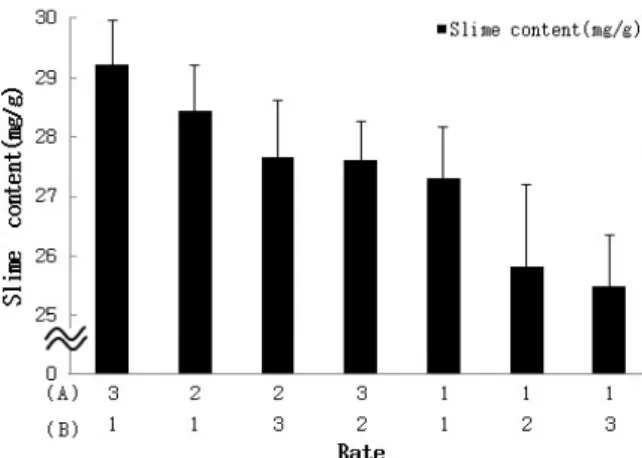
Fig. 1. Slime content in Chungkookjang fermented by mixed cul- ture of B. subtilis MC31 and L. sakei 383. Chungkookjang that Inoculation ratio of B. subtilis MC31 (A) to L. sakei 383 (B) was fermented at 37℃ for 72 hr.
보기 위하여 7일 동안 12시간 단위로 청국장을 제조하여 ho- mogenizer로 균질화하고 사용하였다. B. subtilis MC31 균주는 LB plate에 도말한 후 37℃에서, L. sakei 383 는 MRS plate에 도말한 후 35℃에서 배양하였다. 생균수는 배양 후 생성된 col- ony를 계수하여 log number CFU/g으로 나타내었다.
일반성분 분석
일반 성분은 AOAC법[2]에 따라 측정하였다. 수분은 105℃
상압가열건조법으로 측정하였으며 조회분은 직접회화법에 따라 분석하였다. 조단백질은 Kjeldahl법으로 자동단백질분석 기(Kjeltec 2400, AUT Foss Tecator, Sweden)로 측정하였고 조지방은 Soxhlet 추출법, 조섬유는 산․알칼리 분해법을 이 용하여 분석하였다.
총당
총당은 phenol-sulfuric acid법[9]을 이용하여 측정하였다.
동결건조한 청국장 분말에 25% HCL (v/v in water)과 dis- tilled water를 첨가하여 95℃ 항온수조에서 2시간 동안 산 분 해하였다. 산 분해한 시료를 10,000 rpm에서 15 분 동안 원심 분리하고 상등액을 0.45 μm membrane filter로 여과하여 시료 액을 얻었다. 이 시료액 1 ml에 5% phenol 1 ml과 sulfuric acid 5 ml을 가하여 혼합한 후 15분간 25℃에서 반응하여 550 nm에서 흡광도를 측정하였다.
환원당
환원당은 Mann [36]의 방법을 이용하여 측정하였다. 동결 건조한 청국장 분말에 distilled water를 첨가하여 교반한 후 단백질을 침전시키기 위해 10% TCA (v/v in water)를 소량 첨가하여 15분 동안 상온에서 방치하였다. 단백질이 침전된 시료를 10,000 rpm에서 15분 동안 원심분리하고 0.45 μm membrane filter로 여과하여 시료액을 얻었다. 이 시료액 1 ml에 DNS시약 3 ml을 첨가하여 95℃ 항온수조에서 10분간 반응시킨 후 냉각하여 535 nm에서 흡광도를 측정하였다.
암모니아태 질소
암모니아태 질소 함량은 Mann [36]의 방법을 이용하여 측 정하였다. 동결건조된 청국장 분말에 10% KCl 용액을 가하여 1시간동안 교반 후 여과지(Whatman filter paper N0.2)로 여 과하였다. 이 여과액에 magnesium oxide를 첨가하여 시료액 으로 사용하였으며 Kjeldahl 자동 적정기(FOSS 2200 system, Japan)를 이용하여 분석 하였다.
아미노태 질소
최적조건으로 발효된 청국장의 아미노태 질소함량은 Choi 등[7]의 방법을 변형하여 측정하였다. 동결건조한 청국장 분말 과 distilled water을 첨가하여 30℃에서 30분간 교반하였다.
시료액을 10,000 rpm에서 15분 동안 원심분리한 후 0.45 μm
membrane filter로 여과하여 상등액 20 ml을 얻었다. 이 여액 에 페놀프탈레인 지시약을 넣은 후 0.1N NaOH용액으로 미홍 색이 될 때까지 적정하였다. 이때 중성포르말린 용액 20 ml를 혼합하여 pH가 떨어지면 다시 0.1 N NaOH용액으로 pH 8.3 이 될 때 까지 적정하였다. 소비된 0.1N NaOH용액의 양을 계산하여 아미노태 질소 함량으로 나타내었다.
pH와 총산도
최적조건으로 발효된 청국장의 시간별 pH를 알아보기 위 하여 12시간 단위로 발효된 청국장에 멸균된 distilled water을 가하여 균질화하였다. 균질액을 10,000 rpm에서 5분간 원심분 리한 후 0.45 μm membrane filter로 여과하여 얻은 여과액 20 ml을 pH-meter (pH meter pH-200L, Istek, Korea)로 측정 하였다.
한편, 총산도는 발효된 청국장 시료액의 pH가 pH 8.3이 될 때까지의 소요되는 0.1 N NaOH의 양을 측정하여 초산 양으로 환산하였다.
결과 및 고찰
비율별로 제조된 청국장의 점질물의 양
B. subtilis MC31과 L. sakei 383을 1:1, 1:2, 1:3, 2:1, 2:3, 3:1, 3:2의 비율로 증자한 대두에 접종하여 발효한 청국장의 점질 물의 생성량을 Fig.1에 나타내었다. 비율 1:1, 1:2, 1:3의 경우 점질물의 양이 각 27.30±0.74 mg/g, 25.83±0.76 mg/g, 25.50±
0.95 mg/g으로 L. sakei 383의 비율이 높아질수록 점질물의 양이 감소함을 확인할 수 있었다. 비율 2:1, 2:3, 3:1, 3:2도 각각 28.44±0.64 mg/g, 27.67±0.88 mg/g, 29.22±1.37 mg/g, 27.61±
0.86 mg/g으로 비율 1:1, 1:2, 1:3의 경우와 마찬가지로 L. sakei 383의 접종량이 높을수록 점질물의 양이 줄어드는 결과를 나 타내었다. 따라서 B. subtilis MC31과 L. sakei 383을 혼합배양하
Table 1. Viscosity, foul odor and bitter taste of Chungkookjang by mixed culture of B. subtilis MC 31 and L. sakei 383 Rate1)
Viscosity Foul odor Bitter taste
(A) (B)
1 1 1 2 2 3 3
1 2 3 1 3 1 2
+++
++
+ +++
++
++++
++++
+ + + +++
+++
++++
++++
++
+ + ++++
+++
++++
+++
1)Inoculation ratio of B. subtilis MC31 (A) and L. sakei 383 (B).
2)++++: over powering detectable activity, +++: strong detect- able activity, ++: detectable activity, +: weak detectable activity
Fig. 2. Effect of fermentation temperature on GABA content (%) in Chungkookjang fermented by mixed culture of B. sub- tilis MC31 and L sakei 383. Chungkookjang that Bacillus subtilis MC31 and Lactobacillus sakei 383 were inoculated in a 1:1 ratio was fermented for 72 hr.
Fig. 3. Effect of fermentation time on GABA content (%) in Chungkookjang fermented by mixed culture of B. subtilis MC31 and L sakei 383. Chungkookjang that Bacillus subtilis MC31 and Lactobacillus sakei 383 were inoculated in a 1:1 ratio was fermented at 37℃.
여 발효한 청국장의 점질물 양은 2.55∼2.92%로 일반 청국장 의 점질물 함량이 2.15∼6.03%[4, 33]임을 비교하였을 때 적절 한 양의 점질물을 생성함을 확인하였다.
비율별로 제조된 청국장의 점도와 관능평가
B. subtilis MC31과 L. sakei 383을 일정 비율로 접종한 청국 장을 발효하여 점도, 불쾌취, 쓴맛을 비교하였다(Table 1). 점 도의 경우 B. subtilis MC31의 비율이 높을수록 끈끈한 강도가 강했으며 L. sakei 383의 비율이 높아질수록 점점 물처럼 연해 졌다. 이러한 결과는 L. sakei 383의 비율이 높아질수록 점질물 의 양이 줄어드는 것과 일치하였다.
불쾌취의 경우 비율 1:1, 1:2, 1:3에서 다른 비율보다 완화됨 을 확인할 수 있었던 반면 비율 1:2, 1:3에서는 유산균 특유의 시큼한 냄새가 비율 1:1 보다 강하였다. Chun 등[8]과 Kim 등[19]에 의하면 특유의 냄새가 강한 생강과 마늘을 유산균으 로 발효하여 향기성분을 분석하였을 때 자극취가 감소하였다 고 발표하였다. Yoo (32)가 발표한 연구에서는 유산균으로 해 조류를 발효하였을 때 특유의 향기성분이 없어지지는 않았으 나 역가가 강한 향기물질이 생성되어 시료의 냄새 전반을 지 배하는 것으로 판단된다고 발표하였다.
쓴맛은 B. subtilis MC31의 비율이 제일 높은 비율 3:1에서 가장 강했으며 L. sakei 383의 비율이 높아질수록 쓴맛은 줄어 들고 콩 특유의 고소한 맛이 더 강하게 느껴졌다.
Fig. 1과 Table 1을 종합하여 비교하였을 때 비율 1:1의 경우 불쾌취가 거의 없고 점질물의 양과 점도는 다른 비율과 비교 했을 때 크게 차이가 나지 않으며 유산균 특유의 시큼한 냄새 도 적은 것으로 확인되었다. 따라서 GABA측정을 위한 청국장 을 제조할 때 B. subtilis MC31과 L. sakei 383의 접종비율은 1:1로 정하였다.
발효 온도별 GABA함량
B. subtilis MC31과 L. sakei 383을 1:1로 접종한 청국장의 GABA 함량을 알아보기 위해 발효온도와 발효시간을 조건으
로 하여 GABA 함량을 측정해 보았다. 발효온도에 따른 최대 GABA함량을 100%로 하여 생성된 GABA의 상대적인 함량을 백분율로 나타내었다(Fig. 2). 발효온도 37℃에서 가장 높은 GABA함량을 나타내었으며 그 다음으로 40℃, 45℃, 30℃, 3 5℃ 순으로 점점 낮아졌다. 발효온도 37℃에서 발효시간에 따 른 GABA의 상대적인 함량(Fig. 3)은 B. subtilis MC31 균이 정지기에 이르고 유산균인 L. sakei 383이 감소기인 72시간에 발효한 청국장이 가장 높았으며 전체적으로 발효시간이 길어 질수록 GABA 함량이 조금씩 증가함을 알 수 있었다. 발효온 도 37℃에서 GABA 함량이 높게 나온 것은 균주의 생육에 따 른 차이로 보인다. L. sakei 383의 최적 생육 온도는 35℃[18]이 며 B. subtilis MC31의 최적 생육온도는 37℃[35]으로 청국장 발효온도 37℃가 두 균주의 최적 생육 온도와 비슷하기 때문 으로 보여진다.
Table 2. Amino acid content of Chungkookjang fermented by mixed culture of B. subtilis MC31 and L. sakei 383
(unit : mg/g, Dry basis)
Amino acid Chungkookjang1)
Essential amino acid
L-Threonine L-Valine L-Methionine L-Isoleusine L-Leucine L-Phenylalanine L-Lysine L-Tryptophan
2.08±0.01653) 0.05±0.0008 0.59±0.0038 3.40±0.0241 4.75±0.0559
ND2) 7.44±0.0461 1.16±0.0266
Non- essential amino acid
L-Asparagine L-Glutamic acid L-Serine Citrulline L-Alanine L-Cysteine L-Tyrosine β-Alanine Ammonium
DL-β-aminoisobutyric acid L-Ornitine
L-Histidine L-Arginine L-Aspartic acid GABA
1.04±0.0163 1.40±0.0142 1.21±0.0192 8.44±0.0656 2.24±0.0211 6.26±0.0491 15.76±0.0940
2.31±0.0150 9.08±0.0319 6.30±0.0284 2.04±0.0119 3.42±0.0225 2.99±0.0276 0.57±0.0060 0.47±0.0027
Total amino acids 83.00±0.5977
1)Chungkookjang was fermented at 37℃ for 72 hr.
2)ND : Not detected.
3)All values are mean ± SD (n=3).
Fig. 4. Change of viable cell number of Chungkookjang fermented by mixed culture of B. subtilis MC31 and L. sakei 383.
Chungkookjang that Bacillus subtilis MC31 and Lactobacillus sakei 383 were inoculated in a 1:1 ratio was fermented at 37℃ for 7 days.
Table 3. Proximate composition in Chungkookjang fermented by mixed culture of B. subtilis MC31 and L. sakei 383 Proximate composition Chungkookjang1) (%)
Moisture Crude ash Crude protein Crude fat Crde fiber
61.71±0.722) 2.05±0.05 17.54±0.03 8.36±0.01
1.95
1)Chungkookjang was fermented by B. subtilis MC31 and L. sakei 383 at 37℃ for 72 hr.
2)All values are mean ± SD (n=3).
아미노산 함량 분석
B. subtilis MC31과 L. sakei 383을 37℃, 72시간 동안 혼합 발효한 청국장의 아미노산은 22종이 검출되었으며 그 함량은 Table 2에 나타내었다. 제일 높은 함량을 나타낸 아미노산은 tyrosine이며 ammonium, citrulline, lysine 순으로 함량이 낮 아졌다. 혼합 발효한 청국장에서 glutamic acid는 1.40±0.0142 mg/g의 함량을 나타내었으며 GABA함량은 0.47±0.0027 mg/
g으로 나타났다. 선 연구[35]에 따르면 일반 삶은 콩의 GABA 함량은 0.025 mg/g이며 B. subtilis MC31을 단일로 접종하여 발효한 청국장의 GABA 함량은 0.20 mg/g이라고 발표하였 다. 이러한 결과로 보아 일반 삶은 콩에 비해 B. subtilis MC31 과 L. sakei 383을 혼합 발효한 청국장의 GABA 함량은 약 18배 높으며 B. subtilis MC31을 단일 발효한 청국장보다는 약 2배정 도 높은 것을 알 수 있었다. Beak [3] 등에 의하면 발아시키지 않은 대두에 Bacillus licheniformis B-59를 이용하여 발효시킨 청국장의 아미노산을 분석한 결과 glutamic acid는 7.77 mg%
를 나타냈으며 GABA 함량은 0.99 mg%라고 하였다. 이러한 GABA 함량의 차이는 사용균주와 발효조건에 따른 것으로 생 각되어진다.
미생물 생육 변화
B. subtilis MC31과 L. sakei 383을 37℃에서 7일 동안 혼합 발효한 청국장의 미생물의 생육 변화를 Fig. 4에 나타내었다.
1일째에 B. subtilis MC31은 log 8.57 CFU/g, L. sakei 383은 log 6.74 CFU/g를 나타내었다. 이후 시간이 지날수록 B. sub- tilis MC31의 경우 생육도가 점점 증가하여 6일째에 log 9.13 CFU/g으로 최대치를 나타내었고 7일째에는 감소하였다. 반 면 L. sakei 383의 경우 시간이 지날수록 점점 감소하여 7일째 에 log 4.60 CFU/g을 나타내었다. 이러한 결과로 L. sakei 383 은 B. subtilis MC31보다 생육도가 낮음을 알 수 있었다. Ju 등[15]에 따르면 B. subtilis의 빠른 생육이 유산균의 생육을 억 제 시킨다고 보고하였으며 본 실험과 유사한 패턴을 보였다.
일반성분 분석
B. subtilis MC31과 L. sakei 383을 1:1로 혼합하여 발효한 청국장의 일반성분은 Table 3에 나타내었다. 수분함량은 61.71
±0.72%, 조회분함량은 2.05±0.05%, 조단백함량은 17.54±0.03%, 조지방함량은 8.36±0.01%, 조섬유함량은 1.95%로 나타났다.
B. subtilis MC31의 단일 발효 청국장의 일반성분함량[36]은 수분 61.07%, 조회분 1.52%, 조단백 17.66%, 조지방 8.96%, 조
Table 4. Contents of total and reducing sugar in Chungkookjang fermented by mixed culture of B. subtilis MC31 and L. sakei 383
Total sugar (%) Reducing sugar (%) Steamed soybean
Chungkookjang1)
34.45±0.832) 20.63±0.63
0.96±0.00039 1.03±0.00015
1)Chungkookjang was fermented by B. subtilis MC31 and L. sakei 383 at 37℃ for 72 hr.
2)All values are mean ± SD (n=3).
Table 5. Contents of ammonium nitrogen in Chungkookjang fer- mented by mixed culture of B. subtilis MC31 and L.
sakei 383
Ammonium nitrogen contents (mg%)
Chungkookjang1) 213.35±0.082)
1)Chungkookjang was fermented by B. subtilis MC31 and L. sakei 383 at 37℃ for 72 hr.
2)All values are mean ± SD (n=3).
Table 6. Contents of amino type nitrogen in Chungkookjang fer- mented by mixed culture of B. subtilis MC31 and L.
sakei 383
Amino type nitrogen contents (mg%) Steamed soybean
Chungkookjang1)
55.12±2.162) 419.49±1.08
1)Chungkookjang was fermented by B. subtilis MC31 and L. sakei 383 at 37℃ for 72 hr.
2)All values are mean ± SD (n=3).
Fig. 5. Changes of pH and titratable acidity in Chungkookjang fermented by mixed culture of B. subtilis MC31 and L.
sakei 383. Chungkookjang that Bacillus subtilis MC31 and Lactobacillus sakei 383 were inoculated in a 1:1 ratio was fermented at 37℃ for 72 hr.
섬유 2.61%로 본 실험 결과와 비교 했을 때 조회분의 함량은 조금 늘었으며 조섬유의 경우는 약간 줄어들었으나 유사한 결과를 나타내었다. 이러한 차이는 발효조건에서 기인한 것으 로 여겨진다.
총당과 환원당
최적조건으로 발효한 청국장의 총당과 환원당을 정량하여 Table 4에 나타내었다. 총당의 경우 삶은 콩에서 34.45±0.83%, 청국장에서는 20.63±0.63%으로 약 1.6배 감소하였으며 환원당 은 삶은 콩이 0.96±0.00039%, 청국장이 1.03±0.00015%로 나타 났다. 이와 같은 결과는 청국장을 발효하는 균주들이 glucose 를 생육에 이용하기 때문으로 생각된다[24].
암모니아태 질소
청국장은 특유의 불쾌취로 대중들이 꺼려하는 식품이다. 이 불쾌취의 원인 중 하나인 암모니아태 질소는 단백질 분해과정 에서 탈아미노반응에 의해 생성되며 함량이 증가할수록 이취 와 함께 불쾌감을 준다. 따라서 일반적으로 장류제품의 변패 또는 이상발효의 지표로써 이용된다[1]. 최적조건으로 발효한 청국장의 암모니아태 질소 함량은 213.35±0.08 mg%으로 나타 났다(Table 5). 선 연구[36]에서 B. subtilis MC31의 단일 발효 청국장의 암모니아태 질소 함량은 238.74±0.18 mg%으로 나타 났으며 이는 본 실험의 결과보다 약간 높은 함량이었다. B.
subtilis MC31과 L. sakei 383을 혼합 발효한 청국장이 B. subtilis MC31을 단일 발효한 청국장보다 암모니아태 질소 함량이 낮 으므로 이는 청국장의 불쾌취가 줄었음을 알 수 있었다.
아미노태 질소
아미노태 질소는 단백질 분해효소에 의해 단백질이 아미노 산의 형태로 분해되는 정도를 나타낸 것이다. 청국장, 된장과 같은 장류 발효제품의 품질지표로 사용되고 있으며 현재 식품 공전에 따르면 청국장의 아미노태 질소 함량은 280 mg% 이상 으로 규정되어 있다[41]. 최적조건으로 발효한 청국장의 아미 노태 질소는 419.49±1.08 mg%의 함량을 나타내었으며 대조구 인 삶은 콩의 경우 55.12±2.16 mg%의 함량을 나타내었다 (Table 6). 발효가 진행됨에 따라 대두의 단백질이 분해되어 아미노태 질소가 증가함을 알 수 있었다. 선 연구[36]에 따르면 B. subtilis MC31을 단일 접종하여 발효하였을 때 아미노태 질 소는 449.25 mg%의 함량을 나타낸다고 보고하였다. 두 청국 장의 아미노태 질소 함량을 비교 하였을 때 L. sakei 383을 혼합 발효한 청국장의 아미노태 질소 함량이 약간 낮으나 식품공전 에서 지정한 아미노태 질소 함량보다 약 1.5배 높게 나타났다.
pH와 총산도
B. subtilis MC31과 L. sakei 383을 혼합 발효한 청국장의 시 간별 pH와 산도의 변화를 Fig. 5에 나타내었다. pH의 경우 0시간에서 6.52±0.0066을 나타내었으며 시간이 지남에 따라 점점 증가하여 72시간에는 7.88±0.0066을 나타내었다. 총산도 의 경우 pH와 반대로 0시간에서는 0.17±0.0020%에서 점점 감 소하여 72시간에는 0.04±0.0000%를 나타내었다. 이러한 결과 는 청국장은 발효시간이 지남에 따라 pH가 증가한다는 Beak
등[3]의 보고와 같으며 Kim 등[22]이 보고한 우리나라 전통 청국장의 평균 pH인 7.21보다는 약간 높은 결과를 나타내었 다.
감사의 글
본 연구는 부산대학교 자유과제 학술연구비(2년)에 의하여 연구되었기에 이에 감사합니다.
References
1. Allagheny, N., Obanu, Z. A., Campbell-Platt, G. and Owens, J. D. 1996. Control of ammonia formation during Bacillus subtilis fermentation of legumes. Int J Food Microbiol 29, 321-333.
2. AOAC. 1990. Official methods of analysis, 15th ed. Associa- tion of analytical chemists. Washington. DC.
3. Beak, L. M., Kang, K. M., Park, L. Y. and Lee, S. H. 2012.
Fermentation and quality characteristics of Cheongkookjang prepared with germinated soybean. Korean J Food Preserv 19, 547-553.
4. Baek, L. M., Park, L. Y., Park, K. S. and Lee, S. H. 2008.
Effect of starter cultures on the fermentative characteristics of cheonggukjang. Korean J Food Sci Technol 40, 400-405.
5. Cha, M. N., Jun, H. I., Song, G. S. and Kim, Y. S. 2012.
The effects of germination conditions on GABA and the nu- tritional components of barley. Korean J Food Sci Technol 44, 41-47.
6. Chang, J. H., Sim, Y. Y., Kim, S. H., Chee, K. M. and Cha, S. K. 2005. Fibrinolytic and immunostimulating activities of Bacillus spp. strains isolated from Chungkuk-jang. Korean J Food Sci Technol 37, 255-260.
7. Choi, H. S., Joo, S. J., Yoon, H. S., Kim, K. S., Song, I. G.
and Min, K. B. 2007. Quality characteristics of Hwangki (Astragalus membranaceus) Cheonggukjang during fermenta- tion. Korean J Food Preserv 14, 356-363
8. Chun, Y. G. and Chung, H. Y. 2011. Quality properties of fermented gingers. Korean J Food Sci Technol 43, 249-254.
9. Dubois, M., Gillers, K. A., Hamilton, J. K., Robers, P. A.
and Smith, F. 1956. Colorimetric method for determination of sugar and related substance. Anal Chem 28, 350-352.
10. Han, Y. S. 2007. Gamma-amino butyric acid content in com- mercial green tea. Korean J Food Cook Sci 23, 409-412.
11. In, J. p. 2000. Flavor improvement of Chungkookjang by addi- tion of Yucca (Yuccashidigera) extract. M. S. dissertation, Konkuk University, Seoul, Korea.
12. Jeong, Y. K., Beak, H., Seo, M. J., Kim, M. J., Lee, H. H., Joo, W. H., Kim, J. I., Choi, Y. H. and Chung, K. T. 2009.
Solid cultivation of fibrinolytic enzyme (Bacillokinase) from Bacillus subtilis BK-17. J life Sci 19, 1478-1483.
13. Ju, K. E. 2009. Study on the quality improvement of Cheonggukjang by application of lactic acid bacteria. M. S.
dissertation, Kongju National University, Kongju, Korea.
14. Jo, S. J., Hong, C. O., Yang, S. Y., Choi, K. K., Kim, H. K.,
Yang, H. and Lee, K. W. 2011. Changes in contents of γ- aminobutyric acid (GABA) and isoflavones in traditional ko- rean Doenjang by ripening periods. J Korean Soc Food Sci Nutr 40, 557-564.
15. Ju, K. E. and Oh, N. S. 2009. Effect of the mixed culture of Bacillus subtilis and Lactobacillus plantarum on the quality of Cheonggukjang. Korean J Food Sci Technol 41, 399-404.
16. Kang, T. J. 2009. Effect and utilization of lactic acid bacteria.
BRIC Biowave 11, 1-20.
17. Kim, D. H., Jo, I. S., Go, Y. J., Lee, H. Y., Ha, S. Y., Lee, S. G., Song, J. S., Lee, J. S., Oh, K. K. and Ryu, C. H. 2011.
Development and dissemination of Chungkukjang starter.
Ministry of Agriculture, Food and Rural Affairs.
18. Kim, E. A., Mann, S. Y., Kim, S. I., Lee, G. Y., Hwang, D.
Y., Son, H. J., Lee, C. Y. and Kim, D. S. 2013. Isolation and identification of soycurd forming lactic acid bacteria which produce GABA from Kimchi. Korean J Food Preserv 25, 705-711.
19. Kim, E. S., Song, J. H., Cung, H. Y., Jeong, H. S., Jang, H.
D. and Kim, G. N. 2012. Effect of fermentation with Lactobacillus plantarum and heat processing on the anti-oxi- dant activity and volatile composition of garlic. Food Eng Prog 16, 374-380.
20. Kim, G. Y., Yang, Y. S., Yoon, J. Y., Lee, C. J,. Jeon, J. Y., Jung, Y. S. and Choi, Y. H 2009. Fermented food, p 4-87, Kyomunsa: Paju, Korea.
21. Kim, J. H., Kim, S. I., Kim, J. G., Im, D. K., Park, J. G., Lee, J. W. and Byun, M. W. 2006. Effect of green tea powder on the improvement of sensorial quality of Chungkookjang.
J Korean Soc Food Sci Nutr 35, 482-486.
22. Kim, J. S., Yoo, S. M., Choe, J. S., Park, H. J., Hong, S. P.
and Chang, C. M. 1998. Physicochemical properties of tradi- tional Chonggugjang produced in different regions. Agric Chem Biotech 41, 377-383.
23. Kim, S. H., Yang, J. L. and Song, Y. S. 1999. Physiological functions of Chongkukjang. J Korean Soc Food Sci Nutr 4, 40-46.
24. Kang, T. J. and Oh, S. H. 2007. Produce and utilization of GABA. BRIC Biowave 9, 1-18.
25. Kim, W. J. 2006. Soybean health and use, p 30-32, Hyoil: Seoul, Korea.
26. Kim, Y. S. 2010. Quality characteristics of Cheonggukjang fermented by different starter culture. M. S. dissertation, Konkuk University, Seoul, Korea.
27. Kim, Y. S., Jung, H. J., Park, Y. S. and Yoo, D. S. 2003.
Characteristics of flavor and functionality of Bacillus subtilis K-20 Chunggukjang. Korean J Food Sci Technol 35, 475-478.
28. Kwak, C. S., Lee, M. S. and Park, S. C. 2007. Higher anti- oxidant properties of Chungkookjang, a fermented soybean paste, may be due to increased aglycone and malonyglyco- side isoflavone during fermentation. Nutr Res 27, 719-727.
29. Kwon, D. Y., Jang, S. J., Lee, J. E., Kim, Y. S., Shin, D. H.
and Park, S. M. 2006. The isoflavonoid aglycone-rich frac- tions of Chungkookjang, fermented unsalted soybeans, en- hance insulin signaling and peroxisome proliferator-acti- vated receptor-γ activity in vitro. Biofactors 26, 245-258.
초록:Bacillus subtilis MC31 와 Lactobacillus sakei 383의 혼합배양으로 향상된 풍미와 GABA 함량을 지닌 청국장의 품질 특성
이가영1․김수인1․정민기1․성종환1․이영근1․김한수1․정헌식1․이병원2․김동섭1* (1부산대학교 식품공학과, 2농촌진흥청 두류유지작물과)
청국장은 혈전용해능효과, 항산화효과, 항암효과 등의 여러 가지 기능성을 가지고 있으나 특유의 불쾌취로 인 해 어린이들은 좋아하지 않는다. 청국장의 GABA함량과 풍미를 증진시키기 위하여 B. subtilis MC31과 L. sakei 383을 이용하여 혼합배양조건을 연구하였다. 두 균주의 비율이 1:1일 때 불쾌취가 크게 감소되었으며 점질물의 양과 점도는 일반 청국장과 비슷하였다. B. subtilis MC31과 L. sakei 383으로 37℃에서 72시간동안 발효하여 얻어 진 청국장의 GABA함량이 가장 높게 나타났다. 한편, 청국장 발효 기간 동안 혼합 발효 청국장의 생균수는 B.
subtilis MC31가 6일째에 최대치(log 9.13 CFU/g)를 나타냈으며 L. sakei 383은 2일째에 최대치(log 6.78 CFU/g)를 나타내었다. 혼합 발효 청국장의 일반성분으로 수분은 61.71%, 조회분은 2.05%, 조단백은 17.54%, 조지방은 8.36%, 조섬유는 1.95% 의 함량을 나타내었다. 아미노태질소는 혼합 발효한 청국장이 B. subtilis MC31을 단일 발 효한 청국장보다 함량이 낮았으며 암모니아태 질소와 환원당은 혼합 발효한 청국장이 일반 삶은 콩보다 함량이 높았다. 아미노산 분석기로 측정된 Glutamic acid와 GABA의 함량은 각각 1.40 mg/g 과 0.47 mg/g 이었다.이러 한 결과를 보아 단일발효보다 B. subtilis MC31과 L. sakei383를 1:1 혼합발효시 불쾌취가 줄고 발효가 진행됨에 따라 GABA함량이 가장 높게 증가하는 것을 알 수 있었다.
30. Kwon, H. Y., Kim, Y. S., Kwon, G. S., Kwon, C. S. and Sohn, H. Y. 2004. Isolation of immuno-stimulating strain Bacillus pumilus jb-1 from Chungkook-jang and fermentational charac- teristics of Jb-1. Korean J Microbiol Biotechnol 32, 291-296.
31. Lee, B. Y., Kim, D. M. and Kim, K. H. 1991. Physico-chem- ical properties of viscous substance extracted from Chung- kook-jang. Korean J Food Sci Technol 23, 599-604.
32. Lee, J. O., Ha, S. D., Kim, A. J., Yuh, C. S., Bang, I. S. and Park, S. H. 2005. Industrial application and physiological functions of Chongkukjang. Food Sci Ind 38, 69-78.
33. Lee, Y. L., Kim, S. H., Choung, N. H. and Yim, M. H. 1992.
A study on the production of viscous substance during the cheonggukjang fermentation. Korean J Agr Chem Soc 35, 202-209.
34. Lim, S. D. and Kim, K. S. 2009. Effect and utilization of GABA. Korean J Dairy Sci Technol 27, 45-51.
35. Mann, S. Y., Kim, E. A., Lee, G. Y., Kim, R. U., Hwang, D. Y., Son, H. J. and Kim, D. S. 2013. Isolation and identi- fication of GABA-producing microorganism from Chung- kookjang. J Life Sci 23, 102-109.
36. Mann, S. Y., Kim, E. A., Lee, G. Y., Kim, R. U., Hwang, D. Y., Son, H. J., Lee B. W., Lee, C. Y. and Kim, D. S. 2013.
Characteristics of Chungkookjang produced by Bacillus sub- tilis MC31. J Life Sci 23, 560-568.
37. Park, J. H., Han, C. K., Choi, S. H., Lee, B. H., Lee, H. J.
and Kim, S. S. 2011. Development of odor-reduced korean traditional Cheonggukjang added with job's tears. J Korean Soc Food Sci Nutr 40, 259-266.
38. Pyo, Y. H. 2008. Effect of Monascus-fermentation on the con- tent of GABA and free amino acids in soybean. J Korean Soc Food Sci Nutr 37, 1208-1213.
39. Shin, M. K. 2009. Development of functional fermented soy products by mixed culture of Bacillus sp. and Lactic acid bacteria. M. S. dissertation, Andong National University, Andong, Korea.
40. Yang, M. 2012. Fermentation characteristics of soybean yo- gurt by mixed culture of Bacillus Subtilis and Lactobacillus Plantarum. M. S. dissertation, Dong-A University, Busan, Korea.
41. Youn, K. C., Kim, D. H., Kim, J. O., Park, B. J., Yook, H.
S., Cho, J. M. and Byun, M. W. 2002. Quality characteristics of the Chungkookjang fermented by the mixed culture of Bacillus natto and B. licheniformis. J Korean Soc Food Sci Nutr 31, 204-210.
42. Zhang, G. and Bown, A. 1997. The rapid determination of γ-aminobutyric acid. Pytochemistry 44, 1007-1009.
43. Zheng, Y. F. 2011. Fermentative characteristics and physio- logical functionalities of Chunggukjang and kanjang prepared with starter cultures. M. S. dissertation, Pusan National University, Pusan, Korea.
44. Lee, D. G., Kim, N. Y., Jang, M. K., Yoo, B. H., Kim, K.
Y., Kim, S. G., Jeoung, Y. K. and Lee, S. Y. 2006. Isolation of a Fibrinolytic Bacterium from Cheongkukjang and Characterization of Its Bioactivity. Korean J Microbiol Biotechnol 34, 299-305.