Korean J. Microbiol. Biotechnol. Vol. 40, No. 3, 186–189 (2012) http://dx.doi.org/10.4014/kjmb.1206.06002
pISSN 1598-642X eISSN 2234-7305
재조합 Lactobacillus paracasei로부터 Bacillus subtilis의 Mannanase 생산과 효소특성
우송대학교 식품생물과학과윤기홍*
Received : June 11, 2012 / Revised : July 17, 2012 / Accepted : July 18, 2012
Production and Properties of a Bacillus subtilis Mannanase from Recombinant Lactobacillus paracasei.
Yoon, Ki-Hong*. Department of Food Science & Biotechnology, Woosong University, Daejeon 300-718, Korea
− A gene coding for mannanase (manA) from Bacillus subtilis was introduced into a shuttle vector pGK12 between Escherichia coli, B. subtilis and Lactobacillus paracasei. As a result of transferring the resultant plas- mid, designated pGK12M3, into three different strains, the manA gene was found to be expressed in L. para- casei as well as in B. subtilis and E. coli. In a 4 L fermentor culture, the production of mannanase by recombinant L. paracasei (pGK12M3) reached a maximum level of 5.4 units/ml in an MRS medium with a fixed pH 6.5. Based on the zymogram of mannanase, it is assumed that mannanase produced by recombinant L. paracasei is not maintained stably with proteolytic degradation. The optimal temperature and thermostabil- ity of mannanase produced by recombinant L. paracasei were also found to be different from those of enzymes produced by B. subtilis.
Keywords: Bacillus subtilis, expression, Lactobacillus paracasei, mannanase
바이오에너지 생산과 기후변화에 의해 가축사료로 사용할 수 있는 원료곡물의 수급이 불안정하여 급여하는 사료성분 의 변화와 함께 사료첨가용 항생제의 사용이 규제되면서 사 료효율을 높이고 가축의 질병을 예방하기 위해 사료첨가제 로 생균제와 효소 및 올리고당에 대한 관심이 높아지고 있 다. 효소제로는 phytase, protease와 더불어 비전분성 다당류 의 분해효소가 주로 사용되고 있다. 비전분성 다당류는 사 료곡물에 다량 존재하며 수분흡수율이 높아 장내 소화물질 의 점질도를 증가시킬 뿐만 아니라 이용 가능한 영양성분을 감싸고 있어 사료이용율을 감소시킨다. 비전분성 다당류의 분해효소는 이러한 문제점을 해결할 수 있음과 동시에 분해 된 산물이 올리고당 형태로 변환되면서 가축의 면역력 향상 에도 기여하는 장점이 있으며, xylanase와 glucanase가 주로 사용되었다[2].
최근에는 mannan 다당류의 mannose간의 β-1,4 결합을 무 작위로 분해하는 mannanase는 사료첨가용 효소로 효능성이 높은 것으로 확인됨에 따라[12] 그 생산균 개발에 대한 연 구가 활발히 진행되고 있다[3]. 유산균은 인축에 공통적으로 생균제 미생물로 이용되고 있으나 비전분성 다당류를 분해 하는 효소를 생산하지 못한다. 재조합 플라스미드의 형태로
외래 유전자가 도입된 재조합 유산균은 생균제로 활용될 수 없으나, 유산균을 이용한 사료의 원료곡물에 함유된 mannan 다당류 물질의 분해가능성을 제시하기 위해 본 연구에서는 축산용 생균제 유산균인 Lactobacillus paracasei에 Bacillus subtilis WL-3 유래의 mannanase 유전자를 도입하여 재조합 유산균이 생산하는 효소의 생산성과 반응특성을 조사하였다.
Mannanase 유전자의 도입
된장에서 분리된 B. subtilis WL-3의 mannanase (ManA) 는 그 유전자와 효소의 특성이 밝혀졌으며, 자체 signal peptide를 보유한 ManA는 재조합 B. subtilis에서 과잉으로 발현되고 분비되었다[10, 11]. L. paracasei에 manA 유전자 를 도입하기 위해 1,083 bp의 구조유전자를 포함한 1,480 bp 크기의 NaeI 단편을 plasmid pGK12의 HpaII 절단위치 에 삽입함으로써 재조합 플라스미드 pGK12M3를 제조하였 다(Fig. 1A). pGK12는 chloramphenicol (Cm) 내성유전자 가 있으며 유산균, 대장균과 B. subtilis에서 복제 가능한 shuttle vector이다[5]. manA를 함유한 pGK12M3을 이들 균 에 형질전환하기 위해 E. coli XL-1 blue와 B. subtilis 168 은 competent cell 방법, L. paracasei는 electroporation 방 법을 각각 이용하였다. E. coli와 B. subtilis의 경우 Cm을 30과 10 µg/mL로 각각 첨가한 LB 평판배지, L. paracasei는 10µg/mL로 첨가한 MRS 평판배지에서 형질전환주를 선발
*Corresponding author
Tel: +82-42-630-9742, Fax: +82-42-636-2676 E-mail: [email protected]
MANNANASE FROM RECOMBINANT LACTOBACILLUS PARACASEI 187
하였다.
대장균과 B. subtilis에서 manA 유전자는 이미 발현된다는 것이 보고된 바 있으므로[10, 11] L. paracasei 형질전환주 가 mannanase 활성을 보이는지 관찰하기 위해 BCP 평판배 지에 접종하여 24시간 배양한 후 konjac (0.2%), 50 mM sodium phosphate (pH 7.0)와 1.0% agar 녹인 반응액을 중 층하여 37oC에서 3시간 방치하였다. Congo red 용액으로 염 색하여 관찰한 결과 Fig. 1B에 보인 바와 같이 pGK12의 형 질전환주와는 달리 manA를 함유한 pGK12M3의 형질전환 주 주변에서 konjac의 분해환이 관찰되어 manA 유전자가 L.
paracasei에서 발현됨이 확인되었다. 또한 L. paracasei의 형 질전환주로부터 분리된 플라스미드는 전기영동한 결과 pGK12M3과 동일한 이동도를 보였다 (결과 미제시), xylanase, glucanase와 cellulose 유전자가 Lactobacillus 속
균주에서 발현된 예는 있으나[1, 6] mannanase 유전자를 Lactobacillus속 균주에 도입한 예는 처음이다.
재조합 L. paracasei 의 Mannanase 생산성 유산균이 성장함에 따라 배지의 pH가 크게 낮아지므로 균 의 성장과 생산된 효소의 안정성을 유지하기 위해 재조합 L.
paracasei의 배양액의 pH 6.5로 하여 발효조에서 배양하였다.
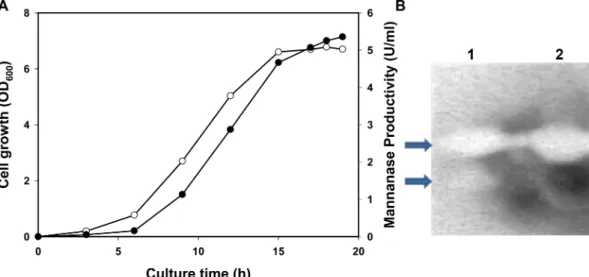
이때 MRS 배지를 사용하였고, 교반속도와 통기량은 각각 150 rpm과 1 vvm으로 조절하였다. 배양시간에 따른 균의 성 장과 배양상등액내의 mannanase 활성을 조사한 결과 균의 성장과 함께 효소 생산성도 증가하였으며 배양시간 15시간 이후에는 균의 성장이 거의 정지되었고 효소 생산성은 19시 간까지 조금씩 증가하여 5.4 U/mL에 이르렀다(Fig. 2A). 이 때 mannanase 활성은 locust bean gum (LBG)을 기질로 하 여 50oC와 pH 6.0에서 15분간 반응을 실시한 후 생성된 환 원당의 양을 DNS 방법으로 정량하여 측정하였다[7].
한편 pGK12M3으로 형질전환된 E. coli와 B. subtilis를 LB 배지에서 각각 20시간동안 플라스크 진탕배양을 하여 배 양상등액의 효소활성을 조사한 결과 1.8 U/mL, 88.0 U/mL 로 각각 확인되었다. 따라서 동일한 재조합 플라스미드를 함 유한 재조합 균주 중 B. subtilis에서 효소 생산성이 월등하게 높으며, 이에 비해 L. paracasei는 생산성이 낮으나 E. coli에 비해서는 높았다. 재조합 E. coli의 경우 생산된 ManA가 균 체 내외에 유사한 수준으로 존재하다고 보고된 바 있는데[10], 균체내 효소활성을 감안하여도 재조합 L. paracasei 보다는 생산성이 낮다고 평가되며 이는 균 성장도의 차이 때문일 수 있다. Clostridium thermocellum의 endoglucanase 유전자를 L. plantarum에서 발현시켰을 때 endoglucanase의 생산성은 재조합 대장균과 유사하며 생산된 효소의 94%가 균체외로 분비된다고 보고되었고[1], 재조합 L. reuteri의 플라스크 배 양시 균체외로 xylanase (2.3 U/mL), β-glucanase (3.1 U/
mL)와 CMCase (1.4 U/mL)을 생산하였으며, 균체내에도 비 슷하거나 이보다 적은 양의 효소가 존재한다고 보고되었다[6].
재조합 L. paracasei 로부터 생산된 Mannanase 의 특성
Cellulase유전자를 이종의 숙주균에서 발현시켰을 때 생산 된 효소는 여러 개의 활성 단백질로 존재하는 경우가 있으 며 이는 이종 숙주균의 단백질 분해활성으로 인해 단백질의 일부가 분해되어 일어난다[4]. 따라서 재조합 L. paracasei로 부터 생산된 mannanase의 물리적 변화여부를 확인하기 위 해 SDS-PAGE를 실시한 후 Yoon과 Lim이 제시한 방법대 로 활성염색을 실시하여[10] 재조합 B. subtilis에서 생산된 mannanase와 비교하였다. 이때 재조합 L. paracasei의 배양 상등액에 존재하는 효소활성이 낮으므로 이를 ammonium Fig. 1. Structure of recombinant plasmid pGK12M3 contain-
ing the manA gene (A) and hydrolysis of konjac by L. para- casei transformed with pGK12 or pGK12M13 (B). In panel A, the open bar indicates the NaeI fragment that includes a B. subtilis WL-3 manA gene and the thin line indicates a region of vector pGK12. The structural genes for chloramphenicol resistance (Cm- R), erythromycin resistance (Em-R), and mannanase (manA) are depicted. The arrows indicate the direction of transcription. In panel B, recombinant L. paracasei was grown on BCP plate con- taining Cm (10 µg/mL) for 1 day, and then overlaid by konjac plate. After incubation for 3 h at 37oC, the plate was stained by congo red solution.
188 YOON, KI-HONG
sulfate (30-70%)로 처리하고 침전된 단백질을 투석하여 농 축한 후 전기영동을 실시하였다. 활성염색의 결과 재조합 B.
subtilis의 배양상등액에서는 그 크기가 38 kDa로 알려진 단 일한 활성 band만 관찰되었으나, 재조합 L. paracasei가 생 산한 mannanase는 2개의 활성 bands로 관찰되었다(Fig. 2B).
이중에 하나는 B. subtilis에서 생산된 효소와 동일한 이동도 를 보이나 다른 하나는 이동도가 빨라 그 크기가 작아진 것 으로 확인되었으며 이로보아 생산된 효소의 일부지역이 분해 된 것으로 추정된다. 한편 WL-3의 manA는 Corynebacterium
lactofermentum에서도 발현되었으며 생산된 mannanase는 B.
subtilis에서 생산된 효소와 동일한 크기의 활성 band만을 보 인 것으로 보고된 바 있다[9].
재조합 L. paracasei로부터 생산된 mannanase 반응특성의 변화를 관찰하기 위해 반응온도와 pH가 효소활성에 미치는 영향 및 열안정성을 조사하였다. 반응온도를 50oC로 고정하 고 pH 4.0-8.0 범위의 여러 반응 pH에서 효소반응을 실시하 였고, 반응액의 pH를 5.5로 고정하고 30-70oC 범위의 여러 온도에서 반응을 실시한 후 효소활성을 비교하였다(Fig. 3A).
Fig. 2. Growth and mannanase production of the recombinant L. paracasei in fermentor (A) and zymogram (B). In panel A, growth (open symbols) and mannanase activity (closed symbols) in the culture filtrates of the L. paracasei carrying pGK12M3 were observed peri- odically during growth in MRS medium containing Cm (10 µg/mL) with fixation of pH 6.5. Enzyme productivity represents the average of three independent experiments. In panel B, concentrated culture filtrates were applied to 10% (w/v) SDS-polyacrylamide gel. Protein exhib- iting mannanase activity was analyzed by activity straining with konjac as substrate and indicated by arrows. Lanes 1; L. paracasei (pGK12M3), 2; B. subtilis (pGK12M3).
Fig. 3. Effects of reaction temperature and pH on the mannanase activity (A), and thermostability of the mannanase (B) in culture filtrate of L. paracase (pGK12M3). Temperature profile (open symbols) was obtained by measuring the mannanase activities at pH 5.5 and different temperatures. The pH profile (closed symbols) was obtained by measuring the mannanase activities at various pH’s and at a constant temperature of 50oC. Buffers (50 mM) used were as follows: sodium citrate (pH 4-6), and sodium phosphate (pH 6-8). Thermo- stability was determined by measuring the residual activities after pre-incubation at different temperatures for 1 h. Relative activity repre- sents the percent compared with maximal mannanase activity.
MANNANASE FROM RECOMBINANT LACTOBACILLUS PARACASEI 189 그 결과 L. paracasei로부터 생산된 mannanase는 pH 5.5와
40oC에서 최대활성을 보였으며 이는 기존에 보고된 WL-3 mannanase와 큰 차이를 보였다[8, 11]. B. subtilis와 재조합 대장균으로부터 생산된 mannanase는 55-60oC에서 최대활성 을 나타내며 40oC에서는 최대활성의 70% 정도의 수준을 보 인 것으로 보고된 것에 비해 재조합 L. paracasei로부터 생 산된 mannanase는 최적반응 온도가 크게 낮아졌으며 60oC 에서는 최대활성의 10% 수준이었다. 한편 반응액의 pH가 6.0일 때 완충액의 종류에 따라 효소활성이 큰 차이를 보였 으며 sodium citrate 완충액보다 sodium phosphate 완충액에 서 효소활성이 높았다.
반응온도가 효소활성의 변화에 미치는 영향이 크므로 열 안정성을 조사하기 위해 기질을 첨가하지 않은 효소액을 30- 60oC 범위의 여러온도에서 1시간동안 각각 방치한 후 동일 한 반응조건 (50oC, pH 6.0)에서 잔존 활성을 측정하고 이 를 열처리하지 않고 얼음에 방치한 효소의 활성과 상대적으 로 비교하였다. 그 결과 40oC 이상의 온도에서 상당량의 실 활이 일어나기 시작하였으며 60oC에서는 잔존활성이 거의 탐지되지 않았다(Fig. 3B). 이는 60oC 이하에서 1시간 방치 하였을 때도 거의 실활되지 않는 것으로 보고된 정제효소의 열안정성과 큰 차이가 보였다[11]. 이러한 내열성이 저하된 현상은 재조합 L. paracasei로부터 생산된 mannanase는 균 체외로 분비되는 과정에서 아미노 말단의 signal peptide가 정확하게 절단되지 않고 수개 정도의 잔기가 차이가 있도록 절단된 때문으로 추측되나 이에 대한 증거는 확보되지 못한 상태이다. Fig. 2B에 보인 zymogram에서 B. subtilis로부터 생산된 mannanase와 동일한 이동도를 보이는 활성 band가 재조합 L. paracasei의 배양상등액에서 관찰되었지만, 몇 개 아미노산 잔기의 차이가 SDS-PAGE에서는 확인되기 어려운 수준이라 하겠다. 한편 재조합 유산균이 생균제로 사용된다 면 이로부터 생산되는 mannanase가 가축 소화기관의 온도 범위에서 최대의 활성을 보이는 것은 재조합 유산균의 효능 성을 높이는 장점이 될 수도 있다.
REFERENCES
1. Bates, E. E. M., H. J. Gilbert, G. P. Hazlewood, J. Huckle, J.
I. Laurie, and S. P. Mann. 1989. Expression of a Clostridium thermocellum endoglucanase gene in Lactobacillus plantarum.
Appl. Envion. Microbiol. 55: 2095-2097.
2. Choct, M. 2006. Enzymes for the feed industry, present and future. World’s Poult. Sci. J. 62: 5-16.
3. Dhawan, S. and J. Kaur. 2007. Microbial mannanases: an overview of production and applications. Crit. Res. Bio- technol. 27: 197-216.
4. Hansen, C. K., B. Diderichsen, and P. L. Jorgensen. 1992.
celA from Bacillus lautus PL236 encodes a novel cellulose- binding endo-β-1,4-glucanase. J. Bacteriol. 174: 3522-3531.
5. Kok, J., J. M. B. M. Van der Vossen, and G. Venema. 1984.
Construction of plasmid cloning vectors for lactic streptococci which also replicate in Bacillus subtilis and Escherichia coli. Appl. Environ. Microbiol. 48: 726-731.
6. Liu, J. -R., B. Yu, F. -H. Liu, K. -J. Cheng, and X. Zhao.
2005. Expression of rumen microbial fibrolytic enzyme genes in probiotic Lactobacillus reuteri. Appl. Environ.
Microbiol. 71: 6769-6775.
7. Miller, M. L., R. Blum, W. E. Glennon, and A. L. Burton.
1960. Measurement of carboxymethylcellulase activity.
Anal. Biochem. 2: 127-132.
8. Oh, Y. P., J. -M. Lee, K. H. Cho, and K. -H. Yoon. 2002.
Isolation and enzyme production of a mannanase-producing strain, Bacillus sp. WL-3. Kor. J. Microbiol. Biotechnol. 30:
247-252.
9. Yoon, K. -H. 2009. Expression of a Bacillus subtilis mannanase gene in Corynebacterium lactofermentum. Kor.
J. Microbiol. Biotechnol. 37: 405-407.
10. Yoon, K. -H. and B. -L. Lim. 2007. Cloning and strong ex- pression of a Bacillus subtilis WL-3 mannanase gene in B.
subtilis. J. Microbiol. Biotechnol. 17: 1688-1694.
11. Yoon, K. -H., S. Chung, and B. -L. Lim. 2008. Charac- terization of the Bacillus subtilis WL-3 mannanase from a recombinant Escherichia coli. J. Microbiol. 46: 344-349.
12. Zou, X. T., X. J. Qiao, and Z. R. Xu. 2006. Effect of β- mannanase (Hemicell) on growth performance and immunity of broilers. Poult. Sci. 85: 2176-2179.