A Study on The Effect of PM Consultant Leadership Capability on Consulting Repurchase Intention
Yang-Woo Lee
1, Woo-hyung Hong
2*, Sang-Bong Kim
21Doctoral Student, Dept. Of Smart Convergence Consulting. Hansung University
2Professor, Dept. Of Economics, Hansung University
PM컨설턴트 리더십역량이 컨설팅 재구매 의도에 미치는 영향에 관한 연구
이양우1, 홍우형2*, 김상봉2
1한성대학교 스마트융합컨설팅학과 박사과정,
2한성대학교 경제학과 교수
Abstract The purpose of this study is to examine the impact of PM consultant leadership competence on consulting repurchase intention and the impact of SME CEO participation on consulting repurchase intention. The validity of the measurement model was secured through CFA (Confirmative Factor Analysis) for the questionnaire data, and consistency was secured through the same method convenience, and significant results were obtained. In other words, not only the ability of PM consultant in repurchase of consulting is important, but also confirms that repurchase intention differs according to the participation of manager. Therefore, the performance that manager feels depends on the degree of manager's interest in repurchase and plays an important role in repurchase. As a result, it is important for PM to report to manager and / or make the manager participate in consulting process so that manager can be interested.
In this study, it is difficult to generalize the relationship between PM's leadership role and manager's involvement in the repurchase intention. However, it is meaningful that PM's competence as well as management's participation are very important, and that this study figured out which drection PM's leadership should focus on. The purpose of this study is to investigate the effect of the variables on the repurchase intention.
Key Words :SMES Consulting, PM Consultant Competency, Consultant, Intention to Repurchase. Ceo's Paticipation
요 약 본 연구는 PM컨설턴트 리더십역량이 컨설팅 재구매 의도에 미치는 영향과 중소기업CEO의 참여도가 컨설팅 재구 매 의도에 어떤 영향을 미치는 지에 대하여 컨설팅을 수진한 기업을 대상으로 연구해보고자 하였다. 설문데이터에 대한 확인적 요인분석(CFA)을 통해 측정모형의 적합도를 확보하였으며, 동일방법 편의를 통해 일관성을 확보하였고, 유의한 결 과를 나타냈다. 즉 컨설팅 재구매에 있어서 PM컨설턴트의 역량도 중요하지만 경영자의 참여도에 따라 재구매 의도가 달라 진다는 것을 확인하여 재구매에 있어서 경영자의 관심의 정도에 따라 경영자가 느끼는 성과가 다르고 또한 재구매로 이어 지는데 있어서 중요한 역할을 한다고 볼 수 있으므로 PM은 수시로 경영자의 관심을 끌 수 있도록 보고 및또는 참여를 시키는 것이 중요하다고 할 수 있다. 본 연구에서는 컨설팅 재구매 의도에 미치는 다양한 영향 중 PM의 리더십 역할과 경영자의 참여도 사이에 어떠한 관계가 있는지에 대하여 한정하여 연구하여 재구매의도 전체로 일반화 하기에는 무리가 있다. 그러나 PM의 역량과 함께 경영자의 참여도 매우 중요하다는 결과를 통해 PM의 리더십이 어떠한 방향으로 중점을 두어야 하는지에 대하여 확인하였다는 것에 의의가 있다 할 것이다. 본 연구를 기반으로 향후 재구매 의도에 미치는 영향에 대한 변인을 확장하여 어떠한 변인이 더 중요하게 작용하는지에 대하여 추가적으로 연구하고자 한다.
주제어 : 중소기업컨설팅, PM컨설턴트능력, 컨설턴트, 재 구매 의도, CEO의 참여도
*This research was financially supported by Hansung university.
*Corresponding Author . Woo-hyung Hong ([email protected]) Received March 6, 2018
Accepted January 20, 2019
Revised December 26, 2018 Published January 28, 2019
1. Introduction
The size of consulting firm is not large In many cases, a consulting firm focuses on selling consulting projects in order to generate profits.
Most small consulting firms carry out projects. PM consultants are often selected and consulted on behalf of the company.
Consulting results and satisfaction of consulting repurchase are important items after consulting from the viewpoint of consulting company representative. As an employee consultant, I realized the importance of PM consultants' ability because I had difficulty completing consulting because their performance and experience were often lower than their representative consultants.
In the case of a consulting consultancy that a representative consultant of a consulting firm receives, the consultant should develop the appropriate PM consultant performance for consulting involving the CEO. In most cases, the satisfaction of consulting lacks practicality. I am studying to find solutions to these problems.
The purpose of this study is to see how PM consultants' capabilities and roles play a key role in the consulting firm's management and consulting sales strategy in order to conduct project consulting.
Therefore, it is the study of how the participation of SME CEO's consulting in regulating the PM consultant's leadership ability influences the repurchase intention of consulting.
Based on the previous research, empirical research methods and research models were established. The research hypothesis set out above is to be verified empirically. The empirical analysis of the research model verifies the effect of the PM consultant 's leadership ability on the intention to purchase the consulting repurchase and the research is conducted using the structural equation program to analyze the influence of the SME CEO participation on the consulting repurchase intention
The details of this study are set as follows.
First, we want to clarify whether PM consultant's leadership ability affects consulting repurchase intention.
Second, we analyze empirically how the participation of SME CEOs has some control effect on consulting repurchase intention and what difference in consultation repurchase intention.
The purpose of this study is to investigate the effect of PM consultant leadership competence on consulting repurchase intention and the influence of SME CEO participation on the intention of consulting repurchase intention. The measurement was done through the reconstructed questionnaire.
2. Materials and Methods
2.1 Theory on consulting
Consulting is defined as a business term in which a person with a professional knowledge in a certain field is consulted and assisted in detail in a business term.
In particular, it is necessary for external experts(Management consulting), who have a lot of knowledge and experience in management about management problems and business management skills, to investigate and analyze the management status positively at the request of the company and to promote the sound development of the management body. We recommend that management consulting is a management improvement technique that conducts guidance consultation in practice of the recommendation. In addition, the Korea Standard Industry Classification, which was implemented in 2008[1], defines management consulting business separately and defines it as an industrial activity that advises and supports business management issues to other businesses. Association of Consulting management Engineers in America defines Management Consulting as the service that experts who trained especially provides professional solutions
to provide practical solutions to identify and solve various problems in business management, and to help them to be implemented in a timely manner.
According to International Labour Organization, consulting is defined as an independent professional advisory service that supports managers and organizations to solve problems in management tasks, discover new opportunities, pursue learning, and realize change in order to achieve organizational goals[2].
Consulting is a service performed by a consultant.
The demand for consulting is mostly caused by the service that provides the company to achieve the desired purpose through the diagnosis and investigation to identify the problems and difficulties of the enterprises. In general, SMEs are conducted by management consultants in management consulting.
Recently, the ratio of self-employed people is gradually increasing from the proportion of SMEs.
According to the status of SMEs nationwide surveyed by the Small and Medium Business Administration in 2014[3], a total of 5,554,266 companies ranked in the order of percentage by industry, consists of, Wholesale and Retail(1,337,318;24.08%), Real Estate and Leasing (1,152,132;20.74%), Food and Hospitality (773,499;13.93%), Transportation (556,203;10.01%), Manufacturing (486,240; 8.75%), Construction Industry(353,126; 6.36%), Repair and Other Personal Services(259,273;4.66%), Education Services (136,612;2.46%), Science and Technology (133,456;,2.40%), Arts, Sports and Leisure Services (107,660;1.94%), Facility Business Management and Business Support Services (79,237;1.43%), Health and social welfare services (73,106;1.32%), Publishing, Video, Broadcasting Communication and Information Service(67,007;1.21%), Finance and Insurance (20,334;0.37%), Electricity, Gas Emission and Water Business (8,954;0.16%), Sewage, Waste Treatment, Raw Material Recovery and Environmental Restoration Business(8,428;0.15%) and Mining Business(1,681;0.03%).
The scope of companies subject to consulting is very
broad in terms of businesses with more than one person, so the capacity of consultants is forced to move toward general consultation. Currently, the proportion of companies that are expected to increase in proportion to the development of technologies such as Internet, VR, and AI will be in the publishing, broadcasting, communication, information service, specialty, and scientific and technical services sectors. In the case of consulting firms, according to industry analysis (2005)[2], the management consulting industry has 23,414 employees in 2,307 companies as of 2003. Less than 10 employees account for 82.3% of the total consulting industry, sales are 29.1%, and there are many very small businesses. In addition, more than 20 medium-sized and large-sized companies account for 58% of sales, and the consultant trends for full-time consultants are 19.1% for three or less employees, 40.1% for 4-5 employees, 19.3% for 6-10 employees, 8.3% for 20 persons, 2.7% for 21 persons or more, etc.
The 4-5 person consulting firm is operating as a flagship consulting company. It is important to note that this analysis is based on 2005[4], and it is estimated that the size and ability tools of consulting company have developed since then. However, looking at the changes in the management environment of SMEs, one can project that they are changing from individual consultants to project-oriented consulting.
H. W. Yim (2018) said that management consulting is to improve the sales of the company by analyzing the processes and improving the overall processes such as management, technology, production, HR, and finance[5].
2.2 Theory on management consultant
The term Management Consultant has been stipulated under 27151(classification) in Korean Standard Classification of Occupations (KSCO) 6th edition (2007), and categorized it in the 9th edition of Korean Employment Classification of Occupants (KECO) 9th edition, under 021219(classification)[1].
The Small and Medium Business Administration
operates a certified qualification as a management consultant and a technical instructor for small business consulting support projects. It is a national certification under the Act on SME Promotion and Purchase of Products, and the main tasks of the manager are categorized in Article 43 of the Act ((1) comprehensive diagnosis and guidance of management, (2) diagnosis and guidance of personnel, organization, labor, office management, (3) diagnosis and guidance of financial management and accounting, (4) diagnosis and guidance of production and operation management, consultation, investigation, analysis, evaluation and confirmation from (1) to (5), (5) and (7))[2].
2.3 Theory on consultant competency
On Consultant Competency, Williams, A. P., &
Woodward, S. (1994) notes that the main key point to watch is the ability of a consultant to provide information and advice in the field of expertise in terms of the role required of the consultant, the ability to manage and oversee the entire project, and the ability to acquire the expertise and self-competence characteristics[6]. M. G, Park (2004) divided the consultant capacity into knowledge, technology and attitude. Knowledge field competency refers to customer understanding, expertise, management knowledge, and optimal solution indicators[7]. K. Y.
Kim. M. S. Kim, C. U. Lee, Y. H. Lee said that technical competencies include communication skills, coaching and guidance, presentation skills, and project management skills. Attitude areas include professional quality, open-mindedness, customer-focused mind-sets, agreed service delivery within the term of the contract, and actions and actions to ensure confidence[8].
D. J. Shin & Y. W. Yoo.[2011] said that knowledge that a consultant should possess includes basic management knowledge, organizational knowledge, expertise in the consulting field, and experience and know-how gained from past consulting[9].
D, J, Shin(2014) proved that the competence of the project manager in the firm has a positive effect on the
ethical attitude of the consultant in the consulting project[10].
2.4 Theory on leadership
Katz and Kahn(1978) defines leader as a person who can establish an organization's goals and strategies, who can appropriately respond to variables that can not be solved on the basis of the current system and who can provide information and strategies necessary for the organization's members to adapt to the environment[11]. N. H. Park (2011) defined that the key task of the leader is to move people's actions and minds. Also, he defined leadership as a combination of the characteristics of leadership and leader, which are the status, nature, and qualification[12]. Yukl (1998) defined leadership as a process that influences the motivation of a group or organization member, the maintenance of cooperative relationships, the development of skills and confidence of the members, and the securing of support and cooperation of outsiders. There is a style of leadership according to the qualities and tendencies of the leader[13]. In the case of leadership style, leadership styles are related to characteristics (qualities and abilities) of leaders and behaviors that leaders see (influence, meaning, change induction, etc.) Yukl (2005) suggested that leadership styles are formed by the personality and behavioral traits of managers[13].
DeChurch(2010) summarized six prior studies on leadership style. First, by defining the specific behaviors of the leaders related to the effectiveness of the leadership through the study of the behaviors of the leader, we classified the behavioral leadership into structure - led leadership and considerable leadership.
Second, the characteristics of leader were defined as extroversion, conformity, integrity, stability, and openness. Third, the transformational leadership theory extends the behavioral leadership theory, so that the characteristics of transformational leaders are composed of ideal influence, motivation, intellectual stimulation, and individual consideration, whereas
transactional leadership is managed by conditional compensation and exception. In other words, transformational leaders enhance voluntary problem-solving ability and creativity of their subordinates, and transactional leaders motivate them based on conditional rewards to encourage subordinates to achieve goals. Fourth, as the leader and member exchange theory, the leader forms a differential relationship within the group and with the members outside the group. Fifth, strategic leadership theory is similar to leader 's characteristics study, but focuses on organizational - level strategy setting and its effects on results, and sixth is sharing leadership with organizational member' and leadership based on environment[14].
Bass (1985) interpreted transactional leadership theory as a contractual or exchange-related process that occurs between the leader and the load, and achieved the agreed goals based on the exchange relationship with the load And that the exercise of influence is achieved by providing the promised reward to the child[15].
J. Y. Kim(2003) shows that transactional leadership comes into contact with other people for the purpose of exchanging something worthwhile by an individual.
This leadership occurs when the leader approaches the subordinates from the point of view of exchange and takes the initiative in the contract, and the transactional leader says that the load should provide the requisite confidence to achieve desirable outcomes[16].
J, Y. Kiml(2018), in order to fulfill the goals of a community, is to create a good environment for people to support their potentials spontaneously in the performance of their work The state is defined as leadership[17].
The leader's competence must be based on the style of this leader. The concept of competence is the power to do something in the past, but the thinking varies according to the scholar. Katz(1974) found that effective management depends on three skills (professional, human, and conceptual) that a manager
(leader) has, and those skills were the personality traits of a leader (traits) and personality and that is of a different dimension[18]. A consultant works with an individual leader or many members of the organization, where the individual's leader, who is part of the organization and performs the consulting project with the consultant, is the project manager. Kim et. al.(2008) asserts that the project manager communicates the position of the consulting firm to the consultant from time to time, coordinates the situation, assists in the smooth running of the consulting project, receives orders from the consultants first and delivers them to the project team members of the referral company[8].
And to manage them, project managers presuppose project management. Kerzner (2005) defined project management as the planning, organization and control of a project to achieve its goals for technology, cost, and scheduling over a set period of time[19]. Dulewicz
& Higgs (2005) presented project management abilities as three types of competency groups. intellectual ability, management skill, and emotional competence, and 15 leadership competency factors. First, intellectual competency (IQ) includes analysis and judgment, vision and creativity, and ability to think strategically. Second, managerial competency (MQ) includes project resource management skills, good communication skills, skills to delegate appropriate authority to members, and ability to foster teams and achieve goals. Third, emotional competency (EQ) included self - awareness, emotion management, intuition, interpersonal ability, influence, motivation ability, and word - action coincidence. The ability of the project leaders were divided into emotional skills, cognitive skills, and social competence.
Emotional competence refers to the qualities of efficiency directional planning, business leadership, self-discipline, flexibility. Cognitive competency is the ability to recognize project related knowledge and concepts, systematic thinking, and job pattern recognition[20]. Social competency is the ability that the project leader interacts with team members to form a network and empathize by communicating,
negotiating, persuading and the ability to develop and manage the skills of team members. These were defined by Boyatzis & Ratti (2009)[21].
2.5 Theory on consulting repurchase intention SMEs will seek to overcome and improve their competitiveness by utilizing consulting for various difficulties in the management environment. If consultants are successful in the outcome of the first consultation, they will be able to easily take orders from consultants if they purchase secondhand consulting repurchase. In order to achieve these results, it is very important to increase consulting repurchase intention. Oliver (1980) refers to the consumer's planned future behavior, which means that beliefs and attitudes are transferred to actions[22]. N. H. Park (2004) stated that repurchase intention is the possibility that customers will repeatedly use current service providers continuously in the future[12]. Y. S.
Jang(2011)s’ opinion is that customers are willing to repurchase their services in the future, that is, their perceptions of usefulness to repurchase in the future, their willingness to repurchase in the future, their perceived wisdom about continuous use, and their intention to recommend to others[23].
2.6 Theory on participation of SMEs’ Ceos SMEs are defined according to numerical criteria such as the total amount of assets and sales, which is defined in Article 2 of the Basic Law of SMEs concerning the scope of SMEs in Korea. “Paragraph 1 should meet the standards set by the Presidential Decree, such as sales by type of business or the total amount of assets, and the independence of ownership and management, such as equity ownership or investment, while the paragraph 2 is the social enterprise defined by Presidential Decree among the social enterprises pursuant to Article 2-1 of the Social Enterprise Promotion Act, the third is the cooperative association according to Article 2 of the Cooperative Basic Act, the cooperative association, the social
cooperative association, is defined as a small business.
According to the Enforcement Ordinance of the Basic Act for Small and Medium Enterprises (No. 27106, Apr.
28, 2016)[24], SMEs should have an average sales or annual sales basis and total assets of less than KRW 500 billion. It is said that it refers to a non-enterprise.
The average sales and annual sales of the manufacturing industry are below KRW 150 billion.
Agriculture, forestry and fishery, mining, manufacturing, hydro, medium and water business, construction industry, wholesale and retail business account for less than KRW 100 billion. The Ministry of Education, Culture, Sports, Science and Technology, the Ministry of Commerce, Industry and Energy, Repair and other personal service businesses are defined as less than KRW 60 billion, and accommodation and restaurant businesses, financial and insurance businesses, real estate businesses, rental businesses and education service businesses are defined as SMEs with less than KRW 40 billion.
S. T. Chung (2014) emphasized that the characteristics of the target company include the commitment of the top management, the ability of the proprietor such as leadership and competent interpersonal relationship, the current organizational culture and flexible organizational structure[25].
In addition to having a great influence on securing necessary resources such as manpower and expenses for consulting on the level of support and interest of top management for management consulting, it also has a great influence on the participation of consultants and acceptance of innovation contents by the members of the organization(Cohen(1992)[26]).
The dictionary defines the CEO as the chief executive of the enterprise. W. R. Kang(2006) describes the CEO concept which is originated in the United States similar to Korea's CEO, as that the final decision of the enforcement responsibility and external corporate representatives, internally, the Executive Board of Directors for the company's business. The CEO’s of Korea is stipulated by the Commercial Law
and Civil Law as a necessary permanent institution of the corporation in order to maximize the value of the company[27].
SMEs have small assets, fewer employees, and many of them have poor conditions, so the success or failure of the company depends on the tendency of the CEO. Homsby and Kuratko (1990) argued that SMEs can change their management strategies according to the CEO's preferences (self-help type, possessive type, seductive type) and intentions, and the mood of the organization can be paralyzed or compulsive depending on the CEO's psychological state[28]. Garamd & Fabi (1991) also demonstrated that CEO personalities have a significant impact on organizational performance[29].
Pfiffner (1960) first identified the process of decision making as collecting data, classifying and analyzing data, creating a list of problem solving tools, and listing alternatives, alternative evaluations, alternative decisions, alternative trends[30]. Also, Hoy and Miskel (2001) identified the process of decision-making as recognizing and defining the problem, analyzing the problem in the current situation, and setting the standard for solving the problem. He looked at the process of developing action plans or strategies, and the process of conducting action plans[31].
Pinto and Prescott (1990) demonstrated in their study that the education, training, and expertise and experience of the promoting organizational members had a significant impact on the success of the project[32].
According to Eisenberger, R., Huntington, R., Hutchison, S., & Sowa, D.(1986), perceived organizational support to see firms' willingness to engage in consulting is the belief that the organization has to the organizational members and that the organizational members have a commitment to the organization[33].
K. J. Yoon(2003) found that formal participation, informal participation, institutional participation, non-institutional participation, individual participation and collective participation, administrative leadership
participation, and resident leadership type participation in terms of openness, legal basis, as they were separated by direct participation and indirect participation[34]. K. Y. Song (2015) argued that it is widely used in the field of business administration in spite of the fact that the term and concept of consulting commitment is not sufficiently explained in the previous research, and it is considered that such commitment is in common with the immersion in management consulting field[35].
H. S. Moon (2012) said that a small company's executives actively participate in consulting activities and that they are engaged. In addition, he argued that in the study of the factors that the willingness of SMEs to engage in consulting performance and reuse, the subject of engagement can be extended to consulting as well as work, job, organization, career and union[36].
Tiles (1961) stated that consulting and consulting recognition of top management is an important variable and it is important to recognize it as a process of achieving consulting through joint efforts[37].
2.7 Differentiation from previous studies In previous researches on consulting, independent variables were consulting repurchase intention of PM consultant, CEO, consultant service quality, and consultant capacity. However, for this research, focus was on analyzing the data, whether the leadership capacity of PM (project manager) consultant has a significant effect on consulting repurchase intention.
The distinctive feature of this study compared to other prior studies, was that the purpose of this study is to examine the relationship between the consulting repurchase intention and the leadership capacity of the consulting company's PM consultant by setting the control variable as to how the participation of the SME CEO is controlled.
3. Research model
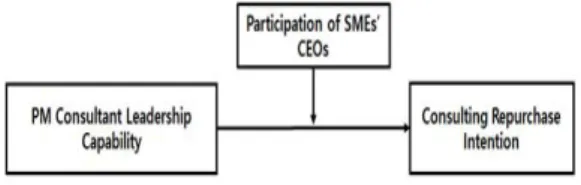
This study first examines the effect of PM consultant's leadership ability on consulting repurchase intention and secondly, it examines whether the participation of SME CEO influences counseling repurchase intention and has controllability. In this study, the PM consultant's leadership abilities, which are presented through manipulative definition, are compared with those of the researchers' research on Katz and Kahn (1978), DeChurch (2010), Knowledge and attitude. The endogenous variables are professional methodology, customer requirement recognition, communication, problem solving, project management, information collection, expert knowledge, consulting experience know-how and confidentiality. We intend to receive consulting for consulting repurchase intentions, continue to use the previous consulting event, use consulting firm preference consulting company, recommend consulting to other companies, and set the participation level of SME CEO as control variable
Fig 1. Structural equation model
3.1 Research hypotheses
The purpose of this study is to investigate the effect of PM consultant leadership competence on consulting repurchase intention. Therefore, the following research hypotheses were set up to investigate the intention factors of consulting repurchase according to PM consultant 's leadership capability.
H1. Professional methodology will have a significant impact on consulting repurchase intentions.
H2. Customer requirement awareness will have a significant impact on consulting repurchase intentions.
H3. Communication will have a significant impact on
consulting repurchase intentions.
H4. Problem solving will have a significant impact on the repurchase intention of consulting.
H5. Project management will have a significant impact on consulting repurchase intentions.
H6. The participation of SME CEOs will play a role in regulating the influence of PM consultants' leadership capacity on repurchase intentions.
3.2 Operational definition of variable and composition of questionnaire
In order to achieve the purpose of this study, we set the leadership capacity of PM consultant as an independent variable, the intention of repurchasing consulting as a dependent variable, and the participation degree of SME CEO as a control variable.
Tayler (2006) presented IT project managers with the skills they need to understand, problem solving, organizational, teaming, communication, and leadership skills[38]. Dulewicz & Higgs (2005) presented project management abilities as three types of competency groups: intellectual ability, management skill, and emotional competence, and 15 leadership competency factors[20]. In this study, the leadership competence of PM consultant, an independent variable, was defined by professional methodology, customer requirement recognition, communication, problem solving, and project management.
According to the data of SME Technology Research Institute (2009), recent research results of government affiliates showed that they did not utilize the consulting results and they showed internal will to use consulting results and lack of consensus. As a result, not only expertise of consultants but also active attitude of SMEs Is also an important factor in consulting performance. According to Eisenberger et al. (1986), perceived organizational support to see firms' willingness to engage in consulting is the belief that the organization has to the organizational members and that the organizational members have a commitment to the organization[26]. It is expected that this
participation and support will make the consulting result good, so CEO's consulting participation is manipulated and defined by active participation and interest[33].
In a previous study on consulting repurchase intent, Y. S Jang (2011) pointed out that "customer intends to repurchase service in the future, that is, recognition of usefulness to repurchase in the future, intention to repurchase in the future, Regarding the consulting repurchase intention, she defined it as "intention to repurchase consulting service in the future[23]."
All variables except for demographic characteristics and consulting experience were measured using the Likert 5 - point scale. The questionnaire included independent variables, dependent variables, control variables, and items of demographic characteristics. In order to analyze the research model based on the previous research, the questionnaire used in this study consisted of PM consultant leadership competency, SME CEO participation and demographic characteristics 8 items (gender, The number of employees, the type of business, the status of listing, the size of the firm, and whether to be consulted).
In this study, a survey tool was constructed to verify the relevance of SME participation in consulting to the repurchase of consulting.
The sample of statistical data needed for the empirical analysis was selected and collected through direct survey through questionnaires. The random sample of 300 companies surveyed by SMEs who had received consulting was surveyed from September 15, 2016 to 2016 The study was conducted until September 27th. A total of 260 (N = 260, 86% recovery rate) questionnaires were used except for 30 questionnaires that were not available as double data.
The questionnaire consisted of self - administered questionnaires, and all items were constructed using the Likert 5 - point scale for consistency of statistical processing.
The validity of KMO and Bartlett's validity test was evaluated by using KMO = .846, p = .000, and .05,
respectively., And the choice of variables for the validity analysis was fairly good, with a commonality ranging from a minimum of .771 to a maximum of .823., The total variance explained was 2 factors. The extracted two initial eigenvalues were 3.970 and 3.162, respectively, and the initial eigenvalue was 44.112 and 35.133, respectively. The cumulative percentage was 79.245%. In the rotational sum of squares, it is 79.245%, which is the same as before the cumulative percentage of rotation.
In order to verify the reliability, Cronbach 'α reliability analysis was performed, As a result of the reliability analysis, it can be judged that the reliability is verified if the confidence coefficient is over .600.
Cronbach's α for professional methodology is 0.694, Cronbach's α for customer's requirement is 0.697, Cronbach 'α was 0.711, Cronbach' α for problem solving was 0.719, and Cronbach 'α for project management was 0.910.
According to the demographic characteristics, the sexes were 89.06% (233) for male and 10.40% (27) for female. The duration of employment was 32.3% (84) for less than 10 years, 33.5% for 11 ~ 20 years And 34.2%
(89 persons) for 21 years or more. The number of students who graduated from graduate school was 36.5% (95 students), college graduates (35.8%, 83 students), and 31.5% (82 students). The number of employees was 33.1% (86 students) 35.8% (93 persons) from 51 ~ 100 persons, and 31.2% (81 persons) from 101 persons or more. By industry, 52.7% (137 persons) were manufacturing, 47.3% (123 persons) were non-manufacturing, and 50.8% (132 persons) were listed and 49.2% (128 persons) In the scale, annual revenues less than 5 billion KRW were 33.5% (87 persons), annual revenues less than 10 billion KRW were 31.9% (83 persons), and annual revenues more than 10 billion persons were 34.6% (90 persons).
Table 1. Technical metrics of the tool
Min Max M SD Skewness Kurtosis
A1 1.00 5.00 3.4577 1.11593 -.305 -.672 A2 1.00 5.00 3.6115 1.06862 -.380 -.610
A3 1.00 5.00 3.1346 .95515 .076 -.518
A4 1.00 5.00 3.4654 .96800 -.197 -.456
A5 1.00 5.00 3.9538 .93298 -.799 .409
4. Results and Discussion
4.1 Structural equation model
Professor James L. Arbuckle of the temple university, widely used until now, is a model used for analysis of structural equation modeling (SEM) data in social science field. It is one of the most used programs by applying the central interface. In the case of regression analysis, the mean value of the items should be taken as a single variable or each item should be linked one by one. On the other hand, in the case of the structural equation model, However, in the case of the structural equation model, AMOS was used for statistical analysis in this study because of the advantage that the significance value between variables can be seen at once even if there are two or more potential variables[39].
In order to construct the research model according to the three research models, it is necessary to input the error parameters (11 ~ 15) of the latent variable, the measurement variable, the endogenous latent variable and the error term (21 ~ 24).
Fig 2. Structural Equation Model
4.2 Validity of the model
The factor analysis was conducted to examine the validity of the PM consultant 's leadership competency.
Factor analysis showed that 5 factors accounted for
79.245% of total items. The factors were professional methodology, customer requirement, communication, problem solving, project management, factor loadings were 0.771 ~ 0.823 respectively. As a result of the reliability analysis, Cronbach's α for professional methodology is 0.699, Cronbach's α for customer's requirement is 0.702, Cronbach's α for communication is 0.711, Cronbach's α for problem solving is 0.723, Cronbach 'α was 0.915 and the reliability was high.
Table 2. The correlation coefficients of the model, AVE&CR
A1 A2 A3 A4 A5 C.R Cronbachα
A1 1.000 8.721 .699
A2 .778 1.000 8.544 .702
A3 .703 .762 1.000 9.778 .711
A4 .724 .702 .725 1.000 10.941 .723
A5 .024 -.026 .023 -.045 1.000 11.495 .915
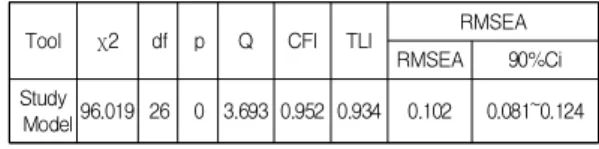
The validity of the research model is as follows. The Q value of less than 0.05 and the χ2 value of χ2 / df is less than 3 and the TLI and CFI index values are 0.9 , It can be said that the fitness of the research model is acceptable and that the model validity is secured.
Table 3. Validity of the research model
Tool χ2 df p Q CFI TLI RMSEA
RMSEA 90%Ci
Study
Model96.019 26 0 3.693 0.952 0.934 0.102 0.081~0.124
4.3 Common method bias
The Common method bias is to separate the measurement method of research design.In other words, when the independent and dependent variables are measured in different ways, the variance of the measurement method becomes smaller because the source of the response is independent. Table 4 show the reductions of χ2 and DF during uncontrolled and controlled control due to the common method bias in this study.
Table 4. Common method bias analysis
χ2 DF △χ2 △DF p
Uncontrolled variance by
Common Method Bias 96.019 26
Controlled variance by Common
Method Bias 48.942 17 47.08 9 0.000
4.4 Test of Research Hypothesis
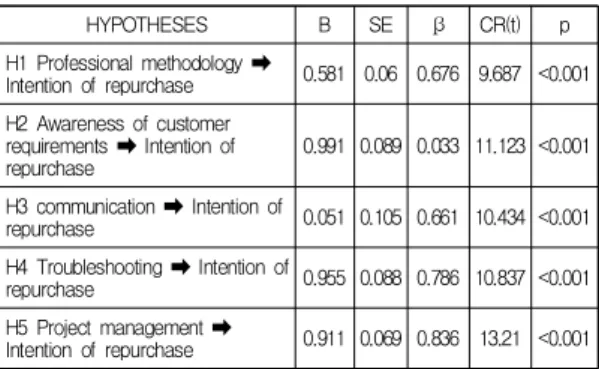
The research hypothesis H1, "Professional methodology will have a significant impact on consulting repurchase intention" was adopted.
The research hypothesis H2, "Customer requirement awareness, will have a significant impact on consulting repurchase intentions" was adopted.
The research hypothesis H3, "Communication, will have a significant impact on the repurchase intention of consulting" was adopted.
The research hypothesis H4, "Problem solving will have a significant impact on consulting repurchase intentions" was adopted.
The research hypothesis H5, "Project management, will have a significant impact on the intention of consulting repurchase" was adopted.
The test results are shown in [Figure 3].
This study aims to confirm whether PM consultant 's leadership ability affects consulting repurchase intention.
The PM consultant leadership competence is the subject of research in many areas on the impact of consulting repurchase intention. Many concepts are structured by the structural relationships between the theoretical and abstract potential variables, and the model is observed and measured quantitatively. The verification of the indices was carried out through a structural equation model. In order to verify this, analyzed characteristics of the data, analyzed the relationship between the variables, and finally analyzed the influencing factors are shown in Table 5. This result shows that PM leadership leads to repurchase rather than high PM leadership, and PM should report to manager if it is possible to understand the process and efficacy of consulting
Fig. 3. Results of research model
Table 5. Research model test of hypotheses
HYPOTHESES B SE β CR(t) p
H1 Professional methodology ➡
Intention of repurchase 0.581 0.06 0.676 9.687 <0.001 H2 Awareness of customer
requirements ➡ Intention of
repurchase 0.991 0.089 0.033 11.123 <0.001 H3 communication ➡ Intention of
repurchase 0.051 0.105 0.661 10.434 <0.001 H4 Troubleshooting ➡ Intention of
repurchase 0.955 0.088 0.786 10.837 <0.001 H5 Project management ➡
Intention of repurchase 0.911 0.069 0.836 13.21 <0.001
4.5 Moderating Effect Test
The hypothesis H6 (Participation of SME CEOs will play a role in controlling the influence of PM consultants' leadership capacity on consulting repurchase intention) was verified using the centralization theorem. The results are shown in Table 6.
Table 6. Mediating effect test results
TOOL B SE β CR(t) p
PM consultant's leadership capacity ➡ Participation of SME CEO ➡ Consulting Intention of
repurchase
0.983 0.092 0.67 10.656 0.000
Table 6 is the result of the analysis about the effect of CEO’s participation on the PM consultant leadership ability.
As the table shows, p=.000, β=0.67, t=10.656.
It means that CEO’s participation have an effect on the repurchase of the consulting.
In other words, the percentage of the repurchase of the consulting is getting higher as CEO takes an active attitude toward consulting program.
As a result, PM consultant should make an effort for CEO to take deeply part in consulting process through communication or report.
5. Conclusion
In this study, the experiment was conducted on the construction of a structural equation model for the impact of PM consultant leadership on consulting repurchase intention, summarize the criteria for evaluating analytical procedures and model fit, and demonstrate that SME CEO participation has some control effect on consulting repurchase intention We tried to find the optimal model by analyzing the structural equations model for 260 companies. In order to select the optimal model, we estimated the observed data to fit the set structural equation model. The optimal parameter was selected through the statistical test and the fitness index. In the structural equation model, the fitness index was generally good, and PM consultant leadership competence influenced consulting repurchase intention. SME CEO participation moderated the consulting repurchase intention.
This study suggests a structural equation model for studying the impact of PM consultant's leadership capacity on consulting repurchase intention, although it is limited to generalization of research results because it is conducted for SMEs who have experienced consulting.
This study is rather difficult to generalize to the conclusion that PM consultant 's leadership capability leads to consulting repurchase.
However, even if the PM competency is high, it is verified through empirical analysis that it does not lead to high repurchase if managerial participation is low,
This research has limited analytical limits on the PM consultant's leadership competency in five areas:
professional methodology, customer requirements awareness, communication, problem solving and project management.
In the future, we will analyze in detail the extent to which the PM consultant competency has a higher impact on repurchase.
References
[1] National Statistical Office. (2008). The 9th Korea Standard Industry Classification.
[2] International Labour Organization.
https://www.ilo.org.
[3] National Statistical Office. (2014). National SME BusinessStatushttp://kosis.kr/statisticsList/statisticsList _01List.jsp?vwcd=MT_ZTITLE&parentId=K#SubCont [4] Small and Medium Business Administration. (2005).
Industry White Paper
[5] H. W. Yim. (2018). A Study on the Causes and Consulting Methods to Reduce the Differentiation of Incubator Center, Journal of Convergence for Information Technology, 8(1), 313-320
[6] Williams, A. P., & Woodward, S. (1997). The competitive consultant: a client-oriented approach for achieving superior performance. Palgrave Macmillan.
[7] M. G. Park. (2004). A Study on the Core Competencies of IT Consultants, Kyung Hee Univ., Master Thesis, Seoul.
[8] K. Y. Kim, M. S. Kim, C. U. Lee, Y. H. Lee. (2008).
Understand and utilize business consulting services, Book publication Chungham.
[9] D. J. Shin & Y. W. Yoo. (2011). Research on the Effects of a Project Manager’s Competency on a Consultant’s Ethical Attitude and the Consulting Achievement with the Regulation Effects of CEO Support. Journal of Digital Convergence, 12(5), 191-201.
[10] D, J, Shin. (2014). A Study on the Impact of Conultant’s Competencies on Consulting Performance of Business Consulting:Moderationg Effect of Project Manager’s Competencies. Journal of Digital Convergence for Information Technology, 9(6), 255~266.
[11] Katz, D., & R. L. Kahn. (1978). The social Pshchology of Organizations, New York:Willey.
[12] N. H. Park. (2009). Organizational Behavior, Park Young Publishing, 24-32, 201.
[13] Yukl, G. A. (2005). Leadership in Organizations,
Pearson Prentice Hall, Englewood Cliffs.
[14] Dechurch, A. Leslie, N. J. Hillte, M. Toshio, D. Daniel, &
S. Eduardo.(2010). Leadership across levels of leaders and their levels of impact, The Leadership quarterly, .21(6), 1069-1085.
[15] Bass. B. M., & Avolio, B. J. (1990). Transformational leadership development : Manual for the multi factor leadership questionnaire. CA : Consulting Psychologists Press.
[16] J. Y. Kim. (2003). A Study on the Effect of Leadership on Trust, Empowerment and Service Quality. Sangji University Doctoral Thesis, Gangwon
[17] J. Y. Kim. (2018). The Concergence of the Servant Leadership of SMEs on Interpersonal Relation of Unicersity Students. Journal of korea Convergunce Society. l9(4), 209 ~ 222.
[18] Katz. (1974). Advanced Project Management: Best Practices on Implementation. John Wiley & Sons.
[19] Kerzner. (1984). Advanced Project Management: Best Practices on Implementation. John Wiley & Sons.
[20] Dulewicz & Higgs. (2005). Assessing Leadership Styles and Organizational Context. Journal of Managerial Psychology, 20(2), 105~123.
[21] Boyatzis, R. E. and F. Ratti. (2009). Emotional, Social, and Cognitive Intelligence Competencies,
Distinguishing Effective Italian Manager and Leaders in a Private Company and Cooperatives. Journal of Management Development, .28(9), 821-838.
[22] Oliver. R. I. (1980). A Cognitive Model of The Antecedents and Consequences of Satisfaction Decision.
Journal of Marketing Reserch, 17(11), 460-469.
[23] Y. S. Jang. (2011). A Study on the Quality and Customer Satisfaction of Small and Medium Business Consulting Service, The Quality Management Society of Korea. The Korean Society for Quality Management, 24-32.
[24] Legislation. Basic Law of Small Business, www.moleg.go.kr
[25] S. T. Jung. (2014). A Study on the Impact of Uncertainty, Environmental Factors of Consulting Service on Purchase Intention. Doctoral dissertation, Hansung University , Seoul.
[26] Cohen, J., and Cohen, P. (1983). Applied Multiple Regression/ Correlation Analysis for The Behavioral Science, Hillsdale, NJ: Laerence Erlbaum Associates.
[27] W. R. Kang. (2006). SERI20th anniversary special feature(Ⅲ),Evolution of Korean CEO System:1986~2004, Samsung Economic Research Institute.
[28] Homsby, J. s. & Kuratko, D. F. (1990). Human Resource
Management in Small Business: Critical Issues for the 1990s. Journal of Small Business Management, 25, 9~18.
[29] Garand, D., & Fabi, B. (1991). Fondements des pratiques de GRH en PME: Formalisation, vision entrepreneuriale et modèle contingentiel. 324-336. Actes du 2e Congrès AGRH, Pour une vision de la GRH, ESSEC, Cergy, 14-15.
[30] Pfiffner, J. M. (1960). Administrative Rationality. Public Administration. Review, 20(3), 125-132.
[31] Hoy, W. K., & Miskel, C. G. (2001). Educational administration: theory, research, and practice(6th ed.).
Boston: McGraw-Hill.
[32] Pinto, and Prescott. (1990). Planning and Tactical Factors in the project Implementation Process. Journal of management Studies, 305-327.
[33] Eisenberger, R., Huntington, R., Hutchison, S., & Sowa, D. (1986). Perceived organizational support. Journal of Applied psychology, 71(3), 500.
[34] K. J. Yoon. (2003). A Comparative Study on the Types of Participation in Major Groups in the 21st District.
Marketing Research, 15(3), 169-188
[35] K. Y. Song. (2015). The Effect of Consulting Commitment on Consulting Quality Perception and Consulting Effectiveness, doctorial dessertion, Hansung University. Seoul.
[36] H. S. Moon. (2012). Effects of Small Business Participation on Consulting Results and Repurchase.
Master dissertation, Hansung University, Seoul [37] Tilles, S. (1961). Understanding the consultants role.
Harvard Business Review, 39(6), 87-99.
[38] Tayler, J. (2006). A Survival Guide for Project Managers. 2nd ed. AMACOM.
[39] G. S. Kim. (2004). Analysis of AMOS Structural Equation Model, Seoul Spss Acadamy, 3, 87-101.
이 양 우(Lee Yang Woo) [정회원]
․1983년 2월 : 인천대학교 무역학 과(경영학사)
․1989년 8월 : 국민대학교 경영대 학원 (경영학석사)
․2015년 9월 ~ 현재 : 한성대학교 스마트융합컨설팅 박사과정
․관심분야 : 경영컨설팅, 소상공인비즈모델, 소상공인정 책
․E-Mail : [email protected]
홍 우 형(Hong, Woo Hyung) [정회원]
․2015년 6월 : 미국 University of Washington 경제학과 (박사)
․2015년 8월 ~ 2017년 2월 : 한국 조세재정연구원 부연구위원
․2017년 3월 ~ 현재 : 한성대학교 경제학과 교수
․관심분야 응용미시경제, 산업조직론, 재정학
․E-Mail : [email protected]
김 상 봉(Sang-Bong Kim) [정회원]
․2008년 8월 : Texas A&M University(경제학 박사)
․2009년 9월 ~ 현재 : 한성대학교 경제학과 교수
․관심분야 : 거시경제, 화폐금융, 행동경제, 국제금융
․E-Mail : [email protected]