• 검색 결과가 없습니다.

A Study on the Effect of Consultant Capability on Consulting Satisfaction

N/A
N/A
Protected

Academic year: 2021

Share "A Study on the Effect of Consultant Capability on Consulting Satisfaction"

Copied!
11
0
0

로드 중.... (전체 텍스트 보기)

전체 글

(1)

1. Introduction

In the era of the fourth Industrial Revolution, many changes have been made in various industrial fields,

and each of them has made numerous efforts to adapt and to lead to change. In line with this trend, the consulting industry is gradually spreading to various fields in the simple field of the past. These changes

A Study on the Effect of Consultant Capability on Consulting Satisfaction

Yong-Kuk Choi

1

, Sang-Bong Kim

2*

, Woo-hyung Hong

2

1

Doctoral Student, Dept. Of Smart Convergence Consulting. Hansung University

2

Professor, Dept. Of Economics, Hansung University

컨설턴트 역량이 컨설팅 만족도에 미치는 영향에 관한 연구

최용국1, 김상봉2*, 홍우형2

1한성대학교 스마트융합컨설팅학과, 2한성대학교 경제학과

Abstract The purpose of this study is to investigate the effect of consultant 's competence on consulting satisfaction, consulting service quality, and understanding of client firm consulting. In summary, the results of this study suggest that the competency of a consultant influences the satisfaction of consulting and affects the satisfaction of consulting through service quality. Responsiveness, empathy, type, assurance and reliability have a significant impact on the hypothesis. Also, the higher the understanding of client firm consulting, the higher the satisfaction of consulting. In order to further improve the satisfaction of such consulting, it is necessary to enhance client firm consulting understanding. In order to improve the satisfaction of consulting, it is suggested that not only the consultant capacity but also the efforts to improve the consulting understanding of the customer can achieve the intended satisfaction.

Further research is needed on how to improve understanding of how to improve consulting satisfaction in the future.

Key Words : Consultant capacity, consulting satisfaction, consulting service quality, degree of understanding

요 약 연구의 목적은 컨설턴트의 능력이 컨설팅 만족도, 컨설팅 서비스 품질 및 고객 회사 컨설팅에 대한 이해에 미치는 영향을 조사하는 것이다. 본 연구결과를 요약해보면 컨설턴트 역량이 컨설팅 만족도에 영향을 미치며, 서비스 품질을 매개 하여 컨설팅 만족도에 영향을 미칠 것이라는 가설에 대해 대응성, 공감성, 유형성, 확신성, 신뢰성이 유의한 영향을 미치는 것으로 확인할 수 있었다. 또한 수진기업이 컨설팅에 대한 이해가 높을수록 컨설팅의 만족도에 영향을 미치는 것으로 나타 났다. 컨설팅의 만족도를 향상하기 위해서는 컨설턴트 역량뿐만 아니라 고객의 컨설팅 이해를 향상하기 위한 노력이 기울 여야 의도하는 만족도를 달성할 수 있다는 점을 시사하고 있다. 향후 수진기업 측면에서 컨설팅 만족도를 향상할 수 있는 이해도 높일 수 있는 방안에 대한 추가 후속 연구가 필요하다.

주제어 : 컨설턴트 역량, 컨설팅 만족도, 컨설팅 서비스 품질, 이해도

*This paper was supported by the research fund of Hansung University in 2018

*Corresponding Author : Sang-Bong Kim([email protected]) Received February 28, 2018

Accepted April 20, 2018

Revised April 2, 2018 Published April 28, 2018
(2)

invite competition and the strategy of consulting is becoming more complex and multifunctional in order to secure competitive advantage in such competition[1].

The domestic consulting market grew gradually from 53.4 billion won in the 1990s to 2.17 billion won in 2015.

However, the domestic consulting market is dominated by overseas global consulting firms, but less than less than 10 people in domestic consulting firms account for 82%[2]. In this paper, we propose a new methodology for consulting, which is based on the concept of customer satisfaction .Kwak, Hong-Ju[3] If the size of such a consulting company is small, the relationship between consulting complaints and management performance is insufficient and customer satisfaction is not satisfied due to lack of role due to supplier-oriented consulting. The consulting firm improves the company's sales by analyzing management, technology, production, human resources and financial-wide processes through management consulting[4]. It defines service quality but is defined in terms of service researchers provided through consulting In addition, the components may be subject to social and environmental background [5]. Service quality management is the core of core services that must be continuously managed to achieve management goals[6]. The service quality measurement is generally judged by the consumer to satisfy the performance of the service provided [7].

Service quality will affect customer satisfaction[8].

Sung-Hwan Yoon[9] differentiated the completeness of consulting and causal relationship, and Yoo-Won Lee[10] empirically analyzed the factors that imipact the business performance from the service recipient’s point of view. In addition, there have been various attempts to study the management performance of service recipients, but there have been some weaknesses. Through these studies, consultants are asked to identify the functions they need to focus on, enhance customer satisfaction, and establish a relationship between consulting and a high level of understanding of capabilities and services. This provides the rationale for business performance by

improving efficiency. Understanding the relationship between the factors that effect this effect and providing effective consulting to the consultant.

2. Literature Reviews

Young dae Cho[11] said in his paper said that consulting is analyzing the problem and proposing specific solutions in respective expert areas, and small and medium business (SME) industry whitepaper suggested[12] the solutions to the problems that the SMEs are experiencing to eventually implement the solutions timely.

Greiner & Metzger[13] viewed it as a professional service, and Williams & Woodward[14] saw the consultant as a process of providing services to meet customer needs. Joe Jae-ryong[15] said it is a series of activities to diagnose the problems of the company and make a prescription appropriate for the situation. Jin Hae Kwang[16] said a consultant is a specialist who helps the company to achieve the management goal.

2.1 Consultant capacity

As for consultant capability, McLaughlin[17]

required consulting performance and integrity, customer control, and ability to deduce clear bottoms, and Young-Dae Cho[11] sees ethics and integrity.

So-Hyun Park and kook-hee Lee[18], based on Josh &

Kuhn’s[19] research, suggested the competency model as 6 areas and 18 items. Choi Chang-ho[20]

emphasized the importance of trust in consultant capabilities. Choi Young-suk[21] pointed out that problems should be diagnosed through experiential and continuous research. Further, strict ethics must be in place to protect the service recipient’s profits and increase it, and while providing advisory services, the final decisions are made by the service recipient resulting in no direct responsibility of the consultant.

Further, the paper saw that consulting is a temporary

assignment during a given contracted time period Mun,

(3)

Hyung-joon[22] said that the interaction is with consultant competence, organizational competence, knowledge competence and executive competence.

Dulewicz and Higgs[23] said intelligence, management competence, emotional intelligence, Tayler[24] said ability to understand technical concepts, problem solving ability, management skills, team management skills, communication skills, leadership, Visscher[25] said problem diagnosis and analysis, alternative presentation, implementation and evaluation, Boyatzis and Ratti[26] said emotional competence, cognitive competence, social competence, Ralph[27]

said consulting costs, accessibility, professionalism, personal personality, personal knowledge, experience, Young jang[28] said professional, educational, political, administrative competence, Yong-eun Moon[29] said business strategy, business function, innovation, business field, general management field, interpersonal skills, technical expertise, Kwang Yong Kim[30] said Problem diagnosis, Alternative presentation, Schedule management, Relationship management, information gathering, consulting ethics, responsibility, management knowledge, expertise, consulting experience, Ik Sung Kim[31] said self-awareness, self-regulation, motivation, and emotion, Dong In jang[32] said problem diagnosis and analysis, alternative presentation, information collection, process management, consulting ethics, responsibility, honesty, Yong-Sub Bae[33] said 18 elements in three dimensions including common competence, job competence, and management competency, and Hu-Jin Kim[34] said knowledge of management technology, knowledge of consulting, expertise, know-how, confidentiality, ethical awareness, compliance with business domain and scope, responsibility, morality

2.2 Consulting Service Quality

In terms of consulting service quality, Kotler[35]

defines service as intrinsic intangible utility or activity provided to the other party without generating ownership. Garvin[36] said the best view of service

quality is from the user perspective.

Garvin et al[36] described fitness for product or service work, and Parasuraman et[37] found that service level differences and service quality perceived by consumers were comparable, and Gronroos[38]

found that the level of service provided was consistent with customer expectations, perishability, inseparability, heterogeneity. Cronin&Taylor[39] suggested SERVPERF model, Yoo Jae Lee[40] suggested KS-SQI model, and Brady & Cronin[41] proposed a three-dimensional quality model

The SERVQUAL model is based on the ability to provide personal attention to customers, empathy of interest and kindness, tangibles of physical facilities, equipment, personnel, communication tools, ability to provide customers with prompt services. We can distinguish between voluntary and responsive responsiveness, reliability, which is the ability to believe and promise a promising service, and assurance, which is the ability to convey service providers' knowledge, discretion, faith and trust.

The SERVPERF model is basing on the service quality after the service is provided, and the simplicity, measurement model, and performance item importance are applied. Because there could be ambiguity with customer expectation that leads to inability to measure objectively, we only applied the perception level to the model

The KS-SQI model reinforces the performance aspect of the service by balancing performance quality and process quality. The three-dimensional quality model has been pointed out that the SERVQUAL model is overly biased to the process quality, blurring the result quality, and neglecting the physical environment.

Therefore, the SERVQUAL model was modified to omit the measurement related to expectation, and the process quality and the result quality were considered together.

2.3 consulting satisfaction

In the case of external consulting, financial

(4)

performance or nonfinancial performance is visible.

However, unexpected problems arise in the course of the solution and consulting performance is not directly linked to the management performance. However, there is a high degree of satisfaction with consulting.

Based on the SERVQUAL model, Myung-gyu Choi[42] investigated the effects of five factors, empathy, tangibility, responsiveness, reliability and certainty, on firm performance and consulting satisfaction and perceived value. In this paper, we propose a new methodology of consulting services that can be used to analyze the performance of consulting services.

2.4 Differentiation from previous studies This study analyzes the relationships between the factors needed to increase the satisfaction of consulting in the long term and can get an immediate insight into actual business performance. The relationship between the factors affecting the satisfaction of consulting was also examined in the existing paper on the effect of consultant capacity on the satisfaction of consulting.

However, in this study, besides the relationship between consulting capacity and satisfaction of consulting, the control of understanding level of consulting was analyzed. Through these studies, it is necessary to draw conclusions as to what part of the competence the consultants should focus on and which service quality enhances the customer's satisfaction, and what actions should be taken to increase understanding of consulting as well as capabilities and services and to draw conclusions.

3. Research model and Hypotheses

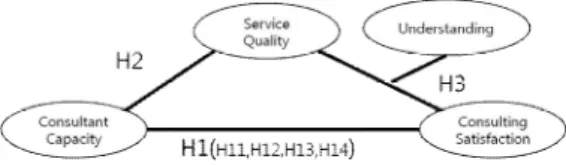
The purpose of this study is to examine the relationship between consultant competence and consulting service quality. Including findings from past studies with the researcher’s opinions on the operational definitions. In this study, consulting

satisfaction was set as a dependent variable, consulting service quality as a parameter, understanding as a control variable, and consultant competence as an independent variable (exogenous variable)Fig.1.

Fig. 1. Research model.

3.1 Research hypotheses

In this study, we analyze the relationship between

the factors needed to improve the consulting

satisfaction that can be confirmed immediately rather

than actual business performance in the long run. The

relationship between factors influencing consulting

satisfaction was investigated by the effect of consultant

capacity on consulting satisfaction. In addition to the

relationship between consulting competency and

consulting satisfaction, we analyzed the effect of

control on understanding level of consulting. The

hypothesis of this study is that the quality of the

consulting service and understanding of the company

are analyzed at the same time, unlike the previous

studies on the management performance over a long

period of time. According to previous research, the

main factors affecting consulting satisfaction are

classified as consultant characteristics, company

characteristics, consultant characteristics and

environmental characteristics. reviewed the factors

affecting the consultant's competence and consulting

satisfaction, and Yoon-Won Lee[10] showed the

manager's ability to manage the consultant's ability

and consulting process. Sung-hwan Yoon[9] argues

that it is the expertise of the consultant is the most

influential factor in the satisfaction of the consulting

firm, and Yong-Dae Cho[11] says it’s the quality,

expertise, experience, ethics and integrity of the

consultant are the most influential factors in the

satisfaction of consulting. Simon & kumar[43] said

(5)

consultant's communication skills and extensive skills, technical knowledge, integrity and honesty, Adamson

& Malachlin[44] said expertise and proficiency of consultants, confidence building with customers, integrity and ability, Young jang[28] said it’s the consultant’s trustworthiness and professionalism, Kwang-Hoon Kim, Kyu-Seung Hwang[45] said it’s the morality, credibility, responsiveness, communication, Zeira and Avedisian[46] said it’s the consultant’s expertise, Keo-Young Song[47] argues that consultant capability, a supplier characteristic of consulting, is a major factor affecting consulting satisfaction.

The purpose of this study is to establish a method to improve the consultant's capacity to contribute to the satisfaction of consulting. The consultant's competency is divided into general competence, competency competence, knowledge competency and attitude competency. In addition, the degree of satisfaction with the consulting satisfaction was confirmed. The following hypotheses were established for these relationships.

H1. The consultant capacity will have a positive impact on consulting satisfaction.

H1-1. The Basic competency of the consultant will have a positive impact on consulting satisfaction.

H1-2. The consultant Skills competency will have a positive impact on consulting satisfaction.

H1-3. The consultant knowledge competency will have a positive impact on consulting satisfaction.

H1-4. The consultant attitude competency will have a positive effect on consulting satisfaction.

Kotler[35] reported satisfaction as degree of happiness or disappointment through purchasing process as a result of comparison between expectation and quality, Taylor[24] described service quality as a prerequisite for customer satisfaction. In addition, the hypothesis that the satisfaction level of the consulting

program will vary according to the degree of understanding of the customer is set up.

H2. The quality of consulting services will have mediating effects on the consultant satisfaction.

H3. The understanding of consulting will have a moderating effect on the effect of consultant competence on consulting satisfaction.

3.2 Operational definition of variable and composition of questionnaire

In this study, setting the hypotheses and setting the variables can be varied according to the researcher to meet the research direction and research intention. In this study, Theories and the theories presented in Chapter 2 were analyzed and the variables were set up based on these theories and questionnaires were constructed. In order to prove the statistical relation to the consulting satisfaction according to the consultant competence, the consultant competency sub-variables general competence, competence competence, knowledge competency, attitude competency and consulting satisfaction were constructed by the five point Likert scale, and for service quality, we selected confidence, tangibility, empathy, correspondence, then we selected survey audience.

In order to analyze the data obtained through the questionnaire, the following analysis was conducted using SPSS Version 23.0 statistical program and AMOS 23.0 structural equation model. First, frequency analysis was conducted to analyze demographic and general characteristics. Second, to ensure consistency of research, reliability analysis was performed with factor analysis and Cronbach’s alpha coefficient before analysis through AMOS structural equation model.

Third, verification factor analysis was performed to

verify the validity of the measured variables. Fourth,

the fitness index extracted from the structural equation

model was evaluated to assess the suitability of the

research model and the path coefficient was estimated.

(6)

4. Results and Discussion

The questionnaire was conducted by self-administered questionnaire survey. All items were composed of 5 points of Likert scale for consistency of statistical processing, and audience was located in Seoul and Kyungin area and had private and public consulting service. Out of 500 surveys, we collected 420, and excluding the incorrect data, 216 surveys were used (N

= 216, 51.4%), and the research hypothesis was verified using the structural equation. The validity of the response to the sample group for each of the items defined through the manipulative definition of the researcher based on the previous research was verified.

The validity analysis of KMO and Bartlett showed the results as follows: KMO = .853, p = .000, and concluded that the choice of variables for the validity analysis was fairly good. The commonality ranged from minimum .456 to maximum .822. The two initial eigenvalues extracted were 4.305 and 2.035, respectively, and the initial eigenvalues were 347.836 and 22.613, respectively, and the cumulative percentage was 70.449%. In the rotational sum of squares, it is 70.449%, which is the same as before the cumulative percentage of rotation. Of the responding companies, 86.1% were male, 13.9% were female, and the period of employment was 33.3% for less than 10 years, 32.4%

for 10 ~ 20 years and 34.3% for over 20 years. In terms of education, 32.9% of high school graduates, 37.5% of college graduates, 29.6% of graduate school graduates or more. 30.6% of companies had employees less than 10, 36.6% of companies had employees less than 10 ~ 50, 32.9% of companies had 50 or more employees. By industry, manufacturing was 48.6% and non-manufacturing was 51.4%. Technical metrics of the tool [Table 1].

Table 1. Technical metrics of the tool

4.1 Structural equation model

Professor James L. Arbuckle of the temple university, widely used until now, invented the Structural equation model, which is a model used for analysis of structural equation modeling (SEM) data in social science field. It is easy to use because it follows graphical user environment. It is one of the most widely used programs by applying the user-focused interface.

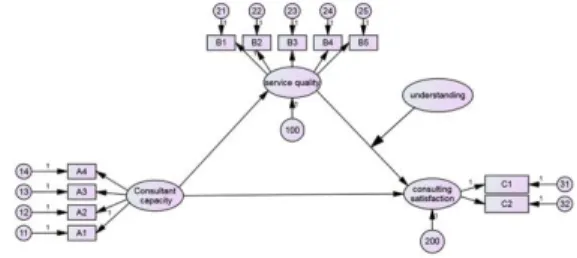
In order to construct the research model according to the research model of Chapter 3 in the structural equation model in the AMOS, the errors (11 ~ 14) of the latent variable and the measurement variable, the endogenous latent variable and the error term (31 ~ 32) were inputted as seen in model in Fig.2.

Fig. 2. Structural equation model

4.2 Validity of the model

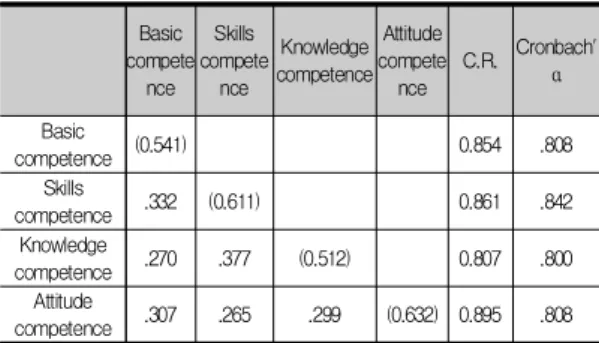
Four factors were used to examine the validity of participation. As a result of the factor analysis, CR value of basic competency of consultant was 0.854, CR value of skills competenc was 0.861, CR value of knowledge competenc was 0.807, and CR value of attitude competenc was 0.895. Cronbach 'α for basicl competence was 0.808, Cronbach' α for skills competence was 0.842, Cronbach 'α 0.800 for knowledge competence, and Cronbach' α for attitude

  Min Max M SD Skewness Kurtosis

A1 Basic competence

1.00 5.00 3.69 1.062 -.635 -.257 

A2 Skills competence

1.00 5.00 3.81 .988 -.448 -.559 

A3 Knowledge competence

1.00 5.00 3.53 1.034 -.419 -.493 

A4 Attitude competence

1.00 5.00 4.35 .815 -1.446 2.478 

(7)

competency was 0.808.The correlation coefficient of the model, AVE&CR [Table 2].

Table 2. The correlation coefficients of the model, AVE&CR

Basic compete

nce Skills compete

nce

Knowledge competence

Attitude compete

nce

C.R. Cronbach' α

Basic

competence (0.541) 0.854 .808

Skills

competence .332 (0.611) 0.861 .842

Knowledge

competence .270 .377 (0.512) 0.807 .800

Attitude

competence .307 .265 .299 (0.632) 0.895 .808

As shown in Table 3, the p value was less than 0.05, the χ2 value was 286.794, the df value was 129, and the TLI and CFI Since the indicator value is 0.9 or more, the fitness of the research model can be evaluated as acceptable and it can be said that the model validity is confirmed. Validity of research model [Table 3].

Table 3. Validity of the research model

Tool χ

2

df p Q CFI TLI RMSEA

RMSEA 90%Ci Research

model 286.794 129 .000 2.223 .937 .947 .075 .064~.087

4.3 Common method bias

The common method bias is to separate the measurement method of research design. In other words, when the independent and dependent variables are measured in different ways, the variance of the measurement method becomes small because the source of the response is independent (Lee, H., 2106). In this study, the decrease in χ2 and DF during uncontrolled and controlled control due to the same method bias is shown in [Table 4].

Table 4. Common method bias analysis

χ

2

DF △χ

2

△DF p

Uncontrolled distribution due to

common method bias 286.79 129 Controlled distribution due to

common method bias 218.744 111 68.05 18 0.000

4.4 Test of research hypothesis

In this study, hypothesis testing was performed by confirming the path coefficients between variables that constitute the hypothesis. The results of the hypothesis testing in the final model in this study are as follows.

The fit of the proposed model was 286.794 (degree of freedom = 129, p = .001), CMIN / DF = 2.223, TLI = 0.947 CFI = 0.937 and RMSEA = 0.075

Research hypothesis "H1-1. The Basic competency of the consultant will have a positive (+) effect on the consulting satisfaction. = 10.821, p = .000. The hypothesis was accepted with a 95% confidence level.

H1-2. The results of the test for "The Consultant Skills competency will have a positive (+) effect on consulting satisfaction." are .780, C.R. = 7.917, p = .000, with a 95% confidence level. H1-3. "The consultant knowledge competency will have a positive (+) effect on consulting satisfaction" = 9.787, p = .000. The hypothesis was accepted with a 95% confidence level.

H1-4. The results of the test for "consultant attitude competency will have a positive (+) effect on consulting satisfaction". = 10.349, p = .000, with a 95%

confidence level.

H2. "The quality of consulting service will have mediating effect on the effect of consultant capacity on consulting satisfaction" was accepted.

H3. "The understanding of consulting will have a moderating effect on the effect of consultant competence on consulting satisfaction". Research model hypotheses validation [Table 5].

Table 5. Research model test of hypotheses

B SE β CR(t) p

H1.1 basic competence

➡ consulting satisfaction 1.030 0.095 0.769 10.821 <0.001 H1.2 skills competence

➡ consulting satisfaction 0.780 0.098 0.703 7.917 <0.001 H1.3 knowledge competence

➡ consulting satisfaction 1.023 0.104 0.799 9.787 <0.001 H1.4 attitude competence

➡ consulting satisfaction 0.859 0.083 0.899 10.349 <0.001

(8)

4.5 Mediating effect test

The quality of consulting service(empathy, tangibles, responsiveness, reliability, assurance) will have mediating effect on the effect of consultant capacity on consulting satisfaction using Hypothesis H2 using Sobel Test. The median effect is considered significant if the Z value of the sobel test is 4.760, p = .000 the result is greater than +1.96 or less than –1.96 Therefore, the mediator effect is considered significant.

The results of the mediator effect test are shown in [Table 6].

Table 6. Mediating effect test results

Tool B SE β CR(t) p

Consultant capacity ➡ service

quality ➡ consulting satisfaction .991 .046 .880 21.459 <0.001

4.6 Moderating effect test

The results of the hypothesis H3, "The effect of consultant capacity on consulting satisfaction, will have a moderating effect on the understanding of consulting". The results of the control effect test are shown in [Table 7].

Table 7. Moderating effect test

Tool B SE β CR(t) p

Consultant capacity ➡ service quality

➡ client firm understanding .903 .185 .762 4.891 <0.001

5. Conclusion

The purpose of this study is to examine how consultant competence affects the satisfaction of consulting and how consultant service quality plays a mediating role on the effect of consultant competence on consulting satisfaction. The results show that the effect of consultant capabilities on consulting satisfaction is significant. There are significant results as to whether service quality plays a mediating role in the effect of consultant capacity on consulting satisfaction. The effect of consultant competence on

consulting satisfaction was examined. These results show that the consultant capacity has a significant effect on the satisfaction of the consulting service, and it also affects the service quality mediation and the high and low understanding of the company. In other words, the consultant's competency is important for the satisfaction of consulting, but it can be concluded that the consultant's competence has an effect on the satisfaction through the systematic service quality.

Also, the higher the understanding degree of the consultant is, It is suggested that service recipient should understand the contents of consulting such as consulting procedure and methodology, so that it is important to build mutual favorable relationship while trusting contents of consulting result. As the consulting service industry grows, companies are trying to acquire education through consulting firms in order to raise internal competencies. This suggests that consultants should provide companies with ongoing training and systematic services in order to develop their capabilities. In addition, the consultant should increase the understanding level of the company by satisfactorily explaining and educating the company in order to utilize the consulting progress procedure and the result of the consultation in order to achieve the desired management performance. In this sense, it can be inferred that the service recipients will increase consulting understanding degree and increase consulting satisfaction while trusting the result of consulting result. The relationship between the factors affecting the satisfaction of consulting was also examined in the existing paper on the effect of consultant capacity on the satisfaction of consulting.

However, in this study, besides the relationship

between consulting capacity and satisfaction of

consulting, the control of understanding level of

consulting was analyzed. Through these studies, it is

necessary to draw conclusions as to what part of the

competence the consultants should focus on and which

service quality enhances the customer's satisfaction,

and what actions should be taken to increase

(9)

understanding of consulting as well as capabilities and services and to draw conclusions. The limitations of this study were self-filling questionnaires through questionnaires, which were influenced by attitudes, situations, and perspectives of the respondents.

Therefore, there is a possibility of distorting the research result and it is difficult to obtain objectivity.

Therefore, the follow-up research will minimize errors in the research method by using in-depth interview method, interview survey, and various statistical data.

The relationship between the service quality and the consultant satisfaction is analyzed. In addition, it can be said that there is significance in confirming that there is a difference in satisfaction with relative importance according to the understanding degree of service recipient. A follow-up study was conducted to find out the potential variables of how consultants can improve the consulting satisfaction and how to effectively utilize consulting performance and service quality in order to better understand the company's understanding. Is required.

REFERENCES

[1] H. S. Lee. (2012). A study on Consulting plans of Business supporting for Venture SME, Master Thesis, Hannam University.

http://www.riss.kr/link?id=T13030537

[2] S. B. Shin. (2012). A Study on the Effects of the Service Quality in Management Consulting on the Customer Satisfaction, Ph.D Thesis, Dongmyung University.

http://www.riss.kr/link?id=T12918460

[3] H. J. Kwak. (2008). A Study on the Improvement Factors of Management Consulting and Real Estate Consulting Performance". Doctoral thesis, Kyonggi University.

[4] H. W. Yim (2018). A Study on the Causes and Consulting Methods to Reduce the Differentiation of Incubator Center. Journal of Convergence for Information Technology, 8(1), 313-320.

http://www.earticle.net/article.aspx?sn=323504

[5] T.G.An (2017). A study on the effects of behavior intention and satisfaction by festival service quality.

Journal of the Korea Convergence Society, 8(11), 279-285.

http://www.earticle.net/article.aspx?sn=313895 [6] K. H. Cho1 & H. S. Bae. (2017). Convergence study of

the in-flight meal quality on customer satisfaction, brand image and brand loyalty in airlines. Journal of the Korea Convergence Society, 8(12), 317-327

http://www.earticle.net/article.aspx?sn=317641 [7] S. S. Shin, M. Shin, Y. S. Jeong & J. Lee. (2015). An

Investigation of Social Commerce Service Quality on Consumer's Satisfaction. Journal of Convergence for Information Technology, 5(2), 27-32

http://www.earticle.net/article.aspx?sn=269193

[8] K. H. Cho1, H. S. Bae. (2017), Convergence study of the in-flight meal quality on customer satisfaction, brand image and brand loyalty in airlines, Journal of the Korea Convergence Society, 8(12), 317-327

[9] S. H. Yoon. (2008). A Study on the Effects of Consultant and Project Manager Capabilities on Business Consulting Performance, Master Thesis, Soongsil University.

[10] J. W. Lee, S. S. Kim, & C. S. Lee. (2011). Mediating Effect of Corporate Characteristics on the Relationship between Completeness of Management Consulting and Management Consulting Performance, Journal of Korean Accounting Research, 16(4), 273-293.

[11] Y. D. Cho. (2005). Business consulting service. Namdoo books.

http://www.riss.kr/link?id=M10062259

[12] Small and Medium Business Administration. (2008).

Small Business Consulting Industry White Paper.

http://old.kmtca.or.kr/board.php?db=con_pds&mode=vie w&idx=97&page=1&ct=&dir=

[13] L. E. Greiner & O. M. Robert. (1983). Consulting to Management. Prentice-Hal.

[14] A. P. O. Williams & S. Woodward, (1994). The Competitive Consultant: A Client–Oriented Approach for achieving Superior Performance. The Macmillan Press Ltd, UK.

[15] J. R. Jo. (2011). Development of the enterprise process evaluation model for small and medium business consulting. Ph. D dissertation, Daegu University.

http://www.riss.kr/link?id=T12720611

[16] H. K. Jin. (2010). The Effect of Strategic Alliance by Management Consulting Company on Performance, Master Thesis, Pukyong National University.

http://www.riss.kr/link?id=T11919454

[17] R. D. Mclachlin. (1999). Factors for consulting

(10)

engagement success. Management Decision, 37(5), 394-402.

[18] S. H. Park & K. H. Lee. (2009). Consulting Competence of IT Consultants: Perceptual Differences between IT Consultants and Business Clients, Information System Review. 11, No. 1, 107-132.

http://www.riss.kr/link?id=A76514880

[19] K. D. Joshi & K. M. Kuhn. (2007). What it takes to succeed in information technology consulting, Information Technology & people, 20(4), 400-424.

[20] C. H. Choi & Y. Y. You. (2014). A study on the Effects of Ties and Trust Relationship between the Clients and Consultants on the Consulting Performance, Journal of Digital Convergence, 12(10), 87-96.

http://www.riss.kr/link?id=A100158186

[21] Y. S. Choi. (2011). The Effect of Consultant Capability on Customer Satisfaction and Renewal Intention:

Mediating Effectiveness of Consulting Service Trust", Master Thesis, Graduate School of Geumho Univ.

http://www.riss.kr/link?id=T12631532

[22] H. J. Moon, T, H, Kim & C. S. Lee. (2010).

Development of Consulting Capability Assessment Model and its Application. Entrue Journal of Information Technology, l9(2), 93-106.

http://www.riss.kr/link?id=A82368112

[23] V. Dulewicz & M. Higgs. (2005). Assessing Leadership Styles and Organizational Context, Journal of Managerial Psychology, 39(2), 58-67.

[24] J. Tayler. (2006). A Survival Guide for Project Managers. 2nd ed. AMACOM, NY, USA.

[26] K. Visscher. (2006). Capturing The Competence of Management Consulting Work, Journal of Workplace Learning, 18(4), 248-260.

[27] R. E. Boyatzis & F. Ratti. (2009). Emotional, Social, and Cognitive Intelligence Competencies Distinguishing Effective Italian Manager and Leader in a Private Company and Cooperatives, Journal of Management Development, 28(9), 821-838.

[28] G. Ralph. (2013). Executive Guide linesf or Selecting Consultants, International Journal of Business and Management, 8(8), 41-48.

[29] Y. Jang. (1997). A contingent analysis of the success factors in management consulting, Ph.D. Thesis, Korea Advanced Institute of Science and Technology.

http://www.riss.kr/link?id=T513285

[30] Y. E. Moon. (2002). Knowledge/Skills and Career Path of IS Project Managers, Information Systems Review, The Korea Management Information Society, 4 (2), 343-360.

http://www.riss.kr/link?id=A75215255

[31] K. Y. Kim, M. S. Kim, C. U. Lee &, Y. H. Lee. (2008).

Understanding and Utilization of Business Consulting Services, Book Publishing Cheogram.

[31] I. S. Ki. (2006). A study on the performance and effects of consulting in domesticSMEs. Korean Journal of Social Science, 18 (1), 159-186.

http://www.earticle.net/Article.aspx?sn=70549

[32] D. I. Jang, K. H. Lee & S. H. Song. (2011). Research on How Consultant`s Capability and Competency Influence on Upgraded Service Quality and Customer Satisfaction: Study Centered on Moderating Effect from Supportive Middle and Small Cooperations, Academy of customer satisfaction management, 13(3), 39-64.

http://www.riss.kr/link?id=A60056749

[33] Y. S. Bae. (2013). An Empirical Study of the Effects of Consultant Competency on the Performance of Management Consulting: Focusing on the Moderating Effects of the Characteristics of Consulting Firm and Client Firm, PhD Thesis, Dankook University.

http://www.riss.kr/link?id=T13242383

[34] H. J. Kim. (2014). A Study on The effect Business Performance by Business Consultant Competency, Business Consulting Services, Changwon University Ph.D Thesis.

http://www.riss.kr/link?id=T13607861

[35] P. J. Kotler & K. L. Keller. (2003). Marketing Management, Prentice Hall International, Inc, 11th Ed.

[36] D. A. Garvin. (1987). Computing on the 8 dimensions of quality. Harvard Business Review, 65(6), 101-109.

[37] A. Parasuraman, V. A. Zeithaml & L. L. Berry. (1988).

Servqual. Journal of Retailing, 64(1), 12-37.

[38] C. Gronroos. (1984). A Service Quality Model and Its Marketing Implications, European Journal of Marketing, 18(4). 36-44,

[39] J. J. Jr. Cronin & S. Taylor. (1992). Measuring Service Quality : A Reexamination and Extension, Journal of Marketing, 55-68.

[40] Y. J. Lee & S. S. La. (2011). Investigating the Superiority across Service Quality Models: Focusing on SERVQUAL, Grönroos’, and Three-Dimensional Quality Models. Service Marketing Journal, 4(2), 91-126.

http://www.earticle.net/Article.aspx?sn=170466 [41] Brady, K. Michael & J. Joseph Cronin Jr. (2001). Some

New Thoughts on Conceptualizing Perceived Service Quality: A Hierarchical Approach, The Journal of Marketing, 65(3), 34-49.

[42] M. G. Choi. (2014). A Study on the Service Quality of

(11)

Small and Medium Enterprise Management Consulting Affecting the Perceived Management Performance, Ph.D Thesis, Soongsil University.

http://www.riss.kr/link?id=T13369123

[43] A. Simon & K. Vanya. (2001). Clients' Views on Strategic Capabilities Which Lead to Consulting Success. Management Decision, 39(5)5, 362-37.

[44] J. Adamson. (2000). Management Consulting Meet a Potential Client for the First Time the Pre-entry Phase of Consultancy in SMEs and the issue of Qualitative Research Methodology, Qualitative Market Research, 3(1), 17-26.

[45] K. H. Kim & K. S. Hwang. (2001). A Study on the Quality Constituents of Management Consulting Service, Management Science, 18(1), 15-22.

[46] Y. Zeira & J. Avedisian. (1989). Organizational Planned Change: Assessing the Chances for Success, Organizational Dynamics, Spring, 31-45.

[47] K. Y. Song, J. W. Hong & Y. Y. You. (2014). Effects of Consulting Characteristics on the Management Performance of SMEs, Focusing on Government Support Consulting, Korean Digital Policy Society, 12(7), 205-215.

http://www.earticle.net/article.aspx?sn=227624

최 용 국(Choi, Yong Kuk) [정회원]

▪2009년 2월 : 한성대학교 지식서 비스&컨설팅학과 (컨설팅학석사)

▪2015년 9월~현재 : 한성대학교 스마트융합컨설팅 박사과정

▪관심분야 : 창업, 마케팅, 기술사 업화

▪E-Mail : [email protected]

김 상 봉(Sang-Bong Kim) [정회원]

▪2008년 8월 : Texas A&M University(경제학 박사)

▪2009년 9월~현재 : 한성대학교 경제학과 교수

▪관심분야 : 거시경제, 화폐금융, 행동경제, 국제금융

▪E-Mail : [email protected]

홍 우 형(Hong, Woo Hyung) [정회원]

▪2015년 6월 : 미국 University of Washington 경제학과 (박사)

▪2015년 8월 ~ 2017년 2월 : 한국 조세재정연구원 부연구위원

▪2017년 3월 ~ 현재 : 한성대학교 경제학과 교수

▪관심분야 응용미시경제, 산업조직론, 재정학

▪E-Mail : [email protected]

수치

Fig.  1.  Research  model.
Fig.  2.  Structural  equation  model
Table  2.  The  correlation  coefficients  of  the  model,  AVE&amp;CR Basic compete nce Skills competence Knowledge competence Attitude competence C.R
Table  6.  Mediating  effect  test  results

참조

관련 문서

The purpose of this study was to investigate the differences in the school life satisfaction of middle school students according to self-directed learning capability and emotion

In the results of this study, it has been confirmed that the consultant selection criteria such as recommendation by others, reputation, consultant's academic background

The Effect of the Service Scape of a Banquet Hall in a Luxury Hotel on Customer Satisfaction and Revisit Intention: Focusing on the Moderating Effect of Hotel Trust.. Daejeon,

The purpose of this study is to investigate and examine the role of specialized marketing capabilities (SMC) in mediating the relationship between customer sensing

(2016), “A Study on the Effects of Marketing Mix Strategy and Product Selection Attributes on Customer Satisfaction and Purchase Behavior of Processed Foods: With the

This study aims to analyze the influence of bakery cafes servicescape on customer satisfaction and revisit intention, and to verify the mediating effect

An, The Influence of School Adjustment on Life Satisfaction of Middle School Students: The Moderating Effects of Perceived Parental Behavior, Journal

The purpose of this study was to examine the influence of service quality on customer satisfaction, repurchase intention and word-of-mouth intention in the automobile