• 검색 결과가 없습니다.

A Study on the Moderating Effects of Problem-Solving Ability on the Effect of Consultant Selection Criteria on Consulting Service Repurchase Intention

N/A
N/A
Protected

Academic year: 2021

Share "A Study on the Moderating Effects of Problem-Solving Ability on the Effect of Consultant Selection Criteria on Consulting Service Repurchase Intention"

Copied!
10
0
0

로드 중.... (전체 텍스트 보기)

전체 글

(1)

1. Introduction

Among the competencies required by the company

to its employees in the workplace such as a company or a specific organization, problem-solving ability is most frequently presented as a representative capability

A Study on the Moderating Effects of Problem-Solving Ability on the Effect of Consultant Selection Criteria on Consulting Service

Repurchase Intention

Bong-Cheol Lee, Do-Sung Na *

Division of Smart Convergence Consulting, Hansung University

컨설턴트 선정기준이 컨설팅서비스 재구매 의도에 미치는 영향에 있어서 문제해결능력의 조절효과에 관한 연구

이봉철, 나도성

*

한성대학교 스마트융합컨설팅학과

Abstract The aim of this study was to test the effect of consultant's problem-solving ability on consulting services.

A questionnaire was conducted for the staff of companies that were consulted, the research models and hypotheses were tested by structural equation. As a result of this study, the moderating effect of the consultant 's problem-solving ability and the fit of the research model were confirmed. In this study, defining the problem solving ability of the consultant as an major variable was a new attempt on the research of the consultant’s competence. We expect that this study will promote various research on consultant’s problem-solving ability and encourage consultants to re-recognize their problem-solving ability. We will conduct research to develop a a tool for measuring the problem-solving ability of consultants recognized as the limitation of this study.

Key Words : Consultant selection criteria, Consultant competency, Problem-solving ability, Consulting service satisfaction, Consulting service repurchase intention

요 약 본 연구의 목적은 컨설턴트선정요인, 컨설팅서비스만족도, 컨설팅서비스재구매의도 간의 관계에 있어서 컨설턴트 의 문제해결능력의 조절효과를 분석하는 것이었다. 컨설팅수진기업에서 컨설팅프로젝트에 참여한 경험이 있는 담당자를 대상으로 설문조사를 실시하였으며 탐색적 요인분석과 구조방정식을 사용하여 연구모형과 가설을 검정하였다. 연구결과 컨설턴트의 문제해결능력의 유의한 조절효과와 연구모형의 적합성이 확인되었다. 본 연구에서 컨설턴트의 문제해결능력을 중요한 변인으로 정의 한 것은 컨설턴트의 역량에 관한 연구의 새로운 시도였다. 본 연구가 컨설턴트의 문제해결능력에 관한 다양한 연구를 촉진하고 컨설턴트 스스로에게는 문제해결능력에 대한 재인식을 갖게 하는 계기가 되기를 기대한다.

향후 본 연구의 가장 큰 한계점으로 인식한 컨설턴트의 문제해결능력 측정도구를 개발하고 그 도구를 사용하여 컨설턴트문 제해결능력의 조절된 매개효과 검정을 위한 연구를 수행할 것이다.

주제어 : 컨설턴트선정기준, 컨설턴트역량, 문제해결능력, 컨설팅서비스만족도, 컨설팅서비스재구매의도

*This study was supported by the research fund of Hansung University.

*Corresponding Author : Do-Sung Na ([email protected]) Received February 27, 2018

Accepted April 20, 2018

Revised April 2, 2018 Published April 28, 2018
(2)

of common job ability[1]. Korea’s online recruiting company, JobKorea, conducted a survey on 382 small to medium enterprises (SMEs) with over 100 employees and fewer than 300 employees, and found that the ability to deal with problems was a top priority among the most highly regarded talents of the company[2].

Therefore, in any organization, problem-solving ability is a very important competence in the performance of the members of the organization. A management consultant is a specialist defined who has the expertise and insight. A management consultant provides a consultation service such as diagnosing problems in the company management and suggesting solutions for a company to achieve management objects or offers a management consultation and advice through more sophisticated planning, organization, motivation, communication, and resource utilization for a company to set a higher management goal or business execution [3]. In consulting, the most important factor that enables customers to determine the validity and reliability of consulting results is their problem-solving ability.

Consultant applicants who apply to Mckinsey&

Company, a global consulting firm, should take the online or direct exam as part of the recruitment process. Depending on the roles they support, tests focus on many aspects of knowledge or ability. One of these tests is the McKinsey Problem Solving Test[4].

In this way, although the problem-solving ability of the consultant is very important in the performance of the consulting, the research on the effect of the consultant's problem-solving ability on the consulting performance or the consulting repurchase intention is insufficient. So we studied whether the problem- solving ability was moderating in the relationship between consultant selection criteria, consulting service satisfaction and consulting service repurchase intention.

2. Theoretical Background

W. H. Yeo(2016) defines the variables that measure

the competence of consultants as a job capacity and a common competence in the study on the effect of the management consultant 's capability and consulting perfection on business performance. First, the job competence and common competency of the management consultant have a significant effect on the completeness of consulting. Second, the job competency and consulting completeness of management consultant have a significant effect on business performance.

Third, the completeness of consulting mediates the influence of the capacity of the management consultant on business performance. Fourth, the greater the managerial support, the greater the influence of the managerial competency of the management consultant on the organizational effectiveness[3].

J. H. Park(2015) proposed that the competency of the consultant is defined as ability, knowledge and attitude, and that the competency of the consultant has a positive effect on the consulting performance. In addition, it was suggested that enhancing the consultant's competency is a prerequisite for enhancing consulting performance[5].

Y. S. Bae(2013) suggested that the common competence and job competence of consultants have a positive impact on the consulting project completeness of management consulting achievement, but the management competence of consultant does not have a significant influence on the completeness of consulting project. The researchers defined the competencies of consultants as common competence, job competence, and management competency[6].

Chung (2011) defined the components of problem-

solving ability as horizontal thinking, problem

recognition and judgment, alternative evaluation,

solution execution, and performance evaluation as a

result of reviewing many previous studies. Among

them, as the three components of horizontal thinking,

perception and judgment, and alternative evaluation and

decision appear to give a direct effect of .758 on

interpersonal abilities, the relationship between these

problem solving abilities and interpersonal abilities is

(3)

the strongest among all relationships Claiming to have a relationship[1]. In addition to these researches, there have been many studies on the relationship and influence of management consultants' competence, consulting perfection, business performance, consulting service quality, consulting performance and customer loyalty, and definition of problem-solving ability.

However, it has been difficult to find out how the consultant's problem-solving ability, which may be one of the important factors of the consultant's competency or consultant selection criteria, affects consulting completion, consulting service quality, consulting performance, consulting satisfaction, and customer loyalty. Although there are various research models, the following study was conducted in this study.

3. Research Model and Hypotheses

3.1 Research Model

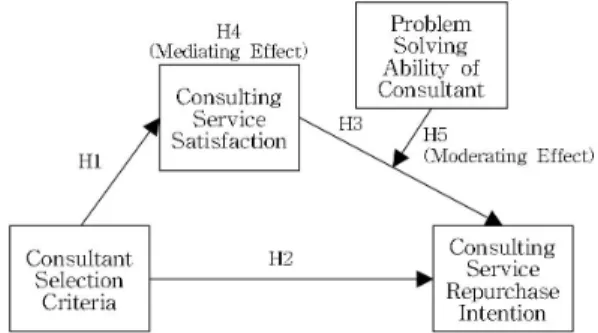
This study established a structural equation model as shown in Fig. 1 and evaluated it in order to investigate the direct and indirect effect of consulting satisfaction, a parameter, and the problem-solving ability of a consultant, a moderating variable, on the effects of consultant selection criteria on the consulting repurchase intention.

Fig. 1. Research Model

3.2 Hypotheses

H1: The consultant selection criteria have a positive effect on the consulting service satisfaction.

H2: The consultant selection criteria have a positive effect on the consulting service repurchase intention.

H3: The consulting service satisfaction influences the consulting service repurchase intention positively.

H4: The consulting service satisfaction mediates the relationship between the consultant selection criteria and the consulting service repurchase intention.

H5: The problem-solving ability of a consultant has a moderating effect on the relationship between the consulting service satisfaction and the consulting service repurchase intention.

3.3 Definition of Variables

3.3.1 Consultant Selection Criteria

Consulting service is an intangible achievement and the capability of a consultant is also invisible.

Therefore, a client has to take a high level of

uncertainty risk when selecting a consultant or a

consulting firm. Chae(2011) suggested that a client

should consider the consulting price, proposal and

presentation contents, consulting firm's experience,

consulting firm’s awareness, consulting firm's

expertise, and the duration of consulting[7]. Lee(2014)

proposed four duty criteria (i.e., consulting know-how,

skills and experiences, the possession of skilled

consultants, and industry reputation) and three

partnership criteria (i.e., revenue size, the size of a

company, and the possession of system)[8]. Jeon (2017)

also examined the criteria for selecting a consultant and

the criteria for considering the characteristics of a

consulting firm from the viewpoint of embeddedness

theory and signaling theory[9]. The embeddedness

theory is the transition area between the economic

theory that under-socializes the behavior and the

conventional sociological theories that over-socializes

behavior. It argues that it is more accurate to regard

the economic rationality as the embedded in social

relations[10]. Signaling theory is useful to explain the

(4)

behavior of two parties assessing different information and has been effectively used in various management literature including strategy management, entrepreneurship, and human resource management[11].

3.3.2 Repurchase intention

Repurchase intention is generally shown in the form of customer satisfaction[12]. When a customer is satisfied with a certain product, the customer is willing to purchase the same product continuously and the customer is not very sensitive to the price incentive activities of competitors. Furthermore, the customer plays an important role to attract new customers through positive word of mouth and increase the profit of the company [13]. Repurchase intention is related to maintaining existing customers and customer retention is an important part of continuously generating corporate profits from a long-term perspective. When a customer has a good perception of a product or service, the customer's repurchase intention increases. On the other hand, a bad perception of a product or service decreased the repurchase intention[14].

3.3.3 Consulting service satisfaction

Consulting service satisfaction indicates how the consulting results satisfy the needs and expectation of a customer company. It includes various factors including the satisfaction of basic consulting needs, effectiveness, cost-efficiency, and overall satisfaction of the consulting process[15].

3.3.4 Problem-solving ability

Problem-solving ability refers to the ability to find practical solutions and achieve the desirable condition for performing the task properly by overcoming obstacles that cause problems in the process of work performance [16].

3.4 Operational Definition of Investigative Tools and Variables

This study used the questionnaire technique among

various empirical analysis techniques such as the interviewing, the participation and observation technique, and the questionnaire technique. A total of 393 questionnaires (N=600, recovery rate = 65.5%) were collected from staffs who were in charge of consulting and worked for the companies received consultation more than once. A regression analysis using structural equation modeling was carried out. AMOS 19.0 was used as an analysis program. The questionnaire was composed of 24 items including 4 items for conducting demographic analyses and Likert 5 point scale was used for them except four items for demographic analysis. Measures related to variables are based on the following studies.

Choi and Hartley (1996) conducted a study on the selection of outsourcing partners based on existing literature. As a result of the factor analysis of 26 items, financial, consistency, relationship, and flexibility were selected as the selection factors[17].

The Korean Small and Medium Business Administration (2009) presented the results of a survey on the development of the consulting industry for companies with experience consulting in the SME consulting white paper. The questionnaire items was

"What are the most important considerations when selecting a consulting company?" and the responses included 1) Career experience of consulting firm 2) Main field of consulting firm 3) Recognition of consulting company 4) External public institution evaluation (recommendation, award history, etc.) 5) Recommendation of company who has experience of consulting in the past 6) Proposal or announcement contents 7) Consulting cost 8) Consulting period and 9) Degree of human network formation with consulting firms[18].

Jeon (2017) presented 8 items as the consultant

selection criteria based on the embeddedness theory

and signaling theory. The items were 1)

Recommendation of other companies who have

experienced consulting, 2) Experience of past

consulting with consultant, 3) Personal acquaintance

(5)

with the consultant, 4) Education of consultant, 5) Career and work experience of consultant, 6) Certification of consultant, 7) The reputation of the consultant (lectures, books, media exposure, etc.), 8) Recommendation of acquaintance's consultant[9].

In this study, because the problem-solving ability of the consultant was a controlling variable, we excluded the items related to the competence of the consultant including the problem-solving ability as the independent factor, the consultant selection factor.

Therefore, Jeon (2017)’s 8 item selection tool, which was judged to be the most suitable for the purpose of the study, was used as the measurement tool for the consultant selection criterion, which was an independent variable of this study model.

The dependent variable, consulting service repurchase intention, was also measured using the four measures proposed by Jeon(2017)[9]. The four metrics presented were 1) If you are consulted again, I will refer you back to the same consultant who has done the consulting before, 2) I am willing to receive in-depth consulting in the same field, 3) I will consult the consultant again if additional costs arise, 4) We are willing to encourage consultants to get around to other people.

The consulting satisfaction as a parameter was measured by four question items except the 'consultant ability' which was the same as the ability measurement among the five question items in the measurement tool presented by Yoon Hye Ran (2016). The items presented in the preceding research were 1) Ability of consultant, 2) Results of consulting, 3) Compliance with consulting contract period, 4) Post-management after completion of consulting, and 5) Suitability for management condition of consulting result[19].

Four items corresponding to the problem-solving ability, a regulatory variable, were constructed by extracting the items determined to correspond to the problem-solving ability among items related to the consultant’s competence, suggested by Shin (2012) and conducting an exploratory factor analysis[20].

4. Result

4.1 Analysis Results of Demographic Characteristics

Forty-eight respondents, out of 393 respondents, worked for listed companies and 87.8% of them were affiliated with unlisted companies. Based on the years of work experience, 34.0% were less than 5 years, 26.5% were over 5 years and less than 10 years, 23.7%

were between 10 years and 20 years, and 15.8% were over 20 years. By industry, 288 people worked for manufacturing businesses (73.3%) and 26.7% worked for non-manufacturing businesses.

4.2 Validity and Reliability Verification

4.2.1 Verifying the Validity and Reliability of Investigation Tool

Descriptive statistics and exploratory factor analysis were conducted on the collected data by using SPSS 19.0 statistical program. The model and hypotheses were verified by using a structural equation modeling (AMOS). An exploratory factor analysis was conducted prior to verify it with using a structural equation model because it was not possible to find a measurement tool that could evaluate only the problem-solving ability of a consultant from previous studies. Therefore, we selected items that were considered to be problem- solving ability among the questionnaire items regarding the competence of a consultant, which were provided by previous studies, in order to develop a tool to measure the problem-solving ability of a consultant.

Moreover, an explanatory factor analysis was conducted to verify if these questionnaire items were valid as a measurement tool.

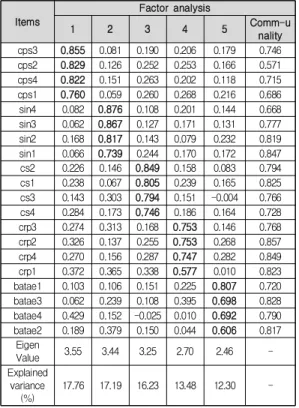
The analysis results showed that 76.96% of total variance was explained by all variables including mediating variables and regulatory variables.

Furthermore, all extracted factors had eigenvalues over

1.0 and the factor loadings of the items were all above

0.5. Consequently, the validity of the measurement tool

was secured. The results of the validity analysis of the

(6)

tool are shown in Table 1.

Table 1. Validity analysis of the tool

Items

Factor analysis

1 2 3 4 5 Comm-u

nality cps3 0.855 0.081 0.190 0.206 0.179 0.746 cps2 0.829 0.126 0.252 0.253 0.166 0.571 cps4 0.822 0.151 0.263 0.202 0.118 0.715 cps1 0.760 0.059 0.260 0.268 0.216 0.686 sin4 0.082 0.876 0.108 0.201 0.144 0.668 sin3 0.062 0.867 0.127 0.171 0.131 0.777 sin2 0.168 0.817 0.143 0.079 0.232 0.819 sin1 0.066 0.739 0.244 0.170 0.172 0.847 cs2 0.226 0.146 0.849 0.158 0.083 0.794 cs1 0.238 0.067 0.805 0.239 0.165 0.825 cs3 0.143 0.303 0.794 0.151 -0.004 0.766 cs4 0.284 0.173 0.746 0.186 0.164 0.728 crp3 0.274 0.313 0.168 0.753 0.146 0.768 crp2 0.326 0.137 0.255 0.753 0.268 0.857 crp4 0.270 0.156 0.287 0.747 0.282 0.849 crp1 0.372 0.365 0.338 0.577 0.010 0.823 batae1 0.103 0.106 0.151 0.225 0.807 0.720 batae3 0.062 0.239 0.108 0.395 0.698 0.828 batae4 0.429 0.152 -0.025 0.010 0.692 0.790 batae2 0.189 0.379 0.150 0.044 0.606 0.817

Eigen

Value 3.55 3.44 3.25 2.70 2.46 -

Explained variance

(%)

17.76 17.19 16.23 13.48 12.30 -

4.2.2 Validity Analysis of the Model by using Structural Equation

The validity of measurement model, convergent validity and discriminant validity are generally used to verify the validity of a measurement tool and a study model by using the confirmatory factor analysis.

The validity analysis of the measurement model is to test the fit of the model by combining the factors with single dimensionality through confirmatory factor analysis.

The validity analysis of measurement model generally uses χ

2

(Pearson’s chi-square test), Degree of Freedom(DF), Q(χ

2

/DF; CMIN/DF), GFI(Goodness-of Fit Index), AGIF(Adjusted Goodness-of Fit Index), CFI(Comparative Fit index), TLI(Tucker Lewis Index), RMSEA(Root Mean Square Error of Approximation)[21].

The results of the validity analysis of the measurement model of this study are shown in Table 2.

Table 2. Results of the validity of measurement model

χ

2

df p Q CFI TLI RMSEA

186.28 69 <0.001 2.700 0.976 0.968 0.066

The χ

2

test conclude that if the value is large, the model does not fit the data. The model did not fit the data as χ

2

=186.28(p<0.001) in this study. However, rejection in the χ

2

test is a requirement for the model, not a sufficient condition, so we referred to other fitness indices[19]. As a criterion for fitness indexes other than χ

2

test, Q is 3 or less, GFI, AGFI, CFI, TLI are 0.9 or more, RMR is 0.05 or less, and RMSEA is 0.1 or less.

Especially, TLI and RMSEA can examine the fitness and simplicity of the model at the same time without being affected by the sample size and CFI is not influenced by the sample size much[22].

In this study, Q was 2.700, CFI was 0.976, TLI was 0.968, and RMSEA was 0.066. Therefore, the fitness of this research model can be evaluated as acceptable.

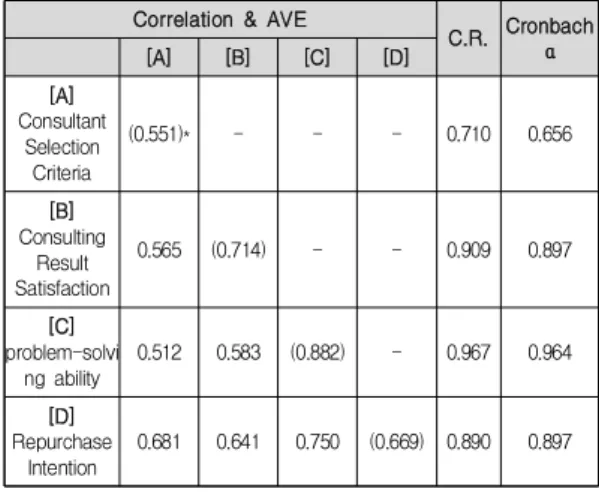
Convergent validity is the concept that there must be a high correlation between the values measured in different ways to measure the same concept. It is a way to verify how multiple items examining the same concept agree to each other well. Convergent validity is measured by several criteria such as β (≥0.5), p (<0.05), average variance extracted (AVE; ≥0.5), and construct reliability (C.R.; ≥0.7). Discriminant validity is the concept that when different concepts are measured, there must be a difference between measurements even though different measurement methods are used. In general, AVE≥R

2

(square of correlation coefficient) is used as a validation index.

The convergent validity and discriminant validity of the measurement tools were obtained as shown in Table 3. All AVE values of measurement tools were over 0.5 and all C.R. values were over 0.7 as well.

Moreover, Cronbach α was always over 0.7. It could be

concluded that the study model met convergent validity

and reliability criteria. On the other hand, all AVE

values were larger than the square of 0.750 (0.5625),

which was the correlation coefficient between the

(7)

problem-solving ability and the repurchase intention, the greatest correlation coefficient. Therefore, it could be concluded that the study model secured the discriminant validity among between tools.

Table 3. Analysis results of the model validity Correlation & AVE

C.R. Cronbach

[A] [B] [C] [D] α

[A]

Consultant Selection

Criteria

(0.551)* - - - 0.710 0.656

[B]

Consulting Result Satisfaction

0.565 (0.714) - - 0.909 0.897

[C]

problem-solvi ng ability

0.512 0.583 (0.882) - 0.967 0.964

[D]

Repurchase Intention

0.681 0.641 0.750 (0.669) 0.890 0.897

*( ): AVE

4.3 Hypotheses Testing 4.3.1 H1, H2, and H3 Testing

H1 (“The consultant selection criteria have a positive effect on the consulting service satisfaction”) was accepted as shown in Fig. 2 and Table 4.

H2 (“The consultant selection criteria have a positive effect on the consulting service repurchase intention“) was accepted as shown in Fig. 2 and Table 4.

H3 (“The consulting service satisfaction influences the consulting service repurchase intention positively”) was accepted as shown in Fig. 2 and Table 4.

Fig. 2. Hypotheses test result by AMOS

Table 4. Hypotheses test result by AMOS

B SE β CR(t) p Result

H1 0.923 0.113 0.580 8.172 <0.001 Accepted H2 0.856 0.119 0.613 7.224 <0.001 Accepted H3 0.266 0.055 0.303 4.804 <0.001 Accepted

4.3.2 H4 Testing (Mediating Effect)

Sobel's formula was used to test the statistical significance of the mediating effect.

H4 (“The consulting service satisfaction mediates the relationship between the consultant selection criteria and the consulting service repurchase intention”) was tested by using the Sobel Test. As shown in Table 5, the z value was 4.162 and the p value was <0.001. The results showed that it was partially mediated.

Table 5. Mediating effect by Sobel test

B SE z p Result

H1 0.923 0.113

4.162 <0.001 Partial Mediation

H3 0.266 0.055

4.3.3 H5 Testing (Moderating Effect)

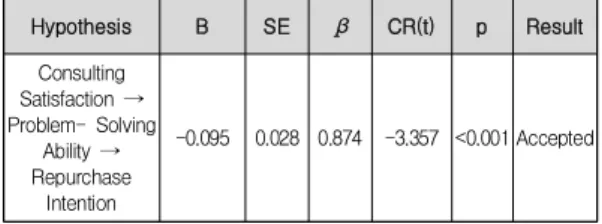
The statistical significance of the moderating effect was tested by using the X, Mo measurement model after centering the mean of variables. H5 (“The problem-solving ability of a consultant has a moderating effect on the relationship between the consulting service satisfaction and the consulting service repurchase intention”) was tested by using the X, Mo measurement model of AMOS. As shown in Fig.

3 and Table 6, the CR(t) value was –3.357(>±1.96) and the p value was <0.001. Therefore, H5 was accepted.

Fig. 3. Moderating Effect Testing by AMOS

(8)

Table 6. Results of Moderating effect

Hypothesis B SE β CR(t) p Result

Consulting Satisfaction → Problem- Solving

Ability → Repurchase

Intention

-0.095 0.028 0.874 -3.357 <0.001 Accepted

5. Conclusion

A management consultant is an expert who needs to provide specific solutions to companies or organizations that have consulting contracts or to provide services such as advice on various management issues. In consulting practice, a consultant does not always have more knowledge and experience in a customer's area.

However, the consultant must respond to customer requests clearly, quickly, and logically. In this case, the competency needed is the ability to solve problems.

In the results of this study, it has been confirmed that the consultant selection criteria such as recommendation by others, reputation, consultant's academic background and qualifications have a significant (+) influence on consulting service satisfaction and consulting repurchase intention, and the level of problem solving ability of consultant is moderating to consulting service repurchase intention affect.

It suggest that the problem-solving ability of the consultant is one of the factors that have an important influence on the consulting business and in order to increase the consulting service contract renewal rate with the clients, various kinds of systematic education programs are required in addition to the consultant's own efforts.

For this study, we used a research information sharing service (RISS) site [23], which is widely used in Korea, and searched for previous studies that included 'consultants' in the key words and ‘problem solving’ in the abstracts including Korean. We found 61 research articles including 26 articles in Korean

journals and 35 theses. No research accomplishment was found that problem-solving ability was defined as independent variable. Although not presented in this paper, the results of the Big Data analysis are also similar.

The results of this study, which defined and confirmed the problem-solving ability of the consultant as a variable, suggest a new research model on the competence of the consultant.

This study has several important limitations.

First, the consultant's problem-solving ability measurement tool set for this study was constructed through exploratory factor analysis and confirmatory factor analysis, but it can not be said to be fully verified. Second, there is a possibility that the causal relationship may not be clear because the response to the independent variables and dependent variables may not be a response to the same consulting project. Third, because of the limitations mentioned above, the moderated mediation effect of consultant problem solving ability is not tested and left as a further study.

There are some limitations to this study, we expect that the results of this research will contribute to the re-recognition of the problem-solving ability by the consultant himself, and to the promotion of various research on the consultant education system innovation and the problem-solving ability of the consultant.

As the further research, we will study the development of measurement tools that can measure the problem-solving ability of consultants objectively and clearly, as well as the development of innovative training programs that can substantially enhance the problem-solving ability of consultants.

REFERENCES

[1] T. Y. Chung. (2011). The Structural Relationship

between Corporate Managers' Life-Long Education

Coaching Leadership and Its Member's Problem

Solving Ability and Interpersonal Ability. Doctoral

dissertation. Ajou University, Suwon.

(9)

[2] Job Korea. (2004). Changeability, Corporate Talent Award: Corporate Talents Want: Excellent work performance, Good interpersonal relationship. HR executive, 5, 30-31.

[3] W. H. Yeo. (2016). The Effect of the Competence of Management consultants and Completion Degree of Consulting on the Management performance. Doctoral dissertation. Hoseo University, Asan.

[4] https://www.mckinsey.com/careers/interviewing [5] J. H. Park. (2015). A Study on the Effects of Consulting

Service Quality & Consultant Competency on Consulting Performance & Customer Loyalty : Focused on SMEs carrying out Government Consulting Project in Daejeon City. Doctoral dissertation. Hansung University, Seoul.

[6] Y. S. Bae. (2013). An Empirical Study of the Effects of Consultant Competency on the Performance of Management Consulting: Focusing on the Moderating Effects of the Characteristics of Consulting Firm and Client Firm. Doctoral dissertation. Dankook University, Yongin.

[7] J. W. Chae. (2011). A Study on the Determinants of Consulting Services for SMEs by Consulting Type.

Doctoral dissertation. Pusan National University, Pusan.

[8] I. S. Lee. (2014). Motives, Partner Selection Criteria, and Alliance Capabilities of Consulting Firms in Strategic Alliances : Their Effects on Performance.

Doctoral dissertation. Hansung University, Seoul.

[9] W. S. Jeon. (2017). An Empirical Study for the Effect of Consultant Selection Criteria on Consultant Competencies, Consulting Completion and Repurchase Intention. Doctoral dissertation. Hansung University, Seoul.

[10] M. Granovetter. (1985). Economic Action and Social Structure: The Problem of Embeddedness. American Journal of Sociology, 9(3), 481-510.

[11] B. L. Connelly, S. T. Certo, R. D. Ireland & C. R. Reutzel.

(2011). Signaling theory: A review and assessment.

Journal of Management, 37 (1), 39-67.

[12] R. L Oliver. (1993). Cognitive, Affective, and Attribute Bases of the Satisfaction. Journal of Consumer Research, 20(3), 451-466.

[13] C. Fornell & B. Wernerfelt. (1987). Defensive Marketing Strategy by Customer Complaint Management: A Theoretical Analysis. Journal of Marketing Research, 24, 337-346.

[14] C. Shuang, K. R. Lee & S. J. Lee. (2017). Study on Chinese Repurchase Intention of Group-buying Social

Commerce: The Moderating Role of Shopping Habit.

Journal of the Korea Convergence Society, 8(2), 169-181.

DOI : 10.15207/JKCS.2017.8.2.167

[15] J. H. Ryu. (2017). Study on the Service Quality of Management Consulting Affecting the Management Performance -Mediating effects of the Consulting Satisfaction and the Consulting Utilization. Doctoral dissertation. Honam University, Gwangju.

[16] C. S. Kim. (2016). A study on the effect of official middle manager's transformational leadership to job performance : Focusing on mediating effect of communication ability and problem-solving ability.

Doctoral dissertation. Baekseok University, Cheonan.

[17] T. Y. Choi. & J. L. Hartley. (1996). An Exploration on Supplier Selection Practice. Journal of Operations Management, 14(4), 333-343.

[18] Korea Technology and Information Promotion Agency for SMEs. (2009). 2008 Small Business Consulting Industry White Paper. Seoul : Small and Medium Business Administration.

[19] H. R. Yoon. (2016). A study on the impact of organizational culture in enterprises on the consulting satisfaction. Master dissertation. Hansung University, Seoul.

[20] D. J. Shin. & Y. Y. Yoo. (2012). A Study on the Impact of Consultant’s Competencies on Service Quality and performance of Consulting. Journal of Digital Convergence, 10(4), 63-78.

[21] J. J. Song. (2014). SPSS/AMOS Statistical Methodology. Paju : 21st Century Corp.

[22] S. H. Hong. (2000). The Criteria for Selecting Appropriate Fit Indices in Structural Equation Modeling and Their Rationales. Korean journal of clinical psychology, 19(1), 161-177.

[23] www.riss.kr

이 봉 철(Bong-Cheol Lee) [정회원]

▪1989년 2월 : 한국외국어대학교 경영학과(학사)

▪2016년 2월 : 한성대학교 지식서 비스&컨설팅학과(컨설팅학석사)

▪2016년 9월 ~ 현재 : 한성대학교 스마트융합컨설팅학과 박사과정

▪관심분야 : 경영전략컨설팅 및 교육

▪E-Mail : [email protected]

(10)

나 도 성(Do-Sung Na) [정회원]

▪1979년 2월 : 서울대학교 영어교 육학, 경제학(학사)

▪1984년 2월 : 서울대학교 행정대 학원(행정학석사)

▪1997년 6월 : 조지아주립대학교 대학원(경제학석사)

▪2001년 2월 : 조선대학교 대학원(경제학박사)

▪2008년 4월 : 중소기업청 차장

▪2008년 9월 ~ 현재 한성대학교 지식서비스&컨설팅 학과/스마트융합컨설팅학과 교수

▪관심분야 : 컨설팅방법론, 경영전략, 스타트-업 전략

▪E-Mail : [email protected]

수치

Fig.  1.  Research  Model
Table  1.  Validity  analysis  of  the  tool
Fig.  2.  Hypotheses  test  result  by  AMOS
Table  6.  Results  of  Moderating  effect Hypothesis B SE β CR(t) p Result Consulting Satisfaction → Problem- Solving Ability → Repurchase Intention -0.095 0.028 0.874 -3.357 &lt;0.001 Accepted 5

참조

관련 문서

In order to accomplish this study purpose, the interpersonal stress of social welfare worker's in social welfare center as an independent variable,