• 검색 결과가 없습니다.

A Study on The Influnene of Consulting Paticipation of The Consulted Firm on Consulting Repurchase Intention

N/A
N/A
Protected

Academic year: 2021

Share "A Study on The Influnene of Consulting Paticipation of The Consulted Firm on Consulting Repurchase Intention"

Copied!
12
0
0

로드 중.... (전체 텍스트 보기)

전체 글

(1)

A Study on The Influnene of Consulting Paticipation of The Consulted Firm on Consulting Repurchase Intention

Yang-Woo Lee

1

, Jung-Ryol Kim

2*

, Sang-Bong Kim

2

1

Doctoral Student, Dept. Of Smart Convergence Consulting. Hansung University

2

Professor, Dept. Of Economics, Hansung University

수진기업의 컨설팅 참여도가 컨설팅 재구매 의도에 미치는 영향에 관한 연구

이양우1, 김정렬2*, 김상봉2

1한성대학교 스마트융합컨설팅학과 박사과정, 2한성대학교 경제학과 교수

Abstract This study suggests that even if the consulting is started by the consulting of the company, it is difficult for the consulting firm to operate the consulting firm Consulting performance differs depending on the degree of understanding of consulting. Although consulting firms have been studying various prior research papers in view of the fact that there are many cases where they proceed with the sales strategy of repurchasing in mind, most of them deal with research on consulting performance on the supplier side, The purpose of this study is to investigate whether a company has a high level of participation in consulting in the event of a situation or situation and consequently influences the intention to purchase consulting. In order to find out whether they are visible, the reliability of the measured values ​ ​ and the fit of the measurement model by CFA were obtained through the exploratory factor analysis.

The results were as follows: The results of this study are as follows. As a result of the study, it is necessary for the consultant to improve the participation of the consulting company and the understanding of the consulting in order to increase the intention of the consulting repurchase intention. Since the consultant shows the result in an empirical way, the consulting company participates in the role and process The results of this study are as follows. First, it is suggested that firms should be very careful about the participation and consulting understanding because they affect the repurchase intention of consulting firms.

Key Words : Consulting, Understanding of consulting, Participation in consulting, Consulting repurchase intention, Responsiveness

요 약 본 연구는 기업의 컨설팅으로 컨설팅 착수되더라도 중소기업의 인력운영상 컨설팅을 위한 전담인력을 별도로 배치 할 정도로 인력운영이 어려운 기업의 현실에 따라 컨설팅수행에 대한 집중도가 낮을 수밖에 없는 환경으로 인하여 컨설팅 수진기업의 참여도와 컨설팅이해도에 따라 컨설팅성과가 달라진다. 컨설팅사는 재구매라는 영업전략을 염두에 두고 진행 하는 경우가 많은 점에 착안하여 여러 선행 연구논문을 살펴보았으나, 대부분이 공급자 측면에서 컨설팅 성과에 대한 연구 가 다루어있어서, 수요자 측면의 연구로 컨설팅을 수진한 기업이 어떠한 경우 또는 상황에서 컨설팅에 대한 참여도가 높아 지고, 결과적으로 컨설팅 재 구매 의도에 영향을 미치는지에 대하여 살펴보고자 하였으며, 수진기업의 컨설팅에 대한 이해 도가 조절력을 보여 차별화된 컨설팅 재 구매 의도를 보이는지에 대해 알아보고자, 탐색적 요인분석을 통해 변수들의 타당 도 분석을 통해 측정값의 신뢰도, 확인적 요인분석(CFA)을 통한 측정모형의 적합도를 확보하였고, 동일방법 편의를 통해 독립변수가 종속변수에 미치는 영향정도를 확인한 결과 일관성을 확보, 유의성검정 결과 수진기업의 참여도가 컨설팅 재구 매 의도에 미치는 영향에 있어서 컨설팅 이해도가 조절하는 것으로 나타났다. 연구결과 컨설턴트가 컨설팅 재 구매 의도를 높이기 위해서 컨설팅 수진기업의 참여도와 컨설팅이해도를 높이는 노력이 필요함 실증적으로 보여주고 있기 때문에 컨설 팅사가 컨설팅을 수행할 때 컨설팅 수진기업의 인력을 어떤 역할과 과정에 참여하게 하느냐에 따라 컨설팅수진기업의 재구 매 의도에 영향을 미치기 때문에 기업의 참여도와 컨설팅 이해도 부문에 대하여 매우 유의해야함을 시사한다.

주제어 : 컨설팅, 컨설팅이해도, 컨설팅참여도, 컨설팅 재구매 의도, 대응성

*This paper was supported by the research fund of Hansung University.

*Corresponding Author : Jung-Ryol Kim([email protected]) Received March 7, 2018

Accepted January 20, 2019

Revised December 24, 2018 Published January 28, 2019
(2)

1. Introduction

Consulting industry has been expanding as a part of knowledge market following the recently drastic change in industrial structure. Also, the constant increase of small businesses consisting of less than 5 people started a trend of changed the consulting methods from positioning dedicated manpower to making businesses work without such resources. The increase of consulting sales also increased in response to the status quo, making consultants work with the equation of consulting results to increase the intention to repurchase for sales increase leading to business.

In IT infused mobile environment, the client satisfaction is absolutely important for service repurchase. The client participation and understanding must be inherent for successful evaluation of such services in order to form a ground of satisfaction.

Consulting participation of client business is a complex concept consisting of growth-based consulting process and content related immersion of group participation.

Previous researches as Effects of Participation Intent of Small Business on Consulting Result and Repurchase. (H. S. Mun, 2011), Deciding Factors for Management Consulting Awareness of Small Business CEO (J. C. Lee,2010), Effects of Capacity of Small Business CEO on Consulting Results (I. S. Yeo ,2015), and "Perceived Organizational Support," Journal of Appled Pshchology, 71(3), 500, 1986 (Eisenberger, R., Huntington, R., Hutchison, S., & Sowa, D.) explain about consulting results and capacity and participation of small business CEO[1-4].

In this study, the effects of the level of consulting participation on intention to repurchase a consulting service and the regulating effects of the level of consulting understanding of the client business will be verified to increase intention to repurchase for the consultants.

Literary and empirical researches were concurrently used. For literary research, native and foreign theses,

scholarly articles and biblical volumes were collected and analyzed to establish theoretical basis for concepts, structure, variables and types of client consulting participation, consulting understanding and intention to repurchase. Empirical models were referenced to formulate the experimental model and hypothesis based on operational definition with experimenters’ opinions and experiences.

To empirically examine the hypothesis, statistical analysis via surveys was conducted on businesses that sought consultation services. The empirical analysis examines the effects of client business participation on client intention to repurchase, and set up an experimental model for effects of client consulting understanding on intention to repurchase. The hypothesis will be tested using structural equation.

The specific examination processes are as follows:

First, the effects of consulting participation of client business on intention to repurchase will be evaluated.

Second, empirically evaluate the regulating effects of consulting understanding of the client business on consulting participation and its differentiation on intention to repurchase.

This research uses surveysto measure the combined effects of client participation in consulting on repurchase intentions with moderating variable of consulting understanding to closely examine the effects on consumer intention of repurchase using reconstructed survey questions based on previous researches.

2. Materials and Methods

2.1 Theory on Small Business

Based on Small Business Act (Executed 2016.1.27,

Act No. 13677), the criteria of a small business are

applied to both for profit and non-profit organizations

and must meet size and independence standards to be

considered a small business[5]. Under Small Business

Act, entities that can be considered a small business

(3)

are for-profit legal entity (company under commercial code, basic cooperative under Cooperative Act) and private business. Therefore, a non-profit legal entity (business) cannot be considered as a small business unless certified as a small business under Social Enterprise Upbringing Act. However, an independent entity that has not formed an organization, "agency within corporation" cannot be considered as a small business under Article 8 Paragraph 1 Subparagraph 1 of Social Enterprise Upbringing Act. The judgement for classification is based on the entire legal entity for corporations and private business as a business unit.

As for the size criterion of SMEs, the sales and total assets must meet the following industry-specific and cap-based criteria. The classification and classification code of the relevant industry shall conform to the Korean Standard Industrial Classification published by the Commissioner of Statistics. For companies that include two or more of the industrial classes, the class with the highest average sales will be considered as the main class for the company. If the company is an affiliate of a large corporation or the size of cooperative exceeds the size of a small business, the company cannot be considered a small company. Small company is considered as following: ① A company that is a part of limited mutual investment business group and limited debt guarantee business group, ②A company that is the biggestinvestor that holds over 30% of the shares of a corporation with over 500 billion won total assets (including foreign and non-profit corporations) directly or indirectly, ③for corporations included in related corporations, average sales equivalent to investment rate are added. Lastly, the corporations that do not meet the standard sizes based on classifications.

SMEs' average sales by industry Average sales less than 150 billion won (Classification code   C13, C15, C17, C24, C28, C32), average sales less than 100 billion won (classification codes A, B, C10, C12, C13, C16, C19, C20, C22, C25, C26, C29, (M, N, Q, R, S), average sales of less than W80bn (classification codes C11, C18, C21, C23, C27, C33, H, J) And sales of less than 40 billion

won (classification codes I, K, L, P).

2.2 Theory on consulting

A dictionary definition of consulting is used as a financial term as an act of someone with professional knowledge counseling and helping a client in detail.

More specifically, management consulting is defined as an outside expert outsourcing of an investigation and analysis of problems with management, especially management skills and receiving necessary recommendations to such problems to promote growth and provide advices and guidance for executing such recommended solutions. Consulting, by definition, can apply to many fields outside of management.

On the concept of consulting, Williams and Woodward categorized consulting as a specific term for third party or an outsider sharing their experience and knowledge for effective use for the organization, and a general term referring to a process of an insider or outsider consultant providing service to meet the clients’ (organization or a person) needs (1994)[6].

"Business consulting industry" is defined in Korean Standard Industry Code as an industry for providing advices and support about business management problems for other companies[7]. This means identifying several management problems and provide support to realistic solutions and their timely executions. Association of Consulting Management Engineersfrom the United States define management consulting as trained and experienced people providing professional service for identifying and solving management problems and suggesting timely executions for the solutions. I. S. Kim (2009) defined the term as a service activity of providing advice for a cost from a client based on a proprietary knowledge, information, or expertise on a subject field[8].

According to "Book on Consulting Industry" of Small Business Administration (2008) consulting is a service that can be categorized as the following:

professional, advisory, independent, temporary, or

commercial service based on the form of execution.

(4)

Professional service only finds one appropriate solution.

Therefore, professional ethics to secure and increase client profit are necessary in this service[9]. The purpose of advisory consulting only includes advises, and do not hold responsibility for the results of such advices. In this case, the final decision is left to the client thus giving the client responsible for such decisions, and the responsibility of the consultant only includes the quality and stability of the service. Also, the responsibility of executing of the plan is also on the client. Independent service must be able to provide independent results of the consultation regardless of personal and business relationships. In addition, they must not purposefully favoring a certain company or product or providing biased suggestions to secure a repurchase from a client. Such risk is almost nonexistent in professional consulting companies, but consults within the firm is somewhat likely to do so due to their involvement with the company. Temporary services from outside experts are used when a consultant within a company is unable to fully participate in consulting activities. In this case, the consultant performs consulting tasks at a company temporarily, and leaves the organization when the job is finished. Commercial service is a business between a buyer and a seller of consulting services. Appropriate rewards are paid for the consulting service provided.

Therefore, consulting contract must be adequately profitable monetarily.

S. B. Shin (2012) classified management consulting based on period of service and the range of service[10].

Classification by period defines a short term as providing consulting service for a period of less than one year, and defines long term as setting up a continuous consulting or advisory agreement for continuous availability for a corporation management to seek advice and receive immediate consultation.

Classification by range is divided into class-specific consulting, consultation provided for a dedicated sector of a company and general consulting, consultation provided for general management duties including

financial, production, marketing, and personal management.

Most Korean small businesses currently only takes the subjective opinion of the representative personal for strategy formation for problem identification and developmental direction. J. I. Kim (2012) states that adding objective perspective from an outside expert is desirable for adapting to the changing business environment and growing the corporation. Also, he explains thatlong term evaluation and strategy with the reality and properties of small businesses in mind is explicitly necessary for vitalization of small businesses, and outside expertise with professional experience and knowledge would be more effective compared to the companies’ own manpower[11].

2.3 Theory on CEOs

CEO means "chief executive officer,"the highest manager of a company. The CEOs of both for profit and non-profit organizations need to retain more knowledge and need to be able to respond quicker and ever as the business environment changes ever so quickly nowadays. The CEO needs to be able to identify the useful information for management out of the flooding river of information. (B.S.Kang, C. H. Cho.

2005)[12]. The added value of CEOs are rising with added responsibilities as the society transitions from industrial to informational, inspiring more people from younger generations. (S. T. Rhee & S.W.Ham, 2009)[13].

Baum (1994) proved that CEO properties affect the results through strategies and structural variables instead of direct effects using company outcome model.

Also, mental properties of CEOs have been studied in

researches about start-up company CEOs and

leadership studies[14]. In these studies, relationship

between the results and need for achievement (Amit et

al.. 1993[15]; Sexton & Bowman, 1985)[16], controlling

position (Van deven et al., 1984)[17], risk taking

personalities (Baum, 1994[18];Amit et al., 1993)[15],

self-efficacy (Sexton& Bowman, 1986[19]; Chen et al.,

(5)

1998[20]; Locke, E. A., & Latham, G. P. (1990)[21]) and etc. Smith, N. R., & Miner, J. B. (1984)[22] concluded that need for achievements leads to company growth, Sexton, D. L., & Bowman, N. (1985)[23] concluded risk taking personality leads to company achievement, Bandura, A. (1986)[24], Robertson, I. T., & Sadri, G.

(1993)[25], Judge, T. A., Erez, A., & Bono, J. E.

(1998)[26]concluded that self-efficacy positively affects behavioral achievements. (K. W. Lee, 2007)[27].

Companies sizes can be classified as as small, medium, medium-large (a Korean concept of an industry not as big as conglomerate, but has established its own brand) and conglomerate, and divided the ranks of the employees excluding the CEO and low-end employees and classify assistant manager, general manager, deputy general manager, team manager, department manager, executives, managing director, senior managing director, and vice president as intermediate managers, their roles are not only to meet goals and managing tasks, but to pursue development-oriented role of respecting each members’

needs and promoting learning (Bhatnagar, J. (2005)[28];

Frohman, A. L., & Johnson, L. W. (1992)[29];Porter, L.

W., & Ghiselli, E. E. (1957)[30]). The participation of intermediate manager in consulting activities are divided into personal factor, which focuses on innovative activities, passion for the task, self-efficacy, focus, satisfaction, and achievement, and organizational factor which includes group concentration, loyalty, and hiring safety. (T. S. Jeong, 2012)[31], Morrow, P.

C.(1983) said that the members’ focus based on the goal of such focus, such as work, duty, experience, and group was classified. He claims that these classifications can be expanded to be useful in consulting[32]. The manager of a small business providing these information would be considered an active participation of the consulting service. K. J. Yun (2003:169-188) defines participation is by the people without power, an action from the bottom, and an attempt to affect the higher up decisions[33]. Under that definition, increasing the consulting understanding

can actually promote cooperation to find the best solution to identify and solve problems. About organization focus, I. S. Yeo (2015)[3] mainly quoted Wiener, Y.(1982), "the result of internalized normative pressure that forces people to act for the goals and profit of the organization"[34] Sheldon, M. E.(1971) defined group focus as "a group-oriented attitude that connects a personal identity with the organization," and stated that all focuses are psychological tie with the focused target, and is important while participating in the consulting process[35]. I. S. Yeo (2015) also defined client consulting participation as CEO interest and support, dedicated organization formation, member cooperation and support, consulting understanding, and will to use consulting outcome[3]. Eisenberger, R., Huntington, R., Hutchison, S., & Sowa, D.(1986) defined a visible support for consulting participation as the visible trust from the organization to its members and a focus the members can have for the organization[4].

2.4 Theory on Repurchase Intentions

About purchasing intentions, Oliver, R. L. (1980) stated that "purchase intentions are affected by the behavior before purchase, and are formed by pre-purchase expectations"[36]. Kotler, P., &

Armstrong, G.(2010) said "Consumer loyalty is an attitude of the consumer to continue reusing a certain company or store"[37]. J. Y. Kim (2005) proved that intention to repurchase goes up as consumer satisfaction goes up and vice versa on his study[38].Therefore, intention to repurchase can be defined as a representation of the customer’s evaluation. On the other hand, Rust, R. T., & Williams, D. C. (1994) stresses the importance of customer satisfaction activities, with a study showing that affinity for the product can increase the intention to repurchase even if the satisfaction levels were low[39].

To gain a new consumers is expensive, maintaining

customers is cheap. In addition, regular customers

bring constant profit. Therefore, it is much more

efficient to maintain regular consumers.

(6)

2.5 Differentiation from Previous Studies The previous studies about consulting focused on consulting understanding of the CEO, ability of chief executive officer, and quality of consulting service as independent variables to measure intention to repurchase. In this study, the focus is on the effects of consulting participation of the client business on the intention to purchase.

In addition, using effects of consulting understanding as a moderating variable to establish the relationship between the intention to repurchase and consulting participation. This would be the difference between this study and many previous works.

2.6 Research Model

First, this research is to determine the effects of consulting participation on intention of repurchase.

Second, identify the regulative effects of consulting understanding on intention of repurchase. The endogenous variables of consultee companies in this structural model were constant interest and support from executive position, formation of dedicated organizations, understanding of the outputs, and willingness of the executive officer. The dependent variable was intention of repurchase such as "would like to receive consultation," "continue using previous consultant," "using company preference consultant,"

and "recommend consulting to other companies." The regulating variable was client consulting understanding.

Fig. 1. Structural equation model

2.7 Research Hypotheses

This study uses consulting understanding as a

regulating variable to find effects on intention to repurchase depending on the types of consulting participation. Therefore, the following hypotheses were made to examine intention to repurchase based on participation types.

Hypothesis H1: constant interest and support from the management will affect the intention to repurchase consulting services.

Hypothesis H2: formation of dedicated organizations will affect the intention to repurchase consulting services.

Hypothesis H3: understanding of the output will affect the intention to repurchase consulting services.

Hypothesis H4: cooperation and support from the members of the organization will affect the intention to repurchase consulting services.

Hypothesis H5: the executive officer’s intents will affect the intention to repurchase consulting services.

Hypothesis H6: the consulting understanding will regulate the participation of the clients’ effects on intention to repurchase.

2.8 Operational Definition of the Variables and Survey Construction

To fulfill the purpose of this study, hypothesis was formulated and independent, dependent, and regulating variables were set to define operability of variables.

About the independent variable of client participation, S. H. Choi(2013)[38] shows that service providers at the point of contact with the service affect consumers' benevolent and unfriendly attitudes toward companies that provide services and products, It was important,

In this study, we try to redefine the participation of consulting firms as an independent variable in terms of how SMEs' consulting participation affects consulting repurchase intention.

As a dependent variable, consulting repurchase

intention is an important sales factor for consultant

companies. J. Y. Kim (2005)[40] on his study for ways

to increase consulting repurchase, he proved that the

higher evaluation of the product was correlated with

(7)

the increase of repurchase intention and vice versa in his intention to repurchase and satisfaction study. In this experiment, however, the effects of the client consulting participation on intention to repurchase was examined.

The client consulting understanding is very important as a regulatory variable for successful consulting and results. Adamson, I. (2000)[41] claimed that checking the requirements from the client business before constructing the consultation plan decides the successfulness of consulting, and Korean Management Skill Consultant Association Corp.(2009)[9] states that the process of consulting includes preparation, pre-diagnosis, main diagnosis, mediation and report, consultation, and after service, and consulting contents are divided into classifications of personnel and organization, finance, marketing, management system construction, management compatibility, cooperation, company analysis,and productivity increase. In this study, consulting understanding is redefined to examine the regulating effects of consulting understanding of client business on consulting participation’s effects on intention of repurchase.

Survey construction used five-level Likert scale for every variable excluding vital statistics and consulting experience. The method used was using a survey including independent, dependent, regulating variables and vital statistical questionnaires based on pre-study research to analyze the model. The questionnaires included four questions about client participation (constant interest and support from the management, organization of dedicated groups, understanding of the output), one question on client understanding (yes/no), and eight questions about vital statistics (gender, hiring organization, education level, number of employees, business classification, listing status, company size, and consulting experience).

Measuring device was constructed to examine the effects client consulting participation on repurchase of the service, and survey group was selected. A sample group was selected for statistical data for empirical

analysis and data was gathered using a direct research using surveys. 250 random small businesses that sought consultations have been chosen, and were surveyed from 10 August 2016 to 30 August 2016. 236 surveys were returned with 20 unusable samples, leaving 216 (N=216, return rate=79%) for actual use for the study.

Surveys were conducted as self-inscribing survey, and all the questionnaires were constructed in level 5 Lickert scale for consistency.

Through operational definition of the variables and examination of previous studies, credibility analysis was run to measure credibility of the sample group for each measured items. KMO=.853, p=.000 was found after examining KMO and Bartlett implementation tests, showing the good results for variable choices used in credibility analysis. Communality value was minimum .456 to maximum .822, and previously explained total variances were two factors. The two extracted initial given values were 2.035 and 4.305.

Initial given values for persuasiveness were 47.836%

and 22.613%, adding up to70.449%. Spin square sum value also showed total cumulative percentage of 70.449%, same as before the spin.

Cronbach' á credibility analysis was also used to prove credibility. If the credibility coefficient is over .600, credibility can be considered verified, and the Cronbach' á value for client consulting participation was 0.843, proving high credibility.

Viral statistics show that 86.10% (186 people)were male and 13.90% (30 people) were female, and 45.21%

(154 people) had been employed for less than 10 years, 22.87% (78 people) for 11~20 years, and 31.91% (108 people) for over 21 years. The degrees of education were 32.91% (74 people) past graduate school, 37.5%

(81 people) past college, and 29.6% (64 people)

answered etc. For the number of employees for each

businesses, less than 50 were 30.6% (66 people), 51~100

were 36.6% (79 people), over 101 was 32.9% (71

people). For types of work provided, 48.6% (105 people)

were employed in production jobs and, the majority

(8)

((51.4% (111 people)) were employed in non-production jobs. For listing status, 50.0% (108 people)were working at listed businesses and 50.0% (108 people)were working for unlisted companies. For company size based on annual sales, 32.9% (71people) worked for companies earning less than 5 billion won (~4.5 million USD), 33.3% (72 people) for less than 10 billion (~9 million USD), and 33.8% (73 people) over 10 billion won.

Table 1 is the result of the descriptive statistical analysis. The independent variables(A1~A5) and dependent variables(C1~C4) are as follows;

A1(the interest and support of the managers), A2(the responsible organization), A3(the degree of understanding output), A4(the cooperation of the organization members), A5(the action will of manager), C1(the tendency to take a consulting), C2(the continuous hiring of consulting company), C3(hiring the consulting company which is considered preferable), C4(recommendation to use other consulting company).

Table 1. Descriptive Statistics Tool

DIVISION Min Max M SD Skewness Kurtosis

A1 1 5 3.69 1.062 -.635 -.257

A2 1 5 3.81 .988 -.448 -.559

A3 1 5 3.53 1.034 -.419 -.493

A4 1 5 4.35 .815 -1.446 2.478

A5 1 5 4.16 .848 -1.092 1.378

C1 1 5 3.49 1.104 -.342 -.569

C2 1 5 3.63 1.070 -.388 -.583

C3 1 5 3.14 .956 .063 -.491

C4 1 5 3.50 .964 -.222 -.424

3. Results and Discussion

3.1 Structural Equation Model

Structural equation model (SEM), developed by Prof.

James L. Arbuckle of Temple University and has been a widely used program for social science statistics analysis since development with its user-friendly interface and easy to use graphics.

Due to research design, a model Fig. 2 was made with latent and observed variable, error variance of endogenous variables (11~15) and error variance of observed variables (21~24), to convert the model from AMOS to SEM.

Fig. 2. Structural Equation Model

3.2 Validity of the Model

Two factors have been extracted from factor analysis of validity of consultee participation. These two factors explained 70.449% of the questions, and both factors were client participation. Factor loading value was 0.456 ~ 0.822. Reliability analysis showed Cronbach' á of client participation as 0.842, indicating high reliability in Table 2.

Table 2. Correlation Coefficient of the Model, AVE&CR

DIVISION A1 A2 A3 A4 A5 C.R Cronbachα

A1 1.000         0.94 .808

A2 .442 1.000       0.96 .842

A3 .623 .434 1.000     0.930 .800

A4 .492 .425 .558 1.000   0.950 .808

A5 .561 .470 .572 .701 1.000 0.940 .795

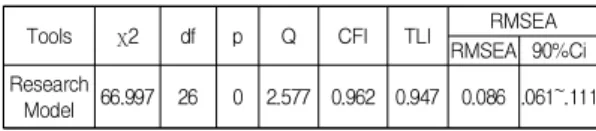
Evaluating the validity of the model as shown in Table 3, all client participation had p value of less than 0.05 with high ÷

2

value, but Q value, which is ÷

2

/df, was less than 3, and TLI andCFI indicator value were both over 0.9, so the validity of the model was within acceptable parameters, and secures the validity of the model.

Table 3. Validity of Research Model

Tools χ2 df p Q CFI TLI RMSEA

RMSEA 90%Ci Research

Model 66.997 26 0 2.577 0.962 0.947 0.086 .061~.111

(9)

3.3 Common Method Bias

Common method bias creates variance in measuring methods in research methods. Therefore, if independent variable and dependent variables are measured with separate methods, the source of the responses are independent, making the variance created by measuring methods smaller. The reduction of ÷

2

and DF from controlled and uncontrolled variance by common method bias are as shown in Table 4 and Fig. 3.

Fig. 3. Common Method Bias Model

Table 4. Common Method Variance Analysis

ANALYSIS χ2 DF △χ2 △DF p

Variance by Common Method Bias Uncontrolled

66.997 26      

Variance by Common

Method Bias Controlled 45.952 18 21.045 8 0.007

3.4 Test of Research Hypothesis

Hypothesis H1, "Constant interest and support from the management will affect the intention to repurchase consulting services" was adopted.

Hypothesis H2, "Formation of dedicated organizations will affect the intention to repurchase consulting services" was also adopted.

Hypothesis H3, "Understanding of the output will affect the intention to repurchase consulting services"

was also adopted.

Hypothesis H4, "Cooperation and support from the members of the organization will affect the intention to repurchase consulting services"was adopted as well.

Hypothesis H5, "the executive officer’s intents will affect the intention to repurchase consulting services"

was adopted as well.

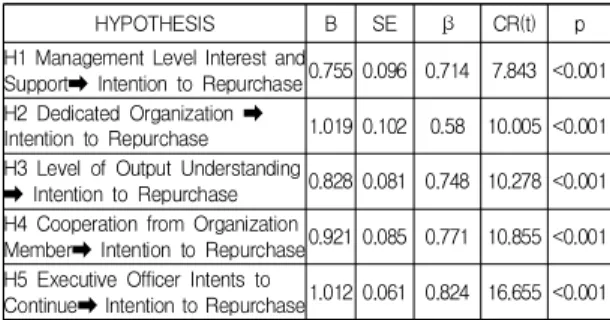
The results are as seen in Figure3.

The purpose of the study was to determine if consulting participation affects the intention to repurchase consultation service. Effects of participation of the clients on repurchase intention has been a subject matter for many fields. Many concepts set up structural relationships between latent variables of theoretical and abstract properties. SEM was used to verify the indicators through quantitative analysis.

Properties of the data and the relationship between variable factors were identified and finally examined as shown in Table 5.

The hypothesis was adopted that the subordinate variable of consulting participation, management 's interest and support, dedicated organization, product understanding, co - operation of organizational members, and executives' willingness will have a significant impact on the dependent variable, repurchase intention.

Table 5. Research Design Hypothesis Examination

HYPOTHESIS B SE β CR(t) p

H1 Management Level Interest and

Support➡ Intention to Repurchase 0.755 0.096 0.714 7.843 <0.001 H2 Dedicated Organization ➡

Intention to Repurchase 1.019 0.102 0.58 10.005 <0.001 H3 Level of Output Understanding

➡ Intention to Repurchase 0.828 0.081 0.748 10.278 <0.001 H4 Cooperation from Organization

Member➡ Intention to Repurchase 0.921 0.085 0.771 10.855 <0.001 H5 Executive Officer Intents to

Continue➡ Intention to Repurchase 1.012 0.061 0.824 16.655 <0.001

3.5 Moderating Effect Test

Using centration theorem, hypothesis H6, "the consulting understanding will regulate the participation of the clients’ effects on intention to repurchase" was examined, and the model showed that understanding the consulting regulated the results. Regulation effect examination results are as shown in Table 6.

Table 6. Regulation Effect Examination Results

Hypothesis B SE β CR(t) p

Participation ➡ Understanding➡

Intention to Repurchase 0.023 0.004 0.385 5.498 0.000

(10)

4. Conclusion

In this study, SEM was constructed for the effects of consulting participation on intention to repurchase and straightened out the criteria for evaluating analysis steps and model fitness. Using consulting understanding of an empirically analyzed consultee small business as a moderating variable, analyzed SEM and tried to find the most fitting model for 216 companies to find the regulating effects on intentions to repurchase. The SEM for this study had good fitness index. The study confirmed that client consulting understanding regulates the effects of client consulting participation on intention to repurchase, and the client understanding also affected the repurchase intention.

In addition, the effects on the repurchase intention are listed in order of executive will (0.824), cooperation of organization members (0.771), understanding of products (0.748), management interest and support (0.714) The results of this study are as follows. First, it shows that the intention to perform is highly influential on repurchase intention.

The results of the study shows that increasing client consulting understanding and participation is an important strategic point for the business in order to increase repurchase through consulting results. Efforts to increase voluntary intentions to repurchase consulting services must be reflected on the consulting plan from the planning phase to after service and must be fulfilled in that direction. To re-iterate, the importance of planning phase must not be overlooked.

The study has limitations due to the sample size of consulting of only small businesses, the results cannot be standardized. However, the importance of the study comes from the evaluation of consulting understanding and participation based on consulting plan of a consulting company with the purpose of increasing intention of repurchase.

This study contains the following limits that needs to be addressed upon further research.

First, the samples did not reflect consulting

experience of the clients. Classification based on the number of consulting service received should be added.

Therefore, the survey must be differentiated based on the number of consulting services the clients have received.

Second, reflection of relationship between actively participating members of the consultation and the consultant during the drafting phase of consulting plans and analyzing repurchase intentions needs to be added.

Third, this study applied only consulting comprehension as an independent variable for the study of repurchase intention of consulting.

As independent variables for future research, Y. K.

Choi, S. B. Kim & W. H. Hong (2018) Consulting service quality [42], Y. K. Choi, J. R. Kim & S. B. Kim (2018) Improve brand awareness of consulting firms [43], Y. K. Choi, W. H. Hong & amp; B. Kim (2018) Consulting Firm Increases Expertise [44], The consulting characteristics of Y. J. Jo & S. H. Lee [2011]

[45], B. Park, S. B. Kim & W. H. Hong (2018) Improvement of understanding of consulting [46] are need.

REFERENCES

[1] H. S. Mun. (2012). Effects of small business participation on consulting results and repurchase. Master dissertation, Hansung University, Seoul.

[2] J. C. Lee. (2010). A study on the determinants of management consulting perception for small and medium business ceo. Doctoral dissertation, Seoul National University of Technology. Seoul.

[3] I. S. Yeo. (2015). Effects of abilities of small business ceo on consulting results. Master dissertation, Hansung University. Seoul.

[4] Eisenberger, R., Huntington, R., Hutchison, S., & Sowa, D. (1986). Perceived organizational support. Journal of Applied psychology, 71(3), 500.

[5] Korean Ministry of Government Legislation. (1977).

Small Business Act (Enforced 2016.12.27.) Act No.

1 3 6 7 7 . h t t p : / / www. l a w. g o . k r / l s Sc . d o ? m e n uId=0&subMenu=1&query=%EC%A4%91%EC%86%8C

%EA%B8%B0%EC%97%85%EA%B8%B0%EB%B3%B

(11)

8%EB%B2%95#undefined.

[6] A. P. O. Williams & S. Woodward. (1994). The Competitive Consultant : A Client-oriented Approach for achieving Superior Performance. The Macmillan Press Ltd.

[7] Statistics Korea. Korean Standard Industry Code.

htt ps:/ /kss c.kos tat .go .kr:8443/kss cNe w_web /kssc/main/main.do?gubun=1#.

[8] I. S. Kim. (2009). Status and Development of Consulting Support Service for SMEs. Zeitschrift fu¨r Wirtschaftswissenschaften, 27(4), 41-67.

[9] Small and Medium Business Administration. (2008).

Consulting Industry Report.

[10] S. S. Shin. (2012). Effects of quality of management service on consumer satisfaction. Doctoral dissertation, Tongmyong University, Busan.

[11] J. I. Kim. (2015). A study on the effects of post-management on business performance and repurchasing intention of small and medium business consulting client firms. Doctoral dissertation, Hansung University Seoul.

[12] C. H. Cho & B. S. Kang. (2005). Effects of service quality on P2P file sharing consumer satisfaction. Doctoral dissertation, 364-365.

[13] S. T. Rhee & S. W. Ham. (2009). A Study on Relationship between CEO's Practical Volition of Business Ethics and Organizational Performance:Focus on Mediating Effect of Trust, Korea Journal of Business Administration, 22(4), 2437-2457.

[14] J. R. Baum, E. A. Locke & K. G. Smith. (2001). A multidimensional model of venture growth. Academy of Management Journal, 44(2), 292-303.

[15] R. Amit, L. Glosten & E. Muller. (1993). Challenges to theory development in entrepreneurship research, Journal of Management Studies, 30, 815-834.

[16] Sexton, Donald L. & Nancy Bowman. (1985). The entrepreneur: A capable executive and more, Journal of business venturing, 1.1, 129-140.

[17] A. H. Van de Ven & D. L. Ferry. (1980). Measuring and assessing organizations. NewYork: Wiely-Interscience.

[18] J. Robert Baum & Stefan Wally. (2003). Strategic decision speed and firm performance. Strategic Management Journal, 24(11), 1107-1129.

[19] Sexton, Donald L. & Nancy B. Bowman. (1986).

Validation of a personality index: Comparative psychological characteristics analysis of female entrepreneurs, managers, entrepreneur- ship students and business students. Frontiers of entrepreneurship

research, 40-51.

[20] Chao C. Chen, Patricia Gene Greene & Ann Crick.

(1998). Does entrepreneurial self-efficacy distinguish entrepreneurs from managers?. Journal of business venturing, 13(4), 295-316.

[21] E. A. Locke & G. P. Latham. (1990). A Theory of Goal Setting and Task Performance Prentice Hall.

Englewood Cliffs, NJ.

[22] N. R. Smith & J. B. Miner. (1984). Motivational considerations in the success of technologically innovative entrepreneurs. Frontiers of entrepreneurship research, 4, 488-495.

[23] D. L. Sexton & N. Bowman. (1985). The entrepreneur: A capable executive and more. Journal of business venturing, 1(1), 129-140.

[24] A. Bandura. (1986). The explanatory and predictive scope of self-efficacy theory. Journal of social and clinical psychology, 4(3), 359-373.

[25] I. T. Robertson & G. Sadri. (1993). Managerial self‐

efficacy and managerial performance. British Journal of Management, 4(1), 37-45.

[26] T. A. Judge, A. Erez & J. E. Bono. (1998). The power of being positive: The relation between positive self-concept and job performance. Human performance, 11(2-3), 167-187.

[27] K. W. Lee. (2007). Speculative Evaluation on Effects of Relationship and Compatibility Between Small Business Environment, CEO, Strategy, and HRM on Achievements. Kyungnam University School of Management Report.

[28] J. Bhatnagar. (2005). The power of psychological empowerment as an antecedent to organizational commitment in Indian managers. Human Resource Development International, 8(4), 419-433.

[29] A. L. Frohman & L. W. Johnson. (1992). The middle management challenge: Moving from crisis to empowerment. McGraw-Hill, Incorporated.

[30] L. W. Porter & E. E. Ghiselli. (1957). The self perceptions of top and middle management personnel.

Personnel Psychology, 10(4), 397-406.

[31] T. S. Jung. (2012). A study on the determinants of management consulting perception (for psychlogical factors of corporations middle management). Master dissertation. Hansung University, Seoul.

[32] P. C. Morrow. (1983). Concept redundancy in organizational research: The case of work commitment.

Academy of management Review, 8(3), 486-500.

[33] K. J. Yun. (2003). Comparison Study of Major

(12)

Organization Participation Types. Marketing Research, 15(3), 169-188.

[34] Y. Wiener. (1982). Commitment in organizations: A normative view. Academy of management review, 7(3), 418-428.

[35] M. E. Sheldon. (1971). Investments and involvements as mechanisms producing commitment to the organization.

Administrative science quarterly, 143-150.

[36] R. L. Oliver. (1980). A cognitive model of the antecedents and consequences of satisfaction decisions.

Journal of marketing research, 460-469.

[37] P. Kotler & G. Armstrong. (2010). Principles of marketing. Pearson education.

[38] S. H. Choi. (2013). The Influences of Salespeople's Verbal & Non-verbal Communication on the Consumer Behavior at a Sales Encounter. Master thesis, Sangmyeong University, Seoul.

[39] R. T. Rust & D. C. Williams. (1994). How length of patronage affects the impact of customer satisfaction on repurchase intention. Journal of Consumer Satisfaction, Dissatisfaction and Complaining Behavior, 7, 107-113.

[40] J. Y. Kim. (2005). Study about Major Factors on Success of Electronic Commerce. Korean Computer Information Association, 10(3), 267-173.

[41] I. Adamson. (2000). Management consultant meets a potential client for the first time: the pre-entry phase of consultancy in SMEs and the issues of qualitative research methodology. Qualitative Market Research: An International Journal, 3(1), 17-26.

[42] Y. K. Choi, S. B. Kim & W. H. Hong. (2018). A Study on the Effect of Consultant Capability on Consulting Satisfaction. Journal of the Korea Convergence Society, 9(4), 189-199.

[43] Y. K. Choi, J. R. Kim & S. B. Kim. (2018). A Study on the Effect of Branding of Consulting Company. Journal of the Korea Convergence Society, 9(4), 241-249.

[44] Y. K. Choi, W. H. Hong & S. B. Kim. (2018). A Study on the Effects of Consulting Service Quality and Participation on the Effect of Consulting Expertise on Business Performance. Journal of Digital Convergence, 16(4), 117-126.

[45] Y. J. Jo & S. H. Lee. (2018). A Study on the Influence of Consulting Characterstic ease of use to the word-of-mouth intention and repurchase intention.

Journal of Digital Convergence, 9(6), 207-216 [46] B. S. Park, S. B. Kim & W. H. Hong. (2018). The Effect

of Service Quality on Consulting Satisfaction through Understanding and Participation in Consulting. Journal

of the Korea Convergence Society, 9(4), 233-240.

이 양 우(Lee Yang Woo) [정회원]

․1983년 2월 : 인천대학교 무역학 과(경영학사)

․1989년 8월 : 국민대학교 경영대 학원 (경영학석사)

․2015년 9월 ~ 현재 : 한성대학교 스마트융합컨설팅

박사과정

․관심분야 : 경영컨설팅, 소상공인비즈모델, 소상공인정책

․E-Mail : [email protected]

김 정 렬(Kim, Jung Ryol) [정회원]

․1988년 2월 : 서강대학교 경제학 과(경제학사)

․1990년 2월 : 서강대학교 경제학 과(경제학석사)

․2000년 5월 : 미국 Purdue

University경제학(박사)

․2001년 11월 ~ 2006년 8월: 예금보험공사 연구위원

․2006년 8월 ~ 현재 : 한성대학교 경제학과 교수

․금융제도, 금융시장, 금융상품, 기업금융 및 컨설팅

․E-Mail : [email protected]

김 상 봉(Kim, Sang Bong) [정회원]

․2008년 8월 : Texas A&M University(경제학 박사)

․2009년 9월 ~ 현재 : 한성대학교 경제학과 교수

․관심분야 : 거시경제, 화폐금융, 행동경제, 국제금융

․E-Mail : [email protected]

수치

Table  2.  Correlation  Coefficient  of  the  Model,  AVE&amp;CR DIVISION A1 A2 A3 A4 A5 C.R Cronbachα A1 1.000         0.94 .808 A2 .442 1.000       0.96 .842 A3 .623 .434 1.000     0.930 .800 A4 .492 .425 .558 1.000   0.950 .808 A5 .561 .470 .572 .701 1.
Table  5.  Research  Design  Hypothesis  Examination

참조

관련 문서

An Empirical Study of the Effects of Consultant Competency on the Performance of Management Consulting: Focusing on the Moderating Effects of the Characteristics of Consulting Firm

The purpose of this study was to examine the moderating effect of attitude toward green brand on green brand positioning and repurchase intention of environmentally

The purpose of this research was to conduct an empirical research on the relations between perceived satisfaction level and value, brand attitude and repurchase

In this study, we examined the structural relationships among brand personality of pizza brands in Korea, customer-brand relationship quality, and repurchase intention

Purpose - This study examined the effect of the importance of selective attribute of HMR(Home Meal Replacement) on customers’ satisfaction and repurchase

Purpose - This study aimed to identify the impact of consumers’ perception of the value of discount store PB products on brand loyalty and repurchase

Han, “The Effect of Technology Readiness and Customer Participation on Service Quality, Customer Satisfaction and Service Repurchase Intention - Focused on

This study examines the relationshipsbetween the antecedents of repurchase intention, with special interest in the role of appraisal emotion and recreation motivation