한 국 버 섯 학 회 지
367
Notes
Journal of Mushrooms
This is an Open-Access article distributed under the terms of the Creative Commons Attribution Non-Commercial License (http://
creativecommons.org/licenses/by-nc/3.0) which permits unrestricted non-commercial use, distribution, and reproduction in any medium, provided the original work is properly cited.
J. Mushrooms 2014 December, 12(4):367-370 http://dx.doi.org/10.14480/JM.2014.12.4.367 Print ISSN 1738-0294, Online ISSN 2288-8853
© The Korean Society of Mushroom Science
*Corresponding author E-mail : [email protected]
Tel : +82-31-229-5832, Fax : +82-31-229-5964 Received October 1, 2014
Revised November 24, 2014 Accepted December 5, 2014
느타리버섯 병재배를 위한 영양원별 첨가 효과
장명준*·이윤혜1
경기도농업기술원 환경농업연구과,
1경기도농업기술원 버섯연구소
Effect of nutrient substrates on Pleurotus ostreatus in bottle culture
Myoung-Jun Jang* and Yun-Hae Lee1
Enviromental Agriculture Research Division, GARES, Hwaseong, Gyeonggi-Do, 445-784, Korea
1
Mushroom Research Institute, GARES, Gyeonggi Province Gwang-ju 464-870, Korea
ABSTRACT: In this study, we attempted to find substitute materials, distillers residue of cassava, alfalfa pellet, and distillers residue of corn, for cotton seed meal in bottle cultivation of Pleurotus ostreatus. In all treatments, the total carbon content was comparable with the exception of T4, and the total nitrogen content of T3 was similar to the control group, and C/N ratio of T4 was higher than other treatments. The diameter of plieus was the largest in T2, and the diameter of stipe was the largest in T2 and T4. And the length of stipe was largest in T1 and T2, and the most number of available stipes was in T1 and T3. The yield and bio-efficiency of fruit-body by residue of corn with soluble treatment(T3), were similar to the control of P. ostreatus.
Therefore, it was suggested that residue of corn was substituted for cotton seed meal for cultivation of P. ostreatus.
KEYWORDS: Bottle cultivation, Nutrient substrate, Oyster mushroom
서 론
느타리버섯(Pleurotus ostreatus (Fr.) Quel.)은 활엽수 고사목에 주로 발생하는 식용버섯이다(Park et al, 1975;
Shin, 1987). 이러한 느타리버섯은 예로부터 식용으로 이 용되어 왔으며, 각종 아미노산이 풍부하고 항암 및 항균 작용이 있는 다당류를 함유하고 있어 식품으로서의 수요 가 증가하고 있다(Sarangi et al, 2006). 또한 2012년 현재 우리나라 농산버섯생산량 중 느타리버섯류 총생산량은
51,991톤으로 전체버섯생산량의 약 30%를 차지하고 있는 버섯이다(Ministry of Agriculture, Food and Rural Affairs, 2012). 버섯을 안정적으로 재배하기 위해서는 배지의 이 화학적 특성이 적합하여야만 하며, 배지의 물리적 특성은 공극과 배지량, 용적밀도 등이 중요한 요인이며, 화학적특 성은 pH, 수분함량, 영양원 조성 등이 중요한 요인이 된 다(Lee et al, 2002; Wainwright, 1992). 우리나라에서 느 타리버섯 병재배를 위한 적정 배지개발은 Park et al (1995)이 톱밥에 비트펄프와 면실박을 혼합한 배지를 개 발함으로써 느타리버섯 재배에 대한 적정 기준을 마련하 였으며, 이후 여러 농림부산물을 활용한 연구가 지속적으 로 추진되어 왔다. 기존 포플러톱밥을 대체할 수 있는 주 재료에 대한 것으로서 미송톱밥(Park et al, 1995), 코코피 트(Jang et al, 2010) 및 감태나무(Lee et al, 2012) 등이 보고되었고, 영양원에는 야자박과 코코넛박(Kim et al, 2005), 케이폭박(Won et al, 2010), 홍삼박(Lee et al, 2011) 등이 보고되었다. 그러나 지속적인 국제곡물가격의 변동과 이에 따른 농림부산물의 급격한 가격변화로 여러 영양원들의 가격상승 시 버섯농가에서는 적정 배지를 찾 기 어려운 실정이다. 따라서 본 연구는 지속적인 병재배 용 느타리버섯의 배지재료 다변화를 통해 배지재료의 수 급불안정에 대비하기 위해 수행하였다.
368
장명준·이윤혜
영양원에 따른 배지성분 및 균사배양특성
시험에 사용한 균주는 버섯연구소에서 보유하고 있는 춘추느타리2호(P. ostreaus)를 PDA평판배지에서 5일간 배양 후 톱밥과 미강이 80:20(v/v)로 혼합된 삼각플라스 크에서 20일 배양시킨 다음 톱밥과 미강이 80:20(v/v)로 혼합된 900 mL PP (polyethylene)병에서 25일간 배양하 여 종균으로 사용하였다. 느타리버섯의 생육에 적합한 영 양원을 선발하기 위한 시험용 배지조합은 T1(미루나무톱 밥+비트펄프+면실박 : 50:30:20, v/v), T2(미루나무톱밥+
비트펄프+알팔파팰릿 : 50:30:20, v/v), T3(미루나무톱밥+
비트펄프+옥수수주정박 : 50:30:20, v/v), T4(미루나무톱 밥+비트펄프+카사바주정박 : 50:30:20, v/v)이었다. 각 처 리구별로 배지를 혼합한 후 수분을 65±5%로 조절하여 900 mL PP(polyethylene)병에 입병하였다. 그리고 121oC 에서 90분간 고압살균한 후 20oC 내외로 냉각한 다음 종 균을 접종하여 배양실에 입상하였다. 혼합배지의 이화학 적 특성 조사는 재료별 혼합 후 상토의 표준분석법(농촌진 흥청, 2002)에 준하여 조사하였다. 배양온도는 20±1oC이었 으며, 30일 동안 배양하였고, 균긁기를 실시한 후 생육실에 입상하였다. 생육온도는 15±1oC, 상대습도는 85~95%이었 으며, 환기조건은 1,500 ppm 이하로 설정하여 생육관리하 였다. 생육특성조사는 농업과학기술 연구조사분석기준(농 촌진흥청, 2003)에 준하여 조사하였다. 통계처리는 Duncan 의 다중범위검정(SAS프로그램)을 통하여 평균값들에 대 한 유의성을 검정하였다.
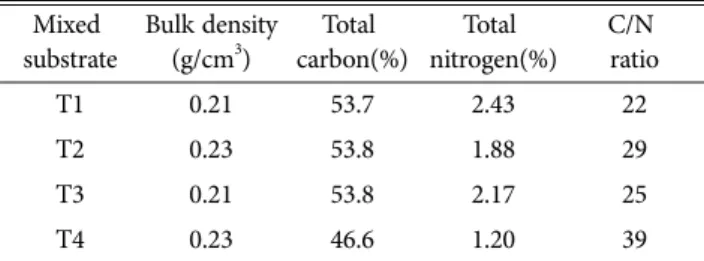
영양원 혼합배지별 이화학성 조사결과 Table 1과 같다.
가비중의 경우 처리구별로 0.21~0.23을 나타내었고, 이는 Park et al(1996)이 애느타리에서 적정 배지량일 때 가비 중이 0.20이라고 보고하였으며, 본 실험에서 수행한 춘추2 호의 경우 이 범위와 크게 다르지 않았다. Lee et al(2002) 은 느타리버섯 봉지재배시 배지의 경도가 너무 높으면 통 기성이 저하되며 자실체 발생 및 수량에도 영향을 끼칠 것이라고 하였다. 그리고 Royse(2000)은 표고버섯 재배시 0.85 mm 이하의 톱밥을 배지로 사용하여 재배했을 때 좁 은 배지내의 공간으로 인해 배지외부와 내부의 공기교환 에 장애가 되어 버섯수량이 감소했다고 보고하였다. 따라 서 배지의 물리성이 버섯의 생산량에 영향을 미치는 것으 로 판단되며, 추후 느타리버섯 병재배를 위한 적정 배지 의 공극량이나 용적밀도에 대한 기준이 설정되어져야 할 것이다.
C/N율은 T4에서 39로 다른 처리구보다 높았고, 다음으 로 T2, T3, T1의 순이었다. Hong(1978)은 느타리버섯 배 지의 C/N율이 너무 높거나 낮을 경우 수량을 감소시킨다 고 하였으며, Won et al(2007)에 의하면 느타리버섯의 적 정 C/N범위는 26±3.3라고 보고하였다. 본 실험에서 조사 한 처리구별 C/N율은 모든 처리구에서 정상적으로 생장 한 것으로 보아 크게 영향을 미치는 범위는 아니었고, T4 를 제외한 모든 처리구에서 Won et al(2007)이 보고한 C/
N의 범위와 대등한 결과를 보였다.
총탄소함량은 T4를 제외한 모든 처리구에서 대등하였 으며, 총질소함량은 T3에서 2.17%로 대조구에 가장 근접 한 값을 나타내었다. Won et al(2010)은 대조구 배지와 케이폭박을 첨가한 배지에서 총질소함량이 각각 2.4, 2.5%로 보고하였으며, 본 실험에서는 옥수수주정박 첨가 시 배지의 총질소함량이 2.17%로 대조구의 2.43%에 가 장 근접한 값을 나타내었다.
영양원에 따른 자실체 생육특성
혼합배지에 따른 자실체의 생육특성을 조사한 결과 갓 직경은 T2에서 가장 컸고, 대직경은 T2와 T4에서 가장 컸 고, 대길이는 T1과 T2에서 가장 많았다. 유효경수는 T1과 T3에서 가장 많았다(Table 2). Won et al(2010)은 케이폭
Table 1. Physico-chemical properties of mixed substrates
Mixed substrate
Bulk density (g/cm
3)
Total carbon(%)
Total nitrogen(%)
C/N ratio
T1 0.21 53.7 2.43 22
T2 0.23 53.8 1.88 29
T3 0.21 53.8 2.17 25
T4 0.23 46.6 1.20 39
Table 2. Characteristics of fruit body according to mixed substrates Mixed
substrate
Size of pileus (mm)
Diameter of stipe (mm)
Length of stipe (mm)
Number of available stipes (Number/bottle)
T1 30.8c
a8.6b 79.6a 29.2a
T2 33.6a 10.3a 74.4b 21.1b
T3 30.9bc 8.7b 81.6a 31.8a
T4 32.2b 10.4a 72.9b 16.7c
a
Values followed by the same letter do not differ significantly at p>0.05 according to Duncan's multiple range test(P> 0.05)
Fig. 1. Yield and Biological effciency of oyster mushroom
according to mixed substrate. aValues followed by the same letter do not differ significantly at p>0.05 according to Duncan's multiple range test(P > 0.05)느타리버섯 병재배를 위한 영양원별 첨가 효과
369박의 경우 유효경수가 수량증가의 직접적인 요인으로 작 용하였다고 하였는 바 본 실험에서도 유효경수는 T3에서 31.8개/병로 수량성(Fig. 3)과 일치하는 경향이었다.
혼합배지에 따른 처리구별 수량성 및 회수율은 Fig. 1과 같다. T3에서 수량이 171 g/병으로 대조구와 대등하였고, 회수율도 89.2%로 대조구와 대등한 결과를 나타내었다.
이상과 같은 결과 옥수수주정박이 느타리버섯 병재배를 위한 영양원으로 이용될 수 있을 것으로 판단되었다. 또 한 적정 첨가비율이나 다른 영양원과의 혼합비율설정을 위한 추가 연구를 통해 보다 안정적인 배지재료의 적용기 술 확립이 필요한 것으로 판단되었다.
적 요
총탄소함량은 T4를 제외한 모든 처리구에서 대등하였 으며, 총질소함량은 T3에서 2.17%로 대조구에 가장 근접 한 값을 나타내었다. C/N율은 T4에서 39로 다른 처리구 보다 높았다. 혼합배지에 따른 자실체의 생육특성을 조사 한 결과 갓직경은 T2에서 가장 컸고, 대직경은 T2와 T4 에서 가장 컸고, 대길이는 T1과 T2에서 가장 많았다. 유 효경수는 T1과 T3에서 가장 많았다. 혼합배지에 따른 처 리구별 수량은 T3에서 171g/병으로 대조구와 대등하였고, 회수율도 89.2%로 대조구와 대등한 결과를 나타내었다.
감사의 말씀
본 연구결과는 농림수산식품부 농수산식품기술기획평 가원(IPET)의 버섯수출연구과제(과제번호 608005-05-4- WT211)의 연구비지원의 일부결과이며, 연구비 지원에 감 사드립니다.
References
Hong JS. 1978. Studies on the physio-chemical properties and the cultivation of oyster mushroom(Pleurotus ostreatus).
J. Korean Soc. Appl. Biol. Chem. 21:150-184.
Jang MJ, Le YH, Ju YC. 2010. Selection of an substitute
sawdust material in Pleurotus ostreatus by bottle cultivation. Kor. J. Mycol. 38:142-145. (in Korean) Kim JH, Ha TM, Ju YC. 2005. Selection of substitute
medium of cotton seed pomace on the oyster mushroom for bottle cultivation. Journal of mushrooms. 3:105-108.
(in Korean)
Lee CJ, Han HS, Jhune CS, Cheong JC, Oh JA, Kong WS, Park GC, Park CG, Shin YS. 2011. Development of new substrate using redginseng marc for bottle culture of oyster mushroom (Pleurotus ostreatus). Journal of mushrooms. 9:139-144. (in Korean)
Lee CJ, Jhune CS, Cheong JC, Kong WS, Park GC, Lee JH, Shin YS. 2012. Optimum mixture ratio of functional Lindera glauca for culture of oyster mushroom(Pleurotus ostreatus). Journal of Mushroom Science and Production.
10:9-14. (in Korean)
Lee YH, Cho YJ, Kim HD. 2002. Effect on mycelial and fruit body development according to additives and mixing ratio in pot cultivation of Pleurotus ostreatus. Kor. J.
Mycol. 30:104-108. (in Korean)
Ministry of Agriculture, Food and Rural Affairs. 2013. 2012 Production performance of Industrial Crop. p62-65. (in Korean)
Park WK, Kim YH, Son SG. 1995. Research of high quality mushroom by bottle cultivation for year-round stable production research. Gyeonggi-do Agricultural Research
& Extension Services. Report of testing and research.
p657-662.(in Korean)
Park WK. 1996. Studies on the use of beet pulp and defatted cottonseed flout as the bottle culture substrates of pleurotus ostreatus(Jacq. ex Fr.) Kummer. Master`s thesis.
Kangwon national University.
Park YH, Go SJ, Kim DS. 1975. Studies on the cultivation of oyster mushroom, Pleurotus ostreatus (Fr.) Quel. using rice straw as growing substrate I. Experiment on the development of growing substrate. Report O.R.D.
17(S.F.P. & M): 103-107.
Royse DF. 2000. Influence of wood chip particle size used in substrate on biological efficiency and post-soak log weights of shiitake. Science and cultivation if edible fungi. 367-373.
Sarangi I, Ghosh D, Bhutia SK, Malick, Maiti TK. 2006.
Anti-tumor and immunomodulating effects of Pleurotus ostreatus mycelia-derived proteoglycans. Int Immunopharmacol.
Fig. 2. Morphology of fruit body in bottle cultivation by mixed substrate. A, Poplar sawdust+beet pulp+cotton seed meal
(50:30:20, v/v); B, Poplar sawdust+beet pulp+distillers residue of cassava(50:30:20, v/v); C, Poplar sawdust+beet pulp+alfalfa pellet(50:30:20, v/v); D, Poplar sawdust+beet pulp+distillers residue of corn(50:30:20, v/v).370
장명준·이윤혜
6:1287-1297.Shin GC. 1987. Harmful fungi associated with rice straw media for growing of oyster mushroom, Pleurotus ostreatus.
Kor. J. Mycol. 15:92-98.
Wainwright M. 1992. An introduction to fungal biotechnology.
John Wiley & Sons. pp 9-10.
Won SY, Chung JW, Jang MJ, Ju YC. 2007. The yield examination and the chart framing by mixed ratio of
substrate. Gyeonggi-do Agricultural Research & Extension Services. Report of testing and research. p714-732. (in Korean).
Won SY, Lee YH, Jeon DH, Ju YC, Lee YB. 2010.
Development of new mushroom substrate using Kapok seedcake for bottle culture of oyster mushroom(Pleurotus ostreatus). Kor. J. Mycol. 38:130-135.