셀러리악 추출물의 암세포 증식 억제 효과
이재혁1, 박정숙2*
1남부대학교 응급구조학과 교수, 2남부대학교 간호학과 교수
Inhibitory Effect of Celeriac Extract on Cancer Cell Proliferation
Jae-Hyeok Lee1, Jeong-Sook Park2*
1Professor, Department of Emergency Medical Rescue, Nambu University
2Professor, Department of Nursing, Nambu University
요 약 본 연구는 다양한 항암성분을 함유한 Celeriac Extract의 암세포 증식에 미치는 영향을 살펴보기 위하여 실시 되었다. 실험에 사용한 암 세포주는 5종으로 폐암세포 A549, 전립샘암세포 DU-145, 자궁암세포 HeLa, 유방암세포 MCF-7, 간암세포 SNU-182 로 모두 인체 유래 암 세포주를 사용하였으며 Celeriac Extract 10ug/mL, 100ug/mL, 1000ug/mL 에 대한 암세포의 증식 억제는 CCK-8 방법을 이용하여 측정하였다. 암세포 증식 억제를 살펴본 결과 Celeriac Extract 1000ug/mL는 폐암세포 A549, 전립샘암세포 DU-145, 자궁암세포 HeLa, 간암세포 SNU-182에 서 유의한 증식 억제를 보였으며 농도 의존성을 나타냈다. 그러나 유방암세포 MCF-7 에서는 농도 의존적인 감소만 보였다. 결론적으로, 다양한 인간유래 암 세포주를 이용한 Celeriac Extract의 세포 증식 억제기전들은 암 예방효과 및 치료제 개발의 잠재력을 제공한다고 볼 수 있다.
주제어 : 셀러리악추출물, 폐암세포, 전립샘암세포, 자궁암세포, 간암세포
Abstract This study was carried out examine the effect of Celeriac Extract, which contains various anticancer ingredients, on the proliferation inhibition of human-derived cancer cells and the degree of inhibition. The five cell lines used in the experiment were lung cancer cells A549, prostate cancer cells DU-145, uterine cancer cells HeLa, breast cancer cells MCF-7, and liver cancer cells SNU-182. All cancer cells derived from the human body were used, and the inhibition of cancer cell proliferation with Celeriac Extract 10ug/mL, 100ug/mL, and 1000ug/mL was measured using the CCK-8 method. As a result of examining the inhibition of cancer cell proliferation, Celeriac Extract 1000ug/mL showed significant proliferation inhibition in lung cancer cells A549, prostate cancer cells DU-145, uterine cancer cells HeLa, and liver cancer cells SNU-182, and showed a concentration dependence. However, only a concentration-dependent decrease was observed in breast cancer cells MCF-7.In conclusion, it can be seen that the cell proliferation inhibition mechanisms of Celeriac Extract using various human-derived cancer cell lines provide the potential for cancer prevention and therapeutic development.
Key Words : Celeriac extract, Lung cancer cell, Prostate cancer cell, Uterine cancer cell, Liver cancer cell
*This paper was supported by research funds from Nambu University, 2020.
*Corresponding Author : Jeong-Sook Park([email protected]) Received June 1, 2021
Accepted September 20, 2021 Revised June 22, 2021
Published September 28, 2021
1. 서론
최근 고령인구증가와 서구화된 식생활로 인하여 암 발 생률이 점점 증가하고 있다[1]. Siegel의 보고서에 따르 면 인구 증가와 연령 분포의 변화, 위험 요인에 의한 유 병률과 관련하여 전 세계의 암 발생 부담도 크게 증가할 것으로 예상되고 있다[2]. 이에 건강한 수명 연장과 건강 관리를 위해 천연물의 기능성 및 생리활성에 대한 연구 가 널리 진행되고 있으며, 암 치료 및 예방을 위해 각종 과일과 채소를 이용한 식이의 중요성이 대두되고 있다[3].
또한 녹황색 채소류의 섭취 횟수가 많을수록 암 발생의 위험이 감소한다고 알려져있다[4]. 특히, Phytochemicals는 잘 알려진 항암 성분으로 다양한 과일과 채소에 풍부하 게 존재하며, Phytochemicals의 일종인 폴리 페놀은 가장 광범위하게 연구되고 있는 생리활성 물질이다[5].
폴리페놀은 다양한 과일, 채소 및 곡물에 존재하며 항산 화 역할을 하고 DNA 손상 및 염증과 관련된 자유 라디 칼을 제거함으로써 암을 억제한다는 보고가 많다[6]. 폴 리페놀은 폐, 위, 결장 직장, 유방암, 난소 암, 자궁 내막 암 및 비호지킨 림프종의 위험 감소와 관련이 있음을 보 여주고 있다[7-9]. 폴리페놀 성분 중 미나리과인 셀러리 나 셀러리악에 풍부한 apigenin은 암 위험 감소와 연관 성이 있음이 보고되었다[10,11].
셀러리악(Celeriac, Apium graveolens var. rapaceum, turnip-rooted celery, celery root)은 미나리과의 두 해살이풀로 셀러리의 일종이며 뿌리 셀러리, 셀러리 아 크라고 불린다. 둥글납작한 배축(胚軸)이 있는 뿌리는 엷 은 갈색으로, 수많은 작은 뿌리가 있는 뿌리채소이다 [12,13]. 초기에는 지중해 분지와 북유럽에서 약용식물 로 경작되었으며[14], 폴리페놀 성분이 풍부하여 면역계 활성과 항산화, 항염, 항 종양효과에 대한 보고들이 있다 [15,16]. 또한 항암 효과가 증명된 apigenin, genistein 성분이 셀러리에 비해 많이 함유되어 있다[17]. 그러나 Celeriac Extract을 이용한 생리활성 실험은 많지 않아 본 연구에서는 Celeriac Extract의 다양한 농도를 인체 유래 암세포인 폐암세포 A549, 전립샘암세포 DU-145, 자궁암세포 HeLa, 유방암세포 MCF-7, 간암세포 SNU-182 에 처리하여 증식 억제에 미치는 영향을 살펴보았다.
2. 연구방법 2.1 실험 재료
위 실험에 사용된 셀러리악은 시중에서 유기농원료를 구입하여 사용하였으며 약 20kg를 음건세절 후 2kg을 methanol로 진탕하면서 50℃에서 48시간동안 2회 추 출하였다. methanol 추출물을 수욕상에서 감압 농축하 여 methanol 엑스를 얻었으며, 이 methanol 엑스를 냉 동 보관 후 시료로 사용 하였다.
2.2 시약
암세포 배양 배지는 Dulbeco's modified eagle medium(DMEM)을 사용하였으며 소 태아 혈청(fetal bovine serum, FBS), 항생제, trypsin-EDTA 등은 모 두 GIBCO (Grand Island Biological Co., NY, USA) 제품을 사용하였고, 추출용 유기용매인 methanol (MeOH), ethanol(EtOH)은 덕산약품(KOREA), 그 외의 시약은 Sigma-Aldrich Co. Ltd(Irvine, UK) 시약과 분석용 시 약 특급을 사용하여 실시하였다. CO2 incubator는 My CO2(Science Technology, Korea)를 사용하였고, 세 포 현미경은 자이스 inverted microscope(Axioverts 100, Germany)를 사용하였다.
2.3 암세포주 배양
실험에 사용한 세포주는 5종으로 폐암세포 A549, 전 립샘암세포 DU-145, 자궁암세포 HeLa, 유방암세포 MCF-7, 간암세포 SNU-182이며, 모두 인체 유래 암세 포주를 사용하였으며 한국 세포주 은행 (KCLB)에서 분 양받았다. 세포배양을 위해 100mm petri dish에 DMEM (5% FBS 함유) 배지와 약 2×10⁴ cells/ml의 5ml을 CO2 incubator 에서 48시간 계대 배양하였다.
2.4 Cell viability assay (CCK-8 assay) Celeriac Extract의 인체유래 암세포주에 대한 증식 억제에 대한 효과는 CCK-8 방법[18]을 이용하여 측정 하였다. 100 μl의 암세포 현탁액 5×10³ cells / well을 96웰 플레이트에 분주한 후 24 시간 동안 37 °C, CO2
5 % 조건에서 미리 플레이트 배양한다. 다양한 농도의 Celeriac Extract 10 μl를 96well 플레이트에 첨가한 다. 그리고 동일한 조건에서 24시간 배양하고 플레이트 의 각 well에 10 μl의 CCK-8 solution을 첨가한 후 2 시간 동안 플레이트를 배양하고 ELISA 리더를 사용하여 450 nm에서 흡광도를 측정한다. 흡광도 값은 살아있는 세포의 수와 비례하므로 각 sample의 암세포 성장 억제 를 흡광도 값으로 알 수 있다.
2.5 통계적 분석
모든 data는 평균±표준오차(Mean±S.E.)로 나타냈 으며 students' t-test를 사용하여 유의성 검사를 실시하 였다. 실험결과에 따라 각 그룹 간의 유의성은 p<0.05 에 해당하는 경우에 유의수준에 준하는 것으로 판단하였다.
3. 결과 및 고찰
3.1 인간 유래 폐암세포 A549 증식억제 효과 Celeriac Extract의 인체유래 폐암 세포주A549 증식 억제에 미치는 영향을 살펴본 결과 Celeriac Extract은 100ug/mL 및 1000ug/mL에서 농도 의존적으로 유의한 증식 억제를 보여주었다. Chunhua등에 의하면 A549 폐암 이종 이식을 한 마우스에서 셀러리악의 주요 성분 인 apigenin 처리시 종양 부피를 감소시켰으며, 이것은 혈관 신생 및 세포 증식의 억제에 기인한다고 하였다[19].
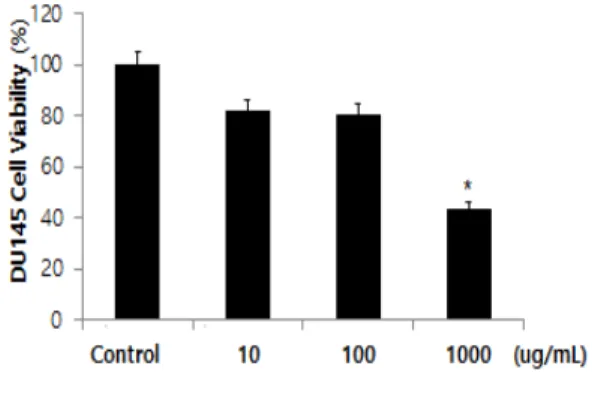
3.2 인간 유래 전립샘암세포 DU-145 증식억제 효과 Celeriac Extract의 인체유래 전립샘 암세포주 DU-145 증식 억제에 미치는 영향을 살펴본 결과 Celeriac Extract은 농도 의존적으로 DU-145암세포 증식 억제 효과가 나타났다. 또한 Fig. 2에서 나타난 것처럼, Celeriac Extract 1000ug/mL에서 유의한 증식 억제를 나타났다. 20주 동안 apigenin 20 및 50 μg을 경구 투 여한 마우스에서 종양 부피를 감소시키고 마우스 전립선 (TRAMP) 모델의 형질 전환 선암에서 기관 전이 억제를 보여주었다[20,21]. 또한 인간 전립선암을 앓고 있는 누 드 마우스에서 종양의 부피와 습윤 중량을 감소시켰다[22].
Fig. 1. Inhibitory effect of Celeriac Extract on human lung cancer cell A549 proliferation * : p<0.05 shows a significantly different from the control group.
Fig. 2. Inhibitory effect of Celeriac Extract on human prostate cancer cell DU-145 proliferation. * : p<0.05 shows a significantly different from the control group.
3.3 인간 유래 자궁암세포 HeLa 증식억제 효과 Celeriac Extract의 인체 유래 자궁암 세포주 HeLa 증식 억제에 미치는 영향을 살펴 본 결과, Celeriac Extract은 농도 의존적으로 증식 억제를 보여주었으며, Fig. 3에서 보여주는 것처럼, Celeriac Extract 1000ug/mL에서 유의한 억제를 보여주었다.
Fig. 3. Inhibitory effect of Celeriac Extract on human cervical cancer cell HeLa proliferation. * : p<0.05 shows a significantly different from the control group.
3.4 인간 유래 유방암세포 MCF-7 증식억제 효과 Celeriac Extract의 인체 유래 유방암 세포주 MCF-7 증식 억제에 미치는 영향을 살펴본 결과 Celeriac Extract은 농도 의존적으로 증식 억제가 나타났다. 그러나 Fig. 4에서 보여주는 것처럼, Celeriac Extract 10ug/mL, 100ug/mL, 1000ug/mL에서 유의한 증식억제를 보여 주지는 않았다. Celeriac Extract가 유방암세포 억제효 과에는 민감하게 작용하지 않는 것으로 사료된다.
3.5 인간 유래 간암세포 SNU-182 증식억제 효과 Celeriac Extract의 인체 유래 간암 세포주 SNU-182 에 대한 증식 억제에 미치는 영향을 살펴본 결과 Celeriac Extract은 농도 의존적으로 증식 억제를 보여 주었으나, Fig. 5에서 보여주는 것처럼, 특히 Celeriac Extract 1000ug/mL에서 유의한 증식 억제를 보여주었 다. 셀러리악의 유효성분인 apigenin은 많은 동물실험 에서 세포자멸과 자가포식을 통하여 종양성장 억제와 전 이억제를 시사하였다[23]. 미나리과의 Apiaceae 속에 속하는 셀러리악은 apigenin 성분이 풍부하며 Birt 등 은 아피게닌의 효과적인 항 변이원성 특성을 입증하였 고[24], 그 이후로 암 예방 및 치료에서 아피게닌의 잠재 적 가치는 다양한 암 동물 모델에 대한 광범위한 연구에 의해 더욱 뒷받침되었다[25,26]. 셀러리악 추출물은 apigenin 성분에 의해 다양한 암세포의 증식을 억제하 는 것으로 사료된다.
Fig. 4. Inhibitory effect of Celeriac Extract on human breast cancer cell MCF-7 proliferation.
Fig. 5. Inhibitory effect of Celeriac Extract on human liver cancer cell SNU-182 proliferation. * : p<0.05 shows a significantly different from the control group.
4. 결론
본 연구는 Celeriac Extract의 인체 유래 암세포주 증식 억제에 미치는 영향을 살펴보기 위하여 실시되었 다. 실험에 사용한 세포주는 5종으로 폐암세포 A549, 전 립샘암세포 DU-145, 자궁암세포 HeLa, 유방암세포 MCF-7, 간암세포 SNU-182이며, 모두 인체 유래 암 세 포주를 사용하였다. Celeriac Extract 10ug/mL, 100ug/mL, 1000ug/mL에 대한 영향을 살펴본 결과 Celeriac Extract은 대부분의 암세포에서 농도 의존적 으로 증식을 억제하였다. 특히, Celeriac Extract 1000ug/mL에서 폐암세포 A549, 전립샘암세포 DU-145, 자궁암세포 HeLa, 간암세포 SNU-182는 유의한 증식 억제를 보였다. 그러나 유방암세포 MCF-7 에서는 농도 의존적인 감소만 보였다. 결론적으로, 다양한 인간유래 암 세포주를 이용한 Celeriac Extract의 세포 증식 억제 기전들은 암 예방효과 및 치료제 개발의 잠재력을 제공 한다고 볼 수 있다.
REFERENCES
[1] B. Rocca & G. A. FitzGerald. (2002). Cyclooxygenases and prostaglandins shaping up the immune response.
Int. Immunopharmacol . 2, 603-607.
[2] R. L.Siegel, K. D. Miller & A. Jemal (2016). Cancer statistics. CA Cancer J Clin, 66, 7-30.
[3] I. Goleberg. (1994). Functional Foods. Chapman &
Hall Press, New York, USA, 350-550.
[4] O. Sadaki. (1996). The development of functional foods and material. Bio-industry, 13, 44-50.
[5] X. Wang, Y. Ouyang, J. Liu, M. Zhu, G. Zhao & W.
Bao. (2014). Fruit and vegetable consumption and mortality from all causes, cardiovascular disease, and cancer: systematic review and dose-response meta-analysis of prospective cohort studies. BMJ, 349.
[6] R. C. Garcia, C. A. Gonzalez, A. Agudo & E. Riboli.
(1999). Intake of specific carotenoids and flavonoids and the risk of gastric cancer in Spain. Cancer Causes Control, 10, 71-75.
[7] M. Rossi, E. Negri, R. Talamini, C. Bosetti, M. Parpinel
& P. Gnagnarella. (2006). Flavonoids and colorectal cancer in Italy. Cancer Epidemiol Biomarkers Prev, 15, 1555-1558.
[8] C. Bosetti, L. Spertini, M. Parpinel, P. Gnagnarella, P.
Lagiou & E. Negri. (2005). Flavonoids and breast
cancer risk in Italy. Cancer Epidemiol Biomarkers
Prev, 14, 805-808.
[9] M. A. Gates, A. F. Vitonis, S. S. Tworoger, B. Rosner, L. Titus-Ernstoff & S. E. Hankinson. (2009). Flavonoid intake and ovarian cancer risk in a population-based case-control study. Int. J. Cancer . 124, 1918-1925.
[10] P. L. Horn-Ross, E. M. John, A. J. Canchola, S. L.
Stewart, & M. M. Lee. (2003). Phytoestrogen intake and endometrial cancer risk. J. Natl. Cancer Inst, 95, 1158-1164.
[11] C. L. Frankenfeld, J. R. Cerhan, W. Cozen, S. Davis, M.
Schenk & L. M. Morton. (2008). Dietary flavonoid intake and non-Hodgkin lymphoma risk. Am J. Clin Nutr, 87, 1439-1445.
[12] Growing Crops: Celery and Celeriac. (2011). Urban Organic.
[13] H. Chisholm. (1911). Encyclopædia Britannica.
Cambridge University Press.
[14] S. Wolfgang. (2012). Celeriac (Apium graveolens rapaceum). Desirable Vegetable Varieties, By Vegetable. The Owlcroft Company.
[15] W. L. Chen & Y. Xiao. (2020). Apigenin protects against ischemia-/hypoxia-induced myocardial injury by mediating pyroptosis and apoptosis. I n Vitro Cellular & Developmental Biology, 13, 307-312.
[16] P. T. Ana et al. (2015). The Effect of Apium Nodiflorum in Experimental Osteoporosis. Current Pharmaceutical Biotechnology, 16(5), 414-423.
[17] J. H. Lee, H. J. Jeong, J. S. Park. (2021). Effect of Celeriac Extract on the LPS-Induced Production of Pro-inflammatory Cytokines by RAW 264.7 cells.
Journal of the Korea Convergence Society, 12(2), 295-300,
[18] S. F Jin, H. L. Ma, Z. L. Liu, S. T. Fu, C. P. Zhang, &
Y. He. (2015). XL413, a cell division cycle 7 kinase inhibitor enhanced the anti-fibrotic effect of pirfenidone on TGF-β1-stimulated C3H10T1/2 cells via Smad2/4. Exp Cell Res, 10;339(2), 289-299.
[19] L. Chunhua, L. Donglan, F. Xiuqiong, Z. Lihua, F. Qin,
& L. Yawei. (2013). Apigenin up-regulates transgelin and inhibits invasion and migration of colorectal cancer through decreased phosphorylation of AKT. J.
Nutr. Biochem, 24, 1766-1775.
[20] D. F. Birt, B. Walker, M. G. Tibbels & E. Bresnick.
(1986). Anti-mutagenesis and anti-promotion by apigenin, robinetin and indole-3-carbinol.
Carcinogenesis, 7, 959-963.
[21] S. Shukla, N. Bhaskaran, M. A. Babcook, P. Fu, G. T.
Maclennan. & S. Gupta. (2014). Apigenin inhibits prostate cancer progression in TRAMP mice via targeting PI3K/Akt/FoxO pathway. Carcinogenesis, 35, 452-460.
[22] S. Shukla, P. Fu & S. Gupta. (2014). Apigenin induces apoptosis by targeting inhibitor of apoptosis proteins and Ku70-Bax interaction in prostate cancer.
Apoptosis, 19, 883-894.
[23] B. Mafuvadze, Y. Liang, C. Besch-Williford, X. Zhang,
& S. M. Hyder. (2012). Apigenin induces apoptosis and blocks growth of medroxyprogesterone acetate-dependent BT-474 xenograft tumors. Horm Cancer, 3, 160-171.
[24] D. F. Birt, B. Walker, M. G. Tibbels & E. Bresnick.
(1986). Anti-mutagenesis and anti-promotion by apigenin, robinetin and indole-3-carbinol.
Carcinogenesis, 7, 959-963.
[25] X. Tong, S. Mirzoeva, D. Veliceasa, B. B. Bridgeman, P. Fitchev, & M. L. Cornwell. (2014). Chemopreventive apigenin controls UVB-induced cutaneous proliferation and angiogenesis through HuR and thrombospondin-1. Oncotarge t , 5, 11413-11427.
[26] B. B. Bridgeman, P. Wang, B. Ye, J. C. Pelling, O. V.
Volpert & X. Tong, (2016). Inhibition of mTOR by apigenin in UVB-irradiated keratinocytes: A new implication of skin cancer prevention. Cell Signal, 28, 460-468.
이 재 혁(Jae-Hyeok Lee) [정회원]
․ 1987년 2월 : 우석대학교 약학과(약학 사)
․ 1989년 2월 : 우석대학교 약학과(약학 석사)
․ 2005년 2월 : 우석대학교 약학과(약학 박사)
․ 2005년 2월 ~ 2018년2월 : 남부대학 교 한방제약개발학과 교수
․ 2018년 3월 ~ 현재 : 남부대학교 응급구조학과교수
․ 관심분야 : 천연물
․ E-Mail : [email protected]
박 정 숙(Jeong-Sook Park) [정회원]