75
Antimicrobial resistance of Staphylococcus aureus isolated from domestic and imported raw meat in Korea
Hee Jin Heo
1, Bok Kyung Ku
1, Dong Hwa Bae
2, Cheong Kyu Park
2, Young Ju Lee
2,*
1National Veterinary Research and Quarantine Service, Anyang 430-824, Korea
2College of Veterinary Medicine, Kyungpook National University, Daegu 702-701, Korea (Accepted: February 12, 2008)
Abstract : The rapid evolution of antibiotic resistance in Staphylococcus ( S. ) aureus is of considerable concern. Methicillin-resistant S. aureus (MRSA) strains are especially one of the greatest public concerns since the treatment of infections is more difficult when encountering resistance. In this study, we conducted a nationwide survey on the antimicrobial resistance of S. aureus isolated from raw meat samples collected from 16 countries, including Korea, and investigated the prevalence of MRSA as a possible source of human infection. Of 1,984 meat samples, S. aureus was isolated from 218 (11.0%) samples consisting of 23 (12.1%) from domestic meat and 195 (10.9%) from imported meat. The isolation rates of poultry meat, pork and beef were 12.8%, 7.0% and 10.0%, respectively. With regard to imported meat, the incidence varied from 4.8% to 16.6% from 13 countries, with the exception of Austria and Poland. In a resistance test to 20 antimicrobial agents, one hundred and eighty-four isolates (84.4%) were resistant to one or more antimicrobial agents tested. Especially, 17 (7.8%), 124 (56.9%) and 28 (12.8%) isolates showed a resistance to 3, 2 and 1 drugs, respectively. One isolate originating from domestic beef was resistant to 7 drugs. Another isolate originating from imported poultry meat showed resistance to oxacillin and methicillin by the disk diffusion test and minimal inhibition concentration methods, but showed negative for detection of the mecA gene.
Keywords : antimicrobial resistance, MRSA, S. aureus
Introduction
Staphylococcus ( S. ) aureus causes severe animal diseases such as suppurative disease, mastitis, arthritis, and urinary tract infections, that are associated with numerous virulence factors [2, 22]. In humans, this organism is a major cause of food poisoning, pneumonia, postoperative wound infections, and nosocomial bacteremia [20]. The rapid evolution of antibiotic resistance in S. aureus is of considerable concern.
Multidrug-resistant S. aureus strains are especially one of the greatest public concerns since the treatment of infections is more difficult when encountering resistance.
Methicillin-resistant S. aureus (MRSA) is known to be one of the most prevalent nosocomial pathogens throughout the world and is capable of causing a wide range of hospital-linked infections. The
β-lactam resistance of MRSA is determined by the function of
the penicillin-binding protein (PBP) 2a, which is encoded by the methicillin resistant gene, mecA [6].
The prevalence of methicillin resistance is known to be more than 70% among S. aureus isolates from hospitals in Korea [12]. The isolation of MRSA from non-human sources, including foodstuffs and animals has also been reported [7, 8, 11]. Such organisms are frequently resistant to the majority of commonly used antimicrobial agents, including aminoglycosides, macrolides, chloramphenicol, tetracycline, and fluoroquinolones [13]. In addition, MRSA strains are considered to be resistant to all cephalosporins, cephems, and other
β- lactams regardless of the in vitro test results obtained with those agents [5].
Although the USA and some European countries have strict regulations on antibiotic uses for animal growth and therapy, there is a lack of data regarding the prevalence and antimicrobial resistance profiles of
*Corresponding author: Young Ju Lee
College of Veterinary Medicine, Kyungpook National University, Daegu 702-701, Korea
[Tel: +82-53-950-7793, Fax: +82-505-950-7793, E-mail: [email protected]]
foodborne pathogens present in imported verses domestic foods in Korea. In this study, we conducted a nationwide survey on the antimicrobial resistance of S. aureus isolated from raw meat samples collected from 16 countries including Korea, and investigated the prevalence of MRSA as a possible source of human infection.
Materials and Methods
Collection of samples
From September 2003 to September 2005, poultry meat, pork and beef samples were collected from 16 domestic slaughter houses and cold storage warehouses containing raw meat samples imported from 15 countries.
Isolation of S. aureus
S. aureus from meat was isolated and identified according to 'Processing Standard and Ingredient Specifications for Livestock Products of the Republic of Korea' [20]. Twenty-five g of samples were weighed into sterile stomacher bags and diluted with 225 ml sterile butterfield's phosphate buffered dilution water (BPD). All samples were homogenized in a stomacher for about 1 min. Ten ml BPD homogenized was inoculated into tryptic soy broth (TSB; Difco, USA) with 10% NaCl and incubated at 37
oC for 18 h. One loopful of the TSB was streaked on Baired-Parker agar (Oxoid, UK) supplemented with egg yolk-tellurite emulsion (Oxoid, UK), and incubated at 37
oC for 24 h. From each plate, typical colonies of S. aureus were isolated and cultured separately on brain-heart infusion (BHI; Difco, USA) agar. The identification was carried out using the following tests; gram staining, production of coagulase, and fermentation of mannitol. If several colonies were isolated from one meat sample, only one isolate was randomly chosen. The organisms were finally confirmed by PCR [6] and kept in freezing at
−
70
oC before use.
Disk diffusion method
All S. aureus isolates were investigated for their antimicrobial resistance by the agar disk diffusion test using the following antibiotics: amikacin (An), amoxicillin/clavulanic acid (Amc), ampicillin (Am), chloramphenicol (C), ciprofloxacin (Cip), clindamycin (Cc), enrofloxacin (Eno), erythromycin (E), gentamicin
(Gm), linezolid (Lzd), nitrofurantoin (F/M), oxacillin (Ox), penicillin (P), quinupristin/dalfopristin (Syn), ripampin (Ra), sulfamethoxazole/trimethoprim (Sxt) and tetracycline (Te) of BBL, and gatifloxacin (Gtx), methicillin (Met) and teicoplanin (Tec) of Oxoid.
Mueller-Hinton agar (MHA; Difco, USA) was dispensed into a plastic culture plate to yield a uniform depth of 4 mm. The density of all isolates tested was adjusted to 0.5 McFarland turbidity (1~2
×10
8CFU/ml) by using a spectrophotometer, and inoculated over the agar surface by flooding. Antimicrobial disks were applied by a dispenser within 15 min after inoculation. Inhibition zone diameters were measured after 16-18 h of incubation at 35
oC, but 24 h for Ox and Met. S. aureus ATCC 25923 and Escherichia coli ATCC 25922 were used as control strains of this test. The results were evaluated according to NCCLS [17].
Minimal inhibitory concentrations (MICs) The MICs for Ox and Met were examined by the agar dilution method. Antimicrobial agents were added to autoclaved MHA (added 2% NaCl for Ox and Met) cooled to 50
oC to the final concentration from 0.25 to 512
µg/ml by two fold diluting, and the medium were dispensed to 20
µl after gently mixing. The isolates suspension, which was adjusted to 10
4CFU/ml, was applied to the surfaces of the agar plates containing a series of concentrations of antimicrobials with a steer's replicator device that delivered about 3
µl of suspension.
The MIC was defined as the lowest concentration of antimicrobials inhibiting visible growth after 24 h incubation at 35
oC. S. aureus ATCC 29213 and Enterococcus faecalis ATCC 29212 were used as control strains. Breakpoints published by the NCCLS [16] were used: Ox susceptible (S)
≤2
µg/ml and resistant (R)
≥4
µg/ml; Met S
≤8
µg/ml and
≥R 16 µg/ml.
DNA extraction
DNA extraction was performed according to the
protocol described in the G-spin genomic DNA extraction
kit (iNtRON, Korea) as follows. Cells incubated 24 h
on BHI agar plates were suspended in 1 ml of
phosphate buffered saline (Sigma, USA), centrifuged
at 13,000 rpm for 1 min and removed supernatant. Fifty
µl of pre-buffer and 3 µl of lysozyme solution were
added and then incubated at 37
oC for 15 min. Two
hundred and fifty µl of G-buffer solution was added
and incubated at 65
oC for 15 min. Two hundred and fifty µl of binding buffer solution was added again and vortexed. Cell lysates were loaded on column and centrifuged at 13,000 rpm for 1 min. After washing two times, 100 µl of elution buffer was added onto the membrane. After incubation at room temperature for 1 min, the column was centrifuged at 13,000 rpm for 1 min. The elute were used for PCR assay and stored at
−20
oC prior to use.
Amplification of mecA gene
The presence of the mecA gene was verified by means of PCR. Amplification of the mecA gene was performed by using the method reported by Kearns et al . [6]. S. aureus ATCC 25923 and S. aureus ATCC 29213 were used as negative control strains and S.
aureus ATCC 43300, S. aureus ATCC 3300, S. aureus ATCC 3287, S. aureus ATCC 3299, S. aureus ATCC 9179 and S. aureus ATCC 2246 were used as positive control strains.
Results
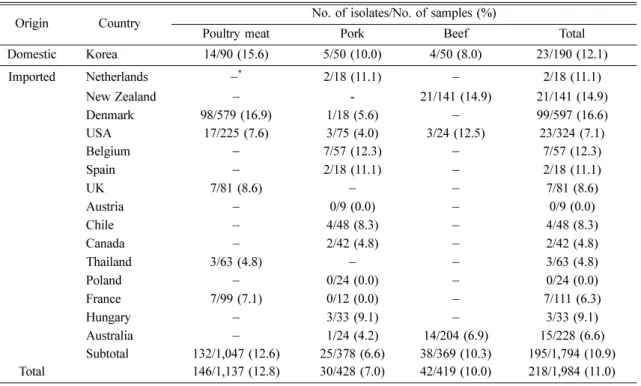
Isolation rate of S. aureus from meat samples is shown in Table 1. Of 1,984 meat samples, S. aureus
was isolated from 218 (11.0%) samples consisting of 23 (12.1%) from domestic meat and 195 (10.9%) from imported meat. Each isolation rate of poultry meat, pork and beef samples were 12.8%, 7.0% and 10.0%, respectively. In imported meat, the frequency of isolation varied from 4.8% to 16.6% from 13 countries, with the exceptions of Austria and Poland.
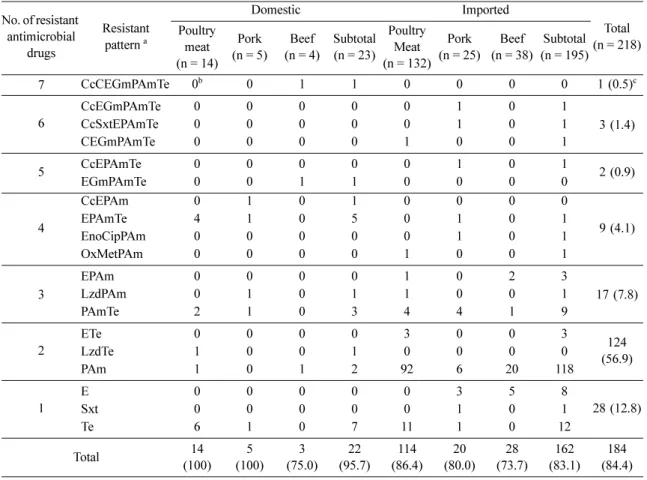
The resistance of S. aureus to 20 antimicrobial agents and antimicrobial resistance pattern are shown in Table 2 and Table 3, respectively. All isolates showed absolute susceptibility to Amc, Gtx, F/M, Syn, Ra, Tec and An. One hundred and eighty-four isolates (84.4%) were resistant to one or more antimicrobial agents tested. Especially, 17 (7.8%), 124 (56.9%) and 28 (12.8%) isolates showed a resistance to 3, 2 and 1 drugs, respectively. One isolate originating from domestic beef was resistant to 7 drugs.
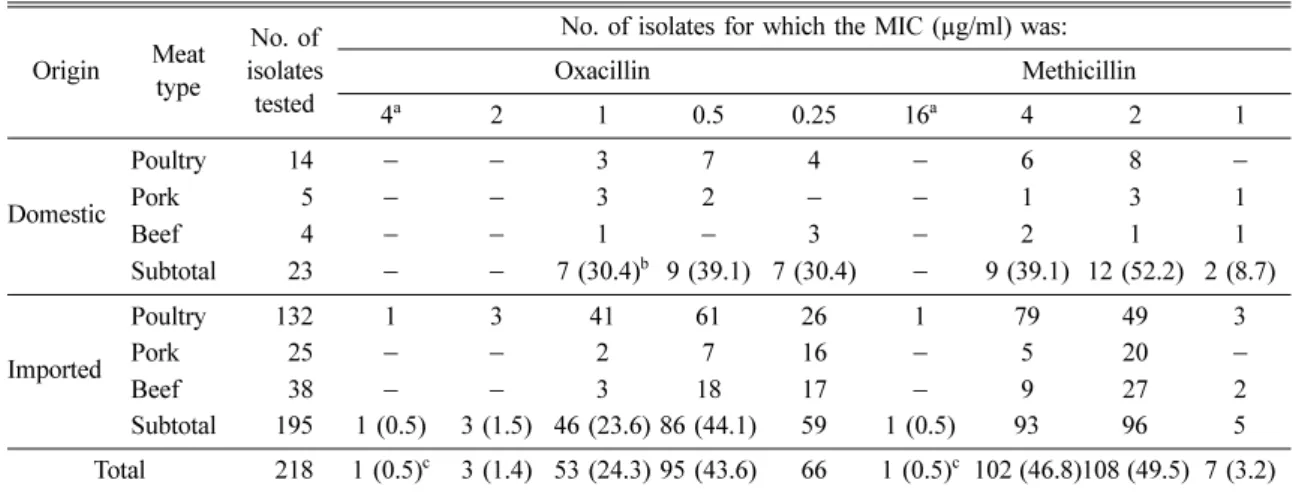
One isolate originating from imported poultry meat showed resistance to Ox and Met by the disk diffusion method and the MICs for this isolate were 4 µg/ml for Ox and 16 µg/ml for Met which are breakpoints according to the resistance-criteria of NCCLS (Table 4). However, this isolate tested negative for detection of the mecA gene.
Table 1. Isolation rate of S. aureus from domestic and imported meat
Origin Country No. of isolates/No. of samples (%)
Poultry meat Pork Beef Total
Domestic Korea 14/90 (15.6) 5/50 (10.0) 4/50 (8.0) 23/190 (12.1)
Imported Netherlands
−*2/18 (11.1)
−2/18 (11.1)
New Zealand
−- 21/141 (14.9) 21/141 (14.9)
Denmark 98/579 (16.9) 1/18 (5.6)
−99/597 (16.6)
USA 17/225 (7.6) 3/75 (4.0) 3/24 (12.5) 23/324 (7.1)
Belgium
−7/57 (12.3)
−7/57 (12.3)
Spain
−2/18 (11.1)
−2/18 (11.1)
UK 7/81 (8.6)
− −7/81 (8.6)
Austria
−0/9 (0.0)
−0/9 (0.0)
Chile
−4/48 (8.3)
−4/48 (8.3)
Canada
−2/42 (4.8)
−2/42 (4.8)
Thailand 3/63 (4.8)
− −3/63 (4.8)
Poland
−0/24 (0.0)
−0/24 (0.0)
France 7/99 (7.1) 0/12 (0.0)
−7/111 (6.3)
Hungary
−3/33 (9.1)
−3/33 (9.1)
Australia
−1/24 (4.2) 14/204 (6.9) 15/228 (6.6)
Subtotal 132/1,047 (12.6) 25/378 (6.6) 38/369 (10.3) 195/1,794 (10.9)
Total 146/1,137 (12.8) 30/428 (7.0) 42/419 (10.0) 218/1,984 (11.0)
*
Not sampled.
Table 2. Percentage of resistant S. aureus isolates to 20 antimicrobial drugs Origin Meat type No. of
isolates Antimicrobial drugs
aP Am Te E Cc Gm Lzd C Sxt Cip Eno Ox Met Amc Gtx F/M Syn Ra Tec An Domestic
Poultry 14 50.0 50.0 92.9 28.6 0.0 0.0 7.1 0.0 0.0 0.0 0.0 0.0 0.0 0.0 0.0 0.0 0.0 0.0 0.0 0.0 Pork 5 80.0 80.0 60.0 40.0 20.0 0.0 20.0 0.0 0.0 0.0 0.0 0.0 0.0 0.0 0.0 0.0 0.0 0.0 0.0 0.0 Beef 4 75.0 75.0 50.0 50.0 25.0 50.0 0.0 25.0 0.0 0.0 0.0 0.0 0.0 0.0 0.0 0.0 0.0 0.0 0.0 0.0 Subtotal 23 60.9 60.9 78.3 34.8 8.7 8.7 8.7 4.3 0.0 0.0 0.0 0.0 0.0 0.0 0.0 0.0 0.0 0.0 0.0 0.0 Imported
Poultry 132 77.3 77.3 15.2 3.8 0.0 0.8 0.8 0.8 0.0 0.0 0.0 0.8 0.8 0.0 0.0 0.0 0.0 0.0 0.0 0.0 Pork 25 60.0 60.0 36.0 28.0 12.0 4.0 0.0 0.0 8.0 4.0 4.0 0.0 0.0 0.0 0.0 0.0 0.0 0.0 0.0 0.0 Beef 38 60.5 60.5 2.6 18.4 0.0 0.0 0.0 0.0 0.0 0.0 0.0 0.0 0.0 0.0 0.0 0.0 0.0 0.0 0.0 0.0 Subtotal 195 71.8 71.8 15.4 9.7 1.5 1.0 0.5 0.5 1.0 0.5 0.5 0.5 0.5 0.0 0.0 0.0 0.0 0.0 0.0 0.0 Total 218 70.6 70.6 22.0 12.4 2.3 1.8 1.4 0.9 0.9 0.5 0.5 0.5 0.5 0.0 0.0 0.0 0.0 0.0 0.0 0.0
a
P, penicillin; Am, ampicillin; Te, tetracycline; E, erythromycin; Cc, clindamycin; Gm, gentamicin; Lzd, linezolid; C, chloram- phenicol; Sxt, sulfamethoxazole/trimethoprim; Cip, ciprofloxacin; Eno, enrofloxacin; Ox, oxacillin; Met, methicillin; Amc, amoxicillin/clavulanic acid; Gtx, gatifloxacin; F/M, nitrofurantoin; Syn, quinupristin/dalfopristin; Ra, ripampin; Tec, teico- planin; An, amikacin.
Table 3. Antimicrobial resistance pattern of S. aureus isolates No. of resistant
antimicrobial drugs
Resistant pattern
aDomestic Imported
Total (n = 218) Poultry
(n = 14) meat
(n = 5) Pork Beef
(n = 4) Subtotal (n = 23)
Poultry (n = 132) Meat
(n = 25) Pork Beef
(n = 38) Subtotal (n = 195)
7 CcCEGmPAmTe 0
b0 1 1 0 0 0 0 1 (0.5)
c6 CcEGmPAmTe 0 0 0 0 0 1 0 1
3 (1.4)
CcSxtEPAmTe 0 0 0 0 0 1 0 1
CEGmPAmTe 0 0 0 0 1 0 0 1
5 CcEPAmTe EGmPAmTe 0 0 0 0 0 1 0 1 0 0 1 0 0 0 1 0 2 (0.9)
4
CcEPAm 0 1 0 1 0 0 0 0
9 (4.1)
EPAmTe 4 1 0 5 0 1 0 1
EnoCipPAm 0 0 0 0 0 1 0 1
OxMetPAm 0 0 0 0 1 0 0 1
3 EPAm 0 0 0 0 1 0 2 3
17 (7.8)
LzdPAm 0 1 0 1 1 0 0 1
PAmTe 2 1 0 3 4 4 1 9
2 ETe 0 0 0 0 3 0 0 3 124
(56.9)
LzdTe 1 0 0 1 0 0 0 0
PAm 1 0 1 2 92 6 20 118
1 E 0 0 0 0 0 3 5 8
28 (12.8)
Sxt 0 0 0 0 0 1 0 1
Te 6 1 0 7 11 1 0 12
Total 14
(100) 5
(100) 3
(75.0) 22
(95.7) 114 (86.4) 20
(80.0) 28
(73.7) 162
(83.1) 184 (84.4)
a
Cc, clindamycin; C, chloramphenicol; E, erythromycin; Gm, gentamicin; P, penicillin; Am, ampicillin; Te, tetracycline; Sxt, sulfamethoxazole/trimethoprim; Eno, enrofloxacin; Cip, ciprofloxacin; Ox, oxacillin; Met, methicillin; Lzd, linezolid.
b
Number of isolates included.
c
Number (%) of isolates included.
Discussion
Recently, MRSA has been a widespread problem in Korea. The rate of Met resistance among human S.
aureus isolates is over 50% in Korea [10]. The existence of MRSA in non-human sources has aroused curiosity as to whether these MRSA isolates originated from foodstuffs, including milk, ice cream and raw meat. But there are only a limited number of publications on the epidemiological relatedness of MRSA isolation in foodstuffs [7, 8, 11]. The prevalence of antimicrobial resistant S. aureus , including MRSA, are considerably different among individual countries [19, 23]. First of all, this study attempted to compare the nationwide tendency regarding the antimicrobial resistance of S. aureus isolated from raw meat samples of 16 countries, including Korea. S. aureus was isolated from 15.6% of poultry meat, 10% of pork and 8% of beef samples. There was no significant difference as to the frequency of isolation in imported verses domestic raw meat samples. However, the incidence for poultry meat was slightly higher than other meats. Lee [11]
reported that the frequency of isolation of S. aureus from beef, pork and chicken meat samples collected from slaughter houses, meat processing facilities and food stores in Korea were 9.3%, 24.2% and 13%, respectively. Therefore, it is suggested that there may be a great variation in incidences from plant to plant,
depending on the level of sanitation in the processing plant.
The number of resistant isolates from imported meat (71.8%) samples was higher than from domestic meat samples (60.9%). However, 15.4% of S. aureus isolated from imported meat samples were resistant to Te.
Otherwise, nearly four-fifths of S. aureus originating from domestic meat samples (78.3%) were resistant to Te. As is known from many reports, Te has been used as a feed additive in Korea for a long time, therefore there is extensive resistance to this antibiotic.
In our survey, only 1 isolate from poultry meat imported from the UK showed resistance to Ox and Met by the disk diffusion method and MICs. However, this isolate did not possess the mecA gene by the PCR method. The identification of Met-resistant staphylococci in the laboratory is sometimes complicated by the heterogenous expression of resistance and variables that influence this express (i.e., pH, temperature, and salt concentrations). The NCCLS provides a breakpoint MIC for resistance, but many investigators advocate recognition of degrees of resistance that are clinically important. Borderline methicillin resistance varies from study to study to include MICs of Ox from 1 to 16 ug/ml with disk diffusion zone diameters of 6 to 13 mm [3, 4, 15, 21]. Lee et al. [9] reported that the mecA gene was not detected in more than 50% MRSA of isolates showing low-level Ox MICs (4 or 8 µg/ml).
Table 4. Distribution of minimal inhibitory concentrations to antimicrobial drugs Origin Meat
type
No. of isolates tested
No. of isolates for which the MIC (µg/ml) was:
Oxacillin Methicillin
4
a2 1 0.5 0.25 16
a4 2 1
Domestic
Poultry 14
− −3 7 4
−6 8
−Pork 5
− −3 2
− −1 3 1
Beef 4
− −1
−3
−2 1 1
Subtotal 23
− −7 (30.4)
b9 (39.1) 7 (30.4)
−9 (39.1) 12 (52.2) 2 (8.7) Imported
Poultry 132 1 3 41 61 26 1 79 49 3
Pork 25
− −2 7 16
−5 20
−Beef 38
− −3 18 17
−9 27 2
Subtotal 195 1 (0.5) 3 (1.5) 46 (23.6) 86 (44.1) 59 1 (0.5) 93 96 5 Total 218 1 (0.5)
c3 (1.4) 53 (24.3) 95 (43.6) 66 1 (0.5)
c102 (46.8)108 (49.5) 7 (3.2)
a
The MIC (µg/ml) as oxacillin-resistant or methicillin-resistant S. aureus according to resistance-criteria of NCCLS was shown in shaded area.
b
No. of isolates (%).
c