http://dx.doi.org/10.14405/kjvr.2014.54.2.91
91
<Original Article>
Characterization of antimicrobial resistance and application of RFLP for epidemiological monitoring of thermophilic Campylobacter spp. isolated
from dogs and humans in Korea
Hyun-Ho Cho1, Sang-Hyun Kim2, Wongi Min3, Bok-Kyung Ku1, Jong-Hyun Kim4, Yong-Hwan Kim3,*
1Animal, Plant and Fisheries Quarantine and Inspection Agency, Anyang 430-757, Korea
2Viral Infectious Disease Research Center, Korea Research Institute of Bioscience & Biotechnology, Daejeon 505-860, Korea
3College of Veterinary Medicine, Research Institute of Life Science, Institute of animal medicine, Gyeongsang National University, Jinju 660-701, Korea
4Division of Enteric Bacteria Infections, Center for Infectious Disease, National Institute of Health, Seoul 122-827, Korea (Received: August 1, 2013; Revised: March 10, 2014; Accepted: March 17, 2014)
Abstract : An antimicrobial susceptibility test was conducted to compare the resistance rates among Campylobacter spp. isolates from dogs (n = 50) raised under diverse conditions and humans (n = 50). More than 60% of Campylobacter (C.) jejuni from dogs and humans showed resistance to nalidixic acid, enrofloxacin and ciprofloxacin. C. jejuni isolates from humans showed higher resistance to tetracycline (83.3%) and ampicillin (91.3%) than those from dogs. None of the C. jejuni or Campylobacter coli isolates from humans or dogs were resistant to erythromycin. Overall, 85%
of Campylobacter spp. isolates showed a multidrug resistant phenotype. Nucleotide sequencing analysis of the gryA gene showed that 100% of NAR/CIPR C. jejuni isolates from dogs and humans had the Thr-86th-Ile mutation, which is associated with fluoroquinolone resistance. flaA PCR restriction fragment length polymorphism (RFLP) typing to differentiate the isolates below the species level revealed 12 different clusters out of 73 strains. The human isolates belonged to eight different RFLP clusters, while five clusters contained dog and human isolates.
Keywords : antibiotic resistance, Campylobacter spp., DNA gyrase, point mutation, RFLP
Introduction
Campylobacter spp. are one of the leading causes of acute bacterial diarrhea worldwide. Infection with Campylobacter (C.) jejuni or Campylobacter (C.) coli is characterized by the sudden onset of fever, abdominal pains, and diarrhea with blood and leukocytes [4, 20]. Occasionally, postinfectious sequale following C. jejuni infection includes reactive arthri- tis and Guillian-barre syndrome [8]. There are many possi- ble sources of infection with C. jejuni and C. coli, as they constitute the normal intestinal flora in a wide range of birds and mammals [4, 31]. Large-scale outbreaks of human campylobacteriosis are rare and usually linked to the con- sumption of contaminated water or raw milk. Sporadic cases of campylobacteriosis are frequently associated with the con- sumption of undercooked chicken, thus contaminated poul- try meat is a major risk factor contributing to human infections [14, 17].
The household dog has previously been identified as a risk factor for human campylobacteriosis [1, 3, 29]. Most of dogs
carrying the bacteria are asymptomatic, serving as reservoirs capable of shedding Campylobacter spp. in the feces. The fecal shedding of bacteria may increase the chance of infec- tion in other animals by contaminating the environment [12, 23].
Most human infection with C. jejuni and C. coli is self- limiting and antimicrobials are usually not recommended for treatment. Occasionally, treatment with erythromycin or fluo- roquinolone is used for individuals with invasive or severe infection [23]. Recently, resistance to fluoroquinolone is increasing worldwide. The increase of antimicrobial resis- tance in Campylobacter spp. is recognized as a major public health concern, and fluoroquinolone resistance is the most common among the human-origin isolates of both C. jejuni and C. coli [22, 27].
The primary target of the fluoroquinolones to C. jejuni has been shown to be DNA gyrase, a type II topoisomerase that is an essential enzyme for DNA replication [9, 26]. DNA gyrase is composed of two A and B subunits encoded by the gyrA and gyrB genes, respectively. A point mutation at the codon 86 (ACA to ATA) in the quinolone resistance-deter-
*Corresponding author
Tel: +82-55-772-2345, Fax: +82-55-772-2808/2349 E-mail: [email protected]
mining region (QRDR) of the gyrA gene, leading to substitu- tion of isoleucine (Ile) for threonine (Thr), is the most common cause of fluoroquinolone resistance among C. jejuni isolates [25, 28]. There are anecdotal reports of mutations leading to additional amino acid changes as well as silent nucleotide mutations [19, 21].
There are several methods available for epidemiological strain typing to determine the source of Campylobacter spp.
infection. These methods include PCR restriction fragment length polymorphism (PCR-RFLP) analysis based on the flagellin gene (flaA typing), pulsed-field gel electrophoresis (PFGE), and amplified fragment length polymorphism (AFLP) analysis. Assessment of the strain typing methods based on the genotypes of Campylobacter spp. has been described in a recent review paper [30]. The RFLP method is simple and reasonable, and has sufficient discriminatory power useful for the typing of C. jejuni and C. coli [17].
Accordingly, the aim of this study was to investigate the prevalence of antimicrobial resistant Campylobacter spp. iso- lated from dogs and humans and to confirm the relationship between fluoroquinolone-resistance and the gyrA mutation by DNA sequencing of the gyrA gene. In order to investi- gate epidemiological relatedness of Campylobacter spp. iso- lated from dogs and humans, a PCR-RFLP method for the flaA typing was also employed [19].
Materials and Methods
Bacterial strains and growth condition
A total of 41 C. jejuni was isolated from dogs in Gyeong- nam and Busan area, in the period between August 2009 and April 2010. Nine strains of C. coli were isolated from dogs in Gyeongnam and Busan area, in the same period. Strains of 46 C. jejuni and 4 C. coli isolated from humans with diar- rhea in Seoul area during the year 2008-2009 were kindly provided by Korea National Institute of Health. All isolates were stored in liquid nitrogen at −150oC. Strains were cul- tured at 42oC for 48 h on Mueller-Hinton agar supplemented with 5% sheep blood in a microaerobic atmosphere (5% O2, 10% CO2, and 85% N2).
Antimicrobial susceptibility test
Antimicrobial susceptibility test was performed by agar dilution method with Mueller-Hinton agar supplement with 5% sheep blood, according to the protocols of Clinical and Laboratory Standards Institute (CLSI) [5]. C. jejuni ATCC 33560 and C. coli ATCC 33559 were used as the quality con- trol organisms for the test. Erythromycin (EM 0.03-64µg/
mL), tetracycline (TC 0.125-512µg/mL), nalidixic acid (NA 0.25-512µg/mL), enrofloxacin (ENO 0.03-64 µg/mL), cipro- floxacin (CIP 0.03-128µg/mL), gentamicin (GM 0.25-512 µg/
mL) and ampicillin (AM 0.25-512µg/mL) were added to the agar plate by a ten-fold serial dilution. Bacterial turbidity for plating was adjusted by using a 0.5 Macfarland standard, according to the guideline of CLSI [5].
Minimal inhibitory concentration (MIC) values for resis- tance criteria were set towards EM (≥ 32 µg/mL), TC (≥ 16 µg/mL), NA (≥ 64 µg/mL), ENO (≥ 2 µg/mL), CIP (≥ 4 µg/
mL), GM (≥ 8 µg/mL), and AM (≥ 32 µg/mL) in accordance with a previous report [2]. Multidrug resistance (MDR) was defined as the case exhibiting resistance to two or more anti- microbials at the same time. The bacterial inoculum was applied to the plate with multipoint inoculator. Then, the agar plates were incubated at 42oC for 48 h in a microaerobic atmosphere (5% O2, 10% CO2, and 85% N2).
DNA extraction
Genomic DNA was extracted from the fresh culture by using QIA amp DNA Mini kit (Qiagen, Germany) according to the recommendations of the manufacturer. The DNA con- centration was measured spectrophotometrically at A260.
DNA sequencing of the gyrA gene
DNA sequencing of the gyrA genes was performed to con- firm the relationship between the fluoroquinolone resistance and the gyrA mutation. The DNA amplification was carried out in a thermal cycler using a forward primer (5’-GCTATG- CAAATGATGAGGC-3’) and a reverse primer (5’-CAG- TATAACGCATCGCAGCGG-3’). The reaction mixture contained 5µL of PCR buffer [10 mM Tris-HCl (pH8.5), 50 mM KCl, 1.5 m M MgCl2] , 1µL of 10 mM dNTP mixture, 1 µL of Taq polymerase (2.5 U), 1µL of bacterial DNA extract as tem- plate, and 2µM of primer mixture in a PCR tube with a final 50µL volume. Each PCR product was purified and sub- jected to (ABI 3730 DNA Analyzer; Applied Biosystems, USA).
The flaA-RFLP
The flagellin gene typing was performed according to the method of Nachamkin et al. [19] in order for comparison of virulence, antimicrobial resistance, and the genotypic profile of the C. jejuni and C. coli isolates from the dog and human stools.
The amplification reaction was carried out in a DNA ther- mal cycler using forward primer (5’-GGATTTCGTATTAA- CACAAATGGTGC-3’) and reverse primer (5’-CTGTAGTA ATCTTAAACATTTG-3’). PCR was performed in a 50 µL mixture containing 10 mM Tris-HCl (pH 8.3), 50 mM KCl, 1.5 mM MgCl2, 200 mM dNTPs, 2.5 µ Taq DNA polymer (Takara Bio, Japan), 1 mM of the two primers, and 1 µL tem- plate DNA. Samples were preincubated at 95oC 5 min and cycled 30 times at 95oC for 20 sec, 52oC for 45 sec, and 72oC for 60 sec. The samples were then incubated at 72oC for 5 min and maintained at 4oC. A reagent blank contained all components of the reaction mixture except template DNA, for which sterile distilled water was substituted. This step was included in every PCR procedure.
After amplification, 5µL of the PCR product was electro- phoresed on a 12.5% acrylamide gel (Bio-rad Laboratories, USA) in Tris borate-EDTA (TBE) buffer. The gels were stained with 0.5µg/mL ethidium bromide to determine the
presence or absence of the PCR products. The amplicon of flaA gene was digested with the restriction enzyme DdeI for 2 h at 37oC. The digested fragments were separated and ana- lyzed by electrophoresis. Acrylamide gels were runned at 75
V for 2 h in 1.0 × TBE buffer. Photographs of gels stained with 0.5 µg/mL ethidium bromide were analysed by Finger- printing Plus software package (ver. 1.2; Bio-Rad Laborato- ries). A 1.0 kb DNA ladder was used as a molecular marker.
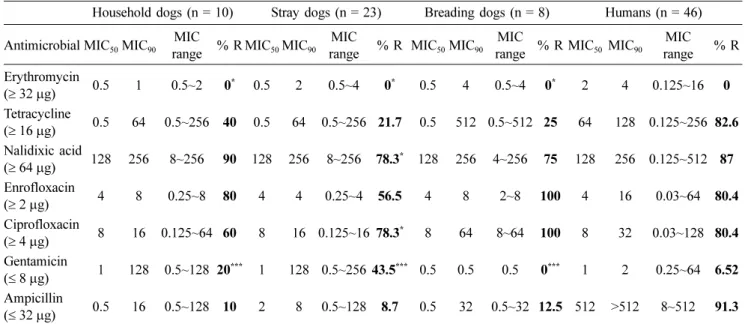
Table 1. Comparison of antimicrobial resistance phenotypes of C. jejuni isolated from humans and dogs raised in different raising conditions and areas
Household dogs (n = 10) Stray dogs (n = 23) Breading dogs (n = 8) Humans (n = 46) Antimicrobial MIC50MIC90 MIC
range % R MIC50MIC90 MIC
range % R MIC50MIC90 MIC
range % R MIC50 MIC90 MIC range % R Erythromycin
(≥ 32 µg) 0.5 1 0.5~2 0* 0.5 2 0.5~4 0* 0.5 4 0.5~4 0* 2 4 0.125~16 0
Tetracycline
(≥ 16 µg) 0.5 64 0.5~256 40 0.5 64 0.5~256 21.7 0.5 512 0.5~512 25 64 128 0.125~256 82.6 Nalidixic acid
(≥ 64 µg) 128 256 8~256 90 128 256 8~256 78.3* 128 256 4~256 75 128 256 0.125~512 87 Enrofloxacin
(≥ 2 µg) 4 8 0.25~8 80 4 4 0.25~4 56.5 4 8 2~8 100 4 16 0.03~64 80.4
Ciprofloxacin
(≥ 4 µg) 8 16 0.125~64 60 8 16 0.125~16 78.3* 8 64 8~64 100 8 32 0.03~128 80.4 Gentamicin
(≤ 8 µg) 1 128 0.5~128 20*** 1 128 0.5~256 43.5*** 0.5 0.5 0.5 0*** 1 2 0.25~64 6.52 Ampicillin
(≤ 32 µg) 0.5 16 0.5~128 10 2 8 0.5~128 8.7 0.5 32 0.5~32 12.5 512 >512 8~512 91.3 MIC50 and MIC90 indicate the concentration (µg/mL) at which 50% and 90% of isolates tested were susceptible to the antimicrobial, respec- tively. MIC range indicates the MIC level for C. jejuni isolates at a particular antimicrobial concentration. %R indicates the ratio of resis- tance strains for the antimicrobial agent. (≥): resistance breaks point (µg/mL) for the antimicrobials. *≤ 0.5, **≤ 0.01, ***≤ 0.001 level of significant statistical difference.
Table 2. Comparison of antimicrobial resistance phenotypes of C. coli isolated from humans and dogs raised in different raising condition and areas
Household dogs (n = 4) Stray dogs (n = 3) Breading dogs (n = 2) Humans (n = 4) Antimicrobial MIC50 MIC90 MIC
range % R MIC50 MIC90 MIC
range % R MIC50 MIC90 MIC
range % R MIC50 MIC90 MIC range % R Erythromycin
(≥ 32 µg) 0.5 2 0.5~2 0 0.5 4 0.5~4 0 0.5 0.5 0.5 0 4 4 0.5~4 0
Tetracycline
(≥ 16 µg) 0.5 0.5 0.5 0 32 64 4~64 66.7 0.5 2 0.5~2 0 64 256 0.5~256 75
Nalidixic acid
(≥ 64 µg) 32 128 2~128 50 128 256 4~256 66.7 32 64 32~64 50 8 256 4~256 50
Enrofloxacin
(≥ 2 µg) 16 64 16~64 100 16 64 8~64 100 8 16 8~16 100 0.125 32 0.06~32 50
Ciprofloxacin
(≤ 4 µg) 0.125 0.125 0.125 0 0.125 0.125 0.125 0 0.125 0.125 0.125 0 0.125 64 0.06~64 50 Gentamicin
(≤ 8 µg) 4 4 4 0** 1 1 1 0 1 1 1 0** 1 32 1~32 25
Ampicillin
(≥ 32 µg) 0.5 1 0.5~1 0 16 32 1~32 33.3 0.5 1 0.5~1 0 128 512 64~512 100
MIC50 and MIC90 indicate the concentration (µg/mL) at which 50% and 90% of isolates tested were susceptible to the antimicrobial, respec- tively. MIC range indicates the MIC level for C. coli isolates at a particular antimicrobial concentration. %R indicates the ratio of resistance strains for the antimicrobial agent. (≥); resistance breaks point (µg/mL) for the antimicrobials. *≤ 0.5, **≤ 0.01, ***≤ 0.001 level of significant statistical difference.
The flaA RFLP pattern was analyzed by BioNumeric soft- ware (ver. 4.01; Applied Maths, Belgium). Images of gel were normalized by alingment with 1.0 Kb DNA ladder (Takara Bio). Matching and the dendrogram of the finger- prints determined by the unweighted pair group method with averages were performed using the Dice coefficient with 1%
tolerance windows.
Stastical analysis
Data were analyzed by Student’s t tests. Differences were considered significant at p < 0.05. Data are expressed as means± standard error.
Results
Antimicrobial susceptibility test
Antimicrobial susceptibility test was performed for com- parison of resistance rate in Campylobacter isolates from dogs raised in diverse condition and humans. Antimicrobial resistance measured against 7 antimicrobial agents is shown in Tables 1 and 2. None of the C. jejuni and C. coli isolates from humans and dogs was resistant to erythromycin. Anti- microbial resistance to tetracycline was observed in 45%, 21.7%, 25%, and 82.6% of the C. jejuni isolates from house- hold dogs, stray dogs, breeding dogs, and humans, respec- tively. C. jejuni isolates from humans showed higher resistance to tetracycline than those isolated from dogs (p≤ 0.01). Tetracycline resistance of C. jejuni from humans showed higher MIC 50 (64µg/mL) than those isolated from dogs (0.5µg/mL). More than 60% of C. jejuni from dogs and humans showed resistance to nalidixic acid, enrofloxacin, and ciprofloxacin. Especially, all of the C. jejuni from breed- ing dogs were resistant to enrofloxacin and ciprofloxacin.
Nalidixic acid resistance of C. jejuni from humans and three different raising groups of dogs revealed equal level of MIC50 (128µg/mL) and MIC90 (256µg/mL). Antimicrobial resis- tance to gentamicin was observed in 20%, 43.5%, and 6.25%
of C. jejuni from household dogs, stray dogs and humans, respectively. However, none of the C. jejuni from breading dogs was resistant to gentamicin. Antimicrobial resistance to ampicillin was observed in 10%, 8.7%, 12.5%, and 91.3% of C. jejuni from household dogs, stray dogs, breading dogs, and humans, respectively. C. jejuni from humans showed higher resistance to ampicillin than those isolated from dogs (p≤ 0.05). Antimicrobial resistance to tetracycline was observed in 66.7% and 75% of C. coli isolates from stray dogs and humans, respectively. However, none of the C. coli from household dogs and breeding dogs was resistant to tet- racycline. More than 50% of C. coli from dogs and humans showed resistance to nalidixic acid and enrofloxacin. Enrof- loxacin resistant C. coli from dogs had higher MIC50 (16µg/
mL) than those isolated from humans (0.125µg/mL). Anti- microbial resistance to ciprofloxacin and gentamicin was observed in 50% and 25% of C. coli from humans, respec- tively. However, none of C. coli from dogs was resistant to
ciprofloxacin and gentamicin. Antimicrobial resistance to ampicillin was observed in 33.5% and all of C. coli from stray dogs and humans, respectively. However, none of C.
coli from household dogs and breeding dogs was resistant to ampicillin.
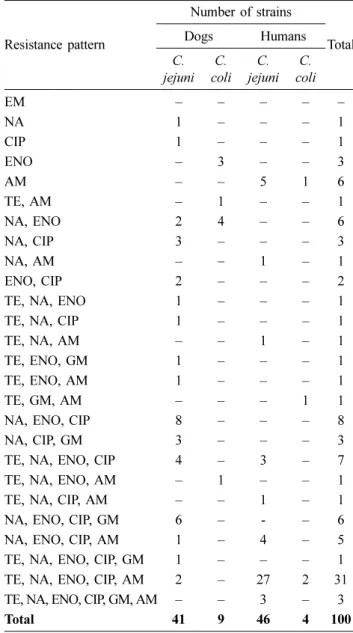
According to the antimicrobial susceptibility test, a large number of Campylobacter spp. isolates used in this study showed a multidrug resistance phenotype. A total of 26 anti- microbial resistance pattern was determined (Table 3). Of 100 Campylobacter spp. isolates, 32 strains (32.0%) were resistant to 5 drugs, 20 strains (20.0%) were resistant to 4 drugs, 17 strains (17.0%) were resistant to 3 drugs and 13 strains (13.0%) were resistant to 2 drugs. Eighty-five percent (85.0%) of the isolates were resistant to two or more kinds of antibiotics (Table 3).
Table 3. Drug resistance patterns of C. jejuni and C. coli isolates from dogs and humans
Resistance pattern
Number of strains
Total
Dogs Humans
C.
jejuni C.
coli C.
jejuni C.
coli
EM – – – – –
NA 1 – – – 1
CIP 1 – – – 1
ENO – 3 – – 3
AM – – 5 1 6
TE, AM – 1 – – 1
NA, ENO 2 4 – – 6
NA, CIP 3 – – – 3
NA, AM – − 1 – 1
ENO, CIP 2 – – – 2
TE, NA, ENO 1 – – – 1
TE, NA, CIP 1 – – – 1
TE, NA, AM – – 1 – 1
TE, ENO, GM 1 – – – 1
TE, ENO, AM 1 – – – 1
TE, GM, AM – – – 1 1
NA, ENO, CIP 8 – – – 8
NA, CIP, GM 3 – – – 3
TE, NA, ENO, CIP 4 – 3 – 7
TE, NA, ENO, AM – 1 – – 1
TE, NA, CIP, AM – – 1 – 1
NA, ENO, CIP, GM 6 – - – 6
NA, ENO, CIP, AM 1 – 4 – 5
TE, NA, ENO, CIP, GM 1 – – – 1
TE, NA, ENO, CIP, AM 2 – 27 2 31
TE, NA, ENO, CIP, GM, AM – – 3 – 3
Total 41 9 46 4 100
EM: erythromycin, NA: Nalidixic acid, CIP: ciprofloxacin, ENO:
enrofloxacin, AM: ampicillin, TE: tetracycline, GM: gentamicin.
Mutations in QRDR of gyrA gene
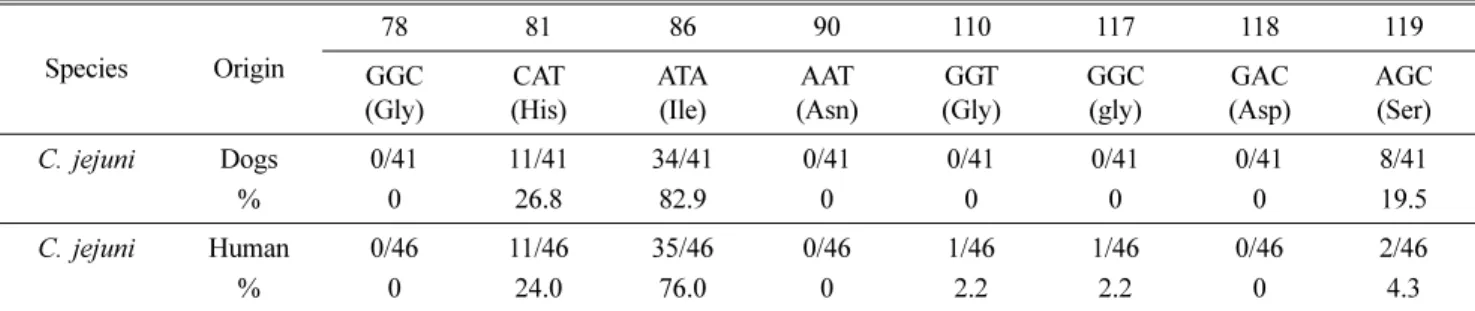
The relationship between quinolone resistance and gyrA mutation was confirmed by DNA sequencing of the gyrA gene in Campylobacter. A total of 87 strains of C. jejuni were selected for analysis of DNA sequence mutations in the QRDR in the gyrA gene. The missense mutation of the 86th codon (ACA→ATA; Thr→IIe) was observed in 34 strains (82.9%) of C. jejuni isolated from dogs, and 35 strains (76%) of C. jejuni isolated from humans, respectively. However, amino-acid substitution (Asp→Asn) in the 90th codon was not found in the gyrA sequence. The silent mutations at the codons 78, 81, 110, 117, 118, and 119 were assessed (Tables 4 and 5). The results showed that the silent mutation at the codons 81 (26.8%), 119 (19.5%) and 81 (24%), 110 (2.2%), 117 (2.2%), 119 (4.3%) in the QRDR of the gyrA genes in C.
jejuni were isolated from dogs and humans respectively. Also sequencing analysis showed that 100% of NAR and CIPR C.
jejuni isolates (n = 63) from dogs and humans have the mutation Thr-86th-Ile, which is known to be associated with quinolone resistance, and the mutations were not exhibited in all fluorquinolone-susceptible C. jejuni at the 86th codon (Table 5).
flaA - RFLP analysis
Ninety-four strains of Campylobacter spp. were selected at random for the analysis of flaA-RFLP after digestion with
DdeI restriction enzyme to compare phenotype and genotype of the Campylobacter isolates from dogs and humans (Fig.
1). The fla-RFLP typing distributed 73 strains of C. jejuni and C. coli into 12 major fla-RFLP clusters. Twenty one strains of C. jejuni and coli were not included in major clus- ter (Fig. 2), because they had low similarity (lower than 90%
similarity). The frequently detected patterns of the fla-RFLP cluster were cluster 1 (n = 12) of C. jejuni and cluster 5, 6, 7 Fig. 1. Representative patterns of gel elctrophoresis of fla-RFLP profile for Campylobacter (C.) jejuni and Campylobacter (C.) coli isolates from dogs. Restriction fragments generated by digestion with DdeI. Lane 1, C. jejuni D37; Lane 2, C. jejuni D38; Lane 3, C. jejuni D39; Lane 4, C. jejuni D40; Lane 5, C.
jejuni D41; Lane 6, C. coli D42; Lane 7, C. coli D43; Lane 8, C. coli D44.
Table 4. Mutation rates in each codon on gyrA gene of C. jejuni isolated from dogs and humans
Species Origin
78 81 86 90 110 117 118 119
GGC (Gly)
CAT (His)
ATA (Ile)
AAT (Asn)
GGT (Gly)
GGC (gly)
GAC (Asp)
AGC (Ser)
C. jejuni Dogs 0/41 11/41 34/41 0/41 0/41 0/41 0/41 8/41
% 0 26.8 82.9 0 0 0 0 19.5
C. jejuni Human 0/46 11/46 35/46 0/46 1/46 1/46 0/46 2/46
% 0 24.0 76.0 0 2.2 2.2 0 4.3
Table 5. Summary of silent and missense mutation in the QRDR of topoisomerase II, gyrA gene of C. jejuni isolated from dogs and humans
Type of mutation
Nucleotide change
Amino acid change
Number of isolates from NAR·CIPR Number of isolates from NAS·CIPS Dogs
(n = 29)
Humans (n = 34)
Dogs (n = 5)
Humans (n = 7)
Silent mutation
GGT→GGC Gly-78→Gly 0 0 0 0
CAC→CAT His-81→His 7 9 0 2
GGC→GGT Gly-110→Gly 0 1 0 0
GGT→GGC Gly-117→Gly 0 0 0 1
GAT→GAC Asp-118→Asp 0 0 0 0
AGT→AGC Ser-119→Ser 6 1 0 1
Missense mutation
ACA→ATA Thr-86→Ile 29 34 0 0
GAT→AAT Asp-90→Asn 0 0 0 0
NAR: nalidixic acid resistance, CIPR: ciprofloxacin resistance, NAS: nalidixic acid susceptibility, CIPS: ciprofloxacin susceptibility.
of C. coli isolates (Fig. 2). Eight fla-RFLP clusters of 1, 2, 3, 5, 8, 10, 11, and 12 included C. jejuni and C. coli from human. Other 8 fla-RFLP clusters of 1, 2, 3, 4, 5, 6, 7, and 9 included C. jejuni and C. coli isolated from dogs. The clus- ters of 8, 10, and 12 have only human isolates and clusters of 4, 6, 7, and 9 were assigned only to dog isolates (Fig. 2).
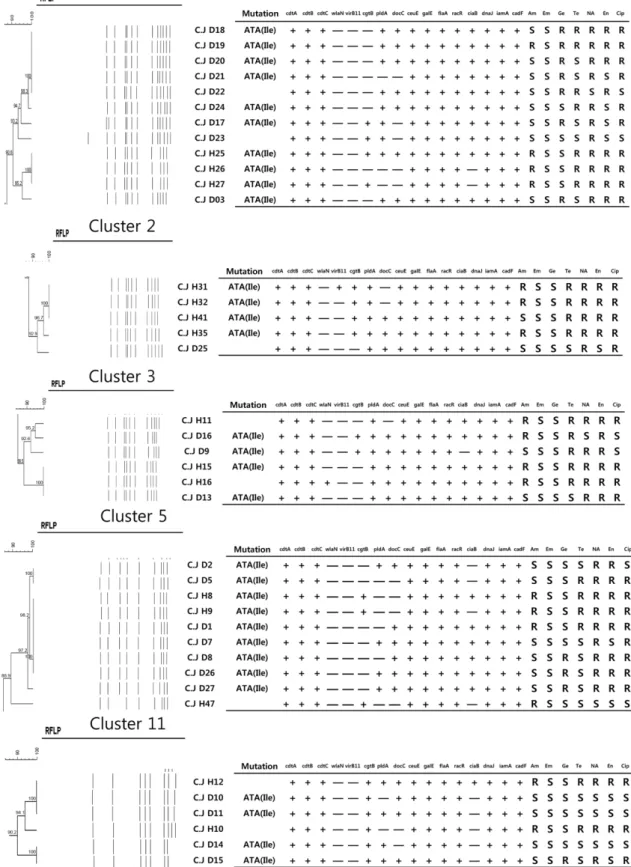
Clusters of 1, 2, 3, 5, and 11 included C. jejuni and C. coli isolated from dogs and humans simultaneously and the geno- type and the phenotype were compared in these clusters (Fig.
3). No strain with a complete homogenous genotype and phenotype was detected.
Discussion
A tendency of increase of antimicrobial resistance in Campylobacter spp. can be recognized as a major public health concern [7, 23]. In this study, the prevalence of antimi- crobial resistance in Campylobacter spp. isolated from dogs raised in diverse conditions and humans was investigated, and the relationship between fluoroquinolon resistance and the gyrA mutation was revealed. In this study, no erythromy- cin resistant Campylobacter spp. isolates from dogs and humans was identified. This result agrees with the previous studies which suggested that none of C. jejuni isolates from humans and companion animals was resistant [16, 28]. How- ever, other studies reported 3-6.8% of erythromycin resis-
tance in C. jejuni isolated from humans [7, 18].
Resistance to ampicillin and other β-lactam antimicrobials has been broadly studied by previous reports [20, 28]. C.
jejuni resistance to ampicillin is known to be correlated with production of ß-lactamase. The β-lactamase is produced by cj0299 open reading frame which is located on a chromo- somal DNA in Campylobacter spp. [21]. The resistance to ampicillin we observed in C. jejuni was 8.7-12.5% from dog isolates and 91.3% from human isolates. In C. coli, a lower level of resistance was observed in the isolates from dogs.
Frequency of ampicillin resistance of C. jejuni from dogs and humans in this study are similar with the previous reports [1, 32]. C. jejuni isolates from humans showed higher resistance to ampicillin than those isolated from dogs (p≤ 0.05). How- ever, C. jejuni isolates from three different raising groups of dogs were not statistically significant.
The rates of tetracycline resistance were previously reported, ranging from 13 to 78.8% among the Campylobacter spp.
isolates from humans and companion animals [16, 18, 30]. A higher rate of resistance to tetracycline was also observed, mainly in C. coli isolated from pigs and broilers (62 and 52%, respectively) [30]. In this study, the resistance of C.
jejuni to tetracycline ranged from 21.7~40% in dog isolates and 83.3% in human isolates. C. jejuni isolates from humans showed a higher resistance to tetracycline than those isolated from dogs (p≤ 0.01). However, C. jejuni isolates from three different raising groups of dogs were not statistically signifi- cant. Since tetracycline has been used as an alternative treat- ment for Campylobacter gastroenteritis, the tetracycline resistance in the isolates of humans has been increasing [18, 20], moreover, the usage of tetracyclines is increasing due to inexpensive cost and their broad spectrum of activity.
Fluoroquinolone resistance is mostly shown in the human isolates of both C. jejuni and C. coli [25].Among C. jejuni isolates from dogs, the rates of resistance were 75~90% for nalidixic acid, 56.5~100% for enrofloxacin and 60~100% for ciprofloxacin. In the results of antimicrobial susceptibility test for Campylobacter spp. isolates from humans for quino- lones, the rates of resistance were 87% for nalidixic acid, 80.4% for enrofloxacin, and 80% for ciprofloxacin. The flu- oroquinolone resistance of C. jejuni from humans and dogs in this study was similar with previous reports [3, 15, 29].
The results of C. coli isolates from humans were 50% resis- tant to three fluoroquinolones. Among C. coli isolates from dogs, the rates of resistance were 50~66.7% for nalidixic acid and 100% for enrofloxacin. However, all strains of C. coli isolated from dogs were susceptible to ciprofloxacin. Glo- bally, antimicrobial resistance rate of C. coli isolates from humans and dogs raised in diverse condition did not show significant stastical difference because of a small number of isolates used in this study. Many previous studies showed that the Thr-86th-Ile (ACA→ATA) mutation in the QRDR of gyrA is the most common mechanism causing nalidixic acid or ciprofloxacin resistance in C. jejuni [11]. Piddock et al.
[22] had demonstrated that a Thr-86th to Ile change is present Fig. 2. Dendrogram of flaA-RFLP patterns of C. jejuni and C.
coli isolated from dogs and humans in Korea. Dendrogram of RFLP banding profiles obtained with 94 Campylobacter spp.
strains isolated from dogs and humans. The dendrogram shows the results of a phylogenetic comparison. The box indicates the 90% similarity threshold. Cam001-050, humans; Cam051-094, dogs.
Fig. 3. Dendrogram highlighting the flaA-RFLP patterns. Virulence genes and antimicrobial resistance profile of Cluster 1, 2, 3, 5 and 11 included C. jejuni and C. coli isolated from dogs and humans, simultaneously. Restriction fragments generated by digestion with DdeI. Virulence gene, data not suggested; +, detected; −, not detected. CJD: C.jejuni isolated from dogs, CJH: C. jejuni isolated from humans, Am: ampicillin, Em: erythromycin, Ge: gentamicin, Te: tetracycline, Na: nalidixic acid, En: Enrofloxacin, Cip: ciproxacin, R: resistance, S: sensitive.
in the huge majority of fluoroquinolone resistant Campylo- bacter spp., whether isolated from dogs or humans. The asso- ciation of this substitution with quinolone resistance in Campylobacter spp. has been reported previously [6].
Regarding the gyrA mutation in the QRDR, it was found that all the fluoroquinolone resistant isolates (n = 63) pos- sessed the mutation at the 86th codon (threonine to isoleu- cine) of the gyrA gene originated from Campylobacter spp.
isolates used in this study. In the case of silent mutation, the mutations were found at the codons 81 (CAC→CAT), 110 (GGC→GGT), 117 (GGT→GGC), 119 (AGC→AGT), which is in line with the previous reports [33] and sequencing anal- ysis showed that 100% of NAR/ CIPR C. jejuni isolates from dogs and humans had the mutation Thr-86th-Ile, which is known to be associated with quinolone resistance.
The flaA-PCR-RFLP has been applied as one of the tools of epidemiological study to differentiate isolates below the species level [10, 13]. Accordingly, flaA-RFLP typing method was used to analyze the genotype. Ninety four strains of Campylobacter isolates were subtyped by flaA-PCR-RFLP into 12 major clusters. Interestingly, clusters of 1, 2, 3, 5, and 11 included dog and human isolates simultaneously. These results suggest epidemiological co-relationship between C.
jejuni isolated from dogs and humans. However, these results may not simply imply that there is no relationship between the Campylobacter spp. isolated from dogs and humans, because these strains were not isolated from homogenous environment at the same time. For further study, molecular epidemiological comparison of Campylobacter spp. isolated from pet owners and their dogs would be necessary.
Acknowledgments
This work was supported by the Gyeongsang National University Fund for professor on Sabbatical Leave, 2011.
References
1. Acke E, McGill K, Quinn J, Jones BR, Fanning S, Whyte P. Antimicrobial resistance profile and mechanisms of resistance in Campylobacter jejuni isolates from pets.
Foodborne Pathog Dis 2009, 6, 705-710.
2. Andersen SR, Saadbye P, Shukri NM, Rosenguist H, Nielsen NL, Boel J. Antimicrobial resistance among Campylobacter jejuni isolated from raw poultry meat at retail level in Denmark. Int J Food Microbial 2006, 107, 250-255.
3. Andzejewska M, Szczepa ska B, Klawe JJ, Spica D, Chudzi ska M. Prevalence of Campylobacter jejuni and Campylobacter coli species in cats and dogs from Bydgoszcz (Poland) region. Pol J Vet sci 2013, 16, 115-120.
4. Butzler JP. Campylobacter, from obscurity to celebrity.
Clin Microbial Infect 2004, 10, 868-876.
5. CLSI. Method for Antimicrobial Dilution and Disk Susceptibility Testing of Infrequently Isolated or Fastidious Bacteria; Approved Guideline. CLSI document M45-A.
Clinical and Laboratory Standard Institute, Wayne, 2006.
6. Cooper R, Segal H, Lastovica AJ, Elisha BG. Genetic basis of quinolone resistance and epidemiology of resistant and susceptible isolates of porcine Campylobacter coli strains. J Appl Microbiol 2002, 93, 241-249.
7. Corcoran D, Quinn T, Cotter L, Whyte P, Fanning S.
Antimicrobial resistance profiling and fla-typing of Irish thermophillic Campylobacter spp. of human and poultry origin. Lett Appl Microbiol 2006, 43, 560-565.
8. Dingle KE, Van Den Braak N, Colles FM, Price LJ, Woodward DL, Rodgers FG, Endtz HP, Van Belkum A, Maiden MCJ. Sequence typing confirms that Campylobacter jejuni strains associated with Gullian-Barré and Miller- Fisher syndromes are of diverse genetic lineage, serotype, and flagella type. J Clin Microbial 2001, 39, 3346-3349.
9. Drlica K, Zhao X. DNA gyrase, topoisomerase IV, and the 4-quinolones. Microbiol Mol Biol Rev 1997, 61, 377-392.
10. Erta HB, Çentinkya B, Muz A, Öngör H. Genotyping of broiler-originated Campylobacter jejuni and Campylobacter coli isolates using fla typing and random amplified polymorphic DNA methods. Int J Food Microbiol 2004, 94, 203-209.
11. Hakanen A, Jalava J, Kotilainen P, Jousimies-Somer H, Siitonen A, Huovinen P. gyrA polymorphism in Campylobacter jejuni: detection of gyrA mutations in 162 C. jejuni isolates by single-strand conformation polymorphism and DNA sequencing. Antimicrob Agents Chemother 2002, 46, 2644-2647.
12. Hald B, Madsen M. Healthy puppies and kittens as carriers of Campylobacter spp., with special reference to Campylobacter upsaliensis. J Clin Microbiol 1997, 35, 3351-3352.
13. Harrington CS, Moran L, Ridley AM, Newell DG, Madden RH. Inter-laboratory evaluation of three flagellin PCR/RFLP methods for typing Campylobacter jejuni and C. coli: the CAMPYNET experience. J Appl Microbiol 2003, 95, 1321-1333.
14. Kapperud G, Skjerve E, Bean NH, Ostroff SM, Lassen J. Risk factors for sporadic Campylobacter infections:
results of a case-control study in southeastern Norway. J Clin Microbiol 1992, 30, 3117-3121.
15. Kayman T, Abay S, Hizlisoy H. Identification of Campylobacter spp. isolates with phenotypic methods and multiplex polymerase chain reaction and their antibiotic susceptibilities. Mikrobiyol Bul 2013, 47, 230-239.
16. Lee MK, Billington SJ, Joens LA. Potential virulence and antimicrobial susceptibility of Campylobacter jejuni isolates from food and companion animals. Foodborne Pathog Dis 2004, 1, 223-230.
17. Lienau JA, Ellerbroek L, Klein G. Tracing flock-related Campylobacter clones from broiler farms through slaughter to retail products by pulsed-field gel electrophoresis. J Food Prot 2007, 70, 536-542.
18. McGill K, Cowley D, Moran L, Scates P, O’Leary A, Madden RH, Carroll C, McNamara E, Moore JE, Fanning S, Collins JD, Whyte P. Antibiotic resistance of retail food and human Campylobacter isolates on the island of Ireland from 2001-2002. Epidemiol Infect 2006, 134, 1282-1291.
19. Nachamkin I, Bohachick K, Patton CM. Flagellin gene typing of Campylobacter jejuni by restriction fragment ní
ní
sç
length polymorphism analysis. J Clin Microbiol 1993, 31, 1531-1536.
20. Nachamkin I, Engberg J, Aerestrup FM. Diagnosis and antimicrobial susceptibility of Campylobacter species. In:
Nachamkin I, Blaser MJ (eds.). Campylobacter spp. 2nd ed.
pp. 45-66, ASM press, Washington DC, 2000.
21. Parkhill J, Wren BW, Mungall K, Ketley JM, Churcher C, Basham D, Chillingworth T, Davies RM, Feltwell T, Holroyd S, Jagels K, Karlyshev AV, Moule S, Pallen MJ, Penn CW, Quail MA, Rajandream MA, Rutherford KM, van Vliet AHM, Whitehead S, Barrell BG. The genome sequence of the food-borne pathogen Campylobacter jejuni reveals hypervariable sequences. Nature 2000, 403, 665-668.
22. Piddock LJV, Ricci V, Pumbwe L, Everett MJ, Griggs DJ. Fluoroquinolone resistance in Campylobacter species from man and animals: detection of mutations in topoisomerase genes. J Antimicrob Chemother 2003, 51, 19-26.
23. Quinn JP. Clinical strategies for serious infection: a North American perspective. Diagn Microbiol Infect Dis 1998, 31, 389-395.
24. Robinson RA, Pugh RN. Dogs, zoonoses and immunosuppression. J R Soc Promot Health 2002, 122, 95- 98.
25. Ruiz J, Goñi P, Marco F, Gallardo F, Mirelis B, Jimenez De Anta T, Vila J. Increased resistance to quinolones in Campylobacter jejuni: a genetic analysis of gyrA gene mutations in quinolone-resistant clinical isolates.
Microbiol Immunol 1998, 42, 223-226.
26. Segreti J, Gootz TD, Goodman LJ, Parkhurst GW, Quinn JP, Martin BA, Trenholme GM. High-level quinolone resistance in clinical isolates of Campylobacter
jejuni. J Infect Dis 1992, 165, 667-670.
27. Tauxe RJ. Epidemiology of Capylobacter jejuni infections in the United States and other industrialized nations. In:
Nachamkin I, Blaser MJ, Tomkins LS (eds.). Campylobacter Jejuni: Current Status and Future Trends. pp. 9-19, American Society for Microbiology, Washington DC, 1992.
28. Thakur S, Zhao S, McDermott PF, Harbottle H, Abbott J, English L, Gebreyes WA, White DG. Antimicrobial resistance, virulence, and genotypic profile comparison of Campylobacter jejuni and Campylobacter coli isolated from humans and retail meats. Foodborne Pathog Dis 2010, 7, 835-844.
29. Tsai HJ, Huang HC, Lin CM, Lien YY, Chou CH.
Salmonellae and Campylobacters in household and stray dogs in northern Taiwan. Vet Res Commun 2007, 31, 931- 939.
30. Van Looveren M, Daube G, De Zutter L, Dumont JM, Lammens C, Wijdooghe M, Vandamme P, Jouret M, Cornelis M, Goossens H. Antimicrobial susceptibilities of Campylobacter strains isolated from food animals in Belgium. J Antimicrob Chemother 2001, 48, 235-240.
31. Wassenaar TM, Newell DG. Genotyping of Campylobacter spp. Appl Environ Microbiol 2000, 66, 1-9.
32. Yong JR, Wu HS, Chiang CS, Mu JJ. Pediatric campylobacteriosis in northern Taiwan from 2003-2005.
BMC Infect Dis 2008, 8, 151.
33. Zirnstein G, Li Y, Swaminathan B, Angulo F. Ciprofloxacin resistance in Campylobacter jejuni isolates: detection of gyrA resistance mutations by mismatch amplification mutation assay PCR and DNA sequence analysis. J Clin Microbiol 1999, 37, 3276-3280.