43
개에서 분리한 Staphylococcus aureus와 S. intermedius의 항생제 감수성
변정혜·김태중1,*
국립수의과학검역원 부산지원, 1전남대학교 수의과대학 (게재승인: 2007년 1월 16일)
Antimicrobial susceptibility of Staphylococcus aureus and
S. intermedius isolated from dogs
Jeong Hye Byun, Tae Jung Kim
1,*
National Veterinary Research & Quarantine Service, Busan Office, Busan 602-233, Korea
1
College of Veterinary Medicine, Chonnam National University, Gwangju 500-757, Korea
(Accepted: January 16, 2007)
Abstract : Staphylococci are Gram-positive, facultatively anaerobic cocci, normally found on the skin and mucosal surfaces of most warm-blooded animals and often involved in a wide variety of diseases in animals.
Staphylococcal infections are treated with antibiotics and, consequently, antibiotic resistance and/or acquired resistance have developed.
Staphylococcus(
S.)
intermediusand
Staphylococcus(
S.)
aureusare 2 common veterinary isolates that are frequently associated with suppurative infections. This study was undertaken to examine antimicrobial susceptibility of
S. aureus(23 isolates) and
S. intermedius(160 isolates) isolated from dogs in Gwangju, Korea and investigate whether the antibiotic resistance of
S. aureusand
S.intermedius
is effected by the site of isolation, age, and sex of dogs. More isolates were isolated from adult dogs (71.3%) than juveniles (20.5%). Antimicrobial resistance was commonly found for Penicillin, Tetracycline, Trimethoprim-Sulphamethoxazole in both
Staphylococcusspecies. All of the isolates were susceptible to Amoxicillin/Clavulanic Acid, Cephalothin, Oxacilin, Neomycin, and Vancomycin. Appropriate protocol for antibiotic use and strategies to reduce antimicrobial resistance rate will be needed. Periodic substitution of antimicrobial agents and limitation of antibiotic use should also be considered.
Key words : antimicrobial susceptibility, dog,
Staphylococcus aureus,
S. intermedius,
서 론
Staphylococcus ( S. ) spp.
는가축의피부와점막에상재하면서 동물의광범위한 질병에원인이 된다
[6]. S.
aureus
는화농성질환의원인균으로서식중독및패혈증등을일으키며
[1],
이들세균은화농소뿐만아니라건강한사람이나동물들의비강및체표등에널리분포 하고 있다
[12]. S. intermedius
는 특히 개에서otitis externa, pyoderma, abscesses
같은세균성피부감염원으로서주요한
coagulase-positive species
중하나로인식되어왔다
[5, 11, 20].
이들균에대한백신은현재개발되어있거나사용되지않기때문에이들균은항생제처 지가가장효과적인치료방법이다
[24].
많은항생제가 개발되어치료에효과적으로이용되고있으나무분별한 사용으로항생제내성균주의발생과빈도가전세계적 으로증가추세에있어심각한문제가되고있고,
이러 한항생제내성양상은국가,
지역은물론병원에따라서도많은차이를보인다
[17].
개에서분리한Staphylo-
*Corresponding author: Tae Jung Kim
College of Veterinary Medicine, Chonnam National University, Gwangju 500-757, Korea [Tel: +82-62-530-2858, Fax: +82-62-530-2857, E-mail: [email protected]]
coccus
의항생제 감수성에대한연구는이전부터있었지만
[11],
광주지방의연구는발표된적이없어개에서분리되는
2
가지 주요Staphylococcus
인S. aureus
와S.
intermedius
의항생제감수성을다음3
가지요소와관련지어실험하였다
[7].
(i)
건강한개/
질환이있는개에 따른S. aureus
와S.
intermedius
의약제감수성[10]
(ii)
성별/
나이에따른S. aureus
와S. intermedius
의약 제감수성[21]
(iii)
균분리부위에따른약제감수성[14]
재료 및 방법
균주 분리
광주지역의개를대상으로균분리를실시하였다
.
선택된동물의이전항생제치료병력은고려하지않았다
.
분리된세균의분포및출현빈도는
male
또는female, adult(> 1 year)
또는juvenile(< 1 year),
그리고S. aureus
또는
S. intermedius
에따라정리하였다.
육안적으로외 부에아무런외부증상이없는개체들을건강한것으로,
그리고피부염과같은질환이있는개체들은질환이있 는것으로구분하였다
.
시료의해부학적부위는눈,
귀,
비강
,
외부생식기,
그리고피부로분류하였다.
대상축의 선정부위를소독 후시료를Tryptic Soy Broth(TSB)
에채취해
37
oC/18-24
시간전증균시킨후5% sheep blood agar
에서용혈양상를관찰했다.
용혈을일으킨colony
를Staphylococcus spp.
선택배지인Baird-Parker(BP) agar
에서
24-48
시간배양한뒤Lu
등[14]
이사용한생화학테 스트를통해S. aureus, S. intermedius ,
그리고coagulase negative strain(CNS)
로구별하였다.
항생제 감수성 검사
배양및동정검사후분리된원인균에대한항생제 감수성검사는
National Committee for Clinical Laboratory
Standards(NCCLS) [15]
의시행지침에준하여디스크한천확산법으로시행했다
.
분리주는Macfarland Nephelo- meter Barium Sulfate Standards(Ex. 55) [8]
에 따라10
6units/ml
이되게saline
으로희석해서접종했고항생제를포함한
disc
를점적해37
oC
에서12
시간배양후가시적 성장이관찰되지않는zone
의diameter
를측정했다.
사 용된 항생제는 β-Lactams
로는amoxicillin/clavulanic acid(AMC), cephalothin(CF), penicillin(P), oxacilin(OX)
이 있고, non-
β-Lactams
로는chloramphenicol(C), tetracycline (TE), ciprofloxacin(CIP), vancomycin(VA), trimethoprim/
sulphamethoxazole(SXT), lincomycin(L), erythromycin(E), neomycin(N), norfloxacin(NOR), clindamycin(CC), genta- micin(GM)
으로총15
종류이다.
본실험에서사용된항생제
disc
는L
과N(RASCO,
Denmark)
를 제외하고는BBL(Becton, Dickinson and
Company, USA)
제품을사용하였다.
감수성의정도는BBL
및RASCO
판독기준에 따라susceptible(S),
intermediate(I)
또는resistant(R)
로정리하였다.
결 과
균주 분포
본 실험에서는 총
23
개의S. aureus
와160
개의S.
intermedius
가분리,
동정되어이용되었다.
성별,
연령별및분리부위별로
Staphylococcus
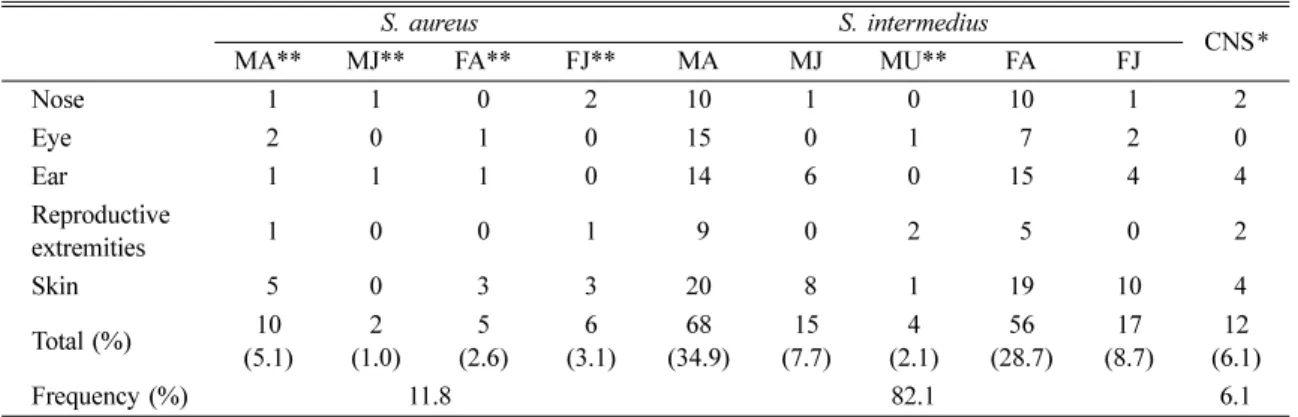
분리주의분리빈도를 정리해본결과는Table 1
과같다.
이중12
개의CNS
분 리주는본실험에서제외되었고,
연령을모르는개에서분리된
4
개의S. aureus
도연령별실험결과에서제외되 었다.
분리주의분포를보면Staphylococcus
의분리빈도Table 1. Frequency and distribution of
Staphylococcusspp. isolated from dogs
S. aureus S. intermedius
CNS
*MA** MJ** FA** FJ** MA MJ MU** FA FJ
Nose 1 1 0 2 10 1 0 10 1 2
Eye 2 0 1 0 15 0 1 7 2 0
Ear 1 1 1 0 14 6 0 15 4 4
Reproductive
extremities 1 0 0 1 9 0 2 5 0 2
Skin 5 0 3 3 20 8 1 19 10 4
Total (%) 10
(5.1) 2
(1.0) 5
(2.6) 6
(3.1) 68
(34.9) 15
(7.7) 4
(2.1) 56
(28.7) 17
(8.7) 12 (6.1)
Frequency (%) 11.8 82.1 6.1
*CNS : coagulase negative strains, **MA : male adults, MJ : male juveniles, MU : Male age un-known, FA : female adults, FJ
: female juveniles.
는
juveniles(20.5%)
보다adult dogs(71.3%)
에서더높았 고, male dogs(50.8%)
과female dogs(43.1%)
의비율을보였다
.
특히S. intermedius (82.1%)
분리주가S. aureus
(11.8%)
분리주보다많이분리되었다.
Table 2
.Antimicrobial susceptibility of
Staphylococcus aureus(Total: 23 isolates)
Antibiotics Susceptible Resistant Intermediate
No. % No. % No. %
AMC 22 96.0 1 4.0 0 0.0
CF 17 74.0 6 26.0 0 0.0
C 12 52.0 11 48.0 0 0.0
TE 5 22.0 18 78.0 0 0.0
CIP 14 61.0 8 35.0 1 4.3
Va 20 87.0 3 13.0 0 0.0
P 3 13.0 20 87.0 0 0.0
SXT 10 43.0 12 52.0 1 4.3
GM 12 52.0 7 30.0 4 17.4
L 7 30.0 12 52.0 4 17.4
E 10 43.0 13 57.0 0 0.0
N 19 83.0 4 17.0 0 0.0
OX 14 61.0 8 35.0 1 4.3
NOR 14 61.0 8 35.0 1 4.3
CC 8 35.0 11 48.0 4 17.4
Table 3
.Antimicrobial susceptibility of
Staphylococcus intermedius(Total:160 isolates)
Antibiotics Susceptible Resistant Intermediate
No. % No. % No. %
AMC 158 99 2 1 0 0
CF 153 96 7 4 0 0
C 129 81 31 19 0 0
TE 16 10 144 90 0 0
CIP 119 74 40 25 1 1
Va 152 95 8 5 0 0
P 30 19 130 81 0 0
SXT 69 43 80 50 11 7
GM 89 56 63 39 8 5
L 86 54 63 39 11 7
E 83 52 72 45 5 3
N 157 98 3 2 0 0
OX 145 91 13 8 2 1
NOR 123 77 37 23 0 0
CC 84 53 53 33 23 14
Table 4. Differences in antimicrobial susceptibility of healthy dogs by sex (among 13 male and 9 female dogs)
AntibioticsSusceptible(%) Resistant(%) Intermediate(%) Male Female Male Female Male Female
AMC 100.0 100.0 0.0 0.0 0.0 0.0
CF 84.6 100.0 15.4 0.0 0.0 0.0
C 84.6 88.9 15.4 11.1 0.0 0.0
TE 0.0 11.1 100.0 88.9 0.0 0.0
CIP 61.5 100.0 38.5 0.0 0.0 0.0
Va 100.0 100.0 0.0 0.0 0.0 0.0
P 15.4 22.2 84.6 77.8 0.0 0.0
SXT 38.5 22.2 61.5 66.7 0.0 11.1
GM 61.5 66.7 38.5 22.2 0.0 11.1
L 46.2 66.7 53.8 11.1 0.0 22.2
E 38.5 66.7 46.2 33.3 15.4 0.0
N 92.3 100.0 7.7 0.0 0.0 0.0
OX 84.6 100.0 15.4 0.0 0.0 0.0
NOR 69.2 100.0 30.8 0.0 0.0 0.0
CC 46.2 77.8 38.5 22.2 15.4 0.0
Table 5. Differences in antimicrobial susceptibility of diseased dogs by sex (among 84 male and 77 female dogs)
AntibioticsSusceptible(%) Resistant(%) Intermediate(%) Male Female Male Female Male Female
AMC 97.6 98.7 2.4 1.3 0.0 0.0
CF 95.2 90.9 4.8 9.1 0.0 0.0
C 72.6 79.2 27.4 20.8 0.0 0.0
TE 11.9 13.0 88.1 87.0 0.0 0.0
CIP 75.0 68.8 23.8 29.9 1.2 1.3
Va 90.5 96.1 9.5 3.9 0.0 0.0
P 21.4 14.3 78.6 85.7 0.0 0.0
SXT 50.0 39.0 44.0 53.2 6.0 7.8
GM 53.6 54.5 41.7 36.4 4.8 9.1
L 57.1 44.2 36.9 46.8 6.0 9.1
E 52.4 49.4 45.2 49.4 2.4 1.3
N 95.2 97.4 4.8 2.6 0.0 0.0
OX 85.7 87.0 13.1 10.4 1.2 2.0
NOR 72.6 75.3 26.2 24.7 1.2 0.0
CC 51.2 48.1 33.3 37.7 15.5 14.3
약제 감수성
S. aureus
분리주의약제 감수성은AMC > Va > N
에높은감수성
(80%
이상)
을나타냈고, CF > CIP, OX, NOR
> C, GM
에중등도의감수성(50%-80%)
을보였으며P >
TE > E > SXT, L
에서는저항성(S% > R%)
을나타냈다(Table 2).
S. intermedius
분리주는AMC > N > CF > Va > OX >
C
에매우높은감수성을나타냈고, NOR > CIP > GM >
L > CC > E
순으로 중등도의감수성을보였으며, TE >
P > SXT
에는저항성을나타냈다(Table 3).
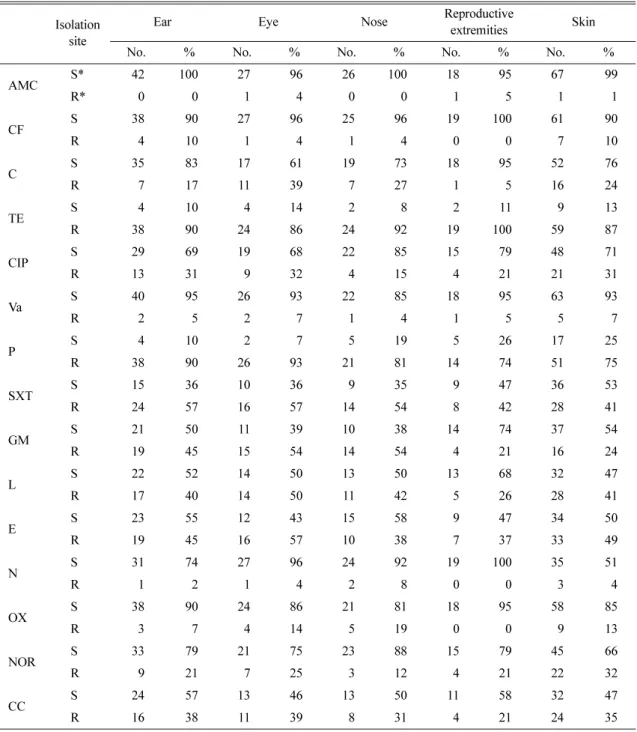
Table 6 . Differences in antimicrobial susceptibility of
Staphylococcusspp. isolates by isolation sites Isolation
site Ear Eye Nose Reproductive
extremities Skin
No. % No. % No. % No. % No. %
AMC S* 42 100 27 96 26 100 18 95 67 99
R* 0 0 1 4 0 0 1 5 1 1
CF S 38 90 27 96 25 96 19 100 61 90
R 4 10 1 4 1 4 0 0 7 10
C S 35 83 17 61 19 73 18 95 52 76
R 7 17 11 39 7 27 1 5 16 24
TE S 4 10 4 14 2 8 2 11 9 13
R 38 90 24 86 24 92 19 100 59 87
CIP S 29 69 19 68 22 85 15 79 48 71
R 13 31 9 32 4 15 4 21 21 31
Va S 40 95 26 93 22 85 18 95 63 93
R 2 5 2 7 1 4 1 5 5 7
P S 4 10 2 7 5 19 5 26 17 25
R 38 90 26 93 21 81 14 74 51 75
SXT S 15 36 10 36 9 35 9 47 36 53
R 24 57 16 57 14 54 8 42 28 41
GM S 21 50 11 39 10 38 14 74 37 54
R 19 45 15 54 14 54 4 21 16 24
L S 22 52 14 50 13 50 13 68 32 47
R 17 40 14 50 11 42 5 26 28 41
E S 23 55 12 43 15 58 9 47 34 50
R 19 45 16 57 10 38 7 37 33 49
N S 31 74 27 96 24 92 19 100 35 51
R 1 2 1 4 2 8 0 0 3 4
OX S 38 90 24 86 21 81 18 95 58 85
R 3 7 4 14 5 19 0 0 9 13
NOR S 33 79 21 75 23 88 15 79 45 66
R 9 21 7 25 3 12 4 21 22 32
CC S 24 57 13 46 13 50 11 58 32 47
R 16 38 11 39 8 31 4 21 24 35
*S : susceptible, R : resistant.
S. aureus
와S. intermedius
는AMC, Va, N
에높은감수성을보이고
P, TE, SXT
에저항성을보여그경향이유사하였지만
, S. intermedius
가S. aureus
에비해광범위 하게항생제에감수성을보였다.
예를들어S. aureus
에서는 중등도의 감수성을 나타낸
CF, C, OX
는S.
intermedius
에서는96%, 81%, 91%
로높은감수성을보 였고, S. aureus
에저항성을갖는L
은S. intermedius
에54%
의감수성을보였다.
건강상태 및 성별에 따른 감수성 차이
건강한 개에서
male
의경우Va, AMC > N > OX, C, CF
순으로높은감수성을, female
의경우Va, AMC, N, OX, NOR, CF, CIP > C > CC
순으로높은감수성을나타냈다
.
감수성에있어서female
이male dogs
에비해높은 수치를보였고, NOR, CIP, CC
는female
에서만높은감수성을보였다
. TE, P, SXT
에는두성별모두에서저항성을획득해치료제로서효용이없음을보여주었고
, male
은추가적으로
L, E
에도저항성을보였다.
그외에아직 은효과가있지만중등도의감수성(I)
의수치가높아서저항성이높아질가능성이있는약물로는
male
에서는CC, female
에서는GM
과L
이있었다(Table 4).
질환이있는개에서
male
의경우AMC > CF > N > Va
> OX
에 높은 감수성(80%
이상)
을, female
의 경우는AMC > Va > CF > N > OX > C
에높은감수성을보여유사한경향을보였다
. TE, P
는성별과무관하게저항성을획득했음을알수있었고
, SXT, GM, L, E, CC
또한전반적으로저항성을보였다
(Table 5).
분리부위에 따른 감수성의 차이
생식기에서는다른부위와는달리
AMC
보다는CF
와
C, Va, N
에보다높은감수성을보였다. GM
은생식기및피부에서는효과를보이지만
,
귀및비강에서는치료효과가떨어지는것으로나타났다
. E
의경우에는특 히눈에적용하기에부적합한것으로나타났다. SXT
에대해서는귀
,
눈,
비강에서저항성을나타냈다(Table 6).
중등도의감수성
(I)
은통계적으로유의한자료를얻을 수없어표에서따로표기하지않았다.
연령에 따른 감수성 차이
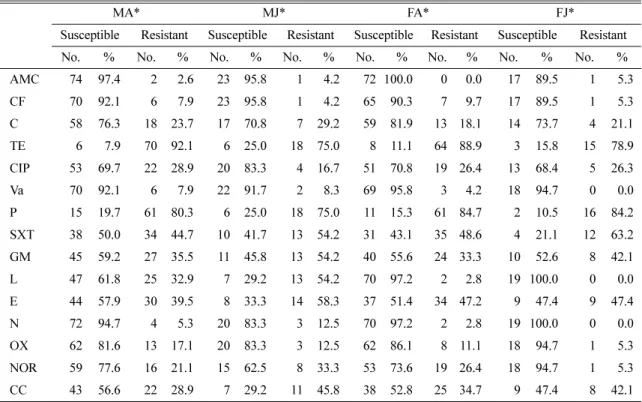
Adults
와juvenile
에서 공통적으로AMC, CF, Va, N,
OX
는매우높은감수성을나타냈고, TE
와P
에는저항성을획득했음을보여주었다
. Male juvenile(MJ)
에서가 장많은항생제에저항성을나타내었는데TE, P
이외에SXT, GM, L, E, CC
에도저항성을획득한것으로나타Table 7. Antimicrobial susceptibility of
Staphylococcusspp. isolates according to age and sex
MA* MJ* FA* FJ*
Susceptible Resistant Susceptible Resistant Susceptible Resistant Susceptible Resistant
No. % No. % No. % No. % No. % No. % No. % No. %
AMC 74 97.4 2 2.6 23 95.8 1 4.2 72 100.0 0 0.0 17 89.5 1 5.3
CF 70 92.1 6 7.9 23 95.8 1 4.2 65 90.3 7 9.7 17 89.5 1 5.3
C 58 76.3 18 23.7 17 70.8 7 29.2 59 81.9 13 18.1 14 73.7 4 21.1
TE 6 7.9 70 92.1 6 25.0 18 75.0 8 11.1 64 88.9 3 15.8 15 78.9
CIP 53 69.7 22 28.9 20 83.3 4 16.7 51 70.8 19 26.4 13 68.4 5 26.3
Va 70 92.1 6 7.9 22 91.7 2 8.3 69 95.8 3 4.2 18 94.7 0 0.0
P 15 19.7 61 80.3 6 25.0 18 75.0 11 15.3 61 84.7 2 10.5 16 84.2
SXT 38 50.0 34 44.7 10 41.7 13 54.2 31 43.1 35 48.6 4 21.1 12 63.2
GM 45 59.2 27 35.5 11 45.8 13 54.2 40 55.6 24 33.3 10 52.6 8 42.1
L 47 61.8 25 32.9 7 29.2 13 54.2 70 97.2 2 2.8 19 100.0 0 0.0
E 44 57.9 30 39.5 8 33.3 14 58.3 37 51.4 34 47.2 9 47.4 9 47.4
N 72 94.7 4 5.3 20 83.3 3 12.5 70 97.2 2 2.8 19 100.0 0 0.0
OX 62 81.6 13 17.1 20 83.3 3 12.5 62 86.1 8 11.1 18 94.7 1 5.3
NOR 59 77.6 16 21.1 15 62.5 8 33.3 53 73.6 19 26.4 18 94.7 1 5.3
CC 43 56.6 22 28.9 7 29.2 11 45.8 38 52.8 25 34.7 9 47.4 8 42.1
*MA : male adults, MJ : male juveniles, FA : female adults, FJ : female juveniles.
났다
.
이결과에따르면SXT, GM, E
는치료제로서의효과를기대하기어려울것으로보이며
, CC
는저항성이증가되는추세를보였다
. L
은MJ
에서만저항성이나타났다
(Table 7).
중등도의감수성(I)
은표에서따로표기하지않았다
.
고 찰
수의분야의화농성감염에서
Staphylococci
의약제내성은전세계적으로증가추세이며빠른전파를보여왔
다
[26].
약제내성의양상은임상에서개에사용하는항균제의종류와노출빈도
,
분리균의유래에따라달라진다
.
따라서Staphylococci
감염증을적절히치료하기위해서는원인균에대한약제감수성검사를실시하여감 수성있는약제를선별투약하는것이바람직하다
[1].
이전보고
[9]
와마찬가지로개로부터분리된Staphylo- coccus spp.
의분포를 보면S. intermedius (82.1%)
가S.
aureus (11.8%)
에비해더많이분리되었고,
이들을실험 에이용하였다.
S. aureus
와S. intermedius
는모두AMC, Va, N
에높 은감수성을 보였으며, S . intermedius
가S . aureus
에비 해많은항생제에높은감수성을보였다. S . intermedius
의항생제감수성의경우
, 1998
년Pellerin
등의보고[19]
에서는
C
에60%-65%, macrolides(E, L, CC)
와SXT
에65%~80%,
β-lactams
인OX, AMC, cephalexin, GM
과quinolones
인enrofloxacin
과marbofloxacin
에는95%
이 상의감수성을보였다.
박등
[2]
의논문에서는S . intermedius
에AMC(88.9%),
OX(100%), Va(100%)
이감수성이높게나타나이번논문과유사하였으나
, CC
는72.7%
로이번결과인53%
와는다소차이를 보였다
. S. aureus
에의한가장일반적인피부질환인
impetigo
에서분리한S. aureus
의항생제감수성결과를이전문헌과비교해보면
, 1999
년까지MIC50
이 항상높았던GM
에저항을보였고, 1994
과2000
년사이에탁월한효과를보였던CC
에도저항을보였다
[16].
Penicillin
내성균은최초발생보고이후그발생비율이점차증가하고있는데
,
이번결과에서도S. aureus
에 서87%, S. intermedius
에서81%
로높게나타나서더이상
P
는치료제로서효용성이없는것으로판단된다. TE
에 대한 저항성은 실험결과
S. aureus
에서78%, S.
intermedius
에서90%
의저항성을보여P
와마찬가지로치료제로서효용이없는것으로판단된다
. TE
계항생제 는 유사한 화학적 구조 때문에 교차내성이 발생해deoxycycline, oxycycline
의저항성 증가에영향을 미칠수 있다
[24]. Staphylococcus
에서P
이외에도L
과sulfonamide
에대한저항성이종종보고된바있으며[5,
20], fluoroquinolones
에대한저항성도CIP
와NOR
의사용빈도가높은만큼내성이증가하고있다고보고된바
있다
[13].
건강한개와질환이있는개의분리주들사이에약제감수성은이전보고들과마찬가지로 크게차 이가나타나지않았다
[18, 22]. Picard
와Goullet
의보고[21]
에서는세균감염증에있어서대상의성별과나이는약제감수성관련인자로제시하였지만본실험의결과 는타연구자들의결과와마찬가지로
[4, 19]
성별이항 생제감수성에큰영향을미친다는유의적인차이는볼 수없었다.
성별에의한차이가Penicillin G, TE
와E
에서보고된바있으며
E
에대한저항성은adult males
에비해
adult females
에서잘나타나므로antibiotics
를사용할때
sex
와분리된bacteria
사이의관계를고려해야한다고보고한논문도 있으나
, antimicrobial resistance
와sex
사이그mechanism
이아직밝혀지지않았다[9].
연령별항생제저항성경향은
adults
보다는juvenile
에서항생제저항성증가추세를볼수있었는데
adults
의경우는수의임상에서항생제사용패턴및사용빈
도의척도로서의미가있고
[22], juvenile
에서감수성을나타낸 항생제의
in vivo
상의 적용은 차후adults
의resistance
경향에영향을 미칠수있다[19]. Staphylo- coccus
에서CF
나C
에대한저항성이흔하게보고되어왔지만
[3, 23]
이번결과에서는감수성을갖는것으로나타났다
.
분리부위가항생제감수성에미치는영향을이번결 과에서관찰할수있었는데외부생식기에서는다른부
위와는달리
AMC
보다는CF
와C, Va, N
에보다높은감수성을보였고
, GM
은생식기및피부에서높은감수 성을보였으며, E
의경우에는눈에적용하기에부적합한것으로나타났다
. SXT
에대해귀에서분리된Staphy-
lococcus
가저항한다는이전의보고와본실험의결과가 일치하였고[25],
추가적으로눈,
비강에서도효용이떨어지는것으로나타났다
. 2002
년국내에서발표된박등[2]
의보고에서ampicillin
의저항성을100%
로보고했고, Pellerin
등[19]
은1993
년의amoxicillin
이감수성을84%
로보고했으나
, Staphylococcus
감염증치료에P group G
와A
보다OX
나cephalosporin
같은약물이보다효과 가좋기때문에이번실험에서는제외하였다.
종합해보면
Staphylococcus
감염증에대한유용한치 료제로는β-lactam antibiotics
인AMC, CF, OX
가있었으 며,
단백합성억제제인N
과glycopeptide
제제인Va
이효과적인 것으로 나타났다
.
현재 수의 임상에서Staphylococcus
감염증 치료에 많이 사용되고 있는GM(male: 55.6%, female: 55.6%), E(male: 53.3%, female:
50.6%), SXT(male: 50.0%, female: 40.7%), CIP(male:
75.6%, female: 67.9%)
등은중등도의약제내성이나타나임상에서이항생제의사용은좀더신중한판단이필 요하겠다
.
항생제내성균주가증가하고있고다약재내 성균주들이분리되고있기때문에감수성테스트를통 한올바른항생제선택과함께상승효과가기대되는적 절한합제약물의제시가필요할것이다.
결 론
개로부터총
23
개의S. aureus
와160
개의S. intermedius
분리주가분리
,
동정되어이용되었는데juveniles(20.5%)
보다는
adult dogs(71.3%)
에서분리가많이되었으며S.
aureus (11.8%)
보다는S. intermedius (82.1%)
가많이분리되었다
.
이들의항생제감수성을조사한결과,
분리주들 은대체적으로AMC, CF, OX, N,
그리고Va
에감수성 을보였다.
그리고이외의항생제들에게는상대적으로높은저항성을보인다는것을감안하여약제의선택을 해야할것으로생각된다
.
특히저항성을보이는항생제 에대해서는다른항생제로의주기적인대용이나사용 제한등을실시하여야할것이다.
감사의 글
본연구는
BK21
바이오치료산업인력양성사업팀의지원을받아수행되었습니다
. 참고문헌
1.
강호조,
손원근,
이주홍.
가축유래 Staphylococcus aureus의Enterotoxin
산생과Plasmid profile
에관한 연구. IV.
분리균의항균제내성.
한국수의공중보건학회지
1992, 16, 21-26.
2.
박세원,
한홍율,
윤화영,
황철용,
유희.
개에서분리된호기성병원성세균의항생제감수성