http://dx.doi.org/10.14405/kjvr.2015.55.1.41
41
<Original Article>
Comparison of antibiotic resistance profiles for Escherichia coli isolated from wild boar and domestic pig fecal samples
Sung J. Yoo, Sun young Sunwoo, Sang won Seo, Young S. Lyoo*
Department of Pathology, College of Veterinary Medicine, Konkuk University, Seoul 143-701, Korea (Received: September 29, 2014; Revised: January 5, 2015; Accepted: January 19, 2015)
Abstract : Increasing presence of wild boar around cities and suburban areas is a growing concern with respect to agronomy, environmental ecology, and public safety. In this study, antibiotic resistance profiles of Escherichia (E.) coli isolated from wild boar and domestic pig fecal samples were compared. Eighty E. coli samples were isolated from wild boars. Resistance of the bacteria to 14 common antimicrobial agents used in human and veterinary medicine was evaluated. Ninety-five E. coli isolates from domestic pig farms were used for comparison. Common and distinct antibiotic resistance patterns were observed when comparing wild boar and domestic pig isolates, indicating that wild boars may significantly influence environmental microbiology.
Keywords: antibiotic resistance, domestic pigs, Escherichia coli, feces, wild boar
Introduction
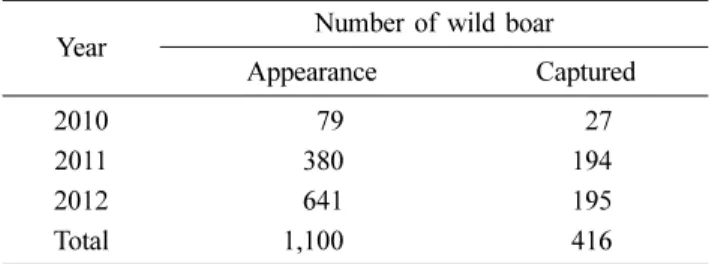
The parallel growth of wild boar population and urban area caused boar migration to peri-urban area, which have resulted in the frequent appearance of wild boars around cit- ies and suburban areas (Table 1) [18]. Subsequently, the transmission of microbes from wild boar fecal material to farms or domestic animals and the public via a number of routes is becoming more likely [13]. Because of the poten- tial of contamination, the antimicrobial sensitivity profile of the wild boar is considered important. Even though many investigations about the antibiotic resistance of intestinal microflora in wild animals have been conducted and reported worldwide [17, 20], there are no reports about antibiotic resistance in wild boar fecal bacteria in Korea. Therefore, a surveillance study of antibiotic resistance in the wild boar was performed. Domestic pigs were selected as a representa- tive group of livestock, and antibiotic resistance of this domestic group was investigated in order to assess the effect of indiscriminate domestic farm-use of antibiotics on antibi- otic resistance in wild boars [9]. Escherichia (E.) coli was selected as a bacterium to survey antibiotic sensitivity for two reasons. First, E. coli is a common component of the gut flora in the animals used for meat production and can there- fore serve as an indicator of enteric organisms acquiring resistance to various antimicrobials [16]. Second, changes in the antibiotic resistance of E. coli may serve as an early warning of the development of resistance by related patho-
genic bacteria [4, 5]. In this study, resistance of wild boar and domestic pig fecal bacteria to various antimicrobial agents was investigated, and the two antibiotic sensitivity profiles of fecal bacteria were compared.
Materials and Methods
Sixty-seven fecal samples were collected from free-rang- ing wild boars hunted in the Gyeonggi province of Korea between March 2010 and March 2012. In order to avoid con- tamination, the fecal samples were taken directly from the rectum after death. According to the enterobacteria preserva- tion protocol, the samples were transported immediately to the laboratory in ice-cooled containers and stored in a trypti- case soy broth-glycerol freezing medium (Becton, Dickinson and Company, USA) at −70
oC [24]. Sixty-four fecal samples
*Corresponding author
Tel: +82-2-450-3719, Fax: +82-2-6008-3791 E-mail: [email protected]
Table 1. Appearance and captured numbers of wild boars around cities in Korea (data provided by the Ministry of Environment, the Republic of Korea)
Year Number of wild boar
Appearance Captured
2010 79 27
2011 380 194
2012 641 195
Total 1,100 416
of domestic growing or finisher pigs were collected by pick- ing up droppings in pigsties between April 2010 and Octo- ber 2012 from 24 different pig farms located in Gyeonggi province. The samples were treated in the same manner as those from wild boars. All the farms were raising a cross breed between Durok males and Landrace × Yorkshire females.
Geographic regions where wild boars were hunted (5 regions) and domestic pig farms (7 regions) were located are indi- cated in Fig. 1, and the area of Gyeonggi province is 10,185.6 km
2.
Approximately 4 g feces was taken from the preserved samples, placed in tubes with 10 mL brain heart infusion (BHI) broth (Becton, Dickinson and Company), and incu- bated at 35
oC for 24 h. A sample (10 µL) of the turbid broth was removed, streaked onto MacConkey agar (Becton, Dick- inson and Company), and incubated at 37
oC for 18~20 h. The plates were examined for the development of red colonies that could precipitate bile and had dark red centers. To inves- tigate the number of antibiotic-sensitivity profile types, 10 colonies were selected from each fecal sample [22] and streaked onto eosin methylene blue (EMB) agar (Becton, Dickinson and Company). The colonies were assumed to be E. coli if they showed a metallic sheen after incubation on EMB agar at 37
oC for 24 h. The E. coli colonies were selected, inocu- lated into BHI, and incubated for 4~5 h until the culture became turbid. Bacteria from the broth were confirmed as E.
coli based on Gram-staining and conventional biochemical tests such as the oxidase and catalase assays, using the BBL Crystal system (Becton, Dickinson and Company, Germany)
and the Vitek system (BioMérieux, USA). Only bacterial iso- lates confirmed as E. coli were selected for antimicrobial agent sensitivity testing. Confirmed isolates were inoculated into fresh BHI and incubated until the turbidity measured 0.5 McFarland units (3~4 h).
The modified Kirby-Bauer disc diffusion method devel- oped by the Clinical and Laboratory Standards Institute (CLSI) was used to determine the susceptibility of the E. coli isolates to 14 antimicrobial agents that were selected based on the suggested standard antimicrobial agents for Entero- bactericeae [7] and the frequency of use of drugs in domestic pig farms. Because E. coli are naturally resistant to penicillin and spiramycin, these antibiotics were excluded from this study [21]. According to the initial screening and phenotypic confirmatory test for extended-spectrum beta-lactamases (ESBLs) provided by the CLSI, azetreonam for screening tests, and cefotaxime and ceftazidime, with or without clavulanic acid, for phenotypic confirmatory tests were also included [7].
These two tests were performed for E. coli isolates showing resistance to cefotaxime. The antimicrobial compounds used in this study were tetracycline (30 µg/disc), gentamicin (10 µg/disc), amoxicillin/clavulanic acid (20/10 µg/disc), norfloxa- cin (10 µg/disc), ampicillin (10 µg/disc), streptomycin (10 µg/
disc), cefazolin (30 µg/disc), amikacin (30 µg/disc), trimetho- prim (5 µg/disc), chloramphenicol (30 µg/disc), tobramycin (10 µg/disc), cefotaxime (30 µg/disc), cefoxitin (30 µg/disc), azetre- onam (30 µg/disc), ceftazidime (30 µg/disc), and cefotaxime/
clavulanic acid (30/10 µg/disc), ceftazidime/clavulanic acid (30/10 µg/disc). The antimicrobial discs (Becton Dickinson, USA) were obtained from Becton, Dickinson and Company.
Samples of the E. coli isolates grown in BHI to a turbidity of 0.5 McFarland Standard were swabbed onto Mueller-Hin- ton agar (Becton, Dickinson and Company). Fourteen pre- pared antimicrobial discs were placed onto the inoculated plates, and the plates were incubated at 35
oC for 18 to 20 h.
The diameters of the inhibition zones surrounding the antimi- crobial discs were used to determine susceptibility or resis- tance based on the criteria suggested by the CLSI [7].
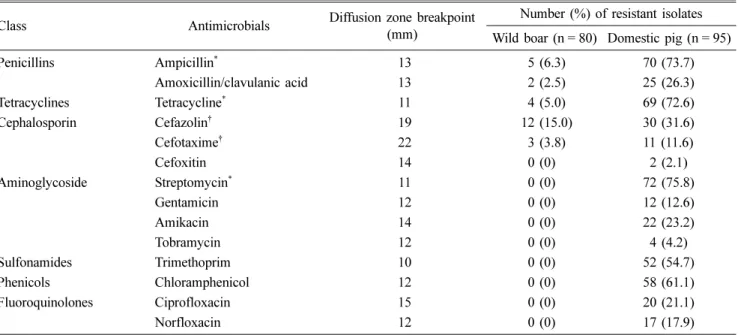
E. coli isolates having the same antibiotic resistance pat- tern for each fecal sample were counted as one. In total, eighty E. coli isolates from wild boars and 95 E. coli isolates from domestic pigs were included for the comparative and statistical analysis to compare antimicrobial profiles between the two groups (Tables 2 and 3). The Fisher’s exact test with a 95% confidence interval (95% CI) was performed using SPSS 19.0 (SPSS, USA) to clarify the difference between the group of domestic pigs that were directly exposed to antibi- otics and wild boars that had not been exposed to antibiotics directly. At p < 0.05, the associations were considered statis- tically significant and odds ratios (ORs) and 95% confidence intervals were calculated.
Results
For each wild boar fecal sample, 10 colonies were selected
Fig. 1. Geographic regions in which wild boar and domestic pigfecal samples were collected in Gyeonggi province, Korea. The regions where wild boars were hunted are shown in grey circles with different diameter, while the site in which domestic pig farms were located are indicated as black diamond.
from the MacConkey agar plates, yielding 670 total colo- nies, of which 643 were identified as E. coli. Among the 640 colonies isolated from domestic pig fecal samples, 621 were identified as E. coli. Antibiotic sensitivity profiles of con- firmed E. coli isolates from each fecal sample were deter- mined by the CLSI disc diffusion method. The average
number of different antibiotic sensitivity profiles for wild boar and domestic pig fecal samples was 1.2 ± 0.4 and 1.5 ± 0.7, respectively.
Statistical analysis of differences between the domestic and wild boar groups revealed that resistance to 11 antimicrobial agents (streptomycin, ampicillin, tetracycline, chlorampheni-
Table 2. Antibiotic resistance of Escherichia (E.) coli isolated from wild boars and domestic pigsClass Antimicrobials Diffusion zone breakpoint
(mm)
Number (%) of resistant isolates Wild boar (n = 80) Domestic pig (n = 95)
Penicillins Ampicillin* 13 95 (6.3) 70 (73.7)
Amoxicillin/clavulanic acid 13 92 (2.5) 25 (26.3)
Tetracyclines Tetracycline* 11 94 (5.0) 69 (72.6)
Cephalosporin Cefazolin† 19 12 (15.0) 30 (31.6)
Cefotaxime† 22 93 (3.8) 11 (11.6)
Cefoxitin 14 90 (0) 92 (2.1)
Aminoglycoside Streptomycin* 11 90 (0) 72 (75.8)
Gentamicin 12 90 (0) 12 (12.6)
Amikacin 14 90 (0) 22 (23.2)
Tobramycin 12 90 (0) 94 (4.2)
Sulfonamides Trimethoprim 10 90 (0) 52 (54.7)
Phenicols Chloramphenicol 12 90 (0) 58 (61.1)
Fluoroquinolones Ciprofloxacin 15 90 (0) 20 (21.1)
Norfloxacin 12 90 (0) 17 (17.9)
*Over 70% of domestic E. coli isolates showed resistance to three antimicrobial agents (ampicillin, tetracycline, streptomycin). †High levels of resistance to cefazolin and cefotaxime were detected in wild boar isolates. Otherwise, the resistance to these antibiotics was relatively low in domestic pig isolates when compared to that of other antibiotics.
Table 3. Antibiotic resistance patterns of Escherichia coli isolated from wild boars and domestic pigs Resistance patterns
Number (%) of resistant
isolates Resistance patterns
Number (%) of resistant isolates
wild boar (n = 80) domestic pig (n = 95)
– 62 (77.5) S-AM-T-C-TM 19 (20.0)
CZ 96 (7.5) AM-T-C-TM-CZ-AmC 13 (13.7)
CTX 93 (3.8) S-T-AN 10 (10.5)
AmC-AM-CZ 92 (2.5) S-AM-T-TM 99 (9.5)
AM-CZ 92 (2.5) S-CZ-AN 99 (9.5)
T 92 (2.5) AM-T-C-CIP-NOR-CTX 98 (8.4)
T-CZ 92 (2.5) S-AM-C 96 (6.3)
AM 91 (1.3) S-AM-C-AmC 95 (5.3)
S-AM-T-C-AmC-CIP-NOR-GM 94 (4.2)
AM-T-C-TM-C-NOR-GM 93 (3.2)
S-TM-CZ-CIP-GM 93 (3.2)
S-TM-CZ-GM-CTX-NN 93 (3.2)
AM-T-C-AmC-AN-CIP-NOR-FOX 91 (1.1)
AM-T-C-TM-CZ-AmC-AN 91 (1.1)
S-AM-T-C-TM-CZ-AmC-AN-CIP-NOR-GM-NN-FOX 91 (1.1)
S; streptomycin, AM; ampicillin, T; tetracycline, C; chloramphenicol, TM; trimethoprim, CZ; cefazolin, AmC; amoxicillin/clavulanic acid, AN; amikacin, CIP; ciprofloxacin, NOR; orfloxacin, GM; gentamicin, CTX; cefotaxime, NN; tobramycin, FOX; cefoxitin.
col, trimethoprim, cefazolin, amoxicillin/clavulanic acid, amika- cin, ciprofloxacin, norfloxacin and gentamicin) was statistically significant ( p < 0.05). ORs (and 95% confidence intervals) for ampicillin, tetracycline, amoxicillin/clavulanic acid, and cefazolin were 44.4 (16.0-122.7), 50.4 (16.8-151.8), 13.9 (3.2- 60.9), and 2.6 (1.2-5.5), and the p values of cefotaxime, tobra- mycin, and cefoxitin were 0.091, 0.126, and 0.501, respec- tively.
The most frequently observed antibiotic resistance in the wild boar samples was to cefazolin (15.0%), followed by ampicillin (6.3%), cefotaxime (3.8%), tetracycline (5%), and amoxicillin/clavulanic acid (2.5%). On the other hand, nearly 70% of domestic pig-derived isolates showed resistance to streptomycin, ampicillin, and tetracycline. Resistances to chlo- ramphenicol (61.1%), trimethoprim (54.7%), cefazolin (31.6%), amoxicillin/clavulanic acid (26.3%), amikacin (23.1%), nor- floxacin (17.9%), gentamicin (12.6%), cefotaxime (11.6%), tobramycin (4.2%), and cefoxitin (2.1%) were also observed in the domestic isolates (Table 2). In addition, all of the wild boar and domestic pig-derived E. coli isolates resistant to cefotaxime were identified as non-ESBL producers.
While there were no antimicrobial agents that had an effect on all domestic E. coli isolates, all E. coli isolates from wild boar were susceptible to 9 of the 14 antimicrobial agents (amika- cin, cefoxitin, chloramphenicol, ciprofloxacin, gentamicin, nor- floxacin, streptomycin, tobramycin, trimethoprim). Among the 9 antimicrobial agents, 3 agents (chloramphenicol, streptomy- cin, and trimethoprim) had less of an inhibitory effect on domestic pig E. coli isolates than the other 6 agents. Espe- cially, streptomycin inhibited only 24.2% of the domestic isolates. Resistance to 5 of the 14 antimicrobial agents (ampi- cillin, amoxicillin/clavulanic acid, cefazolin, cefotaxime, and tetracycline) was identified in both wild and domestic E. coli isolates. About 73% of the domestic E. coli isolates showed resistance to ampicillin or tetracycline (Table 2).
More E. coli isolates from wild boar showed resistance to a single antimicrobial agent (cephazolin, cefotaxime, tetracy-
cline, and ampicillin) than to two or more antimicrobial agents. In contrast, only multidrug resistance was observed in domestic isolates. The most frequently observed antibiotic resistance patterns in wild boars and domestic pigs were cefa- zolin and streptomycin-ampicillin-tetracycline-chloramphenicol- trimethoprim, respectively (Table 3).
Discussion
A proportional relationship between antibiotic resistance and the amount of exposed antibiotics is well documented [3, 20]. While the prevalence of antibiotic resistance in domes- tic animals is generally high, that of wild animals is rela- tively low because wild animals are not intentionally exposed to large quantities of antimicrobial agents, and there is no known route for them to consume a large variety of antibiot- ics [20, 21]. This known correlation between the extent of exposure to antibiotics and antibiotic resistance was con- firmed in the present study through the statistical analysis comparing the antimicrobial profiles of E. coli isolates derived from wild boars and domestic pigs. Even though the p-val- ues of resistance to some antimicrobial agents such as cefo- taxime, cefoxitin, and tobramycin were larger than 0.05, these exceptions are presumed to have been caused by the low use of these antibiotics in domestic pig farms, consider- ing that the antibiotic resistance rate in domestic E. coli iso- lates is very low (Table 2).
The antibiotic resistance of pathogenic bacteria has become a social issue; therefore, many countries, including Korea, have been making efforts to regulate the use of antibiotics as additives to livestock food. As shown in Fig. 2, the total amount of antibiotics used in swine production and the quan- tity of tetracyclines, sulfonamides, and aminoglycosides used in livestock production have declined since 2005. On the other hand, the use of phenicols and cephalosporins has increased. Decreased resistance to tetracycline and increased resistance to phenicols and cephalosporins of domestic E.
Fig. 2. The amount of antibiotics used in the Korean livestock industry from 2005 to 2012. The total amount (in kg) of each series of antibiotics used in swine production is indicated by the heights of the bars. ‘Total’ means the total amount of antimicrobial agents used in swine production (data provided by the Korea Animal Health Product Association).
coli isolates were observed compared to resistance patterns reported for 2003 and 2004 [12], which is consistent with the consumption changes of these antibiotics.
Tetracyclines and penicillins have been the most widely used antibiotics for 8 years in livestock production. In both wild boar and domestic pig-derived E. coli isolates, rela- tively high rates of resistance to ampicillin or tetracycline were observed. However, despite the small amount of use of aminoglycosides, domestic E. coli isolates showed the high- est resistance to streptomycin (75.8%), which could be par- tially explained by the following two factors. High-level resistance to streptomycin is known to commonly occur by chromosomal mutations affecting ribosome affinity, and resis- tance to streptomycin via an altered ribosome-binding site occurs more readily than for the other aminoglycosides because streptomycin binds to a single site on the 30S sub- unit of ribosomes. Unlike streptomycin, the other aminogly- cosides bind to multiple sites on both the 50S and 30S subunits [2, 8, 11, 14]. However, additional research, includ- ing genetic investigations of ribosome-coding genes, should be performed to establish the exact cause of high resistance rates to streptomycin. Furthermore, continuous efforts to reduce the quantity of penicillins, tetracyclines, and aminoglyco- sides being used in livestock production are needed to con- trol antibiotic resistance to these agents.
Interestingly, even though a lower percentage of domestic isolates were resistant to cefazolin and cefotaxime than to streptomycin, ampicillin, tetracycline, chloramphenicol, or trimethoprim, resistance to these cephalosporins in wild boar isolates was relatively high. From this result, two possible hypotheses can be proposed. One hypothesis is that E. coli easily acquires resistance to cephalosporins because even though the use of cephalosporins has been increasing, the amount of cephalosporins used relative to other antibiotics is still small.
Cefoxitin should be excluded in this case because its use in domestic pig farms is thought to be very low, which is sup- ported by the fact that the rate of resistance to cefoxitin in domestic isolates is low and the p-value corresponding to cefoxitin resistance was greater than 0.05.
Another possible hypothesis for the development of rela- tively high resistance to cefazolin and cefotaxime is that resistant bacteria and resistance genes reach the environment through sewage, for example, and are transmitted to wild boar. In fact, cephalosporins are used widely in veterinary medicine. For example, the third-generation cephalosporin ceftiofur is commonly used to prevent mastitis in dairy cat- tle, and high doses are administered shortly before their slaughter. Bacteria that are resistant to ceftiofur are fre- quently resistant to other important cephalosporins such as cefazolin [15]. Epidemiological surveys around wild boar habitats and investigations into cephalosporin resistance may be required to better understand these research findings.
Cephalosporins are widely used antibiotics in human med- icine, especially for treating pneumonia and skin and soft tis- sue infections. Although there were no suspected ESBL-
producing E. coli isolates in wild boars and domestic pigs, the development of ESBL-producing E. coli could occur in both species of pigs given that cephalosporin use has been increasing. While ESBL-producing E. coli is more likely to develop in domestic pigs than in wild boars because of much more chances to be located under direct exposure to cepha- losporins, the possibility of the occurrence of ESBL-produc- ing E. coli in wild boar cannot be ignored considering the relatively high prevalence of cephalosporin resistance in wild boar isolates. The occurrence of ESBL-producing E. coli in domestic pig represents an obvious risk for fecal-oral trans- mission to human especially through contaminated meat [23]
and this problem could become persistent and widespread by the incidence of ESBL-producing E. coli isolates in wild ani- mals including wild boar. That is because wild life has the potential to serve as reservoirs and transfer vector of antimi- crobial resistance, which would severely threaten public health [1, 19]. There were no chloramphenicol-resistant E.
coli isolates in the wild boar fecal samples. However, given the increase in the use of phenicols, as described in Fig. 2, and the high levels of resistance to chloramphenicol (61.1%) in domestic pig farms, resistance of chloramphenicol in wild boar is likely to occur and the presence of that in wild boar would threaten public health in the same way described above. Thus, regulation of cephalosporin and phenicol use in domestic animals farms is highly recommended.
All E. coli isolates from wild boars were susceptible to flu- oroquinolones, but some isolates from domestic pigs were resistant. Considering that fluoroquinolones are among the most effective antimicrobials used in the treatment of human infections, and that development of resistance to one agent leads to cross-resistance to other fluoroquinolones [6], this result represents a substantial threat to public health. Many countries are reducing the use of these antimicrobials in live- stock [10]. In Korea, the use of 4 types of fluoroquinolones (ciprofloxacin, norfloxacin, pefloxacin, and ofloxacin) in livestock has been prohibited by law since 2008. However, more strict restrictions on the use of fluoroquinolones in live- stock are needed as soon as possible.
Previous research showed that restrictions on antimicro- bial use in livestock decreased antibiotic resistance in live- stock, which encourages efforts to reduce the amount of antibiotics used in livestock production. Both common and distinct aspects of the antibiotic resistance profiles were observed between domestic pig isolates and wild boar isolates in this study. Our results indicate that while there is a need for more detailed epidemiological studies to investigate the exposure to antimicrobial agents in the environment and analyze anti- biotic resistance genes, wild boars could also be used as an indicator of antibiotic presence in the environment, and as a tool for research on the formation of antibiotic resistance, as demonstrated by the observed cephalosporin resistance.
However, given that the frequency of contact between wild
boar and human-dominated environments is increasing along
with wild boar population growth and natural habitat distur-
bance, besides influencing the microflora of livestock, wild boar could substantially threaten public health and environ- mental ecology, especially via their droppings. Therefore, further efforts to control the wild boar population, as well as epide- miological investigations with periodical surveillance of the antibiotic resistance of the normal flora of wild boars and domestic pigs are necessary.
Acknowledgments
This paper was written as part of Konkuk University’s research support program for its faculty on sabbatical leave in 2013.
References
1. Allen HK, Donato J, Wang HH, Cloud-Hansen KA, Davies J, Handelsman J. Call of the wild: antibiotic resistance genes in natural environments. Nat Rev Microbiol 2010, 8, 251-259.
2. Allen PN, Noller HF. A single base substitution in 16S ribosomal RNA suppresses streptomycin dependence and increases the frequency of translational errors. Cell 1991, 66, 141-148.
3. Bagcigil FA, Moodley A, Baptiste KE, Jensen VF, Guardabassi L. Occurrence, species distribution, antimicrobial resistance and clonality of methicillin- and erythromycin- resistant staphylococci in the nasal cavity of domestic animals.
Vet Microbiol 2007, 121, 307-315.
4. Blake DP, Hillman K, Fenlon DR, Low JC. Transfer of antibiotic resistance between commensal and pathogenic members of the Enterobacteriaceae under ileal conditions. J Appl Microbiol 2003, 95, 428-436.
5. Blake DP, Humphry RW, Scott KP, Hillman K, Fenlon DR, Low JC. Influence of tetracycline exposure on tetracycline resistance and the carriage of tetracycline resistance genes within commensal Escherichia coli populations. J Appl Microbiol 2003, 94, 1087-1097.
6. Blondeau JM. Fluoroquinolones: mechanism of action, classification, and development of resistance. Surv Ophthalmol 2004, 49 (Suppl 2), S73-78.
7. CLSI. Performance Standards for Antimicrobial Susceptibility Testing; Twenty-Third Informational Supplement. CLSI docu- ment M100-S23. Clinical and Laboratory Standards Institute, Wayne, 2013.
8. Feldman MB, Terry DS, Altman RB, Blanchard SC.
Aminoglycoside activity observed on single pre-translocation ribosome complexes. Nat Chem Biol 2010, 6, 54-62.
9. French GL. The continuing crisis in antibiotic resistance.
Int J Antimicrob Agents 2010, 36 (Suppl 3), S3-7.
10. Huotari K, Tarkka E, Valtonen V, Kolho E. Incidence and risk factors for nosocomial infections caused by fluoro- quinolone-resistant Escherichia coli. Eur J Clin Microbiol
Infect Dis 2003, 22, 492-495.
11. Lacey RW, Chopra I. Evidence for mutation to streptomycin resistance in clinical strains of Staphylococcus aureus. J Gen Microbiol 1972, 73, 175-180.
12. Lim SK, Lee HS, Nam HM, Cho YS, Kim JM, Song SW, Park YH, Jung SC. Antimicrobial resistance observed in Escherichia coli strains isolated from fecal samples of cattle and pigs in Korea during 2003-2004. Int J Food Microbiol 2007, 116, 283-286.
13. Mieszkin S, Furet JP, Corthier G, Gourmelon M.
Estimation of pig fecal contamination in a river catchment by real-time PCR using two pig-specific Bacteroidales 16S rRNA genetic markers. Appl Environ Microbiol 2009, 75, 3045-3054.
14. Mingeot-Leclercq MP, Glupczynski Y, Tulkens PM.
Aminoglycosides: activity and resistance. Antimicrob Agents Chemother 1999, 43, 727-737.
15. Payne DJ, Amyes SG. Transferable resistance to extended- spectrum beta-lactams: a major threat or a minor incon- venience? J Antimicrob Chemother 1991, 27, 255-261.
16. Persoons D, Bollaerts K, Smet A, Herman L, Heyndrickx M, Martel A, Butaye P, Catry B, Haesebrouck F, Dewulf J. The importance of sample size in the determination of a flock-level antimicrobial resistance profile for Escherichia coli in broilers. Microb Drug Resist 2011, 17, 513-519.
17. Poeta P, Costa D, Igrejas G, Rodrigues J, Torres C.
Phenotypic and genotypic characterization of antimicrobial resistance in faecal enterococci from wild boars (Sus scrofa).
Vet Microbiol 2007, 125, 368-374.
18. Radeloff VC, Hammer RB, Stewart SI, Fried JS, Holcomb SS, McKeefry JF. The wildland-urban interface in the United States. Ecol Appl 2005, 15, 799-805.
19. Radhouani H, Silva N, Poeta P, Torres C, Correia S, Igrejas G. Potential impact of antimicrobial resistance in wildlife, environment and human health. Front Microbiol 2014, 5, 23.
20. Sayah RS, Kaneene JB, Johnson Y, Miller R. Patterns of antimicrobial resistance observed in Escherichia coli isolates obtained from domestic- and wild-animal fecal samples, human septage, and surface water. Appl Environ Microbiol 2005, 71, 1394-1404.
21. Schierack P, Römer A, Jores J, Kaspar H, Guenther S, Filter M, Eichberg J, Wieler LH. Isolation and characteri- zation of intestinal Escherichia coli clones from wild boars in Germany. Appl Environ Microbiol 2009, 75, 695-702.
22. Schlager TA, Hendley JO, Bell AL, Whittam TS. Clonal diversity of Escherichia coli colonizing stools and urinary tracts of young girls. Infect Immun 2002, 70, 1225-1229.
23. van den Bogaard AE, Stobberingh EE. Epidemiology of resistance to antibiotics. Links between animals and humans.
Int J Antimicrob Agents 2000, 14, 327-335.
24. Wasfy M, Oyofo B, Elgindy A, Churilla A. Comparison of preservation media for storage of stool samples. J Clin Microbiol 1995, 33, 2176-2178.