45
*Corresponding author: Young-Hwan Kim, Tel. +82-55-772-2345, Fax. +82-55-772-2308, E-mail. [email protected]
도축장의 소와 돼지 분변에서 분리한 살모넬라속의 약제내성 및 약제내성 유전자의 보유율
하도윤ㆍ지대해ㆍ조상래ㆍ박애라ㆍ정은희ㆍ박동엽ㆍ이국천ㆍ양정웅1 김종수1ㆍ김혜정2ㆍ정종화2ㆍ송익현3ㆍ김애란4ㆍ이지연4ㆍ김용환1*
경상남도 축산진흥연구소 중부지소, 1경상대학교 수의과대학, 2경남 보건환경연구원 미생물 역학조사과,
3삼성전자 메모리 사업부, 4국립수의과학검역원 세균과
(접수 2011. 2. 25, 게재승인 2011. 3. 22)
Prevalence of the antimicrobial resistance and resistance associated gene in Salmonella spp. isolated
from pigs and cattle in slaughterhouse
Do-Yun Hah, Dae-Hae Ji, Sang-Rae Jo, Ae-Ra Park, Eun-Hee Jung, Dong-Yeop Park, Kuk-Cheon Lee, Jung-Wung Yang1, Jong-Shu Kim1, Hye-Jung Kim2, Jong-Hwa Jung2,
Ick-Hyun Song3, Ae-Ran Kim4, Ji-Youn Lee4, Young-Hwan Kim1*
Central branch of Gyeongnam Livestock Promotion Research Institute, Kimhae 621-833, Korea
1College of Veterinary Medicine and Institute of animal Science, Gyeongsang National University, Jinju 660-701, Korea
2Microbiology and Epidermiology Division Gyeongsangnam-Do Govermnet Research Institute of Public Health Environment, Changwon 641-702, Korea
3Memory Division, Samsung Electronics, Hwaseong 445-701, Korea
4Bacteriology Division National Veterinary Research and Quarantine Service, Anyang 430-757, Korea (Received 25 February 2011, accepted in revised from 22 March 2011)
Abstract
This study was conducted to investigate the distribution of Salmonella spp. from pigs and cattle in slaughterhouse, the antimicrobial resistance pattern and the prevalence of resistance genes of isolates.
A total of 640 fecal samples from pigs and cattle in slaughterhouse were collected for isolation of Salmonella spp.. Isolation rate was revealed as 15% in pigs and 1.6% in cattle. As result of serotyp- ing, group B (56.6%) were identified as most common in pigs and cattle isolates, in order of group C (24.5%) and group E (15.1%). S. Typhimurium (50.9%) was most common serotype. The major se- rotypes were in order of S. Rissen and S. London (11.3%) and S. Riggil (7.6%). In antimicrobial test, all isolates were demonstrates susceptibility to nitrofurantoin. But isolates were revealed resistance oth- er antibiotics in order of tetracycline (64.6%), streptomycin (68.3%), ampicillin and amoxicillin (56.3%) and spectinomycin (47.9%). With polymerase chain reaction, antimicrobial resistance gene strA (75.0%) and aadA1 (3.1%) were detected in streptomycin resistance isolates and tetA (94.3%) and tetB (11.3%) gene were detected in tetracycline resistant isolates, but tetG was not detected. Class 1 integron gene was detected in all Salmonella isolates.
Key words : Salmonella, Multidrug resistant, Resistance gene, Slaughterhouse
서 론
살모넬라속 균은 1885년 Smith와 Salmon이 돼지 콜 레라로 폐사한 돼지의 장으로부터 S. Choleraesuis를 처음으로 분리· 보고(Molorny 등, 2001) 이후, 균체 표 면 항원성분 중 serogroup의 특성을 부여하는 주체 성 분인 lipopolysaccharide (LPS;O-antigen)와 편모항원인 flagellin protein (H-antigen)의 다형성에 근거하여 혈청 형을 결정할 수 있음을 보고한(Tuchili LM 등, 1996;
Kwang 등, 1996) 이래, O-antigen의 혈청형에 따라 A, B, C, D, E의 group으로 구분하며(Edwards와 Ewing, 1986), 현재까지 밝혀진 serotype은 항원 구조에 따라 약 2,500여 종 이상이 보고되었으며 분리율이 비교적 높은 것은 200여 종의 혈청형으로 알려져 있다 (Baggesen 등, 2000; Chiu 등, 2005).
Salmonella속 균은 장염과 식중독의 대표적인 원인 으로서 오염된 식육이나 환경을 통하여 사람에 감염 되며, 식품의 제조, 가공 또는 저장 중에 직·간접적으 로 동물의 분변에 의해 오염되는 것으로 추정하고 있 어 공중보건학적 측면에서 중요시되고 있다(Baggesen 등, 2000).
항균제는 동물에서 세균성 감염증 치료에 유용하 게 사용되었으나 이의 남용이나 발육촉진을 위해 사 료에 첨가 투여함으로써 항균제 내성을 선택적으로 증가시켜 세균성 감염증의 치료 및 예방에 많은 문제 점을 일으키고 있다(Sato와 Kodama, 1974). 약제내성 획득 기전으로는 plasmid, transposon, phage 및 integron- mediated mechanism에 의하며(Baggesen 등, 2000), plasmid는 Salmonella속 균을 포함한 여러 장내세균에 서 약제내성 뿐만 아니라 장관부착능, 장관침입능 및 독소생성능 등의 유전정보를 암호화하고 있다(Gahring 등, 1990).
Plasmid와 transposon에 존재하는 약제내성 유전자 의 본질적인 부위는 integron에 통합되어 있고, in- tegron은 cassette 유사 구조 내에 약제내성 유전자들 의 통합과 발현을 가능하게 하는 유전자 부위를 포함 하고 있으며, integron class 1과 2는 그람 음성균의 다 제 내성과 밀접하게 관련되어 있어 각국에서 많은 연 구가 이루어지고 있다(Leverstein 등 2002; Gebreyes 등, 2004; Randall 등, 2004; Nemergut 등, 2008).
약제 내성 관련 유전자는 β-lactam계 항균제에 대 한 bla (carbB2)와 bla (Tem), sulfonamide계에 대한 sul1 과 sul2, dhfr1 및 floR, streptomycin과 spectinomycin에
대한 aadA1과 aadA2, aminoglycoside 계에 대한 aadB 와 aphA1-1AB, tetracyline계에 대한 tet (A, B 및 G), chloramphenicol에 대한 cat1과 cat2 등이 알려져 있다 (Randall 등, 2004).
그러나 국내에서는 동물 유래 Salmonella속 균의 약제내성유전자와 integron에 관한 연구는 이 등 (2009b)의 보고 외에는 거의 없는 실정이다.
이번 실험에서는 경남 지역 도축장의 소와 돼지에 서 살모넬라속 균의 분리율과 분리균의 혈청형별 분 포도를 조사하고, 각종 항균제에 대한 내성 유형과 내성유전자의 관련성을 규명하여, 살모넬라속 균 감 염에 대한 치료 및 예방대책을 확립하기 위한 기초자 료를 제시하고자 하였다.
재료 및 방법
시료채취
2010년 1월에서 8월 동안 경상남도 중부지역의 2 개 도축장에 출하된 118농가의 소 320두, 16농가의 돼지 320두의 분변 내용물, 총 640건의 시료를 채취 하여 균 분리에 사용하였으며, 각 시료는 무균적으로 채취한 후 4시간 이내에 냉장상태로 실험실로 운반 하여 균 분리에 사용하였다.
Salmonella속 균의 분리 및 동정
살모넬라균의 분리방법은 Edwards 및 Ewing (1986) 의 방법 및 축산물의 가공기준 및 성분규격(국립수의 과학검역원, 2010)의 방법에 따라 수행하였다. 증균 배양은 buffered peptone water (Difco, USA) 25.0 ml에 분변 25 g을 넣어 37oC에서 16∼20시간 예비 증균한 후 이 증균배양액 0.1 ml을 10 ml의 Rappaport-Vassili- adis R10 Broth (Merck, USA)에 접종하여 42oC에서 18
∼24시간 배양한 다음 선택배지 Salmonella-Shigella agar (Merck, Germany), Xylose lysine desoxycholate agar
(Merck, Germany) 및 Rambach agar (Merck, Germany) 에 도말하여 37oC에서 18∼24시간 배양하였다. 선택 배지에서 의심 집락 2∼3개를 취하여 triple sugar iron agar (TSI) 사면배지에 37oC에서 18∼24시간 배양하고 성상을 확인한 다음 API Kit (BioMerieux, France) 또 는 Vitek system (BioMerieux, USA)을 이용하여 최종
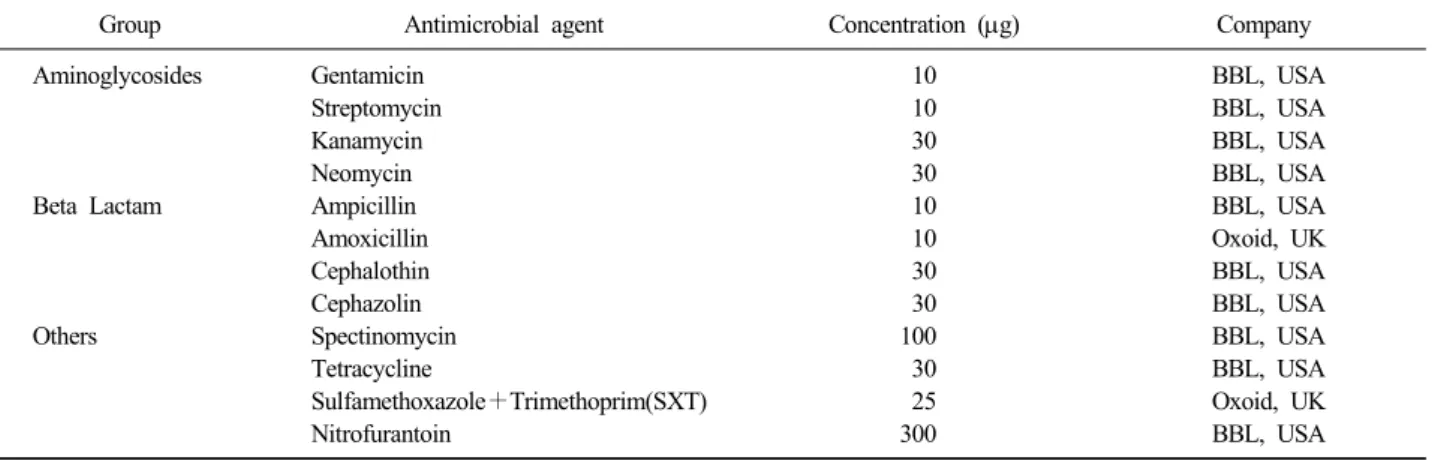
Table 1. Antimicrobial agent used for disc diffusion test
Group Antimicrobial agent Concentration (μg) Company
Aminoglycosides
Beta Lactam
Others
Gentamicin Streptomycin Kanamycin Neomycin Ampicillin Amoxicillin Cephalothin Cephazolin Spectinomycin Tetracycline
Sulfamethoxazole+Trimethoprim(SXT) Nitrofurantoin
10 10 30 30 10 10 30 30 100 30 25 300
BBL, USA BBL, USA BBL, USA BBL, USA BBL, USA Oxoid, UK BBL, USA BBL, USA BBL, USA BBL, USA Oxoid, UK BBL, USA
확인하였다.
분리된 균을 trytic soy agar (Difco, USA) agar에 24 시간 배양하여 12.5% glycerol이 함유된 nutrient broth (Difco, USA)로 수확한 다음 −70oC에 보관하였으며, trytic soy agar에 계대하여 4oC에 보관하면서 사용하 였다. 또한, Serotyping은 균체항원(O) 및 편모항원(H) 에 대한 표준항혈청(Difco, USA)을 이용하여 Edward 와 Ewing(1986)의 방법에 따라 형별하였다.
항균제 감수성 시험
분리균에 대한 항균제 감수성 시험은 Bauer (1966) 와 Bryant (1972)의 방법을 참고로 하여 Sensi disc (BBL, USA and Oxoid, UK)를 이용한 disc 확산법으 로 실시하였다. Disc는 gentamicin (GM 10 μg)등 20종 을 사용하였으며(Table 1), 균주는 Mueller-Hinton broth (Difco, USA)에 접종하여 37oC에서 2∼6시간 동안 배 양하여 균 농도를 McFarland No. 0.5 탁도로 조정한 후, 멸균면봉을 이용하여 Mueller-Hinton agar 평판배 지를 60°로 회전하면서 3회 도포 하였다. 평판을 3∼
5분간 말리고 15분 이내에 항균제 disc를 dispenser로 접종하였다. 37oC에서 16∼18시간 배양 후 균 억제대 의 크기를 관찰하여 National Committe for Clinical Laboratory Standards (NCCLS, 2002)의 기준에 따라 내 성 여부를 판정하였다. 항균제 감수성 시험의 표준균 주로는 E. coli ATCC 25922를 사용하였다.
본 실험에 사용한 항균제는 aminoglycoside계와 β-lactam계 각 4종과 그 외 항균제 4종을 포함한 12종 을 사용하였으며, 각 항균제의 종류와 disc의 농도는 Table 1과 같다.
약제 내성 관련 유전자 검출
PCR은 소와 및 돼지에서 분리된 살모넬라속 균 53 주에 대해서 실시하였다.
DNA 추출:공시된 주로부터 genomic DNA 추출은 이 등(2009b)의 방법을 수정 보완하여 QIAamp DNA extraction kit (QIAamp DNA mini Qiagen, Germany)를 사용하였다.
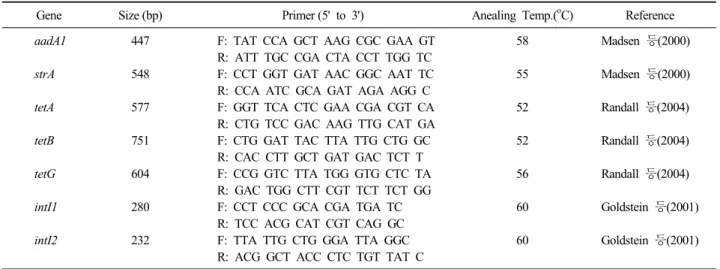
Oligonucleotide primer의 합성:PCR에 사용된 oligo- nucleotide primer의 염기서열, 증폭산물의 크기 및 온 도는 Table 2에서와 같다. aadA1, strA, tetA, tetB, tetG 유전자 및 intI1, intI2 등의 oligonucleotide primer를 Bioneer (Korea)및 Xenotech (Korea)에 합성을 의뢰하 여 사용하였다.
PCR을 통한 약제 내성 관련 유전자 검출:약제 내성 관련 유전자 검출을 위한 PCR은 Randall (2004)과 Madsen (2000) 및 Goldstein (2001)등의 방법을 수정 보완하여 실시하였다. 모든 PCR 검출은 GoTag Green Master Mix, 2×(Promega, U.S.A) 12.5 μl, upstream 및 downstream primer (Genotec, Korea)를 각 1 μl, DNA template 2 μl를 포함하여 최종량이 25 μl이 되게 nu- clease-free water를 첨가하였다. PCR은 94oC에서 5분 간 denaturation시킨 후, 94oC에서 60초, 52∼60oC에서 30∼60초간 annealing 시킨 후, 72oC에서 1분 조건으 로 총 30cycle로 수행한 다음 72oC에서 10분간 extention 시켰다. PCR 수행은 T-gradient (Biometra, Germany)를 이용하였다.
증폭산물의 확인
PCR에 의해 증폭된 산물은 1.5% agarose gel
Table 2. Primer for antimicrobial resistance genes
Gene Size (bp) Primer (5' to 3') Anealing Temp.(oC) Reference
aadA1 strA tetA tetB tetG intI1 intI2
447
548
577
751
604
280
232
F: TAT CCA GCT AAG CGC GAA GT R: ATT TGC CGA CTA CCT TGG TC F: CCT GGT GAT AAC GGC AAT TC R: CCA ATC GCA GAT AGA AGG C F: GGT TCA CTC GAA CGA CGT CA R: CTG TCC GAC AAG TTG CAT GA F: CTG GAT TAC TTA TTG CTG GC R: CAC CTT GCT GAT GAC TCT T F: CCG GTC TTA TGG GTG CTC TA R: GAC TGG CTT CGT TCT TCT GG F: CCT CCC GCA CGA TGA TC R: TCC ACG CAT CGT CAG GC F: TTA TTG CTG GGA TTA GGC R: ACG GCT ACC CTC TGT TAT C
58
55
52
52
56
60
60
Madsen 등(2000)
Madsen 등(2000)
Randall 등(2004)
Randall 등(2004)
Randall 등(2004)
Goldstein 등(2001)
Goldstein 등(2001)
Table 3. Isolation rates of Salmonella spp. from pig and cattle feces
Animal No. of samples No. of isolates (%) Pig
Cattle Total
320 320 640
48 (15.0) 5 (1.6) 53 (8.3)
(Difco, U.S.A)상에 loading하고 TBE buffer (40 mM Tris, 20 mM boric acid, 1mM EDTA; Difco, U.S.A)에 서 100volt로 약 1시간 동안 전기영동을 실시하였다.
Agarose gel (Difco, U.S.A)을 0.5 μg/ml의 ethidium bro- mide (Sigma, Germany)용액으로 염색시킨 후 UV transilluminator를 사용하여 증폭된 산물을 확인하였 다. Maker로는 100 bp molecular ladder (Introgen, Korea)를 사용하였다.
결과 및 고찰
Salmonella spp.의 분리율
소와 돼지의 분변에서 분리한 Salmonella속 균의 분리율은 Table 3에서와 같이 총 640 건 중에서 8.3%
(53건)이었다. 축종별 분리율은 돼지에서 15%(48건), 소는 1.6% (5건) 이었다. 소의 분변에서 조사된 Salmonella속 균 분리율을 보면 Edrington 등(2004)은 미국 젖소의 분변에서 25.2%, 강과 손(1999)은 한우 의 분변과 음용수로부터 9.1%의 분리율을 보고한 성 적에 비하여 낮게 나타났으나 최(1986), 최 등(1988)
의 젖소의 분변에서 각각 1.2%와 1.1%의 분리율과 유사하였고, 이 등(2009a)과 Davies 등(2004)이 소 맹 장 내용물에서 0.5%와 0.2% 분리율을 보고한 성적보 다 높은 분리율을 보였다.
돼지에서 조사된 Salmonella속 균의 분리율을 보면 김(2000)은 돼지 분변에서 9.5%의 분리율을, 최 등 (1986)의 돼지분변 및 환경 재료에서 2.9% 분리율 보 인 결과보다는 높았지만, Swanenburg 등(2001)의 네 덜란드의 돼지 직장내용물에서 25.6%의 분리율, Davies 등(2004)의 도축된 영국의 돼지 맹장내용물에 서 23.0%의 분리율보다 본 실험에서 조사된 분리율 이 낮게 나타났다.
위와 같은 차이는 사육형태와 환경, 분리지역 및 시료의 종류와 시료의 수 등의 요인에 의한 것으로 생각된다.
Salmonella spp.의 혈청형별 분리율
Serogroup:분리된 Salmonella 속 균 53주에 대한 serogroup은 Table 4와 같다. Group B가 소, 돼지에서 30주(56.6%)로 가장 많이 분리되었고 다음 group C가 13주(24.5%), group E가 8주(15.1%) 순이었다.
Serotype:분리된 Salmonella 속 균 53주에 대한 se- rotype은 Table 4에서와 같이 모두 12종으로 분류되었 고, type별 분포는 B group인 S. Typhimurium이 50.9%(27주)으로 가장 높은 분리율을 보였으며, C와 E group인 S. Rissen과 S. London이 각각 11.3% (6주), C group인 S. Riggil이 7.6% (4주)의 순으로 나타났고, 나머지는 1∼2주씩 분포를 나타내었다. 돼지 유래균
Table 5. Antimicrobial susceptibility of 53 Salmonella ioslates
Antimicrobial agent
No. of isolates (%)
Pig (n=48) Cattle (n=5) Total (n=53)
S (%) I (%) R (%) S (%) I (%) R (%) S (%) I (%) R (%)
Aminoglycosides Gentamicin Streptomycin Kanamycin Neomycin β-lactams Ampicillin Amoxicillin Cephalothin Cephazolin Others Spectinomycin Tetracycline STX (Sulfamethoxa- zole+Trimethoprim) Nitrofurantoin
23 (47.9) 5 (10.4) 17 (35.4) 14 (29.2)
20 (41.7) 19 (19.6) 12 (25.0) 39 (81.3)
13 (27.1) 7 (14.6) 16 (33.3)
47 (97.9)
3 (6.3) 15 (31.3) 20 (41.7) 27 (56.3)
1 (2.1) 2 (4.2) 15 (31.3) 7 (14.6)
12 (25.0) 10 (20.8) 12 (25.0)
1 (2.1)
22 (45.8) 28 (58.3) 11 (22.9) 7 (14.6)
27 (56.3) 27 (56.3) 21 (43.8) 2 (4.2)
23 (47.9) 31 (64.6) 20 (41.7)
0
1 (20.0) 1 (20.0) 1 (20.0) 2 (40.0)
3 (60.0) 3 (60.0) 3 (60.0) 2 (40.0)
0 1 (20.0) 2 (40.0)
5 (100)
0 0 3 (60.0) 2 (40.0)
0 0 0 2 (40.0)
2 (40.0) 0 1 (20.0)
0
4 (80.0) 4 (80.0) 1 (20.0) 1 (20.0)
2 (40.0) 2 (40.0) 2 (40.0) 1 (20.0)
3 (60.0) 4 (80.0) 2 (40.0)
0
24 (45.4) 6 (11.2) 18 (34.0) 16 (30.2)
23 (43.4) 22 (41.5) 15 (28.3) 41 (77.5)
13 (24.5) 8 (15.1) 18 (34.0)
52 (98.1)
3 (5.6) 15 (28.5) 23 (43.5) 29 (54.7)
1 (1.9) 2 (3.8) 15 (28.3) 9 (16.9)
14 (26.4) 10 (18.9) 13 (24.5)
1 (1.9)
26 (49.0) 32 (60.3) 12 (22.5) 8 (15.1)
29 (54.7) 29 (54.7) 23 (43.4) 3 (5.6)
26 (49.1) 35 (56.0) 22 (41.5)
0 Table 4. Serotypes of 53 Salmonella isolates
Serogroup Serotypes
No. of iolates with
Total (%) S. Enterica serotype
Pig (%) Cattle (%) B
C
D E
S. Typhimurium S. Potsdam S. Mbandaka S. Stanley S. Rissen S. Riggil S. Brandenburg S. Kentucky S. Othmarschen S. Panama S. London S. Give S. Havana
24 (50) 1 (2.1) 1 (2.1) 1 (2.1) 6 (12.5)
4 (8.3) 1 (2.1)
0 1 (2.1) 2 (4.2) 6 (12.5)
1 (2.1) 0
3 (60) 0 0 0 0 0 0 1 (20)
0 0 0 1 (20)
30 (56.6)
13 (24.5)
2 (3.8) 8 (15.1)
Total 13 48 (100) 5 (100) 53 (100)
48주는 11종으로 분류되었고 S. Typhimurium이 24주 (45.3%)로 가장 높은 분포를 보였으며, 소 유래균은 5 주는 3종으로 분류되었으며 S. Typhimurium이 3주 (5.7%)로 가장 높은 분리율을 보였다. 이는 김(2000) 이 소, 돼지 및 닭에서 분리한 Salmonella속 균 264주 에서 18종을, 이 등(2009a)이 돼지와 소에서 분리한 Salmonella속 균 457주에서 34종을 분류한 성적과는
차이를 보였으나 분리된 주요 serotype은 S. Typhimu- rium이 가장 높은 것은 일치하였다.
우리나라의 소 사육 형태가 소규모 형태에서 대규 모 다두 밀집 사육형태로 변해가고 있으며, 돼지 또 한 대단위 다두밀집 기업형 사육형태로 변해가고 있 다. 따라서 농장이 Salmonella에 감염 또는 전염성이 강한 질병에 오염되면 개체간에 비교적 전파가 빠르 고 감염률이 높다.
분리주의 항균제 감수성
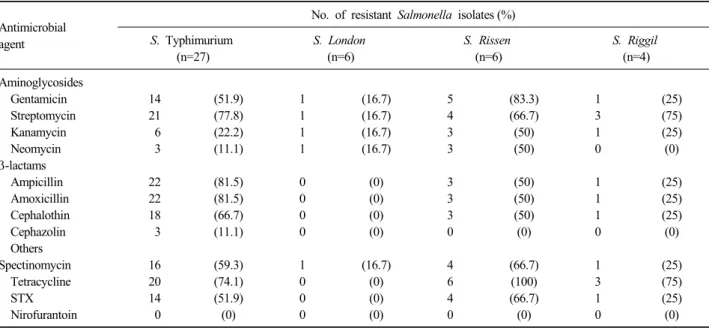
분리된 살모넬라속 균 53주에 대한 항균제 감수성 시험결과는 Table 5에서와 같다. 돼지유래균주의 항균 제 내성률은 tetracycline (64.6%), streptomycin (58.3%), ampicillin과 amoxicillin (56.3%) 및 spectinomycin (47.9%) 순이었으며 nitrofurantoin에 대해서는 내성을 나타낸 균주가 없었다. 소유래 균주의 항균제 내성률 은 tetracycline, gentamicin 및 streptomycin에 대해 80%, spectinomycin에 대해 60%, ampicillin, amox- icillin, cephalothin 및 STX에 대해 40%, kanamycin, neomycin 및 cephazolin에 대해서는 20%로 나타났으 며 nitrofurantoin에 대해서는 내성을 나타낸 균주가 없었다.
이전 연구에 따르면, 가축에서 유래된 살모넬라속 균의 약제감수성시험에서 돼지유래균은 streptomycin
Table 6. Antimicrobial resistance of commonly encountered Salmonella serotypes
Antimicrobial agent
No. of resistant Salmonella isolates (%) S. Typhimurium
(n=27)
S. London (n=6)
S. Rissen (n=6)
S. Riggil (n=4) Aminoglycosides
Gentamicin Streptomycin Kanamycin Neomycin β-lactams Ampicillin Amoxicillin Cephalothin Cephazolin Others Spectinomycin Tetracycline STX Nirofurantoin
14 21 6 3
22 22 18 3
16 20 14 0
(51.9) (77.8) (22.2) (11.1)
(81.5) (81.5) (66.7) (11.1)
(59.3) (74.1) (51.9) (0)
1 1 1 1
0 0 0 0
1 0 0 0
(16.7) (16.7) (16.7) (16.7)
(0) (0) (0) (0)
(16.7) (0) (0) (0)
5 4 3 3
3 3 3 0
4 6 4 0
(83.3) (66.7) (50) (50)
(50) (50) (50) (0)
(66.7) (100) (66.7) (0)
1 3 1 0
1 1 1 0
1 3 1 0
(25) (75) (25) (0)
(25) (25) (25) (0)
(25) (75) (25) (0)
과 tetracycline에 대해 내성이 높았다고 하였으며(최 등, 1986), 소유래균에서는 ampicillin, streptomycin 및 tetracycline에 대해 내성이 높다고 하였다(최 등, 1988). Esaki 등(2004)에 따르면 동물유래 살모넬라속 균의 내성률은 streptomycin (67.1%), ampicillin (30.5%) 및 trimethoprim (22.0%) 순이었다고 하였으며, 이 등 (2009a)은 돼지유래균주의 항균제 내성률은 tetracy- cline (68.7%), streptomycin (52.3%) 및 ampicillin (15.3%) 의 순으로 나타났다고 하였으며, 소유래 균주의 항균 제 내성률은 tetracycline에 대해서 57.9%, 다음으로 streptomycin (55.3%), ampicillin (18.4%)순으로 나타났 다고 하였다. 이번 연구에서도 tetracycline과 strepto- mycin에 대해서는 이전 연구들의 성적과 유사한 결 과로 나타났으며 ampicillin에 대해서는 비교적 높은 내성률을 보였다. 이들 항생제에 대한 다른 연구자들 의 내성률과의 차이는 지역적인 차이, 시료의 종류 및 감수성 시험의 방법에 따른 결과로 생각된다.
살모넬라속 균 53주 중 분리율이 상대적으로 높은 4종의 serotype에 속하는 43주에 대한 항균제 내성률 은 Table 6과 같다. Serotype별 내성률은 S. Typhimu- rium의 경우 ampicillin과 amoxicillin (81.5%), strepto- mycin (77.8%), cephalothin (66.7%), spectinomycin (59.3%), gentamicin과 STX (51.9%) 순으로 나타났으며 nitro- furantoin에 대해서는 모두 감수성을 나타내었다.
S. London 6주는 gentamicin, streptomycin, kanamy- cin, neomycin 및 spectinomycin에 각 1주(16.7%)가 내
성을 나타내었으나, ampicillin, amoxicillin, cephalothin, cephazolin, tetracycline, STX 및 nitrofurantoin에 대해 서는 모두 감수성을 나타내었다.
S. Rissen 6주의 내성률은 tetracycline에 대하여 100%, 그 다음 gentamicin (88.3%), streptomycin, spec- tinomycin 및 STX (66.7%) 순이었으며 cephazolin과 ni- trofurantoin에 대해서는 모두 감수성을 나타내었다.
S. Riggil의 내성률은 tetracycline 및 streptomycin에 75%, gentamicin, kanamycin, ampicillin, amoxicillin, cephazolin, spectinomycin 및 STX에 대해서는 25%로 나타났으며, neomycin, cephazolin 및 nitrofurantoin에 대해서는 모두 감수성 나타내었다.
Duijkeren 등(2002)이 조사한 보고에 의하면 돼지유 래균에서 내성률이 가장 높은 것은 S. Typhimurium으 로서 tetracycline 및 ampicillin에 대한 내성률이 현저 하게 증가한다고 하였다. 이 등(2009a)에 의하면 S.
Typhimurium의 tetracycline에 대한 내성률은 96.9%이 었고, 다음으로 streptomycin (92.7%) 및 nalidixic acid (52.1%)이었고 ampicillin (46.9%) 및 sulfamethoxazole/
trimethoprim (45.8%) 순이었다고 하였다. 이는 이번 연구의 결과와 유사하게 나타났으나, β-lactams계의 ampicillin에는 높은 내성률을 나타내었다. 따라서 S.
Typhimurium이 이들 항생제에 대한 내성도가 높게 나타나는 이유에 대해 연구가 계속되어야 할 것으로 생각한다.
Table 7. Number of strains in Salmonella spp. serotype with specific resistance genes
Serotype
No.
of tested
Streptomycin Tetracycline
No. of detected
Integron
No. of RS* aadA1 strA No. of
RS* tetA tetB tetG intI1 intI2
S. Give S. Havana S. Kentucky S. London S. Mbandaka S. Othmarschen S. Panama S. Potsdam S. Riggil S. Rissen S. Typhimurium
1 1 1 1 1 1 1 1 3 6 23
0 0 1 1 1 1 0 1 3 4 20
0 0 0 1 (100%)
0 0 0 0 0 0 4 (20.0%)
0 0 0 0 1 (100%)
0 0 0 2 (66.7%) 4 (100%) 17 (85%)
1 1 0 0 1 1 1 1 3 6 20
0 1 (100%)
0 0 1 (100%) 1 (100%) 1 (100%) 1 (100%) 3 (100%) 6 (100%) 19 (95%)
0 0 0 0 0 0 0 0 0 0 4 (20%)
0 0 0 0 0 0 0 0 0 0 0
1 1 1 6 1 1 1 1 3 6 23
1 (100%) 1 (100%) 1 (100%) 6 (100%) 1 (100%) 1 (100%) 1 (100%) 1 (100%) 3 (100%) 6 (100%) 23 (100%)
0 0 0 0 0 0 0 0 0 0 0
Total (%) 40 32 5 (15.6%) 24 (75%) 35 33 (94.3%) 4 (11.4%) 0 45 45 (100%) 0
*RS: resistant strain.
Fig. 2.Representative PCR amplification of strA gene (548bp), M: 100 kb marker, lane 1∼5: S. Typhimurium, lane 6:
S. Mbandaka, lane 7: S. Rissen, lane 8: S. Kentucky, lane 9: S. Give, lane 10, S. Havana.
Fig. 1. Representative PCR amplification of aadA1 gene (447bp), M: 100kb marker, lane 1∼5: S. Tyhpimurium, lane 6∼
10: S. London.
약제내성 관련 유전자별 균주 수 및 유형별 유전자 profile
Streptomycin과 tetracycline에 대해 내성을 가진 40 주에 대하여 약제내성 관련 유전자를 검출한 결과 aadA1, strA, tetA, tetB 및 intI1 유전자 등 5종의 내성 관련 유전자가 검출되었다(Table 7, Fig. 1∼5).
약제 내성유전자별 균주 수는 streptomycin 내성 32 주 중 5주(15.6%)에서 aadA1 유전자가 검출되었으며 strA는 24주(75%)에서 검출되었다. Tetracycline 내성 35주 중 33주(94.3%)에서 tetA 유전자가 검출되었으 며, tetB 유전자는 4주 (11.4%)에서 검출되었고, tetG는 검출되지 않았다. intI1유전자는 모든 균주에서 검출 되었으며, intI2 유전자는 모든 균주에서 검출되지 않 았다.
Serotype별 약제 내성 유전자를 검출한 결과 S.
Typhimurium (n=23) 균주 중에서 streptomycin 내성 20 주 중 aadA 유전자는 4주(20%), strA 유전자는 17주 (85%)에서 검출되었으며, tetracycline 내성 20주 중 tetA 유전자는 19주(95%), tetB 유전자는 4주(20%)에 서 검출되었다. S. Rissen 6주 중에서 streptomycin 내 성 4주 중 strA 유전자는 모든 균주에서 검출되었으 며, tetracycline 내성 6주 모두에서 tetA 유전자가 검출 되었다. S. Riggil 3주 중에서 streptomycin 내성 3주 중 strA 유전자는 2주(66.7%)에서 검출되었으며, tetra- cycline 내성 3주 모두에서 tetA 유전자가 검출되었다.
이 등(2009b)은 streptomycin 내성 69주 중 strA가 61 주(88.4%) 검출되었으며, aadA1이 50주(72.5%)에서 검출되었고, tetracycline 내성 97주 중에서는 tetA가 95주(97.9%), tetB가 21주(22.1%)가 검출되었다고 하
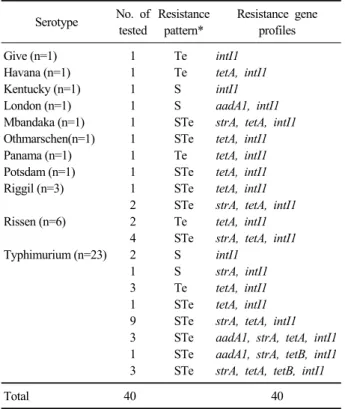
Table 8.Resistance and resistant gene profiles of Salmonella spp. for streptomycin and tetracycline
Serotype No. of tested
Resistance pattern*
Resistance gene profiles Give (n=1)
Havana (n=1) Kentucky (n=1) London (n=1) Mbandaka (n=1) Othmarschen(n=1) Panama (n=1) Potsdam (n=1) Riggil (n=3)
Rissen (n=6)
Typhimurium (n=23)
1 1 1 1 1 1 1 1 1 2 2 4 2 1 3 1 9 3 1 3
Te Te S S STe STe Te STe STe STe Te STe S S Te STe STe STe STe STe
intI1 tetA, intI1 intI1 aadA1, intI1 strA, tetA, intI1 tetA, intI1 tetA, intI1 tetA, intI1 tetA, intI1 strA, tetA, intI1 tetA, intI1 strA, tetA, intI1 intI1
strA, intI1 tetA, intI1 tetA, intI1 strA, tetA, intI1 aadA1, strA, tetA, intI1 aadA1, strA, tetB, intI1 strA, tetA, tetB, intI1
Total 40 40
*S: streptomycin, Te: tetracycline.
Fig. 4. Representative PCR amplification of tetB gene (741bp), M: 100 kb marker, lane 1: S. Habana, lane 2: S.
Mbandaka, lane 3∼6: S. Typhimurium, lane 7∼8: S.
Rissen.
Fig. 3. Representative PCR amplification of tetA gene (577bp), M: 100 kb marker, lane 1∼4: S. Typhimurium, lane 5:
S. Habana, lane 6: S. Mbandaka.
Fig. 5. Representative PCR amplification of intI1 gene (280bp), M: 100 kb marker, lane 1∼5: S. Typhimurium, lane 6:
S. Mbandaka, lane 7: S. Rissen, lane 8; S. Kentucky, lane 9: S. Give.
였다. Pezzella 등(2004)은 동물유래 58주의 다제내성 살모넬라속 균에 대한 streptomycin 및 tetracycline 내 성 관련 유전자를 검출한 결과 strA의 검출률은 84%
였으며 tetA의 검출률은 68%였다고 하였다. 이번 연 구의 결과는 이들의 결과에 비해 strA의 검출률은 다 소 낮았으며, tetA의 검출률은 유사한 수준으로 나타 났다.
Streptomycin 및 tetracycline의 약제내성유형과 내성 유전자 profile과의 관계는 Table 8에서와 같이 S.
Typhimurium 23주는 8종의 내성유전자 profile로 나타 났고, 다음으로 S. Rissen 6주는 2종의 내성유전자 profile, S. Riggil 3주는 2종의 내성유전자 profile을 나 타내었다. S. Typhimurium의 23주 중 streptomycin 및 tetracycline에 내성을 가지고, strA, tetA, intI1 profile 주가 9주(39.1%)로 가장 높게 분포하였다. 이러한 결 과는 이 등(2009b)이 S. Typhimurium 등의 약제내성 유전자 유형을 조사한 성적과 유사하였다.
Class 1 integron은 Salmonella spp.에서 가장 빈번하 게 검출되는 class이다. van Essen-Zandbergen 등(2007) 은 동물과 사람에서 분리된 살모넬라속 균 중 43%의 균주들에서 class 1 integron이 검출되었으나, 단 1%에 서만 class 2 integron이 검출되었다고 하였다. 또한, Goldstein 등(2001)은 가금류에서 분리된 살모넬라속 균 중 class 1 integron은 61.5%에서 검출되었고, class 2 integron은 4.6%에서 검출되었다고 하였다. 돼지에 서 분리된 살모넬라속 균들의 integron 분포를 살펴보 면, Gebreyes와 Thakur (2005)는 28주의 분리균주 중, 21주에서 class 1 integron이 검출되었다고 하였다. 이
번 실험의 결과에서는 intI1 유전자가 100% 검출되어 외국의 성적 및 우리나라의 이 등(2009b)의 성적보다 도 높게 나타났으며, intI2 유전자는 검출되지 않았다.
이는 균이 분리된 지역적 및 serotype에 의한 차이, 또 는 각 연구자가 사용한 primer에 의해서도 차이가 발 생한다고 추측된다.
결 론
2010년 1월에서 8월 동안 경남 중부지역의 2개 도 축장에서 출하된 소, 돼지의 분변에서 살모넬라속 균 을 분리하여 serotype 및 항균제에 대한 내성 유형을 조사하고 내성유전자 유형을 분석해 본 결과 다음과 같은 결론을 얻었다.
소와 돼지의 분변에서 분리한 살모넬라속 균의 분 리율은 총 시료 640 건에서 8.3% (53건)가 분리되었 으며 축종별로는 돼지에서 15% (48건), 소는 1.2% (5 건)에서 분리되었다.
Serogrouping 결과 group B가 소, 돼지에서 30주 (56.6%), 다음이 group C가 13주(24.5%), group E가 8 주(15.1%) 순이었다. Serotyping 결과 53주 중 13종류 의 serotype이 분리되었고, S. Typhimurium이 50.9%
(27주)으로 가장 분리율이 높았으며, S. Rissen과 S.
London이 각각 11.3% (6주), S. Reggil이 7.6% (4주)의 순으로 나타났으며 이들 4종의 serotype이 전체의 81.1%를 차지하였다. 돼지 유래군 48주는 11종으로 분류되었고 S. Typhimurium 이 24주(50%)로 가장 높 은 분포를 보였으며, 소 유래균은 5주는 3종으로 분 류되었으며 S. Typhimurium이 3주(60%)로 가장 높은 분리율을 보였다.
약제감수성시험 결과 분리균의 내성율은 strepto- mycin (60.3%), tetracycline (56%), ampicillin 및 amox- icillin (54.7%) 순이었으며 nitrofurantoin에 대해서는 내성을 나타낸 균주가 없었다.
PCR기법을 이용하여 내성 관련 유전자를 검출해 본 결과 약제 내성유전자별 균주 수는 streptomycin 내성 32주 중 5주(15.6%)에서 aadA1 유전자가 검출되 었으며 strA는 24주(75%)에서 검출되었다. Tetracycline 내성 35주 중 33주(94.3%)에서 tetA 유전자가 검출되 었으며, tetB 유전자는 4주(11.4%)에서 검출되었다. 그 리고 tetG 및 intI2 유전자는 모든 균주에서 검출되지 않았으며, intI1유전자는 모든 균주에서 검출되었다.
이상의 도축장 소, 돼지 분변에서 분리한 Salmonella 속 균의 약제내성 및 약제내성 유전자에 관한 결론은 항생제의 신중한 사용 원칙 및 수의사의 처방에 의한 사용으로 귀결된다. 따라서 농장주 및 축주들의 올바 른 항생제 사용 인식은 농장 HACCP 뿐만 아니라 도 축장 HACCP로 순환되어 최종적으로 우리 국민 건강 에 영향을 끼쳐 매우 중요하다 말할 수 있다.
참 고 문 헌
국립수의과학검역원. 2010. 축산물의 가공기준 및 성분규격.
161-182.
김상윤. 2000. 경북지역 가축에서 분리된 Salmonella속 균의 역학적 특성 및 병원성. 안동대학교 대학원 박사학위 논문. 26-27.
강호조, 손원근, 1999. 한우 사육장내 Salmonella 속균의 존재 관련요인 분석. 한국수의공중보건학회지 23(2): 121-126.
이우원, 정병열, 이강록, 이동수, 김용환, 2009a. 소와 돼지유 래 Salmonella속 균의 혈청형 및 약제 감수성. 한국가 축위생학회지 32(1): 49-59.
이우원, 정병열, 이강록, 이동수, 김용환, 2009b. 소와 돼지유 래 살모넬라속 균의 약제내성유전자의 특성에 관한 연구. 한국가축위생학회지 32(3): 227-239.
崔源弼, 李熙碩, 呂相建, 李憲俊, 鄭錫贊, 1986. 養豚場에서 살 모넬라感染症의 疫學的 硏究: I. 發生 및 汚染狀況, 血 淸型과 Salmonella typhimurium의 生物型. 大韓獸醫學 會誌 26(1): 49-59.
崔源弼, 李熙碩, 呂相建, 李憲俊, 蔡太喆, 1988. 牛, 豚에서 分 離한 Salmonella由來 R plasmid의 遺傳學的 및 分子生 物學的 性狀에 관한 硏究 I. 乳牛에서 Salmonella屬菌 의 分布狀況 및 藥劑耐性. 大韓獸醫學會誌 28(2):
331-337.
Baggesen DL, Sandvang D, Aarestrup FM. 2000. Charaterization of Salmonella enterica serovar Typhimurium DT104 iso- lated from Denmark and comparison with isolates from Europe and the United States. J Clin Mirobiol 38(4):
1581-1586.
Bauer AW, Kirby WM, Sherris JC, Turck M. 1966. Antibiotic susceptibility testing by a standardized single disk method. Am J Clin Pathol 45(4): 493-496.
Bryant MC. 1972. Antibiotics and their Laboratory control. 2nd ed. Butterworth, London. : 41-45
Chiu CH, Tang P, Chu C, Hu S, Bao Q, Yu J, Chou YY, Wang HS, Lee YS, 2005. The genome sequence of Salmonella enterica serovar Choleraesuis, a highly invasive and re- sistant zoonotic pathogen. Nucleic Acids Res 33(5):
1690-1698.
Davies RH, Dalziel R, Gibbens JC, Wilesmith JW. Ryan JM, Evans SJ, Byrne C, Paiba GA, Pascoe SJ, Teale CJ, 2004. National survey for Salmonella in pigs, cattle and
sheep at slaughter in Great Britain (1999-2000). J Appl Microbiol 96(4): 750-760.
Edrington TS, Schultz CL, Bischoff KM, Callaway TR, Looper ML, Genovese KJ, Jung YS, McReynolds JL, Anderson RC, Nisbet DJ, 2004. Antimicrobial resistance and sero- type prevalence of Salmonella isolated from dairy cattle in the southwestern United States. Microb Drug Resist 10(1): 51-56.
Edwards PR, Ewing WH. 1986. Identification of Enterobac- teriaceae. 4eds. Elsevier Science Pub. Co., New York:
17-21.
Esaki H, Morioka A, Ishhara K, Kojima A, Shiroki S, Tamura Y, Takahashi T, 2004. Antimicrobial susecptibilies of Salmonella isolated from cattle, swineand poultry (2001-2002): reprot from Japanese Veterinary Antimi- crobial Resistance Monitoring Program. J Antimicrob Chemother 53(2): 266-270.
Gahring LC, Heffron F, Finlay BB, Falkow S, 1990. Invasion and replication of Salmonella typhimurium in animal cells.
Infect Immun 58(2): 443-448.
Gebreyes WA, Thakur S, Davies PR, Funk JA, Altier C, 2004.
Trends in antimicrobial resistance, phage types and in- tegrons among Salmonella serotypes from pigs, 1997-2000. J Antimicrob Chemother 53(6): 997-1003.
Gebreyes WA, Thakur S. 2005. Multidrug-resistant Salmonella enterica serovar Muenchen from pigs and humans and potential interserovar transfer of antimicrobial resistance.
Antimicrob Agents Chemother 49(2): 503-511.
Goldstein C, Lee MD, Sanchez S, Hudson C, Phillips B, Register B, Grady M, Liebert C, Summers AO, White DG, Maurer JJ, 2001. Incidence of class 1 and 2 integrases in clinical and commensal bacteria from livesock, com- panion animals, and exotics. Antimicro Agents Chemo- ther 45(3): 723-736.
Leverstein-Van Hall MA, Paauw A, Box AT, Blok HE, Verhoef J, Fluit AC. 2002. Presence of integron-associated resist- ance in the community is widespread and contributes to multidrug resistance in the hospital. J Clin Microbiol 40(8): 3038-3040.
Kwang J, Littledike ET, Keen JE. 1996. Use of the polymerase chain reaction for Salmonella detection. Lett Appl Microbiol 22(1): 46-51.
Madsen L, Aarestrup FM, Olsen JE. 2000. Characterisation of streptomycin resistance determinants in Danish isolates of Salmonella Typhimurium. Vet Microbiol 3;75(1):
73-82.
Molorny B, Schoreter A, Bunge C, Hoog B, Steinbeck A, Helmuth R. 2001. Evaluation of Molecular typing meth- ods for Salmonella enterica serovar Tyhimurium DT 104 isolated in Germany from healthy pigs. Vet Res 32(2): 119-129.
National Committe for Clinical Laboratory Standards. 2002.
Performance standards for antimicrobial discs and dilu- tion susceptibility test for bacteria isolated from animals - second edtion : Approved standards M32-A2. NCCLS, Villanova, PA, USA.
Nemergut DR, Robeson MS, Kysela RF, Martin AP, Schmidt SK, Knight R. 2008. Insights and inferences about integron evolution from genomic data. BMC Genomics 31:9:261.
Pezzella C, Ricci A, DiGiannatale E, Luzzi I, Carattoli A. 2004.
Tetracycline and streptomycin resistance genes, trans- posons, and plasmid in Salmonella enterica isolates from animals in Italy. Antimicrob Agents Chemother 48(3):
903-908.
Randall LP. Cooles SW, Osborn MK, Piddock LJ, Woodward MJ. 2004. Antibiotic resistance genes, integrons and multiple antibiotic resistance in thirty five serotypes of Salmonella enterica isolated from humans and animals in the UK. J Antimicrob Chemother 53(2): 208-216.
Sato G, Kodama H. 1974. Appearance of R-factor-mediated drug resistance in Salmonella Typhimurium excreted by car- rier calves on a feedlot. Jpn J Vet Res 22(3): 72-79.
Swanenbrug M, Urlings HA, Snijders JM, Keuzenkamp DA, van Knapen F. 2001. Salmonella in slaughter pigs: preva- lence, serotypes and critical control points during slaughter in two slaughterhouses. Int J Food Microbiol 70(3): 243-254.
Tuchili LM, Kodama H, Sharma RN, Takatori I, Pandey GS, Kabilika S, Mukamoto M, Tsuji S, Baba T. 1996.
Detection of Salmonella DNA in chicken embryos and environmental samples by polymerase chain reaction. J Vet Med Sci 58(9): 881-884.
van Duijkeren EV, Wannet WJ, Houwers DJ, van Pelt W, 2002.
Serotype and phage type distribution of Salmonella strains isolated from humans, cattle, pigs, and chickens in the Netherlands from 1984 to 2001. J Clin Microbiol 40(11): 3980-3985.
van Essen-Zandbergen A, Smith H, Veldman K, Mevius D. 2007.
Occurrence and characteristics of class 1, 2, and 3 in- tegrons in Escherichia coli, Salmonella and Campylo- bacter spp. in the Netherlands. J Antimicrob Chemother 59(4): 746-750.