1. Introduction
National health promotion act had enacted and been carried out since 1995 as an aggressive political correspondence to the increasing pub- lic health needs and as a public health assurance plan. From this institutional establishment that could consolidate public health promotion in national level, social needs and roles of a dental hygienist is emphasized1)and needs for profes- sional healthcare workers for providing higher- quality dental health service is increasing.
Dental hygienist must pass the national den- tal hygienist exam enforced under the provision of the 4th Medical technicians, etc. act and obtain a licence from the Health, Welfare and Family affairs Minister, and the importance of this role as the only human resources that shares oral cure of the public is rising. Korea's
first batch of the dental hygienist came out in 1971 with 11 licensed professionals2), but as of 2003, there are 21,381 dental hygienists with 2,810 enrollment in the faculty of dental hygiene of 35 universities3). Since the health care sector is known to be labor intensive, with 2/3 of the sector is composed of labor force4), it is most rational to produce highly qualified dental hygienists in order to create high quality oral care and health service.
Recently, as interest of the public in the national exam that examines the quality of a dental hygienist is increasing, a call for improvement on subjects and system of the national exam for dental hygienist is gaining momentum. Previous studies done on the national exams include conference of training and application of dental hygienist and dental health education development5), symposium for 한국치위생교육학회지 : 제10권 제2호, 2010 J Korean Acad Dental Hygiene Education Vol. 10, No. 2, 2010
A study on improvement for national examination of dental hygienists in Korea
Young-Ok Nam・Sun-Hee Jang・Seon-Yeong Kim
1Wonkwang Health Science University, Chunnam Techno College1
key words : national health promotion act, oral health cure human resources, health cure services, comprehensive dental hygiene management
연락처 : 남용옥 우) 570-750 전북 익산시 신용동 원광보건대학 치위생과 전화 : 063-840-1261 전송 : 840-1269 E-mail: [email protected] 접수일-2010. 01. 20 수정일-2010. 04. 25 게재확정일-2010. 04. 25 본 논문은 2009년도 원광보건대학 학술연구비지원에 의해 수행되었음
the development of the national exam for public health worker6 ), studies on problems and improvements of the current national exam7), and groping for development direction of the national exam for public health worker8), but case studies are extremely small in quantity.
Also, in order to improve the national exam sys- tem, basic understanding in current educational ideology and curriculum of a dental hygienist is required. Therefore studies such as analysis of current college dental hygienist curriculum9), dental hygienist role focused dental hygiene faculty curriculum model development study10), study on college dental hygiene faculty curricu- lum improvement and correction11), exploring for the dental hygienist role focused dental hygiene faculty curriculum model development12), and oriented direction of the school practices and clinical practices education program of dental hygiene faculty13)are used to analyze curriculums of faculty of dental hygiene in Korea and models for curriculum are continuously presented through comparative analysis with curriculums foreign countries.
However, increased enrollment of competi- tively established new faculties of dental hygiene in colleges brings concern about deteri- orating quality of dental hygienists, and the four year dental hygienist curriculum instituted in 2002 does not show any distinguishing fea- tures from the previous curriculum. Thus, refor- mation of dental hygiene curriculum is a neces- sity to amend and correct these problems so to create professional skill practice opportunities for dental hygienists. In addition, since an improvement of curriculum cannot exclude the
relations with the national exam in current Korean environment, without a rational improvement of the national exam system including the execution of the national exam, subjects and its range, content, banking ques- tionnaires, improvement of the education can- not be done. Also, comparative analysis with the U.S.A. and Canada, where professionality of dental hygienists are approved and curriculum is accepted to be the top of the world, will yield many advisable improvement ideas.
Therefore, this analysis will grasp the prob- lems of the current national dental hygienist exam system and provide basic data for future dental hygiene curriculum improvement from comparing Canada's national exam system, which is advanced than Korea's system, in order to provide improvements for advance dental hygiene education through a rational reformation of the national dental hygienist exam.
2. Study subject and method
2.1. Study subject
The investigator has carried out a conve- nience sampling on the population composed of participants of the national exam and professors who work for dental hygiene education and health facilities in the country, surveyed for 15 days, from June 9th of 2008 to June 23rd of 2008, by using fax and email. Total of 172 survey papers were retrieved and 160 results, exclud- ing dishonest results, were used as the total research data for this study. Based on the public
opinion from the collected survey data, possible improvements of the current national dental hygienist exam have been reviewed and provid- ed improvements of the national exam using the data of the Canadian national dental hygienist exam.
2.2. Study method
This study used the survey paper as a tool, and questionnaires about the national exam was prepared by the investigator based on the stud- ies of Hyuk-soo Moon14)and Young-soon Park15). Survey contents were composed of 13 ques- tions, including 3 questions on common charac- teristics related questions, 3 questions on the subjects of the national exam, 1 question on the educational goal of the national exam, 3 ques- tions on the question types of the national exam, 2 questions on the validity of the national exam, and 1 question on the necessity of the teacher's training of the national exam.
National Dental Hygiene Certification Examination Application Guide 200016) and National Board Dental Hygiene Examination Candidate Guide 200017)were used as refer- enced to compare with the subjects of the Korean national exam.
SPSS statistics program(Version 11.0) was used to analyze the collected data, Chi-square test and percentage were used as the analysis technique, and examinations were done with Fisher's Exact Test.
3. Study result
3.1. Survey research
3.1.1. Common characteristics of survey subjects
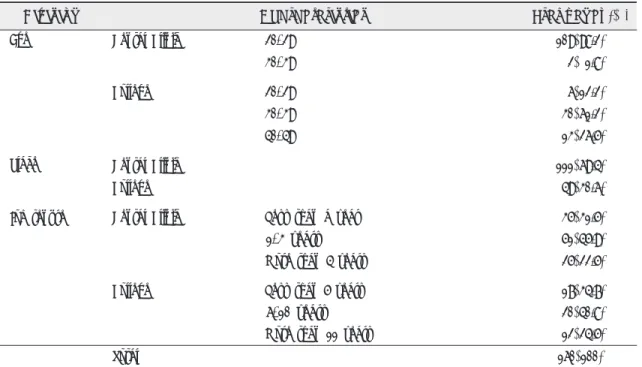
Distribution of the subjects based on the com- mon characteristics showed 30.6% of college professor and 69.4% of the dental hygienist in Dental Clinic. Since the survey was targeted for recent national exam participants thus limiting the job tenure under 5 years, job tenure of less than 1 year was 31.5%, more than 1 year but less than 3 years was 45.9%, and more than 4 years was 22.5% of the subjects employed in Dental Clinic. Age distribution showed 98.2% in 20~29 year old group. For college professors, job tenure of more than 6 years but less than 10 years was 40.8%, less than 6 years was 34.7%, and more than 11 years was 24.5%. Age distrib- ution showed 30~39 year old group the largest with 61.2%, with 40~49 year old 26.5% and 20~29 year old 12.2% following behind respec- tively.
3.1.2. Adequacy and necessity of subject adjustments for the current national exam
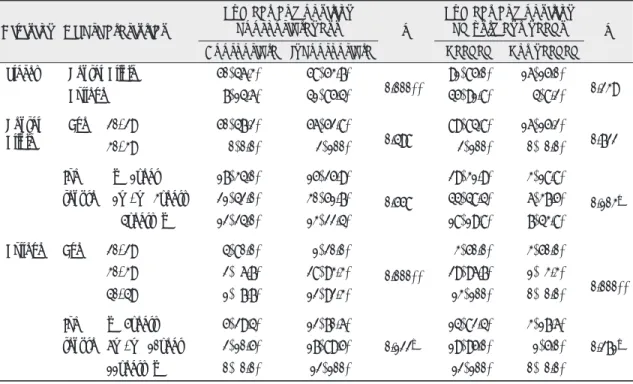
While dental hygienists employed in Dental Clinic exhibited similar opinions regarding the questions on the adequacy of the subject com- position of the current national exam with 46.3% in "adequate" and 53.7% in "inadequate,"
85.4% of the college employees answered "inad- equate," showing statistically relevant distinc- tion(p=0.000), exhibit problems within the sub- ject compositions of the national exam.
Especially, 93.3% of the 30~39 year old age group of the college employees showed "inade- quate," showing statistically relevant distinc- tion(p=0.000) than other age groups, shows that college employees with age older than 30 and longer job tenure were feeling problems of the subject compositions of the exam. Regarding the necessity of the subject adjustments, 91.8%
of the college employees and 85% of the med- ical facility employees answered "adjustment needed," showing no distinctive opinion differ- ences between two groups. However, 96.7% of the 30~39 year old age group of the college employees answered "necessary," showing sta- tistically relevant distinction(P=0.000), shows that aged and longer tenured college employees feel the necessity of subjects adjustment than other groups.
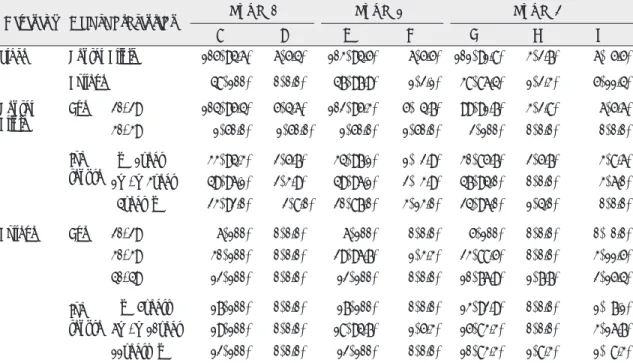
3.1.3. Distributions of types of national dental hygienist exam questions Regarding the questions on the distributions of types of national dental hygienist exam ques- tions, 100% of the college employees and 94.6%
of medical workers answered were focused on text books when only 5.4% of the subjects answered were focused on practices. 97.9% and 94.5% of the subjects answered that most ques- tions were fragmented questions on individual subjects, all subjects giving similar answers regardless of age groups and job tenures. Only 2.1% of the college employees and 5.5% of med- ical workers answered that there were many overall practical situations solving problems.
Subjects who answered that there were many memorization and analysis questions were 86.4% of the college employees and 91.8% of the medical workers, subjects who answered that
Division Characteristics Frequency(%)
Age Dental Clinic 20-29 109(98.2)
30-39 2( 1.8)
College 20-29 6(12.2)
30-39 30(61.2)
40-49 13(26.5)
Place Dental Clinic 111(69.4)
College 49(30.6)
Job tenure Dental Clinic Less than a year 35(31.5)
1-3 years 51(45.9)
More than 4 years 25(22.5)
College Less than 5 years 17(34.7)
6-10 years 20(40.8)
More than 11 years 12(24.5)
Total 160(100)
Table 1. Common characteristics of respondents
there were many questions for testing memo- rization, analysis, and problem solving abilities at the same time were 11.4% of the college employees and 5.5% of the medical workers, and subjects who answered that there were many questions for testing problem solving abilities were 2.3% of the college employees and 2.7% of the medical workers.
3.1.4. Difficulty and demand for expertise in the national dental hygienist exam Regarding the question that asked whether the current range of the national exam demands expertise from participants, only 2.0% of the col- lege employees and 7.3% of the medical work- ers answered "yes," 71.4% of the college
employees and 67.9% of the medical workers answered "somewhat," making it the highest distribution, and 26.5% of the college employees and 24.8% of the medical workers answered
"not at all.“ For the college employees, older age groups answered the exam does not demand expertise, and 33.3% the job tenure group of 11 or more years answered the exam does not demand expertise. Regarding the question that asked about the overall difficulty of the national exam, 61.7% of the college employees and 45.5%
of the medical workers answered "appropriate,"
and older the age and longer the job tenure, it was likely for subjects to answer "inappropri- ate" for the question.
Division Characteristics
Subject composition
appropriateness p
Subject composition adjustment needs p Appropriate Inappropriate Needed Not needed Places Dental Clinic 50(46.3) 58(53.7)
0.000**
91(85.0) 16(15.0)
0.239
College 7(14.6) 41(85.4) 45(91.8) 4(8.2)
Dental Age 20-29 50(47.2) 56(52.8)
0.498
89(84.8) 16(15.2)
0.722
Clinic 30-39 0(0.0) 2(100) 2(100) 0( 0.0)
Job < 1year 17(34.0) 15(25.9)
0.558
29(31.9) 3(18.8)
0.103†
tenure 1≤-≤ 3years 21(42.0) 30(51.7) 44(48.4) 6(37.5)
4years < 12(24.0) 13(22.4) 18(19.8) 7(43.8)
College Age 20-29 4(80.0) 1(20.0)
0.000**
3(50.0) 3(50.0)
0.000**
30-39 2( 6.7) 28(93.3) 29(96.7) 1( 3.3)
40-49 1( 7.7) 12(92.3) 13(100) 0( 0.0)
Job tenure
< 5years 5(29.4) 12(70.6)
0.122†
14(82.4) 3(17.6)
0.271†
6≤-≤ 10year 2(10.5) 17(89.5) 19(95.0) 1(5.0)
11years < 0( 0.0) 12(100) 12(100) 0( 0.0)
Table 2. Subject composition appropriateness and subject composition adjustment need based on common characteristics
*: p<0.05, by chi-square test
**: p<0.01, by chi-square test
†: Fisher's Exact Test
Division Characteristics Type 1 Type 2 Type 3
A B C D E F G
Place Dental Clinic 105(94.6) 6(5.4) 103(94.5) 6(5.5) 101(91.8) 3(2.7) 6( 5.5) College 48(100) 0(0.0) 47(97.9) 1(2.1) 38(86.4) 1(2.3) 5(11.4) Dental
Clinic
Age 20-29 104(95.4) 5(4.6) 102(95.3) 5( 4.7) 99(91.7) 3(2.8) 6(5.6) 30-39 1(50.0) 1(50.0) 1(50.0) 1(50.0) 2(100) 0(0.0) 0(0.0) Job
tenure
< 1year 33(94.3) 2(5.7) 34(97.1) 1( 2.9) 30(85.7) 2(5.7) 3(8.6) 1≤-≤3year 49(96.1) 2(3.9) 49(96.1) 2( 3.9) 47(94.0) 0(0.0) 3(6.0) 4year < 23(92.0) 2(8.0) 20(87.0) 3(13.0) 24(96.0) 1(4.0) 0(0.0) College Age 20-29 6(100) 0(0.0) 6(100) 0(0.0) 5(100) 0(0.0) 0( 0.0) 30-39 30(100) 0(0.0) 29(96.7) 1(3.3) 23(88.5) 0(0.0) 3(11.5) 40-49 12(100) 0(0.0) 12(100) 0(0.0) 10(76.9) 1(7.7) 2(15.4) Job
tenure
< 5years 17(100) 0(0.0) 17(100) 0(0.0) 13(92.9) 0(0.0) 1( 7.1) 6≤-≤10year 19(100) 0(0.0) 18(94.7) 1(5.3) 15(83.3) 0(0.0) 3(16.7) 11years < 12(100) 0(0.0) 12(100) 0(0.0) 10(83.3) 1(8.3) 1( 8.3) Table 3. Distribution of the national dental hygienists exam question types
A - Many text book focused questions B - Many practice focused questions
C - Many fragmented questions on different subjects
D - Many comprehensive practical situation problem solving questions E - Many memorization and analysis questions
F - Many problem solving skill questions
G - Many questions evaluating memorization, analysis, and problem solving skills simultaneously
Division Characteristics National exam difficulty National exam expertise demand Appropriate Inappropriate Demands Somewhat Not at all
Place Dental Clinic 50(45.5) 60(54.5) 8(7.3) 74(67.9) 27(24.8)
College 29(61.7) 18(38.3) 1(2.0) 35(71.4) 13(26.5)
Dental Clinic
Age 20-29 50(46.3) 58(53.7) 8(7.5) 72(67.3) 27(25.2)
30-39 0( 0.0) 2(100) 0(0.0) 2(100) 0( 0.0)
Job < 1year 13(38.2) 21(61.8) 5(14.7) 20(58.8) 9(26.5)
tenure 1≤-≤3year 27(52.9) 24(47.1) 3(6.0) 37(74.0) 10(20.0)
4year < 10(40.0) 15(60.0) 0(0.0) 17(68.0) 8(32.0)
College Age 20-29 4(80.0) 1(20.0) 0(0.0) 5(83.3) 1(16.7)
30-39 18(62.1) 11(37.9) 1(3.3) 22(73.3) 7(23.3)
40-49 7(53.8) 6(46.2) 0(0.0) 8(61.5) 5(38.5)
Job < 5years 9(60.0) 6(40.0) 1(5.9) 11(64.7) 5(29.4)
tenure 6≤-≤10year 13(65.0) 7(35.0) 0(0.0) 16(80.0) 4(20.0)
11years < 7(58.3) 5(41.7) 0(0.0) 8(66.7) 4(33.3)
Table 4. Difficulty and expertise demand of the national dental hygienists exam
3.1.5. Priorities for the national exam sub- ject adjustment
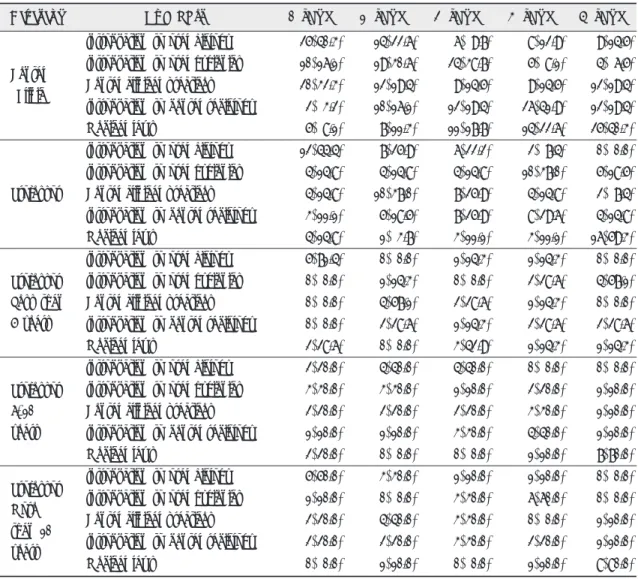
In priorities for the national exam subject adjustment, 40.3% of the dental hygienists in Dental Clinic picked introduction to oral biolo- gy as the first, 32.3% for dental clinical practices, 16.1% for introduction to oral hygienics, 8.1%
for medical laws, and 3.2% for dental radiology.
44.4% of the college employees picked introduc- tion to oral biology as well, 14.8% for introduc- tion to oral hygienics, 14.8% for dental clinical practices, 14.8% for medical laws, and 11.1% for dental radiology. By reviewing this data with job tenure of the subjects, 71.4% of the group with less than 5 years and 50.5% of the group with more than 11 years showed for introduc- tion to oral biology, making it the subject that needs most adjustment. However, 30.0% of the group with more than 6 years and less than 10 years picked introduction to oral hygienics.
Therefore, regardless of employment, introduc- tion to oral biology was shown to be the sub- jects that needs most adjustment.
Table 5. Adjustment required subject list of the national exam according to job tenures of health workers and professors
3.2. Comparisons of the subjects of the Korean national dental hygienist exam and the Canadian national dental hygienist exam
3.2.1. Korean national dental hygienist exam
The national dental hygienist exam is enacted by the Medical technicians, etc. act to be held every year, and is carried out by the secretary of
the ministry of health and welfare as the direc- tor of the national exam. Test subjects are divid- ed into a written examination composed of 200 questions in 5 subjects and a practical(skill) examination composed of 2 questions of practi- cal test. In order to pass the exam, 60% of over- all average and 40% of subject average of the written examination and 60% total score in the practical examination are required. This nation- al exam carried out separately in different regions of the country.(Article 9 of enforcement regulation of Medical technicians, etc. act)
3.2.2. Canadian national dental hygienist exam
The current Canadian national dental hygien- ist exam is divided into a written examination and a practical examination. The canadian national exam is composed of contents and for- mat that is are similar to the U.S. national dental hygienist exam. National Board of Dental Hygiene Examination divided the exam into Components A that contains 350 multiple- choice test item on overall theoretical knowl- edge of various subjects, and Component B that tests the practical application ability.
Component A, just like the written examination part of the Korean's, evaluates theoretical knowledge of participants through 200 ques- tions, and is divided into 3 major sections that cover scientific basis for dental hygiene practice, provision of clinical dental hygiene services and community health activities. On these subjects, 5% includes behavior and other 5% include morality(ethics) of the profession. Component B can be seen as the practical examination part of
the Korean exam, but the format and the con- tents are very different.
While the practical examination part of the Korean national exam evaluates the overall den- tal hygiene management ability of participants through scaling alone, the Canadian national exam evaluates participants by organizing 150 case questions from 12~15 case reports of dental hygiene patients (including adult periodontal
patients, elderly patients, special patients, gen- eral disease patients, and children) selected and presenting 12~15 problems per patient selected, occasionally after providing information such as intraoral and extraoral photographs. Scoring more than 75 in both Component A and B will pass the exam. Certain provinces allowed par- ticipants who scored less than 75 in one section of the exam to re-test the failed section, and
Division Subjects 1 rank 2 rank 3 rank 4 rank 5 rank
Dental Clinic
Introduction to oral biology 25(40.3) 14(22.6) 6( 9.7) 8(12.9) 9(14.5) Introduction to oral hygienics 10(16.1) 19(30.6) 24(38.7) 5( 8.1) 4( 6.5) Dental clinical practices 20(32.3) 12(19.4) 9(14.5) 9(14.5) 12(19.4) Introduction to dental radiology 2( 3.2) 10(16.1) 12(19.4) 26(41.9) 12(19.4)
Medical laws 5( 8.1) 7(11.3) 11(17.7) 14(22.6) 25(40.3)
Professor
Introduction to oral biology 12(44.4) 7(25.9) 6(22.2) 2( 7.4) 0( 0.0) Introduction to oral hygienics 4(14.8) 4(14.8) 4(14.8) 10(37.0) 5(18.5) Dental clinical practices 4(14.8) 10(37.0) 7(25.9) 4(14.8) 2( 7.4) Introduction to dental radiology 3(11.1) 5(18.5) 7(25.9) 8(29.6) 4(14.8)
Medical laws 4(14.8) 1( 3.7) 3(11.1) 3(11.1) 16(59.3)
Professor Less than 5 years
Introduction to oral biology 5(71.4) 0( 0.0) 1(14.3) 1(14.3) 0( 0.0) Introduction to oral hygienics 0( 0.0) 1(14.3) 0( 0.0) 2(28.6) 4(57.1) Dental clinical practices 0( 0.0) 4(57.1) 2(28.6) 1(14.3) 0( 0.0) Introduction to dental radiology 0( 0.0) 2(28.6) 1(14.3) 2(28.6) 2(28.6)
Medical laws 2(28.6) 0( 0.0) 3(42.9) 1(14.3) 1(14.3)
Professor 6-10 years
Introduction to oral biology 2(20.0) 4(40.0) 4(40.0) 0( 0.0) 0( 0.0) Introduction to oral hygienics 3(30.0) 3(30.0) 1(10.0) 2(20.0) 1(10.0) Dental clinical practices 2(20.0) 2(20.0) 2(20.0) 3(30.0) 1(10.0) Introduction to dental radiology 1(10.0) 1(10.0) 3(30.0) 4(40.0) 1(10.0)
Medical laws 2(20.0) 0( 0.0) 0( 0.0) 1(10.0) 7(70.0)
Professor More than 10 years
Introduction to oral biology 5(50.0) 3(30.0) 1(10.0) 1(10.0) 0( 0.0) Introduction to oral hygienics 1(10.0) 0( 0.0) 3(30.0) 6(60.0) 0( 0.0) Dental clinical practices 2(20.0) 4(40.0) 3(30.0) 0( 0.0) 1(10.0) Introduction to dental radiology 2(20.0) 2(20.0) 3(30.0) 2(20.0) 1(10.0)
Medical laws 0( 0.0) 1(10.0) 0( 0.0) 1(10.0) 8(80.0)
Table 5. Adjustment required subject list of the national exam according to job tenures of health workers and professors
demand reeducation if participants fail more than twice. However, this differs according to the provinces.
Table 6. Number of questions per subjects of Canadian national exam (Component A)
4. Colligation and device
According to the article 6 of the Medical tech- nicians, etc. act, the national dental hygienist exam is an national exam that judges abilities of a dental hygienist as an employee of oral dis- ease prevention and a collaborator in dental care services in order to protect and promote
public health by the state, and it evaluates the knowledge and skill of dental hygiene and health care related regulations18). The basis for passing the examination of the dental hygienist is the test score.
Since the current national exam has fixed number of subjects and number of questions, it seems a regular standard is arranged, but reviewing the contents and the quality of the exam exhibited many points that need to be improved. Changes in the role of dental hygien- ists in Korea appear to be very different and unlike dental hygienist of the U.S. and Canada, where dental hygienists hold a firm position as preventative professionals in dental care. It is
Field Subject Number
of questions SCIENTIFIC BASIS FOR DENTAL
HYGIENE PRACTICE(60)
Anatomic science 17
Physiolgy 5
Biochemistry and Nutrition 6
Microbiology and Immunology 10
Pathology 12
Pharmacology 10
PROVISION OF CLINICAL DENTAL HYGIENE SERViCES(120)
Assessing Patient Characteristics 23
Obtaining and Interpreting Radiographs 19 Planning and Managing Dental Hygiene Care 30
Performing Periodontal Procedures 27
Using Preventive Agents 12
Providing Supportive Treatment Services 9 COMMUNITY HEALTH /
RESEARCH PRINCIPLES(20)
Promoting Health and Preventing Disease Within Groups 4
Participating in Community Programs 8
Analyzing Scientific Literature, Understanding Statistical 8 Concepts, and Applying Research Results
Total 200
Table 6. Number of questions per subjects of Canadian national exam (Component A)
not an exaggeration to say that the American dental hygiene education curriculum, which is the originating country for the education sys- tem and education contents for the field, is pro- ducing modified Korean styled dental hygien- ists. It is necessary to review dental hygienist education system of Korea and re-think how much of the overall dental hygiene manage- ment ability of dental hygienist is evaluated by the national dental hygienist exam. It is impor- tant to know that an improvement of the national exam system that authorizes partici- pants of practice licenses, such as dental hygien- ist exam, will improve the overall quality of dental hygienists. In order to improve the quali- ty of dental hygiene education, evaluation of how the factors of the exam such as demanded standard, test courses, contents range, test area, difficulty, the distinction of participants levels, and accuracy of grading are appropriately used in the exam must be done before. However, since this evaluation is not carried out currently, it can not positively affect the quality of educa- tion for the dental hygienist. Problems of the current national dental hygienist exam and the state policy subject problem have been already pointed out by the national board of examin- ers's report in 19987), and 84.8% of the partici- pants of the survey report of dental hygienic professors regarding the evaluation ability of quality of dental hygienists by the national exam answered that the exam is not performing to its fullest ability to evaluate the quality5). The survey research done on this study showed that 85.4% of the college employees and 53.7% of the medical workers answered "subject composition
is inappropriate," and 91.8% and 85.0%
answered "subject composition adjustment required," showing that the biggest problem of the current national exam is the inappropriate- ness of the subject composition. The biggest rea- son for the inappropriateness was "there are too many subjects in the exam," and other reasons such as "relation to practices is too little," "distri- bution of subjects and marks is inappropriate,"
"there are unnecessary subjects," and "too many basic subjects" showed the problems similar to the previous study results. The comparison between the Canadian national exam clarifies this point too. First of all, the Korean national dental hygienist exam is not composed of sub- jects that can train professional dental hygienist, but is similar to the national dentist exam, mak- ing is problematic to evaluate the performance ability of the professional role of dental hygien- ists. Out of 200 questions of the Canadian national exam, 120 questions are for the provi- sion of clinical dental hygiene services to evalu- ate the professionalism of the dental hygienist, and the contents of the questions are composed of evaluation of patient characteristics, pho- tographing and analyzing dental radiograph, planning and execution of dental hygiene man- agement, execution of the periodontal process, use of preventative measures, and other con- tents related to supporting treatment services.
However, according to the Korean national exam, only two sections, dental preventive mea- sures and scaling, of the related subject, field of introduction to oral hygienics, as oral hygiene management(40 questions), and even the con- tents of the practical questions are limited to
evaluate theoretical parts of the subjects, show- ing drastic differences with the U.S. and Canadian national exams that define, train, and evaluate dental hygienics as a professional posi- tion. This seems to be the biggest problem of the current dental hygienics education, and the rea- son why Korean dental hygienists do not hold professional position. In the public oral health studies section, the Korean exam allotted 40 questions divided into local community oral health, oral health administration, oral health statistics, and oral health education, while the Canadian exam allotted 20 questions for the basic principles of community health and refer- ence analysis and investigation. This difference could not be simply compared due to drastic differences in contents. The section that evalu- ates the basic principles through reference analysis is not conducted in Korean dental hygienics, which can create problems following the current trend of dental hygienics and new dental hygiene technique. Also, a comparison of the dental clinical practice was impossible as it is not selected as the exam subject in the U.S.
and Canada.
As pointed out above, it had been a mistake to include such a different subject, which is a subject for dentists, into the national exam for dental hygienists. Therefore, the Korean nation- al exam exhibits a drastic difference with the Canadian exam in the education curriculum.
The study has found that the introduction to oral biology as the first and the dental clinical practice as the second in the list of subjects that need to be adjusted urgently, but instead the Canadian national exam allotted 60 questions,
which is larger than the Korean exam, on the basic subjects for dental hygiene practice, and the subjects were composed of anatomical sci- ence(anatomy, histology, embryology), physiol- ogy, biochemistry, dietetics, microbiology, immunology, pathology, and pharmacology, which is larger than the Korean exam subjects composed of oral anatomy, tooth morphology, oral histology, oral pathology, and oral physiol- ogy. Also, the dental clinical practice section is irrelevant to the professional role of dental hygienists and not tested in the U.S. and Canadian national exam, and therefore is con- sidered to be abolished in the future. The study has indicated the introduction to oral biology to be the subject that needs to be adjusted urgent- ly, but the comparison with the Canadian national exam subjects has shown that it is more important to adjust the dental clinical practice and the introduction to oral hygienics; thus not only the subject composition of the exam, but the contents and the format of the current Korean national exam must be reformed in order to properly evaluate the execution of the overall dental hygienic process. The current dif- ficulty of the national exam deemed to be appropriate, but since the Canadian national exam focuses more on the practical problem solving questions, an adjustment of the question type distribution is needed to focus more on the practical approach to the problems in order to recognize the professionalism of dental hygien- ists. In addition, as it is shown that the current national dental hygienist exam does not evalu- ate the overall dental hygiene operation processes but evaluates participants based on
exam subjects, this problem must be fixed in near future. This establishment of the national exam subjects and evaluation must be founded on the primary and basic understanding of the education ideology and the education curricu- lum. However, the survey was carried out before informing the participants of this under- standing, there has been a limit in the analysis of this section of the research and must be improved upon in the future study. Also in order for studies on improvement and reforma- tion of the current national dental hygienists exam to be conducted more effectively and in- depth, studies on the current dental hygienics curriculum should be carried out together. The dental hygienics education curriculum used until now had been developed by the dental hygienics majors, but in order to improve and fix the problems, a cooperative project between curriculum specialists and professional educa- tion curriculum developers is required. At the same time, the dental hygienics curriculum and the improvement of the national exam must operate in conjunction for dental hygienists to adapt to the field, to secure the professionalism, and to strengthen the role in the field.
5. Conclusion
The summary of the study is as follows.
1. The result of the survey research for the improving the Korean national dental hygien- ists exam system showed the subject compo- sitions of the national exam deemed inappro- priate and require urgent adjustment. The
need for adjustment had been strongly exhib- ited by college employees, and older and longer the job tenure showed stronger need.
2. Most of the national dental hygienists exam question types were composed of fragmented memorization questions of different subjects, but the difficulty was appropriate and seemed professional.
3. The subject adjustment priority list of the national exams was composed in the order of the introduction to oral biology, the dental clinical practice, the introduction to oral hygienics, the medical laws, and the introduc- tion to dental radiology, but the comparison with the Canadian national exam showed the dental clinical practice and the introduction to oral hygienics were in need for adjustment.
4. Formats of the Canadian and Korean national exams were similar, but the subject composi- tions and the contents were drastically differ- ent.
5. Compared to the Canadian national exam, the Korean national exam was shown to be diffi- cult in evaluating the overall dental hygiene management ability, resulting an urgent improvement in the current national dental hygienists exam.
References
1. In-sik Kim, Ho-sung Choi, Hyun-suk Kwon, Development theory for dental hygienists training curriculum. Seoul: Education Science Corp. 2000. page 2.
2. Young-kyung Kim, Study on training dental hygienists resources[Masters degree paper]
Danguk University Public Administration Grad School. 2000.
3. Bu-wul Kang and others. Introduction to den- tal hygienics. Seoul: Chunggu house. 2003.
Page 25
4. Alan L・ orkin, Health Manpower. An Economic Perpective, Lexington, Mass. D.C.
Health & Co .1978. Page 1.
5. Public Oral Health Institute. Conference of training and application of dental hygienist and dental health education development.
Seoul: Gomunsa. 1990
6. Hyuk-soo Moon. 21st century Korea Oral Health Manpower Management. Symposium for the development of the national exam for public health worker. Seoul:Daehan Dentist Association. 1997;11-15
7. Study report 98-1. Studies on problems and improvements of the current national exam.
Seoul:Korea Health Worker National Exam Center. 1998;171-184
8. Korea Health Worker National Exam Center.
Groping for development direction of the national exam for public health worker : Practical test evaluation. Seoul: Korea Health Worker National Exam Center. 2003;73-96 9. Hyun-suk Kwon. Analysis of current college
faculty of dental hygienics curriculum
[Masters degree paper]. Kyungnam:
Kyungnam University Grad School. 1995 10. Suk-hyang Kim. Dental hygienist focused
dental hygiene faculty curriculum model development study[Post doc degree paper].
Danguk University Grad School. 1997 11. Se-won Oh, Man-tae Jung, Min-jung Cho.
Study on college dental hygiene faculty cur- riculum improvement and correction.
Kwangju Health College Paper Collection.
1989;14:285-321
12. Mi-young Hwang. Exploring for dental hygienist role focused dental hygiene faculty curriculum model development[Post doc degree paper]. Seoul: Sungshin Women's University Grad School. 2002
13. Kye-won Jang. Oriented direction of school practices and clinical practices education program of dental hygiene faculty[Masters degree paper]. Kyungsan University Education Grad School. 2001
14. Hyuk-soo Moon. National dentist exam management status. National dentist exam development conference. Seoul: Daehan Dentist Association. 1998;21-30
15. Young-soon Park, Jun-chul Park, Byung-kyu Yu. Study on improvement of national radi- ology exam. Daehan Radiologist Paper.
1998;33-43, 74-75
16. National Dental Hygiene Certification Board. Application Guide 2000. Orleans:
National Dental Hygiene Certification Board. 2000;7-16.
17. National Dental Examinations American Dental Association. National Board Dental Hygiene Examination Candidate Guide.
Chicago:America Dental Association. 2000;3- 4, 27-28.
18. Article 3 of enforcement of the Medical tech- nicians, etc. act
목
목적적 :: 현재 우리 사회는 건강증진에 대한 욕구가 증가함에 따라 보건의료에서 질적 서비스향상이 요구
되고 있고, 구강진료를 분담하는 치과위생사들도 보다 전문적인 역할을 수행하기 위해서는 지식과 기술 의 수준향상이 필요하다. 이에 치과위생사의 질적 수준을 향상시키는 데 가장 빠르고 효과적인 방법이 국가시험제도이며 국가시험에서의 타당성과 신뢰성을 높이고 필요한 과목과 내용을 직무를 중심으로 조 정한다면 가장 좋은 방법이라고 사료되어 현행 우리나라 치과위생사 국가시험제도에 따른 문제점을 파 악하고 캐나다 국가시험 제도와의 비교를 통해 문제점을 분석하고 이에 따른 개선책을 알아보았다.
방
방법법 :: 전국 치과위생사 교육기관에 근무하는 교수와 의료기관에 종사하는 치과위생사 중에서 최근 국가
시험 응시경험자를 대상으로 2008년 6월 9일부터 6월 23일까지 설문조사를 실시하였으며 E-mail 과 Fax를 이용하였다. 캐나다 국가시험제도는 National Dental Examinations American Dental Association. National Board Dental Hygiene Examination Candidate Guide자료를 사용하여 비교하였다. 자료의 분석은 SPSS통계프로그램(Version 11.0)을 이용, Chi-square 검정을 하였으며, Fisher's Exact Test에 의한 검정을 실시하였다.
결 결과과 ::
1. 국가시험과목구성은 현행 국가시험과목구성에 문제가 있는 것으로 사료되어 과목조정 필요성이 큰 것 으로 나타났고, 특히 대학근무자가, 나이가 많을수록, 재직기간이 길수록 더 높았다.
2. 국가시험 문제의 유형은 암기해석 문제가 대부분이었고 난이도는 비교적 양호하였으며, 전문성도 있 는 것으로 조사되었다.
3. 과목조정 필요성은 구강생물학개론, 치과임상학 순으로 상대적으로 높았다. 캐나다 국가시험과 비교 해 보면 치과임상학과 구강위생학개론 분야의 조정이 더욱 필요한 것으로 나타났다.
4. 한국과 캐나다의 국가시험제도는 형식은 비슷하나 내용과 과목의 구성에서는 큰 차이가 있었다.
현행 치과위생사 국가시험 개선에 관한 조사
남용옥・장선희・김선영
1원광보건대학・전남과학대학1
색인 : 국민건강증진법, 구강보건의료인력, 보건진료용역, 포괄치과위생관리
5. 캐나다의 국가시험과 비교 시 한국은 치과위생사의 포괄적인 치과위생관리능력을 평가하기 어려웠다.
결
결론론 :: 이상의 결과로 보면 현행 국가시험은 과목 구성이 부적절하므로 조정의 필요성이 시급한 것으로
조사되었으며, 캐나다 국가시험과는 과목구성에서 큰 차이가 있었고 치과위생사에게 요구되는 포괄적 치과위생관리능력을 평가할 수 없는 것으로 조사되어 현행 국가시험 개선이 요구되었다.