Choi, Young-Eun
Climate Research Lab., Meteorological Research Institute, Korea Meteorological Administration
남부지방의 강수강도와 극값의 변화경향에 관한 연구
최 영 은
기상연구소, 기후연구실
요 약
호우는 우리나라에 매년 약 60여명의 인명과 6,000억원에 달하는 재산 손실을 가져오는 가장 파괴적인 자연 재해이다. 그러므로, 강수 행태의 변화, 특히 호우 빈도와 규모의 변화를 이해하 는 것은 악기상과 관련된 재해를 최소화하는데 필요한 환경영향평가에 필수적이다. 최근 기후변 화의 징후로써 뿐만 아니라 사회에 미치는 영향 때문에 강수 극값에 대한 관심이 크게 증가하 고 있다. 기후변화가 사회에 영향을 미치게 될 규모는 기후변동성의 변화, 특히 기후극값의 강도 와 빈도에 의해서 결정 될 것이다. 본 연구의 목적은 한반도 남부지방의 장기간의 강수강도와 극값의 변화 경향을 파악하는 것이다. 장기간의 일 강수 자료(1920-1999)를 보유하고 있는 대구, 전주, 부산, 목포의 자료를 산술 평균하여 남부지방의 지역 일 강수 계열을 구축하였다.
남부지방의 연강수일수는 뚜렷한 감소현상이 나타나는 반면 연강수량은 약한 증가현상을 보 인다. 이로 인해서 강수일수당 강수량을 보여주는 강수강도는 뚜렷하게 증가하고 있다. 이 모든 경향은 통계적으로 유의한 수준의 변화이다. 계절별로는 여름의 강수량 증가와 가을의 강수일 수 감소가 가장 뚜렷하다. 또한 강수극값의 규모를 나타내는 90번째, 95번째, 99번째 백분위수의 값도 증가하는 경향을 보여주고 있다. 호우 사상의 발생빈도와 그에 의한 강수량은 증가하는 반면, 비호우 사상의 발생빈도는 감소하고, 그에 의한 강수량에는 뚜렷한 경향이 나타나지 않았 다. 남부지방에 나타난 강수일수의 감소는 비호우 사상의 감소에 의한 것이었고, 강수량의 증가 는 호우 사상의 발생빈도와 그에 의한 강수량 증가에 의한 것 임을 알 수 있다. 위의 결과는 한 반도에서도 기후변화에 의한 수문순환의 강화를 나타나고 있음을 보여주는 것으로, 기후변화에 대응하기 위한 적절한 지역영향평가를 위해서는 강수 극값에 대한 보다 상세한 분석이 필요함 을 제안하고 있다.
주요어 : southern region of Korea, extreme precipitation events, percentile, Mann-Kendall tau test
I. Introduction
Climate changes due to anthropogenic increase of greenhouse gases have an important influence on human beings as well as the whole ecosystems and the direct effects have been iden- tified by changes in temperature and precipita- tion. Precipitation is particularly important con- sidering that changes in precipitation behaviors may lead severe floods and droughts(Tomozeiu, 2000). Heavy precipitation events are the most frequent and severe among many natural disas- ters in Korea, accounting for 224 million US dol- lars in property loss and about 60 life losses every year(MGAHA, 2000). Understanding the change of precipitation extremes might be essen- tial for the environmental impact assessment to minimize the damage that might be associated with extreme weather events due to climate change.
Studies on annual and seasonal precipitation in global and local scales showed trends over many regions of the world(Nicholls and Lavery, 1992; Brunetti et al., 2001b) indicating that the trend is globally positive in the 20th century although some areas are indicated by negative trends(Houghton et al., 1996; Nicholls et al., 1998; Zhang et al., 2001). In recent years interests in precipitation extremes have been rapidly growing both due to their great impacts on soci- ety and as climate indicators(Nicholls and Murray, 1999; Brunetti et al., 2001a) and the increases of extreme precipitation were reported in many countries such as the US, China, Australia, Canada, Italy, Norway, Mexico, Japan and Poland(Iwashima and Yamamoto, 1993;
Groisman et al., 1999; Easterling et al., 2000;
Bonsal et al., 2001). The degree to which climate change affects society will more likely depend on changes in climate variability and particularly in the intensity and frequency of climate extremes. However, due to either random events or long-term persistent changes, or more often combinations of them can bring out significant swings in a variety of climate indicators from one time period to the next, there is a difficulty to detect change of climate extremes, especially for precipitation. Most of the commissioned assessments have concluded the observed changes in global climate are not yet sufficiently large to be ascribed unequivocally to anthro- pogenic increases of greenhouse gases, suggest- ing that any response to the question of impend- ing climate change must first be weighed in light of regional and national impacts(Karl et al., 1995).
Fewer studies have examined trends in cli-
mate extremes other than changes in mean val-
ues because even a relatively small amount of
missing data immediately raises the possibility
that an extreme event has been missed while not
necessarily affecting the mean significantly
(Manton et al., 2001). The purpose of this study
is to examine whether there is a long-term trend
on precipitation intensity and extreme events in
the southern region of Korea using daily precipi-
tation series. It is the changes themselves that are
important for impact sectors, regardless of
whether the reason is a change in the relative
contributions from different precipitation mecha-
nisms. It would be interesting to attribute
changes in daily precipitation intensities to spe-
cific cause, but is beyond the scope of this study.
II. Data and Methodology
To understand precipitation behaviors better as an indicator of climate change in the last century, first of all daily precipitation series should be analyzed. Table 1 summarized the trends of total precipitation, precipitation days and extreme pre- cipitation events in Southeast Asia and the South Pacific during the period of 1961-1998 conducted by Asia-Pacific Network for Global Change Research(Manton et al., 2001). No spatially-consis- tent pattern of trends in the precipitation extreme indices emerged from the area during the period, but in general, rain days have been decreased and extreme events have been increased. Asia- Pacific Network for Global Change Research has
required following criteria to select stations for monitoring and detecting changes in climate extremes(Manton et al, 2001):
• The records were as long as possible, and included the standard reference period(1961- 1990);
• Less than 20% of the daily values were missing in each year;
• The stations were of high-quality, preferably non-urban, and well maintained;
• The station, in most cases, has a documented history of changes such as those involving instrumentation, observation practices and the station’ immediate environment; and
• In most cases, the station has been located at a single site during the period of record.
Daily precipitation data from four southern stations, Tague, Chonju, Pusan and Mokpo hav- ing the longest and most reliable records for the 80-year period(1920-1999) are used to construct the regional daily precipitation series for the southern region which was calculated by averag- ing daily precipitation over four stations although all of these criteria cannot be fulfilled. Advantage of using regional precipitation includes the less- ening of the effect of inhomogeneities, which may remain undetected for some stations(Osborn et al., 2000). The problem of inhomogeneities or discontinuities in a climate record can be caused by a change to the station or its operation, including site location, exposure, instrumentation, or observation practice. These discontinuities will not only affect mean climate values but also the extremes of the climatic distribution, and may affect the extremes differently to the mean(Trewin and Trevitt, 1996). Numerous stud- ies have used procedures such as visual examina- Table 1. The summary of trends in total precipitation, precipi-
tation days and extreme precipitation events for 13 countries in Southeast and the South Pacific during the period of 1961-1998(after Manton et al., 2001).
Country Total Rain Extreme
rainfall days rainfall
Australia Southeast - -
Northwest - +
Fiji - +
French Polynesia +
Indonesia -
Japan - +
Malaysia -
Myanmar New Caledonia New Zealand North Island
South Island + -
Philippines -
Solomon Island -
Thailand - +
Vietnam
+ : significant increase, - : significant decrease, no sign : in significant change
ppt : precipitation
Country Total ppt Extreme
ppt days ppt event
tion of data, neighboring station checks and sta- tistical tests to identify and adjust for inhomo- geneities in seasonal or annual mean temperature and total precipitations(Karl and Knight, 1998;
Suppiah and Hennessy, 1998; Choi et al., 2002).
However, a few studies have made adjustments at the daily time-scale and allowed for different magnitudes of discontinuity at different parts of rainfall distribution. Attempts were made to min- imize the influence of inhomogeneities on the results of the analysis for this study. If no major discontinuities were detected for a station, then it was accepted for analysis.
Only potential biases incurred from station relocations are checked up using a very simple statistical method. The differences between the series at a candidate station and the reference regional series were calculated to identify statisti- cally significant shifts in the annual mean series of the candidate station. The reference rainfall series were constructed using three stations excluding the candidate station. Potential break points were identified when the standardized anomalies are higher than ±2 and compared with available metadata(KMA, 1995). It is assumed that the annual series are discontinuous if the year of station relocation and the year of potential break point are concurrent. Only Pusan and Mokpo have come under the test because Tague and Chonju have not exposed any reloca- tion during the study period. Pusan has relocated
one time in 1934 while Mokpo has three times, 1929, 1964 and 1997(Table 2). The potential break points in annual precipitation series for Pusan appear in 1963, 1970, 1991, and 1999 while for Mokpo in 1942, 1948, 1952, and 1990(Figure 1). It was determined to include all of the four stations to construct the regional precipitation series because the years of site relocation and potential break points are not agreed for both stations.
As a preliminary, it is useful to consider trends in some simple statistics of the precipitation series such as the seasonal total precipitation, the number of precipitation days per season and the intensity(the mean amount of precipitation on these precipitation days). Annual and seasonal time series of precipitation days(PD), total precip- itation(TP), and precipitation intensity(PI) (i. e.
mean precipitation amount per precipitation day) are analyzed. Anomalies for each series are calcu- lated, relative to 1920-1999 mean and are smoothed using 11-year moving average to sup- press fluctuations at smaller time-scales and to highlight decadal variations. PD, TP and PI are insufficient to describe the nature of precipitation distribution changes, for example it is necessary to know whether the change in precipitation fre- quency is due to a change in the number of days with heavy precipitation or with light precipita- tion. Information about these kinds of events might be obtained by analysis of specific class intervals. Percentiles are used to evaluate changes in the distribution of daily precipitation and to define extreme events. Numerous extreme precip- itation indices have been used involving arbitrary threshold such as the number of days each year with daily rainfall exceeding 25 mm or 50 mm(Karl et al, 1996; Zhang et al., 2000), but per- Table 2. The years of station relocation and higher than ±2
standardized difference anomalies for Pusan and Mokpo.
Year of station relocation Year of > 2 SD anomalies
Pusan 1934 1963, 1970, 1991, 1999
Mokpo 1929, 1964, 1997 1942, 1948, 1952, 1970
Year of station relocation Year of >±2 SD anomalies
centiles are more appropriate as upper or lower percentiles would be considered extreme in all regions and time(Manton et al., 2001). That is, higher percentiles are extreme in all regions although they vary in absolute magnitude from site to site. The influence of changing mean pre- cipitation and the frequency of precipitation days was defined by categorizing all daily precipita- tion events into a number of classes from light to heavy events and then computing the propor- tions of precipitation the was provided by events in each class. Although 10 categories each with 10% of rainfall events in them were identified, for
this study categories regrouped into extreme and non-extreme events. Days with rainfall ≥ the 90th percentile are defined as extreme events while those < the 90th percentile as non-extreme events.
For more detailed analysis, extreme precipitation events were subdivided into three classes, 90th, 95th and 99th percentiles.
All time series are subjected to the non-para- metric Mann-Kendall test to detect any trend and the slope of the trends were calculated by least square linear fittings. Each annual time series was computed without removing the seasonal cycle, i.e., changes in the extreme frequency Figure 1. The standardized difference anomalies(SDA) between a candidate station and other stations for
(a) Pusan-TCM and (b) Mokpo-TCP. TCM: Tague, Chonju and Mokpo, TCP: Tague, Chonju and Pusan.
1920 1930 1940 1950 1960 1970 1980 1990 2000
Year
1920 1930 1940 1950 1960 1970 1980 1990 2000
Year (a)
SDASDA
(b) 4.0 3.0 2.0 1.0 0.0 -1.0 -2.0 -3.0
3.0
2.0
1.0
0.0
-1.0
-2.0
-3.0
would be representative of changes in the wettest season, so changes in extreme events during other seasons are excluded. Hence, the indices convey information about events with the most extreme magnitude each year. Seasons are defined as winter(DJF), spring(MAM), summer (JJA) and fall(SON).
III. Results
1. Annual and seasonal PD, TD and PI
The anomalies of annual and seasonal precipi- tation days, total precipitation and precipitation intensities were examined to detect any distinct trends on the precipitation patterns in the south- ern region of Korea. The mean annual precipita- tion of the southern region was 1314.5 mm and standard deviation was 254.8 mm appearing both the wettest year(1985, 1872. 8 mm) and the driest one(1988, 803.2 mm) in the 1980s. The mean annual precipitation days were 176.9 days with 13.6 days of standard deviation. The most rainy days appeared in 1963 with 202 days while the least rainy days appeared in 1994 with 140 days.
With the decade-to-decade variations, annual total precipitation has been increasing during the period of 1920-1999(Figure 2a) while the frequen- cy of precipitation days(with at least 0.1 mm of rain) has decreased significantly(Figure 2b). These are very similar to results from other countries such as Australia and the United States for total precipitation(Nicholls et al., 1998; Groisman et al., 1999). However, the mean number of precipita- tion days in U.S. has increased during the 20 cen- tury(Karl et al., 1995). Both the increasing trends on total precipitation and the more distinct
decreasing trends on precipitation days bring out a significant increase in precipitation intensity, mean precipitation per day(Figure 2c). It is clear that during the past century there have been a sign of changes in precipitation pattern over in the area of southern region of Korea that is so affected. The long-term trends on PT can be caused by due to following three reasons: a change in the frequency of precipitation events; a change in the intensity of precipitation per events; or combination of both. Also, it is very interesting that the time series of PD, TP and IP showed a larger variability in the latter years than in the earlier years suggesting the increase of possibility on the more frequent occurrence of extreme events, as Zwiers and Kharim (1998) speculated that the increase in the global temper- ature might resulted in an intensification of the hydrologic cycle.
A 10-year mean for each decade from the 1920s to 1990s was calculated. Both the10-year mean of TP and PI also show the highest values during the recent twenty years, the1980s and 1990s while lowest values on precipitation days during the same period. It might be said that the changes on precipitation pattern have been observed suggesting that annual TP increased 7%
and PI increased 18% while PD decreased 14%
during the recent years relative to 1920s.
To better interpret these changes, seasonal pre-
cipitation behaviors are analyzed. In a seasonal
basis, TP showed a distinct increasing trend only
for summer and no trends for other seasons
reflecting that the increase of annual TP mainly
resulted from summer(Figure 3a). For the fre-
quencies of PD, there were consistent decreasing
trends for all the seasons, the most distinct for
fall(not shown). The more distinct negative trends on PD combined with weak or insignificant increasing trends on TP result in a significant
increase in PI for all the seasons. It might be sug- gested that the strongest contributions to increase of annual PI come from increase of TP from Figure 2. The time series of annual anomalies for (a) PD, (b) TP and (c) PI in the southern region of Korea, 1920-1999. PD:
precipitation days, TP: total precipitation, and PI: precipitation intensity. The anomalies are calculated relative to 1920-1999 mean. Least-square trend lines are overlain and bold curves are 11-year moving average.
1920 1930 1940 1950 1960 1970 1980 1990 2000
Year
1920 1930 1940 1950 1960 1970 1980 1990 2000
Year
1920 1930 1940 1950 1960 1970 1980 1990 2000
Year (a)
Daysmmmm/day
(b)
(c) 3.0 2.0 1.0 0.0 -1.0 -2.0 -3.0 -4.0
800 600 400 200 0 -200 -400 -600
3.0
2.0
1.0
0.0
-1.0
-2.0
-3.0
summer and decrease of PD from fall. However, an analysis of precipitation changes would be incomplete without considering the changes in daily precipitation distribution and extreme events.
2. Changes in daily precipitation distribution
An extreme precipitation event is normally defined as a daily amount exceeding a certain threshold and a threshold of 50 mm was used Figure 3. The time series of summer anomalies for (a) PD, (b)TP and (C) PI, 1920-1999.
1920 1930 1940 1950 1960 1970 1980 1990 2000
Year
1920 1930 1940 1950 1960 1970 1980 1990 2000
Year
1920 1930 1940 1950 1960 1970 1980 1990 2000
Year (a)
Daysmmmm/day
(b)
(c) 20 15 10 5 0 -5 -10 -15 -20
500 400 300 200 100 0 -100 -200 -300 -400
8.0
6.0
4.0
2.0
0.0
-2.0
-4.0
-6.0
here as Karl et al.,(1996). As shown in Figure 4, a number of events with 50 mm or higher daily precipitation have been drastically increasing since the mid 1970s in the southern region of Korea with a large inter-annual variability. Total precipitation from those events also showed a very similar pattern with an abrupt increase since the 1970s(not shown). Trends on both time series were statistically significant at 95% level. Because these events are less frequent, total event num- bers of the 10-year period were compared(Table 3). The number of the events has increased 35%-
22% in the recent twenty years relative to 1920s indicating the recent years experience one more extreme event in a year than in the past years.
Changnon and Kunkel(1995) suggested that sig- nificantly wetter conditions(increase by 7% above average) could have increased flood activities examining floods associated with heavy precipita- tion events.
The frequency of extreme precipitation can be changed either by a change in the distribution of intensity, by a change in the number of precipita- tion days or a combination of both(Osborn et al.,
Table 4. The annual and seasonal 80-year mean for the selected percentiles, 1920-1999
99th 95th 90th 80th 70th 60th 50th 40th 30th 20th 10th
Winter 18.2 10.7 6.5 3.3 2.1 1.4 0.9 0.6 0.4 0.2 0.1
Spring 38.7 25.3 18.6 11.2 6.8 4.0 2.5 1.5 0.9 0.4 0.2
Summer 64.3 43.8 30.7 18.5 12.2 7.8 4.9 2.9 1.6 0.8 0.3
Fall 47.2 28.1 19.1 10.0 6.0 3.6 2.2 1.4 0.8 0.4 0.2
Annual 56.8 32.0 20.9 11.2 6.4 3.7 2.2 1.3 0.8 0.4 0.2
99th 95th 90th 80th 70th 60th 50th 40th 30th 20th 10th
(unit: mm) Table 3. Numbers of 50 mm or higher daily precipitation events for the 10-year period in the southern region of Korea, 1920-1999.
1920-29 1930-39 1940-49 1950-59 1960-69 1970-79 1980-89 1990-99
36 35 36 26 28 43 49 44
1920-29 1930-39 1940-49 1950-59 1960-69 1970-79 1980-89 1990-99
Figure 4. The time series of a number of days with daily precipitation exceeding 50 mm, 1920-1999.
1920 1930 1940 1950 1960 1970 1980 1990 2000
Year
Days
12
10
8
6
4
2
0
2000). To define whether there is change of daily precipitation regime with more objective criteria, especially extreme events in the southern region of Korea, percentiles are examined. Table 4 shows the annual and seasonal 80-year mean for the selected percentiles. The 90th percentile is used to define the extreme or non-extreme events
and the events with around daily precipitation higher than 20 mm will be classified as extreme events in the annual basis. The extreme events were subdivided into three classes, 90th, 95th and 99th percentiles because higher percentiles mean more severe extreme events. Here the magnitude of 99th percentile refers upper 1%, which is very Figure 5. The time series of annual percentiles for (a) 99th, (b) 95th and (c) 90th, 1920-1999.
1920 1930 1940 1950 1960 1970 1980 1990 2000
Year
1920 1930 1940 1950 1960 1970 1980 1990 2000
Year
1920 1930 1940 1950 1960 1970 1980 1990 2000
Year (a)
Magnitude(mm)Magnitude(mm)Magnitude(mm)
(b)
(c) 100
80 6.
40 20 0
60 50 40 30 20 10 0
35
30
25
20
15
10
5
0
similar to annual maximum 1-day precipitation amounts.
Figure 5 shows that interannual variations of 90th, 95th and 99th percentiles are all significant- ly increasing indicating the possible changes in the distribution of daily precipitation and extreme events. It clearly showed that the magni- tude of extreme events has been increased in the southern region of Korea. The 80-year mean of annual 90th, 95th and 99th percentiles was 56.8mm, 32.0 mm, 20.9 mm, respectively. A num- ber of days exceeding those percentiles were cal- culated and the annual time series were con- structed(not shown). The trends on all three cate- gories are increasing.
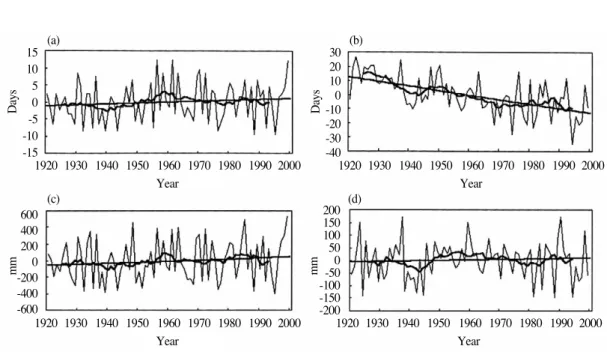
Figure 6 shows the interannual variation of annual precipitation falling into the extreme events(extreme proportion of precipitation) and non-extreme events(non-extreme portion of precip-
itation) and number of days. The annual precipita- tion from the extreme events showed a significant- ly increasing trend while the total precipitation from the non-extreme events showed no trend.
The frequency of non-extreme events showed a distinct decreasing trend while the frequency of extreme events showed an increasing trend reflect- ing that the decrease of precipitation days mainly resulted from the decrease of non-extreme events.
Jung et al.,(2002) also demonstrated the increase of amount and frequency of extreme precipitation events in the Korean Peninsular using the magni- tude of 2-day duration and 1-yr recurrence inter- val rainfall events for summer. This result may imply that the increase of annual precipitation can be attributed to the increase of extreme events, having the southern region of Korea exposed to more heavy rainfall events, possibly severe floods in recent years than ever.
Figure 6. The time series of annual anomalies for (a) EPD, (b) NEPD, (c) EPT and (d) NEPT, 1920-1999. EPD and NEPD:
number of precipitation days from extreme events and non-extreme events, EPT and NEPT: total precipitation from extreme and non-extreme events.
1920 1930 1940 1950 1960 1970 1980 1990 2000 Year
1920 1930 1940 1950 1960 1970 1980 1990 2000 Year
1920 1930 1940 1950 1960 1970 1980 1990 2000 Year
1920 1930 1940 1950 1960 1970 1980 1990 2000 Year
Daysmm mmDays
(a)
(c) (d)
(b) 15
10 5 0 -5 -10 -15
600 400 200 0 -200 -400 -600
200
150
100
50
0
-50
-100
-150
-200
30
20
10
0
-10
-20
-30
-40
In a seasonal basis, the frequency of non- extreme events showed the distinct decreasing trends for all the seasons while the precipitation from non-extreme events showed no trend. The frequency of extreme events showed no trend except for summer and seasonal precipitation from extreme events only showed increasing trends in spring and summer. Figure 7 shows the interannual variation of summer precipitation falling into the non-extreme and extreme events.
The summer precipitation from the extreme events showed a significant increasing while the summer precipitation from the non-extreme events showed no trend. Because summer is a major rainy season in Korea, the changes of extreme events mainly caused by the increase of extreme events in summer.
IV. Summary and Conclusions
Among many natural disasters, heavy precipi-
tation events are the most frequent and severe in Korea, accounting for 224 million dollars in prop- erty loss and about 60 life losses every year (MGAHA, 2000). Understanding trends on the change of precipitation extremes might be essen- tial for the environmental impact assessment to reduce the damage associated with extreme weather events. In recent years interests in pre- cipitation extremes have been rapidly growing both due to their great impacts on society and as climate change indicator and the degrees to which climate change affects society will more likely depend on changes in climate variability and particularly in the intensity and frequency of climate extremes. The purpose of this study is to examine long-term trend on precipitation intensi- ty and extreme events in the southern region of Korea. Daily precipitation data from four south- ern stations, Tague, Chonju, Pusan and Mokpo with the longest and most reliable records for the 80-year period(1920-1999) are used to construct Figure 7. The time series of summer anomalies for (a) EPD, (b) NEPD, (c) EPT and (d) NEPT, 1920-1999.
1920 1930 1940 1950 1960 1970 1980 1990 2000 Year
1920 1930 1940 1950 1960 1970 1980 1990 2000 Year
1920 1930 1940 1950 1960 1970 1980 1990 2000 Year
1920 1930 1940 1950 1960 1970 1980 1990 2000 Year
Daysmm mmDays