
Journal of the Korean Crystal Growth and Crystal Technology Vol. 23, No. 3 (2013) 142-145
http://dx.doi.org/10.6111/JKCGCT.2013.23.3.142
Visible green upconversion luminescence of Li + /Er 3+ /Yb 3+ co-doped CaWO 4 phosphor and effects of Yb 3+ concentration
Hyun Cho, Jung-Il Lee* and Jeong Ho Ryu*
,†Department of Nanomechatronics and Engineering, Pusan National University, Miryang 627-706, Korea
*Department of Materials Science and Engineering, Korea National University of Transportation, Chungju 380-702, Korea (Received May 20, 2013)
(Revised June 4, 2013) (Accepted June 7, 2013)
Abstract The upconversion (UC) luminescence of Li
+/Er
3+/Yb
3+co-doped CaWO
4phosphors and effects of Yb
3+concentration are investigated in detail. Single crystallized CaWO
4: Li
+/Er
3+/Yb
3+phosphor can be obtained, co-doped up to 35.0/5.0/30.0 mol% (Li
+/Er
3+/Yb
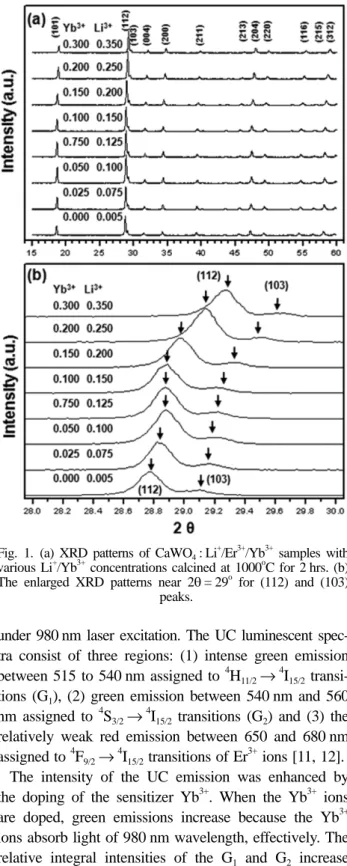
3+) by solid-state reaction. Under 980 nm excitation, CaWO
4: Li
+/Er
3+/Yb
3+phosphor exhibited strong green UC emissions visible to the naked eye at 530 and 550 nm induced by the intra 4f transitions of Er
3+(
4H
11/2,
4S
3/2→
4I
15/2).
The optimum doping concentrations of Yb
3+that would result in the highest UC luminescence were determined, and a possible UC mechanism that depends on the pumping power is discussed in detail.
Key words CaWO
4: Li
+/Er
3+/Yb
3+, Upconversion, Luminescence
1. Introduction
Over the past several decades, upconversion (UC) luminescence in rare earth (RE) ions doped phosphor materials has been extensively studied since its discov- ery in the 1960s [1]. Potential applications include solar cells, novel display technologies and, more recently, bio- physics. The UC phosphors could indeed be used as probes for imaging of individual molecules in biologi- cal cells [2, 3]. Fluorescence imaging using near infra- red (NIR) excitation is expected to have a major impact in biomedical imaging [4, 5]. The application of UC phosphor is also being considered in the photovoltaic industry to develop high-efficient solar cells [6].
Both of the above applications require, however, the development of more efficient and highly stable UC phosphors with low excitation density thresholds. Up to now, most of the RE doped UC phosphors have been halides such as NaYF 4 [7]. However, they have very poor physicochemical stabilities, which make their applications difficult in industrial fields. Therefore, it is important to search for stable oxide host materials with high UC efficiency.
Tungstate represents an important family of oxide materials that can be applied in various fields, such as
photoluminescence, microwave, optical fibers, and scin- tillating materials [8]. Among them, calcium tungstate (CaWO 4 ) has high density (6.1 g/cm 3 ), high irradiation damage resistance and relatively low phonon threshold energy compared to the other oxide materials [9]. The W 6+ ions in CaWO 4 matrices have strong polarization because of their large electric charge and small radius;
this strong polarization consequently decreases symme- tries and enhances the Stark energy splitting of the RE ion in the crystal field [10]. We already reported effects of Li + and Er 3+ concentration in Li + /Er 3+ /Yb 3+ co-doped CaWO 4 [11, 12]. In this work, Li + /Er 3+ /Yb 3+ co-doped CaWO 4 UC phosphors were synthesized with various Yb 3+ concentrations by solid-state reaction. Their struc- tural and UC luminescent properties were investigated, and effects of Yb 3+ concentrations on UC luminescence were discussed according to the UC mechanism.
2. Experimental
Li + /Er 3+ /Yb 3+ co-doped CaWO 4 (CaWO 4 : Li + /Er 3+ /Yb 3+ ) phosphor samples were prepared by the traditional solid- state reaction method. The starting materials were CaCO 3 (Kojundo Chemical, 99.99 %), WO 3 (Kojundo Chemi- cal, 99.99 %), Li 2 CO 3 (Kojundo Chemical, 99.99 %), Er 2 O 3 (Shinetsu Chemical, 99.99 %) and Yb 2 O 3 (Shi- netsu Chemical, 99.99 %). The molar ratios of the cat- ions were as follows: (1 − 2x − 2y)Ca 2+ + xYb 3+ + yEr 3+ +
†
Corresponding author
†
Tel: +82-43-841-5384
†
Fax: +82-43-841-5380
†

![OPEN BID INVITATION [SECURITY SERVICE]](data:image/gif;base64,R0lGODlhAQABAIAAAP///wAAACH5BAEAAAAALAAAAAABAAEAAAICRAEAOw==)