Introduction
Radial probe endobronchial ultrasound (R-EBUS) is a procedure that shows the lung images around the bronchus by transmitting the ultrasound signals generated at the endo- scopic ultrasound center to the miniature probe through the driving unit. It shows a 360° view of the lung around the probe tip by advancing the probe till it reaches the pulmonary lesion through the working channel of the bronchoscope
1,2. R-EBUS–
guided transbronchial lung biopsy (TBLB) is currently widely performed for peripheral pulmonary lesions (PPLs), such as lung nodules, to obtain tissue samples.
For PPLs, it is well known that the diagnostic yield of R- EBUS–guided TBLB is higher than that of the conventional TBLB without using R-EBUS
1,3,4. Upon tissue diagnosis for PPLs, the diagnostic yield of conventional TBLB reportedly ranges from <20%
5to 60%
6,7. However, the diagnostic yield of R- EBUS–guided TBLB is known to be around 70%
1. The reason
Utility of Radial Probe Endobronchial Ultrasound-Guided Transbronchial Lung Biopsy in Diffuse Lung Lesions
Eun Jin Kim, M.D. and Kyung Chan Kim, M.D.
Department of Internal Medicine, Daegu Catholic University Medical Center, Daegu Catholic University College of Medicine, Daegu, Korea
Background: Radial probe endobronchial ultrasound (R-EBUS) is widely used for diagnosing peripheral pulmonary lesions. However, the utility of R-EBUS–guided transbronchial lung biopsy (TBLB) for diffuse lung lesions (DLLs) remains unknown. We designed this study to evaluate the utility of R-EBUS–guided TBLB in DLLs.
Methods: This retrospective study enrolled patients admitted from January 2016 to November 2017 who underwent TBLB for DLLs. The R-EBUS–guided TBLB and blind TBLB groups were compared. DLL was defined as any lung disorder that involved more than one segment of the lung. In both the groups, fluoroscopy and guided sheath were not used during TBLB.
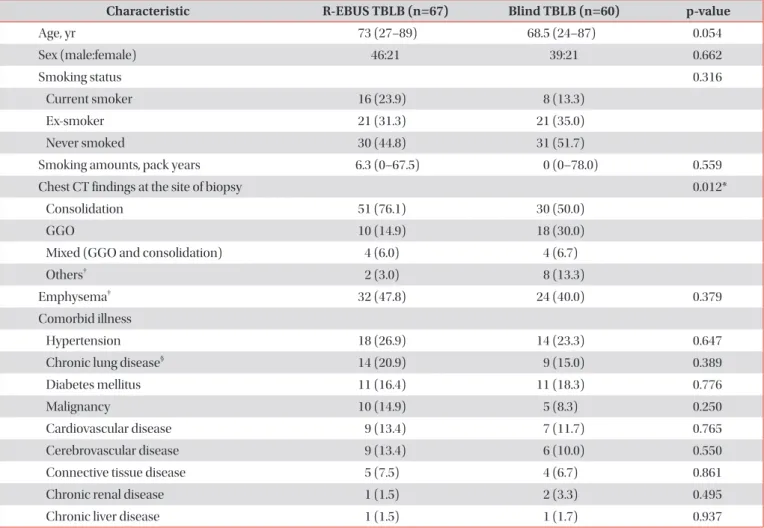
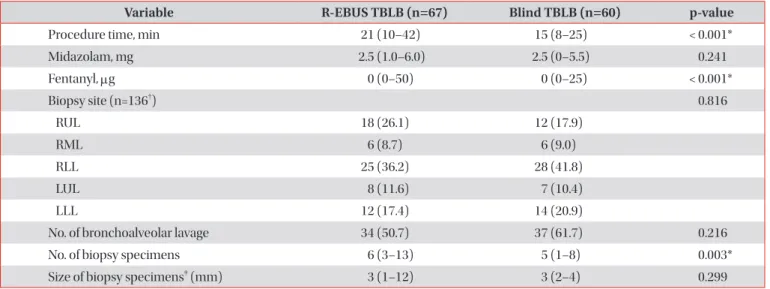
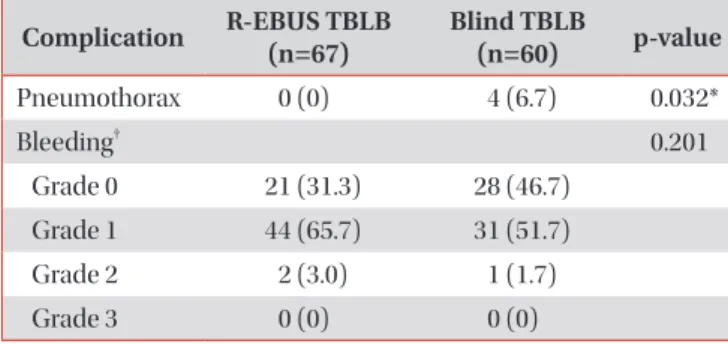
Results: A total of 127 patients underwent TBLB for DLLs (67 patients in the R-EBUS–guided TBLB group and 60 in the blind TBLB group). There were no differences in age, sex, and comorbid illnesses between the two groups. Furthermore, there was no difference in the TBLB diagnostic yield of the two groups (p=0.660) although more samples were collected from the R-EBUS–guided TBLB group (p=0.003). Procedure time was significantly longer in the R-EBUS–guided TBLB group than in the blind TBLB group (p<0.001). Thus, incidence of pneumothorax was significantly lower in the R-EBUS–
guided TBLB group than in the blind TBLB group (p=0.032).
Conclusion: Diagnostic yield in DLLs did not differ between the R-EBUS–guided TBLB and blind TBLB groups. Findings show that R-EBUS–guided TBLB in DLLs may reduce risk of pneumothorax.
Keywords: Biopsy; Bronchoscopy; Ultrasonography; Pneumothorax
Address for correspondence: Kyung Chan Kim, M.D.
Department of Internal Medicine, Daegu Catholic University Medical Center, 33 Duryugongwon-ro 17-gil, Nam-gu, Daegu 42472, Korea Phone: 82-53-650-4294, Fax: 82-53-622-2072
E-mail: [email protected] Received: Sep. 5, 2018 Revised: Dec. 18, 2018 Accepted: Mar. 27, 2019 Published online: May. 31, 2019
cc It is identical to the Creative Commons Attribution Non-Commercial License (http://creativecommons.org/licenses/by-nc/4.0/).