• 검색 결과가 없습니다.

Nontuberculous Mycobacterial Lung Disease Caused by Mycobacterium terrae in a Patient with Bronchiectasis

N/A
N/A
Protected

Academic year: 2021

Share "Nontuberculous Mycobacterial Lung Disease Caused by Mycobacterium terrae in a Patient with Bronchiectasis"

Copied!
4
0
0

로드 중.... (전체 텍스트 보기)

전체 글

(1)

173

http://dx.doi.org/10.4046/trd.2012.72.2.173 ISSN: 1738-3536(Print)/2005-6184(Online) Tuberc Respir Dis 2012;72:173-176

CopyrightⒸ2012. The Korean Academy of Tuberculosis and Respiratory Diseases. All rights reserved.

Nontuberculous Mycobacterial Lung Disease Caused by Mycobacterium terrae in a Patient with Bronchiectasis

Won-Jung Koh, M.D., Ph.D.

1

*, Go-Eun Choi, Ph.D.

2

*, Nam Yong Lee, M.D., Ph.D.

3

, Sung Jae Shin, Ph.D.

2

1

Division of Pulmonary and Critical Care Medicine, Department of Medicine, Samsung Medical Center, Sungkyunkwan University School of Medicine, Seoul,

2

Department of Microbiology and Research Institute for Medical Sciences, Infection Signaling Network Research Center, Chungnam National University College of Medicine, Daejeon,

3

Department of Laboratory Medicine, Samsung Medical Center, Sungkyunkwan University School of Medicine, Seoul, Korea

We report a rare case of lung disease caused by Mycobacterium terrae in a previously healthy woman. A 45-year-old woman was referred to our hospital due to a chronic cough with sputum. A computed tomography scan of the chest revealed bronchiolitis in conjuction with bronchiectasis in both lungs. Nontuberculous mycobacteria were identified and isolated from the bronchoalveolar lavage fluid collected from each lung. All isolates were identified as M. terrae by various molecular methods that characterized the rpoB and hsp65 gene sequences. Antibiotic therapy using clarithromycin, rifampin, and ethambutol improved the patient's condition and successfully resulted in sputum conversion.

Key Words: Bronchiectasis; Mycobacterium Infections, Nontuberculous

Address for correspondence: Sung Jae Shin, M.D., Ph.D.

Department of Microbiology, Chungnam National University College of Medicine, 6, Munwha 1-dong, Jung-gu, Daejeon 301-747, Korea

Phoen: 82-42-580-8246, Fax: 82-42-585-3686 E-mail: [email protected]

*These authors contributed equally to this work.

Received: Nov. 18, 2011 Revised: Dec. 7, 2011 Accepted: Jan. 4, 2012

Introduction

Mycobacterium terrae complex is known to comprise multiple species, including M. terrae , M. non- chromogenicum , and M. trivia

1

. M. terrae is ubiquitous in the environment and generally considered a non- pathogenic nontuberculous mycboacteria (NTM)

1

. The most common presentation of M. terrae infection is te- nosynovitis of the upper extremities, often following trauma

2,3

. To date, few cases of NTM lung disease caused by M. terrae have been reported. Here, we re- port a very rare case of M. terrae lung disease asso- ciated with bronchiectasis in an immunocompetent patient.

Case Report

In March 2008, a 45-year-old woman was referred to our hospital due to chronic cough and sputum. The pa- tient had been healthy until two months earlier, when cough and purulent sputum developed. She had a his- tory of smoking (10 pack-years), but had stopped 10 years prior. The patient had pectus excavatum. Labora- tory results were normal with the exception of elevated CA 19-9 (75.32 U/mL, normal range, 0∼37 U/mL). Her height was 161 cm and body weight was 51 kg. A hu- man immunodeficiency virus (HIV) antibody test was negative.

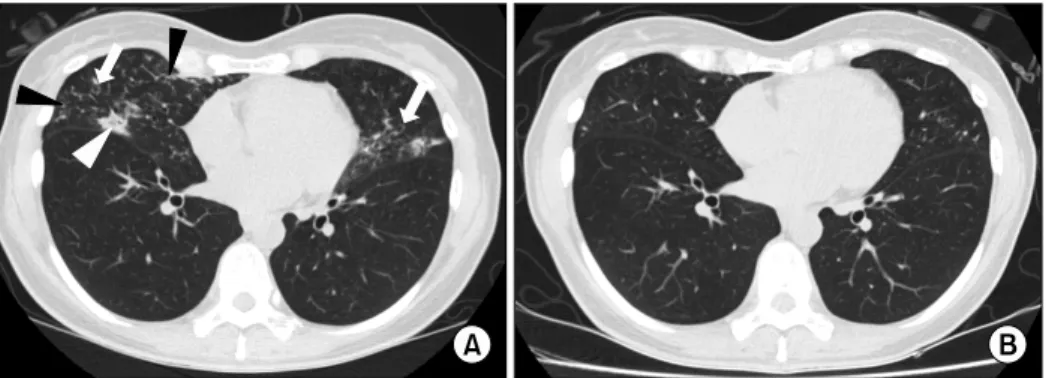
A computed tomography (CT) scan of the chest re- vealed bronchiectasis and bronchiolitis in both lungs (Figure 1A). The patient also had pectus excavatum in the anterior chest wall. There was no evidence of cystic fibrosis or other common causes of bronchiectasis. NTM were isolated from bronchoalveolar lavage fluid col- lected from both lungs and cultured in vitro .

Polymerase chain reaction (PCR) restriction fragment length polymorphism analysis (PRA) was used to identi- fy the particular mycobacterial species isolated from the

Case Report

(2)

WJ Koh et al: NTM lung disease caused by M. terrae

174

Figure 1. A 45-year-old woman with bronchiectasis and nontuberculous mycobacterial lung disease caused by Mycobacterium terrae. (A) A transverse CT scan (2.5-mm-section thickness) obtained on level with the right inferior pulmonary vein at the time of presentation, before treatment, reveals bilateral bronchiectasis (arrows) in the right middle lobe and the lingular segment of the left upper lobe, as well as cellular bronchiolitis with tree-in-bud signs (black arrow heads) in both lungs. Lobular consolidation in the right middle lobe (white arrow heads) was also noted. (B) A CT scan of the same patient after 12 months of antibiotic therapy revealed a decrease in the extent of cellular bronchiolitis and lobular consolidation in both lungs. CT: computed tomography.

Figure 2. Electrophoresis of the PCR restriction enzyme PRA of the rpoB and hsp65 genes from the clinical isolate of the patient. M, size marker; Lane 1, rpoB gene PCR product after digestion by MspI Lane 2, PCR product of the rpoB gene after digestion by Hae III Lane 3, PCR product of the hsp65 gene after digestion by Hae III.

PCR: polymerase chain reaction; PRA: polymorphism analysis.

patient. DNA was extracted from pure culture colonies of mycobacteria grown on 7H10-OADC agar plate and the genes rpoB and hsp65 were amplified by PCR. PCR product was digested using the restriction enzymes Msp I and Hind III as described previously

4,5

. The pattern of the resulting DNA fragments was then compared to those kept in a database of known mycobacterial species. PRA of the rpoB gene resulted in fragment lengths of 110, 95, 55, and 45 bp using Msp I and 175, 55, and 45 bp using Hae III (Figure 2). These DNA frag- ment lengths matched the known restriction fragment patterns of the reference strain of M. terrae ATCC15755 reported in the previous studies

5,6

. The identity of etio- logical agent was also confirmed by sequencing analy- sis, revealing 99 and 100% sequence similarity with the rpoB gene (GenBank accession no. AF057488.1) and hsp65 gene (GenBank accession no. AF547879) of M.

terrae ATCC15755, respectively.

Drug susceptibility testing was performed using a broth microdilution method, as previously described for slow growing mycobacteria, such as M. kansasii , ac- cording to the guidelines of the Clinical and Laboratory Standards Institute (CLSI)

7

. The clinical isolate of M. ter- rae was susceptible to clarithromycin, ethambutol, and amikacin but resistant to ciprofloxacin and rifampin (Table 1).

The patient was treated with oral clarithromycin (1,000

mg/day), rifampin (600 mg/day), and ethambutol (800

mg/day) for 18 months. The treatment outcome was fa-

vorable; the patient's symptoms resolved completely, ra-

diographic findings improved (Figure 1B), and negative

(3)

Tuberculosis and Respiratory Diseases Vol. 72. No. 2, Feb. 2012

175 Table 1. Antimicrobial susceptibility patterns for the

Mycobacterium terrae strain isolated from our patient Antimicrobial agent MIC (μg/mL) Interpretation

Clarithromycin ≤0.5 Susceptible

Rifampin 2 Resistant

Ethambutol 2 Susceptible

Amikacin 4 Susceptible

Ciprofloxacin 8 Resistant

Moxifloxacin 2 Intermediate

MIC: minimum inhibitory concentration.

conversion of sputum cultures was achieved and main- tained after 12 months of antibiotic therapy (Figure 1B).

Discussion

Despite the prevailing view that M. terrae complex isolates are nonpathogenic, these organisms are occa- sionally identified in clinical specimens

8

. For example, in our institution, M. terrae complex made up 3% of 1,548 NTM clinical isolates during the 2-year period from 2002 to 2003

9

. Nonetheless, no patient had clin- ically significant disease caused by M. terrae complex infection during that time.

NTM lung disease caused by M. terrae complex is rarely reported in the literature

10-12

, and there is no re- ported case in Korea. Furthermore, previous studies have had difficulty identifying the exact species of clin- ical isolates, as commercial DNA probes and high per- formance liquid chromatography (HPLC) are not suit- able methods to distinguish between different member species of the M. terrae complex. A recent study analyz- ing 16S rRNA and hsp65 genes demonstrated genomic heterogeneity among M. terrae complex members

13

. Therefore, we were able to confirm that our patient had M. terrae infection using modern molecular techniques that enabled sequencing of the rpoB and hsp65 genes.

NTM lung disease has two distinct radiographic mani- festations: an upper lobe fibrocavitary form and a nod- ular bronchiectatic form

1

. The nodular bronchiectatic form of the disease occurs predominantly in non- smoking middle-aged or elderly women who have no

underlying lung disease. The radiographic features of the nodular bronchiectatic form include bronchiectasis and multiple nodules, which tend to be most severe in the lingular segment of the left lung and in the right middle lobe. These features are well characterized in M. avium complex lung disease, but have also been noted in NTM lung disease caused by other NTM spe- cies, such as M. abscessus complex

14-16

. In addition, women with the nodular bronchiectatic form of NTM lung disease also often have certain medical conditions, including pectus excavatum, scoliosis, and thin body habitus

17

. Our case study presented with typical clinical and radiographic features of the nodular bronchiectatic form of NTM lung disease.

The optimal antimicrobial therapy regimen for M. ter- rae infection has yet to be established. Some have sug- gested that drug treatment regimen for M. terrae in- fection should include macrolide, rifampin, and etham- butol

2

. Our patient received these three drugs and had substantial improvement without significant sequelae.

Despite the rifampin resistant that the clinical isolates exhibited in vitro , it was included in the treatment regi- men for our patient. It is unclear whether the combina- tion of rifampin and ethambutol proved an additive, or synergistic, effect

2

.

In conclusion, M. terrae should be considered a pos- sible etiologic pathogen of the nodular bronchiectatic form of NTM lung disease, despite the rare occurrence of M. terrae lung disease. Additionally, macro- lide-containing antibiotic therapies may be effective in the treatment of M. terrae lung disease.

Acknowledgements

This study was financially supported by research fund of Chungnam National University in 2011 (2011-1587).

References

1. Griffith DE, Aksamit T, Brown-Elliott BA, Catanzaro A,

Daley C, Gordin F, et al. An official ATS/IDSA state-

ment: diagnosis, treatment, and prevention of non-

(4)

WJ Koh et al: NTM lung disease caused by M. terrae

176

tuberculous mycobacterial diseases. Am J Respir Crit Care Med 2007;175:367-416.

2. Smith DS, Lindholm-Levy P, Huitt GA, Heifets LB, Cook JL. Mycobacterium terrae: case reports, literature re- view, and in vitro antibiotic susceptibility testing. Clin Infect Dis 2000;30:444-53.

3. Chen HW, Lai CC, Tan CK. Arthritis caused by Myco- bacterium terrae in a patient with rheumatoid arthritis.

Int J Infect Dis 2009;13:e145-7.

4. Telenti A, Marchesi F, Balz M, Bally F, Böttger EC, Bodmer T. Rapid identification of mycobacteria to the species level by polymerase chain reaction and re- striction enzyme analysis. J Clin Microbiol 1993;31:

75-8.

5. Lee H, Park HJ, Cho SN, Bai GH, Kim SJ. Species iden- tification of mycobacteria by PCR-restriction fragment length polymorphism of the rpoB gene. J Clin Microbi- ol 2000;38:2966-71.

6. Alban SM, Sella SR, Miranda RN, Mira MT, Soccol VT.

PCR-restriction fragment length polymorphism analysis as a tool for Mycobacterium species identification in lepromas for lepromin production. Lepr Rev 2009;80:

29-42.

7. Clinical and Laboratory Standards Institute (CLSI).

Susceptibility testing of mycobacteria, nocardiae, and other aerobic actinomycetes; approved standard. Docu- ment no, M24-A. Wayne, PA: CLSI; 2003.

8. Wayne LG, Sramek HA. Agents of newly recognized or infrequently encountered mycobacterial diseases. Clin Microbiol Rev 1992;5:1-25.

9. Koh WJ, Kwon OJ, Jeon K, Kim TS, Lee KS, Park YK, et al. Clinical significance of nontuberculous mycobac- teria isolated from respiratory specimens in Korea.

Chest 2006;129:341-8.

10. Kuze F, Mitsuoka A, Chiba W, Shimizu Y, Ito M, Teramatsu T, et al. Chronic pulmonary infection caused by Mycobacterium terrae complex: a resected case. Am Rev Respir Dis 1983;128:561-5.

11. Krisher KK, Kallay MC, Nolte FS. Primary pulmonary infection caused by Mycobacterium terrae complex.

Diagn Microbiol Infect Dis 1988;11:171-5.

12. Tonner JA, Hammond MD. Pulmonary disease caused by Mycobacterium terrae complex. South Med J 1989;

2:1279-82.

13. Lee CK, Gi HM, Cho Y, Kim YK, Lee KN, Song KJ, et al. The genomic heterogeneity among Mycobacterium terrae complex displayed by sequencing of 16S rRNA and hsp 65 genes. Microbiol Immunol 2004;48:83-90.

14. Koh WJ, Lee KS, Kwon OJ, Jeong YJ, Kwak SH, Kim TS. Bilateral bronchiectasis and bronchiolitis at thin- ection CT: diagnostic implications in nontuberculous mycobacterial pulmonary infection. Radiology 2005;

35:282-8.

15. Jeon K, Kwon OJ, Lee NY, Kim BJ, Kook YH, Lee SH, et al. Antibiotic treatment of Mycobacterium abscessus lung disease: a retrospective analysis of 65 patients.

Am J Respir Crit Care Med 2009;180:896-902.

16. Koh WJ, Jeon K, Lee NY, Kim BJ, Kook YH, Lee SH, et al. Clinical significance of differentiation of Myco- bacterium massiliense from Mycobacterium abscessus.

Am J Respir Crit Care Med 2011;183:405-10.

17. Kim RD, Greenberg DE, Ehrmantraut ME, Guide SV, Ding L, Shea Y, et al. Pulmonary nontuberculous my- cobacterial disease: prospective study of a distinct pre- existing syndrome. Am J Respir Crit Care Med 2008;

78:1066-74.

수치

Figure  1.  A  45-year-old  woman  with  bronchiectasis  and  nontuberculous  mycobacterial  lung  disease  caused  by  Mycobacterium  terrae

참조

관련 문서

Lung Abscess and Bacteremia Caused by Neisseria flavescens and Streptococcus sanguis in Patient with Idiopathic..

Conclusion: Although low levels of serum HMGB1 has the potential to be a marker of mycobacterial lung disease, these levels were unable to differentiate disease progression

This treatment was successful but a chest X-ray (CXR) at the time of treatment completion showed parenchymal destructive lesions, with fi- brotic changes in the right upper

We report a case of normalization of elevated serum CA 19-9 levels after treatment of the nodular bronchiectatic form of Mycobacterium abscessus lung disease.. A

A Case of Endobronchial Aspergilloma Associated with Foreign Body in Immunocompetent Patient without Underlying Lung Disease.. Seung Won Jung, M.D., Moo Woong Kim, M.D.,

Based on the experience with this patient, we suggest that, if medical treatment fails, surgical resection of a diseased lung should be considered even in patients with