416
Nontuberculous Mycobacterial Lung Disease Caused by Mycobacterium shinjukuense : The First Reported Case in Korea
Seong Mi Moon, M.D.
1,*, Su-Young Kim, Ph.D.
1,*, Myung Jin Chung, M.D.
2, Seung Heon Lee, Ph.D.
3, Sung Jae Shin, Ph.D.
4and Won-Jung Koh, M.D.
11
Division of Pulmonary and Critical Care Medicine, Department of Medicine,
2Department of Radiology, Samsung Medical Center, Sungkyunkwan University School of Medicine, Seoul,
3Korean Institute of Tuberculosis, Osong,
4Department of Microbiology, Yonsei University College of Medicine, Seoul, Korea
Mycobacterium shinjukuense is a novel species of nontuberculous mycobacteria (NTM) that was first reported in Japan in 2011. It is a slow-growing NTM pathogen that can cause chronic pulmonary infections. There are only a few reported cases of M. shinjukuense infections, all of which are from Japan. We reported a case of chronic lung disease caused by M.
shinjukuense . The organism was identified by 16S rRNA, rpoB , and hsp65 gene sequencing. To the best of our knowledge, this was the first confirmed case of lung disease caused by M. shinjukuense outside of Japan.
Keywords: Bronchiectasis; Mycobacterium ; Nontuberculous Mycobacteria
specific diagnostic criteria that have already been proposed
5. Mycobacterium shinjukuense, a novel slow-growing NTM pathogen, was introduced as a new species in 2011
6. There are only a few reported cases of M. shinjukuense that met the di- agnostic criteria for NTM lung disease
6-9. All of the prior cases were reported from Japan. We report a case of NTM lung dis- ease caused by M. shinjukuense, which was identified using 16S rRNA, rpoB, and hsp65 gene sequencing. To the best of our knowledge, this is the first case of M. shinjukuense lung disease in Korea.
Case Report
A 56-year-old Korean woman with a history of pulmonary tuberculosis (10 years prior to presentation) was referred to our hospital with a mild, but persistent productive cough for three months. Otherwise, the patient was a healthy, non- smoker. She has not lived in Japan.
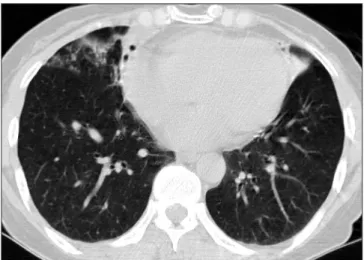
A chest radiography revealed subtle crowding of the bron- chovascular bundle in both lower lung zones. A computed tomography scan of her chest revealed several nodules, micro-nodules, and bronchiectasis with lung atelectasis in the right middle lobe and the lingular division of the left up- per lobe (Figure 1). There was no organic growth on the initial Copyright © 2015
The Korean Academy of Tuberculosis and Respiratory Diseases.
All rights reserved.
Introduction
The class of nontuberculous mycobacteria (NTM) is gener- ally comprised of mycobacteria other than Mycobacterium tuberculosis complex and Mycobacterium leprae. The preva- lence of lung diseases caused by NTM is increasing world- wide, including in Japan and South Korea
1-4. NTM are ubiqui- tous in the environment. Therefore, it is crucial to isolate and identify the causative organisms for diagnosis. There are some
CASE REPORT
http://dx.doi.org/10.4046/trd.2015.78.4.416ISSN: 1738-3536(Print)/2005-6184(Online) • Tuberc Respir Dis 2015;78:416-418
Address for correspondence: Won-Jung Koh, M.D.
Division of Pulmonary and Critical Care Medicine, Department of Medicine, Samsung Medical Center, Sungkyunkwan University School of Medicine, 81 Irwon-ro, Gangnam-gu, Seoul 06351, Korea
Phone: 82-2-3410-3429, Fax: 82-2-3410-3849 E-mail: [email protected]
*Seong Mi Moon and Su-Young Kim contributed equally to this work.
Received: May 26, 2015 Revised: Jun. 23, 2015 Accepted: Jun. 25, 2015
cc
It is identical to the Creative Commons Attribution Non-Commercial
License (http://creativecommons.org/licenses/by-nc/4.0/).
Mycobacterium shinjukuense lung disease in Korea
http://dx.doi.org/10.4046/trd.2015.78.4.416 417
www.e-trd.org
microbiological study of three sputum specimens. However, cultures of two bronchial washing specimens demonstrated NTM growth.
Initially, a polymerase chain reaction (PCR)-reverse blot hy- bridization assay method based on rpoB gene (REBA Myco- ID; M&D Inc., Wonju, Korea) was used to identify the species.
However, this method was unsuccessful, because there were no available reference sequences of the organism
10,11. Next, we performed sequencing analysis of the nearly complete 16S rRNA gene sequence and partial sequences of the rpoB and hsp65
12-14. The 16S rRNA, rpoB, and hsp65 sequences were
100% identical to those of the M. shinjukuense type strain GTC 2738 (GenBank accession Nos. NR112623, AB268504 and AB268505, respectively). Phylogenetic analysis was per- formed the rpoB sequences from the isolated SMC-shi-001 strain, and sequences of closely related species within the slow growing mycobacteria class. It revealed that the isolated strain belongs to M. shinjukuense (Figure 2). The GenBank accession numbers of 14 species’ sequences were compared to that of SMC-shi-001. The sequences were obtained from the GenBank sequence database.
After the isolate was identified, we planned to start antibiot- ics because of persistent productive cough and progression of multiple nodules on the chest radiography during 6 months of follow-up. However, the patient was reluctant to receive long- term antibiotic therapy and refused further follow-up.
Discussion
NTM species are well known for causing chronic pulmo- nary disease. Some of the most commonly isolated species are the Mycobacterium avium complex, Mycobacterium ab- scessus complex, and Mycobacterium kansasii
5. Other NTM species have also been implicated in lung disease. More than 150 NTM species have been discovered, and the number is still increasing as mycobacteriology methods continue to im- prove
15. M. shinjukuense is a novel species of Mycobacterium that was first reported by Saito et al.
6in Japan in 2011. M. shin- jukuense was described a slow growing, non-chromogenic Mycobacterium species. Compared to other mycobacteria, M.
shinjukuense has unique gene sequences. Although it is phy- logenetically related to M. tuberculosis, Mycobacterium ul- cerans, and Mycobacterium marinum, it demonstrated <70%
reassociation in DNA-DNA hybridization
6.
It is essential to accurately identify isolated NTM species in Figure 1. A 57-year-old female with a chronic cough productive
with sputum. Axial computed tomography (CT) imaging shows several nodules, micro-nodules, and bronchiectasis with lung atel- ectasis in the right middle lobe. It also reveals bronchiectasis with lung atelectasis in the lingular division of the left upper lobe. These are typical CT findings of the nodular bronchiectatic form com- monly seen in nontuberculous mycobacterial disease.
M. scrofulaceum CIP 105416 (AY544959) M. parascrofulaceum CIP 108112 (AY943190)
M. avium CIP 104244 (AY544887) M. europaeum DSM 45397 (Hg673738) M. parmense CIP 107385 (AY943191)
M. heidelbergense CIP 105424 (AY544923) M. malmoense CIP 105775 (AY544942)
M. saskatchewanense CIP 108114 (AY943192) M. haemophilum CIP 105049 (AY544920)
M. tuberculosis H37Rv (JX303312) M. kansasii CIP 104589 (AY544931)
SMC-shi-001
M. shinjukuense GTC 2738 (AB268504) M. marinum CIP 104528 (AY544943)
M. ulcerans CIP 105425 (AY544975) 0.01
43 47 51 22
20 21 39 18
100 21
100 24