• 검색 결과가 없습니다.

A retrospective study of feline cutaneous tumors in Korea from 2013 to 2018

N/A
N/A
Protected

Academic year: 2021

Share "A retrospective study of feline cutaneous tumors in Korea from 2013 to 2018"

Copied!
7
0
0

로드 중.... (전체 텍스트 보기)

전체 글

(1)

https://doi.org/10.14405/kjvr.2019.59.4.187

187 ORIGINAL ARTICLE

A retrospective study of feline cutaneous tumors in Korea from 2013 to 2018

Ji-Youl Jung, Kyu-Ryeon Ko, Young-Min Choi, Seong-Hwan Jang, Jae-Hoon Kim*

College of Veterinary Medicine and Veterinary Medical Research Institute, Jeju National University, Jeju 63243, Korea Abstract: This study examined the relative incidence of feline cutaneous tumors according to age, breed, sex, and site predilection for these tumors. Biopsy samples were examined and diagnosed from the histopathology. Over a 72-month period, from January 2013 to December 2018, 478 feline biopsy samples were received from veterinary practitioners across the nation. Of these, 232 (48.54%) cases were skin masses. Among them, 73.71% (171/232) were neoplastic lesions and 26.29% (61/232) were non-neoplastic. Twenty- two different types of cutaneous neoplasms were diagnosed as epithelial tumors (15.79%), mesenchymal tumors (83.63%), or melanocytic tumor (0.58%). The four most common tumors were mast cell tumor (60.23%), lipoma (5.85%), basal cell carcinoma (4.68%), and fibrosarcoma (4.68%), which comprised 75.44% of all tumor cases. Cutaneous tumors were located most commonly in the head of the cat (43.27%) and in the Korean shorthaired breed (75.44%). According to this study, cutaneous tumors were the most common tumor types in feline neoplasms in Korea. The incidence of cutaneous tumors was highest in Korean shorthaired cats, the most prevalent breed in Korea. Mast cell tumors are the most common skin neoplasm in Korea and can affect very young cats.

Keywords: biopsy, cat, neoplasms, skin

Introduction

Tumors are devastating diseases in both humans and companion animals.

Although less common than in dogs, tumors have been observed frequently among the feline population in recent years [1]. Previous studies have shown that the skin is the most common site for tumors in the felines aside from the lymphoid system [2-5]. On the other hand, according to recent studies, cuta- neous tumors represent the most common neoplasm in cats and account for approximately 27% in Switzerland [6] and 55% in Italy [7]. The incidence of feline cutaneous tumors varies between studies; however, the consensus is that the four most common cutaneous tumor types are basal cell tumor, fibrosar- coma, squamous cell carcinoma (SCC), and mast cell tumor (MCT) [8-10].

Recently, numerous surveys and studies from extensive data collections have been performed, covering broad aspects of veterinary oncology research.

These reports include breed, sex, and site predilection for a range of feline tumors [9,10]. On the other hand, the results of these studies may have been affected by differences in data sources, sample numbers, size of the geograph- ical region assessed, availability of population data, and the depth and speci- fication of data evaluation [9]. Moreover, there is no information available on the incidence of feline cutaneous tumors in Korea. This study examined the relative incidence of cutaneous tumors in the Korean feline population using samples from January 2013 to December 2018. Furthermore, the age, breed, sex, and site predilections for the most common neoplasms were also assessed.

Materials and Methods

A total of 478 feline biopsy samples were submitted to the Department of Veterinary Pathology at the Jeju National University for diagnosis during des- ignated periods from January 2013 to December 2018. The formalin-fixed tis- sue specimens were obtained from veterinary practitioners in local animal hospitals across the nation. The submitted samples were processed routinely and paraffin-embedded tissue blocks were sectioned into 4-µm slices. The

*Corresponding author Jae-Hoon Kim

College of Veterinary Medicine, Jeju National University, 102 Jejudaehak-ro, Jeju 63243, Korea

Tel: +82-64-754-3387 Fax: +82-64-702-9920 E-mail: [email protected] ORCID IDs

Ji-Youl Jung

https://orcid.org/0000-0002-5938-2029 Kyu-Ryeon Ko

https://orcid.org/0000-0003-3807-8164 Young-Min Choi

https://orcid.org/0000-0002-6357-5237 Seong-Hwan Jang

https://orcid.org/0000-0002-2768-2967 Jae-Hoon Kim

https://orcid.org/0000-0002-4410-9126 Conflict of Interest

The authors declare no conflicts of interest.

Received: September 2, 2019

Revised: October 27, 2019

Accepted: November 5, 2019

(2)

sections were then deparaffinized, rehydrated through a graded series of alcohol, and stained with hematoxylin and eosin. Replicate sections of particular cases were also stained with special stains, such as toluidine blue and periodic acid- Schiff, to confirm the diagnosis. Following the diagnosis, only skin masses were included in this study. Masses from mammary glands and cases with an inadequate history were not included. Tumors arising from the ears and anal gland region were included. For all cases included in this study, the age, breed, sex and neuter status of the cat, and location of the biopsy sample were recorded.

Cutaneous masses were classified as either neoplastic or non-neoplastic (including cysts, hamartomas, inflammatory, and hyperplastic or pigmentary growths forming a mass-type lesion). Neoplastic masses were categorized further into one of three groups based upon their embryological origin as epi- thelial, mesenchymal, or melanocytic.

Results

During the 72-month period, of 478 feline biopsy samples, 232 (48.54%) cases were diagnosed as skin masses. Among them, 73.71% (171/232) were neoplastic lesions and 26.29%

(61/232) were non-neoplastic. The three most common diag- noses in non-neoplastic lesions were panniculitis (13 cases), follicular cyst (6 cases), and folliculitis (6 cases). Twenty-two

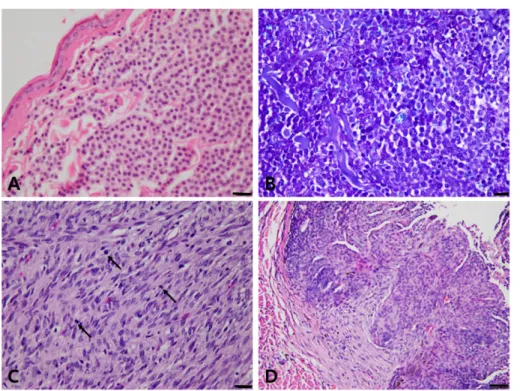
different types of cutaneous neoplasms were diagnosed and classified into epithelial tumors (15.79%, 27/171), mesenchy- mal tumors (83.63%, 143/171), and melanocytic tumor (0.58%, 1/171). Among them, 84.21% (n = 144) were benign and 15.79% (n = 27) were malignant. Among the benign and malignant neoplasms, mesenchymal origin tumors were the most frequent subtype, accounting for 88.19% (127/144) and 59.26% (16/27) of all benign and malignant neoplasms, respectively. Tumors of epithelial and melanocytic origin in benign tumors were 11.11% (16/144) and 0.69% (1/144), respectively. Among the malignant neoplasms, the incidence of an epithelial origin was 40.74% (11/27) (Table 1). The four most common tumor types were MCT (n = 103; 60.23%), lipoma (n = 10; 5.85%), basal cell carcinoma (n = 8; 4.68%), and fibrosarcoma (n = 8; 4.68%). Table 2 provides detailed information, including the incidence of individual tumors, sex distribution, and mean and median age. Fig. 1 shows rep-

Fig. 1. Photographs of feline cutaneous tumors. (A) Mast cell tumor (MCT), well-differentiated type. Compact accumulation of neo- plastic mast cells with fine, basophilic, cytoplasmic granules without eosinophil infiltration. Hematoxylin and eosin (H&E).

Bar = 20 µm. (B) MCT. The mast cells contained numerous metachromatic purple granules in the cytoplasms. Toluidine blue stain.

Bar = 20 µm. (C) Fibrosarcoma. The pleomorphic spindle cells arranged in interlacing pattern with numerous high mitotic figures (arrows). H&E. Bar = 20 µm. (D) Basal cell carcinoma. Invasive neoplastic basal cells with a surrounding desmoplastic response.

H&E. Bar = 50 µm.

Table 1. Classification of cutaneous tumors according to the histologic origin and malignancy

Origin Benign Malignant Total

Epithelial 16 11 27

Mesenchymal 127 16 143

Melanocytic 1 - 1

Total 144 27 171

(3)

resentative photomicrographs of cutaneous tumors, such as MCT, fibrosarcoma, and basal cell carcinoma.

Age

The age of the cats with skin mass ranged from under one year up to 17 years with a median age of 6 years at the time of surgical excision. More than half of the cutaneous tumors

occurred between 4 and 8 years of age (Fig. 2). On the other hand, there were no significant correlations between the cats’

age and the occurrence of benign or malignant neoplasms.

Breed

Cats suffering from cutaneous tumors were classified into 13 different breeds. The cats with the greatest number of Fig. 2. Number of the four most common cutaneous tumors according to feline ages. More than half of the cutaneous tumors occurred between 4 and 8 years of age.

Table 2. Cutaneous tumors from 171 cats with the number of affected cats, male:female ratio, mean and median age Tumor type No. of cases (%) Male : female ratio Median age (range) Mean age (SD)

Mast cell tumor 103 (60.23) 0.98 85 (3m-15y) 85.08 (3.33)

Lipoma 810 (5.85) 1.00 86 (3-11y) 87.3 (2.50)

Basal cell carcinoma 888 (4.68) 1.67 88.5 (6-15y) 89.75 (3.65)

Fibrosarcoma 888 (4.68) 1.00 10 (4-15y) 88.38 (4.31)

Basal cell tumor 886 (3.51) 1.00 87 (5-11y) 87.17 (2.04)

Sebaceous adenoma 886 (3.51) 5.00 10 (6-15y) 89.67 (3.39)

Fibroma 885 (2.92) 0.67 88 (4-14y) 89 (3.74)

Histiocytic sarcoma 885 (2.92) 4.00 89 (4-11y) 87.2 (3.11)

Histiocytoma 884 (2.34) 1.00 89 (2-13y) 88.25 (4.86)

Apocrine cystadenoma 882 (1.17) 1.00 10 (9-11y) 10 (1.41)

Hemangioma 882 (1.17) 2 male 89.5 (7-12y) 89.5 (3.54)

Lymphoma 882 (1.17) 2 male 84.5 (4-5y) 84.5 (0.71)

Apocrine adenoma 881 (0.58) 1 female 14 14

Apocrine carcinoma 881 (0.58) 1 male 8 8

Ceruminous gland carcinoma 881 (0.58) 1 female 7 7

Hemangiosarcoma 881 (0.58) 1 male 8 8

Leiomyosarcoma 881 (0.58) 1 female 17 17

Leiomyoma 881 (0.58) 1 male 15 15

Myxosarcoma 881 (0.58) 1 male 10 10

Melanoma 881 (0.58) 1 female 14 14

Inverted papilloma 881 (0.58) 1 male 11 11

Squamous cell carcinoma 881 (0.58) 1 female 7 7

SD, standard deviation.

(4)

cutaneous tumors were Korean shorthair (KSH, n = 129;

75.44%), followed by Persian (n = 11; 6.43%) and Turkish angora (n = 10; 5.85%). Table 3 provides detailed informa- tion on the feline breeds.

Sex

Of the cutaneous tumors, 53.21% (91/171) and 46.79%

(80/171) were found in male and female cats, respectively.

There was no significant sex predilection for feline cutane- ous tumors. On the other hand, sebaceous adenoma and his- tiocytic sarcoma were more frequent in male cats than in female cats.

Anatomic location

The cutaneous tumors were found most commonly on the head (43.27%; 74/171), followed in order by the trunk (30.99%;

53/171), extremities (19.30%; 33/171), and neck (6.43%; 11/

171). Table 4 provides further details regarding the location of the tumors.

Diagnosis MCT

MCTs were the most common cutaneous tumors in this study, accounting for 60.23% (103/171) of all neoplastic skin masses. Within the diagnostic criteria, the majority of MCTs were classified as the mastocytic form (n = 101; 98.06%) and the remaining cases were the histiocytic type (n = 2; 1.94%).

The KSH cat breed (n = 87; 84.47%) had the highest inci- dence of MCT. The average age of cats with MCT was 5.08

Table 4. Number of cutaneous tumors according to the location of skin mass in 171 cats

Tumor type Values

Head Neck Trunk Extremities

Mast cell tumor (n = 103) 59 (57.28) 95 (4.85) 19 (18.45) 20 (19.42)

Lipoma (n = 10) 97 (70.00) 93 (30.00)

Basal cell carcinoma (n = 8) 92 (25.00) 95 (62.50) 91 (12.50)

Fibrosarcoma (n = 8) 92 (25.00) 94 (50.00) 92 (25.00)

Basal cell tumor (n = 6) 92 (33.33) 93 (50.00) 91 (16.67)

Sebaceous adenoma (n = 6) 91 (16.67) 94 (66.67) 91 (16.67)

Fibroma (n = 5) 92 (40.00) 92 (40.00) 91 (20.00)

Histiocytic sarcoma (n = 5) 91 (20.00) 92 (40.00) 92 (40.00)

Histiocytoma (n = 4) 92 (50.00) 91 (25.00) 91 (25.00)

Apocrine cystadenoma (n = 2) 92 (100.00)

Hemangioma (n = 2) 91 (50.00) 91 (50.00)

Lymphoma (n = 2) 92 (100.00)

Apocrine adenoma (n = 1) 91 (100.00)

Apocrine carcinoma (n = 1) 91 (100.00)

Ceruminous gland carcinoma (n = 1) 91 (100.00)

Hemangiosarcoma (n = 1) 91 (100.00)

Leiomyosarcoma (n = 1) 1 (100.00)

Leiomyoma (n = 1) 91 (100.00)

Myxosarcoma (n = 1) 91 (100.00)

Melanoma (n = 1) 91 (100.00)

Inverted papilloma (n = 1) 91 (100.00)

Squamous cell carcinoma (n = 1) 91 (100.00)

Total 74 (43.27) 11 (6.43) 53 (30.99) 33 (19.30)

Values are presented as number (%).

Table 3. Prevalence of cutaneous tumors according to the feline breeds (n = 171)

Breed Values

Korean shorthair 129 (75.44)

Persian 811 (6.43)

Turkish angora 810 (5.85)

Russian blue 887 (4.09)

American shorthair 883 (1.75)

Siamese 883 (1.75)

Abyssinian 882 (1.17)

Scottish fold 881 (0.58)

British shorthair 881 (0.58)

Maine coon 881 (0.58)

Oriental shorthair 881 (0.58)

Munchkin 881 (0.58)

Scottish straight 881 (0.58)

Values are presented as number (%).

(5)

years, and the ages of the cats affected ranged from three months to 15 years. These tumors were located predomi- nantly in the head (57.28%), particularly in the ear, followed by the extremities (19.42%).

Other tumors

Ten cases of lipoma (9 KSH and one Siamese) accounted for 5.85% of cutaneous tumors. The most common site was the trunk, followed by the extremities. Eight cases (4.68%) of basal cell carcinoma and six cases (3.51%) of basal cell tumors were encountered. The trunk was the most common site of basal cell origin tumors. Eight cases of fibrosarcoma accounted for 4.68% of skin tumors. These included feline injection-site sarcomas with the histological phenotype of a fibrosarcoma. Overall, the most common site for this tumor was the trunk (50%).

Discussion

Based on this investigation, the incidence of cutaneous tumors in feline biopsy samples was 35.77% (171/478) and cutaneous tumors were the most common of all tumor types.

These findings are in accordance with a report from Switzer- land (34.79%), but higher than a report from the USA (9.6%) [6,8]. As the largest and the most exposed organ of the body, the skin is exposed continuously to various chemical and physical insults along with other environmental factors [6,9].

The majority of cutaneous tumors (84.21%) diagnosed in this study were benign. This finding did not match with earlier reports from other countries. According to previous studies, malignant tumors comprise a high proportion of skin tumors:

approximately 76.1% in Switzerland [11] and 52.7% in the UK [9]. The differences between this study and other reports may be closely related to the small sample size and the pre- dominance of MCT. In this study, the most common type of cutaneous tumor was MCT, and the majority of them were histologically benign in Korea.

Previous studies indicated that basal cell tumor, fibrosar- coma, SCC, and MCTs were the top four skin tumors in cats.

On the other hand, the individual proportion of these tumors was somewhat different in those studies [8,9]. The overall

prevalence of the top four tumors in cats in the UK decreased gradually from 65.3% in the 1970s [10] to 60.3% in the 2000s [9]. These tumors accounted for 77.1% [8] of all cuta- neous tumors in 1980s in USA and 71.5% [11] in a recent Swiss study. In the present study, the four most common cutaneous tumors were MCTs, lipoma, basal cell carcinoma, and fibrosarcoma, accounting for 75.44% of all cutaneous tumors. Similar to other studies, MCTs and fibrosarcoma were included in the top four tumors and accounted for 64.91% of feline cutaneous tumors in Korea.

According to a large scale retrospective study with long period records of more than 40 years, the tumor frequency in European shorthair cats (40.94%), a type of non-pedigree cat, was higher than in pedigree breeds, such as Persian (25.88%), Siamese (32.80%), Abyssinian (21.84%), and Turkish angora (33.14%) [6]. In this study, cutaneous tumors were diag- nosed in 13 breeds of cat and accounted for the majority in KSH (75.44%) and minor pedigree breeds (24.56%). KSH cats accounted for 65.9% of all feline sample submissions to the laboratory, and the remainder of the cat population (34.1%) comprised various pedigree breeds. Overall the tumor frequency of cutaneous tumors was higher in KSH cats (40.95%, 129/315) than in pedigree breeds, including Persian (20.0%, 11/55), Turkish angora (35.71%, 10/28), Russian blue (38.88%, 7/18), and other breeds. KSH cats are the most prevalent breed in Korea; hence, periodic monitor- ing and owner awareness of feline skin tumors will be neces- sary to prevent the development of tumors in these breeds.

Feline MCTs were the most common cutaneous tumors in this study, comprising 60.23% of all neoplastic skin masses.

This result is quite different from that of previous surveys in other countries (Table 5). The proportion of MCTs in feline skin tumors in this study was 3- or 9-times higher than the results from other nations including the US (21.1%) [8], UK (6.7-7.7%) [9,10] and Switzerland (6.7%) [11]. Increased risk of MCTs for Siamese cats and a male sex predilection were reported previously [8]. On the other hand, an extremely high incidence of MCTs was found in KSH cats (84.47%) than in other breeds, including Persian (4.85%), Turkish angora (2.91%), and Siamese (0.97%) cats without an apparent sex predilection. The geographic variations in the prevalence of Table 5. Comparison of prevalence of the most common cutaneous tumors in this study with relevant data from other surveys

Tumor type Prevalence (%)

This study USA

*

United Kingdom

United Kingdom

Switzerland

§

Mast cell tumor 60.23 21.1 87.69 86.7 86.7

Lipoma 85.85 80.3 82.3 85.7 NR

Basal cell carcinoma 84.68 NR NR 82.8 NR

Fibrosarcoma 84.68 14.7 25.4 19.5 NR

Basal cell tumor 83.51 26.1 14.8 22.6 14.4

Sebaceous adenoma 83.51 84.4 82.3 NR NR

Squamous cell carcinoma 80.58 15.2 17.4 11.4 11.7

NR, not reported.

*

From Miller et al. [8];

Bostock [10];

Ho et al. [9];

§

Graf et al. [11].

(6)

MCTs might be related to the proportion of pedigree cats in the feline population in Korea. The median age of cats diag- nosed with MCTs was five years (ranging from three months to 15 years), and significantly different from the median age of 10 years reported in previous studies [8,9]. In accordance with other studies [9,12], four cats with MCTs in this study were very young (< one 1 year of age). These tumors were located predominantly on the head (57.28%), extremities (19.42%), trunk (18.45%), and neck (4.85%). The head has been the most common site of MCTs in previous studies, as well as in the present study. MCTs are classified as one of three histological types: well-differentiated mastocytic, pleo- morphic mastocytic, and atypical, also called histiocytic [13,14]. Most feline cutaneous MCTs are clinically benign and are cured by complete surgical excision. On the other hand, a small portion of MCTs may show aggressive behav- ior and ultimately lead to lymph node metastases, visceral organ involvement, and/or cutaneous dissemination [13].

With the exception of MCTs, lipomas, basal cell carcino- mas, and fibrosarcomas were included in the top four tumors and accounted for 15.21% of all cutaneous tumors in this study. Lipoma was the second most common skin tumor and affected six-year-old cats on average. Although the inci- dence was relatively low, lipoma was the fifth most common tumor in the UK study (5.7%) [9]. Basal cell carcinoma and fibrosarcoma were the third and fourth most common skin tumors and affected cats with a mean age of 8.5 and 10 years, respectively. Therefore, malignant tumors were diag- nosed more frequently than benign tumors in old aged cats in this study. Fibrosarcomas were found to be the first or sec- ond most common skin tumors in other countries [9-11]. The occurrence of this tumor was closely associated with the prevalence of feline leukemia virus (FeLV) infection and an injection of vaccine against rabies and FeLV in cats. There- fore, the risk factors associated with the development of this tumor might be different in Korean feline populations com- pared to other countries. In a previous study for the seroprev- alence of FeLV and feline immunodeficiency virus (FIV), approximately 1.1% of cats (10/875) were seropositive for FeLV and no cat was positive for FIV in Korea [15]. The overall seroprevalence of FeLV and FIV were much lower than in other countries. Moreover, the incidence of fibrosar- comas ranges from one case per 1,000-10,000 vaccinated cats in North America [16,17]. Although there is no data available on the incidence of fibrosarcoma associated with vaccine injections in Korean feline populations, the risk of developing this tumor might be low.

Compared to other countries, this study showed that benign cutaneous tumors are more prevalent than malignant tumors in cats in Korea. MCTs are the most common skin neoplasms in Korea and can affect very young cats. This study was based on clinical samples submitted for diagnosis in Jeju National University from practitioners across the nation. Although the results of this study cannot describe the prevalence of feline tumors in Korea accurately, they serve as

fundamental data that can be used to support future investi- gations. To clarify the entity of feline neoplasm further, more in depth, and nation-wide surveillance will be necessary.

Acknowledgments

This study was supported by the research grant of Jeju National University in 2019.

References

1. Santos S, Bastos E, Baptista CS, SáD, Caloustian C, Guedes- Pinto H, Gärtner F, Gut IG, Chaves R. Sequence variants and haplotype analysis of cat ERBB2 gene: a survey on spontaneous cat mammary neoplastic and non-neoplastic lesions. Int J Mol Sci 2012;13:2783-2800.

2. Engle GC, Brodey RS. A retrospective study of 395 feline neoplasms. J Am Anim Hosp Assoc 1969;5:21-31.

3. Nielsen SW. Classification of tumors in dogs and cats. J Am Anim Hosp Assoc 1983;19:13-52.

4. Scott DW. Feline dermatology 1900 to 1978: a monograph. J Am Anim Hosp Assoc 1980;16:331-459.

5. Whitehead JE. Neoplasia in the cat. Vet Med Small Anim Clin 1967;62:357-358.

6. Graf R, Grüntzig K, Hässig M, Axhausen KW, Fabrikant S, Welle M, Meier D, Guscetti F, Folkers G, Otto V, Pospischil A. Swiss feline cancer registry: a retrospective study of the occurrence of tumours in cats in Switzerland from 1965 to 2008. J Comp Pathol 2015;153:266-277.

7. Vascellari M, Baioni E, Ru G, Carminato A, Mutinelli F.

Animal tumour registry of two provinces in northern Italy:

incidence of spontaneous tumours in dogs and cats. BMC Vet Res 2009;5:39.

8. Miller MA, Nelson SL, Turk JR, Pace LW, Brown TP, Shaw DP, Fischer JR, Gosser HS. Cutaneous neoplasia in 340 cats.

Vet Pathol 1991;28:389-395.

9. Ho NT, Smith KC, Dobromylskyj MJ. Retrospective study of more than 9000 feline cutaneous tumours in the UK: 2006- 2013. J Feline Med Surg 2018;20:128-134.

10. Bostock DE. Neoplasms of the skin and subcutaneous tissues in dogs and cats. In: Kirk RW (ed.). Current Veterinary Therapy VI: Small Animal Practice. 6th ed. pp. 493-505, WB Saunders, Philadelphia, 1977.

11. Graf R, Grüntzig K, Boo G, Hässig M, Axhausen KW, Fabrikant S, Welle M, Meier D, Guscetti F, Folkers G, Otto V, Pospischil A. Swiss feline cancer registry 1965-2008: the influence of sex, breed and age on tumour types and tumour locations. J Comp Pathol 2016;154:195-210.

12. Chastain CB, Turk MA, O’Brien D. Benign cutaneous mastocytomas in two litters of Siamese kittens. J Am Vet Med Assoc 1988;193:959-960.

13. Blackwood L, Murphy S, Buracco P, De Vos JP, De Fornel- Thibaud P, Hirschberger J, Kessler M, Pastor J, Ponce F, Savary-Bataille K, Argyle DJ. European consensus document on mast cell tumours in dogs and cats. Vet Comp Oncol 2012;10:e1-e29.

14. Henry C, Herrera C. Mast cell tumors in cats: clinical update

and possible new treatment avenues. J Feline Med Surg

2013;15:41-47.

(7)

15. Park SW, Lee DH, Ko YH, Hong JH, Lee CW.

Seroprevalence of FeLV and IFV infections in domestic cats in Korea. J Vet Clin 2005;22:1-5.

16. Gobar GM, Kass PH. World Wide Web-based survey of vaccination practices, postvaccinal reactions, and vaccine site-

associated sarcomas in cats. J Am Vet Med Assoc 2002;220:

1477-1482.

17. Lester S, Clemett T, Burt A. Vaccine site-associated sarcomas

in cats: clinical experience and a laboratory review (1982-

1993). J Am Anim Hosp Assoc 1996;32:91-95.

수치

Table 1. Classification of cutaneous tumors according to the histologic origin and malignancy
Table 2. Cutaneous tumors from 171 cats with the number of affected cats, male:female ratio, mean and median age Tumor type No
Table 3. Prevalence of cutaneous tumors according to the feline breeds (n = 171) Breed Values Korean shorthair 129 (75.44) Persian 811 (6.43) Turkish angora 810 (5.85) Russian blue 887 (4.09) American shorthair 883 (1.75) Siamese 883 (1.75) Abyssinian 882

참조

관련 문서

3 Department of Internal Medicine, Korea University College of Medicine, Korea University Guro Hospital, Seoul; 4 Department of Internal Medicine, Seoul National University

Department of Internal Medicine, Jeju National University College of Medicine and Graduate School of Medicine, 15 Aran 13-gil, Jeju 63241, Korea.. Tel: +82-64-717-2833,

2 Brain Korea 21 Program for Veterinary Science, College of Veterinary Medicine, Seoul National University, Seoul 151-742, Korea.. 3 KRF Zoonotic Disease Priority

2 Cancer Research Institute, Seoul National University College of Medicine, Seoul, Korea. 3 Department of Pathology, Seoul National University College of Medicine,

College of Veterinary Medicine, Kyungpook National University, Daegu 41566, Korea Stem Cell Therapeutic Research Institute, Kyungpook National University, Daegu 41566,

Department of Biochemistry, School of Medicine, Institute of Medical Science, Jeju National University, Jeju 690-756, Republic of Korea. *Corresponding

3 Department of Surgery, Asan Medical Center, University of Ulsan College of Medicine, Seoul, Korea.. 4 Department of Surgery, Seoul National University College of Medicine,

1 Department of Radiology, Seoul National University College of Medicine, and Institute of Radiation Medicine, Seoul National University Medical Research Center, Seoul 03080, Korea;