大韓獸醫學會誌(2008) 第48卷 第1號
Korean J Vet Res
(2008) 48(1) : 89~9289
Isolation of Serratia fonticola from pirarucu Arapaima gigas
Casiano H. Choresca Jr
1, Ji Hyung Kim
2, Dennis K. Gomez
3, Hwan Jang
4, Seong Joon Joh
4, Se Chang Park
2,3,*
1
College of Veterinary Medicine, Seoul National University, Seoul 151-742, Korea
2
Brain Korea 21 Program for Veterinary Science, College of Veterinary Medicine, Seoul National University, Seoul 151-742, Korea
3
KRF Zoonotic Disease Priority Research Institute, Seoul National University, Seoul, 151-742, Korea
4
National Veterinary Research and Quarantine Service, Anyang 430-824, Korea
(Accepted: February 13, 2008)
Abstract : The pirarucu, Arapaima gigas (body weight = 18.3 kg and total length = 102 cm) which had been reared in one of the private commercial aquaria for exhibition was found dead and submitted for diagnostic examination. A pure bacterial culture was isolated from the kidney, which was enlarged, and contained fluids. Result of the bacterial identification yielded Serratia fonticola . This paper describes the first isolation of S. fonticola from pirarucu.
Keywords : Arapaima gigas , fish, pirarucu, Serratia fonticola
Introduction
The pirarucu, Arapaima gigas is a gigantic tropical freshwater fish native to South America and Africa and undoubtedly one of the most important food fish species of the Amazon icthyofauna [3, 8]. Starting as early as the late 18th century, a commercial fishery was developed for Arapaima to satisfy demand of bacalhau, a salted and dried cod for which Arapaima was found to be an excellent freshwater substitute [4]. The fish often grows up to 5 m in length and weigh as much as 200 kg [8]. In nature, pirarucus prey on small fish and other items such as mollusks, crustaceans and insects [3]. Recently, the use of pelleted feeds has been developed for intensive culture of this species [3]. The lack of knowledge about controlled breeding and general health management still hampers the pirarucu culture and needs to be overcome despite of all the advances achieved [3]. Due to its enormous commercial importance, Arapaima became increasingly scarce and commercially extinct near larger Amazonian cities [4]. In 1975, Arapaima became one of a few fish species listed by the Convention on International Trade
in Endangered species (CITE) II convention [4].
In this paper, five pirarucus (about 2 years old) were imported from Amazon River, South America. They were reared and confined in a 30 m
3aquarium tank equipped with heating and filtration systems and fed with frozen baitfish. They were displayed in one of the private commercial aquaria for indoor exhibition in Seoul, Korea for almost 3 years. In January 2007, four of the five pirarucus in the present aquarium showed abnormal swimming behavior and were later transferred to the other aquarium without any treatment. In the new aquarium, the four fishes showed lethargy, loss of appetite and died after 5 days. One of the pirarucus that were found dead was submitted for diagnostic examination. Fish showed no external body signs of disease, opercula and gills appeared to be normal, however, internally, kidney was enlarged and showed the presence of fluids. A pure bacterial culture was isolated from the enlarged kidney. The result of the bacterial identification yielded Serratia fonticola . This paper describes the first isolation of S. fonticola from pirarucu, Arapaima gigas .
*Corresponding author: Se Chang Park
College of Veterinary Medicine, Seoul National University, Seoul 151-742, Korea
[Tel: +82-2-880-1282, Fax: +82-2-880-1213, E-mail: [email protected]]
90 Casiano H. Choresca Jr
et al.
Materials and Methods
Fish
Pirarucu (weighing 18.3 kg, total length 102 cm) that was found dead in one of the commercial aquaria was submitted for diagnostic examination.
Isolation and Identification of bacteria
Swabs from the gills, liver, spleen and kidney were streaked onto brain heart infusion agar (BHIA) (Becton, Dickinson and Company, USA), and incubated at 25
oC for two days. Dense culture growth of bacteria was recovered from the kidney of the fish directly streaked onto BHIA. An isolated bacterium was restreaked again on fresh media to obtain the pure culture.
Gram staining and motility test were performed. An API 20E profile (bioMérieux, France) and Vitek System 2 (bioMérieux, France) were used for the purpose and to further characterize the isolate. The result of the bacterial identification was compared to reference strain from Bergey’s Manual of Determinative Bacteriology [7].
Results
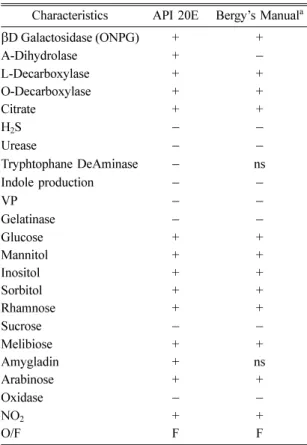
Result of the identification revealed that the isolated bacterium was Gram negative, rod in shape, and motile. Table 1 shows the result of bacterial identification as revealed by API 20E in comparison with the phenotypic characteristics from Bergey’s Manual of Determinative Bacteriology.
The isolate was positive for
β-galactosidase, arginine dihydrolase, lysine decarboxylase, ornithine decarboxylase, and utilization of citrate and fermentative. Negative for the production of H
2S, urease, tryphtophane deaminase, production of indole, Voges-Proskauer reaction, gelatinase and utilization of sucrose.
The isolate was also positive for the utilization of glucose, mannitol, inositol, sorbitol, rhamnose, melibiose, amygladin and nitrite. Based on these features and with reference strain from the Bergey’s Manual of Determinative Bacteriology, it only differed in arginine dihydrolase in which the isolate was positive while negative in Bergey’s reference. However, we further characterized the isolated strain using Vitek 2 and the result showed 91% probability indicating that the isolate is closely related to Seratia fonticola .
Discussion
In 1979, S. fonticola is an enterobacterium that was described as a new species of Serratia and was first isolated from water and soil [6]. It has been related to contaminants in the respiratory tract, and has been isolated in the droppings of European wild birds [11].
This bacterium was recognized to be a human pathogen. It has been described as a contaminant in cases involving wound sustained in a traffic accident [2], an abscess in an open fracture [13], a diarrheic process in an immunodepressed patient [14], and a wound from a bear bite [9]. It was reported that S.
fonticola has an extensive distribution in aquatic environments [5] but no report yet in fish. So far, there were only a few reports on the isolation of other pathogenic Serratia species from fish [1, 10, 12, 15].
Table 1. The characteristics of isolated strain as revealed by API 20E profile in comparison with the reference of Seratia fonticola strain from Bergey’s Manual of Determinative Bacteriology
Characteristics API 20E Bergy’s Manual
aβ
D Galactosidase (ONPG) + +
A-Dihydrolase +
−L-Decarboxylase + +
O-Decarboxylase + +
Citrate + +
H
2S
− −Urease
− −Tryphtophane DeAminase
−ns
Indole production
− −VP
− −Gelatinase
− −Glucose + +
Mannitol + +
Inositol + +
Sorbitol + +
Rhamnose + +
Sucrose
− −Melibiose + +
Amygladin + ns
Arabinose + +
Oxidase
− −NO
2+ +
O/F F F
+: positive,
−: negative, ns: not stated, F: fermentative.
a
Bergey’s Manual of Determinative Bacteriology.
Serratia fonticola