
Clinical Characteristics and Outcomes of Acute Hepatitis A in Korea: A Nationwide Multicenter Study
The aim of this study was to investigate the clinical characteristics of acute hepatitis A during a recent outbreak in Korea. Data of patients diagnosed with acute hepatitis A from 2007 to 2009 were collected from 21 tertiary hospitals retrospectively. Their demographic, clinical, and serological characteristics and their clinical outcomes were analyzed. A total of 4,218 patients (mean age 33.3 yr) were included. The median duration of admission was 9 days. The mean of the highest ALT level was 2,963 IU/L, total bilirubin was 7.3 mg/dL, prothrombin time INR was 1.3. HBsAg was positive in 3.7%, and anti-HCV positive in 0.7%. Renal insufficiency occurred in 2.7%, hepatic failure in 0.9%, relapsing hepatitis in 0.7%, and cholestatic hepatitis in 1.9% of the patients. Nineteen patients (0.45%) died or were transplanted. Complications of renal failure or prolonged cholestasis were more frequent in patients older than 30 yr. In conclusion, most patients with acute hepatitis A recover uneventfully, however, complication rates are higher in patients older than 30 yr than younger patients. Preventive strategies including universal vaccination in infants and active immunization of hepatitis A to adult population should be considered for prevention of community-wide outbreaks of hepatitis A in Korea.
Keywords: Hepatitis A; Morbidity; Mortality So Young Kwon,1 Sang Hoon Park,2
Jong Eun Yeon,3 Sook Hyang Jeong,4 Oh Sang Kwon,5 Jin Woo Lee,6 Hong Soo Kim,7 Yeon Seok Seo,8 Young Seok Kim,9 Joo Hyun Sohn,10 Hyung Joon Yim,11 Jong Young Choi,12 Myung Seok Lee,2 Young Oh Kweon,13 Jae Youn Cheong,14 Haak Cheoul Kim,15 Heon Ju Lee,16 Soon Koo Baik,17 Hyonggin An,18 and Kwan Soo Byun3
1Department of Internal Medicine, Konkuk University School of Medicine, Seoul; 2Department of Internal Medicine, Hallym Univesity College of Medicine, Hallym Univesity Kangnam Sacred Heart Hospital, Seoul;
3Department of Internal Medicine, Korea University College of Medicine, Korea University Guro Hospital, Seoul; 4Department of Internal Medicine, Seoul National University College of Medicine, Seoul National University Bundang Hospital, Seongnam; 5Department of Internal Medicine, Gachon University Graduate School of Medicine, Gachon University Gil Medical Center, Incheon; 6Department of Internal Medicine, Inha University School of Medicine, Inha University Hospital, Incheon; 7Department of Internal Medicine, Soonchunhyang University College of Medicine, Soonchunhyang University Cheonan Hospital, Cheona;
8Department of Internal Medicine, Korea University College of Medicine, Korea University Anam Hospital, Seoul; 9Department of Internal Medicine, Soonchunhyang University College of Medicine, Soonchunhyang University Bucheon Hospital, Bucheon;
10Department of Internal Medicine, Hanyang University College of Medicine, Hanyang University Guri Hospital, Guri; 11Department of Internal Medicine, Korea University College of Medicine, Korea University Ansan Hospital, Ansan; 12Department of Internal Medicine, The Catholic University of Korea School of Medicine, The Catholic University of Korea St. Mary’s Hosptial, Seoul; 13Department of Internal Medicine, Kyungpook National University College of Medicine, Kyungpook National University Hospital, Daegu; 14Department of Internal Medicine, Ajou University School of Medicine, Ajou University Hospital, Suwon; 15Department of Internal Medicine, Wonkwang University School of Medicine, Wonkwang University Hospital, Iksan;
16Department of Internal Medicine, Yeungnam University College of Medicine, Yeungnam University Medical Center, Daegu; 17Department of Internal Medicine, Yonsei University Wonju College of Medicine, Yonsei University Wonju Christian Hospital, Wonju;
18Department of Biostatistics, Korea University College of Medicine, Seoul, Korea
Received: 21 October 2013 Accepted: 29 November 2013 Address for Correspondence:
Kwan Soo Byun, MD
Department of Internal Medicine, Liver Center, Korea University Guro Hospital, 148 Gurodong-ro, Guro-gu, Seoul 152-703, Korea
Tel: +82.2-2030-5027, Fax: +82.2-2030-5029 E-mail: [email protected]
This work was supported by 2008 KASL research funding.
http://dx.doi.org/10.3346/jkms.2014.29.2.248 • J Korean Med Sci 2014; 29: 248-253
INTRODUCTION
The seroprevalence of hepatitis A differs by region according to urbanization and envi
ronmental hygiene. Hepatitis A was endemic in Korea, and most people were infected asymptomatically in early childhood with lifelong immunity (1, 2). However, the sero
prevalence of hepatitis A has been decreasing over the last thirty years with the impro
vement in the socioeconomic status and general public health (35). The decrease in hepatitis A virus (HAV) infection in young adults has resulted in the reduction of indi
viduals who have been naturally immunized and has thus resulted in an increase in the adult population atrisk for acquiring the disease. Sporadic cases and regional out
breaks of hepatitis A have been reported during the last 15 yr (610). The majority of patients develop selflimiting acute illness following HAV infection; however, the dis
ease in adults can lead to serious complications. Recent studies showed increasing tendency in mean age and severity of the disease in symptomatic hepatitis A (11, 12).
Complications of hepatitis A, such as cholestatic hepatitis, relapsing hepatitis or pro
longed course, and acute renal failure are not uncommon during the course of hepati
tis A (1315). Symptomatic hepatitis A is increasing recently in Korea. The surveillance data from Korea Centers for Disease Control (KCDC) demonstrated that the number of hepatitis A patients was rapidly increasing, as an large number of patients developed hepatitis from 2007 to 2009 (16).
The aims of this study were to investigate the clinical characteristics and complica
tions of acute hepatitis A during the recent outbreak in Korea.
Gastroenterology & Hepatology
MATERIALS AND METHODS Patients
Consecutive patients with acute hepatitis A, who visited hospi
tals during the period between June 2007 and May 2009, were included in this study. From medical records of the institutions, the patients with hepatitis Arelated disease categorization codes were collected. A disease categorization codes include the In
ternational Classification of Diseases 10 classification system, B15 (acute hepatitis A), B15.0 (hepatitis A with hepatic coma), and B15.9 (hepatitis A without hepatic coma). There were 21 tertiary hospitals from which the data was obtained and these hospitals are distributed throughout Korea. The patients’ medi
cal records were reviewed retrospectively. Acute hepatitis A was diagnosed by typical symptoms of acute hepatitis, by the pres
ence of serum IgM antiHAV, and by the exclusion of other eti
ologies of acute hepatitis including acute hepatitis B virus infec
tion, drug, ischemia, autoimmune hepatitis, or vascular disorders.
Study design
Demographic, clinical, and laboratory data of liver function and viral markers were collected during the initial visit and at all fol
low ups. In addition, we studied the incidences of complica
tions such as acute renal failure, cholestatic hepatitis, relapsing hepatitis, fulminant hepatitis, death, or transplantation. Acute renal failure was defined as an increase in serum creatinine of 0.5 mg/dL over the baseline value or an increase of more than 50% over the baseline value in patients with no history of renal dysfunction (17). Fulminant hepatic failure was defined as the presence of coagulopathy (prolongation of prothrombin time, international normalized ratio [INR] ≥ 1.5) and clinical evidence of hepatic encephalopathy within 26 weeks of symptom onset in the absence of preexisting liver disease (18). Cholestatic he
patitis was defined as persistence of cholestatic features (biliru
bin > 2.5 mg/dL) for more than 8 weeks (19). Relapsing hepati
tis was defined as recurrence of symptoms and liver function abnormalities (ALT > × 2 nadir) after an apparent recovery (14).
Statistical analysis
Continuous variables were expressed as mean and standard deviations, and the Student’s ttest was employed to compare parametric data. Nonparametric data were analyzed with Mann
Whitney Utest. Categorical variables were expressed as frequen
cy distributions, and Chisquare or Fisher’s exact tests were per
formed. All P values were twotailed, and P values < 0.05 were considered statistically significant.
Ethics statement
This study’s protocol was approved by the institutional review board of Konkuk University Hospital (IRB No. KUH 1010092) and each institute. Informed consent was waived by the board.
The study was conducted in accordance with the principles of the Declaration of Helsinki.
RESULTS
Demographic data of hepatitis A patients
A total of 4,218 patients with acute hepatitis A were included.
Male gender was predominant (62.4%). Mean age of the pa
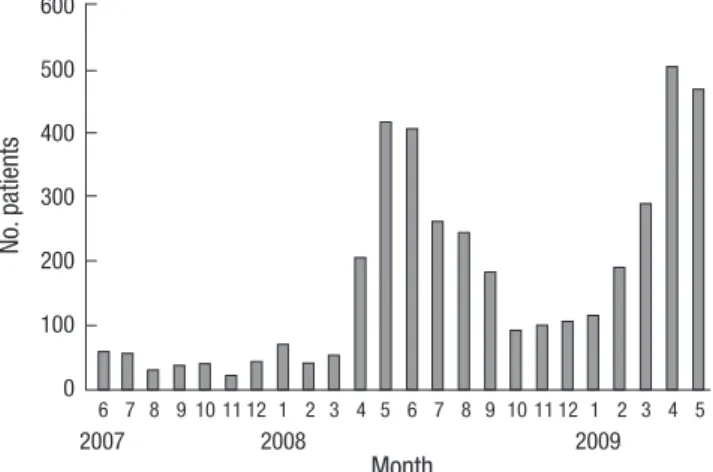
tients was 33.3 yr (standard deviation [SD] 7.7 yr, range 4 to 76 yr). Hepatitis A frequently occurred in their thirties (52.8%), and 17.6% of the patients was over forty years old (Fig. 1). Among the 4,218 patients, 3,555 (59.1%) were admitted via emergency room for severe symptoms. The median duration of admission was 9 days (SD 5.1 days, range 2 to 59 days). During one year, the occurrence of hepatitis A peaked during the months April to August (Fig. 2).
Clinical manifestations
The frequent symptoms of hepatitis A are summarized in Table
Fig. 1. Age distribution of hepatitis A patients (n = 4,218).
Age groups (yr)
<10 10-14 15-19 20-24 25-29 30-34 35-39 40-44 45-49 50-54 >55 1,400
1,200 1,000 800 600 400 200 0
No. patients
Fig. 2. Distribution of hepatitis A patients (n = 4,218) by month.
No. patients
Month
6 7 8 9 10 11 12 1 2 3 4 5 6 7 8 9 10 11 12 1 2 3 4 5
2007 2008 2009
600 500 400 300 200 100 0
1. Gastrointestinal symptoms and fever were most frequent, and jaundice was observed in approximately 50% of the patients.
Laboratory findings showed severe hepatic dysfunction (Table 2). Mean peak ALT was 2,963 IU/L (SD 2,412) with a mean peak bilirubin of 7.3 mg/dL (SD 5.3).
Serologic data showed HBsAg was positive in 3.7% (153/4,049), antiHBs in 63.7% (2,628/3,936), and antiHCV was positive in 0.7% (29/3,937), respectively.
Outcomes of hepatitis A
Fulminant hepatic failure developed in 0.91% of hepatitis A pa
tients. Table 3 demonstrates mortality and morbidity of the he
patitis A patients. Nineteen of 4024 (0.47%) patients died or re
quired liver transplantion. Ten patients died due to fulminant hepatic failure and 9 patients received liver transplants, and 5 of the transplanted patients survived. The incidence of renal fail
ure without combined fulminant hepatitis was 2.73%. The mean age of the 19 cases with mortality or transplantation was not different compared to that of total hepatitis A patients. Severe
hepatic dysfunction and impairment of renal function was ob
served in the mortality cases including death or liver transplan
tation (Table 4). HBV carrier rate was high in the mortality cases (3/19 patients, 15.8%), however, statistical analysis was not avail
able due to great difference in a number of patients.
Comparison of clinical findings by age group
The severity of hepatitis A was compared between patients youn
ger and older than 30 yr (Table 5). There was no significant dif
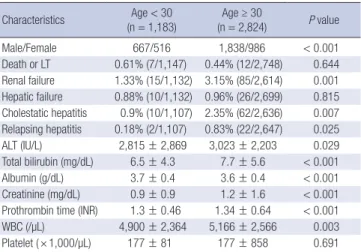
ference in mortality. However, complication rates such as renal failure and cholestasis were significantly higher in the group older than 30 yr. Laboratory data revealed that levels of trans
aminases, total bilirubin, and creatinine were significantly high
er in the group older than 30 yr, and showed more prolonged prothrombin time and lower albumin in the group (Table 5).
Those results represented greater severity in hepatic and renal dysfunction in the group older than 30 yr. Interestingly, male/
female ratio was significantly different between the two groups.
Proportion of male patients was higher in the group older than 30 yr.
Table 1. Symptoms and signs of hepatitis A (n = 4,218)
Symptoms and signs Freguency (%)
Nausea, vomiting 77.2
Fatigue 74
Fever 71.5
Loss of appetite 66.2
Jaundice 49
Arthralgia 17.8
Diarrhea 13.4
Skin rash 4.4
Table 2. Laboratory findings of hepatitis A patients (n = 4,218)
Laboratory items Results
AST (IU/L) 2,676 ± 3,347
ALT (IU/L) 2,963 ± 2,412
Alkaline phosphtase (IU/L) 272 ± 179
GGTP (IU/L) 378 ± 238
Albumin (g/dL) 3.6 ± 0.5
Total bilirubin (mg/dL) 7.3 ± 5.3
Prothrombin time (INR) 1.3 ± 0.5
Creatininte (mg/dL) 1.1 ± 1.5
WBC (/µL) 5,101 ± 2,509
Platelet ( × 1,000/µL) 177 ± 84
Data represents mean ± S.D. of the peak (highest or lowest) level during the follow- ups. AST, aspartate aminotransferase; ALT, alanine aminotransferase; GGTP, gamma glutamyl transpeptidase; WBC, white blood cell.
Table 3. Mortality and morbidity rates of hepatitis A
Outcomes Frequency (case/total)
Death or transplantation 0.47 (19/4,024)
Acute renal failure 2.73 (108/3,949)
Hepatic failure 0.91 (36/3,949)
Cholestatic hepatitis 1.92 (74/3,855)
Relapsing hepatitis 0.65 (25/3,860)
Table 4. Clinical characteristics of cases including death or liver transplantation (n = 19)
Clinical characteristics Results
Mean age (yr) 33 ± 12.2
Male/Female 10/9
Admission duration (day) 17.5 ± 11.9
HBsAg positive 3 cases
Anti-HCV positive 0 case
AST (IU/L) 4,059 ± 5,757
ALT(IU/L) 2,893 ± 3,419
Total bilirubin (mg/dL) 20.3 ± 13.7
Albumin (g/dL) 2.9 ± 0.6
Prothrombin time (INR) 3.3 ± 1.6
Creatininte (mg/dL) 3.8 ± 5.2
Data represents mean ± S.D. AST, aspartate aminotransferase; ALT, alanine amino- transferase.
Table 5. Clinical and laboratory characteristics by age groups in acute hepatitis A Characteristics Age < 30
(n = 1,183) Age ≥ 30
(n = 2,824) P value
Male/Female 667/516 1,838/986 < 0.001
Death or LT 0.61% (7/1,147) 0.44% (12/2,748) 0.644 Renal failure 1.33% (15/1,132) 3.15% (85/2,614) 0.001 Hepatic failure 0.88% (10/1,132) 0.96% (26/2,699) 0.815 Cholestatic hepatitis 0.9% (10/1,107) 2.35% (62/2,636) 0.007 Relapsing hepatitis 0.18% (2/1,107) 0.83% (22/2,647) 0.025
ALT (IU/L) 2,815 ± 2,869 3,023 ± 2,203 0.029
Total bilirubin (mg/dL) 6.5 ± 4.3 7.7 ± 5.6 < 0.001
Albumin (g/dL) 3.7 ± 0.4 3.6 ± 0.4 < 0.001
Creatinine (mg/dL) 0.9 ± 0.9 1.2 ± 1.6 < 0.001 Prothrombin time (INR) 1.3 ± 0.46 1.34 ± 0.64 < 0.001
WBC (/µL) 4,900 ± 2,364 5,166 ± 2,566 0.003
Platelet ( × 1,000/µL) 177 ± 81 177 ± 858 0.691 Laboratory data shows mean ± SD. LT, liver trasnsplantation; ALT, alanine amino- transferase.
DISCUSSION
This study demonstrated that symptomatic hepatitis A occurr
ed primarily in adult populations, the mortality rate including death or liver transplantation was 0.47%, and a significant num
ber of patients experienced complication of renal impairment or prolonged cholestasis. HAV infection used to be endemic in Korea and often occurred asymptomatically in early childhood with lifelong immunity. However, improvement in the econo
mic status and general public health over the last 30 yr has led to a change in seroprevalence of hepatitis A (36). Recent stud
ies have demonstrated that the positivity of antiHAV decreased to less than 10% in the children and adolescents, 20%30% in young adults and the seropositivity is over 90% in adults over 40 yr of age not only in Korea but also in many countries (4, 2022).
The decrease in HAV infection in young adults has resulted in an increase in the adult population that is susceptible to the in
fection. In Korea, symptomatic hepatitis A has been increasing from mid 1990s; in 1998, a countrywide outbreak of the disease occurred. A nationwide study of hepatitis A from 1996 to 1998 including 1391 patients showed that their mean age was 26.5 yr, and most cases recovered uneventfully (23). Lee et al. (23) re
ported that two cases (0.14%) with HAV superinfection among the chronic hepatitis B patients died of fulminant hepatitis. At present, the most common etiology of acute viral hepatitis is hepatitis A virus (50%90%) (24, 25). In addition, hepatitis A is becoming a common etiology of fulminant hepatitis and an in
creasing need for liver transplantation (26). Surveillance data
from KCDC showed that the incidence of hepatitis A was grad
ually increasing after 2000, and large number of patients devel
oped hepatitis from 2007 to 2009 (Fig. 3) (16). This study includ
ed 4,218 hepatitis A cases from the 21 participating institutions during the 2 yr of this study. The incidence of hepatitis A was highest in persons over age 30 yr. This result may suggest that the age of the population susceptible to hepatitis A is getting older and it may result in worse outcomes of the disease.
Hepatitis A is a selflimited acute disease in most cases. Most children younger than 6 yr of age are asymptomatic or develop a mild selflimiting illness (27). However, adults with HAV in
fection can develop more severe symptoms, which can lead to serious complications (11, 28). Therefore, the increasing inci
dence of HAV infection due to changing seroepidemiology in adults might have an impact on morbidity and mortality. In this study, most patients had severe clinical manifestation of gastro
intestinal symptoms and jaundice, and more than a half of the patients visited emergency room for the severe illness. Labora
tory data also showed severe hepatitis in terms of abnormal liv
er function test, the mean levels of peak ALT (2,963 IU/L) and total bilirubin (7.3 mg/dL). Also, unusual pattern of hepatitis A, such as cholestatic hepatitis, relapsing hepatitis or prolonged course, occurs in a considerable number of patients. In this study, most patients with hepatitis A recover uneventfully. However, fulminant hepatic failure occurred in 0.91% of the patients, and mortality rate including death or liver transplantation was 0.47%.
This represents that hepatitis A is no longer a mild disease in the current situation as it presents in Korea. Unusual complica
Fig. 3. Number of acute hepatitis A from data of national surveillance in 2006-2010 in Korea [Reference 16].
No. of patients
2006 2007 2008 2009 2010 1 2 3 4 5 6 7 8 9 10 11 12 1 2 3 4 5 6 7 8 9 10 11 12 1 2 3 4 5 6 7 8 9 10 11 12 1 2 3 4 5 6 7 8 9 10 11 12 1 2 3
3,000
2,500
2,000
1,500
1,000
500
0
tions of hepatitis A were not rare. Acute renal failure occurred in 2.73% of the patients, and some patients were treated with renal replacement therapy. Acute renal failure without fulmi
nant hepatitis is not uncommon during the course of hepatitis A. The patients with the acute renal failure have more severe hepatitis than those without renal failure, however, most cases have a good prognosis. Cholestatic hepatitis with prolonged cho
lestasis and pruritus was observed during the disease course in 1.92% of the patients. The prolonged cholestasis and itching in hepatitis A usually has a benign course, however, they results in decrease in the patients’ quality of life, prolonged duration of admission, and increase in the medical costs (13, 19). The inci
dences of the complications were different between our study and previously published data in 1998 from Korea. They report
ed the complication rate of prolonged cholestasis was 4.7% and acute kidney injury was 1.5% (23). This discrepancy could be in part due to different criteria of the complication and character
istics of patients enrolled. The 19 mortality cases had similar characteristics of age and gender to the included patients. Hep
atitis A may lead to a serious morbidity or mortality in those pa
tients with chronic liver disease (29). The seroprevalence of HAV infection in patients with chronic liver diseases is similar to that in general population by age (30, 31). It has been reported that the clinical features of hepatitis A are severe in patients with chronic HBV infection (32, 33). However, the clinical impact of chronic hepatitis B on the prognosis of hepatitis A is still contro
versial. Kim et al. (33) reported that acute hepatitis A superim
posed on chronic HBV infection is associated with serious mor
bidity and mortality including acute liver failure compared with acute hepatitis alone. Our data revealed that the prevalence of HBsAg in the study population was 3.7%, which is a similar rate in young Korean adults. The HBV carrier rate was high in the mortality cases (15.8%), though statistical significance could not be analyzed due to small number the mortality cases as compared with the study population. Seroprevalence of HAV was low in young and middleaged adults, therefore, catchup vaccination of HAV should be recommended particularly in chronic HBV carriers and cases with chronic liver diseases.
Acute renal failure associated with nonfulminant hepatitis A is not uncommon in acute hepatitis A patients. The incidence of renal failure is reported as 1%5% and has increasing tenden
cy by age (13, 15). The prognosis of renal failure acute hepatitis A is generally benign, although the patients with acute renal fail
ure experience severe hepatitis in terms of clinical outcome and laboratory findings (15). Some patients need renal replacement therapy and prolonged admission, however, permanent renal complication does not occur. In this large scale study, the inciden
ce of acute renal failure in nonfulminant cases was 2.73% (108/
3949) and there was no mortality in the patients with renal fail
ure. In addition to the renal complication, hepatic failure, cho
lestatic hepatitis, or relapsing hepatitis were not rare in the hep
atitis A patients. These complications lead to mortality or prolong
ed course of recovery and much more medical and social costs.
The prognosis of hepatitis A is dependent on the age of patient.
Young children less than 5 yr are usually asymptomatic, while most elder children and adults develop symptoms with jaundice and high levels of serum aminotransferase (11, 27, 28). Recent studies revealed the seroprevalence of antiHAV is less than 50%
in adult population of 20 yr to 40 yr (35, 20). In this study, the median age of the patients was 33.3 yr, and substantial numbers of patients were over 40 yr. We compared the severity of hepati
tis between the groups of the patients younger and older than 30 yr. The clinical manifestations including complications and laboratory data showed that the clinical course in terms of he
patic dysfunction and renal complication was worse in the group of the patients older than 30 yr than in younger patients. These epidemiologic and clinical results suggest that the change of epidemiologic pattern of hepatitis A in our country may lead to increase the disease burden and increase in healthcare cost.
Recently, most pediatricians recommend HAV vaccination dur
ing childhood, although it is not included in universal immuni
zation program in Korea. Catchup vaccination of HAV should be considered in the adult population to reduce community
wide outbreak of symptomatic hepatitis A and its morbidity.
This study was a largescale, nationwide study of symptom
atic hepatitis A, however, it had some limitations. First, only pa
tients from tertiary referral centers were included. This is likely to largely influence the complication rates seen with acute hep
atitis A. We included the patients visiting outpatient clinic as well as patients with admission. However, the morbidity and mortality rates might be overestimated by the patients’ charac
teristics enrolled. Second, this data did not show the genotype distribution, which could be associated with the different se
verity of the disease. This demonstrated the clinical manifesta
tions of the acute hepatitis A in a large number of cases. The ge
notypic differences of genotypes in recent outbreak and poten
tial confounding factors should be investigated for the predic
tion of outcomes and prevention of hepatitis A.
In conclusion, symptomatic hepatitis A in adulthood occurs frequently in Korea, and the changing epidemiologic pattern of the disease may increase disease severity and incidence of com
plications. Strategies of vaccination against HAV in adult popu
lation, as well as children, should be established for the preven
tion of potential outbreaks of hepatitis A and decrease the dis
ease burden.
ACKNOWLEDGMENTS
In addition to the authors, the following investigators partici
pated in the HAV study: Do Young Kim (Yonsei University Sev
erance Hospital, Seoul, Korea), Han Chu Lee (Ulsan University Asan Medical Center, Seoul, Korea), Jeong Heo (Pusan National
University Hospital, Busan, Korea), Byung Cheol Song (Jeju Na
tional University Hospital, Jeju, Korea), Yoon Jun Kim (Seoul National University Hospital, Seoul, Korea).
The authors thank Young Eun Kim for her help with statistical analysis. We also thank Ji Hyun Kim for her technical support.
DISCLOSURE
All authors have no conflicts of interest to disclose.
ORCID
So Young Kwon http://orcid.org/0000-0003-4290-1950
REFERENCES
1. Hong WS, Kim CY. Seroepidemiology of type A and type B hepatitis in Seoul area. Korean J Med 1982; 25: 19-26.
2. Kim TW, Lee KJ. Antibody to hepatitis A antigen in children and adoles- cents in Korea. J Korean Pediatr Soc 1982; 25: 36-40.
3. Lee JI, Kim JY, Kim ST, Yoon SY, Jeong SM, Kim YK, Lee BH. Epidemio- logic study of antibody to hepatitis A antigen in Choong-chung area. Ko- rean J Gastroenterol 1982; 14: 319-23.
4. Sohn YM, Rho HO, Park MS, Park JH, Choi BY, Ki M, Jang WI. The chang- ing epidemiology of hepatitis A in children and the consideration of ac- tive immunization in Korea. Yonsei Med J 2000; 41: 34-9.
5. Yang DW, Lee YA, Shim JY, Park JY, Jung HL, Park MS, Keum DH. A se- roepidemiologic study on hepatitis A in Seoul, Korea. J Korean Pediatr Soc 1999; 42: 180-5.
6. Lee SG, Lee JH, Paik SW, Koh KC, Choi MS, Rhee PL, Kim JJ. Clinical features of hepatitis A in Korean adults. Korean J Med 1999; 56: 685-90.
7. Kwon YO, Choi IJ, Jung JW, Park JH. An epidemiologic study on the sero- positive rate of hepatitis A virus among a selected group of children and adults in Busan. Korean J Pediatr 2007; 50: 262-7.
8. Park CH, Cho YK, Park JH, Jun JS, Park ES, Seo JH, Lim JY, Woo HO, Youn HS, Ko GH, et al. Changes in the age-specific prevalence of hepatitis A vi- rus antibodies: a 10-year cohort study in Jinju, South Korea. Clin Infect Dis 2006; 42: 1148-50.
9. Choi HK, Song YG, Kim CO, Shin SY, Chin BS, Han SH, Jin SJ, Chae YT, Baek JH, Kim SB, et al. Clinical features of re-emerging hepatitis A: an analysis of patients hospitalized during an urban epidemic in Korea.
Yonsei Med J 2011; 52: 686-91.
10. Jeong SH, Lee HS. Hepatitis A: clinical manifestations and management.
Intervirology 2010; 53: 15-9.
11. Lednar WM, Lemon SM, Kirkpatrick JW, Redfield RR, Fields ML, Kelley PW. Frequency of illness associated with epidemic hepatitis A virus in- fections in adults. Am J Epidemiol 1985; 122: 226-33.
12. Lee D, Cho YA, Park Y, Hwang JH, Kim JW, Kim NY, Lee DH, Lee W, Jeong SH. Hepatitis A in Korea: epidemiological shift and call for vac- cine strategy. Intervirology 2008; 51: 70-4.
13. Jung YM, Park SJ, Kim JS, Jang JH, Lee SH, Kim JW, Park YM, Hwang SG, Rim KS, Kang SK, et al. Atypical manifestations of hepatitis A infection:
a prospective, multicenter study in Korea. J Med Virol 2010; 82: 1318-26.
14. Sjogren MH, Tanno H, Fay O, Sileoni S, Cohen BD, Burke DS, Feighny RJ. Hepatitis A virus in stool during clinical relapse. Ann Intern Med 1987;
106: 221-6.
15. Eng C, Chopra S. Acute renal failure in nonfulminant hepatitis A. J Clin Gastroenterol 1990; 12: 717-8.
16. Korea Centers for Disease Control and Prevention. Statistics of surveil- lance of hepatitis A. Available at http://stat.cdc.go.kr [accessed on 1 Oc- tober 2010].
17. Hoste EA, Kellum JA. Acute kidney injury: epidemiology and diagnostic criteria. Curr Opin Crit Care 2006; 12: 531-7.
18. William R. Classification, etiology, and considerations of outcome in acute liver failure. Semin Liver Dis 1996; 16: 343-8.
19. Gordon SC, Reddy KR, Schiff L, Schiff ER. Prolonged intrahepatic cho- lestasis secondary to acute hepatitis A. Ann Intern Med 1984; 101: 635-7.
20. Choi HJ, Lee SY, Ma SH, Kim JH, Hur JK, Kang JH. Age related preva- lence of antibodies to hepatitis A virus performed in Korea in 2005. Ko- rean J Pediatr Infect Dis 2005; 12: 186-94.
21. Kim JH. Recent epidemiological status and vaccination of hepatitis A in Korea. J Korean Med Assoc 2008; 51: 110-8.
22. Barzaga BN. Hepatitis A shifting epidemiology in South-East Asia and China. Vaccine 2000; 18: S61-4.
23. Lee CH, Chung KW, Moon YM. An outbreak of hepatitis A in Korean young adults in 1998. Korean J Gastroenterol 1998; 32: 105A.
24. Choi HJ, Ko SY, Choe WH, Seo YS, Kim JH, Byun KS, Kim YS, Kim SU, Baik SK, Cheong JY, et al. Clinical features of acute viral hepatitis B in Korea: a multi-center study. Korean J Hepatol 2011; 17: 307-12.
25. Song MH, Lim YS, Song TJ, Choi JM, Kim JI, Jun JB, Kim MY, Pyun DK, Lee HC, Jung YH, et al. The etiology of acute viral hepatitis for the last 3 years. Korean J Med 2005; 68: 256-60.
26. Heo NY, Lim YS, Kang JM, Oh SI, Park CS, Jung SW, Lee YS, Kim KM, Lee HC, Chung YH, et al. Clinical features of fulminant hepatic failure in a tertiary hospital with a liver transplant center in Korea. Korean J Hepatol 2006; 12: 82-92.
27. Gingrich GA, Hadler SC, Elder HA, Ash KO. Serologic investigation of an outbreak of hepatitis A in a rural day-care center. Am J Public Health 1983; 73: 1190-3.
28. Hadler SC, Webster HM, Erben JJ, Swanson JE, Maynard JE. Hepatitis A in day-care centers: a community-wide assessment. N Engl J Med 1980;
302: 1222-7.
29. Keeffe EB. Is hepatitis A more severe in patients with chronic hepatitis B and other chronic liver diseases? Am J Gastroenterol 1995; 90: 201-5.
30. Kim DY, Ahn SH, Lee HW, Kim SU, Kim JK, Paik YH, Lee KS, Han KH, Chon CY. Anti-hepatitis A virus seroprevalence among patients with chronic viral liver disease in Korea. Eur J Gastroenterol Hepatol 2007;
19: 923-6.
31. Song HJ, Kim TH, Song JH, Oh HJ, Ryu KH, Yeom HJ, Kim SE, Jung HK, Shim KN, Jung SA, et al. Emerging need for vaccination against hepatitis A virus in patients with chronic liver disease in Korea. J Korean Med Sci 2007; 22: 218-22.
32. Chu CM, Liaw YF. Increased incidence of fulminant hepatic failure in previously unrecognized HBsAg carriers with acute hepatitis indepen- dent of etiology. Infection 2005; 33: 136-9.
33. Kim KM, Eo SJ, Gwak GY, Choi MS, Lee JH, Koh KC, Yoo BC, Paik SW.
Comparison of the clinical features of hepatitis A between HBsAg-posi- tive and HBsAg-negative patients. Gut and Liver 2011; 5: 500-5.
![Fig. 3. Number of acute hepatitis A from data of national surveillance in 2006-2010 in Korea [Reference 16].](https://thumb-ap.123doks.com/thumbv2/123dokinfo/5137049.92129/4.892.78.796.111.500/fig-number-acute-hepatitis-national-surveillance-korea-reference.webp)
