• 검색 결과가 없습니다.

Genetic Polymorphism of Jeju Horses by Microsatellite DNA Markers in Korea

N/A
N/A
Protected

Academic year: 2022

Share "Genetic Polymorphism of Jeju Horses by Microsatellite DNA Markers in Korea"

Copied!
3
0
0

로드 중.... (전체 텍스트 보기)

전체 글

(1)

219

Genetic Polymorphism of Jeju Horses by Microsatellite DNA Markers in Korea

Jung Eun Lee

1

, Jae Hoon Shin

1

, Young Min Yun

2

, Kyung Kap Lee

2

, Hang Lee

3

, Oh Kyung Kweon

4

, Yeo-Sung Yun

1

, Jun Gyo Suh

5

, Nam Shik Shin

6

* and Je Kyung Seong

1

*

1

Laboratory of Developmental Biology and Genomics, College of Veterinary Medicine, Seoul National University, Seoul, Korea

2

College of Veterinary Medicine, Jeju National University, Jeju, Korea

3

Department of Veterinary Biochemistry, College of Veterinary Medicine, Seoul National University, Seoul, Korea

4

Department of Veterinary Surgery, , College of Veterinary Medicine, Seoul National University, Seoul, Korea

5

Department of Medical Genetics, College of Medicine, Hallym University, Chuncheon, Korea

6

Department of Zoo and Wild Animal Medicine, College of Veterinary Medicine, Seoul National University, Seoul, Korea We determined the genetic diversity and distance between Jeju and Thoroughbred horses by genotyping for 20 microsatellite loci consisting of (TG)n repetitive sequence. The expected heterozygosity ranged from 0.1 to 0.789 in the Jeju horses and from 0.505 to 0.824 in the Thoroughbred horses. Polymorphic information content (PIC) values ranged from 0.09 to 0.709 in the Jeju horses and 0.365 to 0.730 in Thoroughbred horses. There were no significant differences in heterozygosity and PIC values between Jeju and Thoroughbred horsesHowever, LEX035 was estimated relatively high heterozygosity (0.789) and PIC value 0.709) in Jeju horses and LEX050 was respectively 0.824, and 0.730 in the Thoroughbred horses. We may conclude that the genetic differentiation was low between Jeju and Thoroughbred horses.

LEX 050, LEX055, LEX059 and LEX 063 could be used as geneticmarkers for differentiating Jeju from Thoroughbred horses.

Key words: Jeju horses, genetic polymorphism, microsatellite DNA

Received 24 November 2009; Revised version received 7 June 2010; Accepted 14 June 2010

Microsatellites are short tandem repeat sequences consisting of repeat unit of 2-6 base pair (bp) in length. Most repeat sequences of 2-6 bp have been identified in vertebrates and microsatellite DNA seems to be relatively abundant in genomes of many taxa. Microsatellite loci have proved to be powerful tools for gene mapping, paternity test and genetic population structure because of their high heterozygosity. Microsatellites have been suggested to play a role in gene regulation and recombination but there was very little knowledge concerning their function (FitzSimmons et al., 1995; Forbes et al., 1995).

Recently, microsatellite polymorphisms have been used to determine allele frequencies in interspecific population and intrapopulation (Buchanan et al., 1994).

Korean native horses, Jeju horses called, as Jorang are 120- 130 cm in height and indigenouse to Jeju islands. Based on mitochondrial D-loop sequences analysis, Jeju horses were mixed origin in their maternal lineage, and may have inhabited the island beforethe introduction of Mongolian horses in 1276 (Kim et al., 1999). However, genetic markers, phylogenetic relationships and species conservation have not been extensively studied in Jeju horses using molecular technique.

Microsatellite mutation rates are approximately 10

−3

-10

−4

(Dietrich et al., 1992; Weissenbach et al., 1992). According to divergence time of ancestral Equus species, microsatellite loci were suitable marker for studying genetic polymorphism of Jeju horses population in Korea.

In this paper, we described allele size, allele number, heterozygosity, and polymorphic information content (PIC) values, which are useful for a measure of polymorphism for a marker locus used in linkage analysis, to determine the

*Corresponding authors: Je Kyung Seong, College of Veterinary Medicine, Seoul National University, Gwanak 599, Gwanakro, Gwanakgu, Seoul 151-742, Korea

Tel : +82-2-880-1259 Fax: +82-2-875-8395 E-mail: [email protected]

Nam Shik Shin, College of Veterinary Medicine, Seoul National University, Gwanak 599, Gwanakro, Gwanakgu, Seoul 151-742, Korea

Tel: +82-2-880-1260 Fax: +82-2-880-1260 E-mail: [email protected]

Lab. Anim. Res. 2010: 26(2), 219-221

Letter

(2)

220

Jung Eun Lee et al.

Lab. Anim. Res.

| June, 2010 | Vol. 26, No. 2

genetic diversity of Jeju horses in Korea compared with Thoroughbred horses using microsatellite DNA markers consisting of (TG)n repetitive sequences (Shete et al., 2000).

Materials and Methods

Genomic DNA was extracted from peripheral blood obtained from each 20 sample in both Jeju and Thoroughbred horses. Jeju horses samples were provided from Jeju National University and Throughbred samples were from KRA (Korea Racing Authority). The microsatellite loci were amplified by 30-35 cycles, each cycle consisting of denaturation for 30 sec at 95

o

C, annealing for 30 sec at 55

o

C, and extension for 30 sec at 72

o

C. We used 20 primers consisting of (TG)n repetitive sequence based on the data (LEX 034-063) (Coogle and Bailey, 1997; Coogle et al ., 1997). The amplified PCR fragments were identified via 3% agarose gel electrophoresis and run on 6% denatured polyacrylamide gel. The gel was identified using general silver staining method. To identify or confirm exact base pair of microsatellite loci, 1-2 samples per microsatellite loci were selected for sequencing. Statistic analysis was utilized for CERVUS program (Version 1.0, The University of Edinburgh, 1988; http://helios.bto.ed.ac.uk/

evolgen/ cervus/). Allele size, number of alleles, PIC, and heterozygosity were calculated for each microsatellite loci.

Results

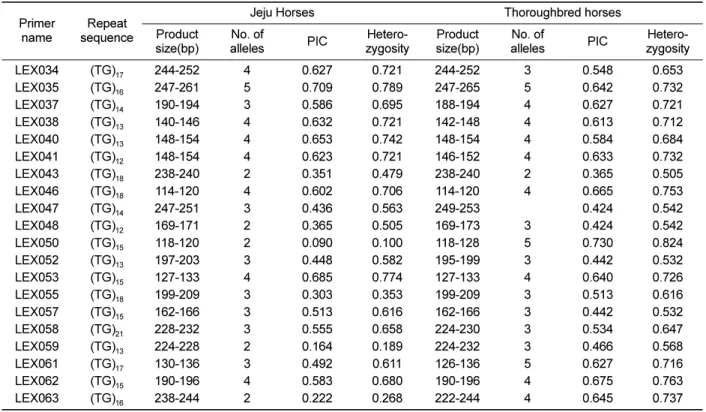
The number of alleles ranged from 2 to 5 per locus. Not all samples were amplified for all loci. Total 64 alleles in Jeju horses and 73 alleles in Throughbred horses were detected across the 20 loci analyzed. Allele size, number of allele, PIC values and heterozygosity per loci were summarized in Table 1. The variation of allele size among Thoroughbred horses was higher than Jeju horses. The differences of allele size at microsatellite loci are due to the variation in the numbers of repeats (Buchanan et al ., 1994; Forbes et al ., 1995).

All microsatellite loci were polymorphic in this study.

Expected heterozygosity was ranged from 0.100 to 0.789 in the Jeju horses, and 0.505 to 0.824 in the Thoroughbred racehorses. The mean value of the PIC of dinucleotide microsatellites was 0.482 in Jeju horses and 0.562 in Thoroughbred racehorses. The highest heterozygosity and PIC were estimated at LEX035 (0.789, 0.709) in Jeju horses and LEX050 (0.824, 0.730) in Thoroughbred racehorses. The lowest heterozygosity and PIC was observed at LEX050 (0.100, 0.090) in Jeju horses and LEX043 (0.505, 0.365) in Thoroughbred racehorses. According to the values of PIC and heterozygosity, there were no significant differences among those microsatellite loci between Jeju and Thorough- bred horses in LEX050, LEX05, LEX059 and LEX063. In

Table 1. Characteristics of microsatellite loci of Jeju and Thoroughbred horses Primer

name Repeat sequence

Jeju Horses Thoroughbred horses

Product

size(bp) No. of

alleles PIC Hetero-

zygosity Product

size(bp) No. of

alleles PIC Hetero- zygosity

LEX034 (TG)

17

244-252 4 0.627 0.721 244-252 3 0.548 0.653

LEX035 (TG)

16

247-261 5 0.709 0.789 247-265 5 0.642 0.732

LEX037 (TG)

14

190-194 3 0.586 0.695 188-194 4 0.627 0.721

LEX038 (TG)

13

140-146 4 0.632 0.721 142-148 4 0.613 0.712

LEX040 (TG)

13

148-154 4 0.653 0.742 148-154 4 0.584 0.684

LEX041 (TG)

12

148-154 4 0.623 0.721 146-152 4 0.633 0.732

LEX043 (TG)

18

238-240 2 0.351 0.479 238-240 2 0.365 0.505

LEX046 (TG)

18

114-120 4 0.602 0.706 114-120 4 0.665 0.753

LEX047 (TG)

14

247-251 3 0.436 0.563 249-253 0.424 0.542

LEX048 (TG)

12

169-171 2 0.365 0.505 169-173 3 0.424 0.542

LEX050 (TG)

15

118-120 2 0.090 0.100 118-128 5 0.730 0.824

LEX052 (TG)

13

197-203 3 0.448 0.582 195-199 3 0.442 0.532

LEX053 (TG)

15

127-133 4 0.685 0.774 127-133 4 0.640 0.726

LEX055 (TG)

18

199-209 3 0.303 0.353 199-209 3 0.513 0.616

LEX057 (TG)

15

162-166 3 0.513 0.616 162-166 3 0.442 0.532

LEX058 (TG)

21

228-232 3 0.555 0.658 224-230 3 0.534 0.647

LEX059 (TG)

13

224-228 2 0.164 0.189 224-232 3 0.466 0.568

LEX061 (TG)

17

130-136 3 0.492 0.611 126-136 5 0.627 0.716

LEX062 (TG)

15

190-196 4 0.583 0.680 190-196 4 0.675 0.763

LEX063 (TG)

16

238-244 2 0.222 0.268 222-244 4 0.645 0.737

(3)

Genetic polymorphism of Korean Jeju horses 221

Lab. Anim. Res. | June, 2010 | Vol. 26, No. 2

comparison with allele distribution , the same number and the same allele loci were found only in 7 (LEX040, 043, 046, 052, 055, 057, 062) of 20 loci in both horses.

Discussion

The utility of microsatellites testing has been examined in limited trials of human, cattle and dog parentage. Microsatellite markers of horses have been studied in pedigree assignment, the genetic structure of specific level and the linkage analysis of the gene for family disease (Alford et al ., 1994; Glowatzki- Mullis et al ., 1995; Bailey et al ., 1997). Bowling et al . (Bowling

et al ., 1997) reported that microsatellite testing is a more suitable marker than blood typing for the expanding field of genome mapping of horses. Differences in allele size and polymorphism among taxa may be explained by characterizing microsatellite loci (FitzSimmons et al ., 1995; Pepin et al ., 1995). The range of sizes found for simple repeat sequences depends on the method used to detect them and sample size.

In this study, it was shown that Jeju horses have lower polymorphic loci than thoroughbred horses (Table 1) even though there were no significant differences between Jeju horses (mean of heterozygosity=0.574) and Thoroughbred racehorses (mean of heterozygosity=0.662) based on heterozygosity. We assume that that Jeju horses have been maintaining their conserved genetic uniformity because they have inhabited a limited area, Jeju island. Although the genetic polymorphism between Jeju and Thoroughbred horses could not be exactly clarified due to the small sample size and microsatellite loci, our results will provide stronger evidence to support the genetic difference between Jeju and Thoroughbred horses. We propose that the microsatellite marker will be a powerful tool for pedigree assignment of Jeju horses and will contribute to conservation of Korean native species. In addition, LEX050, LEX055, LEX059 and LEX063 will be candidate markers for differentiating Jeju horses from Thoroughbred horses. Further study is required for much more precise understanding of the genetic polymorphism and the genetic diversity of Jeju horses comparing with other horses.

Acknowledgments

This work was partly supported by MAF-SGRP (Ministry of agriculture and Forestry-Special Grants Research program) to Prof. Seong JK and by Priority Research Centers Program

through the National Research Foundation of Korea (NRF) founded by the Ministry of Education, Science and Technology (2009-0094074) to Prof. Suh JG.

References

Alford, R. L., Hammond, H. A., Coto, I. and Caskey, C. T. (1994) Rapid and efficient resolution of parentage by amplification of short tandem repeats. Am. J. Hum. Genet. 55(1), 190- 195.

Bailey, E., Reid, R.C., Skow, L.C., Mathiason, K., Lear, T.L. and McGuire, T. C. (1997) Linkage of the gene for equine combined immunodeficiency disease to microsatellite markers HTG8 and HTG4; synteny and FISH mapping to ECA9. Anim. Genet. 28(4), 268-273.

Bowling, A. T., Eggleston-Stott, M.L., Byrns, G., Clark, R.S., Dileanis, S. and Wictum, E. (1997) Validation of microsatellite markers for routine horse parentage testing.

Anim. Genet. 28(4), 247-252.

Buchanan, F.C., Adams, L.J., Littlejohn, R.P., Maddox, J.F. and Crawford, A. M. (1994) Determination of evolutionary relationships among sheep breeds using microsatellites.

Genomics 22(2), 397-403.

Coogle, L. and Bailey, E. (1997) Equine dinucleotide repeat loci LEX049-LEX063. Anim. Genet. 28(5), 378.

Coogle, L., Reid, R. and Bailey, E. (1997) Equine dinucleotide repeat loci LEX034-LEX048. Anim. Genet. 28(4), 309.

Dietrich, W., Katz, H., Lincoln. S. E., Shin, H. S., Friedman, J., Dracopoli, N. C. and Lander, E. S. (1992) A genetic map of the mouse suitable for typing intraspecific crosses. Genetics 131(2), 423-447.

FitzSimmons, N. N., Moritz, C. and Moore, S. S. (1995) Conservation and dynamics of microsatellite loci over 300 million years of marine turtle evolution. Mol. Biol. Evol.

12(3), 432-440.

Forbes, S. H., Hogg, J. T., Buchanan, F. C., Crawford, A. M. and Allendorf, F. W. (1995) Microsatellite evolution in congeneric mammals: domestic and bighorn sheep. Mol. Biol. Evol.

12(6), 1106-1113.

Glowatzki-Mullis, M. L., Gaillard, C., Wigger, G. and Fries, R.

(1995) Microsatellite-based parentage control in cattle. Anim.

Genet. 26(1), 7-12.

Kim, K. I., Yang, Y. H., Lee, S. S., Park, C., Ma, R., Bouzat, J. L.

and Lewin, H. A. (1999) Phylogenetic relationships of Cheju horses to other horse breeds as determined by mtDNA D- loop sequence polymorphism. Anim. Genet. 30(2), 102-108.

Pepin, L., Amigues, Y., Lepingle, A., Berthier, J. L., Bensaid, A.

and Vaiman, D. (1995) Sequence conservation of microsatellites between Bos taurus (cattle), Capra hircus (goat) and related species. Examples of use in parentage testing and phylogeny analysis. Heredity 74(Pt1), 53-61.

Shete, S., Tiwari, H. and Elston, R. C. (2000) On Estimating the Heterozygosity and Polymorphism Information Content Value. Theor. Popul. Biol. 57(3), 265-271.

Weissenbach, J., Gyapay, G., Dib, C., Vignal, A., Morissette, J.,

Millasseau, P., Vayssiex, G. and Lathrop, M. (1992) A second-

generation linkage map of the human genome. A second-

generation linkage map of the human genome. Nature

359(6398), 794-801.

수치

Table 1.  Characteristics of microsatellite loci of Jeju and Thoroughbred horses Primer

참조

관련 문서

Department of Naval Architecture and Ocean Engineering, Seoul National University of College of Engineering.. Ship Motion & Wave Load

Department of Naval Architecture and Ocean Engineering, Seoul National University of College of Engineering@. 서울대학교 조선해양공학과 학부4학년

Department of Naval Architecture and Ocean Engineering, Seoul National University.. Naval Architecture

School of Mechanical and Aerospace Engineering Seoul National University..

School of Mechanical and Aerospace Engineering Seoul National University..

Department of Naval Architecture and Ocean Engineering, Seoul National University of College

Department of Naval Architecture and Ocean Engineering, Seoul National University of College of

Department of Nuclear Engineering