ISSN 2234-3806 • eISSN 2234-3814
https://doi.org/10.3343/alm.2017.37.2.124
Long-Term Quality Control Program Plan for Cord Blood Banks in Korea: A Pilot Study for
Cryopreservation Stability
Soo Hyun Seo, M.D.1,2,3,*, Sue Shin, M.D.1,2,3,*, Eun Youn Roh, M.D.1,2,3, Eun Young Song, M.D.1, Sohee Oh, Ph.D.4, Byoung Jae Kim, M.D.5, and Jong Hyun Yoon, M.D.1,2,3
Department of Laboratory Medicine1, Seoul National University College of Medicine; Department of Laboratory Medicine2, Boramae Hospital; Seoul Metropolitan Government Public Cord Blood Bank (Allcord)3; Department of Biostatics4, Boramae Hospital; Department of Obstetrics and Gynecology5, Boramae Hospital, Seoul, Korea
Background: Maintaining the quality of cryopreserved cord blood is crucial. In this pilot study, we describe the results of the internal quality control program for a cord blood bank thus far.
Methods: Donated cord blood units unsuitable for transplantation were selected for inter- nal quality control once a month. One unit of cord blood, aliquoted into 21 capillaries, was cryopreserved and thawed annually to analyze the total nucleated cell count, CD34+ cell count, cell viability test, and colony-forming units assay.
Results: No significant differences in the variables (total nucleated cell count, cell viability, CD34+ cell count) were observed between samples cryopreserved for one and two years.
Upon comparing the variables before cryopreservation and post thawing with the capillar- ies of one year of storage, cell viability and CD34+ cell counts decreased significantly. The use of cord blood samples in capillaries, which can be easily stored for a long period, was similar to the methods used for testing segments attached to the cord blood unit.
Conclusions: The results of this study may be useful for determining the period during which the quality of cryopreserved cord blood units used for transplantation is maintained.
Key Words: Umbilical cord blood, Internal quality control, Cryopreservation, Capillaries
Received: March 2, 2016 Revision received: August 9, 2016 Accepted: November 17, 2016 Corresponding author: Jong Hyun Yoon Department of Laboratory Medicine, Seoul National University Boramae Hospital 20 Boramae-ro 5 gil, Dongjak-gu, Seoul 07061, Korea
Tel: +82-2-870-2601 Fax: +82-2-870-2632 E-mail: [email protected]
* These authors equally contributed to the study.
© Korean Society for Laboratory Medicine This is an Open Access article distributed under the terms of the Creative Commons Attribution Non-Commercial License (http://creativecom- mons.org/licenses/by-nc/4.0) which permits unrestricted non-commercial use, distribution, and reproduction in any medium, provided the original work is properly cited.
INTRODUCTION
Umbilical cord blood is recognized as a source of allogeneic he- matopoietic stem cells since the first successful cord blood transplantation in a patient with Fanconi anemia [1]. Hundreds of thousands of processed cord bloods units (CBUs) are stored globally, and maintaining the quality of long-term cryopreserved cord blood has become an important issue. External and inter- nal quality control programs for cryopreserved cord blood are implemented in each cord blood bank. Total nucleated cell (TNC) count, CD34+ cell count, cell viability, and colony-forming units
(CFU) are the commonly analyzed quality control variables used by both external and internal programs.
While external quality control programs are usually operated by government-related organizations or government-accredited institutions (i.e., EUROCORD, NMDP), internal quality control programs are conducted by the cord blood bank itself at each processing step. According to the Korean law, internal quality control analysis for maintaining the quality of cryopreserved cord blood should be performed monthly, but specific details besides laboratory tests are not described. In our previous study, we eval- uated the quality of 200 CBUs that were cryopreserved for 1–5
yr and concluded that cryopreservation does not affect the qual- ity of CBUs [2]. In line with quality maintenance for a defined period, we describe the results of the internal quality control program thus far, to see the feasibility of our long-term internal quality control program for the cord blood bank, which will con- tinue over a 21-yr period.
METHODS
1. Processing and measurement of cord blood variables
CBUs were collected after obtaining informed consent from the mother and were processed for cryopreservation according to the standard operating procedures of Seoul Metropolitan Gov- ernment Public Cord Blood Bank (Allcord) [3, 4]. The collection bag weight was measured, and the blood volume was calculated with the density factor of 1.05 g/mL. Cord blood samples with a volume >60 mL were then assessed for complete blood count and cell viability (pre-processing viability).Nucleated cell concentrates (20 mL) were obtained after re- moving red blood cells and extra plasma from cord blood using a transfer/freezing bag set (Pall Medical, Covina, CA, USA). The nucleated cell concentrate was then assessed for the TNC and CD34+ cell counts. The TNCs were determined by using an au- tomated cell counter (XE-2100; Sysmex, Kobe, Japan). CD34+ cell determination was conducted as previously described by using a Stem-kit (#IM3630, BD Bioscience, San Jose, CA, USA) [2], on the basis of the single-platform International Society of Hematotherapy and Graft Engineering method. After adding 5 mL of cryoprotectant (2.5 mL of dimethyl sulfoxide [Mylan, Rock-
ford, IL, USA] and 2.5 mL of 10% dextran [Daihan, Namyangju, Korea]), the nucleated cell concentrate resulted in a final volume of 25 mL for each CBU. Pre-cryopreservation cell viability was tested by staining with 0.4% trypan blue, and viabilities over 80%
were considered acceptable. The CBUs were transferred to a controlled-rate freezer (CryoMed, Thermo Forma, Marietta, OH, USA) for cryopreservation.
2. Sample selection for long-term internal quality control plan
Once a month, donated cord blood that was unsuitable for stor- age as a CBU for allogeneic transplantation [5] was selected. The selected nonconforming CBU in this study was a sample with an initial TNC level <8×10⁸/CBU that had no other reason for un- suitability. This study using the nonconforming CBUs as quality control materials was categorized as an exempt review by the In- stitutional Review Board of Boramae Hospital (07-2016-1).
3. Preparation of quality control materials
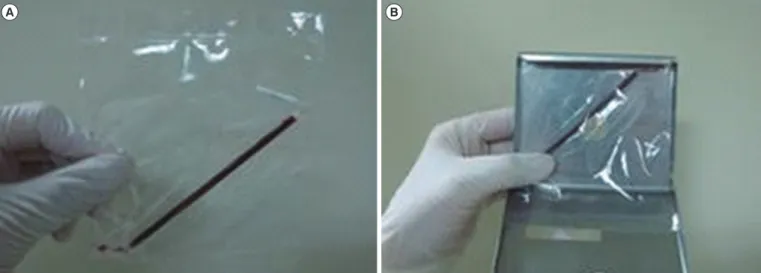
The selected nonconforming CBU was processed with the same steps used for conforming CBUs. The nonconforming CBU ready for cryopreservation was aliquoted into 21 capillaries, which would be cryopreserved for the next 21 yr. Using a 10 mL syringe, 0.3–
0.4 mL of cord blood was filled into each of the 21 capillaries (Medium straws #005569, IMV Technologies, L’Aigle, France), which were then sealed at both ends (Fig. 1). Each capillary was placed into an overwrap bag, and placed in canisters (3 capillaries/canister); there were seven canisters for each CBU, which were stored in liquid nitrogen for future use.
Fig. 1. Capillary preparation for the quality control program. (A) An overwrapped capillary containing 300–400 µL of cord blood sealed at both ends. (B) An overwrapped capillary placed into a canister, which was transferred to a liquid nitrogen tank, similar to the storage condi- tions used for cord blood units.
A B
4. Evaluating homogeneity of capillaries from the same CBU
In order to pre-evaluate the reproducibility of the cord blood variables for each capillary, 4 CBUs in the pre-cryopreservation state were selected and aliquoted into 23–30 capillaries. Capil- laries were stored in liquid nitrogen and thawed seven days later.Cell viability (post-thawing), TNC count, and CD34+ cell count were analyzed for each capillary, and the reproducibility of the measurements among capillaries from each CBU was assessed.
5. Assessment of cord blood variables in capillaries cryopreserved for one year
Cord blood capillaries that were to be tested each month were removed from the freezer and thawed in a 37°C water bath; a similar procedure was used when thawing the segment attached to the main bag for a transplantation verification test. After thaw- ing, the cord blood was poured into a test tube by incising the ends of the capillaries, and the cord blood variables (TNC and CD34+ cell count, cell viability test, and CFU assay) were assess ed using previously described methods [2, 3]. In this study, the first capillary was thawed and analyzed after one year of storage. Af- terwards, one capillary from each CBU will be analyzed every year.
6. The quality control samples for the pilot study
The first CBU capillaries were prepared in October 2012, with one new set prepared each month since. The samples for the pilot study included the samples from October 2012 to January 2014. The 3 CBUs that were processed in 2012 plus the 12 CBUs processed every year from 2013 to 2032 will add up to a total of 243 CBUs. Homogeneity of the capillaries was represent ed as a CV of 7-day-frozen and thawed capillaries. The blood vari- ables were compared for the first and second year of storage to investigate the effects of cryopreservation duration.
7. Statistical analysis
A Wilcoxon signed-rank test was performed to determine the statistical significance of the variable changes between before
freezing and after thawing, and also according to the duration of cryopreservation. P values < 0.05 were considered significant (IBM SPSS Statistics 24, Chicago, IL, USA). The variables of cryopreserved cord blood were presented as median and the range in parentheses.
RESULTS
1. Preparation of the quality control samples
Currently, the first and second year variables have been asse- ssed in 16 and 4 CBUs, respectively. All 243 CBUs will be tested by the end of this protocol.
2. Evaluating homogeneity among capillaries
The CV for cell viability and TNC counts was <4%; however, the CV% value for CD34+ cell count was 8.54–18.14% (Table 1).
3. Effects of cryopreservation for one year
No significant difference in TNC count was observed between before and after cryopreservation of one year for the 16 CBUs, but there was a significant decrease in CD34+ cell counts and cell viability (Table 2). The median CD34+ cell counts were 1.85
Table 1. Reproducibility of variables among capillaries
Cord Blood Unit ID Viability (%) TNC (108/unit) CD34+ (106/unit)
#1 (n=23) Mean SD CV (%)
88.22 1.09 1.23
5.98 0.17 2.81
0.28 0.05 18.14
#2 (n=25) Mean SD CV (%)
90.00 1.97 2.19
6.96 0.28 3.96
1.92 0.29 15.01
#3 (n=30) Mean SD CV (%)
89.87 1.53 1.70
7.59 0.16 2.10
1.29 0.19 14.93
#4 (n=30) Mean SD CV (%)
87.73 1.62 1.84
8.34 0.20 2.42
1.82 0.16 8.54 Abbreviations: ID, identification; TNC, total nucleated cell count.
Table 2. Changes in variables of cryopreserved cord blood from before freezing to after thawing (n=16)
Variables Before freezing After thawing (1st year) Recovery (%)/∆Viability* P value
TNC (108/unit) 7.25 (6.52-8.06) 7.30 (5.88-8.20) 100.7 (79.4-125.8) 0.438
CD34+ (106/unit) 1.85 (0.89-4.04) 1.48 (0.51-3.13) 80.0 (46.0-140.9) 0.003
Cell viability (%) 92.0 (89.0-93.0) 87.3 (79.5-92.0) 4.8 (0.0-12.5) 0.001
The values are presented as median (range).
*The change in viability between before freezing and after thawing.
Abbreviation: TNC, total nucleated cell count.
×106/unit before freezing and 1.48×10⁶/unit after thawing (re- covery 80%). The median cell viability percentage decreased from 92.0% before freezing to 87.3% after thawing (P =0.001).
4. Effects of different durations of cryopreservation
No significant differences were observed in the TNC counts, CD34+ cell counts, cell viability, or CFU between the first and second year of cryopreservation (Table 3).
DISCUSSION
Previous studies suggested that variables of cord blood quality correlate with the engraftment success rate and long-term sur- vival of the patient [6, 7]. A cord blood Apgar score has been recently developed to measure the engraftment potential of cord blood [8]. Maintaining cord blood quality during cryopreserva- tion has become an important issue because umbilical cord blood is more readily available than ever before.
In this study, we present the result of a pilot study as a part of a 21-yr plan for the internal quality control program in our cord blood bank. Besides the relative long-term period of evaluation comparable to other studies [9, 10], our study has three advan- tages over previous studies assessing CBU quality [9-13]. First, while many previous studies compared groups of CBUs that had been stored for a specific duration, we planned to aliquot a sin- gle unit into 21 capillaries that can be tested over time. There- fore, we can compare multiple results (a maximum of 21 results) from one CBU over 21 yr if we test a capillary once per year.
Second, the containers for evaluating cryopreserved CBU have typically been cryotubes [10], which are generally used in pre- clinical research laboratories, but we introduced capillaries that are suitable for long-term preservation of live reproductive cells.
Third, the capillaries were cryopreserved in liquid nitrogen to simulate the environment used for storing conforming CBUs.
Furthermore, the capillary preparation procedure was simple
and allowed easy, long-term follow-up of the same CBU. The CV among capillaries of each CBU showed high reproducibility for viability and TNC counts. The CD34+ cell counts showed higher CV% than other variables, which may be due to the relatively low levels of CD34+ cell counts in the samples used to validate reproducibility. This capillary method can be used for preparing materials for inter-laboratory external proficiency tests, because the capillaries originate from the same CBU.
According to our data, thawing the cryopreserved CBUs re- sulted in a significant decrease in the CD34+ cell counts and cell viabilities. This decrease in CD34+ cells and cell viability were similar to the rates reported previously [11]. Although some re- ports demonstrated an overall decrease in TNCs of approximately 11–30% [11-13], we observed stable TNC levels during upon thawing, and this observation is in line with our previous results [2]. Since the sample numbers, preservation condition (vapor or liquid phase of liquid nitrogen), preservation periods, and the time of sampling (immediate post-thaw or after-washing state) for each study were too diverse to reach a robust conclusion re- garding any changes in TNC, we expect that further studies will determine if cryopreservation period affects the TNC.
On the other hand, the difference in the cryopreservation pe- riod did not result in any significant changes in TNC, viability, or CD34+ cell count between the capillaries stored for one or two years. In previous studies, a significant increase in the percent- age of cells expressing CD34+ was observed with increasing stor- age time [12, 14]. These studies involved CBUs from multiple institutions, which indicates the challenge in quantifying CD34+ cells. When multiple cryopreserved capillaries from the same CBUs are available for internal quality control analysis over 21 yr, differences or deviations in the sample test results may be detected more thoroughly.
This study has some limitations. First, we were only able to conduct a short-term analysis of our long-term plan using the pilot data. Second, this study was based on only in vitro tests, which focused on the quality control of stored CBUs, and did not reflect the clinical outcome of transplanted cord blood ac- cording to the variables analyzed.
In summary, we proposed a long-term internal quality control plan for cord blood banks, which can be used to assess the mar- kers used for quality assessment during long-term cord blood storage. Using cord blood in capillaries, which can be easily stored for a long period, is similar to testing integral segments attached to each CBU. In this pilot study, consisting of 16 and four cord blood samples that were analyzed in the first and second year of storage, respectively, we observed no meaningful changes in Table 3. Changes in variables of cryopreserved cord blood accord-
ing to the duration of cryopreservation (n=4) Variables Duration of storage
P value
1 yr 2 yr
TNC (108/unit) 7.00 (6.5-7.53) 6.94 (5.90-7.42) 0.465 CD34+ (106/unit) 1.15 (0.51-1.55) 1.03 (0.68-1.49) 1.000 Viability (%) 88.3 (87.0-90.0) 86.5 (84.0-89.0) 0.197 CFU (106/unit) 0.60 (0.00-4.20) 1.35 (1.05-1.50) 1.000 The values are presented as median (range).
Abbreviations: TNC, total nucleated cell count; CFU, colony-forming units.
CBU quality during cryopreservation. To the best of our knowl- edge, this is the first study to suggest a detailed plan for a cord blood bank internal quality control program in Korea. We hope that this will lead to the standardization of internal quality pro- grams, which can improve the reliability of CBU cryopreserva- tion. Although most CBUs used for transplantation are only stored for three to five years, the results of this study could be useful for determining the shelf life of cryopreserved CBUs for trans- plantation.
Authors’ Disclosures of Potential Conflicts of Interest
No potential conflicts of interest relevant to this article were re- ported.
REFERENCES
1. Gluckman E, Broxmeyer HA, Auerbach AD, Friedman HS, Douglas GW, Devergie A, et al. Hematopoietic reconstitution in a patient with Fanco- ni’s anemia by means of umbilical-cord blood from an HLA-identical sibling. N Engl J Med 1989;321:1174-8.
2. Lee HR, Song EY, Shin S, Roh EY, Yoon JH, Kim BJ. Quality of cord blood cryopreserved for up to 5 years. Blood Res 2014;49:54-60.
3. Lee HR, Park JS, Shin S, Roh EY, Yoon JH, Han KS, et al. Increased num- bers of total nucleated and CD34+ cells in blood group O cord blood:
an analysis of neonatal innate factors in the Korean population. Transfu- sion 2012;52:76-81.
4. Lee HR, Shin S, Yoon JH, Roh EY, Song EY, Han KS, et al. Attached seg- ment has higher CD34+ cells and CFU-GM than the main bag after thaw- ing. Cell Transplant 2015;24:305-10.
5. Ministry of Health and Welfare. Safety, Management, etc. of Human Tis- sue Act. [Act No. 12451]. http://elaw.klri.re.kr/eng_mobile/viewer.do?hs
eq=32281&type=lawname&key=Safety,%20Management (Updated on Mar 2014).
6. Wagner JE, Barker JN, DeFor TE, Baker KS, Blazar BR, Eide C, et al.
Transplantation of unrelated donor umbilical cord blood in 102 patients with malignant and nonmalignant diseases: influence of CD34 cell dose and HLA disparity on treatment-related mortality and survival. Blood 2002;
100:1611-8.
7. Prasad VK, Mendizabal A, Parikh SH, Szabolcs P, Driscoll TA, Page K, et al. Unrelated donor umbilical cord blood transplantation for inherited metabolic disorders in 159 pediatric patients from a single center: influ- ence of cellular composition of the graft on transplantation outcomes.
Blood 2008;112:2979-89.
8. Page KM, Zhang L, Mendizabal A, Wease S, Carter S, Shoulars K, et al.
The Cord Blood Apgar: a novel scoring system to optimize selection of banked cord blood grafts for transplantation (CME). Transfusion 2012;
52:272-83.
9. Broxmeyer HE, Lee MR, Hangoc G, Cooper S, Prasain N, Kim YJ, et al.
Hematopoietic stem/progenitor cells, generation of induced pluripotent stem cells, and isolation of endothelial progenitors from 21- to 23.5-year cryopreserved cord blood. Blood 2011;117:4773-7.
10. Broxmeyer HE, Srour EF, Hangoc G, Cooper S, Anderson SA, Bodine DM. High-efficiency recovery of functional hematopoietic progenitor and stem cells from human cord blood cryopreserved for 15 years. Proc Natl Acad Sci U S A 2003;100:645-50.
11. Fernyhough LJ, Buchan VA, McArthur LT, Hock BD. Relative recovery of haematopoietic stem cell products after cryogenic storage of up to 19 years. Bone Marrow Transplant 2013;48:32-5.
12. Hubel A, Spindler R, Curtsinger JM, Lindgren B, Wiederoder S, McKen- na DH. Postthaw characterization of umbilical cord blood: markers of storage lesion. Transfusion 2015;55:1033-9.
13. Laroche V, McKenna DH, Moroff G, Schierman T, Kadidlo D, McCullough J. Cell loss and recovery in umbilical cord blood processing: a compari- son of postthaw and postwash samples. Transfusion 2005;45:1909-16.
14. Flores AI, McKenna DH, Montalbán MA, De la Cruz J, Wagner JE, Born- stein R. Consistency of the initial cell acquisition procedure is critical to the standardization of CD34+ cell enumeration by flow cytometry: re- sults of a pairwise analysis of umbilical cord blood units and cryopre- served aliquots. Transfusion 2009;49:636-47.