17
책임저자: 이상호, 부산시 서구 암남동 34
602-703, 고신대학교 의과대학 외과학교실 Tel: 051-990-6499, Fax: 051-246-6093 E-mail: [email protected]
접수일:2009년 8월 27일, 게재승인일:2009년 10월 14일 본 연구는 2007년도 고신대학교 의과대학 학술연구비의 지원에 의해 수행되었음.
4기 위암에서 5년 이상 생존한 예의 분석
고신대학교 의과대학 외과학교실
유중재ㆍ이상호
Factors Affecting Long Term Survival after Gastrectomy for Stage IV Gastric Cancer
Joong-Jae Yoo, M.D., Sang-Ho Lee, M.D.
Department of Surgery, Kosin University College of Medicine, Busan, Korea
Purpose: The prognosis of stage IV gastric cancer is poor, but some patients with stage IV gastric cancer survive for more than 5 years. We investigated the prognostic factors of the stage IV gastric cancer in the patients with survival for more than 5 years after resection of the primary lesion.
Methods: We retrospectively analyzed 194 patients that underwent resection of stage IV gastric cancer from January 1997 to June 2000 in our hospital. We investigated clinicopathological characteristics between patients surviving 5 years or more group (n=17) and less than 5 years group (n=177) with chi-square and T-test. We used univariate analysis with Kaplan-Meier method and Log-rank test, and multivariate analysis with Cox proportional hazard model to investigate prognositic factors for survival rate about each characteristic.
Results: In clinicopathological characteristics between the two groups, we observed statistical significance in regard to macroscopic findings (P=0.035), but not in the others. Curative resection (P=0.001) and intravenous chemotherapy (P=0.012) had statistically significant influence on 5-year survival curve. Multivariate analysis showed that curative resection was a significant factor for long-term survival rates (P=0.005), but chemotherapy and macroscopic type had no effect on survival rate.
Conclusion: Although this study has the limitation of a retrospective study and total patient number in the 5-year survival group, curative resection may be important, as a prognostic factor, and active treatments should be performed for stage IV gastric cancer. (J Korean Surg Soc 2010;78:17-22)
Key Words: Gastric cancer, Stage IV, Long term survival, Prognostic factor 중심 단어: 위암, 4기, 장기생존, 예후인자
서 론
최근 건강검진의 보편화로 전체 위암 중 조기 위암이 차 지하는 비율이 증가하고 생존율 역시 증가하고 있지만, 4기
위암의 경우 아직까지 5년 생존율이 5∼10%로 낮은 것이 사실이다.(1,2) 하지만 4기 위암의 경우에도 장기 생존하는 경우가 있으나 아직까지 이에 따른 임상적인 연구가 이루 어지지 않고 있다.(3,4)
위암의 치료는 기본적으로 광범위 림프절 곽청술을 포함 한 근치적인 위 절제술이 원칙이지만 술전에 원격전이가 진단된 경우 수술 대신 항암 화학 요법을 시행하게 되고, 유문부나 분문부에 폐색이 있거나 종양에 의한 출혈 및 천 공이 있는 경우는 원격 전이가 있더라도 우회로조성술이나 고식적인 절제술을 시행하기도 한다.(4,5)
일부 저자들은 4기 위암에서 D4와 같은 광범위한 림프절
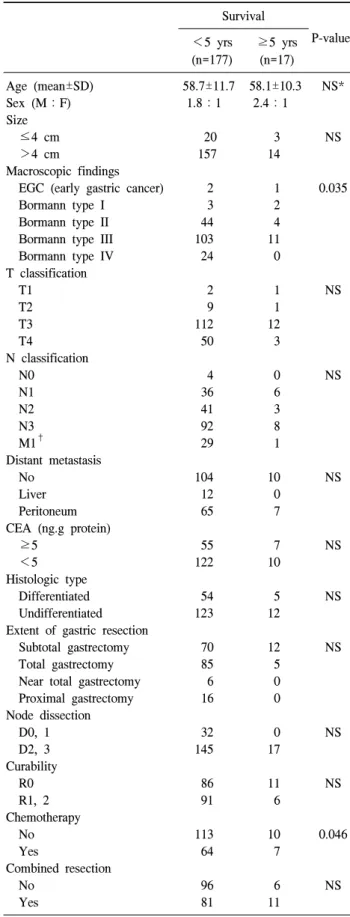
Table 1. Clinicopathological characteristics Survival
P-value
<5 yrs (n=177)
≥5 yrs (n=17)
Age (mean±SD) 58.7±11.7 58.1±10.3 NS*
Sex (M:F) 1.8:1 2.4:1
Size
≤4 cm 20 3 NS
>4 cm 157 14
Macroscopic findings
EGC (early gastric cancer) 2 1 0.035
Bormann type I 3 2
Bormann type II 44 4
Bormann type III 103 11
Bormann type IV 24 0
T classification
T1 2 1 NS
T2 9 1
T3 112 12
T4 50 3
N classification
N0 4 0 NS
N1 36 6
N2 41 3
N3 92 8
M1† 29 1
Distant metastasis
No 104 10 NS
Liver 12 0
Peritoneum 65 7
CEA (ng.g protein)
≥5 55 7 NS
<5 122 10
Histologic type
Differentiated 54 5 NS
Undifferentiated 123 12
Extent of gastric resection
Subtotal gastrectomy 70 12 NS
Total gastrectomy 85 5
Near total gastrectomy 6 0 Proximal gastrectomy 16 0 Node dissection
D0, 1 32 0 NS
D2, 3 145 17
Curability
R0 86 11 NS
R1, 2 91 6
Chemotherapy
No 113 10 0.046
Yes 64 7
Combined resection
No 96 6 NS
Yes 81 11
*NS = not significant; †Distant metastatic lymph node = portal, retropancreatic, mesenteric, para-aortic, retroperitoneal.
곽청술, 복강내 항암요법, 새로운 항암약물 등의 치료가 예 후에 영향을 미친다고 주장을 하고 있지만 실제적인 효과 나 예후에 영향을 주는 인자에 대해서는 아직 논란이 많 다.(6,7)
이에 저자들은 4기 위암의 장기 생존에 영향을 미치는 요 소들을 알아보고자 5년 이상 생존한 경우의 예를 각각의 요소에 따라 분류하여 분석하여 연구를 시행하였다.
방 법
1997년 1월부터 2000년 12월까지 4년간 고신대학교 복음 병원 외과에서 4기 위암 228예 중 위절제술을 시행한 194예 를 대상으로 후향적으로 분석을 시행하였고 우회술만 시행 한 경우나 수술을 진행하지 못한 34예는 제외하였다. 4기 위암의 진단은 수술 소견이나 수술 후 조직검사, 혹은 컴퓨 터 단층 촬영을 통해서 이루어졌다. 4기로 진단된 경우에 수술 결정은 환자가 거절할 경우나 간이나 폐 등에 전이가 여러 군데 있거나 대동맥, 대정맥, 간문맥 등의 절제 불가한 장기에 전이되거나 합병된 침습한 경우에는 하지 않았다.
병기 분류는 AJCC 6th edition을 기준으로 하였다. 이들을 대상으로 연령, 성별, 종양크기, 육안소견, T 분류, N 분류, 원격전이성 림프절 유무, 원격전이 유무, 수술 방법, 림프절 곽청술, 근치도, CEA 상승 정도, 정맥항암요법의 시행 여 부, 조직학적인 형태에 따라 임상병리학적 특성을 비교 분 석하였고 생존율 곡선 및 예후에 영향을 미치는 인자를 분 석하였다. 종양의 크기는 4 cm를 기준으로 나누어 분석하 였고 수술 전 CEA는 5 ug/ml를 기준으로 구분하였으며 어 떤 형태로든 타 장기에 악성 종양이 전이되어 원발 병소와 같이 절제한 경우 합병절제 항목에 포함시켰다. 합병절제 된 장기로는 소장, 결장, 간, 폐 등이 있으며 복막전이가 된 경우에도 전이된 부위의 복막을 절제한 경우도 있었다. 술 전 항암요법이나 복강 내 항암요법을 시행한 예는 없었으 며 술 후 정맥항암요법을 시행한 경우에 한해서만 비교대 상에 포함시켰다.
통계는 SPSS 12.0 package for Windows program을 이용하 였으며 임상병리학적 특성의 비교 분석은 chi-square test 및 T-test를 이용하였고 생존율 분석은 Kaplan-Meier법을 적용 하였으며 이들의 유의성은 Log-rank test를 이용하였다. 그 리고 Cox proportional hazard model을 통한 다변량 분석을 통하여 예후에 영향을 미치는 인자를 분석하였고 P값이 0.05 미만인 경우를 유의하다고 판정하였다.
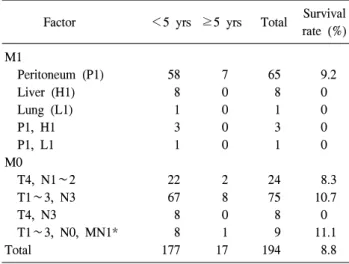
Table 2. Stage IV factor (P=0.910)
Factor <5 yrs ≥5 yrs Total Survival
rate (%) M1
Peritoneum (P1) 58 7 65 9.2
Liver (H1) 8 0 8 0
Lung (L1) 1 0 1 0
P1, H1 3 0 3 0
P1, L1 1 0 1 0
M0
T4, N1∼2 22 2 24 8.3
T1∼3, N3 67 8 75 10.7
T4, N3 8 0 8 0
T1∼3, N0, MN1* 8 1 9 11.1
Total 177 17 194 8.8
*Distant metastatic lymph node = portal, retropancreatic, mesen- teric, para-aortic, retroperitoneal.
Table 3. Distant metastatic node without distant metastasis (P=
0.870)
Metastatic node Survival
Total
<5 yrs (n=105) ≥5 yrs (n=10)
Yes 28 1 29
No 77 9 86
T1∼3, N3 54 7 61
T4, N1∼2 18 2 20
T4, N3 5 0 5
Fig. 1. Survival of patients with stage IV gastric cancer based on radicality.
Fig. 2. Survival of patients with stage IV gastric cancer based on lymph node metastasis.
결 과
4기 위암으로 수술받은 194예 중 남자가 125예(64.4%), 여자가 69예(35.6%)였고 연령분포는 29세부터 93세였으며 평균 연령은 58.7세였다.
5년 이내에 사망한 예와 5년 이상 생존한 예를 임상병리 학적 특성으로 구분하여 비교 분석하였을 때, 5년 이상 생 존한 예는 17예(8.77%)였고 이들 중 의미 있는 분포를 보인 인자는 육안적 소견(P=0.035)과 항암요법의 실시 여부 (P=0.046)였다(Table 1). 각각의 병기를 구성하는 인자인 T 분류, N분류, M분류에 의해 4기가 된 경우를 따라 분류를 하였을 때 P값은 0.910으로 5년 이상 생존하는 비율에 특별 한 의미는 없었고 원격 전이가 있는 경우 전이 장기에 따라 분류를 시행하였을 때는 복막 전이의 경우에서만 5년 이상 생존한 예가 65예 중 7예(9.2%)였으나 복막 외 다른 장기에
전이된 경우는 생존한 예가 없었다(Table 2). 또한 원격전이 성 림프절의 유무에 따라 5년 이상 생존한 예와 그렇지 못 한 예를 비교 분석하였을 때도 P값은 0.870으로 특별한 의 미는 없는 것으로 나왔다(Table 3).
임상 병리학적인 특성을 단변량으로 분석하였던 각각의 인자에 따라 생존율 곡선을 나타내었을 때, 생존율에 영향 을 미치는 것은 근치도와 항암요법의 유무이고 각각의 P값 은 0.001, 0.012였다(Fig. 1∼7).
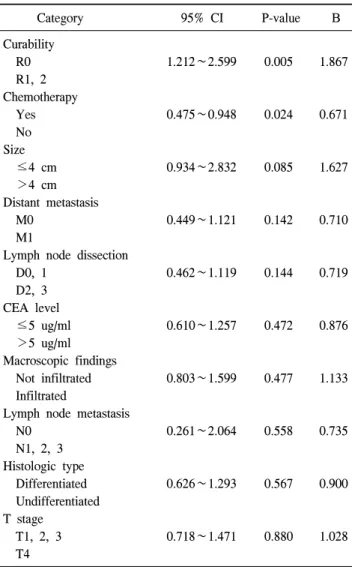
예후에 미치는 인자를 알아보기 위하여 각각의 인자를 다변량분석을 시행하였다. 근치도를 R0와 R1, R2로 나누어 분석하였고 림프절곽청술은 D0, D1과 D2, D3로 나누어 구 분하여 분석하였을 때 가장 예후에 영향을 미치는 것은 근 치도로 P값이 0.005, 95% 신뢰구간이 1.212∼1.599였고 다
Fig. 3. Survival of patients with stage IV gastric cancer based on lymph node dissection.
Fig. 4. Survival of patients with stage IV gastric cancer based on distant metastasis.
Fig. 6. Survival of patients with stage IV gastric cancer metastatic lymph node metastasis without distant metastasis.
Fig. 7. Survival of patients with stage IV gastric cancer based on TNM stage.
Fig. 5. Survival of patients with stage IV gastric cancer based on chemotherapy.
음으로 영향을 미치는 요소는 항암요법으로 P값이 0.024이 고 95% 신뢰구간이 0.475∼0.948로 나타났다. 그 외의 다른 인자들은 예후에 크게 영향을 미치지 않는 것으로 분석되 었다(Table 4).
고 찰
4기 위암은 매우 예후가 좋지 않은 것으로 알려져 있지만 몇몇 예에서 장기 생존을 하는 경우가 있다.(3,4,8) 그렇지만 장기 생존에 영향을 미치는 인자에 대해서는 밝혀진 것이 거의 없어 더 많은 연구가 필요한 실정이다.(8) 이에 저자들 은 후향적으로 4기 위암에 대한 임상병리학적인 특성과 생 존율 및 예후인자에 대하여 조사하였다.
Murata 등(9)은 4기 위암에서 종양의 크기가 크거나 육안
Table 4. Multivariative analysis of prognostic factors by Cox’s pro- portional harzard model
Category 95% CI P-value B
Curability
R0 1.212∼2.599 0.005 1.867
R1, 2 Chemotherapy
Yes 0.475∼0.948 0.024 0.671
No Size
≤4 cm 0.934∼2.832 0.085 1.627
>4 cm Distant metastasis
M0 0.449∼1.121 0.142 0.710
M1
Lymph node dissection
D0, 1 0.462∼1.119 0.144 0.719
D2, 3 CEA level
≤5 ug/ml 0.610∼1.257 0.472 0.876
>5 ug/ml Macroscopic findings
Not infiltrated 0.803∼1.599 0.477 1.133
Infiltrated
Lymph node metastasis
N0 0.261∼2.064 0.558 0.735
N1, 2, 3 Histologic type
Differentiated 0.626∼1.293 0.567 0.900
Undifferentiated T stage
T1, 2, 3 0.718∼1.471 0.880 1.028
T4
적 형태가 Borrman type IV인 경우 예후가 나쁘다고 보고하 였지만 저자들의 경우 종합적으로 분석하였을 때 종양의 크기나 육안적 형태가 예후나 장기 생존율에 크게 영향을 미치지 않는 것으로 나타났다.
Kwon 등(8)은 4기 위암의 경우에도 환자의 전신 상태나 상황이 허용된다면 잔류 병소가 없다고 여겨지는 근치절제 술을 시행하고 술 후 전신 항암요법을 실시하여 5년 생존율 을 높일 수 있으며 술 후 적극적인 치료를 하는 것이 좋다 고 보고하였다. 또한 저자들의 연구에서는 술 전 항암요법 을 시행하지 않아서 그 효과를 확인할 수는 없지만 Yone- mura 등(10)과 Hiramatsu 등(11)은 T4 병변으로 인한 4기 위 암의 경우 술 전 항암요법을 시행하여 생존율이 의미 있게 향상된다는 보고를 하였다. 저자들의 예에서도 4기 위암의 경우 술 후 항암치료가 생존율 곡선에서 의미 있게 나와
영향을 줄 수 있는 것으로 나와 항암요법 자체가 4기 위암 의 환자에서 예후에 영향을 미칠 것으로 생각된다.
저자들은 림프절 곽청술도 4기 위암의 예후에 영향을 미 친다고 생각하였으나 통계적으로는 크게 유의성이 없는 것 으로 나왔다. 그러나 Jung 등(12)은 술 후 조직학적 신경침 습 여부와 재발 여부가 장기 생존을 결정하는 유의한 인자 라고 보고하면서 원격전이가 없는 4기 위암에서 재발을 막 기 위하여 D2 이상의 림프절 곽청술을 포함한 잠재적 치료 절제술이 요구된다고 보고하였다.
Lawrence와 McNeer(13)는 고식적 위절제술을 시행한 경 우와 우회술을 시행한 경우의 379예를 대상으로 비교 연구 하였을 때 고식적 위절제술을 시행한 경우가 생존율이 더 좋고 삶의 질도 향상된다는 보고를 하였다. 또 Hanazaki 등 (14)이 고식적 위절제술을 시행한 84예와 우회술을 하거나 단순 개복술을 시행한 100예를 대상으로 비교 연구하였을 때 복막전이나 원격전이성 림프절 양성인 경우에도 고식적 위절제술을 시행한 경우가 예후가 더 좋았고 간 전이가 함 께 있는 경우에는 고식적인 위절제술을 시행한 경우라도 예후에는 특별한 영향이 없다고 보고하였다. Saidi 등(4)은 원격 전이가 있는 105명을 대상으로 고식적 절제술 이후 항 암요법을 시행한 예와 항암요법만 단독으로 시행한 예를 분석하여 고식적 절제술을 시행하는게 생존율을 향상시키 는데 도움이 된다고 보고하였고 Kaibara 등(15)도 복막전이 가 있는 예에서 원발부위의 절제를 포함한 림프절 절제로 생존율이 증가한다고 보고하였다. 그렇지만 우회술을 시행 한 경우보다 고식적 위절제술을 시행한 경우에 발생할 수 있는 사망가능성 및 합병증 등을 고려하여야 한다.(16,17) 저자들의 연구에서는 T4병변의 위암과 N3병변의 위암, 그리고 M1 병변의 위암이 생존율이나 예후에 영향을 미치 지 않는 것으로 분석되었다. 그에 반해 Nio 등(18)은 1,011 예를 대상으로 일본위암연구회가 제정한 위암병기분류 (GRGCS)와 UICC가 제정한 병기분류를 비교 분석한 연구 에서 T4 병변과 M1 병변 사이에는 분명한 생존기간의 차이 가 있다고 주장하여 4기 위암을 고식적 절제가 가능한 IVa 와 불가능한 IVb로 세분해야 한다고 주장하였다. 또한 Mae- hara 등(19)은 T4 병변의 4기 위암 235명과 M1 병변의 218 명에서 고식적 절제술을 시행하여 5년 생존율이 7.3%와 1.8%로 차이가 난다고 보고하였고 원발위암 또는 수술 후 잔류 위암이 국소적으로 진행 되었을 때 좌측상부 기관적 출술이나 췌십이지장절제술을 포함한 근치적 위절제술을 적용한 결과 20%의 5년 생존율을 보고하기도 하여 근치도
의 중요성을 강조하였다.
본 연구에서는 고식적인 위절제술을 시행한 경우보다 근 치적 절제술을 시행한 경우에 의미 있게 생존율이 증가한 다는 결론이 나왔다. 고식적 절제술만 시행한 경우와 근치 적 절제를 시행한 경우는 예후에 분명한 차이를 보였고, 그 러므로 가능하면 근치적인 절제술을 통하여 완전제거를 하 는 것이 좋을 것으로 생각된다. Yagi 등(20)도 4기 위암 130 예를 분석하여 치료적인 예후인자로 근치도와 림프절곽청 술을 강조하였다. 또한 복막 전이의 경우에도 5년 이상 생 존한 경우가 65예 중 7예였고 그 중 2예는 복막전이에 대하 여 복막절제술을 시행하여 근치적인 절제를 시행하였다고 생각한 경우로 복막 절제술도 예후에 영향을 미치는 것으 로 생각할 수 있으나 예가 적어 통계적인 의미를 가지기 어려우므로 이에 대한 정확한 연구 분석은 더 필요할 것으 로 생각된다.
결 론
4기 위암의 예후는 여전히 불량하고 치료하기에 어렵지 만 적극적인 근치적 수술과 술 후 치료로 생존율을 향상시 킬 수 있을 것이다. 그러나 본 연구가 후향적인 연구라는 한계를 가지고 있고 아직 4기 위암의 치료 및 예후에 대해 논란이 많기 때문에 4기 위암에 대한 계획적이고 대규모적 인 연구가 필요하다고 생각된다.
REFERENCES
1) Park IS, Lee YC, Kim WH, Noh SH, Lee KS, Kim H.
Clinicopathologic characteristics of early gastric cancer in Ko- rea. Yonsei Med J 2000;41:607-14.
2) Hochwald SN, Brennan MF, Klimstra DS, Kim S, Karpeh MS.
Is lymphadenectomy necessary for early gastric cancer? Ann Surg Oncol 1999;6:664-70.
3) Yan CJ, Brooks JR. Surgical management of gastric adeno- carcinoma. Am J Surg 1985;149:771-4.
4) Saidi RF, ReMine SG, Dudrick PS, Hanna NN. Is there a role for palliative gastrectomy in patients with stage IV gastric can- cer? World J Surg 2006;30:21-7.
5) Okuyama K, Isono K, Juan IK, Onoda S, Ochiai T, Yamamoto Y, et al. Evaluation of treatment for gastric cancer with liver metastasis. Cancer 1985;55:2498-505.
6) Takeno S, Noguchi T, Kikuchi R, Sato T, Uchida Y, Yokoya- ma S. Analysis of the survival period in resectable stage IV gastric cancer. Ann Surg Oncol 2001;8:215-21.
7) Medina-Franco H, Contreras-Saldivar A, Ramos-De La Medi- na A, Palacios-Sanchez P, Cortes-Gonzalez R, Ugarte JA. Sur- gery for stage IV gastric cancer. Am J Surg 2004;187:543-6.
8) Kwon OJ, Suh JS, Chung JK, Hong IG, Kang HS. A clinical analysis of stage iv gastric cancer. J Korean Surg Soc 1998;
55:198-205.
9) Murata S, Terata N, Eguchi Y, Tani T, Shibata J, Kodama M. Prognosis of patients with resection of stage IV gastric cancer. Int Surg 1998;83:283-6.
10) Yonemura Y, Sugiyama K, Fujimura T, Kamata T, Sawa T, Takashima T, et al. A new surgical technique (left upper ab- dominal evisceration) for advanced carcinoma of the gastric stump. Hepatogastroenterology 1994;41:130-3.
11) Hiramatsu K, Mizukami Y, Momiyama M, Suzuki M, Niimi K, Nagashima T. Stage IV gastric cancer patient who under- went palliative gastrectomy showing complete response to in- duction therapy with methotrexate plus 5-fluorouracil and sec- ondary treatment with oral TS-1. Gan To Kagaku Ryoho 2005;
32:1163-6.
12) Jung IM, Suh JS, Kim YC, Heo SC, Ahn YJ, Chung JK.
Outcome of potentially curative gastrectomy in patients with stage IV stomach cancer: based on the 5th edition of AJCC/
UICC classification (1997). J Korean Surg Soc 2003;64:383-9.
13) Lawrence W Jr, McNeer G. The effectiveness of surgery for palliation of incurable gastric cancer. Cancer 1958;11:28-32.
14) Hanazaki K, Sodeyama H, Mochizuki Y, Igarashi J, Yokoya- ma S, Sode Y, et al. Palliative gastrectomy for advanced gas- tric cancer. Hepatogastroenterology 2001;48:285-9.
15) Kaibara N, Okamoto T, Kimura O, Iitsuka Y, Takebayashi M, Yurugi E, et al. Possible role of lymph node dissection in the surgical treatment of gastric cancer with disseminating peri- toneal metastasis. Jpn J Surg 1983;13:404-8.
16) Haugstvedt T, Viste A, Eide GE, Soreide O. The survival ben- efit of resection in patients with advanced stomach cancer: the Norwegian multicenter experience. Norwegian Stomach Cancer Trial. World J Surg 1989;13:617-22.
17) Olearchyk AS. Gastric carcinoma. A critical review of 243 cases. Am J Gastroenterol 1978;70:25-45.
18) Nio Y, Tsubono M, Kawabata K, Masai Y, Hayashi H, Meyer C, et al. Comparison of survival curves of gastric cancer pa- tients after surgery according to the UICC stage classification and the General Rules for Gastric Cancer Study by the Japan- ese Research Society for gastric cancer. Ann Surg 1993;218:
47-53.
19) Maehara Y, Kakeji Y, Takahashi I, Okuyama T, Baba H, Anai H, et al. Noncurative resection for advanced gastric cancer. J Surg Oncol 1992;51:221-5.
20) Yagi Y, Seshimo A, Kameoka S. Prognostic factors in stage IV gastric cancer: univariate and multivariate analyses. Gastric Cancer 2000;3:71-80.